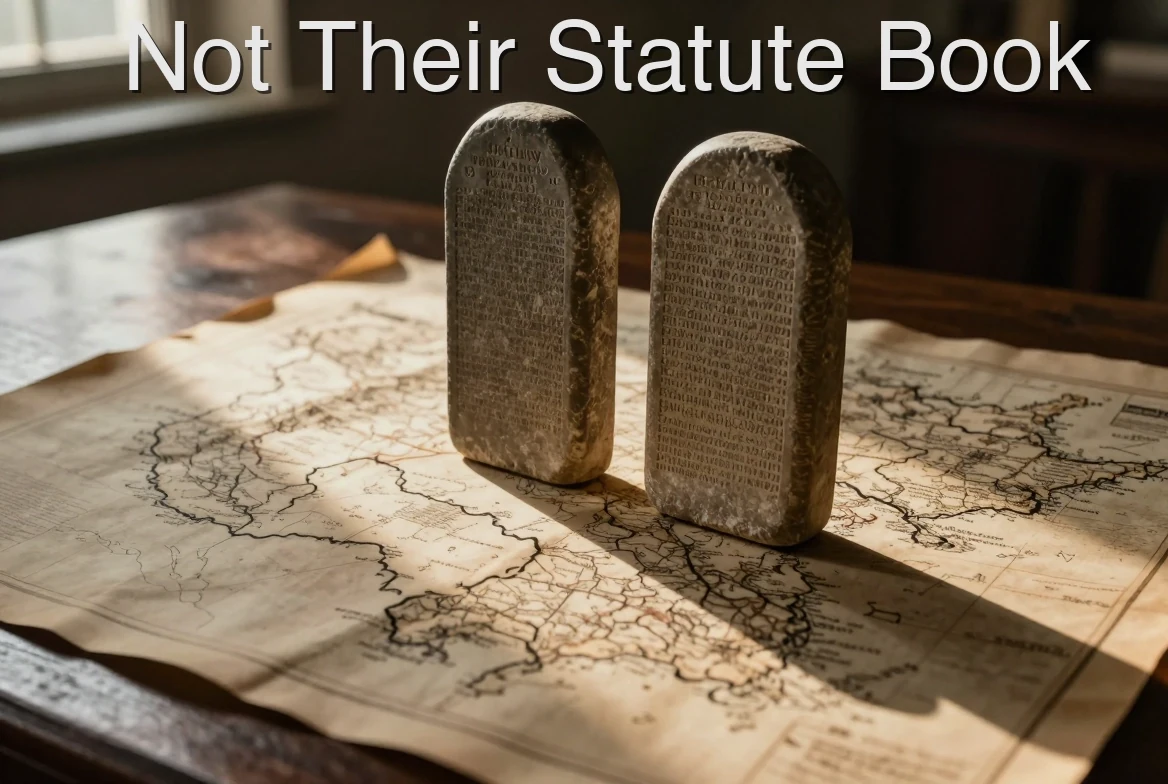
Sooner or later a believer who takes the Bible seriously is handed a question with a sword in it. Should the death penalty stand for murder? For rape? For sodomy? Should the laws of a nation be built on the laws God gave at Sinai? The question arrives with real urgency, because the alternative on offer is a culture that has cut itself loose from any fixed standard at all, and a man who loves the word of God recoils from that.
But the question as usually asked is two questions wearing one coat, and almost every argument on the subject goes wrong at the seam. The first is whether a nation must take its statute book from Moses. The second is what standard it acts by if it does not. This study takes the first, and the answer is no — not because the law is harsh, and not because the law has softened, but because of who it was addressed to. It begins further back than such studies usually do, with what mankind already had before Israel existed, because almost every misunderstanding of this subject comes of starting at Sinai. The second question is the harder one, and it is taken up in the companion study, Him That Doeth Evil: What the Magistrate Is For.
Before there was an Israel, God had spoken
Most treatments of this subject begin with what Israel was given, and that is the wrong end. Start earlier — with what mankind already had when Israel did not yet exist. Settle that first and half the argument never has to be had, because the usual suspicion about this study — that it leaves the nations in the dark and God unjust for judging them — cannot survive the opening chapters of Genesis.
One preliminary, since it will occur to a careful reader. All of this is known to us from the Scriptures God gave to Israel, and that is no difficulty at all. Moses wrote the record; he did not create the events. The book is Israel's. The history in it is mankind's, and it happened long before there was a nation to write it down.
God's first word to man — spoken to Adam alone, before ever the woman was made — was a command with a penalty attached. "And the LORD God commanded the man, saying, Of every tree of the garden thou mayest freely eat: But of the tree of the knowledge of good and evil, thou shalt not eat of it: for in the day that thou eatest thereof thou shalt surely die" (Genesis 2:16-17 KJV). An offense and a sentence, before there was a covenant, a nation or a priest.
To the second man born, God spoke about doing well and doing ill — "If thou doest well, shalt thou not be accepted? and if thou doest not well, sin lieth at the door" (Genesis 4:7 KJV) — and afterward named the murder for what it was: "the voice of thy brother's blood crieth unto me from the ground" (Genesis 4:10 KJV). Cain is not told he has broken a new rule. He is addressed as a man who knew.
And the world that perished had been preached to. God's charge against it is a moral verdict in plain words — "The earth also was corrupt before God, and the earth was filled with violence" (Genesis 6:11 KJV) — and Peter tells us what that generation had been hearing: Noah was "a preacher of righteousness" (2 Peter 2:5 KJV). God did not drown a world that had heard nothing.
Then comes the charge that reaches every nation on earth. After the flood God spoke to Noah and his sons, and required life for life: "And surely your blood of your lives will I require… Whoso sheddeth man's blood, by man shall his blood be shed: for in the image of God made he man" (Genesis 9:5-6 KJV). An offense, a penalty and a reason. And there was nobody else alive — "These are the three sons of Noah: and of them was the whole earth overspread" (Genesis 9:19 KJV). Paul says the same thing standing on Mars' hill: God "hath made of one blood all nations of men" (Acts 17:26 KJV). Every nation that has ever existed descends from men who stood in front of God and were told.
Nor did that knowledge vanish the moment the ark was emptied. Abram, coming home from battle, is met by a Gentile priest of the true God — "Melchizedek king of Salem… he was the priest of the most high God", who blessed him in the name of "the most high God, possessor of heaven and earth" and received tithes of him (Genesis 14:18-20 KJV). No Israel, no Levi, no Sinai — and a true priesthood outside the line altogether.
And God Himself certifies a Gentile's character in words no one may argue with. Of Job, who stands outside the covenant line entirely, the LORD says: "there is none like him in the earth, a perfect and an upright man, one that feareth God, and escheweth evil" (Job 1:8 KJV). Fearing God and eschewing evil, with no law of Moses in existence — and it is God who says so, not Job and not his friends.
The verdicts run the other way too, and just as plainly. "But the men of Sodom were wicked and sinners before the LORD exceedingly" (Genesis 13:13 KJV) — before the LORD, which is a standard, not an opinion. And when the sentence came, Abraham put to God the very question a reader of this study will want to ask: "Shall not the Judge of all the earth do right?" (Genesis 18:25 KJV) The question is not rebuked. It is answered by everything God then does.
Paul gathers all of it up and tells us the direction the nations traveled, which is downward from knowledge and never upward from ignorance: "when they knew God, they glorified him not as God, neither were thankful; but became vain in their imaginations, and their foolish heart was darkened" (Romans 1:21 KJV). That is not the history of men who were never told. It is the history of men who were. And what survived the departure still testifies — the Gentiles "having not the law, are a law unto themselves: Which shew the work of the law written in their hearts, their conscience also bearing witness" (Romans 2:14-15 KJV), with the creation itself leaving men "without excuse" (Romans 1:20 KJV). Paul's summary to a pagan crowd is the sentence to keep: "he left not himself without witness" (Acts 14:17 KJV).
So let this be settled before a word is said about Sinai. The nations were never in the dark. They had a command from the beginning, a charge after the flood, a witness in conscience and in creation, and a knowledge of God they held and let go. Nothing in the rest of this study may be read as saying otherwise — and everything in it depends on the difference between that and a statute book.
The statute book was never sent to the nations
With that in hand, the Psalmist can be read without alarm. Start where he starts, because he says the thing outright:
"He sheweth his word unto Jacob, his statutes and his judgments unto Israel. He hath not dealt so with any nation: and as for his judgments, they have not known them." (Psalm 147:19-20 KJV)
Weigh the word judgments, because an objection lands here at once and the verse cannot carry any weight until it is met. Did the nations not know God's judgments? They felt them. Sodom knew. Egypt knew. The Amorite knew. How can the Psalmist say they have not known them?
Because the word does three different jobs in the Scriptures, and this psalm settles which one is in hand.
There are judgments God executes: "I will redeem you with a stretched out arm, and with great judgments" (Exodus 6:6 KJV); "when I shall execute judgments in thee in anger and in fury" (Ezekiel 5:15 KJV). Those are acts, and a nation on the receiving end of one knows it perfectly well.
There is God's judgment in the sense of His settled verdict — what He has determined an act deserves. And Paul says outright that the Gentiles have this one: "Who knowing the judgment of God, that they which commit such things are worthy of death, not only do the same, but have pleasure in them that do them" (Romans 1:32 KJV). Knowing it — and taking pleasure in those who do it anyway, which is not something a man can manage about a rule he has never heard of. Approval requires recognition.
And there are judgments God teaches: "hearken, O Israel, unto the statutes and unto the judgments, which I teach you, for to do them" (Deuteronomy 4:1 KJV); "Behold, I have taught you statutes and judgments" (Deuteronomy 4:5 KJV). Those are the case law — the rulings, the penalties, the civil administration. They are the category in dispute, and they are the category the psalm is speaking of.
Set the three side by side and the Psalmist's words become exact. The nations received God's judgments as acts. They knew God's judgment as a verdict — Paul says so. What they never had were His judgments as a statute book, and that is the only one of the three the Psalmist denies them.
The psalm says so in the lines just above, and they are usually read past. Before verse nineteen, God's word is running through the whole earth: "He sendeth forth his commandment upon earth: his word runneth very swiftly" — the snow, the hoarfrost, the ice — "He sendeth out his word, and melteth them" (Psalm 147:15-18 KJV). Every nation alive stands under that. Then comes the turn: "He sheweth his word unto Jacob, his statutes and his judgments unto Israel" (Psalm 147:19 KJV). Sheweth — and the thing shewn is His word, set in line with His statutes and His judgments. The same word that moves the weather over every land is taught to one people as law. The psalm's whole contrast is between what all nations live under and what one nation was shown.
A judgment executed is undergone. A verdict is known. A judgment taught is possessed — and the Psalmist does not say the nations disobeyed that kind. He says they never had them.
Notice, too, what the objection concedes once it is put properly. The nations did know God's judgments in the first two senses. That is no difficulty for this study — it is half of its argument, and Him That Doeth Evil is built on it. God judged those nations Himself, and they knew what He thought of what they were doing. What He never did was hand them the book.
One thing more has to be said about that middle sense before leaving it, because the passage it rests on is regularly pressed into service as a penal code and it will not bear it. Read the list Paul gives just before "worthy of death" and see what is in it: "covetousness", "envy", "debate", "whisperers, Backbiters", "proud, boasters", "Without understanding", "implacable, unmerciful" (Romans 1:29-31 KJV). Israel's own law attached no penalty whatever to most of those, and death to none of them. It prescribes no sanction for boasting, none for envy, and none for pride; the tenth commandment forbids coveting and attaches no civil penalty to it at all. If worthy of death meant a sentence a magistrate should pass, Paul has just made the backbiter and the proud man capital offenders, which is plainly not his intent.
It is the wages of sin that is in view — "the wages of sin is death" (Romans 6:23 KJV), "death passed upon all men, for that all have sinned" (Romans 5:12 KJV) — a verdict flat across the whole list, falling on the murderer and the whisperer alike, because it is not a scale of crimes but the due of sin as such. And Paul's very next sentence turns the list on the man reading it: "thou that judgest doest the same things" (Romans 2:1 KJV). A code no reader survives is not a code for a courtroom. It is a verdict for a conscience — which is precisely why it is evidence of what the nations knew and no evidence at all about what a nation should legislate.
And Moses names the difference exactly, in the chapter this study has already been quoting. He nowhere says the nations were left knowing nothing of God. He says no other people ever got it the way Israel got it: "Did ever people hear the voice of God speaking out of the midst of the fire, as thou hast heard, and live?" (Deuteronomy 4:33 KJV); "Out of heaven he made thee to hear his voice, that he might instruct thee" (Deuteronomy 4:36 KJV); "Unto thee it was shewed" (Deuteronomy 4:35 KJV) — which is the Psalmist's own verb. Paul puts the privilege in one line: "unto them were committed the oracles of God" (Romans 3:2 KJV).
So the difference is one of route, not of existence. Israel heard; the nations inherited. What other peoples had came down to them from the fathers, generation upon generation, from men who had stood in God's presence and been told. What Israel had came out of the fire, in words, to an assembled nation, and was written down. The one can be lost in the telling; the other cannot — and Moses warns Israel against that very loss in the same breath: "lest thou forget the things which thine eyes have seen… but teach them thy sons, and thy sons' sons" (Deuteronomy 4:9 KJV).
That is what the Psalmist is marking, and it is why his words stand without charging God with injustice. Not no nation was ever told, but no nation was ever given this: He hath not dealt so with any nation.
And Moses, earlier in that same chapter of Deuteronomy, makes the possession of the law the ground of Israel's uniqueness: "And what nation is there so great, that hath statutes and judgments so righteous as all this law, which I set before you this day?" (Deuteronomy 4:8 KJV) The greatness lies in the contrast. If every nation had them, the question answers itself and the glory evaporates.
Paul states the rule of address flatly: "what things soever the law saith, it saith to them who are under the law" (Romans 3:19 KJV). And he tells the Gentiles exactly where they stood in relation to that commonwealth — "aliens from the commonwealth of Israel, and strangers from the covenants of promise" (Ephesians 2:12 KJV). A man cannot be an alien from a commonwealth and simultaneously be under its statutes. The two descriptions cannot both be true of the same person at the same time.
This is a location argument, not a severity argument. Nothing here makes the law milder. It puts the law where God put it.
If the law is that righteous, why would a nation not adopt it?
That is the strongest thing said on the other side, and it deserves better than a debating answer. Moses does not merely say the law is righteous. He says the nations will notice — Israel's obedience is her wisdom "in the sight of the nations, which shall hear all these statutes, and say, Surely this great nation is a wise and understanding people" (Deuteronomy 4:6 KJV). And if a watching people concluded that, the natural next step is to copy what they saw. A nation that wanted God near would surely be right to do what pleases Him.
Grant all of it. The law is righteous, the wanting is right, and nothing in this study asks anyone to admire Israel's law less.
But Scripture does not leave that nation guessing, because the case actually arises in the text — and the answer is never legislate Moses at home.
The route God provided was to come in, not to copy out. The stranger who wanted what Israel had was circumcised and brought near: "he shall be as one that is born in the land", and "One law shall be to him that is homeborn, and unto the stranger that sojourneth among you" (Exodus 12:48-49 KJV). Ruth put it in a sentence — "thy people shall be my people, and thy God my God" (Ruth 1:16 KJV). The law came with membership. It was never an export.
And Solomon answered this exact question at the dedication of the house. A Gentile hears of God's great name and comes seeking Him; what is he to do? "Moreover concerning a stranger, that is not of thy people Israel, but cometh out of a far country for thy name's sake… when he shall come and pray toward this house" — hear him, "that all people of the earth may know thy name, to fear thee, as do thy people Israel" (1 Kings 8:41-43 KJV). He comes and prays. He does not take the statutes home and enact them.
And when God dealt with Gentile powers that did turn, He never handed them the code. Nineveh was told to "turn every one from his evil way, and from the violence that is in their hands" (Jonah 3:8 KJV) — not to keep the feasts. Daniel, counseling the greatest Gentile king on earth how to avert a judgment, told him to "break off thy sins by righteousness, and thine iniquities by shewing mercy to the poor" (Daniel 4:27 KJV). He had Moses in his hand and did not reach for him.
There is one case that looks like the exception and repays a careful reading. Artaxerxes authorized Ezra to "set magistrates and judges, which may judge all the people that are beyond the river, all such as know the laws of thy God", on pain of death, banishment, confiscation or imprisonment (Ezra 7:25-26 KJV). But notice the scope and the wording. The jurisdiction is over such as know the laws of thy God — the Jewish community in its own province — and the decree keeps two laws carefully distinct: "the law of thy God, and the law of the king". A Persian emperor let a subject people be governed by its own law. He did not adopt it for Persia. The one case closest to the objection turns out to draw the very line this study is drawing.
So the nations get something real from Israel's law, and this study says so plainly later on: they may watch, and learn what justice looks like. What Scripture never once does is hand a Gentile nation the statute book and tell it to legislate. The greatness of Deuteronomy 4 was in the giving, and the way to share in it was to come to the God who gave it.
The beam that holds up the whole structure is not in the text
Those who would hand Moses to a modern legislature never propose to hand over all of him. Nobody is building an altar. The move that makes the selection possible is a prior division of the law into three parts — moral, civil, ceremonial — so that the sacrifices may lapse while the judicials carry on.
That division is not in Scripture. Paul treats the law as one indivisible thing: "I testify again to every man that is circumcised, that he is a debtor to do the whole law" (Galatians 5:3 KJV). Moses puts statutes and judgments in a single breath and calls the lot of it "all this law" (Deuteronomy 4:8 KJV). The threefold cut is a theological instrument brought in from outside to solve a problem the text does not have — and once it is removed, there is no mechanism left for keeping Leviticus 20 while dropping Leviticus 16.
Right division undoes the scheme, and notice how. Not by softening the law. By locating it.
A great deal of the law was never about evil at all
The threefold cut fails hardest on a class of commands people rarely bring up, and they are worth naming, because they are the ones the knife cannot divide.
"Thou shalt not let thy cattle gender with a diverse kind: thou shalt not sow thy field with mingled seed: neither shall a garment mingled of linen and woollen come upon thee" (Leviticus 19:19 KJV). The clean beasts and the unclean. A calendar of feasts and new moons. Put the sorting question to those and the scheme has no answer. Not ceremonial — no altar, no priest, no sacrifice anywhere in them. Not moral — nobody is harmed by a wool-linen coat. And they bound exactly as hard as the commands on either side of them.
Scripture does not leave their purpose to be guessed at. "I am the LORD your God, which have separated you from other people. Ye shall therefore put difference between clean beasts and unclean… And ye shall be holy unto me: for I the LORD am holy, and have severed you from other people, that ye should be mine" (Leviticus 20:24-26 KJV). The law of clean and unclean is given there as the ground of the severing, and Moses says the same of the nation itself: "thou art an holy people unto the LORD thy God, and the LORD hath chosen thee to be a peculiar people unto himself, above all the nations that are upon the earth" (Deuteronomy 14:2 KJV).
So the purpose was difference. Israel was to be recognizable — eating differently, dressing differently, farming differently, keeping a different calendar — and every one of those marks announced that this people belonged to God and the peoples around them did not.
Two things follow, and the second is the heavier. A nation adopting Israel's law would be taking up a great body of commands with no moral content for it at all; they restrain no evil, and were never meant to. And the separation they existed to mark has been ended, by the apostle to the Gentiles. "For he is our peace, who hath made both one, and hath broken down the middle wall of partition between us" (Ephesians 2:14 KJV). "Let no man therefore judge you in meat, or in drink, or in respect of an holyday, or of the new moon, or of the sabbath days: Which are a shadow of things to come; but the body is of Christ" (Colossians 2:16-17 KJV). "For every creature of God is good, and nothing to be refused, if it be received with thanksgiving" (1 Timothy 4:4 KJV).
Which makes the error sharper than misapplication. A nation writing those marks into its statutes would not merely be reaching for a code addressed to somebody else. It would be rebuilding a wall Christ took down.
A book is not a covenant
One distinction has to be settled before going further, because everything below depends on it.
A book of the law is not the same thing as a covenant statute, and Leviticus 18 shows the difference inside a single chapter.
Most of the chapter commands, and it commands Israel: "Ye shall therefore keep my statutes and my judgments" (Leviticus 18:26 KJV). That is covenant legislation, addressed to a named people. But the closing verses report, and what they report is what God had already done to somebody else — "the nations are defiled which I cast out before you" (Leviticus 18:24 KJV). Moses is writing down history that was finished before Israel ever crossed the river.
Now notice how the two halves are joined, because this is the thing most easily missed. The report does not float free of the commands; it points straight back at them. "in all these the nations are defiled which I cast out before you" (Leviticus 18:24 KJV) — all these being the very acts just prohibited. So the commanding half does double duty. To Israel it is statute. To every reader it is the itemized content of a verdict — the acts God had already cast nations out for, set down one by one.
Which raises the old objection in a sharper form. If the statutes were never sent to them, how did these nations know — and how is it just to cast them out? The first section answered that in principle for all mankind. Here the line can actually be traced.
The charge after the flood went to Noah and his sons, and the very chapter that records it names the man this section is about: "Ham is the father of Canaan" (Genesis 9:18 KJV). The table of nations then carries the line down — "Canaan begat Sidon his firstborn, and Heth, And the Jebusite, and the Amorite" (Genesis 10:15-16 KJV). The Amorite whose iniquity God measures is Canaan's son, and Canaan's own father heard the charge. These are not strangers to revelation. They are the great-grandchildren of men who had stood in front of God.
Read Leviticus with that in hand and its words fit exactly. It calls the practices customs — "that ye commit not any one of these abominable customs, which were committed before you" (Leviticus 18:30 KJV) — and a custom is what a departure hardens into. And it explains the waiting: "in the fourth generation they shall come hither again: for the iniquity of the Amorites is not yet full" (Genesis 15:16 KJV). An account that fills is an account that was already open, kept against men who had something to depart from.
So Leviticus 18 does not make these things evil. It writes down, for Israel, what was already evil among men who never read it.
That is why the list matters so much. Leviticus does not merely record that God judged the Canaanites; it tells us what for. Without the commands we would know there was a verdict and not know its content.
Does a passage command or does it describe; and does it reach every age or belong to one people? That is the test, set out at length in Present Truth, Dispensational Truth, and Universal Truth — and Leviticus 18 answers it two ways in two halves of one chapter, while both halves speak about the same acts.
Two chapters, and the whole question in miniature
Keep that in hand and set Leviticus 18 beside Leviticus 20, because between them they contain this entire controversy.
It is worth naming the acts rather than leaving a reader to supply his own list. Leviticus 18 sets them out in order: incest, to "any that is near of kin" (v. 6); relations during a woman's uncleanness (v. 19); adultery, "thy neighbour's wife" (v. 20); child sacrifice — "thou shalt not let any of thy seed pass through the fire to Molech" (v. 21); "Thou shalt not lie with mankind, as with womankind: it is abomination" (v. 22); and bestiality (v. 23).
Look hard at that list, because it will not let anyone off. Child sacrifice sits in the middle of it, and a Gentile people was cast out of its land for burning its children — long before Sinai, and with no statute book in hand. A man who wants to call these merely Israel's ceremonial scruples has to say it about incest, about bestiality, and about children in the fire.
So Leviticus 18 shows the verdict reaching the nations. God says it plainly, and calls their practice what the earlier chapter called it: "ye shall not walk in the manners of the nation, which I cast out before you: for they committed all these things, and therefore I abhorred them" (Leviticus 20:23 KJV).
And Leviticus 20 takes the very same list and attaches Israel's civil penalties to it: the man who gives his seed to Molech, "the people of the land shall stone him with stones" (Leviticus 20:2 KJV); the adulterer and adulteress, "shall surely be put to death" (Leviticus 20:10 KJV); and so through the chapter.
Same acts, two chapters. In the one, God holds the nations accountable. In the other, He hands one people a body of law with a penalty set against each offense, to be carried out by their own courts in their own land. Scripture draws this study's distinction within two pages of itself.
Every penalty names the people it belongs to
Turn to the penalties Israel's courts actually carried out, and notice that the law says, every single time, who they are for: "so shalt thou put away evil from Israel" (Deuteronomy 22:22 KJV); "so shalt thou put the evil away from among you" (Deuteronomy 19:19 KJV). Not from the earth. From Israel. From among you.
That is not incidental phrasing. It is the formula, and it names a people every time it appears.
And the administration those penalties belonged to cannot be lifted out with them. They are inseparable from the tabernacle and the priesthood, from the cities a manslayer could flee to, from land held on God's terms and returned to its family every fiftieth year, from a nation keeping its ground on covenant conditions, and from a God dwelling in the middle of the camp.
One provision shows it better than any argument could. A man who had killed without malice fled to a city of refuge, and the law fixed the length of his confinement — not by a term of years, but by the life of another man in a sacred office: "he shall abide in it unto the death of the high priest, which was anointed with the holy oil" (Numbers 35:25 KJV). Name the modern nation that can administer that sentence. It is not severe or lenient; it is simply unavailable, because the office it turns on does not exist outside the covenant that created it.
Extract the sanction and leave the covenant, the land, the priesthood and the Presence behind, and what remains is not obedience to the law. It is a severity borrowed from an administration no Gentile nation was ever party to.
What a ruler may take from the law, and what he may not
Paul says plainly what the Scriptures given to Israel are for: "whatsoever things were written aforetime were written for our learning" (Romans 15:4 KJV), and "All scripture is given by inspiration of God, and is profitable for doctrine, for reproof, for correction, for instruction in righteousness" (2 Timothy 3:16 KJV). Read the uses he names — doctrine, reproof, correction, instruction. Every one of them teaches a man. Not one of them arms a court.
So a ruler may look into Israel's law and learn what justice looks like, and the lessons are real and nameable. That a man is not condemned on one voice: "One witness shall not rise up against a man… at the mouth of two witnesses, or at the mouth of three witnesses, shall the matter be established" (Deuteronomy 19:15 KJV). That a court must be neither bought nor frightened: "Ye shall not respect persons in judgment; but ye shall hear the small as well as the great; ye shall not be afraid of the face of man" (Deuteronomy 1:17 KJV). That an accuser is answerable for what he tried to bring about: the judges "shall make diligent inquisition", and a false witness receives "as he had thought to have done unto his brother" (Deuteronomy 19:18-19 KJV).
Those are drawn from a real law and they are worth any legislator's attention. What he may not do is lift a covenant sanction out of the covenant and lay it on a people who were never in it.
We learn what evil is from all of Scripture. We learn what we are under from Paul. Both statements are true at once, because they answer different questions.
Divorce turns the argument around
The clearest proof that the selection is being made by the interpreter rather than the text is the case nobody raises.
Moses did not penalize divorce. He regulated it — "then let him write her a bill of divorcement, and give it in her hand, and send her out of his house" (Deuteronomy 24:1 KJV) — and the Lord traced the provision to its root: "Moses because of the hardness of your hearts suffered you to put away your wives: but from the beginning it was not so" (Matthew 19:8 KJV). The law made regulated room for failure, as set out at length in Rightly Dividing Marriage, Divorce, and Remarriage.
So a consistently Mosaic civil code would be more permissive on divorce than most of the men who want Mosaic penalties elsewhere. Add to that a law regulating servitude rather than abolishing it (Exodus 21:2), a law taking two wives for granted and protecting the son of the unloved one (Deuteronomy 21:15-17), a duty laid on a man to marry his dead brother's childless widow (Deuteronomy 25:5), and the cancelling of every debt in the land every seventh year (Deuteronomy 15:1-2). And set beside all that the separation commands above, which nobody proposes to enact at all and which are not even arguable as morals. The point is unavoidable: nobody wants the whole code. Everyone is already selecting — and the principle by which they select is stated nowhere in Scripture. That is the tell. When a system needs a sorting rule the text never supplies, the rule is coming from the man holding the scissors.
Paul's one sustained word on the magistrate, and what it does not say
If the nations were to be governed from Sinai, there is one passage where it would appear. Paul wrote it during Nero's reign, about a pagan administration running Roman law — and he wrote it as a man those magistrates had already beaten and imprisoned more than once.
"Let every soul be subject unto the higher powers… for he beareth not the sword in vain: for he is the minister of God, a revenger to execute wrath upon him that doeth evil." (Romans 13:1, 4 KJV)
Two things follow, and they cut in opposite directions from each other.
The sword is legitimate. Paul does not abolish capital punishment; he calls the man who wields it the minister of God. Anyone reasoning from grace to the abolition of the sword has this verse to get past, and cannot.
And the standard commended is not the Mosaic code. Paul calls a pagan magistrate under pagan law God's minister, and commands subjection to him. That is very nearly the opposite of what the scheme requires the passage to say.
Paul does cite commandments a few verses later — but watch what he does with them. "Thou shalt not commit adultery, Thou shalt not kill, Thou shalt not steal… it is briefly comprehended in this saying, namely, Thou shalt love thy neighbour as thyself" (Romans 13:9 KJV). He collapses them into the believer's walk, not into the nation's statute book. The subject changes between verse four and verse eight.
And the aim of praying for kings is "that we may lead a quiet and peaceable life in all godliness and honesty" (1 Timothy 2:2 KJV) — not the adoption of Leviticus.
The doctrine has to travel
There is a test that settles this for anyone with brethren outside his own country, and it is worth taking slowly, because it is usually stated as a slogan when it is in fact a list.
Paul's civil doctrine works everywhere — and the reason is visible the moment its items are set out. Subjection: "Let every soul be subject unto the higher powers" (Romans 13:1 KJV), and "Put them in mind to be subject to principalities and powers, to obey magistrates" (Titus 3:1 KJV). Tribute and custom: "Render therefore to all their dues: tribute to whom tribute is due; custom to whom custom; fear to whom fear; honour to whom honour" (Romans 13:7 KJV). Prayer for whoever holds office: "For kings, and for all that are in authority" (1 Timothy 2:2 KJV). Honest work and a quiet life: "study to be quiet, and to do your own business, and to work with your own hands… That ye may walk honestly toward them that are without" (1 Thessalonians 4:11-12 KJV). Conduct before outsiders: "Walk in wisdom toward them that are without" (Colossians 4:5 KJV). And the commission itself: "we are ambassadors for Christ" (2 Corinthians 5:20 KJV).
Not one item on that list requires a vote, an office, or a majority. Every one of them can be obeyed by a man who owns nothing and decides nothing — which Paul says outright to men who had no civil standing at all: "Art thou called being a servant? care not for it" (1 Corinthians 7:21 KJV). It asks nothing that a believer in any nation on earth cannot begin doing tomorrow morning.
And he proved it where proof is hardest — in custody, under the very power in question. Writing as a prisoner he reports that his "bonds in Christ are manifest in all the palace", and that the brethren are "much more bold to speak the word without fear" (Philippians 1:13-14 KJV). He ends that letter with greetings from "they that are of Caesar's household" (Philippians 4:22 KJV). The doctrine was not merely surviving under a hostile power; it was working inside that power's own house, with no legislation whatever, and the gospel was already "in all the world" (Colossians 1:6 KJV).
Now set the rival beside it. A doctrine that requires Sinai on the statute book presupposes a nation you can legislate for and a majority you can legislate with, and Paul's instruction presupposes neither. He is addressing subjects, not legislators. The verb he hands them is be subject, and the only sword anywhere in the passage is in somebody else's hand.
So a civil doctrine that works only where believers hold power leaves the greater part of the Body of Christ, across the greater part of its history, with nothing whatever to do — and it would have left Paul himself with nothing to do on the day he wrote it.
That is not a small objection. It is the shape of the thing.
The thing to guard hardest
Civil restraint is not the gospel, and the two must never be allowed to bleed together.
Law restrains. It never saved anybody and was never given to: "Wherefore the law was our schoolmaster to bring us unto Christ, that we might be justified by faith" (Galatians 3:24 KJV). A nation with Leviticus on its books is not a converted nation. A statute can stop a hand; it cannot change a heart, and the believer of all people knows where hearts are changed.
And the believer himself stands somewhere the argument never reaches: "ye are not under the law, but under grace" (Romans 6:14 KJV). He does not hand Moses to Caesar, and he does not take him back himself.
So leave the law whole — not as something to be done, but as something not to be cut up. Read it, learn from it, let it show you the mind of God about sin with a clarity nothing else has. Then put it back where God put it — "his statutes and his judgments unto Israel" (Psalm 147:19 KJV) — and stop handing it to a magistrate it was never addressed to.
Which leaves standing the question this study has deliberately not answered. If the powers that be are not to take their code from Sinai, by what standard do they act at all, and where did they get it? That is the subject of Him That Doeth Evil: What the Magistrate Is For.
© 2026 Edward R. Cross






Comments
No comments yet. Be the first to share your thoughts.
Leave a comment