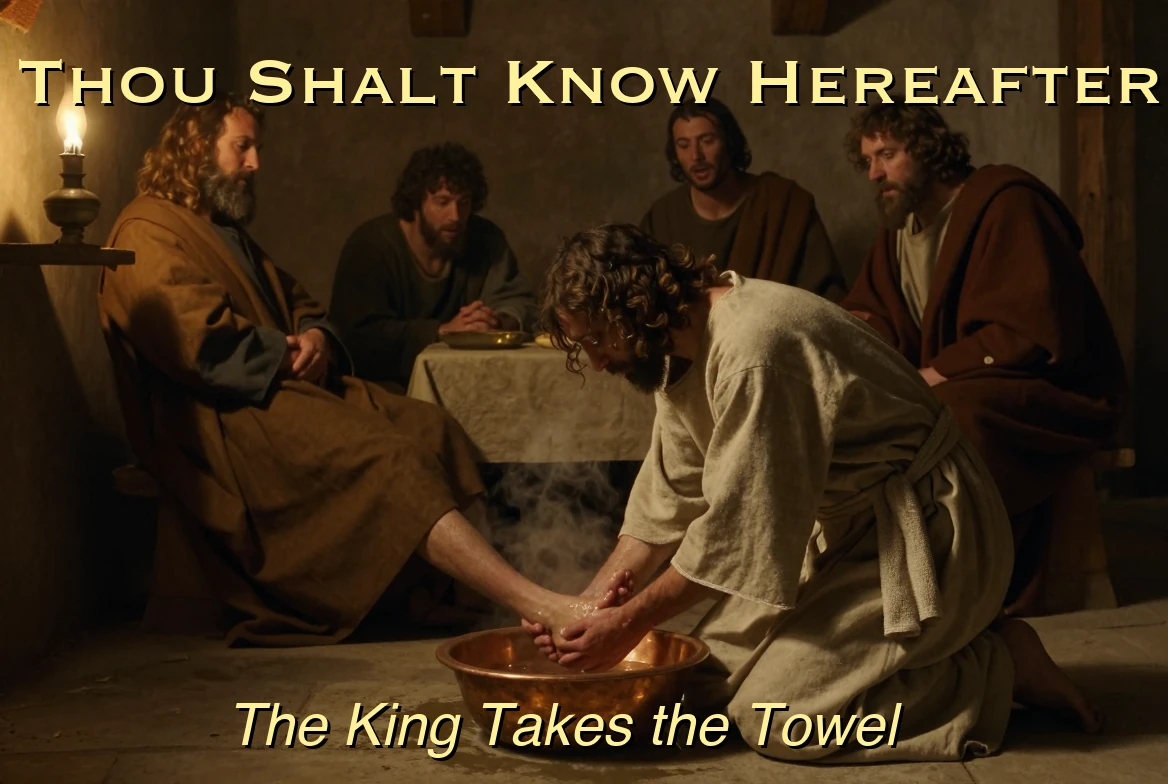
Not long ago I sat with a new professing believer — a man fresh to the Scriptures, hungry for them, and worn thin by churches that will talk about anything except God and His Word. He had come to this very passage looking for depth, and he offered me one: the washing of the sole of the foot, he said, is the washing of the soul — and that is what Peter would know hereafter. I understood the impulse and I would not despise it. A man with a new zeal for the Book — if not yet a zeal according to knowledge — wants it to be deep, and it is. But that reading is not depth; it is the oldest counterfeit of depth there is. It rests on nothing in the text. The verse does not say sole; it says feet. And the tie between sole and soul is a chance likeness of two English words — a sound in the ear, not a truth in the passage. Take the echo away and the meaning collapses, because the meaning was never in the words. It was carried in from outside and laid on top of them.
This is the old spiritualizing, handed down through generations of apostate church history — the medieval habit of reading past the plain words to a hidden sense the writer never put there. And it did not stay in the cloister where it was bred. Generation by generation it seeped into the common mind, until the notion that the Bible is a book of hidden, mystical meanings — a code to be cracked, a treasure buried beneath the words and waiting to be mined — became the ordinary way men suppose Scripture must be read. It is held even by those who never sat under a pulpit, and by those who, like the man I sat with, have walked out on the traditions altogether. That is the strange thing about him: worn thin by the churches, he still carried the one habit the churches bred — the quiet assumption that the plain sense cannot be the real sense, that the true meaning must be dug for somewhere underneath. He came to the Book expecting a secret, and a secret is what he produced.
It wears the face of reverence, but it is a door, and everything walks through it. Once a man may find his soul in a sole, there is no plain word left to tell him he is wrong. His meaning is now his own, and no one can question it, for it is his truth and not the text's. That is exactly why the Spirit warns that "no prophecy of the scripture is of any private interpretation." (2 Peter 1:20 KJV) The safeguard is not cleverness; it is right division — and I have set the whole fence against this kind of handling in a companion study, Rightly Dividing Bible Application.
Peter's hereafter is not spelled by an English echo. It is answered by the text itself — but only if we let the text answer. So set the pun aside and come back to the scene. The Lord said it with a basin of water in His hands and a towel about His waist: "What I do thou knowest not now; but thou shalt know hereafter." (John 13:7 KJV) Most readers walk past the promise without asking the two questions it begs. Know what? And know it when? The answer is not quarried out of the words by force; it is found the plain way — by asking who is in the room, what program he belongs to, and where on God's calendar that one word hereafter is pointing. Answer those from the text, and the verse opens — and it opens onto Israel's program, not ours.
Let us be workmen who rightly divide the word of truth.
The promise was made to a man in Israel's program
Before we ask what Peter would know, we settle who Peter was. The foot washing opens the Upper Room Discourse — the long address the Lord gave the night He was betrayed, running from John 13 through John 17. John names the audience in the first verse of the chapter:
"Now before the feast of the passover, when Jesus knew that his hour was come that he should depart out of this world unto the Father, having loved his own which were in the world, he loved them unto the end." (John 13:1 KJV)
"His own." These are the twelve — Jewish men, called by Him out of Israel, the appointed foundation of Israel's coming kingdom. These are the men to whom He had said they would "sit on thrones judging the twelve tribes of Israel." (Luke 22:30 KJV) These are the men who, weeks later, still asked Him on the Mount of Olives, "Lord, wilt thou at this time restore again the kingdom to Israel?" (Acts 1:6 KJV) — and whom He did not rebuke for asking. Simon Peter is one of them, and the room is a kingdom room.
That fixes the boundary for everything that follows. Whatever Peter is going to know hereafter lands somewhere on Israel's prophetic timeline — because the other timeline did not yet exist. The doctrine that governs the present dispensation was "kept secret since the world began" (Romans 16:25 KJV) and was revealed to no man until the risen Christ revealed it to Paul. You cannot find the mystery in the upper room, because that night it had been made known to no one on earth. So the tempting reading — that Peter was being told he would understand once the Body of Christ was revealed — is closed before we begin. Peter never received the mystery. Years later he is still the apostle "of the circumcision" (Galatians 2:7 KJV), and he speaks of Paul's letters from the outside, as writings with "some things hard to be understood." (2 Peter 3:16 KJV) If hereafter had meant the mystery, Peter of all men would have held it. He did not. We keep the promise inside his own program.
Take the pivotal word out, and the verse collapses
Read the promise once with its last word missing. "What I do thou knowest not now; but thou shalt know..." Leave it there. Without the final word the sentence could mean almost anything — that Peter would grasp it someday, somehow, in some vague spiritual sense, or perhaps never fully at all. The not-knowing would simply hang.
Now put the word back. "...but thou shalt know hereafter." The whole weight of the verse rests on it. Hereafter is not a shrug at mystery; it is an appointment. The knowing is deferred to a coming time — a now set against a hereafter, ignorance now and understanding at a fixed later point. The Lord is not telling Peter the meaning is unknowable. He is telling him the meaning is postponed. Which turns the whole question into a matter of timing: hereafter — but when?
John tells you exactly when hereafter is
We do not have to guess, because John's Gospel defines its own pattern of delayed understanding, and it is the same pattern every time. The disciples do not comprehend in the moment; they comprehend afterward, and the afterward is always tied to the resurrection and the giving of the Spirit.
"When therefore he was risen from the dead, his disciples remembered that he had said this unto them; and they believed the scripture, and the word which Jesus had said." (John 2:22 KJV)
"These things understood not his disciples at the first: but when Jesus was glorified, then remembered they that these things were written of him, and that they had done these things unto him." (John 12:16 KJV)
The same discourse that opens with the foot washing gives the identical shape a few verses later, and again to Peter by name: "Whither I go, thou canst not follow me now; but thou shalt follow me afterwards." (John 13:36 KJV) Now and afterwards. Not yet, and then. And the Lord names the engine that would carry them from the one to the other:
"But the Comforter, which is the Holy Ghost, whom the Father will send in my name, he shall teach you all things, and bring all things to your remembrance, whatsoever I have said unto you." (John 14:26 KJV)
"I have yet many things to say unto you, but ye cannot bear them now. Howbeit when he, the Spirit of truth, is come, he will guide you into all truth." (John 16:12–13 KJV)
There is Peter's hereafter, spelled out by the Lord Himself. It is after the cross, after the resurrection, and above all after the coming of the Holy Ghost — when the promised Comforter would bring these things to their remembrance and teach them what they could not bear the night they first heard them. The knowing was not left to Peter's cleverness. It was appointed to the Spirit given to that remnant, at Pentecost, on Israel's calendar.
The lesson of the towel was not the part held back
Here we must divide the passage itself, because it teaches two things and holds back only one. The lesson in humble service — the towel, the basin, the stooping Lord — the Lord did not defer at all. He explained it on the spot:
"So after he had washed their feet, and had taken his garments, and was set down again, he said unto them, Know ye what I have done to you?" (John 13:12 KJV)
"If I then, your Lord and Master, have washed your feet; ye also ought to wash one another's feet. For I have given you an example, that ye should do as I have done to you." (John 13:14–15 KJV)
That is plain, and it is plainly present-tense. Know ye what I have done. The example of servant-humility was handed to them immediately, and these men needed it that very hour.
For these were no ordinary disciples. That same night, at that same table, they had fallen to disputing "which of them should be accounted the greatest" (Luke 22:24 KJV) — and these were the very men already marked to "sit on thrones judging the twelve tribes of Israel." (Luke 22:30 KJV) Future rulers of the kingdom, quarreling over rank while the towel hung within reach. So the King knelt. The foot washing is His answer to that quarrel, and it is leadership training for the twelve. He shows them at the basin where authority runs in His kingdom: "The kings of the Gentiles exercise lordship over them... But ye shall not be so: but he that is greatest among you, let him be as the younger; and he that is chief, as he that doth serve." (Luke 22:25–26 KJV) The Gentile world climbs in order to be served. The men who would sit on Israel's thrones must first learn to kneel — he who would judge the twelve tribes must be able to take the towel.
So the servant-lesson was not the thing held back for hereafter; it was urgent, and He gave it plainly and at once. The deferred knowledge lay somewhere else — underneath the act, in the meaning of the washing itself.
What Peter could not yet bear: that he must be washed, or have no part
Watch Peter, and you see a man who cannot receive the thing the washing pictured. His first reaction is recoil: "Lord, dost thou wash my feet?" (John 13:6 KJV) His second is flat refusal: "Thou shalt never wash my feet." (John 13:8 KJV) Both are self-will dressed as reverence. And it is against that self-will that the Lord lays down the keystone:
"If I wash thee not, thou hast no part with me." (John 13:8 KJV)
Peter's refusal was a repudiation of the lesson. He had just watched the King take the towel — seen with his own eyes how rule works in the kingdom he was promised: the greatest becomes the servant, and the Lord of all kneels at the feet of men. Thou shalt never wash my feet throws it back. He will not be served by his Lord — and a man who will not be served has not yet grasped how Christ's throne is held.
Everything turns here. Peter's part with Christ — his standing, his fellowship, his place among the Lord's own — does not rest on what Peter would do for his Master. It rests on his being cleansed by his Master. And that part reached further than fellowship. It reached to the very thing Peter had been disputing at that table — his part with Christ in ruling. There is no share in that throne for a man who will not first bow to be washed and then stoop to serve, for that is the only kind of rule the King bestows. To have part with Christ in reigning, Peter had first to have part with Christ in the basin. He could not be a servant-king if he would not be a served one. That is the exact thing he could not yet bear, and his very next words prove it. He swings from refusing the washing to demanding more of it: "Lord, not my feet only, but also my hands and my head." (John 13:9 KJV) Still self-directed, still trying to manage the cleansing himself. And the Lord corrects even that:
"He that is washed needeth not save to wash his feet, but is clean every whit: and ye are clean, but not all." (John 13:10 KJV)
The one already washed is clean every whit; he needs only the washing of the day's defilement, not a fresh cleansing each time he stumbles. This is what Peter would know hereafter — not the etiquette of the towel, but the ground of his own acceptance: that his part with Christ was founded on a cleansing he received, secured by the cross the Lord was then hours from bearing, and opened to him by the Spirit who would teach him after. The man who within the hour would draw a sword, and before the cock crowed would deny his Lord three times, needed precisely that lesson — and needed it taught to him afterward, when he had learned he could not stand on his own devotion.
Keep the washing in its own program
One guard remains, and it is the guard that keeps this study honest. We must not quietly lift Peter's washing into the doctrine of the Body of Christ. The figure of washing belongs to Israel's program — the priests at the laver, the ceremonial cleansings, a nation taught to draw near through washing. Peter's coming understanding is framed in those terms: a cleansing bound to Christ's finished work, received as Israel's believing remnant would receive it.
Paul gives the Body its own words, and they are not these. When he speaks of the believer being washed today, he assigns the washing to the Spirit and to the word, never to a basin: "but ye are washed, but ye are sanctified, but ye are justified in the name of the Lord Jesus, and by the Spirit of our God" (1 Corinthians 6:11 KJV); "by the washing of regeneration, and renewing of the Holy Ghost" (Titus 3:5 KJV); "with the washing of water by the word." (Ephesians 5:26 KJV) Peter's foot washing is a figure inside Israel's upper room. It is not the mystery's doctrine of a believer washed once by the Spirit and the word. Read it for what it was to the man who received it, and leave it there.
The example is humble service, not a rite to repeat
From these words many have made a standing ceremony. They take "ye also ought to wash one another's feet" (John 13:14 KJV) as the institution of a rite to be performed in the assembly and repeated down the years. But before we ask whether it is a rite, a plainer question must be answered: an example of what? The Lord Himself calls it an example — "For I have given you an example, that ye should do as I have done to you" (John 13:15 KJV) — and everything turns on what it is an example of.
It is not an example of foot washing. It is an example of humble service by the one in authority. Mark how He frames it: "If I then, your Lord and Master, have washed your feet" (John 13:14 KJV) — the Lord and Master doing the slave's task. The lesson is not the water and the towel; it is the stooping. He had just told these men, who were disputing which of them should be greatest, that the greatest must be the servant, and then He showed them what that looks like in a Master who kneels. Foot washing was simply the form humility took at that table, in that country — the lowest service in a land of dusty roads and open sandals. "Do as I have done to you" is not perform this ceremony; it is so serve one another. Keep the water and miss the lowliness, and you have kept the shell and thrown away the kernel.
And here the word ordinance must be handled with care, for we do not mean by it what the churches mean. An ordinance in Paul's epistles is not a sacrament, and not a spiritual rite to be repeated; it is an order — a thing ordained and commanded. "Keep the ordinances, as I delivered them to you" (1 Corinthians 11:2 KJV): the ordinances are the orders the apostle delivered to be obeyed, not ceremonies to be enacted for their own sake. And among all the orders Paul gave the Body of Christ, he never once commanded a washing of feet. So whichever way the word is taken — as the churches' sacrament or as Paul's plain order — foot washing is no ordinance for the Body. Paul commanded no such thing.
What Paul did with it is tell us plainly what it is. The single time he names the act, it is a kindness, listed among a widow's good works: "if she have lodged strangers, if she have washed the saints' feet, if she have relieved the afflicted" (1 Timothy 5:10 KJV) — hospitality to weary travelers, set beside a bed for the night and mercy to the afflicted. So leave it exactly there. Foot washing is a kindness, not a rite — a courtesy of that place and time, and a fine expression of humble love wherever a real need for it arises, but never a ceremony laid upon the Body of Christ. Those who make it a standing rite go wrong twice at once: they mistake the example (humble service) for the act (the washing), and they mistake an order to obey for a ritual to perform. This study has warned against both kinds of mishandling; here they meet in one place.
Peter's own ministry proves where hereafter landed
The final proof that Peter's hereafter stayed inside his own program is Peter himself. After Pentecost he did understand — the Spirit came, and the man who could not bear these things now preached with power. And everything he preached and wrote remained circumcision-program truth. He points his readers back to the very lesson of that night — "Christ also suffered for us, leaving us an example, that ye should follow his steps" (1 Peter 2:21 KJV) — the stooping, serving, suffering Master held up again as the pattern. And nowhere is it plainer than when Peter turns to instruct the elders. The man who once drew back from the basin, who had to be taught that the greatest must be the servant, now charges the shepherds of the flock in the very terms the King had used on him: feed the flock of God, "Neither as being lords over God's heritage, but being ensamples to the flock." (1 Peter 5:3 KJV) Not as lords — that was the Gentile reflex the King had corrected in the upper room, ye shall not be so. Ensamples to the flock — that was the pattern He had set when He rose from washing their feet and said, I have given you an example. Peter had learned it. He had let the King wash his feet, he had taken up the towel, and now he was handing it on. He remained the apostle to Israel, and he read Paul's letters as a brother looking in from outside, at things "hard to be understood." (2 Peter 3:16 KJV) His later understanding was real, and it was Israel's understanding. It never became the mystery. That is the size and shape of hereafter.
Paul gives the Body its humility in full — do not go back for it
Here a warning must be set, because the danger in a study like this one is subtle and wears a humble face. Having seen how rich the servant-lesson is in the upper room, a teacher is tempted to preach John 13 — or Peter's charge to the elders — as the Body of Christ's doctrine of humility, as though this were the passage where we go to learn it. It is not. To handle it so is to fall into the very error a companion study, Rightly Dividing Bible Application, was written to fence out: reaching back into another program for a truth our own apostle has already given us in full.
For Paul does not leave the Body short a syllable on humility. He gives it plainly, as our commandment, and grounds it in the same self-humbling Christ: "Let nothing be done through strife or vainglory; but in lowliness of mind let each esteem other better than themselves." (Philippians 2:3 KJV) "Let this mind be in you, which was also in Christ Jesus" (Philippians 2:5 KJV) — the mind of the One who "made himself of no reputation, and took upon him the form of a servant... he humbled himself, and became obedient unto death, even the death of the cross." (Philippians 2:7–8 KJV) Mark the manner of it: not by handing us the towel and the basin, but in plain words — the lowly mind of Christ laid directly on the Body as its own doctrine. And he presses it as walk: "With all lowliness and meekness, with longsuffering, forbearing one another in love" (Ephesians 4:2 KJV); "by love serve one another." (Galatians 5:13 KJV) Whatever John 13 shows us of a serving Christ, Paul has already commanded of the serving saint.
So mark what that means for the passage in hand. Going to Peter's basin to teach the Body its humility adds nothing to Paul — the lesson was ours already, in Philippians, before we reached for it. And a reach that adds nothing, yet carries us out of our own epistles to get it, is never harmless. It quietly tells the reader that his apostle left him wanting, that he must forage in Israel's program for what grace did not supply — and that habit, once formed, does not stop at humility. It is the open door to cherry-picking, to lifting Israel's promises and commands at will, to corrupting the word by mishandling it. The study that warns against spiritualizing must not turn and commit the selective handling that stands next to it. Read John 13, then, as it is given: the true record of the King forming the future rulers of Israel — a lesson to those men, for our learning, not the source of our command. Learn the humility of Christ from the upper room gladly; take your orders from your own apostle.
The lesson under the lesson
So what do you do with a verse that was never spoken to you? You learn to read. You do not carry Peter's basin into your own dispensation, and you do not turn his coming understanding into a preview of the mystery of Christ. You let the towel stay in Israel's upper room, and you take instead the truth that stands underneath it — the one thing Peter had to be brought, painfully, to see.
But take that truth the honest way — the way this whole study has urged. The rest itself is not lifted from Peter's basin; it is your own apostle's gospel, spoken plainly to you: "For by grace are ye saved through faith; and that not of yourselves: it is the gift of God: Not of works, lest any man should boast." (Ephesians 2:8–9 KJV) What Peter was brought slowly to see, Paul hands you outright. So stop trying to wash your own hands and head. Your part with Christ does not rest on what you do for Him, but on what you have received from Him — finished at the cross, applied freely, held out to you not in an upper-room basin but in the epistles of the apostle God gave you. Rest there: not in your service to Christ, but in His cleansing of you.
© 2026 Edward R. Cross


Comments
No comments yet. Be the first to share your thoughts.
Leave a comment