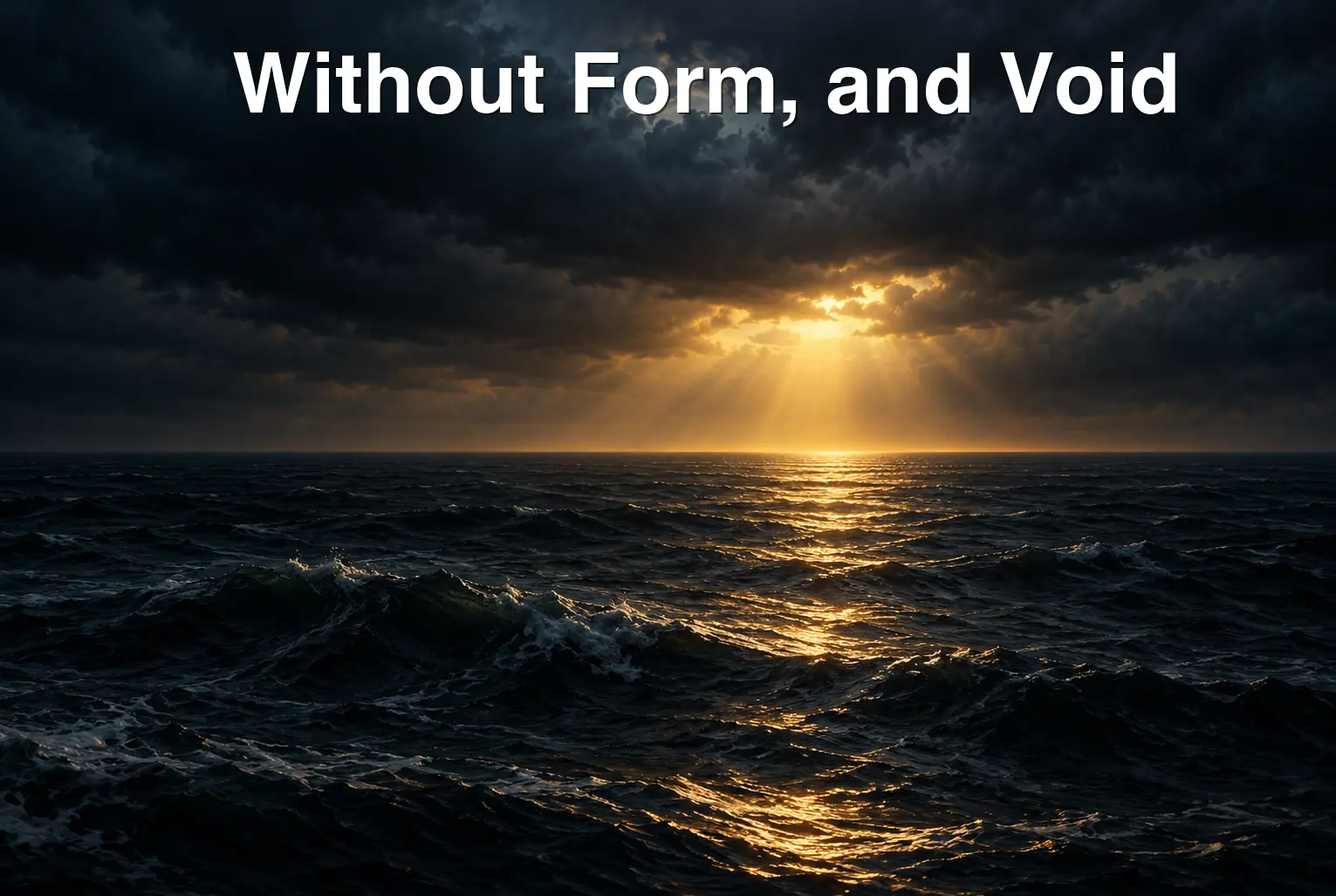
Between the first two verses of the Bible, many readers have been taught, a whole world rose and fell. God created a perfect heaven and earth. Satan ruled it and rebelled. God judged that world with a flood, and the earth of Genesis 1:2 is what was left. The six days that follow are then God re-forming the wreck. The teaching goes by several names — the gap theory, the ruin-and-reconstruction theory, the pre-Adamic earth — and it is really three claims traveling together:
- A ruin. An earth was created, then ruined by judgment, and Genesis 1:2 describes the ruin. An interval of unstated length lies between verses 1 and 2.
- A cause. Satan's fall brought the ruin, and a flood of that earlier world was the judgment.
- A prior race. Beings lived on that earlier earth before Adam.
It is not a new idea and it is not a foolish one. It stands in the notes of the Scofield Reference Bible, in Clarence Larkin's Dispensational Truth, in G. H. Pember's Earth's Earliest Ages (1876), and in Arthur Custance's Without Form and Void (1970), and some Mid-Acts teachers hold it as well. Justin Johnson, teaching Genesis at Grace Ambassadors in The First Day, says what this study will say: the gap is not in the text. In his Romans study According to Their Deeds he calls it an assumption, and says that anyone who holds it has to put it in the verses.
This study does one thing. It takes each of the three claims to the text, the King James, verse by verse, and asks of every argument offered for it: does the verse say this, or is something being brought to the verse? Where the text says a thing, we say so. Where an argument goes on past what the text says, we mark the place where the text stops and the argument continues. That is the main claim: that the King James text does not clearly teach a ruin, a flood of Lucifer's world, or a race before Adam. Along the way the study also says what the text does teach about the same passages. It claims no more than the text gives, and it does not need to.
What the first two verses say, and what stands between them
"In the beginning God created the heaven and the earth. And the earth was without form, and void; and darkness was upon the face of the deep. And the Spirit of God moved upon the face of the waters." (Genesis 1:1-2 KJV)
The first verse states that God created the heaven and the earth. The second states the condition of the earth: without form and void, darkness on the deep, the Spirit of God moving on the waters. The third verse is God speaking, "Let there be light" (Genesis 1:3).
Nothing stands between verse 1 and verse 2. No sentence in these two verses mentions a judgment, a rebellion, a flood or a people. Every one of the three claims therefore has to be brought to these verses from somewhere else, and the rest of this study goes to those places and reads them where they stand.
Some gaps are marked by the text itself
The defenders of the gap make a fair point, and it should be heard first. Scripture does leave things unsaid, and it does supply them later. Pharaoh's magicians appear in Exodus (Exodus 7:11) with no names; Scripture gives their names in Paul's second letter to Timothy (2 Timothy 3:8). A reader who wants every fact in the place he first looks for it has not understood how the Bible is written.
But some gaps the text marks itself. A clear case is Isaiah 61. The Lord stood up in the synagogue at Nazareth (Luke 4:16-17) and read from it:
"The Spirit of the Lord is upon me, because he hath anointed me to preach the gospel to the poor; he hath sent me to heal the brokenhearted, to preach deliverance to the captives, and recovering of sight to the blind, to set at liberty them that are bruised, To preach the acceptable year of the Lord. And he closed the book, and he gave it again to the minister, and sat down. And the eyes of all them that were in the synagogue were fastened on him." (Luke 4:18-20 KJV)
Now set beside it the sentence He was reading:
"The Spirit of the Lord GOD is upon me; because the LORD hath anointed me to preach good tidings unto the meek; he hath sent me to bind up the brokenhearted, to proclaim liberty to the captives, and the opening of the prison to them that are bound; To proclaim the acceptable year of the LORD, and the day of vengeance of our God; to comfort all that mourn;" (Isaiah 61:1-2 KJV)
He read to the words "the acceptable year of the Lord" and stopped in the middle of the sentence. The prophecy goes on: "and the day of vengeance of our God." The text itself shows where the sentence breaks, and the reader can see the break by laying the two passages side by side.
Nothing in Genesis 1:1-2 breaks off a sentence. The principle that God gives later what He withholds earlier is true, but it has a limit: when a later passage supplies what an earlier one withheld, it says so in its own words. The question for the gap is whether any later passage does. That is the question the rest of this study asks, and its three parts follow the three claims: the ruin, the cause, and the prior race.
How we read: the English text, not a dictionary behind it
Some of the arguments for the gap do not rest on the English at all. They rest on claims about the languages behind it: what a word really means, how a sentence is built, which of two senses a small word must carry. Defenders and opponents alike make such claims with great confidence, and they cannot all be right. We do not weigh them against a lexicon, and the reason is not that they cannot be answered. The reason is that a lexicon that decides what the English text may mean has become the final authority. Even if such a claim were proved against a dictionary, that would put the dictionary over the text, and we will not do that.
The Bible in the reader's hand is the preserved word of God. Not one original page exists to go back to, and the words God kept are the words a reader can check (see Preserved, Not Re-Inspired: Why We Hold the King James). So every argument below is met in English, where any reader can check it. Where an argument exists only by reaching behind the English for the words it needs, we say that it does, and we set it aside.
One more boundary. The passages in this study come from every part of the Bible. Most were written to Israel, and some of the later ones to Israel's believing remnant. We read them for one thing: what they say about the earth and the beings in it, which is the same for every man. We take no doctrine for the Body of Christ from them. The Body's doctrine is Paul's, and where Paul speaks to the question, we quote him.
Part one: Isaiah 45:18 says why God made the earth, not what shape it first had
A text the gap theory leans on is this one:
"For thus saith the LORD that created the heavens; God himself that formed the earth and made it; he hath established it, he created it not in vain, he formed it to be inhabited: I am the LORD; and there is none else. I have not spoken in secret, in a dark place of the earth: I said not unto the seed of Jacob, Seek ye me in vain: I the LORD speak righteousness, I declare things that are right." (Isaiah 45:18-19 KJV)
The argument is that God "created it not in vain" means He did not create it as a formless waste, and Genesis 1:2 shows a formless waste, so the earth must have become one afterward. It adds that the word behind "in vain" is the word behind "without form" in Genesis 1:2. That last step is a claim about the original, and we set it aside as such.
In English, the verse is plain. It gives its own reason: "he formed it to be inhabited." The next verse uses the same words in the same kind of sentence, "I said not unto the seed of Jacob, Seek ye me in vain" (Isaiah 45:19). That sentence does not mean a ruin. It means to no purpose. The verse is about purpose: God did not make the earth for nothing, He made it to be lived on. Justin Johnson reads it this way in his Isaiah 45 study, Every Knee Shall Bow.
Nothing in the verse speaks of an earlier earth, a ruin or a re-forming. A reader who needs the verse to say "a ruin" has to change the words. Larkin's Rightly Dividing the Word quotes it from the Revised Version, "not a waste," in place of the King James. That is the argument changing the preserved English for the very words it needs.
A leading defender of the gap grants the point. Arthur Custance, who wrote a full-length book for the theory, says this argument is "not compulsive," and he agrees that the next verse reads "in vain."
Part one: Jeremiah 4 and Isaiah 24 describe judgments on living peoples
Another argument comes from Jeremiah. The words "without form, and void" stand together in the King James in only two places, Genesis 1:2 and this one:
"I beheld the earth, and, lo, it was without form, and void; and the heavens, and they had no light. I beheld the mountains, and, lo, they trembled, and all the hills moved lightly. I beheld, and, lo, there was no man, and all the birds of the heavens were fled. I beheld, and, lo, the fruitful place was a wilderness, and all the cities thereof were broken down at the presence of the LORD, and by his fierce anger. For thus hath the LORD said, The whole land shall be desolate; yet will I not make a full end." (Jeremiah 4:23-27 KJV)
The argument is that Jeremiah uses the language of Genesis 1:2 for a desolation caused by God's anger, so Genesis 1:2 must be a desolation caused by God's anger too. Isaiah 24 is brought alongside:
"Behold, the LORD maketh the earth empty, and maketh it waste, and turneth it upside down, and scattereth abroad the inhabitants thereof." (Isaiah 24:1 KJV)
"The earth also is defiled under the inhabitants thereof; because they have transgressed the laws, changed the ordinance, broken the everlasting covenant. Therefore hath the curse devoured the earth, and they that dwell therein are desolate: therefore the inhabitants of the earth are burned, and few men left." (Isaiah 24:5-6 KJV)
Read where they stand, both passages are about a people. Jeremiah's vision is introduced by "my people is foolish" (Jeremiah 4:22) and ends with "yet will I not make a full end" (Jeremiah 4:27). Isaiah 24 names the cause: the inhabitants "have transgressed the laws, changed the ordinance, broken the everlasting covenant." Neither passage looks back to a first creation. Neither mentions a prior earth.
Two things about the argument itself. First, it is an argument from shared wording. Shared wording tells us that one passage resembles the other. It does not tell us which resembles which, and nothing in either passage says. Second, the defenders of the gap do not agree on how to use these verses. Some read Jeremiah 4:23-26, with its "no man" and its broken cities, as the earlier world. Others read the same verses as the future Tribulation. If they are future, they cannot show what Genesis 1:2 was. They can show only a likeness.
Part one: Darkness and the deep are God's own work as often as His judgment
Another argument says that "darkness," "the deep" and "void" are words of judgment in Scripture, so Genesis 1:2 is judgment. The words do appear in judgments. Darkness fell on Egypt (Exodus 10:21-22), and the fountains of the great deep were broken up at the flood (Genesis 7:11).
But Scripture also tells of God making them. In His own account of the sea He says He made it:
"Or who shut up the sea with doors, when it brake forth, as if it had issued out of the womb? When I made the cloud the garment thereof, and thick darkness a swaddlingband for it, And brake up for it my decreed place, and set bars and doors, And said, Hitherto shalt thou come, but no further: and here shall thy proud waves be stayed?" (Job 38:8-11 KJV)
"Thick darkness a swaddlingband" is God describing His own work. So is the psalmist's "Thou coveredst it with the deep as with a garment" (Psalm 104:6), and his "Thou makest darkness, and it is night" (Psalm 104:20). "He made darkness his secret place" (Psalm 18:11).
The words alone do not settle it. Johnson makes the same point in the Genesis lesson: the same words can mean either, and context decides. The context in Genesis 1 is God speaking, from the next verse on.
Part one: "Replenish" is the word for filling, and it never required an earlier world
Adam was told to fill the earth:
"And God blessed them, and God said unto them, Be fruitful, and multiply, and replenish the earth, and subdue it: and have dominion over the fish of the sea, and over the fowl of the air, and over every living thing that moveth upon the earth." (Genesis 1:28 KJV)
The argument is that "replenish" means "fill again," so there had been a population before. The word occurs seven times in the King James. Besides Genesis 1:28 and 9:1, it stands in Isaiah 2:6, "replenished from the east"; Isaiah 23:2, where the merchants of Zidon "have replenished" the isle; Jeremiah 31:25, "I have replenished every sorrowful soul"; Ezekiel 26:2, where Tyre says "I shall be replenished" over the fall of Jerusalem; and Ezekiel 27:25, "thou wast replenished, and made very glorious."
Every one of the seven reads naturally as filled, or stocked. None asks for "again." Genesis 9:1, where Noah and his sons are told to "replenish the earth" after the flood, reads either way: fill, or fill again. The word was never carrying an earlier world. The argument carries it in. Custance, who defended the theory at book length, declines to use it.
Part one: 2 Peter 3 names a flood, and 2 Peter 2 tells us whose
Peter wrote to the scattered believing remnant of Israel, not to the Body of Christ (see Peter's Audience: The Little Flock of Israel). We read his letter here for one thing only: what it says about the earth's history. Here is the passage in Peter that the theory leans on:
"Knowing this first, that there shall come in the last days scoffers, walking after their own lusts, And saying, Where is the promise of his coming? for since the fathers fell asleep, all things continue as they were from the beginning of the creation. For this they willingly are ignorant of, that by the word of God the heavens were of old, and the earth standing out of the water and in the water: Whereby the world that then was, being overflowed with water, perished: But the heavens and the earth, which are now, by the same word are kept in store, reserved unto fire against the day of judgment and perdition of ungodly men." (2 Peter 3:3-7 KJV)
The argument is that "the world that then was" is a world before Adam, destroyed by a flood, and that "the heavens and the earth, which are now" are the re-formed earth.
Peter has already told us what he calls a world that perished. Two chapters earlier, in the same letter:
"And spared not the old world, but saved Noah the eighth person, a preacher of righteousness, bringing in the flood upon the world of the ungodly;" (2 Peter 2:5 KJV)
The old world was not spared, and Noah the eighth person was saved. In Peter's own usage, a world can perish while eight are saved. The objection that the world could not have "perished" in Noah's flood because eight survived does not hold against Peter's own sentence.
Another objection holds that Noah's flood only covered the earth and never overflowed it. The flood account says otherwise:
"In the six hundredth year of Noah's life, in the second month, the seventeenth day of the month, the same day were all the fountains of the great deep broken up, and the windows of heaven were opened." (Genesis 7:11 KJV)
"And the waters prevailed exceedingly upon the earth; and all the high hills, that were under the whole heaven, were covered. Fifteen cubits upward did the waters prevail; and the mountains were covered." (Genesis 7:19-20 KJV)
The highest hills were under the water. And the LORD Himself speaks of that event this way:
"For this is as the waters of Noah unto me: for as I have sworn that the waters of Noah should no more go over the earth; so have I sworn that I would not be wroth with thee, nor rebuke thee." (Isaiah 54:9 KJV)
"The waters of Noah" went "over the earth." Peter sets the earth's origin in the water beside its perishing by water, and Genesis 7:11 names "the great deep" and "the windows of heaven" as the flood's sources.
Three more points from the text. The fire passage is written at a different scale. In the water judgment it is "the world" that perished (2 Peter 3:6). In the fire judgment "the heavens shall pass away with a great noise, and the elements shall melt with fervent heat" (2 Peter 3:10). The two are not the same event described twice. Next, "ungodly" is in both: Peter speaks of "the world of the ungodly" in 2 Peter 2:5 and of "perdition of ungodly men" in 2 Peter 3:7, so the flood and the coming fire are both said to fall on men. Last, "the beginning of the creation" in 2 Peter 3:4 is the scoffers' phrase, "all things continue as they were from the beginning of the creation" (2 Peter 3:4). It is not Peter's date for the flood.
The argument does have real ground, and it should be said. Peter pairs "the heavens were of old" with "the heavens and the earth, which are now" and speaks of a change. A reader who presses that is reading what the words say. But Peter names the event that made the change: a flood by which "the world that then was ... perished." In his own letter that flood is Noah's. In the verses examined here, no second flood is named.
One phrase remains, "the earth standing out of the water and in the water." In English it reads as Genesis 1:9-10 does:
"And God said, Let the waters under the heaven be gathered together unto one place, and let the dry land appear: and it was so. And God called the dry land Earth; and the gathering together of the waters called he Seas: and God saw that it was good." (Genesis 1:9-10 KJV)
Dry land out of the water, with the seas left in it. Defenders of the gap do not agree on this phrase either. Some read it as an earth with both dry land and water, as the words say. Others hold that the first earth had no sea at all. Both cannot rest on this verse.
Part one: Revelation 21 ends the first heaven and earth by fire, and that is not what Genesis 1:2 describes
Revelation is one of the remnant epistles, written to believing Israel under the prophetic program (see What Are the Remnant Epistles), and we read it here only for what it says about the end of the earth. Some defenders of the gap set Genesis 1:2 and Revelation 21 side by side as a pattern: the earth destroyed by water, then re-formed; the earth passing away by fire, then a new heaven and a new earth. Here is what the text says of the ending:
"And I saw a new heaven and a new earth: for the first heaven and the first earth were passed away; and there was no more sea." (Revelation 21:1 KJV)
"But the day of the Lord will come as a thief in the night; in the which the heavens shall pass away with a great noise, and the elements shall melt with fervent heat, the earth also and the works that are therein shall be burned up. Seeing then that all these things shall be dissolved, what manner of persons ought ye to be in all holy conversation and godliness, Looking for and hasting unto the coming of the day of God, wherein the heavens being on fire shall be dissolved, and the elements shall melt with fervent heat? Nevertheless we, according to his promise, look for new heavens and a new earth, wherein dwelleth righteousness." (2 Peter 3:10-13 KJV)
The heavens pass away. The elements melt. "All these things shall be dissolved," the earth and its works are "burned up," and what follows is new: "new heavens and a new earth." Isaiah had promised it in the same terms, "I create new heavens and a new earth: and the former shall not be remembered, nor come into mind" (Isaiah 65:17), as we followed in They Shall Never Perish: Kingdom Salvation, Eternal Life, and the Resurrection of Israel's Remnant. And John saw the great white throne, "from whose face the earth and the heaven fled away; and there was found no place for them" (Revelation 20:11).
That is a different kind of ending from the one the gap theory describes for Genesis 1:2: a water ruin that leaves the earth to be re-formed out of what remained. The ending Peter and John describe is fire, dissolution and a new creation, not a water ruin and a re-forming. So the pattern, ruin followed by reconstruction on one side and passing away followed by new creation on the other, is not a pattern of the same event. That removes one support the gap has leaned on.
Three limits keep this from being stretched. First, it does not exclude an earlier ruin and re-forming. That "the first heaven and the first earth were passed away" (Revelation 21:1) is said of the earth that exists at the end, and it says nothing of that earth's earlier history. "First" is set against "new" in Revelation 21:1 and against "the former things" in the next verses:
"And God shall wipe away all tears from their eyes; and there shall be no more death, neither sorrow, nor crying, neither shall there be any more pain: for the former things are passed away. And he that sat upon the throne said, Behold, I make all things new. And he said unto me, Write: for these words are true and faithful." (Revelation 21:4-5 KJV)
The former things are death, sorrow, crying and pain, the order the curse brought in (Genesis 3:17; Revelation 22:3). Second, Peter shows that an earth can pass through a water judgment and remain: the world "perished" (2 Peter 3:6), and yet "the earth also" stands to be burned (2 Peter 3:10). Third, the text speaks of change as well as dissolution: "as a vesture shalt thou fold them up, and they shall be changed" (Hebrews 1:12), and in the psalm, "they shall be changed" (Psalm 102:26), and "Behold, I make all things new." So the argument rests on what the verses say about melting, burning and dissolving, not on a claim that nothing carries over.
Part one: Exodus 20:11 and Genesis 1:31 say what God made, and neither settles the gap
"For in six days the LORD made heaven and earth, the sea, and all that in them is, and rested the seventh day: wherefore the LORD blessed the sabbath day, and hallowed it." (Exodus 20:11 KJV)
The argument is that "made" here is not the word for "created" in Genesis 1:1, so the commandment speaks of the six days' re-forming and not of the first creation. That is again a claim about the original, and we set it aside. In English, Genesis 2:3 says of the one work that God rested from "all his work which God created and made." And "made" is used of the heavens, their host and the earth: "thou hast made heaven, the heaven of heavens, with all their host, the earth, and all things that are therein" (Nehemiah 9:6), and "By the word of the LORD were the heavens made; and all the host of them by the breath of his mouth" (Psalm 33:6). The English does not draw the line the argument needs.
The common argument against the gap has the same duty to be tested. It runs: God called everything He had made "very good" (Genesis 1:31), and "all the host of them" were finished (Genesis 2:1), so no fallen angel stood in creation. The reply is that Genesis 1:31 speaks of "every thing that he had made" in the six days, and that Genesis 2:1 says the host were finished, not that they were good. That reply is fair as far as it goes. These two verses state what God made in the six days, and they state that all stood finished and good at the end. Neither states what, if anything, came before verse 2. They do not teach the gap, and they do not by themselves exclude it.
Part one: The mystery was purposed before the world began, and the text does not say it answers a rebellion
A serious argument for the gap comes from Paul, and it should be stated fully. It says that the mystery of the Body of Christ was purposed "before the foundation of the world," that it concerns "things in heaven" as well as on earth, that principalities and powers are being taught through the church, and that all this must therefore have been God's answer to a rebellion in heaven before the world began, which puts the fall before Genesis 1:2. These are the verses:
"According as he hath chosen us in him before the foundation of the world, that we should be holy and without blame before him in love:" (Ephesians 1:4 KJV)
"And to make all men see what is the fellowship of the mystery, which from the beginning of the world hath been hid in God, who created all things by Jesus Christ: To the intent that now unto the principalities and powers in heavenly places might be known by the church the manifold wisdom of God, According to the eternal purpose which he purposed in Christ Jesus our Lord:" (Ephesians 3:9-11 KJV)
"And, having made peace through the blood of his cross, by him to reconcile all things unto himself; by him, I say, whether they be things in earth, or things in heaven." (Colossians 1:20 KJV)
All of that is in the text. The mystery was purposed before the foundation of the world. It was hid in God. It was "the eternal purpose which he purposed in Christ Jesus our Lord" (Ephesians 3:11). Principalities and powers in heavenly places are being taught the manifold wisdom of God through the church. And Christ is to reconcile things in heaven. The Body's place toward the principalities and powers rests on these verses whether or not any theory is true.
What the verses do not say is that this purpose answers a rebellion. A purpose formed before the foundation of the world was formed before any rebellion inside the world. That God foreknew what would come is not in question; what the verses do not say is that the purpose responds to a rebellion, or when one took place. That things in heaven are to be reconciled tells us something in heaven is not at peace. It does not tell us when that began or why. The same verses fit a fall before Genesis 1:2 and fit a fall after Genesis 2:1 equally. In Why Did God Create Man, Knowing He Would Sin — and Would It Have Been Better Not to Create at All? we set out what Paul does say about the purpose: God made the world to show the exceeding riches of His grace, and He purposed it before there was an Adam, a garden or a sin.
Part one: Paul's comparison of light in the heart to light in creation is a comparison of power
One more argument comes from Paul:
"For God, who commanded the light to shine out of darkness, hath shined in our hearts, to give the light of the knowledge of the glory of God in the face of Jesus Christ." (2 Corinthians 4:6 KJV)
The argument is that Paul treats Genesis 1 as the first picture of salvation, with light out of darkness, a fallen world made new, and so Genesis 1:2 was a ruin. But Paul's comparison is of the One who acts: "God, who commanded the light to shine out of darkness, hath shined in our hearts". The verses before name the darkness of the unbeliever: "the god of this world hath blinded the minds of them which believe not" (2 Corinthians 4:4). Paul does not say the darkness of Genesis 1:2 was judgment. The comparison works if that earth was unfinished and dark, and it works if it was ruined and dark. It does not choose between them. We read the verse the same way in Can Anyone Make You Believe?, as a statement that the God who said "let there be light" is the one who gives light to the darkened heart.
Part two: Isaiah 14 and Ezekiel 28 reach beyond the kings to Satan, and neither dates the fall
The second claim is that Satan's fall brought the ruin, and that a flood of that world was God's judgment on it. Scripture does teach that Satan fell, and we followed what these two chapters say about him in Satan's Two Campaigns: His War on the Remnant and His War on the Body of Christ. Here we ask only what they say about when.
"How art thou fallen from heaven, O Lucifer, son of the morning! how art thou cut down to the ground, which didst weaken the nations! For thou hast said in thine heart, I will ascend into heaven, I will exalt my throne above the stars of God: I will sit also upon the mount of the congregation, in the sides of the north: I will ascend above the heights of the clouds; I will be like the most High. Yet thou shalt be brought down to hell, to the sides of the pit." (Isaiah 14:12-15 KJV)
"Thou hast been in Eden the garden of God; every precious stone was thy covering, the sardius, topaz, and the diamond, the beryl, the onyx, and the jasper, the sapphire, the emerald, and the carbuncle, and gold: the workmanship of thy tabrets and of thy pipes was prepared in thee in the day that thou wast created. Thou art the anointed cherub that covereth; and I have set thee so: thou wast upon the holy mountain of God; thou hast walked up and down in the midst of the stones of fire. Thou wast perfect in thy ways from the day that thou wast created, till iniquity was found in thee." (Ezekiel 28:13-15 KJV)
Each passage is introduced with a man. The proverb in Isaiah 14 is taken up against "the king of Babylon" (Isaiah 14:4). Ezekiel is told to speak to "the prince of Tyrus" and then to take up a lamentation "upon the king of Tyrus" (Ezekiel 28:2, 12). Then the language outruns anything said of a king. One is "fallen from heaven," "son of the morning," who said "I will ascend into heaven." Another was "in Eden the garden of God," is "the anointed cherub that covereth," and is told, "Thou wast perfect in thy ways from the day that thou wast created, till iniquity was found in thee". Those words reach the one behind the kings: Satan, made perfect, whose heart was lifted up (Ezekiel 28:17).
What the two chapters do not say is when. Neither gives a date. Neither mentions Genesis 1:2, a ruined earth or a flood. The ruin theory dates the fall before Genesis 1:2 by its own reading of other verses. These chapters are silent on the date.
Part two: The verses on Satan's beginning say that he fell, not when
Other verses speak of Satan's beginning:
"And he said unto them, I beheld Satan as lightning fall from heaven." (Luke 10:18 KJV)
"Ye are of your father the devil, and the lusts of your father ye will do. He was a murderer from the beginning, and abode not in the truth, because there is no truth in him. When he speaketh a lie, he speaketh of his own: for he is a liar, and the father of it." (John 8:44 KJV)
"He that committeth sin is of the devil; for the devil sinneth from the beginning. For this purpose the Son of God was manifested, that he might destroy the works of the devil." (1 John 3:8 KJV)
And Genesis 3:1 opens with the serpent already the enemy:
"Now the serpent was more subtil than any beast of the field which the LORD God had made. And he said unto the woman, Yea, hath God said, Ye shall not eat of every tree of the garden?" (Genesis 3:1 KJV)
All the sources we have read agree that Satan fell before Genesis 3:1. The question is where. The gap theory places the fall before Genesis 1:2. Another placing puts it after Genesis 2:1 and before Genesis 3:1. Johnson takes the second and says plainly that nothing in the Bible tells of the fall "specifically," that the date is deduced from other verses. We do not need to choose between them to see what the text does. Neither placing is written in the text. Each is a deduction, and a deduction is the right name for it. The gap theory's placing is the one that needs everything else this study has examined: a ruin, a flood and a re-forming.
The beginning of the earth does tell us who was present. God asked Job:
"Where wast thou when I laid the foundations of the earth? declare, if thou hast understanding. Who hath laid the measures thereof, if thou knowest? or who hath stretched the line upon it? Whereupon are the foundations thereof fastened? or who laid the corner stone thereof; When the morning stars sang together, and all the sons of God shouted for joy?" (Job 38:4-7 KJV)
The sons of God were there when the foundations were laid, and Satan came among the sons of God (Job 1:6). The verses say they were present. They do not say they lived on the earth, or that any had fallen by then.
Part two: The angels of Jude 6 are those of Genesis 6, and 2 Peter 2:4 most likely speaks of the same
Those who date the fall before Genesis 1:2 often point to the angels that sinned:
"For if God spared not the angels that sinned, but cast them down to hell, and delivered them into chains of darkness, to be reserved unto judgment;" (2 Peter 2:4 KJV)
"And the angels which kept not their first estate, but left their own habitation, he hath reserved in everlasting chains under darkness unto the judgment of the great day. Even as Sodom and Gomorrha, and the cities about them in like manner, giving themselves over to fornication, and going after strange flesh, are set forth for an example, suffering the vengeance of eternal fire." (Jude 6-7 KJV)
Look at the company these angels keep. In 2 Peter 2:4-6 the angels, the old world and Sodom stand in a row of three judgments. In Jude 5-7 they stand between Israel in the wilderness and Sodom and Gomorrha, and Jude sets Sodom "in like manner" beside them, "giving themselves over to fornication, and going after strange flesh". The angels who "left their own habitation" and went after strange flesh are the sons of God who, in the days before the flood, "came in unto the daughters of men":
"That the sons of God saw the daughters of men that they were fair; and they took them wives of all which they chose." (Genesis 6:2 KJV)
"There were giants in the earth in those days; and also after that, when the sons of God came in unto the daughters of men, and they bare children to them, the same became mighty men which were of old, men of renown." (Genesis 6:4 KJV)
Jude 6-7 refers to that event, and 2 Peter 2:4 most likely refers to the same angels. These verses then speak of a sin after Adam and say nothing of a fall before Genesis 1:2. We do not go past the text here. The sons of God came, and the text says so. How they arose or how they did what they did is not told, and we do not supply it.
Part two: A flood of Lucifer's world is an inference with no verse of its own
The flood of the gap theory is argued from three things we have read: the waters and the deep of Genesis 1:2, the language of Jeremiah 4:23, and 2 Peter 3:6. We have read each. The first does not mention a flood, the second describes Judah, and the third names Noah's flood in its own letter. None of the verses we have read that speak of Satan's fall mentions a flood.
The flood the verses we have read name as God's judgment on the world is Noah's. The Lord Himself spoke of "the days that were before the flood" (Matthew 24:38), and of how "the flood came, and destroyed them all" (Luke 17:27). A second flood, of an earlier earth, is an inference from the ruin claim. It has no verse of its own.
Part three: The verses on the origin of men trace the race to Adam
The third claim is that beings lived on the earlier earth before Adam. Start with what the text says of men:
"Wherefore, as by one man sin entered into the world, and death by sin; and so death passed upon all men, for that all have sinned:" (Romans 5:12 KJV)
"And so it is written, The first man Adam was made a living soul; the last Adam was made a quickening spirit." (1 Corinthians 15:45 KJV)
"And hath made of one blood all nations of men for to dwell on all the face of the earth, and hath determined the times before appointed, and the bounds of their habitation;" (Acts 17:26 KJV)
Adam is "the first man." Sin entered the world "by one man." All nations of men are "of one blood." Eve is "the mother of all living" (Genesis 3:20). Justin Johnson makes the case from these same verses in Paul and Creation. The verses that speak of the origin of men trace the race to Adam. These verses speak of men. They say nothing for or against beings who were not men.
That difference matters, because the defenders of the theory do not agree among themselves on what lived on the earlier earth. Some say angels only, the sons of God of Job, and reject men before Adam outright. Others allow that men may have lived and built cities, reading Jeremiah 4:25-26, "there was no man" and the cities "broken down," as a picture of the earlier world. The first claim goes past the text at one point. Job 38:7 puts the sons of God at the laying of the earth's foundations. It does not put them on the earth. The second claim runs against the verses above, and it rests on reading Jeremiah's vision of Judah as the earth before Adam.
Part three: A prior race is an inference, and the inference belongs to the teacher
When a teacher says there was a prior race, the question is what verse he points to. For the beings who ruled the former world, Pember pointed to none. He argued that since a lord was set over the animals of our world, and fell, "we should naturally conclude" that beings once ruled the former world and fell. A conclusion drawn by analogy is a conclusion, not a verse. Others add that the "gods" of Psalm 82 or the gods of the nations were this earlier population. No verse says so. Others place the fossils in the interval between verses 1 and 2. No verse does.
We have not shown that animals died before Adam, and we do not claim it. None of the verses examined here states it. We have not measured the age of the earth, and nothing in this study depends on its age.
What the text does teach, and what to do with a gap between two verses
Here is what the verses say plainly, and none of it needs a gap to stand. God created the heaven and the earth (Genesis 1:1). He called all that He had made in the six days very good (Genesis 1:31). Satan fell (Isaiah 14:12-15; Ezekiel 28:13-15; Luke 10:18), and the text does not give the date. Sin entered by one man (Romans 5:12), who was the first man (1 Corinthians 15:45). A flood in Noah's day judged the world (Genesis 7; 2 Peter 2:5). Fire is coming, and after it new heavens and a new earth (2 Peter 3:10-13; Revelation 21:1).
Here is what the verses we have read do not say. They do not say the earth of Genesis 1:2 was ruined by judgment. They do not say Satan's fall caused it, or that a flood of an earlier world followed. They do not say beings lived on that earth before Adam. The arguments we have examined have this in common: each goes to another passage and brings back what Genesis 1:2 does not say.
So when a teacher says "between the first and second verses," ask him for the verse. When he gives you one, read it in its own paragraph and ask whether it says what he says it says. Where it says it, believe it. Where it stops, stop with it. A doctrine that depends on what is unwritten between two verses has to be carried to those verses from somewhere else, and the reader is entitled to check each place it comes from.
"Prove all things; hold fast that which is good." (1 Thessalonians 5:21 KJV)
© 2026 Edward R. Cross



Comments
No comments yet. Be the first to share your thoughts.
Leave a comment