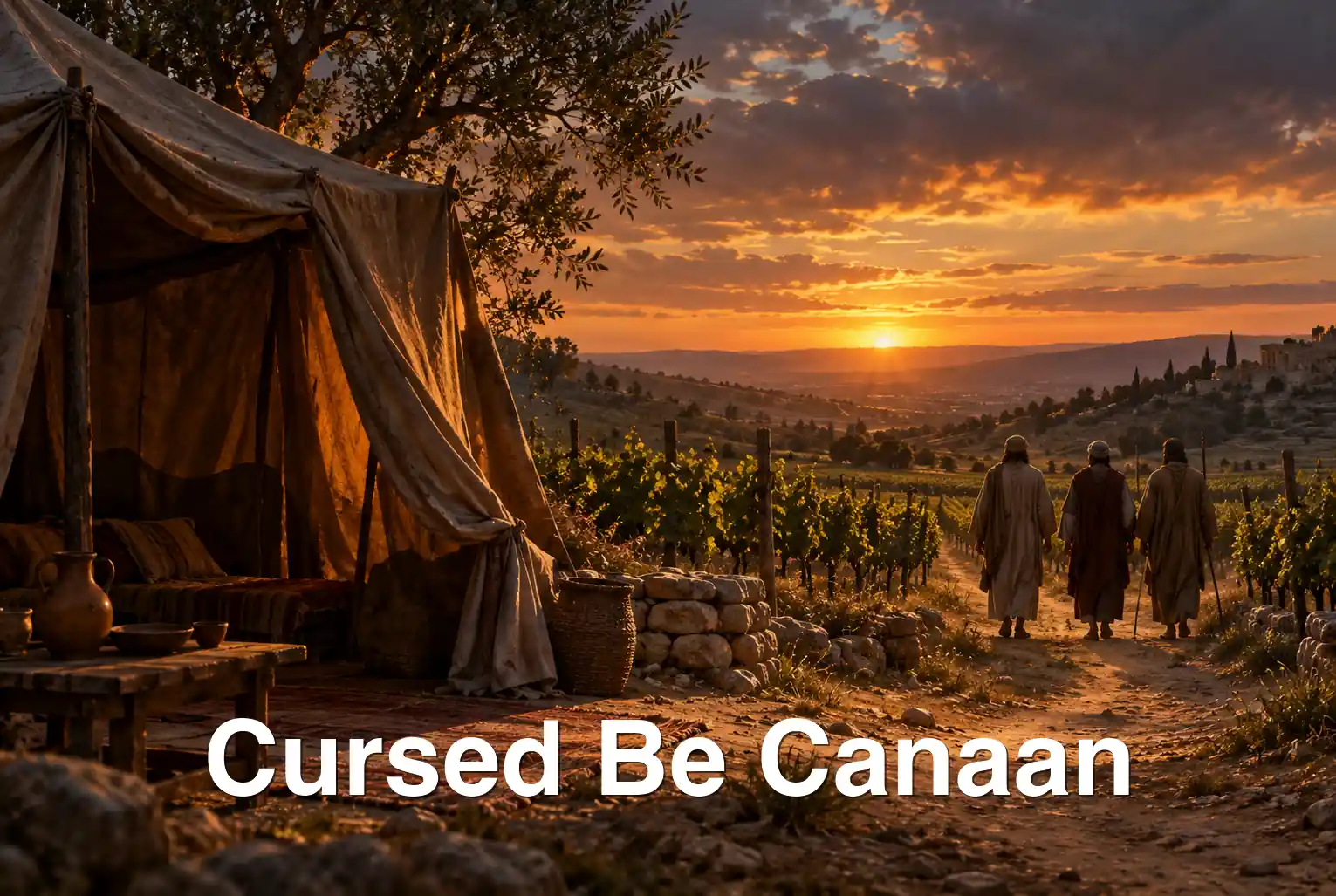
Genesis 9 curses Canaan. It does not curse Ham, it does not curse Ham's other sons, and it does not curse a race. It names three men, Canaan, Shem and Japheth, and every pronoun in the passage is singular. There is no word in it for descendants, nations, families or colour, and nothing in the chapter or in Genesis 10 puts Canaan in Africa. The idea that Noah cursed the dark-skinned peoples of the earth to serve the rest is not in the text. It has to be brought to the text, and this article asks, one claim at a time, what the King James puts in its place.
Here is the passage.
"And the sons of Noah, that went forth of the ark, were Shem, and Ham, and Japheth: and Ham is the father of Canaan. These are the three sons of Noah: and of them was the whole earth overspread. And Noah began to be an husbandman, and he planted a vineyard: And he drank of the wine, and was drunken; and he was uncovered within his tent. And Ham, the father of Canaan, saw the nakedness of his father, and told his two brethren without. And Shem and Japheth took a garment, and laid it upon both their shoulders, and went backward, and covered the nakedness of their father; and their faces were backward, and they saw not their father's nakedness. And Noah awoke from his wine, and knew what his younger son had done unto him. And he said, Cursed be Canaan; a servant of servants shall he be unto his brethren. And he said, Blessed be the LORD God of Shem; and Canaan shall be his servant. God shall enlarge Japheth, and he shall dwell in the tents of Shem; and Canaan shall be his servant." (Genesis 9:18-27 KJV)
Where this passage stands, and where it does not
Genesis 9 is not Paul. It was spoken before Abraham, before the law and before Israel, to a man standing on the far side of the flood, and nothing in it is addressed to the Body of Christ. The doctrine of the Body is Paul's, and it was given to him: Gentiles and Jews are one in Christ, and the middle wall is gone. That doctrine answers the question of how a believer is to regard any man, and it answers it whatever Genesis 9 turns out to say. A believer does not have to win an argument about Noah to know that he may not despise a brother.
But the claim made from Genesis 9 is a claim about what the text says, and it deserves to be tested as one. Many have been taught that this passage fixes a place for whole peoples, and a man who was taught it will not be moved by Paul alone, because he will say that Paul does not cancel what Noah said. So the work here is to read Noah's words as they stand, in the King James, and to let them say what they say. Everything below is read from the English text. No Greek or Hebrew word is made to carry any step of it.
What Ham did
The first thing to settle is the offence, because the curse follows it. The text says three things in a row. Noah drank, was drunken, and "was uncovered within his tent." Ham "saw the nakedness of his father, and told his two brethren without." Shem and Japheth took a garment, laid it on their shoulders, walked in backward, and covered him, "and their faces were backward, and they saw not their father's nakedness."
That last clause fixes what "saw" means in verse 22. The brothers are said not to see their father's nakedness, and the means is given: their faces were turned away. Whatever the brothers did not do, the verse says they avoided it by looking the other way. So the thing Ham did is the thing they declined to do, and it is looking. The brothers then change Noah's condition from uncovered to covered by laying a garment on him, which is a remedy for exposure and for nothing else. And the one exposed is Noah himself: the text gives no wife in the tent and no wife in the chapter.
Two other readings are in circulation, and both turn "saw the nakedness" into the sexual idiom of the law. They are not weak readings, and they get their own section next.
The strongest case for the other readings
Peter Ruckman reads Ham's act as sodomy committed on Noah, and in his Luke commentary states it as fact: "When Noah got drunk and was violated by his son." A second reading, argued in academic journals, holds that Ham had intercourse with Noah's wife, and that Canaan is the fruit of it. Here is the case for them at full strength, and then the answer.
The law uses the phrase sexually. In Leviticus the "nakedness" of a person is what a sexual act uncovers: "And the man that lieth with his father's wife hath uncovered his father's nakedness" (Leviticus 20:11 KJV). Leviticus 20:17 joins the two verbs together: "and see her nakedness, and she see his nakedness; it is a wicked thing... he hath uncovered his sister's nakedness" (Leviticus 20:17 KJV). So "see nakedness" is not a harmless phrase in the Law, and a reader who says it is has not read Leviticus.
The father's nakedness in the law is the father's wife. "The nakedness of thy father's wife shalt thou not uncover: it is thy father's nakedness" (Leviticus 18:8 KJV). On this showing, to see "the nakedness of his father" is to take what belongs to the father, which is his wife, and not to look at his body. The male-male law reads differently ("Thou shalt not lie with mankind, as with womankind," Leviticus 18:22), and it does not use the word at all. That is the weight of the maternal reading, and it is more than the sodomy reading has.
The setting is suggestive. A man is drunk, and sexual sin follows in the same circumstances elsewhere: "And they made their father drink wine that night: and the firstborn went in, and lay with her father" (Genesis 19:33 KJV). And the reading explains what the plain reading cannot, which is why the curse falls on Canaan. If Canaan was the fruit of the act, the choice of Canaan is no longer a puzzle. It would also explain why the passage tells us twice that Ham is "the father of Canaan" (verses 18 and 22).
And it has an answer for verse 23. If "saw the nakedness" means intercourse in verse 22, the brothers "saw not their father's nakedness" in verse 23, and the verse then seems to mean that they did not commit it. Its defenders say the brothers' backward walk plays on the wider sense of the word.
That is the case, and it deserves a straight answer, not a dismissal. Here is mine, from the English alone.
First, the Leviticus evidence shows that the phrase can be sexual. It does not show that it is, here. In Leviticus the sexual sense is carried by the context: a man who takes his sister, or who "lieth with" his father's wife. Genesis 9 has no such context. Ham "saw," and the very next verse uses the same word of the brothers who did not.
Second, verse 23 is not a side objection. It is the best evidence in the chapter for what verse 22 means, because it is the same sentence turned over. The brothers "saw not their father's nakedness," and the text tells us how they managed it: "their faces were backward." A man does not avoid an act of intercourse by turning his head. He avoids a sight. The reading that has to say the brothers' act "plays on" the wider sense of the word needs the word to mean one thing in verse 22 and a different thing in verse 23, and the text gives no sign of the change.
Third, the one exposed is Noah, and the cure is a garment. "He was uncovered within his tent" is said of Noah alone. The brothers lay a garment upon his body and cover him. That answers exposure, and nothing in the text answers any other offence.
Fourth, both readings bring costs the passage does not pay. The wife reading adds a person whom the text last mentions in Genesis 8:18 ("and his wife"), and who is not in the chapter. It must read "Ham is the father of Canaan" in verse 18 as running ahead of the event, and it needs the curse spoken before Canaan could have been born. Its defenders answer that the narrator compressed the story, and that is an admission that the text must be supplemented. Neither reading says how Noah "knew what his younger son had done unto him."
Fifth, "done unto him" does not decide it. The phrase is used of speech and conduct as well as of physical acts, and the verse says nothing that would make it one kind and not another.
What the plain reading cannot do is explain, from the text, why the curse falls on Canaan. I grant that, and I have said above that the text gives no reason. But a reading that explains the choice of Canaan by putting an act into the text that the text does not describe has purchased an answer at the cost of the passage. I would rather have a question the text leaves open than an answer it does not give. If someone produces a verse in Genesis 9 or nearby that turns "saw" in verse 22 into the sexual act, the question is open again. The Leviticus verses are not that verse.
Another idea travels with these readings. Ruckman holds that Ham's sin touched his seed, so that the curse falls on his seed. It depends wholly on the sexual reading, and it falls with it: a telling is not a sin about procreation.
A different claim is that Noah spoke prophetically. Ruckman says, "Noah certainly prophesied," and Osteen calls the words "prophetic declarations concerning his sons and their descendants... just as Jacob later." Look at what the text does with Jacob: "Gather yourselves together, that I may tell you that which shall befall you in the last days" (Genesis 49:1 KJV), and at the end, "All these are the twelve tribes of Israel" (Genesis 49:28 KJV). Jacob's words carry their own label and their own scope. Noah's carry neither: they are introduced with "And he said." The King James never calls Noah a prophet or says he prophesied. The first man it calls a prophet is Abraham (Genesis 20:7), Enoch "prophesied" (Jude 1:14), and what it says of Noah is "a preacher of righteousness" (2 Peter 2:5). Grant the word anyway, and a prophecy still fulfils what it says. This one says Canaan.
Who is cursed
Noah wakes and "knew what his younger son had done unto him." Then he speaks, and the first word out of his mouth is a name that is not the offender's: "Cursed be Canaan; a servant of servants shall he be unto his brethren."
Count what the next two verses contain. There is a blessing on "the LORD God of Shem." There is "God shall enlarge Japheth, and he shall dwell in the tents of Shem." And twice more, "Canaan shall be his servant." Three men are named. Every pronoun that follows is singular: he, his. Ham is not named in the curse. Ham's other sons are not named: Cush, Mizraim and Phut, who stand beside Canaan in the list of Genesis 10:6. And the three verses use no word for seed, children, descendants, generations, nations, families or races.
That silence is not an accident of style. Where Genesis means a promise or a blessing to reach those who come after, it says so in words. God says to Noah and his sons, "I establish my covenant with you, and with your seed after you" (Genesis 9:9 KJV). To Abraham: "And I will establish my covenant between me and thee and thy seed after thee in their generations" (Genesis 17:7 KJV). To Rebekah: "Two nations are in thy womb" (Genesis 25:23 KJV). The vocabulary was available, and in the very chapter where Noah speaks God has just used it. In verses 25 to 27 it is not used.
Two phrases do reach past one man in a natural reading. "God shall enlarge Japheth" and "the tents of Shem" are words that the King James uses of a man and of a people alike, and it is reasonable to ask whether they look forward. But that is an inference, and it should be called one. The text states a curse on a man named Canaan and a blessing on two others. It does not state that the curse and blessing pass to peoples, and it certainly does not state that they pass to a colour.
Why Canaan and not Ham
Everyone who reads the passage asks the question: Ham did it, so why does the curse fall on Canaan? The honest answer from the English text is that the text does not say. It gives Ham's act, it gives Canaan's name in verse 25, and it gives nothing between them. It does not say Canaan was in the tent. It does not say Canaan did something. It does not say the curse was laid on the son as a penalty for the father.
Several answers have been offered, and each can be tested against the English. One is that God had already blessed Ham (Genesis 9:1, "And God blessed Noah and his sons"), so Noah could not curse him. The blessing is a fact in the text. But no verse says that a blessed man cannot be cursed, so this is an inference. Another is that Noah saw in Canaan the same corruption. The text says nothing of Canaan's conduct in this chapter; the later chapters show the Canaanites' wickedness, but they do not tie it to this verse. A third makes the curse fall on Canaan because Canaan was the fruit of Ham's act, but that rests on the sexual reading of verse 22, and it falls with it. Each of these may be argued. None is stated. A reason supplied for a conclusion already held is not the text's reason, and a reader who cannot name the verse it comes from has nothing to adopt.
One more detail bears on who is meant. "His brethren" in verse 25 need not mean only Canaan's brothers: the King James calls Lot Abram's brother when Lot was Abram's brother's son (Genesis 13:8; 14:12, 14), so Shem and Japheth, who are Canaan's uncles and are named in the next two verses, can fall within it.
The sin of the fathers
One more objection sits behind a good deal of argument about this passage. A curse on a son for his father's sin seems to be a thing God does not do, and so, it is said, the curse on Canaan cannot be a curse for Ham's act. The objection has a real basis. "The soul that sinneth, it shall die. The son shall not bear the iniquity of the father" (Ezekiel 18:20 KJV), and the law says the same about courts: "every man shall be put to death for his own sin" (Deuteronomy 24:16 KJV).
But the same book of Moses has God say of Himself that He is "visiting the iniquity of the fathers upon the children unto the third and fourth generation of them that hate me" (Exodus 20:5 KJV). The two statements have to be held together, and they can be. In the second, the ones who receive it are "them that hate me," those who share the iniquity. In the first, the soul that sins is the soul that dies. The most that can be said from Scripture is that God sometimes lets a father's sin fall into the lives of his children, and that He never makes a righteous son guilty of it. Neither tells us why the curse fell on Canaan. For that we are back at the silence of the text.
Where the three lines run
If the curse is to be applied to anyone today, it must be applied by tracing, and Genesis does the tracing for us in chapters 10 and 11. Take the three lines in turn.
Canaan. The line is named: "Canaan begat Sidon his firstborn, and Heth, And the Jebusite, and the Amorite, and the Girgasite" (Genesis 10:15-16 KJV), and on through the Hivite, Arkite, Sinite, Arvadite, Zemarite and Hamathite. Verse 19 gives their border: "from Sidon, as thou comest to Gerar, unto Gaza; as thou goest, unto Sodom, and Gomorrah, and Admah, and Zeboim, even unto Lasha." These are the peoples of the land that God later promised to Abram's seed. The text puts them there and keeps them there. It does not carry Canaan out of that country and into Africa. Egypt is separate: "Israel also came into Egypt; and Jacob sojourned in the land of Ham" (Psalm 105:23 KJV), and Egypt belongs to Mizraim, a different son of Ham named in Genesis 10:6.
Shem. The line to Israel is one branch of Shem and not the whole of it. It runs through Arphaxad, Eber, Peleg and Terah to Abram, and the same Shem is the father of Elam, Asshur and Aram, of Joktan's sons, and, through Abraham, of Midian (Genesis 25:1-2), of Ishmael's twelve princes (Genesis 25:16), and of Edom: "Now these are the generations of Esau, who is Edom" (Genesis 36:1 KJV). Moab and Ammon come by Lot, the son of Haran, Abram's brother (Genesis 11:27; 19:37-38). If Shem's blessing is read as a blessing on Israel, it is a blessing on the Abram, Isaac and Jacob branch, and the other branches of Shem would then have to be accounted for, which Genesis does not do.
Japheth. The text names his seven sons: "Gomer, and Magog, and Madai, and Javan, and Tubal, and Meshech, and Tiras" (Genesis 10:2 KJV), and gives their sons, and then says: "By these were the isles of the Gentiles divided in their lands" (Genesis 10:5 KJV). The isles of the Gentiles, and no more. The text does not make Japheth the father of all Gentiles. Ham's families and Shem's families are also nations: "These are the sons of Ham... in their nations" (Genesis 10:20 KJV), and "These are the sons of Shem... after their nations" (Genesis 10:31 KJV). The chapter closes on all three together: "by these were the nations divided in the earth after the flood" (Genesis 10:32 KJV).
Nor are the lines kept apart in the record itself. Judah "saw there a daughter of a certain Canaanite, whose name was Shuah; and he took her" (Genesis 38:2 KJV), and her sons were Er, Onan and Shelah (Genesis 38:3-5). Esau took Hittite wives (Genesis 26:34). Joseph, who was set over Egypt, was given "Asenath the daughter of Potipherah priest of On" (Genesis 41:45 KJV), and Ephraim and Manasseh are hers. Israel "dwelt among the Canaanites" and "took their daughters to be their wives" (Judges 3:5-6 KJV). And Rahab of Jericho is named in the line of the Lord: "Salmon begat Booz of Rachab" (Matthew 1:5 KJV), though the text does not call her a Canaanite by name.
The result is plain enough. The text traces three men to the places and names it gives and then stops. It traces no people now living to Shem, Ham, Japheth or Canaan. Anyone who says that a particular living race is Canaan's, or Ham's, is not reading the line; he is drawing one the text does not draw, and drawing it in a place the text does not go.
The Canaanites and the command
The one place in Scripture where Canaan's line is treated as a people under sentence is the conquest, and it is worth taking carefully, because it is brought in beside Genesis 9 as the curse's fulfilment.
Begin with what the text says the reason was. It is not colour and it is not Noah's words. God told Abram, "the iniquity of the Amorites is not yet full" (Genesis 15:16 KJV), which says the sentence waited on measure of conduct. Moses told Israel, "for the wickedness of these nations the LORD doth drive them out from before thee" (Deuteronomy 9:4 KJV). Leviticus names the conduct and calls it a defilement: "for in all these the nations are defiled which I cast out before you: And the land is defiled: therefore I do visit the iniquity thereof upon it, and the land itself vomiteth out her inhabitants" (Leviticus 18:24-25 KJV). And when Israel is forbidden to marry among the seven nations, the reason is stated in the same breath: "For they will turn away thy son from following me, that they may serve other gods" (Deuteronomy 7:4 KJV). The same reason is given when Solomon fails (1 Kings 11:2) and when Ezra confronts the people in the land: they had not "separated themselves from the people of the lands, doing according to their abominations" (Ezra 9:1 KJV). The prohibition is about gods. No verse rests it on a bloodline. How these nations could be held to account without the statutes, and why the charge reached them through Noah's own line, is traced in He Hath Not Dealt So With Any Nation: Why Moses Was Never the Nations' Civil Code.
The reason being religious, a person of those peoples who turned to the LORD is a case the text meets with mercy. Rahab is the plain example of one spared: "And Joshua saved Rahab the harlot alive, and her father's household, and all that she had" (Joshua 6:25 KJV). That a convert from those peoples could marry in Israel is an inference, drawn from the reason given in Deuteronomy 7:4 and supported by Rahab and by Ruth. The law's own prohibition names no exception, and I do not claim that it does.
Now the sharper point, on which I read the English differently from Justin Johnson. He teaches that Israel, on entering the land, offered peace to the Canaanites as Deuteronomy 20:10-14 describes, and that those who refused were fought. I do not find that in the passage. Read the verses in order. Verses 10 to 14 give the procedure for a city: offer peace, and if it opens, it serves; if not, besiege it. Verse 15 then closes the procedure with a word that marks its limit: "Thus shalt thou do unto all the cities which are very far off from thee, which are not of the cities of these nations." The procedure is for the far cities. Verse 16 turns with "But": "of the cities of these people, which the LORD thy God doth give thee for an inheritance, thou shalt save alive nothing that breatheth." And verse 17 names them: "the Hittites, and the Amorites, the Canaanites, and the Perizzites, the Hivites, and the Jebusites; as the LORD thy God hath commanded thee." The nations of verse 17 are under the command to utterly destroy, and no offer is prescribed for them. Verse 17 itself points back to a command already given, which is Deuteronomy 7:2: "thou shalt smite them, and utterly destroy them; thou shalt make no covenant with them, nor shew mercy unto them."
This does not make the account harsher than the text. It makes the account the text's own. The reason given in verse 18 is that Israel not be taught their abominations: "That they teach you not to do after all their abominations, which they have done unto their gods; so should ye sin against the LORD your God." What Johnson has right, and what this reading keeps, is that the fault was conduct and not descent. The mercy shown to Rahab and the long warning of Genesis 15:16 both stand. What the text does not give is an offer to the seven nations that they refused, and I will not supply one.
It is worth noticing, too, that peace was sent to Sihon, king of the Amorites: "I sent messengers out of the wilderness of Kedemoth unto Sihon king of Heshbon with words of peace" (Deuteronomy 2:26 KJV). That is before the command of Deuteronomy 7:2, which is spoken later, on the plains of Moab. The text does not say that the command waited on Sihon's answer, and I do not say it. It says that peace was offered to one group, and that the command to destroy came after. Where the text records an offer, it says so, and I have followed it in that and no further.
Servants
The curse says Canaan shall be a servant. The record tells us what became of the Canaanites who remained in the land, and it says it in the plainest way: "when Israel was strong, that they put the Canaanites to tribute, and did not utterly drive them out" (Judges 1:28 KJV; see also Joshua 17:13). At Gibeon, whose men are Hivites by Joshua 9:7, Joshua said, "Now therefore ye are cursed, and there shall none of you be freed from being bondmen, and hewers of wood and drawers of water for the house of my God" (Joshua 9:23 KJV).
Justin Johnson reads Joshua 21:41-45 as the fulfilment, in a sense, of Noah's words: the forty-eight cities of the Levites were Canaanite cities, any Canaanites left in them were servants, and "all came to pass." Part of that is right and part of it asks more of the passage than it says.
The Levites' list does include places where the record elsewhere reports Canaanites, Gezer (Joshua 21:21; 16:10), Gibeon (Joshua 21:17) and Hebron (Joshua 21:11), and Gibeon is the closest match in the book to "Blessed be the LORD God of Shem; and Canaan shall be his servant," since its men served "for the altar of the LORD" (Joshua 9:27). But Joshua 21:41-42 names no Canaanite and no servant. The words "all came to pass" are said of "any good thing which the LORD had spoken unto the house of Israel" (Joshua 21:45 KJV), and Noah's words are introduced with "And he said," and are not given as a word of the LORD to Israel. The same book records what was left: "there remaineth yet very much land to be possessed" (Joshua 13:1 KJV), and the Jebusites, the Canaanites of Gezer, and the nations the LORD left "to prove Israel" (Joshua 15:63; 16:10; Judges 3:1-4). And no verse after Genesis 9 repeats "cursed be Canaan," "servant of servants" or "the LORD God of Shem," or says that Joshua or the judges fulfilled them. So the history matches Noah's words in places, and the link between them is an inference. It is a reasonable one, and it leaves Johnson's conclusion standing: the words name Canaan, no later verse extends them, and nothing in them is a charter for any age after.
What the text does show is the shape of the thing: a people under tribute, in the land, within the reach of Israel. It is not the shape of a slave trade in other men from other continents, and nothing in Genesis 9 can be made to authorize one.
What has been built on it
If the curse is not on a race, a good deal is left without a foundation. It is worth seeing how much has been placed on it, because the weight shows the size of the step the text does not take.
Ruckman states the doctrine for today in plain terms: "Genesis 9:25 is Christian, New Testament doctrine, applicable in the twentieth and twenty-first century." He puts "Ham" where the verse puts Canaan, and writes, in a 1989 bulletin, that "the descendants of HAM will serve Japeth and Shem." He then applies it to individual persons. Check the verses he cites.
- The Ethiopian eunuch is called, by him, a "servant of servants." The text says: "a man of Ethiopia, an eunuch of great authority under Candace queen of the Ethiopians, who had the charge of all her treasure" (Acts 8:27 KJV). Ham and Canaan are not in the verse.
- Simon the Cyrenian, he calls a member of "a race cursed by God." The text says only, "they compel one Simon a Cyrenian" (Mark 15:21 KJV).
- Hagar he calls a "servant of servants." The text says she was "an handmaid, an Egyptian" (Genesis 16:1 KJV). Egypt is the land of Mizraim, and Canaan is not Mizraim.
- A policy of which he disapproves "has the smell about it of JAPHETH RUNNING HAM." Genesis 9:27 says that Canaan shall be Japheth's servant, and Ham is not in the verse.
In his Hebrews and Revelation commentaries the scheme grows larger. He writes that Japheth is "the killer," the one "with the blue eyes," with "no spiritual discernment," while Shem is the spiritual one. Cush, he says, is "a full-blooded African black man," the Antichrist "a Hamitic Jew," and Judas a "Hamitic Syrian-Jew" from Kerioth, a place the New Testament never mentions. He says the name Ham means "burnt black." The text of Genesis 10 gives Cush's name and his son Nimrod's (Genesis 10:8) and gives no colour for either. The King James gives no meaning for the name Ham. Judas is called "Judas Iscariot the son of Simon" (John 6:71 KJV), and no verse calls him Hamitic, Syrian or anything else. He states these as fact, and no verse is under them.
Osteen is a different case, and he should be treated as one. He reads Ham's act as dishonour, as this article does ("What did Ham do to his father? He greatly dishonored him"), citing Proverbs 30:17. He teaches that in Christ all believers are one (Galatians 3:27-28), and that lineage today makes no difference to a man's standing before God. He asks of his own reading of the prophecy: "How could they [reach to our day] when very few have a family tree that is strictly of Shem, Ham, or Japheth?" And where Ruckman states the extension flat, Osteen softens it to "the general course of the descendants... While there have been exceptions."
But his notes also carry the step the text does not take. His headings give the continents and colours: "North into Europe (White)," "South into Africa (Black)," "East into Asia (Yellow)." Not one of those words is in Genesis 10. The text gives names, lands, tongues and nations (Genesis 10:5, 20, 31). He writes that the curse "reached beyond Canaan to his descendants," and follows it with Nimrod. Nimrod is the son of Cush (Genesis 10:8), and Cush's line is not Canaan's (Genesis 10:6, 15-19). The curse of verse 25 names Canaan.
Every one of these applications rests on the same two steps. The first goes from Canaan to Ham, and the second goes from Ham to Africa, and the words of Genesis 9:25-27 make neither. The steps cannot be defended from the verse, and a doctrine that depends on them is not Noah's.
What the Body of Christ is told
All of that is the reading of Genesis. For a believer in this dispensation the matter does not rest on Genesis. Paul, in the dispensation of the grace of God given to him, writes: "For he is our peace, who hath made both one, and hath broken down the middle wall of partition between us" (Ephesians 2:14 KJV). He writes of the new man, "Where there is neither Greek nor Jew, circumcision nor uncircumcision, Barbarian, Scythian, bond nor free: but Christ is all, and in all" (Colossians 3:11 KJV). And: "For there is no difference between the Jew and the Greek: for the same Lord over all is rich unto all that call upon him" (Romans 10:12 KJV).
At Athens, Paul said it of all mankind: God "hath made of one blood all nations of men for to dwell on all the face of the earth" (Acts 17:26 KJV). The whole earth was overspread from the three sons who went out of the ark (Genesis 9:19), and Paul's "one blood" leaves no man outside it.
The position of the Body does not wait on how Genesis 9 is read, and the plain reading of Genesis 9 does not collide with it. The text curses a man named Canaan for reasons it does not give. It blesses two others. It traces three lines to named places and traces no living people to any of them. And it says nothing at all about a race.
Where the text is silent, say so, and stop. Whoever answers a question the verses never asked, and then teaches the answer as though it were the verse, has added to Noah's words.
© 2026 Edward R. Cross





Comments
No comments yet. Be the first to share your thoughts.
Leave a comment