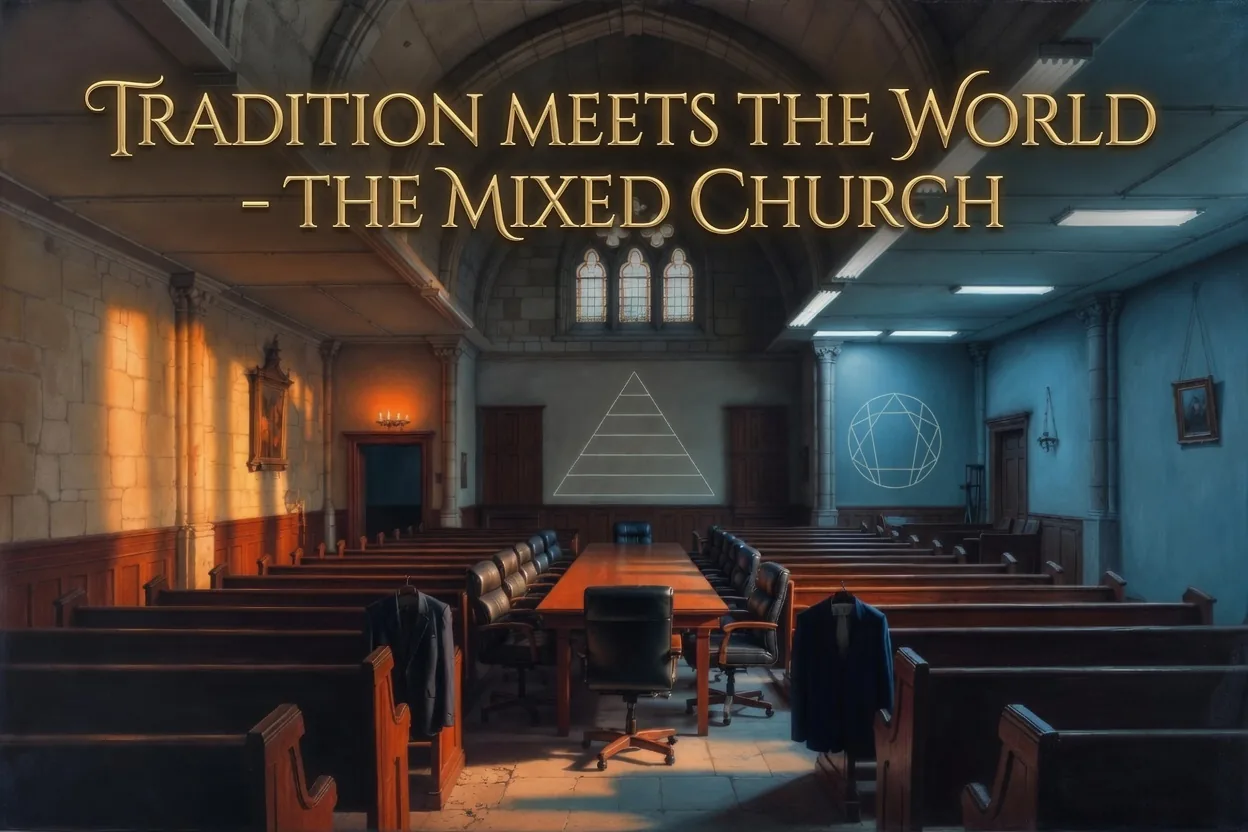
"Beware lest any man spoil you through philosophy and vain deceit, after the tradition of men, after the rudiments of the world, and not after Christ." (Colossians 2:8 KJV)
The apostle Paul warned the church at Colosse — and through them, every member of the Body of Christ in every age — that the great danger to sound doctrine would not always come from outside the church walls. It would come wrapped in the language of spirituality, ministry, and personal growth. It would promise relevance, effectiveness, and deeper self-understanding. And it would arrive, as Paul put it, "after the tradition of men, after the rudiments of the world." That warning has proven prophetic beyond measure.
Over the past century, and with accelerating speed in the last five decades, the institutional church in America has borrowed so heavily from secular philosophy, corporate management theory, developmental psychology, personality science, and consumer marketing that in many congregations it has become genuinely difficult to distinguish the programs of the church from those of a well-funded community center or a mid-sized corporation. The language has been baptized, the Bible verses attached as proof-texts, and the worldly content delivered from the pulpit with full pastoral authority.
This article examines the most prominent of these intrusions: the spiritualized personality and gifts tests borrowed from corporate human-resources practice, Tim LaHaye's popularization of the ancient pagan theory of the four temperaments, the transformation of children's ministry into an entertainment and consumer-parent program, the importation of business-management models into church leadership, the infiltration of Maslow's secular hierarchy of needs into pastoral ministry, the spread of the Enneagram with its occult origins, the therapy culture that has replaced Scripture with the language of psychology, and the well-intentioned but doctrinally deficient reaction of the nouthetic counseling movement. The aim is not merely to criticize, but to call the church back to what Paul declared sufficient:
"All scripture is given by inspiration of God, and is profitable for doctrine, for reproof, for correction, for instruction in righteousness: That the man of God may be perfect, throughly furnished unto all good works." (2 Timothy 3:16-17 KJV)
I. The Spiritual Gifts Test Industry: Borrowed from the Boardroom
The Rise of the Spiritual Gifts Inventory
Walk into the membership class of almost any evangelical or charismatic church in America today and you will likely be handed a questionnaire. It may be called a Spiritual Gifts Inventory, a Ministry Profile, or a SHAPE Assessment. You will be asked whether you prefer working with people or with ideas, whether you are more comfortable in front of a crowd or behind the scenes, whether you feel energized or drained by social interaction. From your answers, a computerized or printed report will tell you which spiritual gifts God has given you and which ministry slot in the church you should fill.
This practice has become so normalized that few church members pause to ask where it came from. The answer is not the New Testament. It came from the boardroom and the corporate human-resources department.
The Myers-Briggs Connection
The foundational tool behind most modern spiritual gifts assessments is the Myers-Briggs Type Indicator (MBTI), developed by Katharine Cook Briggs and her daughter Isabel Briggs Myers during the 1940s. The MBTI was itself drawn from the psychological theories of Carl Gustav Jung, whose model of personality types was rooted in his broader philosophical and quasi-spiritual worldview — a worldview that included occult interests, a rejection of orthodox Christianity, and the concept of the collective unconscious. Jung drew no distinction between Christian spirituality and Eastern mysticism; to him, all religious experience pointed to the same archetypal inner world.
The MBTI proposes four binary dichotomies — introversion/extroversion, sensing/intuition, thinking/feeling, and judging/perceiving — yielding sixteen personality types. Corporations adopted it enthusiastically in the latter half of the twentieth century to guide hiring decisions, team formation, and leadership development. It was embraced not because it is scientifically validated (repeated studies have shown it is not reliably reproducible, with individuals often testing as a different type upon retaking it weeks later) but because it gave managers a tidy framework for sorting people.
The church followed the corporation's lead. Rick Warren's Saddleback Community Church popularized the SHAPE profile — an acrostic standing for Spiritual gifts, Heart, Abilities, Personality, and Experiences — which explicitly incorporates personality type assessment alongside a spiritual gifts inventory. PLACE Ministries, used in thousands of churches across the country, builds its ministry placement system around the DISC personality model — another corporate assessment tool developed for business management. Platforms marketed to churches now routinely offer MBTI, DISC, the Enneagram, and StrengthsFinder alongside their spiritual gifts surveys, presenting secular personality science and Holy Spirit gifts as two sides of the same coin.
What the Bible Actually Says About Gifts
The Scripture nowhere suggests that a believer should discover his or her spiritual gifts by answering a self-assessment questionnaire. The gifts of the Spirit described in the epistles of Paul were not discovered through introspection. They were given sovereignly by God and recognized through operation within the body.
"Now there are diversities of gifts, but the same Spirit. And there are differences of administrations, but the same Lord. And there are diversities of operations, but it is the same God which worketh all in all." (1 Corinthians 12:4-6 KJV)
Importantly, many of the gifts listed in 1 Corinthians 12 — tongues, prophecy, healing, miracles — were sign gifts belonging to Israel's prophetic program, operative during the Acts period as God confirmed the transition of His purposes. These gifts have ceased. Paul's later prison epistles — Ephesians, Philippians, Colossians, and Philemon — written after the close of the Acts period, make no mention of tongues or miraculous healing as ongoing gifts. The spiritual gifts inventories used in churches today regularly include these ceased gifts among their options, as though any believer might discover by questionnaire that God has given them the gift of healing or prophecy. This is not only borrowed from secular personality science; it is doctrinally confused at its foundation.
The practical problem of the gifts-test approach runs even deeper than the doctrinal confusion over which gifts remain. When a church assigns members to ministry roles based on a personality-type report, it has substituted self-report psychology for the genuine discernment of the body and the leading of God through His word. A person who scores high on an "administration" profile may be put in a leadership position not because he has demonstrated godliness and spiritual maturity — the actual biblical qualifications — but because he circled the right answers on a form. Paul's qualifications for church leaders in 1 Timothy 3 and Titus 1 say nothing about personality type. They speak of character, conduct, and doctrine.
II. Tim LaHaye and the Four Temperaments: Ancient Paganism in a Christian Suit
LaHaye's Enormously Influential Books
Few Christian authors of the twentieth century shaped the thinking of ordinary church members more comprehensively than Tim LaHaye. Known today primarily for the Left Behind novels, LaHaye produced an even more widely distributed body of work on human temperament and personality — most notably Spirit-Controlled Temperament (1966), Transformed Temperaments (1971), and Why You Act the Way You Do (1984). These books sold millions of copies and became staples of Sunday school classes, small groups, and counseling ministries across the English-speaking evangelical world. Their central claim was that every person is born with one of four basic temperaments — Sanguine, Choleric, Melancholy, and Phlegmatic — and that understanding one's temperament, submitted to the Holy Spirit, is the key to Christian character and effective service.
The problem is that LaHaye did not derive this framework from the Bible. He took it from ancient pagan medicine and philosophy, gave it a Christian veneer, and presented it to millions of believers as a biblical tool for self-understanding.
The Pagan Roots: Hippocrates and the Four Humors
The theory of the four temperaments predates Christianity by five centuries. It originated with the Greek physician Hippocrates (c. 460–370 BC) and was developed further by the Roman physician Galen. The theory held that the human body contained four fluids — blood, yellow bile, black bile, and phlegm — and that a person's dominant fluid determined his personality. An excess of blood produced a Sanguine personality (cheerful, sociable, impulsive). Excess yellow bile produced a Choleric (ambitious, aggressive, hot-tempered). Excess black bile produced a Melancholic (analytical, anxious, perfectionistic). Excess phlegm produced a Phlegmatic (calm, slow, reliable). These were not metaphors or spiritual categories; they were statements about body chemistry as understood by pagan medicine.
The psychiatric and psychological establishments abandoned the four humors during the Middle Ages as anatomical knowledge advanced. The framework was not only unscientific but unfalsifiable — there was no way to measure bile ratios or verify that personality flowed from body fluids. It persisted only as a folk theory, largely ignored by serious researchers, until the 1960s, when it experienced a remarkable revival — not in laboratories, but in Christian publishing houses.
LaHaye repackaged the four humors as God-given temperaments, assigned biblical characters to each type (Peter as Sanguine, Paul as Choleric, Moses as Melancholy, Abraham as Phlegmatic), and argued that the Holy Spirit sanctifies each temperament's natural weaknesses into strengths. This is a clever synthesis, but it has no biblical warrant. The Scripture never describes human personality in terms of these four categories. The assignment of biblical figures to temperament types is entirely the author's speculation, not exegesis. Paul does not describe himself as Choleric; Moses does not describe himself as Melancholy. These labels are placed on them from the outside, according to a pre-Christian pagan framework.
The Danger of Pre-Judging
Beyond the question of origins, the practical effect of the temperament system in church life has been the quiet introduction of a form of categorical pre-judgment. When a church member or pastor is identified as a particular temperament type, expectations are set in advance. The Phlegmatic is expected to be passive and resistant to change. The Melancholy is expected to be critical and prone to depression. The Choleric is expected to be domineering and impatient. These labels become self-fulfilling and, more dangerously, become excuses. Rather than confronting sin as sin and calling for repentance and growth through the word of God, a pastor trained in LaHaye's system is tempted to say, "That's just his Choleric temperament — you have to understand that about him."
Paul does not give Timothy or Titus any such framework for evaluating or managing church members. He gives them doctrine, reproof, correction, and instruction in righteousness — the sufficient tools of Scripture. The temperament system substitutes a pagan personality taxonomy for the living and powerful word of God. It tells the believer that the fundamental question about himself is not "Am I walking after the spirit or the flesh?" but rather "What is my temperament type?" — and that is precisely the wrong question.
"This I say then, Walk in the Spirit, and ye shall not fulfil the lust of the flesh." (Galatians 5:16 KJV)
III. Children's Ministry: When the Church Became a Playground
The Sunday School's Honest Beginning
The children's ministry movement in its modern American form has roots that are far older than the entertainment model that now dominates. The Sunday school concept originated in England in the 1780s with Robert Raikes, who organized classes for poor working children on their one free day. The aim was literacy and basic moral instruction — reading the Bible and learning to behave. In nineteenth-century America, Sunday school grew into the primary means of evangelism, with as many as eighty percent of new church members reporting they had first been introduced to their church through Sunday school.
Through the first half of the twentieth century, Sunday school remained primarily a teaching institution. Children were expected to sit, listen, memorize Scripture, and learn doctrine. The model was educational, not theatrical.
The Shift Toward Entertainment
Everything changed in the 1960s. As television transformed children's expectations of what engagement should look like — fast-paced, colorful, amusing, and effortlessly consumable — Christian publishers and church programmers followed the culture rather than leading it. Developmental psychology, borrowed wholesale from secular education theory, became the guiding framework for children's curriculum design. Publishers began prioritizing what children wanted over what children needed. Age-appropriate learning stages, sensory engagement, and emotional connection replaced theological content as the primary design criteria.
Under the influence of the church growth movement in the 1970s, 1980s, and 1990s, children's ministry crossed a decisive line. The stated goal shifted from teaching doctrine to making church attractive to families. The Sunday school hour became "Kids Church," complete with puppet shows, skits, video clips, prize giveaways, and loud music. One researcher described the trajectory accurately: children's ministries became less like the formation-focused Fred Rogers and more like the showman Walt Disney. The underlying message to families was clear — your children will have so much fun here that they will want to come back.
The Soccer-Mom Mentality and the Consumer Church
The entertainment model of children's ministry both fed and was fed by a larger cultural shift in American family life: the emergence of what has been called the soccer-mom mentality. The term describes a parent whose identity and schedule revolve around the activities and achievements of her children. Youth sports leagues, music lessons, academic enrichment programs, dance recitals, and school extracurriculars command total family loyalty. These activities are non-negotiable; they structure the week, the weekend, and the family budget.
The church recognized this cultural reality and, rather than challenging it, accommodated it. If the family was organized around the children's schedule, then the church had to compete for a place on that schedule. The solution was to make the children's program so impressive — so well-staffed, so entertainingly designed, so emotionally engaging — that parents would choose church over the soccer tournament. The implicit concession was that church attendance had become a consumer choice to be marketed to parents whose primary concern was whether their children would enjoy it.
The fruit of this approach is visible everywhere. It is now considered unremarkable for a Christian family to skip Sunday worship for a youth sports tournament, reasoning that the children's enjoyment and team commitment outweigh corporate worship with the Body of Christ. Church attendance is one option among many on the family's menu of weekend activities, and the church itself has trained families to think of it that way by spending decades positioning itself as a provider of quality programming rather than as the assembly of God's people around His word.
There is a deeper problem still. When children's ministry is built around entertainment and emotional experience, children grow up associating church with fun rather than with truth. When the fun stops — as it inevitably does when adolescence arrives and the world offers far more exciting entertainment than any church can match — there is no doctrinal foundation to hold them. The epidemic of teenagers leaving the church after confirmation or upon graduating high school is not a coincidence; it is the predictable harvest of a program that never prioritized teaching them the word of God.
Paul's instruction to fathers in the present dispensation of grace is plain and direct:
"And, ye fathers, provoke not your children to wrath: but bring them up in the nurture and admonition of the Lord." (Ephesians 6:4 KJV)
The responsibility for bringing children up in the nurture and admonition of the Lord belongs to parents — not to a children's pastor with a budget for theatrical props. The modern children's ministry model has, in practice, transferred that responsibility from parents to professionals, relieving parents of their God-given duty while simultaneously creating a consumer relationship between the family and the church.
IV. The Church Growth Machine: Peter Drucker and Corporate Christianity
The Father of the Movement
No single figure has shaped the philosophy of the modern American megachurch more profoundly than Peter Drucker — a fact that should give every serious Christian pause, because Drucker was not a believer in any meaningful biblical sense. Drucker was a management consultant and author whose ideas about organizational effectiveness, leadership, and customer-focused strategy transformed American business in the latter half of the twentieth century. By his own admission, he was not a "born-again Christian" — that phrase is Drucker's own self-description, not our Pauline language for salvation; "born again" belongs to John 3 and Israel's prophetic program, not to the gospel of the grace of God revealed to Paul. But whatever terminology one uses, Drucker had not trusted in the death, burial, and resurrection of Christ. His intellectual influences were not Paul's epistles but the philosopher Søren Kierkegaard, Zen Buddhism, Confucianism, and the Jewish philosopher Martin Buber.
In the 1980s, Drucker began mentoring evangelical leaders Rick Warren of Saddleback Community Church and Bill Hybels of Willow Creek Community Church in the application of his management theories to church governance. He also mentored Bob Buford, founder of Leadership Network in Dallas, which has spent decades integrating Drucker's ideas into church leadership training programs serving thousands of pastors across the country.
Drucker's core counsel to churches was essentially the same as his counsel to corporations: identify your customer, determine what the customer needs and wants, and deliver it. In a 1989 interview, he stated plainly that churches should deliver what the market demands — and added, revealingly, that they should do so without worrying too much about doctrine or theology. Doctrine, in Drucker's framework, was an internal matter that should not interfere with the organization's effectiveness in serving its market.
The Corporation Replaces the Assembly
The application of this philosophy to church life has been thorough and pervasive. The seeker-sensitive church model assumes that the same leadership and management principles that work for a profit-centered corporation can be applied to running a church. The pastor becomes the CEO, the elder board becomes the board of directors, the congregation becomes the customer base, and the church's "product" — worship, programs, and community — must be designed to satisfy consumer preferences.
Rick Warren's The Purpose Driven Church has been described by critics as a guidebook that could be used in a secular business setting with no significant modification — simply substituting the word "business" for "church" throughout. This is not a coincidence; it reflects the thoroughness with which corporate management theory has been imported into the pastoral calling.
The language of corporate management is now embedded in the church's vocabulary. Churches speak of their "vision statement" and "strategic plan,"* of "branding" and "target demographics," of *"scaling" and "leadership pipelines." Pastoral ministry is evaluated by attendance metrics, giving trends, and volunteer engagement scores. A pastor who is not growing his congregation numerically is considered to be failing — not because the Scripture says so, but because the corporate model demands it.
Paul gave Timothy a very different job description:
"Preach the word; be instant in season, out of season; reprove, rebuke, exhort with all longsuffering and doctrine. For the time will come when they will not endure sound doctrine; but after their own lusts shall they heap to themselves teachers, having itching ears." (2 Timothy 4:2-3 KJV)
The pastor who is managing a corporation to satisfy consumer demand is not the pastor Paul describes. And the congregation that shops for a church offering the best programs, the most comfortable atmosphere, and the most engaging entertainment is precisely the congregation with itching ears — heaping to themselves teachers who will tell them what they want to hear.
V. Maslow in the Pulpit: The Hierarchy of Needs Replaces the Gospel
The Secular Theory
Abraham Maslow was a twentieth-century psychologist whose 1943 paper introduced what he called the hierarchy of needs — a pyramid-shaped model proposing that human beings are motivated by a progression of needs, from the most basic physiological requirements (food, water, shelter) through safety, love and belonging, and esteem, up to the pinnacle of self-actualization: the full development of one's potential and the realization of one's authentic self. Maslow's framework was explicitly humanistic — it located the highest human goal in the development of the self, with no reference to God, sin, redemption, or eternity.
Maslow's hierarchy has been widely criticized even within secular psychology as lacking empirical support. Studies have repeatedly failed to confirm that human motivation proceeds in a neat hierarchical sequence. The model is unfalsifiable in practice and reflects the assumptions of mid-twentieth century American individualism more than it reflects universal human nature. Nevertheless, it became one of the most-cited frameworks in business management training and has proven remarkably tenacious in the popular imagination.
Maslow in the Sanctuary
The influence of Maslow's hierarchy on church ministry has been documented. Research has found that approximately one in six senior pastors, unprompted and in their own words, referred either specifically to Maslow's hierarchy or to its core idea when describing how their church decides to structure its outreach and ministry. The premise is that physical and social needs must be met before people can respond to spiritual truth — and that the church's first task is therefore to address felt needs.
The practical result is a church that leads with programs addressing felt needs — financial counseling, marriage enrichment, addiction recovery, career coaching, parenting classes — and treats the gospel as a secondary offering for those who have been sufficiently won over by the practical benefits. The logic sounds compassionate. The problem is that it is fundamentally backwards. The Scripture does not present sinners as people who need their felt needs met before they can receive the gospel. It presents sinners as spiritually dead — incapable of meeting their own deepest need — and the gospel as the power of God unto salvation precisely because it addresses the need that lies beneath all other needs.
"For I am not ashamed of the gospel of Christ: for it is the power of God unto salvation to every one that believeth." (Romans 1:16 KJV)
At its worst, the Maslovian framework in the church produces the prosperity gospel — the teaching that God's primary purpose is to meet your physical, financial, and emotional needs, and that faith is the mechanism for ascending Maslow's pyramid. Self-actualization is rebranded as "becoming all God created you to be." The pinnacle of Christian experience becomes not conformity to Christ through suffering and self-denial — "I am crucified with Christ: nevertheless I live; yet not I, but Christ liveth in me" (Galatians 2:20) — but the fulfillment of personal potential and the satisfaction of individual destiny. This is Maslow with a cross hung on it.
VI. The Enneagram: Occult Mysticism at the Retreat Center
Origins in the Occult
The Enneagram is a nine-pointed geometric figure assigned to nine personality types, and it has spread with remarkable speed through evangelical and particularly Catholic Christian communities over the past two decades. Books on the Christian Enneagram fill shelves at Christian bookstores. Church small groups study it together. Retreat centers offer Enneagram workshops. Many pastors have taught it from the pulpit as a spiritual formation tool. Almost none of them have investigated — or disclosed to their congregations — where it actually came from.
The Enneagram's modern form traces to two men of the early twentieth century: the Russian occultist Georges Gurdjieff and his student P.D. Ouspensky, who claimed the nine-pointed figure encoded esoteric cosmic knowledge. The personality typing system attached to the figure was developed by Óscar Ichazo, a Bolivian-born occultist who claimed that the archangel Metatron taught him the Enneagram while he was under the influence of mescaline. His student Claudio Naranjo, a psychiatrist, further developed the personality typology — and acknowledged that his insights into the nine types came through automatic writing, a practice central to spiritism and the occult, in which a person allows a spiritual entity to guide their hand.
These origins are not disputed by scholars of the Enneagram; they are simply ignored or downplayed by Christian teachers who have found the framework useful. The system was introduced to Christian spiritual direction circles primarily through Jesuit retreat centers in the 1970s, and from there it spread into evangelical churches. The Christian repackaging involves attaching Bible verses to each type and presenting the nine-type system as a tool for spiritual growth and self-understanding.
The problem is not merely historical contamination. The Enneagram's philosophical core — that each human being is one of nine essential types, that the path to wholeness lies in understanding your type and moving toward its "integration point" — is a system of knowledge about human nature derived from occult revelation, not from the word of God. Attaching Bible verses to it does not sanctify it any more than dipping a pagan idol in holy water transforms it into a Christian image.
"And have no fellowship with the unfruitful works of darkness, but rather reprove them." (Ephesians 5:11 KJV)
VII. The Therapy Couch in the Sanctuary: Psychology Replaces Scripture
The Infiltration of Freud and James
The field of pastoral counseling in America was reshaped in the early twentieth century by the influence of Sigmund Freud and William James. Seminary training began incorporating psychoanalytic frameworks for understanding human behavior. The clinical models of medicine and social work became the template for how pastors were trained to help troubled members of their congregations. Howard Clinebell's widely used textbook Basic Types of Pastoral Counseling (1966) accelerated the shift, recommending that pastors adopt short-term counseling methods drawn from secular therapeutic practice.
The consequences have been far-reaching. An entire generation of pastors has been trained to think of human problems primarily in psychological categories — trauma, codependency, low self-esteem, attachment disorders, emotional wounds — rather than in biblical categories: sin, unbelief, carnality, and the spiritual consequences of walking after the flesh rather than the Spirit.
The Language of Therapy Replaces the Language of Scripture
The therapeutic vocabulary has now so thoroughly colonized the church's language that many Christians cannot articulate their personal struggles except in psychological terms. A man who lies habitually is not a liar in need of repentance; he is someone with "trust issues rooted in childhood trauma." A woman who is consumed with bitterness is not told to "Let all bitterness, and wrath, and anger, and clamour, and evil speaking, be put away from you, with all malice" (Ephesians 4:31); she is encouraged to "process her pain" and "do her healing work." The category of sin has been effectively abolished and replaced by the category of woundedness.
This shift has produced churches full of people who describe themselves as on a journey of healing rather than as believers called to walk in the Spirit and put off the works of the flesh. It has produced a counseling industry within Christianity — Christian psychology, faith-based therapy, biblical counseling (which in many of its forms is conventional therapy with Scripture verses attached) — that has replaced the straightforward application of the word of God with hybrid models that owe more to Freud, Carl Rogers, or Aaron Beck than to Paul.
One writer has identified the problem with piercing clarity: the secular therapeutic culture communicates a godless alternative — living in the presence of a therapist, under the authority of that therapist, to feel better and be a healthier you. When the church adopts this model uncritically, it replaces the authority of Scripture and the sufficiency of Christ with the authority of the clinician and the goal of psychological wellness.
Paul's description of the believer's armor leaves no room for any supplement from secular science:
"And take the helmet of salvation, and the sword of the Spirit, which is the word of God." (Ephesians 6:17 KJV)
The word of God is the Spirit's sword. When the church trades it for the therapeutic tools of Freud, Rogers, or Beck, it has gone into battle unarmed by its own choice. The Scripture does not need to be supplemented with clinical psychology to accomplish what it promises. When pastors and teachers believe and teach that the word of God is sufficient, they will find that it is. When they conclude — even with good intentions — that some human problems are too complex for Scripture alone and require the tools of secular therapeutic science, they have, in practice if not in doctrine, denied the sufficiency of God's word.
Nouthetic Counseling: Right Instinct, Wrong Foundation
Not everyone in the evangelical world accepted the drift into secular therapy without protest. In 1970, Reformed theologian Jay Adams published Competent to Counsel, a sharp and largely warranted attack on the church's capitulation to Freudian and Rogerian psychology. Adams argued that the vast majority of what passes for psychological disorder is in reality the fruit of sin — and that the Scripture, properly applied, is fully adequate to address it. He called his approach nouthetic counseling, built around the biblical practice of confronting and admonishing believers with the word of God rather than referring them to a therapist's couch. The movement later rebranded itself as "biblical counseling," which has become a significant force in conservative evangelical churches.
Adams was right about the central problem. The church had abandoned its own tools in favor of the world's, and the result was a generation of Christians more fluent in therapy-speak than in Scripture. His instinct to return to the Bible, to treat sin as sin rather than as a diagnosable mental health condition, was sound and necessary. To his credit, he recognized what many pastors refused to see: that secular psychology is not a neutral science but a humanistic worldview dressed in clinical language, fundamentally at odds with the word of God.
The limitations of nouthetic counseling, however, are significant — and they matter particularly to those who take right division seriously. Adams built his counseling framework on a Reformed Calvinist theological foundation, shaped by the presuppositional philosophy of Cornelius Van Til. This Reformed framework carries with it covenant theology's core assumption: that all of Scripture speaks directly and equally to all believers in all ages. That assumption is the precise error that right division is designed to correct. Adams drew his counseling directives from the Psalms, the Proverbs, the Gospels, and Paul's epistles interchangeably, without distinguishing between what was written to and for Israel and what was revealed to Paul for the Body of Christ. A system that quotes Matthew, Deuteronomy, and Romans as though they carry identical authority for the church today is not rightly dividing the word of truth — however sincerely it intends to be "biblical."
Furthermore, Adams's working assumption that nearly every personal and emotional problem is the result of personal sin, while correct in its ultimate premise that all suffering traces to the fallen condition, can be mechanically applied in ways that cause genuine harm. When a person who has suffered real abuse is told that her ongoing distress is primarily the result of her own sinful response to it, the problem is not that Scripture is being applied but that it is being applied without the grace, wisdom, and doctrinal precision that Paul's epistles bring to the question of human suffering. Paul does not treat suffering as simply a by-product of personal sin. He speaks of suffering as something Christ's servants share with him:
"That I may know him, and the power of his resurrection, and the fellowship of his sufferings, being made conformable unto his death." (Philippians 3:10 KJV)
The choice for the church is not between secular therapy on one side and nouthetic confrontation on the other. Both frameworks, for all their differences, share a common failure: neither is built on Paul's epistles rightly divided, applied in the grace that marks the present dispensation, and grounded in the believer's complete and unconditional position in Christ. That is the only foundation that neither borrows from the world nor drives the wounded away.
VIII. Further Infiltrations: A Catalogue of the World in the Church
Positive Psychology and the Self-Esteem Gospel
The positive psychology movement, associated with figures like Martin Seligman and popularized in the 1990s and 2000s, focuses on human strengths, happiness, and flourishing. Its central premise is that psychological well-being comes from identifying and amplifying one's personal strengths and cultivating positive emotions. This framework has entered the church through the widespread emphasis on self-esteem, positive confession, and the redefinition of faith as optimism about one's own potential and God's commitment to one's personal happiness.
Robert Schuller of the Crystal Cathedral was among the earliest and most explicit in importing the self-esteem gospel into evangelical preaching. His argument, drawn directly from secular humanistic psychology, was that the greatest human need is not forgiveness of sin but "self-esteem" — a sense of personal worth and dignity. This redefinition of the human condition has filtered into countless churches whose pastors would never claim Schuller as an influence, but whose preaching consistently emphasizes what God has done for your self-image over what God has done for your sin.
Social Justice and Liberation Theology
The social justice movement, in its contemporary form, applies to the church a framework largely derived from academic Marxist analysis — specifically the critical theory developed at the Frankfurt School and its descendants in critical race theory, intersectionality, and liberation theology. These frameworks divide human society into oppressor and oppressed groups, define sin primarily in terms of systemic injustice rather than individual rebellion against God, and locate salvation in social liberation rather than in the finished work of Christ on the cross.
When these categories enter the church, the gospel is quietly transformed from the good news of personal justification by faith in Christ's death and resurrection into a call to social transformation. Paul's statement that "there is neither Jew nor Greek, there is neither bond nor free, there is neither male nor female: for ye are all one in Christ Jesus" (Galatians 3:28) is repurposed as a social justice manifesto rather than read in its actual context: the equal standing of all believers in Christ before God, regardless of their national, social, or biological identity.
Environmentalism as Spiritual Duty
The "creation care" movement has introduced a further secular framework into church life: environmental activism reframed as Christian stewardship. While the Scripture does affirm that God created the physical world and that man was given dominion and responsibility within it, the creation care movement frequently moves beyond this biblical foundation to adopt the assumptions and agendas of secular environmentalism — including a quasi-pantheistic reverence for the earth as sacred and a political agenda indistinguishable from that of secular environmental organizations.
For the church that rightly divides the word of truth, the earth's future is not in doubt — not because of human environmental policy, but because God has declared His purposes for it in His word. The believer's hope is not in a sustained or restored earth but in a heavenly position in Christ:
"For our conversation is in heaven; from whence also we look for the Saviour, the Lord Jesus Christ." (Philippians 3:20 KJV)
Corporate Small-Group Models
The small group movement, which has reshaped the internal structure of thousands of churches since the 1980s, draws its organizational theory from corporate team-building research and the work of management consultants rather than from the New Testament. The cell-group model, the G-12 model, and the various small-group discipleship systems used in churches were designed primarily to solve a management problem — how to care for large numbers of people when the pastor cannot personally know every member. They were modeled on the small-team organizational structures used by corporations and military units for efficiency and accountability.
The result is that what passes for Christian fellowship and discipleship in many churches is a program managed by trained "group leaders" following a standardized curriculum, with defined group sizes, session formats, leadership pipelines, and multiplication targets. The organic, doctrine-centered, Spirit-led assembly of believers described in Paul's epistles — built around sound doctrine, genuine prayer, and mutual edification through the word — has been replaced by a managed program that looks remarkably like a corporate team-building initiative with Bible verses.
Conclusion: The Sufficient Word and the Separate Walk
The catalogue of secular intrusions into church life is long, and this article has not exhausted it. Wherever the church has looked to the world for its methods — its organizational models, its self-understanding tools, its therapeutic approaches, its personality frameworks, its entertainment strategies — the world has delivered goods that carry hidden costs. The cost is always the same: the sufficiency, the authority, and ultimately the centrality of the word of God.
Paul warned the Colossians — and through them, the Body of Christ — with unmistakable clarity:
"Beware lest any man spoil you through philosophy and vain deceit, after the tradition of men, after the rudiments of the world, and not after Christ. For in him dwelleth all the fulness of the Godhead bodily. And ye are complete in him, which is the head of all principality and power." (Colossians 2:8-10 KJV)
The word "spoil" in this verse means to carry off as plunder — to rob. The church that adopts the personality type frameworks of Carl Jung and Hippocrates, the management theories of Peter Drucker, the needs hierarchy of Abraham Maslow, the occult typology of the Enneagram, the therapeutic vocabulary of Sigmund Freud, the consumer-entertainment model of corporate America, or even the well-intentioned but Reformed-anchored methods of nouthetic counseling has been spoiled in one degree or another. It has been robbed of something it can scarcely afford to lose: its confidence in the complete sufficiency of Jesus Christ and His word.
The answer is not mere criticism of these intrusions but the positive proclamation of the alternative: the whole counsel of God rightly divided, Paul's gospel and his doctrine, the word of God applied without apology to every question of life and godliness. The believer who is "rooted and built up in him, and stablished in the faith" (Colossians 2:7) does not need a personality inventory to know his place in the Body of Christ. He does not need a pagan temperament theory to understand his strengths and weaknesses. He does not need a corporate strategy to fulfill his calling. He does not need a therapist to address his sin. He needs the word of God, believed, studied, and obeyed.
"Study to shew thyself approved unto God, a workman that needeth not to be ashamed, rightly dividing the word of truth." (2 Timothy 2:15 KJV)
The world has much to say about human nature, organizational effectiveness, personality, development, and felt needs. The church that listens to the world rather than to Paul will find itself with full programs and empty souls, with impressive facilities and powerless doctrine, with engaged children who abandon the faith at eighteen and adults who feel understood by their Enneagram type but have never been broken before a holy God.
The church that rightly divides the word of truth — that understands its position in Christ, its calling under Paul's gospel, its separation from both Israel's program and the world's wisdom — will find in the Scripture everything it needs. Not everything the world offers. Everything it needs.
"Blessed be the God and Father of our Lord Jesus Christ, who hath blessed us with all spiritual blessings in heavenly places in Christ." (Ephesians 1:3 KJV)
© 2026 Edward R. Cross



Comments
No comments yet. Be the first to share your thoughts.
Leave a comment