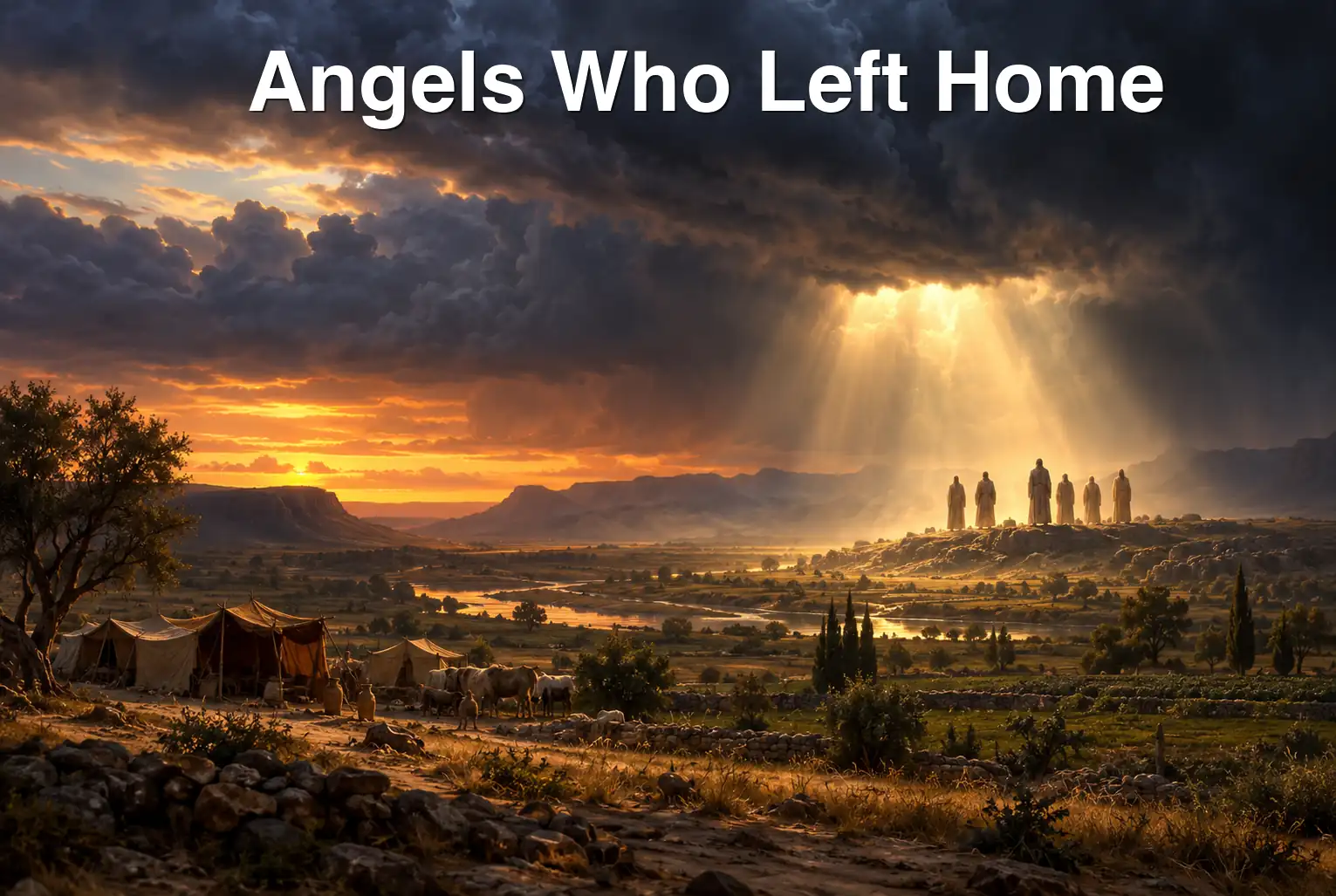
The sons of God of Genesis 6 were angels, and the King James text shows it in three places that support one another: Genesis 6 itself, the book of Job, and the book of Jude. The same text says that they came in unto the daughters of men, that it happened more than once, and that God judged it. It does not say how any of it was done. This article keeps those two things apart. What the verses prove is set out first, one proof at a time, and then the speculation that has grown up in the silence is answered, one claim at a time, by asking each claim for its verse.
Here is the passage.
"And it came to pass, when men began to multiply on the face of the earth, and daughters were born unto them, That the sons of God saw the daughters of men that they were fair; and they took them wives of all which they chose. And the LORD said, My spirit shall not always strive with man, for that he also is flesh: yet his days shall be an hundred and twenty years. There were giants in the earth in those days; and also after that, when the sons of God came in unto the daughters of men, and they bare children to them, the same became mighty men which were of old, men of renown." (Genesis 6:1-4 KJV)
Three questions come out of it. Who are the sons of God? What does "also after that" mean? And what, if anything, does the rest of Scripture say about what they did? Verse 3 sits between the two halves of the story, and its "also" is read three ways in the sources I checked: Ruckman takes it as man as well as the sons of God who became flesh, Bullinger as Adam, and Johnson as man given God's spirit who is also flesh. Nothing here rests on it.
A word on method before the proofs. Everything below is read from the King James text alone, with no Greek or Hebrew word in it. Where I say that no verse says a thing, I name the place I searched. A claim that a verse is silent is only as good as the search behind it, so each of those claims was checked against the whole King James text.
Job uses the phrase of heavenly beings, and Genesis 6 uses it the same way
The words "sons of God" occur eleven times in the King James. Six of them are in John, Romans, Philippians and 1 John, and every one of the six is said of believers: "But as many as received him, to them gave he power to become the sons of God" (John 1:12), and "For as many as are led by the Spirit of God, they are the sons of God" (Romans 8:14). Both are said of men who believe. The other five are Genesis 6:2, Genesis 6:4, and three verses in Job.
Job is where the phrase can be examined without anyone's help.
"Now there was a day when the sons of God came to present themselves before the LORD, and Satan came also among them." (Job 1:6 KJV)
These sons of God come into the presence of the LORD, and Satan comes among them. The same scene is repeated in Job 2:1. No man is in this scene. And when the LORD answers Job out of the whirlwind, He asks where Job was when the earth was founded.
"Where wast thou when I laid the foundations of the earth? declare, if thou hast understanding." (Job 38:4 KJV)
"When the morning stars sang together, and all the sons of God shouted for joy?" (Job 38:7 KJV)
The sons of God were there when the earth's foundations were laid. Man was made afterward, on the sixth day (Genesis 1:26-27). So the sons of God of Job are creatures older than man, standing in God's presence, with Satan among them. In all three verses in Job the phrase names heavenly beings.
Now put the phrase in Genesis 6 beside them. It is the same phrase, in the same Bible, in a chapter where the other party in the story is the daughters of men. The chapter itself sets one against the other. The sons of God are not called men; the daughters are called daughters of men.
One more thing the text says bears on who is called a son of God. Luke traces the line of the Lord back to its beginning and ends it with the words "which was the son of Adam, which was the son of God" (Luke 3:38). Adam's own sons are a different matter: "And Adam lived an hundred and thirty years, and begat a son in his own likeness, after his image; and called his name Seth" (Genesis 5:3). Seth was begotten in Adam's likeness. And when Moses speaks of the whole human family, he calls it the sons of Adam (Deuteronomy 32:8), not the sons of God. I draw one conclusion from that and no more: outside the verses in dispute, Genesis 6:2 and 6:4, the Old Testament never calls the begotten descendants of Adam "sons of God." The nearest verse is Hosea 1:10, and it is a promise about what Israel will one day be called, in different words: the sons of the living God. It is not a description of men then living.
So in Job, the only other place the Old Testament uses the phrase, it names beings who were present when the earth was founded, and they are plainly heavenly. The one place where a reader must decide is Genesis 6, and nothing in Genesis 6 tells him to read the phrase differently from the way Job reads it.
The Seth reading adds a line the text never draws
The usual alternative is that the sons of God were the godly descendants of Seth, and the daughters of men were the daughters of Cain. The note on Genesis 6:2 in the 1917 Scofield Reference Bible carries it and calls it "the uniform Hebrew and Christian interpretation," Larkin sets it beside the others, and Johnson lists it among the views he declines to choose between. It needs three things, and the text supplies none of them.
It needs the sons of God to be men. The previous section looked at every use of the phrase in the Old Testament, and outside the verses in dispute it is never said of men.
It needs a godly line of Seth. Genesis 4:26 says that in the days of Seth's son Enos men began to call upon the name of the LORD. That is the beginning of something, and it is said of men, not of a family. Genesis 5 lists the generations from Adam to Noah and says of Enoch that he walked with God (Genesis 5:22), and Genesis 6:9 says it of Noah. It does not say that Seth's descendants were a godly people, and of mankind at large it says that "the wickedness of man was great in the earth, and that every imagination of the thoughts of his heart was only evil continually" (Genesis 6:5).
It needs the daughters of men to be the daughters of Cain. But Genesis 6 does not mention Cain. The daughters of verse 1 are simply the daughters born to men as they multiplied, and Seth himself begat sons and daughters (Genesis 5:7), and they were daughters of men too.
The reading also has to explain what it produces. No marriage of a godly man to an ungodly woman in the King James is said to bring forth giants. And it has to explain "also after that," because the flood ended every line but Noah's, and yet Genesis 6:4 says that the same thing happened again afterward.
None of this makes the Seth reading a wicked idea. It makes it a reading that is built partly from the text and partly from an inference that the text will not carry.
Jude says what these angels did, and compares it to Sodom
Jude is one of the remnant epistles. He wrote to believing Israel, not to the Body of Christ, and the reasons are given in What Are the Remnant Epistles, which covers who wrote those books, to whom, and why their doctrine differs from Paul's. I use Jude here as Scripture's own record of a past event, and I draw no doctrine for the Body from it. Everything I say about Jude 6 and 7 is about what happened, not about what the Body is to do.
"I will therefore put you in remembrance, though ye once knew this, how that the Lord, having saved the people out of the land of Egypt, afterward destroyed them that believed not. And the angels which kept not their first estate, but left their own habitation, he hath reserved in everlasting chains under darkness unto the judgment of the great day. Even as Sodom and Gomorrha, and the cities about them in like manner, giving themselves over to fornication, and going after strange flesh, are set forth for an example, suffering the vengeance of eternal fire." (Jude 1:5-7 KJV)
Jude gives three examples of judgment: the people brought out of Egypt who did not believe, the angels, and Sodom and Gomorrha. Verse 6 says that angels left their own habitation and are held in chains until judgment. It says what they left. It does not say what they left it to do. That is where the question begins, because verse 7 begins with two words that tie it to verse 6.
"Even as." Thirteen verses in the King James open with the words "Even as." Three of them carry a "so" later in the same verse, and they look ahead to it: Numbers 36:10, Deuteronomy 12:22 and 1 Kings 1:30. The other ten have no "so" in the verse. Nine of them are Job 4:8, Matthew 20:28, Luke 1:2, Romans 4:6, 1 Corinthians 1:6, 1 Corinthians 10:33, Galatians 3:6, Philippians 1:7 and 1 Peter 3:6, and in every one of the nine the comparison points back to what was said in the sentence just before it. The tenth is Jude 7. It has no "so." It points back to verse 6, which is about the angels.
"In like manner." The phrase occurs twelve times in the King James. Besides Jude 7 there are eleven uses, and in ten of them the likeness is to an act already named earlier, usually by a different person. The magicians of Egypt did in like manner with their enchantments (Exodus 7:11), as Aaron had just done. Israel sent to the king of Moab in like manner as they had sent to Edom (Judges 11:17). Sanballat sent his servant a fifth time in like manner to the four before (Nehemiah 6:5). The seven brothers took the widow in like manner as the third had (Luke 20:31). The one forward-looking use is marked by an "as" that introduces what it compares: He "shall so come in like manner as ye have seen him go into heaven" (Acts 1:11). Jude 7 has no earlier clause in its own verse that names the act, and no "as" after the phrase. The cities about Sodom and Gomorrha are added to say that they did it too; the likeness is not to them. The acts that are named earlier, by someone other than Sodom, are Israel's unbelief in verse 5 and the angels' leaving their habitation in verse 6. So verse 7 says that Sodom, and the cities about it, sinned in the manner of the angels.
"Strange flesh." The phrase occurs once in the King James, and its meaning is plain from Sodom's own story. Two angels came to Sodom (Genesis 19:1), and the men of the city called out to Lot, "Where are the men which came in to thee this night? bring them out unto us, that we may know them" (Genesis 19:5). The visitors were angels in the form of men, and the men of Sodom went after them. That is flesh of another kind. Jude says that is what Sodom did, and he says that the angels did it in like manner.
"These filthy dreamers." Verse 8 reads: "Likewise also these filthy dreamers defile the flesh, despise dominion, and speak evil of dignities." This verse describes one set of men, the ones Jude is warning against, and it lays its charges against all of them. It does not hand one charge to each of the three examples. Each example shows the first two charges, defiling the flesh and despising dominion. Israel in the wilderness defiled the flesh, for "the people began to commit whoredom with the daughters of Moab" (Numbers 25:1), and despised dominion in the gainsaying of Core (Jude 11), who resisted Moses and Aaron. Sodom defiled the flesh in going after strange flesh, and despised dominion when it answered Lot, "This one fellow came in to sojourn, and he will needs be a judge" (Genesis 19:9). The angels despised dominion when they kept not their first estate, and they defiled the flesh when, in like manner with Sodom, they went after strange flesh.
Jude could have written that the angels rebelled and stopped there. He did not. He wrote fornication and strange flesh, and he tied them to the angels with the comparing words "Even as" and "in like manner."
No other event. If Jude is pointing at a recorded event, which event? I searched the whole King James text for a verse that joins the word angel with fornication, whore, whoredom, wives, daughters of men or strange flesh. The search returns two verses, Revelation 14:8, in which an angel announces Babylon's fornication, and Revelation 17:1, in which an angel speaks of the great whore, and neither is an act of angels. I searched for every verse that sets the sons of God beside daughters, and the search returns Genesis 6:2 and Genesis 6:4. There is no other recorded case in the King James of heavenly beings going in to women. If Jude 6 and 7 describe a recorded event, Genesis 6 is the event.
Jude does cite things the Old Testament narrative does not record: Michael contending about the body of Moses (verse 9), and Enoch's prophecy (verses 14 and 15). So an unrecorded event would not have been impossible for him to name. But he does not need one here, because the event he describes is on the page in Genesis 6.
Peter describes the angels that sinned in nearly the same words: "For if God spared not the angels that sinned, but cast them down to hell, and delivered them into chains of darkness, to be reserved unto judgment" (2 Peter 2:4). I do not rest anything on Peter. Genesis, Job and Jude carry the point, and Peter stands beside Jude.
I should say plainly where this leaves one teacher whose work I rely on. Justin Johnson teaches through the Bible verse by verse at Grace Ambassadors. In a series on 1 Peter recorded in 2010, he stated the angel reading as the consensus. In his Genesis series, recorded in 2014 and 2015, he listed the angel, Seth and rulers views and chose none, saying that nobody can know for certain. He called the angel view unsupported by Scripture and traced it to Enoch and Jewish fables, and he leaned toward men, but he did not rule the angel view out. This article takes the step he declined to take. It does not use Enoch, it rests on Genesis, Job and Jude, and it sets out each step so that it can be checked against a verse.
Genesis 6:4 says it happened twice, and the text records how it ended
The verse says: "There were giants in the earth in those days; and also after that, when the sons of God came in unto the daughters of men." That is one verse with two times in it. "In those days" is the first. "Also after that" is the second, and it is said of the same act: the sons of God came in unto the daughters of men.
What does "after that" refer to? The verse gives one thing it can point back to, and that is "those days." The Lord Himself names those days as the days that were before the flood (Matthew 24:38, quoted below). "Also after that" is therefore after the flood.
The flood left nothing alive that could carry a giant through it. God said to Noah, "The end of all flesh is come before me; for the earth is filled with violence through them; and, behold, I will destroy them with the earth" (Genesis 6:13), and when the waters had done it, "every living substance was destroyed which was upon the face of the ground, both man, and cattle, and the creeping things, and the fowl of the heaven; and they were destroyed from the earth: and Noah only remained alive, and they that were with him in the ark" (Genesis 7:23). Noah was perfect in his generations (Genesis 6:9), and nothing in Genesis 6 to 9 puts a giant in the ark. A giant in Canaan after the flood has no ancestry the text gives in Noah's household. Genesis 6:4 supplies what is needed: a second time, "also after that," when the sons of God came in.
Giants are in the record after the flood, and the record is specific. In Abraham's day the kings of the east smote "the Rephaims in Ashteroth Karnaim, and the Zuzims in Ham, and the Emims in Shaveh Kiriathaim" (Genesis 14:5). Of the Emims Moses wrote that they "also were accounted giants, as the Anakims" (Deuteronomy 2:11). The spies came back with this report: "And there we saw the giants, the sons of Anak, which come of the giants: and we were in our own sight as grasshoppers, and so we were in their sight" (Numbers 13:33). Moses wrote of Og, "For only Og king of Bashan remained of the remnant of giants; behold, his bedstead was a bedstead of iron" (Deuteronomy 3:11).
And the text records how it ended. Joshua cut off the Anakims from the mountains, and "There was none of the Anakims left in the land of the children of Israel: only in Gaza, in Gath, and in Ashdod, there remained" (Joshua 11:21-22). Goliath came from Gath (1 Samuel 17:4). The last giants the King James names in battle are the four of whom it says, "These four were born to the giant in Gath, and fell by the hand of David, and by the hand of his servants" (2 Samuel 21:22).
That is the whole biography the King James gives the giants: a beginning in Genesis 6, a second coming-in after the flood, a presence in Canaan from Abraham to Moses to Joshua, and an end under David. The King James narrative names no giant after David's day; Job 16:14 uses the word only as a comparison.
The Lord put marrying on His list for the days of Noe
When the disciples asked the Lord about His coming and the end of the age (Matthew 24:3), He answered, among other things, with the days of Noe. Matthew 24 and Luke 17 are the Lord's words to His disciples about the coming of the Son of man in the prophetic program, which is Israel's, and they are not the hope of the Body of Christ. I use them as the Lord's own account of what the days before the flood were like, and as His statement of what He would compare the days of His coming to.
"But as the days of Noe were, so shall also the coming of the Son of man be. For as in the days that were before the flood they were eating and drinking, marrying and giving in marriage, until the day that Noe entered into the ark, And knew not until the flood came, and took them all away; so shall also the coming of the Son of man be." (Matthew 24:37-39 KJV)
"And as it was in the days of Noe, so shall it be also in the days of the Son of man. They did eat, they drank, they married wives, they were given in marriage, until the day that Noe entered into the ark, and the flood came, and destroyed them all." (Luke 17:26-27 KJV)
Two observations, and I will keep each one to what the verses say.
The first is that "marrying" in those days is unrestricted. The Lord says of the people of the days before the flood, without limit, that they were marrying and that they married wives. Genesis 6:2 says that the sons of God took them wives of all which they chose. Taking wives is marrying. Nothing in the Lord's words fences the marriages of Genesis 6:2 out of the marrying He names.
The second is how far the Lord's comparison goes. The likeness He names is ordinary living, no knowledge of what was coming, and judgment arriving suddenly. He pairs Lot with Noe on the same terms, in Luke 17:28-29, and He says nothing there of Sodom's sin. The Lord's lists are not complete accounts of either age. So whether the days of the Son of man will repeat the marriages of Genesis 6 as well as the unawareness, He does not say, and I will not say it for Him.
The text says they came in. It does not say how.
There is a limit on what this article may say, and it is a limit that the text itself sets. Genesis 6:4 says that the sons of God came in unto the daughters of men. That they came, the text states. How they arose, how they came, and how they bore children, the text does not state, and I do not say. Moses says of the gods Israel would sacrifice to that they were "new gods that came newly up, whom your fathers feared not" (Deuteronomy 32:17). I build no proof on that verse, because it does not name the sons of God. I note only that it says of new gods that they came up, and it says no more.
Justin Johnson, in the question time after his Genesis 6 lesson, was offering natural explanations for the giants' size, and he remarked in the same breath that no one can say how it even happens that an angel can cohabit with a woman. I use the remark for a narrow point that the text itself supports: it does not say how. Every claim that goes past that carries a burden the text does not.
This is the line I drew in Speculation and Sound Doctrine: Where the Line Must Be Drawn, which takes the claim that the Body of Christ will replace the fallen angels as its example and draws the line between what God has plainly said and what men build on top of it. That line is the instrument for everything below.
The speculations fill the silence, and each can be asked for its verse
"The Book of Enoch tells the story." One telling of the story comes from a book that is not in the Bible, and the King James never names it. Johnson traces the angel view to it. The authors in our library who hold the angel view, in the writings I checked, argue it from Jude 6-7, 2 Peter 2:4-5 and Job, not from Enoch. The name Enoch appears in thirteen verses of the King James, and the words "book of Enoch" appear in none. What Scripture says of Enoch is that he walked with God (Genesis 5:22), that he was translated (Hebrews 11:5), and, in Jude, that he was the seventh from Adam and prophesied: "Behold, the Lord cometh with ten thousands of his saints, To execute judgment upon all" (Jude 1:14-15). Jude records the prophecy. He does not name a book, and he does not endorse one. The proofs above stand on Genesis, Job and Jude, with no book of Enoch in them, and the account does not need one.
A word on the fables. Johnson calls the Enoch version a fable (in his 1 Timothy lessons, 2016-2017) and, in his Genesis series, ties the angel story to Jewish fables. What Scripture itself says about fables is more limited. The word "fables" occurs five times in the King James, and only one says "Jewish" (Titus 1:14). None of the five tells us what a fable contained. Two of the five name their settings, genealogies and commandments of men: "Neither give heed to fables and endless genealogies, which minister questions, rather than godly edifying which is in faith" (1 Timothy 1:4); "Not giving heed to Jewish fables, and commandments of men, that turn from the truth" (Titus 1:14). Nothing in them mentions angels, Genesis 6 or Enoch. So I do not call the event that Genesis and Jude describe a fable, and I do not claim to know which stories Paul had in view. I say only that anything added to that event which Scripture does not say has no verse behind it.
"They bore children by taking blood, or through DNA, or by possessing men." These are the claims about mechanism, and I mean the ones made by men who agree with me that the sons of God were angels. They say that the angels could reproduce only by obtaining blood, or that they altered human DNA, or that they possessed men and changed their bodies. Not one of these is in the text. Genesis 6:4 says they bare children. It does not say through what. Whoever makes them, they are guesses placed where the text is silent, and the believer should say so when he hears them: I do not know how; the text does not say.
"The giants' bloodline survived the flood, and it is hidden among us." The bloodline claim has to get past Genesis 7:21-23. All in whose nostrils was the breath of life died, and only Noah and those with him in the ark remained. It has to get past the record of the giants after the flood, which closes in the days of David. It has to get past Joshua 11:21-22, where none of the Anakims were left in Israel except in three cities, and 2 Samuel 21:22, where the last four fell by David's hand. If the King James gives the giants an end, then a claim that they never ended is a claim without a verse, and it is made against two books that say otherwise.
"They are the aliens." The question for this one is what the King James says such beings looked like. In the cases it gives, angels who appeared in human form were taken for men. The two who came to Sodom are called "two angels" (Genesis 19:1), and the men of the city called them "the men" (Genesis 19:5). Manoah "knew not that he was an angel of the LORD" (Judges 13:16). And at the empty tomb, Matthew 28:5 speaks of the angel, and Mark 16:5 describes what the women saw as a young man. That is how the text says such beings appear. It says nothing of ships or abductions, and nothing of creatures in the sky.
"Devils are the spirits of the giants who died in the flood." I write devils, as the King James does. The guess is that the devils of the gospels were once the offspring of the sons of God. No verse says it. The devils of the gospels are called unclean spirits and devils, and they ask the Lord for leave: "Send us into the swine, that we may enter into them" (Mark 5:12), and Jesus gave it (Mark 5:13). Where they came from, the King James does not say.
"The sons of God were a race on the earth before Adam." Job 38:7 puts the sons of God at the founding of the earth, shouting for joy. It does not put them on the earth, and it does not say they were a race. The idea that an earlier race of them lived on the earth and was wrecked before Genesis 1:2 is an addition to Job 38. The text says that they were present.
"Daniel 2:43 says they return." The verse reads: "And whereas thou sawest iron mixed with miry clay, they shall mingle themselves with the seed of men: but they shall not cleave one to another, even as iron is not mixed with clay." It sits inside Daniel's explanation of the image. The iron is the fourth kingdom (Daniel 2:40), the clay is the weaker part (Daniel 2:41-42), and the verse says that the two mingle without joining. The verse does not mention angels. "They" follows the iron and the clay, which Daniel has just explained, and the words "mingle themselves" are used of Israel when the holy seed mingled with the people of the lands around them (Ezra 9:2). "The seed of men" is language the King James uses of a human population: "I will sow the house of Israel and the house of Judah with the seed of man, and with the seed of beast" (Jeremiah 31:27). A man may hold that Daniel 2:43 means more than it says, but he holds it as an inference, and not as a verse.
"The Body of Christ will replace the fallen angels." Speculation and Sound Doctrine, linked above, answers it. The texts offered do not say it, and Peter and Jude speak of the angels that sinned not as vacancies but as judgment.
"The spirits in prison in 1 Peter 3:19-20 are these angels." This may be so, and the text does not settle it. Peter writes of Christ, "By which also he went and preached unto the spirits in prison; Which sometime were disobedient, when once the longsuffering of God waited in the days of Noah, while the ark was a preparing" (1 Peter 3:19-20). Features of the verses point both ways. The word "disobedient" is said of men in the twelve other places in the King James where it occurs. The word "spirits" is said of angels (Hebrews 1:7, 14) and of men (Hebrews 12:23, the spirits of just men made perfect). The word "prison" is said of the host of the high ones in Isaiah 24:21-22 and of Satan in Revelation 20:7. And Peter says in his second letter that Noah was a preacher of righteousness to the world of the ungodly (2 Peter 2:5). The passage does not say what Christ preached, and it does not mention Genesis 6 or Jude. I do not build on it either way.
"1 Corinthians 11:10 proves the angels wanted the women." Paul's one verse that joins women with angels reads, "For this cause ought the woman to have power on her head because of the angels" (1 Corinthians 11:10). It follows an argument from creation order: the man is the image and glory of God, the woman is the glory of the man, and the woman was made for the man (verses 7-9). It says "because of the angels" and no more. In the teachers I checked, Manley and Jordan read the angels as watchers, which Paul says elsewhere (1 Corinthians 4:9; Ephesians 3:10), and Stam calls the verse inexplicable and points to Ephesians 3:10. Johnson, Sadler, Jordan in 1996, and Ruckman each raise Genesis 6 for it, most with hedges. The Genesis 6 reading would explain why the sign is the woman's and not the man's, which the watcher reading does not explain by itself. But the verse does not state that link, and I treat it as consistent with what Genesis and Jude say, not as a proof of it.
"It is happening now, and it is why the church must fight." The King James states no bar on angels doing again what they did, and Paul's epistles record no instance. What Paul does say is that the Body's wrestling is spiritual, in the heavenly places, and not with flesh: "For we wrestle not against flesh and blood, but against principalities, against powers, against the rulers of the darkness of this world, against spiritual wickedness in high places" (Ephesians 6:12 KJV). The weapon Paul gives is truth, and the posture is standing: "Wherefore take unto you the whole armour of God, that ye may be able to withstand in the evil day, and having done all, to stand" (Ephesians 6:13). I have written on Satan's war on the Body in Satan's Two Campaigns: His War on the Remnant and His War on the Body of Christ, which shows how it differs from his war on the remnant. Paul also writes that there is a present hindrance of the revealing of the man of sin: "For the mystery of iniquity doth already work: only he who now letteth will let, until he be taken out of the way" (2 Thessalonians 2:7). He does not say what hinders, and he does not say that the hindrance bears on angels coming in to women. Osteen reads it as the restraining influence of the Body of Christ, and Johnson rejects that reading. The text does not name the hinderer, and I do not say. Revelation 12 shows the dragon and his angels cast to the earth in great wrath against the woman and her seed, and it belongs to the prophetic program, which is Israel's, as Matthew 24 does. Neither Revelation 12 nor 2 Thessalonians 2:7 says what the fallen angels can do toward women now.
What Scripture proves, and what it does not
What the text proves.
The sons of God of Genesis 6:2 and 6:4 are angels. The phrase is used in Job of heavenly beings present at the founding of the earth, and outside the verses in dispute the Old Testament never uses it of the begotten sons of Adam.
Jude 6 and 7 speak of that event. The angels who left their own habitation went after strange flesh, in like manner with Sodom, and God holds them in chains unto the judgment of the great day. Genesis 6 is the only recorded event in the King James that fits.
It happened more than once. Genesis 6:4 says "also after that," and the Lord calls those days the days before the flood. The giants appear again in Canaan, and the text records their end under Joshua and David.
The Lord put marrying in the days of Noe, and nothing in His words excludes the marriages of Genesis 6:2 from it.
What the text does not prove.
How the sons of God arose. How they came. How they bore children. Whether the Book of Enoch is accurate. That devils are the spirits of the giants. That a bloodline survives. That a race of them lived before Adam. That Daniel 2:43 or Matthew 24 says they return. That they are doing it now. That the spirits in prison are these angels. That the Body replaces them. That 1 Corinthians 11:10 states the Genesis 6 link.
Hold what is written, and stop where it stops
Believe what the text says: that the sons of God of Genesis 6 were angels, that they came in unto the daughters of men, that it happened more than once, and that God judged it. Then stop. The believer is not asked to explain Genesis 6. He is asked to believe it, and to believe nothing about it that the text withholds.
When you meet the next book or video that claims to know how the sons of God arose, how they bore children, or where their descendants live, do the one thing that settles it. Ask for the verse. If there is one, read it in its paragraph and see whether it says what it is claimed to say. If there is none, set the claim down. A claim past the text has no more authority than the man who made it, and a man's reasoning, however consistent, does not stand where the text is silent.
And put your weight where Paul puts it. The Body's enemy is real, and he is spiritual, and he works by deception. The answer to him is the truth that has been given to you, held, and stood on.
© 2026 Edward R. Cross




Comments
No comments yet. Be the first to share your thoughts.
Leave a comment