Walk through the Christian corner of the internet today and you will find the gym has come to church. There are barbell ministries and CrossFit fellowships, faith-and-fitness magazines and conferences, gym-churches where the workout is the gathering, whole discipleship brands built on the sculpted body as a testimony. Some of it is thoughtful; much of it is sincere; and nearly all of it, sooner or later, has to reckon with one short line from Paul that seems to stand squarely in the doorway:
"For bodily exercise profiteth little: but godliness is profitable unto all things, having promise of the life that now is, and of that which is to come." (1 Timothy 4:8 KJV)
The line is often read as a shrug at the body — as if Paul, had he lived to see the modern gym, would have waved it off. But that reading misses him on both ends. Paul is not scorning the body, and he is not blessing its worship. Read where he actually stands — between a Greek world that exalted the trained physique and a false religion that punished the flesh — he is doing something more useful than either the athlete or the ascetic expects. He is not answering the question is exercise good? He is answering a better one: where does it rank?
The Word Paul Chose
Notice that Paul reaches for the gymnasium a full verse before he ever mentions the body. The instruction that sets up our text is this:
"But refuse profane and old wives' fables, and exercise thyself rather unto godliness." (1 Timothy 4:7 KJV)
Both of Paul's words here belong to the athlete. "Exercise thyself" in verse 7 and "bodily exercise" in verse 8 are the vocabulary of the training-ground — the disciplined, repeated, resisted labor by which a man builds and hones his body for the contest. Paul has deliberately picked up the language of the athlete and set it down one rung higher. You know how a man trains his body for the games — the discipline, the repetition, the years of it? Train yourself like that — but unto godliness.
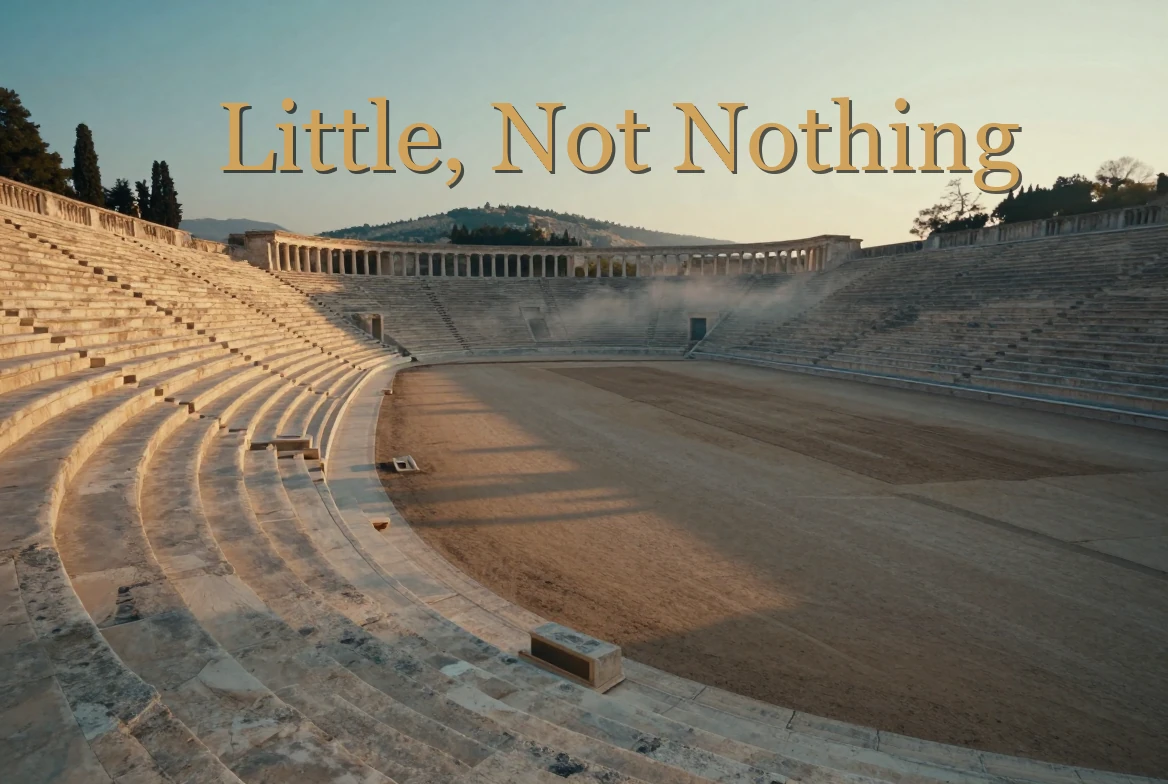
That choice of words is not incidental, and to a first-century reader in Ephesus it was not neutral. The Greek gymnasium was no fitness club. It was the beating heart of Hellenistic civic and religious life — a place of education, culture, and cult, its grounds dedicated to Hermes and Heracles. And above it towered the games: Olympia, Isthmia, Nemea, Delphi — great festivals held in honor of the gods, where the disciplined, oiled, victorious body was the visible proof of a man's excellence, and the crowd's near-worship went with it. Timothy pastored in the thick of that culture. So when Paul ranks bodily exercise as of little profit, his reader does not hear a passing health remark. He hears the apostle quietly lifting one of his culture's most exalted objects off its pedestal — the same instinct that met the altars of Athens and the silversmiths of Diana. The thing your world crowns, Paul says, is worth less than you have been told.
Little — Not Nothing
Here is where a careless reading does real damage, and where the exact word matters most. Try the verse for a moment with its pivotal word removed:
"For bodily exercise profiteth ______..."
The mind, trained by a suspicious Christianity that has always been a little embarrassed by the body, wants to fill that blank with nothing. But that is not what Paul wrote. He wrote "profiteth little" — and little is not nothing. Restore the word and the whole tone changes. Paul had the vocabulary to dismiss a thing outright when he meant to; he could say of a thing that it "profiteth me nothing" (1 Corinthians 13:3), and he pointedly does not say it here. He grants bodily exercise a genuine, positive return. He simply caps it.
And the cap is twofold — a matter of how much and of how long. In measure, bodily exercise is profitable for a little, while godliness is "profitable unto all things" — the one bounded, the other with no ceiling. And in duration the small word fits just as well, for the profit is as passing as the body that earns it. Scripture speaks the same way of a life that is "a vapour, that appeareth for a little time, and then vanisheth away" (James 4:14). The athlete's dividend, however real, expires with the flesh it strengthens. Godliness, by contrast, holds "promise of the life that now is, and of that which is to come." It pays in both worlds. That is the arithmetic Paul is doing — and it is the very same sum he works elsewhere, where the runners "do it to obtain a corruptible crown; but we an incorruptible" (1 Corinthians 9:25).
So the honest teacher must hold both halves. To preach this verse as though Paul despised the body is to add a word he refused to write. He said little. He did not say nothing.
Two Ditches, and the Road Between Them
Read verse 8 in its own neighborhood and Paul's balance comes clear, because he is steering between two errors, one on either side of the road. Look just above our text:
"Forbidding to marry, and commanding to abstain from meats, which God hath created to be received with thanksgiving of them which believe and know the truth." (1 Timothy 4:3 KJV)
That is body-denial — the ascetic impulse that mistakes the punishing of the flesh for holiness. Paul demolishes it: "every creature of God is good, and nothing to be refused, if it be received with thanksgiving" (1 Timothy 4:4). He knew this counterfeit well and named it again to the Colossians — a religion of "will worship, and humility, and neglecting of the body" that carries "a shew of wisdom" and no real power against the flesh (Colossians 2:23).
Then, a few words later, Paul glances the other direction — toward the games, toward the culture that exalts the body. And to that side he says: little profit. Set the two together and you have his whole posture. The ascetic worships God by starving the body; the athlete's world worships the body itself; Paul will do neither. Godliness is not the flogging of the flesh, and it is not the crowning of it. The body is a servant — no more, and, we must add for our own day, no less.
The Modern Floor
Paul's first readers needed to hear that line as a ceiling. They lived in a world of walking, labor, and constant motion; their temptation was to over-esteem the trained body, not to neglect it. Our temptation runs the opposite way, and so for most of us the verse has to be heard first from the floor.
We have engineered movement out of life to a degree the ancient world could not have imagined — the ten-hour chair, the screen, the car from door to door. And the body, made to move, pays the bill. What the physicians now call sarcopenia is exactly the wages of disuse: muscle that quietly wastes when it is not worked, strength and stability draining away with the years until, for many, the second half of life becomes a slow negotiation with frailty. In that setting the "little" profit Paul concedes is not a trifle. For a great many people it is the difference between carrying their own weight through old age and being carried. The body is the instrument through which we serve in "the life that now is" — and to let that instrument decay through simple neglect is its own failure of stewardship, the mirror image of the ascetic who ruins it from the other side. Paul honored the little. So should we.
There is even a sermon hiding in the atrophy itself. The reason a muscle wastes is the very reason Paul reached for the gymnasium in the first place: strength that is not trained does not hold. A body is built only by deliberate, repeated, resisted effort — the athlete's whole science — and the moment the training stops, the loss begins. That is exactly the logic of verse 7. "Exercise thyself rather unto godliness" assumes that godliness, like the body, does not keep its strength on its own. Left untrained, it atrophies too. Paul borrows the athlete's discipline not to distract us from the spiritual life but to describe it: the same patient, progressive, resisted effort — only aimed one rung higher, where the crown does not corrupt.
A Ladder, Not a Wall
This is the correction the modern conversation most needs, in both directions. Paul is not building a wall between the body and godliness, forcing a choice of sides — the ascetic's wall on one hand, the culture's on the other. He is stacking a ladder. Bodily exercise stands on the lower rung: genuinely good, genuinely profitable, and genuinely limited — its returns real but expiring with this flesh. Godliness stands on the rung above: "profitable unto all things," paying now and forever. The rungs are not enemies. They are ordered.
Every error around this verse is a failure of that order. The games culture worshiped the lower rung. The ascetic kicked it out from under himself. And our own age, mostly, just never climbs onto it at all. Paul's answer to all three is one and the same: give the body its due — no more, no less — and pour the surplus of your discipline into godliness. He models it himself, and never more plainly than in the athlete's own arena:
"But I keep under my body, and bring it into subjection: lest that by any means, when I have preached to others, I myself should be a castaway." (1 Corinthians 9:27 KJV)
There is the whole priority in one sentence. Paul disciplines his body — hard, deliberately, in athletic language — but the body is the servant of the ministry, never its point. The training serves the preaching. The lower rung holds up the climb; it is not the summit.
What Godliness Is — and Where It Is Grounded
None of this weighs rightly until we are clear on what Paul means by the godliness he ranks so far above the gymnasium. This is where right division keeps us from turning the verse into mere religious self-improvement. Godliness is one of Paul's great words in these letters to Timothy — but he does not leave us to guess its source. He roots it, of all places, in a mystery:
"And without controversy great is the mystery of godliness: God was manifest in the flesh, justified in the Spirit, seen of angels, preached unto the Gentiles, believed on in the world, received up into glory." (1 Timothy 3:16 KJV)
The godliness Paul commends is not a code of conduct we generate by effort, and it is emphatically not the law-keeping by which Israel was to be proven godly. It is the practical outworking of Christ Himself — God manifest in the flesh — now revealed and lived out in those who are His. It flows from the finished work and the sound doctrine Paul was given for the Body of Christ, rightly divided from the program of the law and the prophets. That is why bodily exercise cannot compete with it and cannot counterfeit it. A barbell can build a shoulder; it cannot manifest Christ. The gymnasium trains the flesh that dies; godliness is the life of the One who was "received up into glory," and it carries His promise into the age to come.
This is also the quiet warning for the body-building ministry that means well. The test is simple, and it is the test of the whole passage: is the body serving the godliness, or is the "godliness" serving the body? Where a fitness ministry uses the gym as a place to meet people, and the athlete's discipline as a living picture of spiritual training, it stands on ground Paul himself walked — he mined the games for metaphor constantly: running the race, striving lawfully (2 Timothy 2:5), fighting a good fight and finishing a course (2 Timothy 4:7). But the moment the physique becomes the message — the moment the sculpted body is quietly re-enthroned as the badge of blessing, the proof of God's favor, the thing the ministry is really for — it has walked backward into the exact exultation of the games that Paul weighed and found wanting. It has crowned the lower rung. It has traded the incorruptible for the corruptible and called it discipleship.
Why It Matters
For the member of the Body of Christ, this verse is not a rebuke of the treadmill. It is a lens for the whole life. We are not the ascetics of verse 3, and we owe the body no contempt — it is God's good creation, the temple of His Spirit, the instrument of our service in the life that now is, and we do well to keep it in working order. But neither are we the athletes of the arena, whose crown withers with the body that won it. We are stewards of a discipline, and the question Paul presses on us is only ever where are you spending it?
Give the body its little — honestly, gladly, without the false piety that neglects it. Then take the same resolve that trains a muscle and turn it upward, onto the thing that profits "unto all things." The gymnasium closes when the body fails. Godliness holds its promise on both sides of the grave.
© 2026 Edward R. Cross











Comments
No comments yet. Be the first to share your thoughts.
Leave a comment