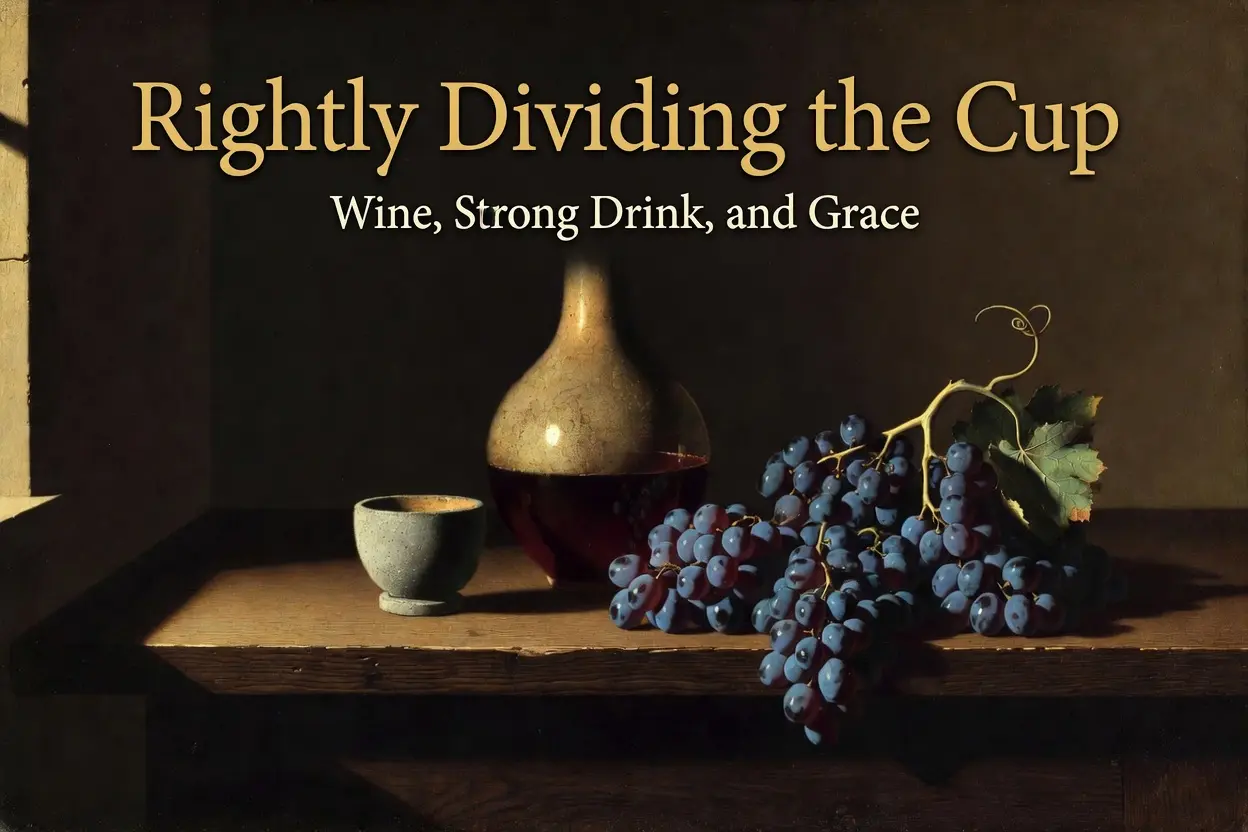
“Forbidding to marry, and commanding to abstain from meats, which God hath created to be received with thanksgiving of them which believe and know the truth. For every creature of God is good, and nothing to be refused, if it be received with thanksgiving: For it is sanctified by the word of God and prayer.” (1 Timothy 4:3-5 KJV)
Why This Question Will Not Go Away
Few subjects produce more heat and less light than the question of alcohol. As one writer recently observed in a thoughtful post making the rounds, "this is one of those subjects where many believers already have a strong opinion before they ever examine all of the relevant Scriptures." That is exactly right. People arrive at the text already certain, then look for verses to confirm what they have already decided.
The post in question — written by someone who does not claim our Mid-Acts position, but who handles the Bible carefully — comes to a sound conclusion: alcohol itself is not inherently sinful, drunkenness is repeatedly condemned, and the believer is called to wisdom, self-control, and love. As far as it goes, that is correct, and I want to commend it. But it does not go far enough, and it does not rightly divide. It gathers verses from Psalms, Proverbs, the Gospels, Isaiah, and Paul's epistles and lays them side by side as though they all address us in exactly the same way. They do not. When we read the Scriptures the way Paul told us to — "rightly dividing the word of truth" (2 Timothy 2:15) — the answer becomes even clearer, and the favorite "prooftexts" of the total-abstinence teacher fall apart one by one.
So let us do what the post recommended but did not finish. Let us examine all of the relevant Scriptures, and let us examine them in context.
First, What the Post Gets Right
Before correcting anything, let us affirm the truth. Scripture nowhere presents the fruit of the vine as evil in itself. God Himself lists wine among His blessings to man:
“He causeth the grass to grow for the cattle, and herb for the service of man: that he may bring forth food out of the earth; And wine that maketh glad the heart of man, and oil to make his face to shine, and bread which strengtheneth man's heart.” (Psalm 104:14-15 KJV)
Notice that wine sits in the same list as bread and oil — the ordinary provisions of God for the comfort and gladness of man. The vine itself says its wine is that "which cheereth God and man" (Judges 9:13). Solomon writes, "drink thy wine with a merry heart; for God now accepteth thy works" (Ecclesiastes 9:7). Paul tells Timothy to "use a little wine for thy stomach's sake and thine often infirmities" (1 Timothy 5:23). If alcohol were sinful in itself, God could not bless it, command it, or prescribe it — and He does all three.
The post also insists that the wine in view at the wedding of Cana — and in the Bible's warnings against drunkenness — was real, fermented wine, not mere grape juice. In those places it is exactly right, and we will return to the point, because it is the hinge on which one of the most common abstinence arguments turns. We should say carefully that the word wine does have some range in Scripture; it can even take in the fresh juice still in the cluster, of which the LORD says "a blessing is in it" (Isaiah 65:8). But that range does not help the abstinence teacher one bit, for no man is ever made drunk, or slandered as a winebibber, over grape juice. Where the text speaks of drinking to excess, or of the good wine at a feast, fermented wine is plainly in view.
And the post is entirely correct that drunkenness is sin. The Bible is relentless on this. "Be not drunk with wine, wherein is excess" (Ephesians 5:18). "Wine is a mocker, strong drink is raging: and whosoever is deceived thereby is not wise" (Proverbs 20:1). No one defending Christian liberty defends drunkenness. The two are not the same thing, and confusing them is the first mistake of the abstinence teacher.
So the post's conclusion is sound. The problem is that it leaves the abstinence teacher's main weapons untouched. Let us take them up.
The "Jesus Made Grape Juice" Argument
This is perhaps the most popular dodge of all. Faced with the wedding at Cana — where the Lord Jesus turned water into wine — the total-abstinence teacher insists that what Jesus made was not really wine but unfermented grape juice. He cannot allow the sinless Son of God to have manufactured an alcoholic beverage, so he redefines the word.
The context destroys the claim. Read what the governor of the feast actually said:
“When the ruler of the feast had tasted the water that was made wine, and knew not whence it was: (but the servants which drew the water knew;) the governor of the feast called the bridegroom, And saith unto him, Every man at the beginning doth set forth good wine; and when men have well drunk, then that which is worse: but thou hast kept the good wine until now.” (John 2:9-10 KJV)
The governor describes the ordinary custom of a feast: serve the good wine first, and bring out the inferior wine later "when men have well drunk." The phrase "well drunk" only makes sense of a beverage that affects men when they drink freely of it. No one is "well drunk" on grape juice. The whole proverb the governor quotes assumes fermented wine — that is precisely why hosts saved the cheaper stuff for after the guests' palates were dulled. And the Lord made the best wine of the feast, in great quantity, six waterpots holding "two or three firkins apiece" (John 2:6). The text will not bend to the grape-juice theory.
There is also a simple, practical reality the grape-juice argument ignores. In a world with no refrigeration and no pasteurization, the juice of crushed grapes begins to ferment within days; left in a vessel, it becomes wine on its own. The notion of a stable, non-alcoholic "grape juice" that could be bottled and kept is a modern invention — it depends on the pasteurizing process developed in the nineteenth century, long after the days of our Lord. When the Scripture speaks of "new wine," it is not speaking of sweet sterile juice but of wine in its fresh state, which is exactly why Scripture can warn that a man may be "full of new wine" (Acts 2:13) and mistaken for drunk (Acts 2:13). To read the modern grocery-store product back into the wedding at Cana is to import an anachronism the text never knew. The wine the Lord made was wine.
Some have tried to rescue the grape-juice theory with more elaborate machinery. There is a body of temperance literature — most famously William Patton's Bible Wines, or the Laws of Fermentation and Wines of the Ancients (1871), built upon the earlier "two-wine theory" of George Duffield and Moses Stuart — which argues that the ancients preserved grape juice unfermented by boiling it down into a thick syrup or paste, which could then be reconstituted with water and supposedly kept sweet indefinitely. From this the theory concludes that wherever Scripture speaks well of wine it must mean this unfermented syrup, and wherever it speaks ill of wine it means the fermented kind. It is an ingenious system, and it deserves a plain answer, because it is the scholarly backbone behind the simple "it was only grape juice" claim.
It fails on several counts. First, it is special pleading. As we have noted, the word wine does have some range — it can take in the fresh juice of the cluster as well as the aged drink that gladdens the heart or, abused, makes a man drunk. But that ordinary range is a very different thing from the rigid moral split the theory requires, in which every approving mention must mean unfermented juice and every disapproving mention must mean alcohol. That division is not drawn out of the text but imposed upon it from the outside, to defend a conclusion already reached before coming to Scripture. Wine that "cheereth God and man" (Judges 9:13) and wine that a man can be "drunk" with (Ephesians 5:18) are simply wine, used rightly or abused. Second, the history actually runs the other way. Boiling grape juice down into a syrup produced a sweetener and a concentrate; it was not a reliable method of permanent preservation, and a syrup thinned back out with water in a warm climate ferments as readily as fresh juice ever did. Boiling delays fermentation; it does not abolish it. Third, and decisively, the theory cannot survive the very texts we have already handled. No syrup explanation can account for men being "well drunk" at Cana (John 2:10), for the slander that the Lord was a "winebibber" (Luke 7:34), for Paul's warning not to be "drunk with wine" (Ephesians 5:18), or for God commanding "strong wine" to be poured out upon His own altar (Numbers 28:7). You cannot get drunk on syrup, you cannot pour a paste out as a drink offering, and no one is ever accused of being a drunkard for reconstituting grape concentrate. The two-wine theory was not drawn out of the Scriptures; it was manufactured in the nineteenth century to serve the temperance cause, and then read back into a Book that never taught it.
The post made this same observation from a different angle, and it is decisive: if the wine were merely grape juice, then the accusation that Jesus was a "winebibber" would be meaningless. But notice that the Lord makes the point by way of a deliberate contrast with John the Baptist:
“For John the Baptist came neither eating bread nor drinking wine; and ye say, He hath a devil. The Son of man is come eating and drinking; and ye say, Behold a gluttonous man, and a winebibber, a friend of publicans and sinners!” (Luke 7:33-34 KJV)
This contrast does double duty for our subject. First, it settles beyond dispute that the Lord Jesus drank wine. John "came neither eating bread nor drinking wine" — he was the abstainer — while "the Son of man is come eating and drinking." The two are set deliberately opposite each other. Whatever John did not do, the Son of man did; and what John did not do was drink wine. A man is not slandered as a drunkard for drinking grape juice. The charge against the Lord was false — He was sinless and never drank to excess — but it was only plausible because He genuinely drank wine. The grape-juice argument has to call the Lord's enemies fools for a charge that, on the abstinence theory, no one would ever think to make. It collapses on its own terms.
Second, the contrast quietly demolishes the notion that abstinence is the mark of superior holiness. John abstained — and it was right that he did, for it was his particular calling from the womb: "he shall be great in the sight of the Lord, and shall drink neither wine nor strong drink; and he shall be filled with the Holy Ghost, even from his mother's womb" (Luke 1:15). And let us be honest about what John refused: it was real, fermented drink. "Strong drink" is intoxicating by its very name — no man separates himself from grape juice and calls it strong drink — and the contrast itself, with the Son of man charged as a winebibber, only makes sense if the wine John declined and the wine the Lord drank was fermented wine. John's lifelong separation was Nazarite-like, though we should not flatten the two: the Nazarite vow reached further still, forbidding every fruit of the vine, even moist grapes and the husk (Numbers 6:3-4), while John is specified as refusing wine and strong drink. The thread that ties them together is not the exact list of what was forbidden but a single principle — a special, God-appointed separation for a particular man, not the universal standard laid on everyone. And yet the critics called this Spirit-filled abstainer a man with a devil. Then the Son of man came eating and drinking, and the very same critics called Him a glutton and a drunkard. Their problem was never wine; it was unbelief. They would receive neither the man who abstained nor the man who drank. So the Lord concludes, "wisdom is justified of all her children" (Luke 7:35). Holiness was never located in the cup or in the refusing of it — it was found in those who received the wisdom of God whether it came fasting or feasting.
"It Is Not for Kings to Drink Wine" (Proverbs 31)
The second favorite is Lemuel's proverb: "It is not for kings, O Lemuel, it is not for kings to drink wine; nor for princes strong drink" (Proverbs 31:4). The abstinence teacher reads it as a blanket prohibition: God's best people do not drink. But he stops reading at exactly the wrong place. Look at the very next verses:
“It is not for kings, O Lemuel, it is not for kings to drink wine; nor for princes strong drink: Lest they drink, and forget the law, and pervert the judgment of any of the afflicted. Give strong drink unto him that is ready to perish, and wine unto those that be of heavy hearts. Let him drink, and forget his poverty, and remember his misery no more.” (Proverbs 31:4-7 KJV)
Two things are fatal to the abstinence use of this passage.
First, the reason given is not that wine is evil but that a judge must keep a clear head: "lest they drink, and forget the law, and pervert the judgment of any of the afflicted." This is a warning about the responsibilities of office — a king on the bench must not be impaired while rendering judgment. It is the same wisdom that keeps a surgeon or a pilot sober on duty. It says nothing about wine being forbidden to ordinary men, and nothing about the king's table on an ordinary evening.
Second — and this is the part the abstinence teacher never quotes — the same passage, in the same breath, commands giving "strong drink unto him that is ready to perish, and wine unto those that be of heavy hearts." If wine were sinful in itself, this would be a command to sin. It is nothing of the kind. It is the recognition that strong drink has a proper, merciful use. To cite verse 4 against all drinking while ignoring verses 6 and 7 is not handling Scripture; it is editing it.
There is a further turn this argument often takes, and it must be answered directly, because it is aimed straight at us. The teacher says: "It is true the proverb speaks of earthly kings — but have we not been made kings and priests? Then the rule against a king drinking wine is a rule for us." The bridge sounds spiritual, but it is built on a borrowed text. The phrase "kings and priests" comes from the Revelation:
“And hath made us kings and priests unto God and his Father…” (Revelation 1:6 KJV)
“And hast made us unto our God kings and priests: and we shall reign on the earth.” (Revelation 5:10 KJV)
Notice the last clause: these kings and priests "shall reign on the earth." That is Israel's hope, the earthly kingdom long promised to her — the same calling first spoken to the nation at Sinai, "ye shall be unto me a kingdom of priests, and an holy nation" (Exodus 19:6), and pressed again upon the believing remnant of the circumcision by Peter, "a royal priesthood, an holy nation" (1 Peter 2:9), a letter written "to the strangers scattered" (1 Peter 1:1), not to the Body of Christ. The crown of Revelation is an earthly throne for Israel's overcomers. It is not the calling of the Body of Christ at all.
For the Body, Paul never once calls us "kings and priests." Our position is not a throne upon the earth but a seat in the heavenlies: God "hath raised us up together, and made us sit together in heavenly places in Christ Jesus" (Ephesians 2:6). So the argument collapses at its very first step — it lifts a title God gave to Israel's earthly kingdom and pins it on members of the Body, then uses that misplaced title to bind a rule the proverb never taught in the first place. It is wrong division stacked upon a misread proverb. And even if a believer wished, as a matter of personal wisdom, to take up the spirit of Lemuel's counsel, that counsel was about keeping a clear head for judgment, not about abstinence — and it sat right beside the command to give wine and strong drink to the perishing. The "we are kings" argument does not merely fail; it fails twice.
"Woe to Him That Giveth His Neighbour Drink" (Habakkuk 2:15)
The third weapon is the woe of Habakkuk:
“Woe unto him that giveth his neighbour drink, that puttest thy bottle to him, and makest him drunken also, that thou mayest look on their nakedness!” (Habakkuk 2:15 KJV)
Pulled out of its sentence, this sounds like a curse on anyone who ever hands another person a drink. Read the whole verse and the curse lands somewhere entirely different. The woe is not on giving a man a beverage; it is on the man who deliberately "makest him drunken also, that thou mayest look on their nakedness" — that is, who plies his neighbor with drink in order to get him intoxicated and then exploit, shame, or take advantage of him. The sin condemned is malicious intoxication and the predatory use of drink to dishonor another person. It is a woe against a cruel motive, not against a cup of wine at a wedding.
This is the same pattern we have seen each time: a verse is wrenched from its context, the qualifying clause is dropped, and a warning against drunkenness or abuse is converted into a prohibition God never gave. Isaiah 5:11 works the same way — "Woe unto them that rise up early in the morning, that they may follow strong drink; that continue until night, till wine inflame them!" (Isaiah 5:11) The woe is on those who chase drink from dawn to dark until it inflames them. That is drunkenness and dissipation, plainly condemned. It is not a word against the man who gives thanks and drinks in moderation.
The Knockout: God Commanded a Strong Drink Offering
Here is the argument the abstinence teacher cannot answer, and it is the one I most want to press. God did not merely permit strong drink. He commanded it — and commanded it as part of the worship He prescribed.
“And the drink offering thereof shall be the fourth part of an hin for the one lamb: in the holy place shalt thou cause the strong wine to be poured unto the LORD for a drink offering.” (Numbers 28:7 KJV)
In the holy place, by God's own command, strong wine was to be poured out unto the LORD. And this was no rare or occasional rite. The drink offering accompanied the continual burnt offering — the lamb offered morning and evening, every single day, year after year:
“And with the one lamb a tenth deal of flour mingled with the fourth part of an hin of beaten oil; and the fourth part of an hin of wine for a drink offering.” (Exodus 29:40 KJV)
So this was the daily, perpetual worship of Israel. Twice a day, every day, wine was poured out before the LORD as part of the prescribed offering, alongside the strong wine of Numbers 28:7. Now follow the logic carefully. If God were teaching His people total abstinence — if wine and strong drink were inherently defiling — then God commanded His priests to bring into the holy place, day after day for centuries, and pour out before His own face, the very thing He had forbidden. That is unthinkable. God does not require, as a perpetual act of worship, the handling of something He calls sin. The altar itself refutes the abstinence teacher.
And it is not only the offering. When Israel came to keep the feast before the LORD, here is what God told them to do with their tithe money:
“And thou shalt bestow that money for whatsoever thy soul lusteth after, for oxen, or for sheep, or for wine, or for strong drink, or for whatsoever thy soul desireth: and thou shalt eat there before the LORD thy God, and thou shalt rejoice, thou, and thine household,” (Deuteronomy 14:26 KJV)
Read that again slowly. God told His people to take the money set apart for Him, spend it on "wine, or strong drink," and "rejoice... before the LORD thy God." This is not a grudging concession to weakness. It is a command to celebrate God's goodness with wine and strong drink in the place where God put His name.
Now ask the abstinence teacher the obvious question: if Israel was under a rule of total abstinence, where exactly were they to obtain the wine and strong drink that God commanded them to offer in the holy place and to buy for their feasts? Down at the local Gentile package store? Were the priests to send a runner outside the camp to purchase from the heathen the very substance God required, twice daily, for His own altar? It will not do. A people who must supply wine for the morning and evening sacrifice every day of the year must grow the grapes, keep the vineyards, work the winepresses, and store the wine themselves. Indeed, God promised that very abundance as a blessing — He would bless "thy corn, and thy wine, and thine oil" (Deuteronomy 7:13) — and the wine He blesses cannot be the wine He forbids. The question answers itself. God commanded the offering; therefore God's people lawfully grew, pressed, stored, possessed, and used wine and strong drink. A God who teaches total abstinence does not write strong drink into His own order of worship, and He does not name a full winepress among the blessings He pours out on an obedient people.
The Nazarite Vow Proves the Rule by the Exception
There is one more passage worth bringing forward, because it actually settles the matter. God did establish a season of abstinence — but only as a special, voluntary, temporary vow, the Nazarite separation:
“He shall separate himself from wine and strong drink, and shall drink no vinegar of wine, or vinegar of strong drink, neither shall he drink any liquor of grapes, nor eat moist grapes, or dried.” (Numbers 6:3 KJV)
If abstinence were already God's universal standard for every Israelite, this vow would be meaningless — there would be nothing special about separating from wine if no one was supposed to drink it in the first place. The Nazarite vow stands out precisely because ordinary Israelites drank wine. And note how the vow ends:
“…and after that the Nazarite may drink wine.” (Numbers 6:20 KJV)
When the days of separation were fulfilled, the man returned to the normal life of God's people — which included drinking wine. Abstinence was the rare exception that proved the ordinary rule. The total-abstinence teacher has taken what God made a special vow for a few and tried to bind it on everyone, which is exactly backward.
Where We Actually Live: Rightly Dividing the Word
Now I must say what the original post, for all its care, never says — because the writer does not hold our position. Every passage we have examined so far comes from Israel's program: the law, the prophets, the wisdom books, and the earthly ministry of Christ to the circumcision. Those Scriptures are "written for our learning" (Romans 15:4) and they reveal the unchanging character of God. But the believer today, a member of the Body of Christ in this dispensation of grace, does not live under the law of Moses, the Nazarite code, or the kingdom commandments. We live under the doctrine the risen Lord revealed through the Apostle Paul.
This matters even for the proof texts. The post quotes the Lord's words at the Last Supper — "this is my blood of the new testament" (Matthew 26:28) — to show that Jesus drank wine. He certainly did. But that passage is kingdom instruction to Israel's little flock, tied to the cup He says He will drink anew "in my Father's kingdom" (Matthew 26:29). The cleaner proof that the Lord drank wine is the slander His enemies threw at Him — "a gluttonous man, and a winebibber" (Luke 7:34; Matthew 11:19) — and the wine He made at Cana. Rightly dividing does not weaken the point; it sharpens it.
So what is our rule? It is liberty governed by love. Paul settles the whole category of food and drink for the Body of Christ:
“Let no man therefore judge you in meat, or in drink, or in respect of an holyday, or of the new moon, or of the sabbath days:” (Colossians 2:16 KJV)
“For the kingdom of God is not meat and drink; but righteousness, and peace, and joy in the Holy Ghost.” (Romans 14:17 KJV)
We are "not under the law, but under grace" (Romans 6:14). No man has the authority to sit in judgment over another believer's drink. To erect a rule of total abstinence and bind it on the consciences of the saints is to do exactly what Paul warned against — and notice that he placed such rule-making in startling company:
“…Forbidding to marry, and commanding to abstain from meats, which God hath created to be received with thanksgiving…” (1 Timothy 4:3 KJV)
Paul calls the spirit behind "touch not; taste not; handle not" (Colossians 2:21) what it is: a religious system "after the commandments and doctrines of men" which "have indeed a shew of wisdom in will worship, and humility, and neglecting of the body; not in any honour to the satisfying of the flesh" (Colossians 2:22-23). Total-abstinence teaching, however sincere, belongs to that family. It adds a commandment God never gave and dresses it up as superior holiness.
Liberty Is Not an Occasion to the Flesh
Now hear the balance, because liberty is not an excuse for the flesh, and the post was right to press this. Everything lawful is not therefore wise:
“All things are lawful for me, but all things are not expedient: all things are lawful for me, but all things edify not.” (1 Corinthians 10:23 KJV)
Three things keep us from turning that liberty into an occasion to the flesh. First, drunkenness remains sin for the Body of Christ — Paul forbids it directly: "be not drunk with wine, wherein is excess; but be filled with the Spirit" (Ephesians 5:18). Second, the believer is never to be mastered by what he is free to use; though all things are lawful to him, Paul's own rule is that he "will not be brought under the power of any" (1 Corinthians 6:12). A man who cannot drink without being brought under its power should not drink at all — that is not abstinence-as-law, that is wisdom. Third, and most important, liberty bows to love:
“It is good neither to eat flesh, nor to drink wine, nor any thing whereby thy brother stumbleth, or is offended, or is made weak.” (Romans 14:21 KJV)
“For, brethren, ye have been called unto liberty; only use not liberty for an occasion to the flesh, but by love serve one another.” (Galatians 5:13 KJV)
The believer who is free to drink is also free not to drink — and love will often choose the second for a brother's sake. That is the genius of grace: it does not bind the conscience with a law, yet it produces more carefulness than any law could, because it works by love rather than by fear.
"Given to Wine" and "Given to Much Wine": Defining the Terms
There is one more set of verses the abstinence teacher leans on, and they come from Paul himself — the qualifications for those who serve in the Body. Of a bishop Paul writes that he must be "not given to wine" (1 Timothy 3:3; Titus 1:7); of deacons, "not given to much wine" (1 Timothy 3:8); and of the aged women, "not given to much wine" (Titus 2:3). At a glance these can be made to sound like a call to abstinence. They are nothing of the kind, and the wording itself shows why.
First, mark what Paul does not say. He does not say "shall not drink wine." The word drink is absent. He says given to wine — and that is a wholly different thing. To be "given to" something, in the plain English of the King James, is to be devoted to it, mastered by it, characterized by it. Paul uses the very same construction two clauses earlier, on the good side of the ledger: the bishop must be "given to hospitality" (1 Timothy 3:2) — that is, given over to it, marked by it. And on the bad side he sets wine beside money: "not given to filthy lucre" (Titus 1:7). No one imagines that "not given to filthy lucre" forbids a man to own a penny; it forbids him to be ruled by the love of it. Just so, "not given to wine" does not forbid the cup; it forbids the man to be ruled by it — to be a tippler whose life is given over to drink.
Second, weigh the little word much. To the deacons and the aged women the Spirit did not write "not given to wine" but "not given to much wine." Had total abstinence been the standard, that word would be worse than useless — it would mislead, as though a little were no trouble and only much the sin. The qualification plainly assumes that wine may be used; what it forbids is being given over to much of it. You cannot warn a man against much of a thing he is meant to have none of.
Third, ask whom these words govern. They are not a general law laid on every believer; they are qualifications for office and for the mature who teach — the bishop or elder (1 Timothy 3:3; Titus 1:7), the deacon (1 Timothy 3:8), and the aged women who are to teach the younger (Titus 2:3). They describe the character and manner of those entrusted with leading and teaching the Body, who must keep a clear head for the sake of sound doctrine. Grace Ambassadors, teaching through 1 Timothy 3, draws this very line: "given to wine" describes a manner of life — the man who turns to the bottle to drown his troubles rather than face them — and the bishop is forbidden it for the same reason the king of Proverbs 31 was: one who is responsible for the truth must not let his judgment be clouded. It is not that the leader may not drink; it is that he must never be mastered, never be the kind of man who escapes into the cup.
So even this — the strongest "office" text in the abstinence arsenal — turns out to presuppose the very liberty we have been defending. It assumes lawful, moderate use and forbids only bondage. The standard for the leader is not a dry house; it is a free man, never "brought under the power of any" (1 Corinthians 6:12).
Romans 14 and the "Weaker Brother" — What It Actually Says
No verse is conscripted more often by the abstinence teacher than Romans 14:21, and almost always against its plain sense. He reads it as a universal gag order: because some brother somewhere might disapprove, no believer may ever drink. But that is not what Paul wrote, and the misuse falls apart the moment we ask three questions: Who is the weak brother? What does it mean to make him stumble? And what is the remedy?
First, who is the weak brother? Paul tells us outright:
“For one believeth that he may eat all things: another, who is weak, eateth herbs. Let not him that eateth despise him that eateth not; and let not him which eateth not judge him that eateth: for God hath received him.” (Romans 14:2-3 KJV)
Notice carefully: the weak brother is the one who restricts himself — the one who "eateth herbs," the one who abstains. The strong brother is the one whose faith allows him to eat and drink freely. This turns the popular argument on its head. In Paul's own description, the abstainer is generally the weaker brother, not the stronger; and the very first thing Paul commands him is that he must "not judge" the one who eats and drinks. The abstinence teacher who uses Romans 14 to bind everyone else is doing the one thing Romans 14:3 forbids the weak brother to do.
Second, what does it mean to make a brother stumble? This is the hinge, and the matter of grape juice makes it plain. To "stumble" a brother does not mean to annoy him, to be disapproved of by him, or to drink something he dislikes. A man with a scruple against alcohol is not made to stumble by watching me drink — and he is certainly not made to stumble if I am only drinking grape juice. If "stumbling" meant mere disapproval, then a glass of juice, a cup of coffee, or anything a scrupulous brother frowned on would be sin, which is absurd. Paul defines the stumble precisely, and it is something far more serious:
“Let us not therefore judge one another any more: but judge this rather, that no man put a stumblingblock or an occasion to fall in his brother's way… But if thy brother be grieved with thy meat, now walkest thou not charitably. Destroy not him with thy meat, for whom Christ died.” (Romans 14:13,15 KJV)
“And he that doubteth is damned if he eat, because he eateth not of faith: for whatsoever is not of faith is sin.” (Romans 14:23 KJV)
To stumble a brother is to embolden him to act against his own conscience — to lead a man who believes a thing is wrong into doing it anyway, so that he sins by violating his own faith. To see this clearly, we need to understand the actual situation Paul was addressing, because the modern reader pictures something very different from what was happening in Corinth.
The backdrop in 1 Corinthians 8 is meat that had been offered to idols. In a pagan city like Corinth, much of the meat sold in the markets — and certainly the meat served at feasts in the temples — had first been dedicated to a false god. The mature believer understood that an idol is nothing, that there is but one God, and that meat is meat regardless of what some priest had muttered over it. With that knowledge, he could eat freely and give thanks. But not every brother had that settled knowledge:
“Howbeit there is not in every man that knowledge: for some with conscience of the idol unto this hour eat it as a thing offered unto an idol; and their conscience being weak is defiled.” (1 Corinthians 8:7 KJV)
Here is the weak brother — and notice that Paul does not define him by his background but by his conscience. He is the one who still has "conscience of the idol." In his mind, that meat remains bound up with idol worship; he cannot yet eat it as ordinary food, for to him it is still an idol's meat. We should be careful here, for the text does not say this man was necessarily a former pagan. He may well have been a Jew — and in the Acts period, a remnant Jew especially would carry a deep, scripturally-trained horror of anything connected to idols. It was the believing Jews at Jerusalem who wrote to the Gentile believers that they should "abstain from meats offered to idols" (Acts 15:29). Jew or Gentile, then, the weak brother is not marked by where he came from but by the scruple of his conscience: he regards the meat as defiled, and so to him it is defiled. Now watch what happens when he sees a knowledgeable brother reclining at a feast in the idol's own temple:
“For if any man see thee which hast knowledge sit at meat in the idol's temple, shall not the conscience of him which is weak be emboldened to eat those things which are offered to idols; And through thy knowledge shall the weak brother perish, for whom Christ died? But when ye sin so against the brethren, and wound their weak conscience, ye sin against Christ.” (1 Corinthians 8:10-12 KJV)
This is the stumble Paul fears, and it is something far graver than hurt feelings. The weak brother, seeing the strong brother eat, is emboldened — drawn — to do the same thing while his own conscience still screams that he is participating in idolatry. He eats not in faith but against it, and so he is drawn into the very idolatry his conscience condemns. He does not merely disapprove; he is wounded, defiled, and in danger of perishing in his walk. That is why Paul calls it sinning "against Christ." The danger is never that the weak brother is offended; it is that he is led to act against his own conscience and is harmed by it.
Now bring that straight back to the question of drink. A man whose conscience forbids alcohol does not violate his conscience by abstaining while I drink. He keeps his conscience perfectly clean by doing exactly what he believes is right — not drinking. He is only made to stumble if he is pressured, shamed, or emboldened to drink against his own faith — the way a man newly delivered from drunkenness might be drawn back to the bottle by watching a careless brother. That is a real stumble, and love will move heaven and earth to prevent it. But the scrupulous teetotaler standing across the room, untroubled and unmoved in his abstinence, is not stumbling at all. And he is certainly not made to stumble by watching a brother drink grape juice. If mere disapproval were "stumbling," then juice, coffee, a second helping of dessert, or anything a strict brother frowned upon would become sin, and the Christian life would dissolve into an endless attempt to satisfy every scruple of every onlooker. Paul never asks that. He asks that we not destroy a brother by leading him into sin against his own faith. The grape-juice teetotaler is in no such danger. He is, in fact, doing precisely what Romans 14 tells the weak brother to do: holding his own conviction before God, and leaving his brother to his Master.
Third, what is the remedy? It is not a universal law. It is love applied case by case. Where there is genuine danger of leading a brother to sin against his conscience — a soul just turned from drink, a brother whose faith would be wounded — love gladly sets the cup aside:
“Wherefore, if meat make my brother to offend, I will eat no flesh while the world standeth, lest I make my brother to offend.” (1 Corinthians 8:13 KJV)
But mark who makes that sacrifice and why. It is the strong brother choosing, in love, to limit his own liberty for a specific brother in a specific situation. It is never the weak brother imposing his scruple on the whole Body as a rule. Paul keeps faith and conscience exactly where they belong:
“Hast thou faith? have it to thyself before God. Happy is he that condemneth not himself in that thing which he alloweth.” (Romans 14:22 KJV)
The strong man does not flaunt his liberty, and he does not surrender it to another man's rule either. He holds it "before God." So Romans 14, far from teaching total abstinence, actually forbids the very thing the abstinence teacher does with it. It tells the abstainer not to judge those who drink, it defines stumbling as wounding a brother's conscience rather than merely offending his taste, and it leaves liberty intact while love voluntarily restrains it where a real soul is at stake.
A Word on the Cup of the Lord's Supper
A further word belongs here about the cup itself, for it is a separate question from everything above. Whether the believer is free to drink wine is one matter; what kind of cup suits the Lord's memorial is quite another. And on this second question the weight of evidence leans toward the unfermented fruit of the vine — not by any strained theory about the meaning of words, but by the plain setting of the supper itself.
Consider where the Lord instituted it: at the Passover, in the midst of the Feast of Unleavened Bread, when every trace of leaven was to be purged from the house. The command was absolute — "even the first day ye shall put away leaven out of your houses" (Exodus 12:15), for "seven days shall there be no leaven found in your houses" (Exodus 12:15,19). Now fermentation is itself a leavening, a working of corruption through the substance. It would be a strange Passover table that banished leaven from the bread while setting fermented, "leavened" drink beside it. The unleavened bread and an unfermented cup belong together; they keep the same testimony.
The words of institution point the same way. In giving the cup, the Lord never calls it wine. He calls it "the fruit of the vine" (Matthew 26:29; Mark 14:25; Luke 22:18) — the produce of the grape, which is most naturally its juice. And the figure confirms it. What the cup sets forth is the blood of Christ, and Scripture ties that drink to the blood of the grape — "the blood of grapes" (Genesis 49:11), "the pure blood of the grape" (Deuteronomy 32:14). It is the pure, red juice pressed from the grape — the juice of which the LORD says "a blessing is in it" (Isaiah 65:8) — that pictures the sinless, incorruptible blood, not a drink that has worked and soured. Paul makes leaven the very emblem of corruption to be purged, "Purge out therefore the old leaven… For even Christ our passover is sacrificed for us" (1 Corinthians 5:7), and there is a fitness in letting the cup that shows His blood be free of that same working.
None of this contradicts what we have seen elsewhere. The wine at an ordinary wedding feast was fermented; the warnings against drunkenness plainly concern fermented drink; and the believer remains at liberty to use wine or juice, for the Lord's Supper is a memorial, not a sacrament or an ordinance binding the conscience to a prescribed element. The power of it lies in remembering the Lord — "this do in remembrance of me… ye do shew the Lord's death till he come" (1 Corinthians 11:24-26) — not in the working of the cup. But where a choice is to be made, the Passover setting and the figure of the incorruptible blood commend the unfermented fruit of the vine. And this cuts only one way. To say that the fresh fruit of the vine is the better illustration of the blood of the grape is a statement about the symbol, not a verdict against wine. It no more forbids the lawful use of fermented wine for other purposes than the unleavened bread of the table forbids leavened bread at any other meal. The memorial simply chooses the fitter emblem for what it shows; it does not outlaw what it sets aside. (For a fuller treatment of the memorial itself, see "The Lord's Supper: A Pauline Memorial for the Body of Christ".)
Conclusion
Does the Bible teach total abstinence from wine and strong drink? It does not. God put wine on His list of blessings, prescribed it for Timothy's health, commanded strong drink for His own altar and for Israel's feasts before His face, and made the best wine at a wedding through His sinless Son. The verses marshaled for abstinence — the "grape juice" at Cana, the warning to kings in Proverbs 31, the woe of Habakkuk 2:15 — every one of them, read in context, turns out to condemn drunkenness, exploitation, or impaired judgment, not the lawful and thankful use of God's gift. And the Nazarite vow proves the point: abstinence was the special exception, never the universal command.
What the Bible does teach, and teaches plainly, is this. Drunkenness is sin. Liberty is not an occasion to the flesh. The believer in the Body of Christ is not under law and is not to be judged by any man in meat or drink. And whether we drink or whether we abstain, the standard is the same — not a rule of men, but the glory of God and the good of our brethren:
“Whether therefore ye eat, or drink, or whatsoever ye do, do all to the glory of God.” (1 Corinthians 10:31 KJV)
© 2026 Edward R. Cross





Comments
No comments yet. Be the first to share your thoughts.
Leave a comment