
There is hardly a verse more loved in all of Christendom than this one:
"Let us therefore come boldly unto the throne of grace, that we may obtain mercy, and find grace to help in time of need." (Hebrews 4:16 KJV)
It is stitched on pillows, printed on bookmarks, and preached from ten thousand pulpits as the believer's invitation to "come" to God whenever trouble strikes. And the sentiment is sweet. But sentiment is not the same as rightly dividing the word of truth (2 Timothy 2:15), and the moment we ask who is being addressed, what program they belong to, and why they are told to come, a very different picture emerges.
The question before us is simple: does a member of the Body of Christ have to travel to a throne of grace to obtain mercy and find grace for a moment of need? When we read this verse the way most of Christianity reads it — as a flat command to everyone in every age — the answer seems obviously yes. But when we let Paul's revelation govern our understanding of our own standing, the answer is just as clearly no. And the reason why is the very heart of the gospel committed to Paul for us today.
The Verse in Its Own Setting
Hebrews 4:16 does not float free. It is the conclusion of an argument about the high priesthood of Christ:
"Seeing then that we have a great high priest, that is passed into the heavens, Jesus the Son of God, let us hold fast our profession. For we have not an high priest which cannot be touched with the feeling of our infirmities; but was in all points tempted like as we are, yet without sin. Let us therefore come boldly unto the throne of grace..." (Hebrews 4:14–16 KJV)
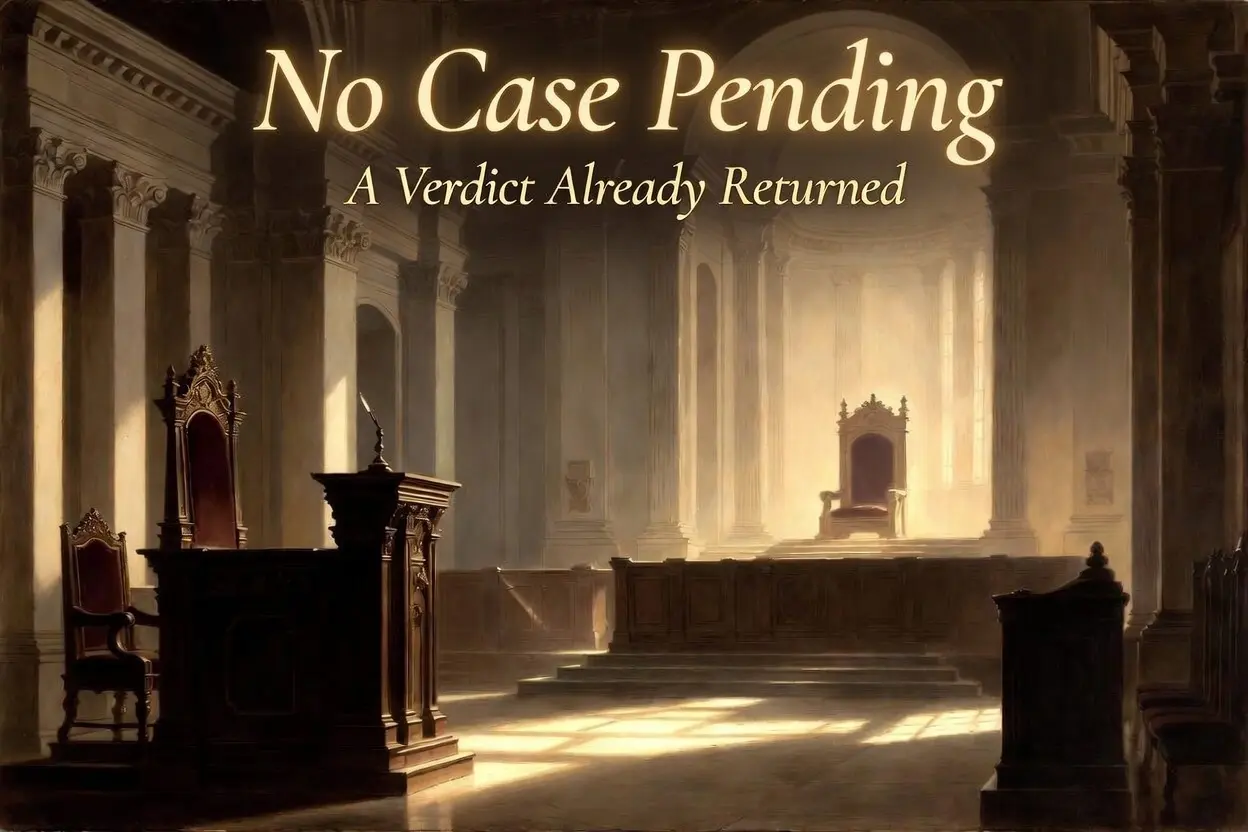
The whole flow rests on Christ as High Priest — One who is "passed into the heavens," to whom the believer must come in order to obtain mercy and find grace. That is priestly, approach-based language. It pictures a worshipper drawing near to a throne where a Priest mediates. Hold that picture in mind, because it is precisely not the language Paul uses to describe the Body of Christ.
The Posture of the Body: We Already Stand in Grace
Paul never tells the Body of Christ to come to grace to obtain it. He says we already stand inside it:
"Therefore being justified by faith, we have peace with God through our Lord Jesus Christ: By whom also we have access by faith into this grace wherein we stand, and rejoice in hope of the glory of God." (Romans 5:1–2 KJV)
Look carefully at the difference in posture. Hebrews pictures someone approaching a throne to get mercy and grace in a moment of need. Romans pictures someone already standing in grace, permanently. You cannot "come to" a place where you already stand. Grace is not a destination the believer in this dispensation visits in a crisis; it is the ground beneath his feet at all times.
This grace is not metered out crisis by crisis, either. It is the abounding grace that swallowed up the whole debt of sin:
"Moreover the law entered, that the offence might abound. But where sin abounded, grace did much more abound." (Romans 5:20 KJV)
And it is grace so absolute that it excludes the very category of earning that Hebrews keeps in view:
"And if by grace, then is it no more of works: otherwise grace is no more grace." (Romans 11:6 KJV)
Our Access Is Already Granted — Not Pending
Hebrews tells its readers to come with boldness in order to obtain. Paul tells the Body of Christ that the boldness and the access are already ours, already secured:
"For through him we both have access by one Spirit unto the Father." (Ephesians 2:18 KJV)
"In whom we have boldness and access with confidence by the faith of him." (Ephesians 3:12 KJV)
The boldness that Hebrews exhorts Israel to bring to a throne is something the Body of Christ already possesses — "boldness and access with confidence." Our access is not to a throne we must reach, but directly "unto the Father," and it is already granted by the indwelling Spirit. There is no waiting room, no approach, no transaction to complete.
We Are Seated in Christ, at the Right Hand of God — Far Above All
This is where Paul's revelation goes beyond anything in the Hebrew epistles. The Body of Christ does not stand at the foot of the throne waiting to obtain mercy. We have been raised and seated together with Christ in the heavenly places:
"Even when we were dead in sins, hath quickened us together with Christ, (by grace ye are saved;) And hath raised us up together, and made us sit together in heavenly places in Christ Jesus." (Ephesians 2:5–6 KJV)
Paul is careful about where that seat is. He never locates it at "the right hand of the throne" — that is the throne-room language of Hebrews, fitted to Israel's priestly program (Hebrews 8:1). Paul locates the seat at the right hand of a Person, the Father, far above every rank of authority:
"...when he raised him from the dead, and set him at his own right hand in the heavenly places, Far above all principality, and power, and might, and dominion." (Ephesians 1:20–21 KJV)
"If ye then be risen with Christ, seek those things which are above, where Christ sitteth on the right hand of God." (Colossians 3:1 KJV)
So our position is not above the throne, and it is not in the throne — to sit in the throne is Israel's overcomer promise (Revelation 3:21), not ours. Our position is in Christ, who is Himself seated at the right hand of God, far above all. You cannot meaningfully be commanded to come to a throne to find grace when you are already seated in the One who sits at the right hand of God, complete in Him. Our blessings are not handed out on request at a time of need; they were already given, in full, before we ever asked:
"For in him dwelleth all the fulness of the Godhead bodily. And ye are complete in him, which is the head of all principality and power." (Colossians 2:9–10 KJV)
Already complete in Him. Already accepted in the beloved:
"...wherein he hath made us accepted in the beloved." (Ephesians 1:6 KJV)
There is nothing left to obtain at a throne. The transaction is finished.
Already Blessed With All: The "All Spiritual Blessings" Argument
There is a single verse that settles the matter by itself, and it deserves to stand on its own. Reduce the question to a plain syllogism and watch it close.
First, grace to help in the time of need is, beyond any dispute, a spiritual blessing. It is not a material thing — not bread, not money, not bodily relief. It is grace, supplied by the Spirit of grace, for the soul. Whatever else it is, it belongs to the category of spiritual blessings.
Second, Paul tells the Body of Christ that we have already been blessed with the whole of that category — past tense and comprehensive, with nothing held in reserve:
"Blessed be the God and Father of our Lord Jesus Christ, who hath blessed us with all spiritual blessings in heavenly places in Christ." (Ephesians 1:3 KJV)
Mark the words. Not some spiritual blessings — all of them. Not blessings God will bestow at a time of need — blessings He hath bestowed, already, in Christ. The verb is finished and the scope is total.
Put the two together and the conclusion is unavoidable. If grace to help in the time of need is a spiritual blessing, and the Body of Christ has already been blessed with all spiritual blessings, then that grace is already in our possession. There is simply nothing of it left at a throne for us to come and obtain. To tell a member of the Body to journey to the throne of grace to find grace to help in time of need is to send him to fetch what God already deposited in his account in Christ before he ever felt the need.
And this is precisely why Hebrews 4:16 and Ephesians 1:3 cannot be addressed to the same people. Hebrews says come and find — the grace is future, conditional, not yet in hand. Ephesians says we have been blessed with all — already, fully, in hand. One audience is still reaching for grace it does not yet hold; the other was handed the entirety of it in Christ before the trial ever came. Two verses, one line drawn straight through the middle of the Book, dividing Israel's program from ours.
Someone may protest that "all spiritual blessings" in Ephesians 1 means the positional blessings — election, adoption, redemption, the sealing of the Spirit — and not the practical help a believer needs in a hard hour. But Paul has already answered that objection too. Our practical help also flows out of what is already ours, never from a throne we must approach to release it:
"But my God shall supply all your need according to his riches in glory by Christ Jesus." (Philippians 4:19 KJV)
The supply is measured "according to his riches" — riches already ours in Christ — not dispensed in exchange for a successful approach to a throne. Whether the blessing is called positional or practical, it was given in full when we believed Paul's gospel. There is no second window to visit.
Grace Already Sufficient: Paul's Own "Time of Need"
What did Paul do when he came to a genuine "time of need" — the thorn in the flesh that buffeted him? He did not journey to a throne of grace to find help. He asked the Lord, and the Lord's answer was not "come and obtain," but a present, settled sufficiency:
"And he said unto me, My grace is sufficient for thee: for my strength is made perfect in weakness. Most gladly therefore will I rather glory in my infirmities, that the power of Christ may rest upon me." (2 Corinthians 12:9 KJV)
The grace is already sufficient. The strength is made perfect in the weakness itself. This is the Pauline counterpart to Hebrews 4:16, and the contrast is exactly the dispensational difference. Israel's remnant is told to come and find grace for a time of need; Paul declares grace already sufficient in the time of need. For the Body of Christ, supply is not a thing we petition a throne to release — "my God shall supply all your need according to his riches in glory" (Philippians 4:19), out of riches already ours in Christ.
So To Whom Is Hebrews 4:16 Written?
Hebrews belongs to the Hebrew epistles, written to the believing remnant of Israel — not to the Body of Christ. This is not a guess; the book announces its audience and its program from the first verse:
"God, who at sundry times and in divers manners spake in time past unto the fathers by the prophets, Hath in these last days spoken unto us by his Son." (Hebrews 1:1–2 KJV)
The "fathers" are Israel's fathers; the "prophets" are Israel's prophets. The salvation in view was first spoken by the Lord and confirmed by those who heard Him in His earthly ministry to Israel:
"How shall we escape, if we neglect so great salvation; which at the first began to be spoken by the Lord, and was confirmed unto us by them that heard him." (Hebrews 2:3 KJV)
That is not Paul's gospel, received by revelation of the risen Christ. The readers are addressed as Israel's holy brethren, partakers of a calling tied to their promised hope:
"Wherefore, holy brethren, partakers of the heavenly calling, consider the Apostle and High Priest of our profession, Christ Jesus." (Hebrews 3:1 KJV)
And the entire epistle is built upon the New Covenant — a covenant God expressly makes with Israel and Judah, never with the Body of Christ:
"Behold, the days come, saith the Lord, when I will make a new covenant with the house of Israel and with the house of Judah." (Hebrews 8:8 KJV)
(I avoid the publisher's label "the New Testament" here on purpose. The Body of Christ is not under that covenant at all; these are simply the post-resurrection Scriptures, and Hebrews among them speaks to Israel's program, not ours.)
A Throne and a Melchisedec Priest — A Kingdom Relationship
Why is grace pictured as something Israel must come to a throne to obtain? Because the whole book frames the believer's relationship to Christ as subjects approaching a King-Priest — a high priest forever after the order of Melchisedec, who combines the offices of king and priest:
"Whither the forerunner is for us entered, even Jesus, made an high priest for ever after the order of Melchisedec." (Hebrews 6:20 KJV)
Israel's hope is to come to the heavenly Jerusalem, to a Mediator, under that covenant:
"But ye are come unto mount Sion, and unto the city of the living God, the heavenly Jerusalem... And to Jesus the mediator of the new covenant." (Hebrews 12:22, 24 KJV)
A throne, a priest, a mediator, a covenant, an approach — this is the architecture of Israel's relationship to her Messiah. It is real, it is precious, and it is not the relationship the Body of Christ sustains to her Head.
One clarification keeps this from overstating the case. The word mediator is not Israel's exclusive property — Paul gives the Body of Christ a Mediator too:
"For there is one God, and one mediator between God and men, the man Christ Jesus; Who gave himself a ransom for all, to be testified in due time." (1 Timothy 2:5–6 KJV)
The difference is not the word but the kind of mediation. In Hebrews, Christ is "the mediator of the new covenant" (Hebrews 12:24) — a covenant mediator, administering the covenant God makes with Israel and Judah. In Paul, Christ mediates not by covenant but by His person and His ransom: the one man who gave Himself a ransom for all. So when this article assigns the throne–priest–covenant pattern to Israel, it is the covenant mediatorship that belongs to her program, not the simple fact that Christ mediates. The Body has a Mediator; He simply does not mediate to us as the Priest of a covenant we were never under.
The "Time of Need" Is Israel's Hour of Trial
For the remnant, salvation is bound up in the future fulfillment of covenant promises, received by patient endurance unto the end. That is why their grace comes as help for a time of need rather than as a settled standing already possessed:
"For ye have need of patience, that, after ye have done the will of God, ye might receive the promise." (Hebrews 10:36 KJV)
"...unto them that look for him shall he appear the second time without sin unto salvation." (Hebrews 9:28 KJV)
"There remaineth therefore a rest to the people of God." (Hebrews 4:9 KJV)
Their rest still remaineth; it is not yet entered. Their salvation arrives when Christ appears the second time. They must come to the throne of grace because, for them, the grace to endure is supplied along the way to a salvation not yet received. The "time of need" is their hour of trial — the remnant pressing through tribulation while waiting for the promised kingdom. That is exactly who is told to come.
How Grace Is Administered to the Remnant: The Pattern Across the Hebrew Epistles
Hebrews 4:16 is not an isolated verse. It is one piece of a consistent pattern that runs through all the Hebrew epistles — Hebrews, James, the epistles of Peter, and the rest written to the believing remnant of Israel. When you read how grace operates across these books, you see a wholly different administration from the one Paul reveals for the Body of Christ. Grace is real and precious to the remnant, but it comes to them as help to endure a trial, supplied in measure, conditioned upon their walk, and crowned only at the appearing of Christ. It is not the finished, total, already-given possession Paul describes for us.
Notice first the audience markers themselves. These books announce that they are written to scattered Israel:
"James, a servant of God and of the Lord Jesus Christ, to the twelve tribes which are scattered abroad, greeting." (James 1:1 KJV)
"Peter, an apostle of Jesus Christ, to the strangers scattered throughout Pontus, Galatia, Cappadocia, Asia, and Bithynia." (1 Peter 1:1 KJV)
The twelve tribes; the scattered strangers of the dispersion. That is Israel's remnant, not the one new man of Jew and Gentile that Paul was sent to reveal. So whatever these books say about grace, they say it to that people, in their program.
And what do they say? They present grace as something still being supplied, and even still future. Peter tells the remnant to set their hope not on a grace already possessed in full, but on a grace yet to be brought to them at the second coming:
"Wherefore gird up the loins of your mind, be sober, and hope to the end for the grace that is to be brought unto you at the revelation of Jesus Christ." (1 Peter 1:13 KJV)
Read that against Ephesians 1:3 and the contrast is total. The Body has already been blessed with all spiritual blessings; the remnant is told to hope to the end for "the grace that is to be brought unto you" when Christ is revealed. Their grace is on the way; ours is in hand. They wait for it; we possess it. This is the same difference Hebrews 4:16 draws — a people coming to obtain what they do not yet hold.
Grace also reaches the remnant as the strength to be made perfect through suffering, dispensed only after the trial has done its work:
"But the God of all grace, who hath called us unto his eternal glory by Christ Jesus, after that ye have suffered a while, make you perfect, stablish, strengthen, settle you." (1 Peter 5:10 KJV)
"After that ye have suffered a while" — that is the "time of need" of Hebrews 4:16 from another angle. Grace carries the remnant through the suffering toward a perfecting still ahead. For the Body, by contrast, we are already "complete in him" (Colossians 2:10); there is no perfecting yet to be earned through a season of suffering.
This remnant-grace is even conditioned in a way that Body grace never is. It is given to the humble and resisted to the proud — a moral condition placed on its supply:
"But he giveth more grace. Wherefore he saith, God resisteth the proud, but giveth grace unto the humble." (James 4:6 KJV)
"...for God resisteth the proud, and giveth grace to the humble." (1 Peter 5:5 KJV)
"He giveth more grace" — grace added as it is needed, measured out to the humble. Paul never doles the Body's grace out by degrees according to our humility; he says we were blessed with all of it at once, in Christ. And because remnant-grace is supplied on the way and not yet finished, it can be forfeited — a man can fall short of it:
"Looking diligently lest any man fail of the grace of God; lest any root of bitterness springing up trouble you, and thereby many be defiled." (Hebrews 12:15 KJV)
A member of the Body of Christ cannot "fail of" a grace he has already been given in full and sealed in until the day of redemption. But the remnant can, because for them grace is the help that must be received and held all the way to the end.
Now, an honest objection: Peter does tell the remnant they "stand" in grace — "...exhorting, and testifying that this is the true grace of God wherein ye stand" (1 Peter 5:12 KJV) — and Paul uses that very word of the Body in Romans 5:2. Does that collapse the distinction? Not at all. The remnant stand within the sphere of God's gracious dealing with them, yet within that very sphere they are told to come and obtain (Hebrews 4:16), to hope for grace still to be brought (1 Peter 1:13), to be perfected after suffering (1 Peter 5:10), and to take care lest they fail of grace (Hebrews 12:15). Their standing is a standing in a grace still being administered toward a future end. The Body's standing is a standing in a grace already complete — "all spiritual blessings," nothing left to bring, nothing that can be failed of. The same word describes two very different administrations, and only right division keeps them apart.
So the whole pattern coheres. Across the Hebrew epistles, grace is help-grace: future at Christ's appearing, supplied through suffering, measured to the humble, and capable of being forfeited. That is exactly the kind of grace one would have to come to a throne to find in a time of need — and exactly the kind of grace the Body of Christ has no need to come for, because we were blessed with the whole of it before the need arose.
Subjects of a King-Priest vs. Members of a Head
Here is the cleanest way to hold the distinction. Israel relates to Christ as subjects to a King-Priest — they approach a throne, they obtain mercy, they find grace at a mediator's hand. The Body of Christ relates to Christ as members to a Head — we are not approaching Him, we are joined to Him and seated in Him:
"And hath put all things under his feet, and gave him to be the head over all things to the church, Which is his body, the fulness of him that filleth all in all." (Ephesians 1:22–23 KJV)
"And he is the head of the body, the church: who is the beginning, the firstborn from the dead; that in all things he might have the preeminence." (Colossians 1:18 KJV)
A subject travels to the throne. A member of the body is already united to the Head and already lives by His life. This is why Paul received a distinct gospel for a distinct people:
"...the gospel of the uncircumcision was committed unto me, as the gospel of the circumcision was unto Peter." (Galatians 2:7 KJV)
To read Israel's throne-of-grace command onto the Body of Christ is to drag a member of the body back down to the floor of a throne room to beg for what he was already freely given when he believed Paul's gospel.
Why This Matters
This is not a quibble over verses. It strikes at assurance. If grace is something I must come and obtain afresh at every time of need, then grace is conditioned on my coming — and the believer is thrown back onto a performance treadmill, never sure he has approached well enough, prayed hard enough, or come boldly enough to secure the help he needs. That is precisely the uncertainty the Hebrew epistles hold over a remnant whose salvation is still future.
But Paul's revelation lifts the Body of Christ entirely off that treadmill. We do not come to the throne to obtain mercy; we have already obtained it. We do not travel to grace to find it in a crisis; we stand in it and are seated in Christ, at the right hand of God, far above all. Our Lord indeed liveth and maketh intercession (Romans 8:34), but our relationship to Him is not a worshipper's approach to a throne — it is a member's union with the Head. The grace is already sufficient. The seat is already ours. The blessings are already given, in full, in Christ.
So, must a member of the Body of Christ come to the throne of grace to find grace in the time of need? No — and it is no small mercy that we need not. That command belongs to the believing remnant of Israel, supplied grace to endure unto a salvation not yet received. We who are saved under Paul's gospel were never sent to a throne to obtain what we already possess. We were raised, seated, accepted, and completed in Christ before we ever faced the trial — and there we remain.
© 2026 Edward R. Cross









Comments
No comments yet. Be the first to share your thoughts.
Leave a comment