Since the beginning of the Apostle Paul's ministry there has been an attempt to co-mingle law and grace, thereby moving the believer away from faith in what has been revealed in the words of Christ given to Paul. Paul claimed that Christ was speaking through him.
"Since ye seek a proof of Christ speaking in me, which to you-ward is not weak, but is mighty in you." (2 Corinthians 13:3 KJV)
As the Apostle to the Gentiles, Paul spoke to the Gentiles magnifying his office and authority in the things he was saying to them.
"For I speak to you Gentiles, inasmuch as I am the apostle of the Gentiles, I magnify mine office:" (Rom. 11:13 KJV)
Either Paul was an extreme egotist or he had been given a special office when it came to ministering to the Gentiles, unlike any of the other apostles who were apostles to the circumcision. He was ordained to be a preacher and an apostle, a teacher of the Gentiles in faith and verity.
"Whereunto I am ordained a preacher, and an apostle, (I speak the truth in Christ, and lie not;) a teacher of the Gentiles in faith and verity." (1 Tim. 2:7 KJV)
No one was better equipped to instruct the believers in what to believe during the dispensation of grace than Paul. He understood God's relationship with believers under grace like none of the apostles to the circumcision. Peter even professed he had a hard time understanding some of the things in Paul's epistles.
"But contrariwise, when they saw that the gospel of the uncircumcision was committed unto me, as the gospel of the circumcision was unto Peter; (For he that wrought effectually in Peter to the apostleship of the circumcision, the same was mighty in me toward the Gentiles:) And when James, Cephas, and John, who seemed to be pillars, perceived the grace that was given unto me, they gave to me and Barnabas the right hands of fellowship; that we should go unto the heathen, and they unto the circumcision." (Galatians 2:7–9 KJV)
Why would Paul draw a distinction in the "gospel of the uncircumcision" and the "gospel of the circumcision" if they were the same gospel?
"And account that the longsuffering of our Lord is salvation; even as our beloved brother Paul also according to the wisdom given unto him hath written unto you; As also in all his epistles, speaking in them of these things; in which are some things hard to be understood, which they that are unlearned and unstable wrest, as they do also the other scriptures, unto their own destruction." (2 Peter 3:15–16 KJV)
The gospel of the uncircumcision was committed to Paul and the gospel of the circumcision was committed to Peter, James, and John. It should be no surprise to find doctrinal variances between Paul's epistles to the Gentiles and the epistles written by James, Peter, and John who were ministering to the Jews.
Paul often stressed his special relationship to the Gentile believers in Christ.
"For this cause I Paul, the prisoner of Jesus Christ for you Gentiles," (Ephesians 3:1 KJV)
"Nevertheless, brethren, I have written the more boldly unto you in some sort, as putting you in mind, because of the grace that is given to me of God, That I should be the minister of Jesus Christ to the Gentiles, ministering the gospel of God, that the offering up of the Gentiles might be acceptable, being sanctified by the Holy Ghost." (Romans 15:15–16 KJV)
It is truly a mystery why teachers of the word of God fail to emphasize Paul's unique ministry to the Gentiles, but instead try to mix the epistles written by the apostles to the circumcision into Paul's teaching.
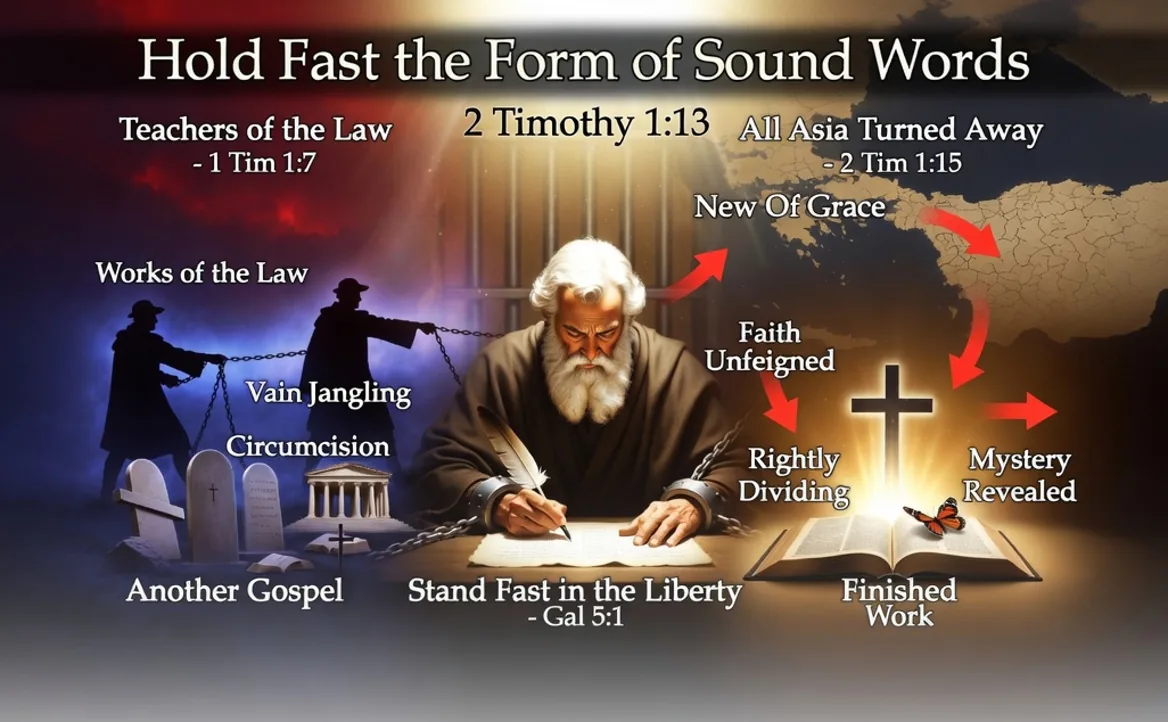
Paul had warned young Timothy regarding those who desired to be teachers of the law.
"Now the end of the commandment is charity out of a pure heart, and of a good conscience, and of faith unfeigned: From which some having swerved have turned aside unto vain jangling; Desiring to be teachers of the law; understanding neither what they say, nor whereof they affirm. But we know that the law is good, if a man use it lawfully;" (1 Timothy 1:5–8 KJV)
Paul referred to this law-teaching as vain jangling — a lot of useless noise. These teachers were troubling Paul's converts in the region of Galatia.
"O foolish Galatians, who hath bewitched you, that ye should not obey the truth, before whose eyes Jesus Christ hath been evidently set forth, crucified among you? This only would I learn of you, Received ye the Spirit by the works of the law, or by the hearing of faith? Are ye so foolish? having begun in the Spirit, are ye now made perfect by the flesh?" (Galatians 3:1–5 KJV)
Paul instructed Timothy to continue in the things he had learned from Paul and had been assured of.
"But continue thou in the things which thou hast learned and hast been assured of, knowing of whom thou hast learned them;" (2 Timothy 3:14 KJV)
Let's look at some things written by Paul through which he was ministering the Spirit to them by the "hearing of faith."
"Now to him that worketh is the reward not reckoned of grace, but of debt. But to him that worketh not, but believeth on him that justifieth the ungodly, his faith is counted for righteousness. Even as David also describeth the blessedness of the man, unto whom God imputeth righteousness without works, Saying, Blessed are they whose iniquities are forgiven, and whose sins are covered. Blessed is the man to whom the Lord will not impute sin." (Romans 4:4–8 KJV)
What a tremendous truth — that God justifies the ungodly. He WILL NOT impute sin to them. Do you believe that? Do your teachers believe that?
Paul gave assurance of these marvelous truths repeatedly.
"In whom we have redemption through his blood, the forgiveness of sins, according to the riches of his grace;" (Ephesians 1:7 KJV)
Paul wrote very clearly that in Christ believers HAVE the forgiveness of sins — according to the riches of his grace. God's wisdom and prudence are demonstrated by the abounding riches of his grace in forgiving believers of their sins through the blood of Christ.
"Who hath delivered us from the power of darkness, and hath translated us into the kingdom of his dear Son: In whom we have redemption through his blood, even the forgiveness of sins:" (Colossians 1:13–14 KJV)
Believers HAVE the forgiveness of sins. And when Christ was quickened from the dead, none of us alive today had committed a single sin — yet in our quickening together with Christ, God forgave ALL our trespasses.
"And you, being dead in your sins and the uncircumcision of your flesh, hath he quickened together with him, having forgiven you all trespasses;" (Colossians 2:13 KJV)
Now it's up to you to believe it. Those who are saved are blessed because God has forgiven ALL of their sins according to the riches of his grace and the Lord WILL NOT impute sin to them.
This is important because it will determine whether believers continue to live by the "hearing of faith" or try to be made perfect by the flesh by taking heed to the vain jangling of would-be law teachers.
Watch as Paul uses this knowledge to exhort believers in their daily walk:
"And be ye kind one to another, tenderhearted, forgiving one another, even as God for Christ's sake hath forgiven you." (Ephesians 4:32 KJV)
"Forbearing one another, and forgiving one another, if any man have a quarrel against any: even as Christ forgave you, so also do ye." (Colossians 3:13 KJV)
How ridiculous would it be for Paul to appeal for believers to forgive others on the basis of God for Christ's sake having forgiven them, if they weren't already forgiven? There is no need for believers saved under the gospel of the grace of Christ to seek forgiveness from God for sins. Why? Because they already have it and He won't impute sin to them.
Now let's look at a contradiction in scripture, if you don't rightly divide the word of truth as Paul instructs in 2 Timothy 2:15.
"Study to shew thyself approved unto God, a workman that needeth not to be ashamed, rightly dividing the word of truth." (2 Timothy 2:15 KJV)
Here are the words of Christ spoken as the minister of the circumcision (Romans 15:8) to his Jewish followers:
"For if ye forgive men their trespasses, your heavenly Father will also forgive you: But if ye forgive not men their trespasses, neither will your Father forgive your trespasses." (Matthew 6:14–15 KJV)
That is conditional forgiveness — they have to forgive to be forgiven, they don't forgive because they've already been forgiven. That is a kingdom readiness truth aimed at Israel. It is not doctrine for the body of Christ under the dispensation of grace. The same is true of 1 John 1:8-9, which is written by an apostle to the circumcision to the Jewish remnant — not to Gentile members of the body of Christ under Paul's gospel.
Paul says our flesh must be changed:
"For this corruptible must put on incorruption, and this mortal must put on immortality." (1 Corinthians 15:53 KJV)
Our flesh, as it is, cannot inherit the kingdom of God — so it must be changed by the Spirit of Christ. Do you still think you need to be washed again and again in the blood of Christ to get God to forgive you? Or are you willing by faith to believe the scriptural truths that Paul has revealed?
"Not by works of righteousness which we have done, but according to his mercy he saved us, by the washing of regeneration, and renewing of the Holy Ghost;" (Titus 3:5 KJV)
Believers have been made new by the Holy Ghost and the washing of regeneration — wholly on the basis of God's mercy and not a single work of righteousness on the part of the believer.
Paul says we have already been reconciled to God:
"Therefore if any man be in Christ, he is a new creature: old things are passed away; behold, all things are become new. And all things are of God, who hath reconciled us to himself by Jesus Christ, and hath given to us the ministry of reconciliation; To wit, that God was in Christ, reconciling the world unto himself, not imputing their trespasses unto them; and hath committed unto us the word of reconciliation." (2 Corinthians 5:17-19 KJV)
In Christ, believers are reconciled to God and our trespasses are not imputed to us — just like Romans 4:8 declared.
Paul warned the believers about false teachers seeking to bring them back into bondage:
"And that because of false brethren unawares brought in, who came in privily to spy out our liberty which we have in Christ Jesus, that they might bring us into bondage:" (Galatians 2:4 KJV)
"Stand fast therefore in the liberty wherewith Christ hath made us free, and be not entangled again with the yoke of bondage." (Galatians 5:1 KJV)
Paul's ministry was to testify the gospel of the grace of God, pure from the blood of all men, having not shunned to declare all the counsel of God.
"For whatsoever things were written aforetime were written for our learning, that we through patience and comfort of the scriptures might have hope." (Romans 15:4 KJV)
Yes, believers can learn from what was written in the other scriptures, but the focus should be through patience and comfort of the scriptures to have hope — not despair.
Do you believe what Christ revealed to the Apostle Paul for the body of Christ? Our relationship with God is based upon the finished work of Christ and faith in what he has done for us. For New Testament Christians the relationship is — do because you've already received the promise because of the work of Christ. The promise is unconditional to us because Christ met the conditions for us.
Will you believe that God has forgiven all your trespasses? Will you exercise faith in those words of scripture revealed to Paul for the body of Christ and thank God for his grace in not imputing your trespasses to you? This is the ministry of the Spirit of Christ in this age.
May the Lord bless you as you believe his word through Paul.