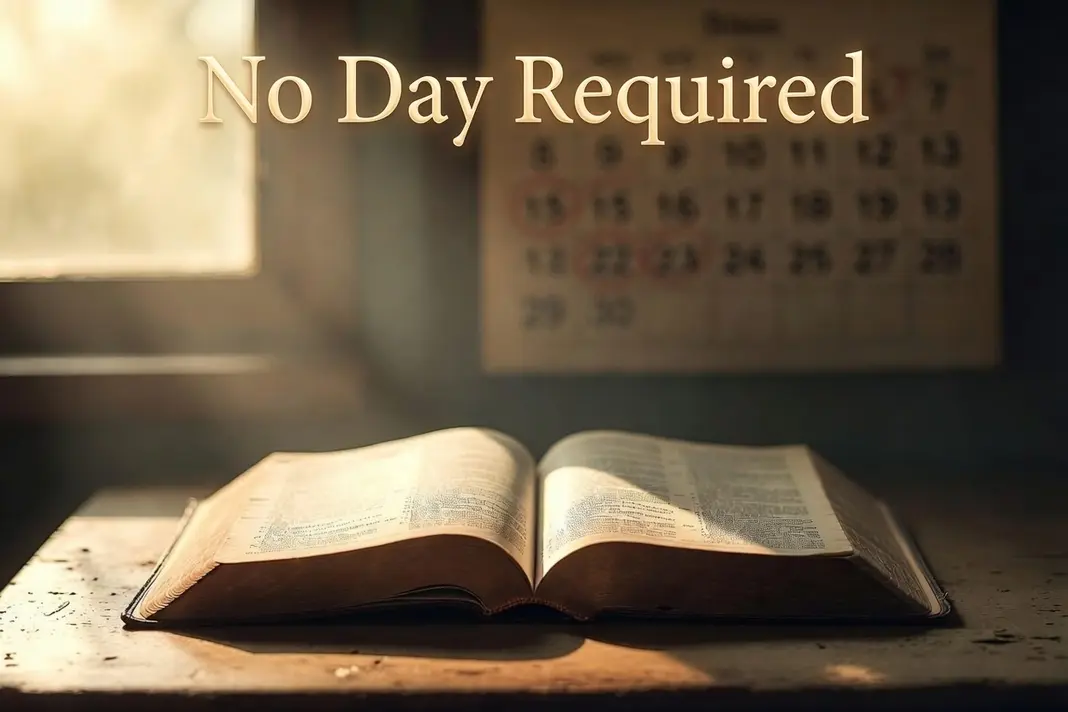
If you have spent any time in a church, you have felt it — the unspoken expectation. Miss Easter Sunday and you are spiritually suspect. Skip the Christmas Eve service and something must be wrong with you. And if you dare suggest that neither Saturday nor Sunday carries any special divine obligation for believers today, prepare for a look you will not soon forget.
These expectations run deep. But when we follow Paul's instruction to rightly divide the word of truth, we find that the entire structure of sacred days — Sabbath, new moons, annual feasts, and the church calendar alongside them — was never given to the Body of Christ in the first place.
This article is not an argument against celebrating anything. If Christmas morning fills your home with gratitude for the Savior, rejoice. If gathering with believers on Easter calls your heart to the cross and the empty tomb, there is nothing wrong with that. The issue is not the day. The issue is the requirement — spoken or unspoken — that observing certain days is what faithful Christians do, and that failing to observe them is a mark against you.
That requirement, wherever it comes from, is not from Paul. And Paul is our apostle.
The Sabbath Was Given to Israel
Before addressing the Mosaic command, one prior objection must be answered. Sabbatarians often argue that the Sabbath is not a Mosaic institution at all — it is a creation ordinance, predating Israel and therefore binding on all mankind. They point to Genesis 2:2–3:
"And on the seventh day God ended his work which he had made; and he rested on the seventh day from all his work which he had made. And God blessed the seventh day, and sanctified it: because that in it he had rested from all his work which God created and made." (Genesis 2:2–3 KJV)
God rested. God blessed the seventh day. God sanctified it. All of that is in the text. What is not in the text is any command given to man. No human being in Genesis 2 is instructed to observe anything. The sanctification of the day is God's act in relation to His own rest — the text records what He did, not what He required of Adam. There is no imperative. No obligation is stated. The bridge from "God blessed this day" to "all mankind is therefore commanded to observe it" is a theological inference the passage does not make.
The patriarchal record confirms this. If the Sabbath were a universal creation ordinance in force from the beginning, we would expect to find it observed by Adam, Enoch, Noah, Abraham, Isaac, and Jacob. It is entirely absent from every one of their narratives. Not a single Sabbath observance is recorded in Genesis — nor a rebuke for failing to observe it. The silence of thirty-five chapters speaks plainly: the seventh-day rest was God's, not yet a command laid upon mankind.
The first Sabbath command given to human beings appears in Exodus 16 — to Israel, in the wilderness, in the context of the manna. And Exodus 20:11 does cite creation as the ground of the command — "For in six days the LORD made heaven and earth... and rested the seventh day: wherefore the LORD blessed the sabbath day, and hallowed it" (Exodus 20:11) — but this is God explaining the authority behind the command He is now giving to Israel — the reason He chose the seventh day. It is not a citation of an obligation already in force. The creation pattern is the reason for the choice, not evidence of a prior universal law.
The Sabbath commandment therefore appears first in Exodus 16, before Sinai, in the context of the manna. God told Israel not to gather on the seventh day because it was a day of rest. By Exodus 20 it was formalized as the fourth commandment:
"Remember the sabbath day, to keep it holy. Six days shalt thou labour, and do all thy work: But the seventh day is the sabbath of the LORD thy God: in it thou shalt not do any work, thou, nor thy son, nor thy daughter, thy manservant, nor thy maidservant, nor thy cattle, nor thy stranger that is within thy gates." (Exodus 20:8–10 KJV)
Notice the scope: Israel, their households, their servants, and the stranger within their gates. The Sabbath was given to a covenant people in a covenant land. It was not issued to all nations. It was not designed for export.
Ezekiel makes the covenantal character of the Sabbath explicit:
"Moreover also I gave them my sabbaths, to be a sign between me and them, that they might know that I am the LORD that sanctify them." (Ezekiel 20:12 KJV)
A sign between God and Israel. Not a universal moral law binding all people of all ages, but a covenant sign — as specifically Israel's as circumcision. The nations were never commanded to keep it.
The Sabbath Could Not Have Been Universal
There is a practical problem with claiming the Sabbath is binding on all people everywhere: the command as given cannot function globally.
The weekly Sabbath is tied to a specific 24-hour period — sundown Friday to sundown Saturday in the Hebrew reckoning. But the earth is a sphere. When it is Friday evening in Jerusalem, it is already Saturday morning in parts of Asia and still Friday afternoon in the Americas. A believer in New Zealand and a believer in California cannot keep the same moment simultaneously. The system was simply never architected for global application — because it was never intended for global application.
Furthermore, the Sabbath was embedded in a larger calendar system that only made sense in the land: weekly Sabbaths, new moons, annual feasts, sabbatical years, and the Jubilee. Every layer was tied to an agricultural cycle, a sacrificial system, and a land flowing with milk and honey. Strip it from that context and you are keeping the shell of a commandment whose substance was always covenantal and geographical.
A Shadow, Not a Substance
Paul addresses the Sabbath and related holy days directly in Colossians:
"Let no man therefore judge you in meat, or in drink, or in respect of an holyday, or of the new moon, or of the sabbath days: Which are a shadow of things to come; but the body is of Christ." (Colossians 2:16–17 KJV)
The structure of Paul's argument is important, and his exact wording matters. He says these holy days, new moons, and Sabbaths are shadows of things to come — present tense, future orientation. He is not describing something past or defunct. He is describing their essential nature and identity: by their very character, these ordinances are prophetic shadows belonging to Israel's program. They are not operative today — not because they have been abolished, but because the program they belong to is not the program God is presently running. They will have their proper place again when Israel's prophetic program resumes.
It should be acknowledged honestly that some of these ordinances had both a backward and a forward dimension. Exodus 12:14 explicitly calls Passover "a memorial" — it looked back to the Exodus from Egypt at the same time it pointed forward to the Messiah. The Feast of Booths commemorated the wilderness wandering while pointing forward to the coming kingdom. These were not single-direction shadows; they carried the weight of Israel's history on one side and Israel's prophetic future on the other.
The objection built on that passage — that Paul is shielding the sabbath-keeper rather than the free man — is answered in full in Who Is Paul Protecting? Answering the Colossians 2 Objection. But this is precisely where the most common defense of Christian holy day observance fails — not because the shadows only pointed forward, but because Paul's release from these ordinances does not depend on which direction they face. The defense runs: these days pointed to Christ — His birth, His death, His resurrection — and now that those events have occurred, we observe them as memorials, looking back at what they pointed to. But Paul does not say let no man judge you because the referents are still future. He says let no man judge you — full stop — because the body is of Christ. The substance is the issue, not the shadow's orientation. Whether a particular feast looked backward to the Exodus, forward to the kingdom, or both simultaneously, the Body of Christ possesses the substance to which every shadow, in every direction, ultimately points. That settles the observance question regardless of the memorial argument.
The body — the substance that casts the shadow — is of Christ. We who are members of the Body of Christ have the substance. We are complete in Him now, in this dispensation. You do not observe a shadow — backward-facing or forward-facing — when the substance is already yours.
What did the Sabbath shadow? The seventh day rest pictured the coming time when Israel's work would be complete — when the Messiah would have established His kingdom and the covenant people would enter into their promised rest. That day is still future for Israel. But for members of the Body of Christ, something far better is already true: we are complete in Him (Colossians 2:10). We do not wait for a weekly day to remind us that rest is coming. We rest in Christ now, every day, because our sins are already forgiven and our standing before God is already settled.
Returning to the observance of these days diminishes the full sufficiency of what we already have in Christ — something Paul addresses directly, as we will see.
The "Christian Sabbath" Has No Basis
Two groups claim a Sabbath obligation today, and both are wrong.
Seventh-day Sabbatarians — including Seventh-day Adventists and various Messianic groups — argue that the Saturday Sabbath was never abrogated and remains binding on all believers. But as we have seen, the Sabbath was never given to all believers. It was given to Israel as a covenant sign. Paul's explicit statement in Colossians 2:16 releases the Body of Christ from any obligation to observe it.
Beyond the covenantal argument, the global functioning problem exposes the Sabbatarian claim at its practical foundation. The seventh-day Sabbath was tied to a specific 24-hour period — sundown Friday to sundown Saturday in the Hebrew reckoning. If the command is binding on all believers everywhere, then all believers everywhere must keep the same moment. But the earth is a sphere. When it is Friday evening in Jerusalem, it is already Saturday morning in parts of Asia and still Friday afternoon in the Americas. A believer in New Zealand and a believer in California cannot keep the same moment simultaneously. No calendar adjustment resolves this — the problem is geometric, not administrative.
A command that cannot be universally and simultaneously obeyed was never designed for universal simultaneous obedience. The Sabbath was architected for a specific people in a specific land under a specific covenant. It was given to Israel in Canaan, embedded in an agricultural and sacrificial calendar that functioned within those borders. The seventh-day Sabbatarian, in insisting on global observance of a land-bound ordinance, is pressing the command far beyond the boundaries it was ever designed to reach.
Sunday-as-Sabbath Christians span virtually all of Christendom — Roman Catholic, Eastern Orthodox, and Protestant alike. The practice of treating Sunday as the primary sacred day of rest and worship is not a Protestant distinctive; it is nearly universal across Christian tradition. What varies is the reasoning and the label.
The Roman Catholic Church does not merely say the church recognized or inherited Sunday worship — it claims to have authorized the change from Saturday to Sunday, pointing to that authority as evidence of the church's power to bind and loose. Rome makes the claim openly, and Seventh-day Adventists regularly cite it in their arguments against Catholicism. Eastern Orthodoxy observes Sunday as the Lord's Day with equal conviction, grounding it in the resurrection and the ancient practice of the church.
Within Protestantism, the Reformed and Puritan tradition took the position furthest. The Westminster Confession of Faith, the foundational doctrinal standard of Presbyterian and Reformed churches, states explicitly that God has appointed one day in seven as a Sabbath, binding on all men in all ages, and that at the resurrection of Christ this was transferred to the first day of the week — which it calls, in its own words, "the Christian Sabbath." The Confession goes further, requiring that the day be kept by "holy rest, all the day, from their own works, words, and thoughts about their worldly employments and recreations." Not an hour of worship followed by an ordinary afternoon — the entire day, set apart.
That standard is worth noting, because it exposes a further inconsistency. Even within the tradition that most explicitly names Sunday as the Christian Sabbath and spells out its requirements, modern observance falls dramatically short of the Confession's own definition. The very tradition that coined the term does not keep what it defined.
None of these positions — Catholic, Orthodox, or Reformed — has Scriptural warrant. The post-resurrection Scriptures nowhere command Sunday worship or transfer Sabbath obligations to the first day. The shift developed in early church history as Christianity sought to distinguish itself from Judaism and accommodate Roman culture. Whatever authority is claimed for it, that authority is tradition, not Scripture.
The problem runs deeper than a missing proof text, however. The moment you measure typical Sunday observance against the actual content of the Sabbath law, the claim that Sunday is the Christian Sabbath collapses entirely on its own terms.
The Sabbath law was not simply a command to rest. It was a detailed and enforceable code. No work of any kind was permitted — for anyone in the household, including servants and animals (Exodus 20:9–10). Fire was explicitly forbidden:
"Ye shall kindle no fire throughout your habitations upon the sabbath day." (Exodus 35:3 KJV)
Food was to be prepared the day before; cooking on the Sabbath was prohibited (Exodus 16:23). Israelites were not to leave their place:
"Abide ye every man in his place, let no man go out of his place on the seventh day." (Exodus 16:29 KJV)
Commerce — buying and selling — was forbidden (Nehemiah 10:31; 13:15–17). Carrying burdens was forbidden (Jeremiah 17:21–22). Travel beyond a Sabbath day's journey — roughly three-quarters of a mile — was not permitted. And violation was not a matter for mild rebuke. When a man was found gathering sticks on the Sabbath, God commanded that he be stoned to death (Numbers 15:32–36).
Now consider what professing Christians do on their "Sabbath." They drive to church — a journey exceeding a Sabbath day's journey many times over, powered by an engine that kindles fire. They turn on lights, heating, and air conditioning in the building — fire. Many cook Sunday dinner at home, or drive to a restaurant — cooking and commerce. The church receives an offering — commerce. Someone carried a load. Someone worked. And the congregation goes home afterward to an ordinary afternoon.
At this point someone will rightly raise what Christ himself said. When the Pharisees accused his disciples of Sabbath violation, Jesus pointed to the priests:
"Or have ye not read in the law, how that on the sabbath days the priests in the temple profane the sabbath, and are blameless?" (Matthew 12:5 KJV)
The priestly exception is real and Christ acknowledged it. Those serving in the temple on the Sabbath — offering sacrifices, maintaining the service of God's house — were not in violation. One could argue that the pastor preaching, the musicians leading worship, and the staff serving the congregation fall under the same principle.
Grant it entirely. The priestly exception still only reaches so far. It covered defined temple duties — not the drive to church, not the restaurant after the service, not the grocery run on the way home, not the fire kindled in every home and vehicle. The exception was specific and law-governed, existing within the same law that prescribed death for gathering sticks. You cannot invoke the priestly exception to cover the religious hour and then ignore the Sabbath law for the other twenty-three.
More pointedly: invoking the priestly exception concedes that you are under the same law that grants it — which means you are equally under the same law that prohibits travel, fire, commerce, and labor, with death as the penalty for violation. The exception tightens the very obligation it was meant to relieve.
Sunday-as-Sabbath Christianity has not relocated the Sabbath. It has taken the Sabbath name, attached it to the wrong day — the first day rather than the seventh — stripped out the entire legal substance, and called the result holy. It is a tradition wearing the Sabbath's clothes.
At this point a gentler defense is sometimes offered: we are not claiming to keep the Sabbath precisely — we are simply observing Sunday in the spirit of a day of rest. The specific rules are the letter; rest is the principle behind them, and that principle is what we honor.
This argument is a significant concession dressed as a defense. The Sabbath was never given as a general principle of rest. It was a specific, detailed commandment with specific, enforceable rules. There is no provision in the law for keeping it "in spirit." The man who gathered sticks on the Sabbath was not spared because he explained that he understood the principle of rest.
To be clear about what follows: Christ's words in Matthew 5 were spoken during his earthly ministry to Israel, under and within the Mosaic law. He was not addressing the Body of Christ — we will come to that dispensational boundary momentarily. But for someone who claims to be observing the Sabbath, or observing Sunday as its equivalent, Christ's own words within that same context apply with full force:
"For verily I say unto you, Till heaven and earth pass, one jot or one tittle shall in no wise pass from the law, till all be fulfilled. Whosoever therefore shall break one of these least commandments, and shall teach men so, he shall be called the least in the kingdom of heaven." (Matthew 5:18–19 KJV)
Not one jot or tittle. Even the least commandments. If you are claiming to stand under the Sabbath law — or a Sunday version of it — Christ will not allow the "principle without the specifics" move. The fire prohibition is not a jot to be discarded. The travel restriction is not a tittle to be set aside in favor of the spirit of the thing. The argument is used here not to bind the Body of Christ to the law, but to show that those who claim the Sabbath's authority cannot selectively invoke its name while dismissing its content.
Some will appeal here to another statement Christ made in the same ministry context — "The sabbath was made for man, and not man for the sabbath" (Mark 2:27) — as if this softens the requirement and supports the "spirit of rest" reading. But you cannot take the softening from one verse and ignore the hardening from the other. Both are from the same earthly ministry, to the same audience, within the same law. Christ said the Sabbath was a benefit given for man's sake. He also said not one jot or tittle of the law passes. Both statements stand together. The Sabbath was indeed made as a gift of rest for those to whom it was given — but that gift came with its full legal weight intact, and Christ insisted that weight was not being reduced.
The dispensational boundary of both statements matters. Christ spoke in Matthew 5 and Mark 2 to Israel, under the law He was born under and would fulfill. He was not addressing the Body of Christ. Those who claim Sunday as the Christian Sabbath cannot selectively borrow the comfort of Mark 2:27 from that context while declining the obligation of Matthew 5:18–19 from the same context. The two stand or fall together — and neither was spoken to us.
But we need not rest the case on inference and cross-examination. Paul speaks directly to this. Writing to believers — members of the Body of Christ — he addresses those who had begun turning back to the observance of special days:
"But now, after that ye have known God, or rather are known of God, how turn ye again to the weak and beggarly elements, whereunto ye desire again to be in bondage? Ye observe days, and months, and times, and years. I am afraid of you, lest I have bestowed upon you labour in vain." (Galatians 4:9–11 KJV)
Days. Months. Times. Years. Paul is not describing a neutral choice. He calls it a return to weak and beggarly elements — a turning back from the sufficiency of Christ to the lesser things that once served as pictures of Him. He calls it bondage. And he says he is afraid for them, because their orientation has shifted away from the one thing that gives them standing and rest: the gospel of grace.
This is Paul — our apostle, the apostle of the Gentiles, the one through whom the mystery of Christ was revealed — speaking with apostolic concern directly to the Body of Christ about the adoption of sacred days. His verdict is not ambiguous. Neither group can produce a Pauline command requiring any weekly sacred day for members of the Body of Christ. What they can find is Paul's alarm at those who adopted one.
Some object that Galatians 4 does not address Jewish calendar observance at all — that when Paul asks how the Galatians can turn "again" to the weak and beggarly elements, he means their former pagan religious calendar (v.8: "ye did service unto them which by nature are no gods" (Galatians 4:8)), not Jewish Sabbaths and feasts. On this reading, Galatians 4 has nothing to say about the Sabbath question.
The objection does not hold, for three reasons. First, the Galatian epistle as a whole is written against Judaizers pressing circumcision and law-keeping on Gentile believers — that is the letter's central concern, and the "days, months, times, years" of verse 10 belong to that context, paralleling exactly the "holyday... new moon... sabbath days" of Colossians 2:16. Second, "again" does not mean returning to the identical calendar — it means returning to the same nature of bondage. Moving from pagan sacred days to Jewish sacred days is not an escape from weak and beggarly elements; it is a change of address within them. Third, Paul's verdict covers both regardless of source. If calendar observance imposed on Gentile believers constitutes bondage when the calendar is pagan, it remains bondage when the calendar is Jewish. Paul's concern is not where the days came from. It is any system of days and seasons placed between the believer and the full sufficiency of Christ.
"The Lord's Day" Is Not Sunday
One passage gets pressed into service to establish Sunday as a sacred day:
"I was in the Spirit on the Lord's day, and heard behind me a great voice, as of a trumpet." (Revelation 1:10 KJV)
The argument runs: John said "the Lord's day," the church had already been calling Sunday "the Lord's day" by the second century, therefore this confirms Sunday observance.
But look at what follows in Revelation 1. John does not describe a pleasant Sunday morning worship service. He describes the glorified Christ in terrifying majesty, delivers seven letters to seven churches with urgent warnings, and then is transported through visions of judgment, tribulation, cosmic upheaval, the return of Christ, and the establishment of the kingdom. What John was "in the Spirit" for was not a weekly gathering — it was the Day of the Lord.
The Day of the Lord is a well-established prophetic period throughout Scripture. Isaiah, Joel, Amos, Zephaniah, Zechariah — the prophets consistently use this phrase for a coming time of divine judgment and restoration. Paul uses it in exactly this sense:
"For yourselves know perfectly that the day of the Lord so cometh as a thief in the night." (1 Thessalonians 5:2 KJV)
Peter uses the same language — "But the day of the Lord will come as a thief in the night" (2 Peter 3:10).
Revelation 1:10 is John saying he was caught up prophetically into that future period and saw its events. The entire book of Revelation is the content of what he saw there. The phrase was not establishing a Christian worship day — it was describing the subject of the vision.
The second-century church had already drifted significantly from Paul's gospel by the time "the Lord's day" as Sunday became common terminology. Reading that tradition back into Revelation 1:10 is letting church history interpret Scripture rather than letting Scripture speak for itself.
Other Texts Used for Sunday Worship
Revelation 1:10 is not the only passage pressed into service for Sunday observance. Two others appear frequently and deserve a direct answer.
The first is Acts 20:7:
"And upon the first day of the week, when the disciples came together to break bread, Paul preached unto them, ready to depart on the morrow; and continued his speech until midnight." (Acts 20:7 KJV)
Three things are worth noting. First, this is descriptive, not prescriptive — it records what occurred on a particular occasion, not what is commanded for all believers. Second, the Hebrew reckoning of days runs from sundown to sundown. The first day of the week begins at Saturday sundown. The gathering in Acts 20 took place in the evening — there were "many lights in the upper chamber" (v.8) and Paul preached until midnight. By modern reckoning this is Saturday night, not Sunday morning. Third, the reason for the gathering is explicit: Paul was leaving the next day. This was a farewell meeting, not a pattern of weekly Sunday worship. Nothing in the passage sanctifies a day, commands a sacred rest, or transfers any Sabbath obligation to the first day of the week.
The second passage is 1 Corinthians 16:2:
"Upon the first day of the week let every one of you lay by him in store, as God hath prospered him, that there be no gatherings when I come." (1 Corinthians 16:2 KJV)
The phrase "lay by him in store" is the key. By him — at home, set aside privately. Paul is not instructing a church collection taken up at a Sunday service. He is telling each believer to put money aside at home, week by week, so that when he arrives the fund will already be assembled and there will be no scrambling to organize a collection at the last minute. This is a practical instruction regarding a specific one-time relief offering for the saints in Jerusalem — it has nothing to do with worship, rest, or the sanctification of any day. The mention of the first day is simply the most natural starting point for a weekly habit of setting something aside: do it at the beginning of the week. No Sabbath is in view.
Neither passage establishes Sunday as a sacred day. Together, Acts 20:7 and 1 Corinthians 16:2 describe a farewell gathering and a home savings discipline — both involving the first day of the week, neither commanding its observance.
There is an irony here worth naming. The Baptist and broader Protestant tradition has long insisted that Scripture is the final authority in all matters of faith and practice — meaning doctrine must be grounded in what Scripture commands, not in what tradition has accumulated. Yet Sunday observance, as drawn from these two passages, is not a command found in Scripture. It is a practice read back into Scripture. The first day appears in a farewell gathering and a home savings instruction, and a sacred day is inferred from both. That is not the Bible as final authority. That is tradition wearing the Bible's name.
Holy Days: Freedom, Not Obligation
The Roman Catholic Church uses a specific term for its required sacred days: holy days of obligation. The name is at least honest. It acknowledges openly what other traditions enforce quietly — that certain days carry a binding requirement on the faithful. Miss the obligation and you have sinned. The language is explicit; the claim is institutional.
Paul's answer to all such claims — Catholic, Protestant, or otherwise — is equally explicit:
When Paul addresses the question of special days among believers in Rome, his answer is striking in its balance:
"One man esteemeth one day above another: another esteemeth every day alike. Let every man be fully persuaded in his own mind. He that regardeth the day, regardeth it unto the Lord; and he that regardeth not the day, to the Lord he doth not regard it." (Romans 14:5–6 KJV)
Paul does not forbid observing special days. He does not command observing special days. He says: be fully persuaded in your own mind, and whatever you do, do it unto the Lord.
This is the proper framework for Christmas, Easter, Good Friday, Advent, or any other day on the church calendar. You are free to observe them. You are free not to. Your standing before God is not affected either way. The cross settled that.
The same liberty extends naturally to national, cultural, and personal observances — Memorial Day, Independence Day, Thanksgiving, birthdays, anniversaries, heritage celebrations. None of these carry spiritual weight before God, none are obligations, and none require a Scriptural mandate to be enjoyed. A believer who marks a birthday with gratitude is doing exactly what Paul describes: regarding the day unto the Lord, fully persuaded in his own mind. A believer who treats every day alike is equally free. The Body of Christ is not under a religious calendar dictating which days carry meaning. We are under grace — which means genuine freedom in both directions, accountable to God alone.
Paul has already settled the matter in Romans 14. But it is worth noting that even in a more restricted dispensation, this liberty existed in practice. John's gospel records that Christ was present at the Feast of Dedication in Jerusalem:
"And it was at Jerusalem the feast of the dedication, and it was winter. And Jesus walked in the temple in Solomon's porch." (John 10:22–23 KJV)
The Feast of Dedication — Hanukkah — had no place in the Mosaic calendar. It was a historical and national celebration, instituted by the Maccabees centuries after the law was given. God had not commanded it. Yet Christ, who was made under the law (Galatians 4:4) and fulfilled its every obligation, was there. He did not refuse to attend on the grounds that the feast was not commanded. He did not condemn it. Our authority for the Body of Christ is Paul, not the pattern of Christ's earthly ministry to Israel — but it is worth noting that even under the law, the liberty to observe a non-commanded celebration was not a violation. If that liberty existed under law, those who are not under law but under grace have it in fuller measure still.
What is not permissible under Paul's gospel is imposing that observance on others — whether through explicit command or the quieter pressure of social expectation. When a church culture communicates, even wordlessly, that absence on Easter Sunday is a sign of weak faith or spiritual indifference, it has added a requirement that Paul never gave. That is the leaven of a different gospel.
When Holy Days Hide the Gospel
There is a further problem with the Christian high days that goes beyond mere obligation. Some observances, taken as a package, actually work against the gospel they claim to celebrate.
Consider Holy Week. The pageant moves through Palm Sunday, Maundy Thursday, Good Friday, and Easter Sunday. Believers are invited to walk through each event as if reliving the week. The events recorded in the gospel accounts — the triumphal entry, the last supper, the betrayal, the crucifixion, the empty tomb — belong to Christ's earthly ministry to Israel. They are not the Body of Christ's program. But even on those terms, Holy Week as a structured observance fails on its own logic, for a reason the gospel record itself makes plain: during that entire week, no one understood the cross. The disciples were confused, frightened, and in hiding. The crowds who waved palms on Sunday consented to the crucifixion by Friday. The disciples did not understand the resurrection even when they found the empty tomb (John 20:8–9; Luke 18:33–34). The ignorance is not incidental — it is documented.
Holy Week, as traditionally observed, reenacts a week of ignorance, darkness, and mourning — and calls it holy. Tenebrae services literally extinguish candles to dramatize darkness. Good Friday is styled as a day of sorrowful reflection over Christ's death. But Paul — writing to the Body of Christ — says:
"But God forbid that I should glory, save in the cross of our Lord Jesus Christ." (Galatians 6:14 KJV)
Paul does not mourn the cross. He glories in it. The cross is not a tragedy to be solemnly mourned once a year — it is the power of God unto salvation (1 Corinthians 1:18), the foundation of our complete standing before God, the ground of our daily rejoicing. To set aside that daily glorying in order to reenact a week of ignorance does not honor the cross. It hides it.
The Danger of Unspoken Requirements
The most powerful requirements are often the ones never spoken aloud. No one hands you a doctrinal statement that reads "you must attend Christmas Eve service to be a faithful Christian." But miss it two years in a row and see what conclusions are drawn.
An explicit command, for all its weight, can at least be examined. You can ask where it is written. You can open the text and test it. An unspoken requirement has no text to examine. It operates entirely through social pressure — a raised eyebrow, a pointed silence, a question about where you were. You cannot dispute what was never stated. You cannot ask for the chapter and verse behind a look. This is precisely what makes the unspoken requirement more oppressive than the explicit one: it is unchallengeable by design, not by accident. The explicit Sabbatarian can be answered from Colossians 2:16. The congregation whose culture quietly demands your presence on Easter Sunday cannot be answered the same way, because the demand was never made in words.
The pressure runs in both directions, and both are equally binding where they take hold. There are unspoken requirements to observe — you must be at the Christmas Eve service, you must participate in Holy Week, you must acknowledge Advent, you must not let Easter pass without marking it in the prescribed way. Absence is noticed. Absence is interpreted. Absence communicates something about you, even if no one says so out loud.
But there are equally powerful unspoken requirements not to observe — you must not mow the lawn on Sunday morning, you must not go to the cinema on Sunday afternoon, you must not shop, must not work, must not do anything that looks too ordinary for the Lord's day. And in some traditions the prohibition falls on the day itself: you must not observe Christmas because it is too Roman, you must not observe Easter because the name is pagan, you must not keep any feast day because it smells of Rome or of the law. The calendar is policed in both directions — some days forced upon you, others forbidden to you — and neither the forcing nor the forbidding has a word from Paul behind it. The legalism presses in from both sides. You are required to be present for the sacred, and you are required to be absent from the ordinary. Together these two pressures construct a box that Paul never built.
This is precisely the kind of bondage Paul confronted throughout his ministry. The Galatians were not being told to abandon Christ. They were being told to add to Christ — circumcision here, a feast day there, a Sabbath observance for good measure. Paul called it turning back to weak and beggarly elements. He said it was a different gospel. He said he was afraid for them.
The unspoken requirements of the Christian calendar work the same way. They subtly teach that your relationship with God is mediated through seasons and observances — that Christmas is when we think about the Incarnation, Easter is when we think about the resurrection, and the ordinary weeks in between are for ordinary Christians. But Paul reminds us:
"And all things are of God, who hath reconciled us to himself by Jesus Christ." (2 Corinthians 5:18 KJV)
There is no sacred season more sacred than another, because Christ is the substance of every day.
Our Rest Is in Christ
The positive truth behind all of this is glorious. We do not need a Sabbath day because we are not waiting to be complete. We are already complete.
"And ye are complete in him, which is the head of all principality and power." (Colossians 2:10 KJV)
Some will raise Hebrews 4 at this point, which speaks of a rest that "remaineth" for the people of God and calls believers to "labour to enter" it:
"There remaineth therefore a rest to the people of God. For he that is entered into his rest, he also hath ceased from his own works, as God did from his. Let us labour therefore to enter into that rest, lest any man fall after the same example of unbelief." (Hebrews 4:9–11 KJV)
Rightly divided, this passage confirms rather than contradicts the argument. Hebrews is addressed to Hebrews — Jewish believers being urged not to turn back from Christ to the Levitical system. The "people of God" here is Israel, and the rest that remains for them is Israel's Millennial kingdom rest — the literal thousand-year reign of Christ on earth promised through the Abrahamic and Davidic covenants, when Israel will dwell in the land under her Messiah and the long work of the covenant ages will be complete. That rest is still future. It has not yet arrived. Israel must labor to enter it and can come short of it — the warning of verse 11 and of Hebrews 4:1 makes that plain.
That conditional, effortful, still-awaited rest is entirely foreign to the Body of Christ's present position. We do not labor to enter rest. We do not risk coming short of it. Paul does not warn us that we might fall short of our standing in Christ if we are not diligent. The Body's rest is not a future kingdom promise still to be secured — it is a present reality already given. Hebrews 4 also confirms what Colossians 2:17 establishes: the Sabbath shadows the Millennial rest still coming for Israel's program, still pointing forward, still not yet arrived. These are not two descriptions of the same thing. They are two distinct promises for two distinct peoples in two distinct programs.
Israel was given a weekly rest as a shadow of that coming Millennial rest they are still waiting for. We do not wait for that. Our sins are already forgiven — not provisionally, not pending a future day of atonement, but now. Our position before God is already settled in Christ. Our rest is not at the end of the week; it is the present reality of every believer who has trusted Paul's gospel.
"Therefore being justified by faith, we have peace with God through our Lord Jesus Christ." (Romans 5:1 KJV)
That peace does not require a calendar. It does not require a sacred day. It does not wax and wane with the seasons of the church year. It is the constant inheritance of those who are in Christ Jesus — every day, without interruption, without obligation, and without the judgment of any man.
Let no man therefore judge you. You are complete in Him.
© 2026 Edward R. Cross





Comments
No comments yet. Be the first to share your thoughts.
Leave a comment