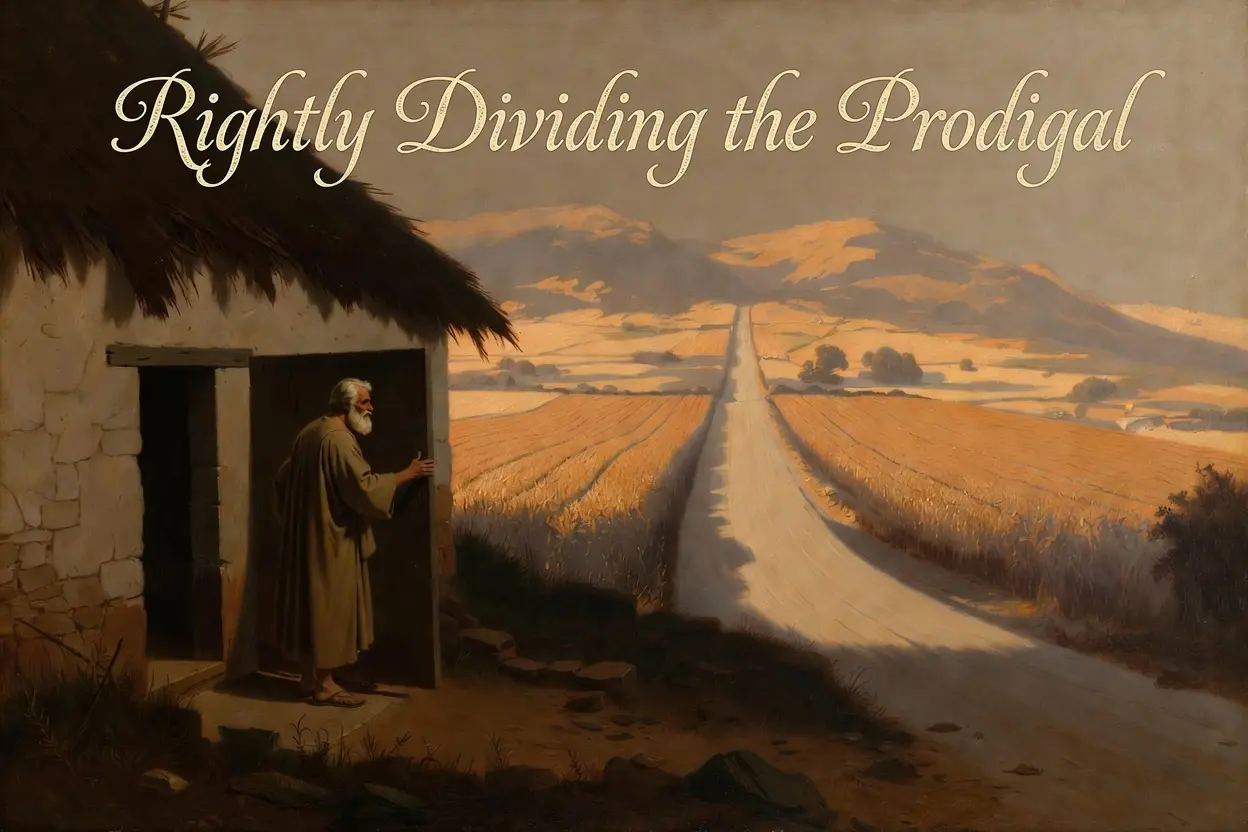
Few sorrows cut a believing parent deeper than a child who has turned away. The phone calls grow rare, the old faith looks like a coat that was outgrown and left behind, and the choices being made are the very ones you spent years warning against. And somewhere in that grief a familiar word surfaces — prodigal. He's our prodigal. We're just waiting, like the father in the story, watching the road. It is a tender picture, and a hopeful one, and I do not want to take it away from any aching parent without putting something better and surer in its place.
But the picture is borrowed from a parable, and a parable must be read where it was spoken before it can comfort anyone. So let me do two things in this article. First, let me set the parable of the prodigal son back into its own place, where the Lord Jesus actually spoke it — because when you see who He was answering, the story opens up and means far more than the greeting-card version. And then let me turn and put into your hands what your Bible actually says about your child, rightly divided — because the deepest comfort for a grace-age parent is not found in the mechanics of that parable at all. It is found in something steadier.
Who Was the Parable Spoken To?
The Lord Jesus did not tell the story of the prodigal son into the air. He told it to a particular audience, answering a particular complaint, and Luke is careful to tell us so:
“Then drew near unto him all the publicans and sinners for to hear him. And the Pharisees and scribes murmured, saying, This man receiveth sinners, and eateth with them.” (Luke 15:1-2 KJV)
That murmur is the reason for everything that follows. The publicans and sinners — the openly wayward of Israel — were crowding in to hear the Lord, and the religious leaders despised Him for welcoming them. So the Lord answered with three parables in a row: the lost sheep, the lost coin, and the lost son. Each one moves toward the same climax — something was lost, something was found, and heaven rejoices over the finding. “I say unto you, that likewise joy shall be in heaven over one sinner that repenteth, more than over ninety and nine just persons, which need no repentance.” (Luke 15:7) The whole chapter is the Lord's defense of receiving repentant sinners against men who thought such people beneath their table.
This matters enormously, because it tells us what kind of teaching the prodigal son is. The Lord Jesus was, in His earthly ministry, “a minister of the circumcision for the truth of God, to confirm the promises made unto the fathers” (Romans 15:8). He came “to seek and to save that which was lost” (Luke 19:10) — and the lost He was sent to were “the lost sheep of the house of Israel” (Matthew 10:6). The prodigal son is a kingdom parable, spoken to Israel, before the cross, about repentance and the Father's welcome of the sinners who turn back to Him. That is its home. Read there, it is glorious. Lifted out and pressed into service as a manual for raising and recovering Christian children today, it begins to mislead — as we will see.
Two Sons, One Nation
Notice the Lord gives the father two sons, and the parable is not finished until both have been dealt with. That second son is the key most readers walk right past.
“And he said, A certain man had two sons.” (Luke 15:11 KJV)
The younger son is the publicans and sinners of verse one — the ones who had wandered into open rebellion but were now drawing near to hear the Lord. The elder son is the Pharisees and scribes of verse two — the ones who stayed home, kept up appearances of service, and murmured. Both are sons of the same father. Both belong to Israel. This is not a picture of a sinner versus a saint, nor of the church versus the world; it is a portrait of two kinds of men within the one covenant nation — the openly lost, and the self-righteous who never thought themselves lost at all. Keep both sons in view and the parable does its real work. Forget the elder brother, and you have missed the point the Lord was driving home to the very men in front of Him.
The Far Country and the Long Way Home
The younger son's path is told in unsparing detail. He demands his inheritance early — in effect wishing his father out of the way — and leaves:
“And not many days after the younger son gathered all together, and took his journey into a far country, and there wasted his substance with riotous living.” (Luke 15:13 KJV)
Then comes the collapse every runaway eventually meets. The money is gone, a famine rises, and the boy who would not serve his own father hires himself out to a stranger and is sent to feed swine — about as low as a Jewish hearer could imagine a son of Israel sinking. “And he would fain have filled his belly with the husks that the swine did eat: and no man gave unto him.” (Luke 15:16) It is there, in the pig field, that the turn comes:
“And when he came to himself, he said, How many hired servants of my father's have bread enough and to spare, and I perish with hunger! I will arise and go to my father, and will say unto him, Father, I have sinned against heaven, and before thee.” (Luke 15:17-18 KJV)
He rehearses his confession, resolves to ask only for a servant's place, and starts the long walk home. And the father — who has plainly been watching the road — does not wait for the speech:
“But when he was yet a great way off, his father saw him, and had compassion, and ran, and fell on his neck, and kissed him.” (Luke 15:20 KJV)
The boy gets out his confession, but never his request to be made a hired servant; the father overrides it with the best robe, a ring, shoes, and the fatted calf — “For this my son was dead, and is alive again; he was lost, and is found.” (Luke 15:24) Read in its place, this is Israel's own ancient pattern: the wandering son turning back to the LORD in repentance, and the LORD receiving him with joy. The "death" and "life" here are the language of a son estranged from his father's house and then restored to it — a relationship broken and mended within the covenant family. It is repentance and return, the kingdom's terms, and it answers the murmurers exactly: this is what God does when one sinner repents, and it is cause for a feast, not a complaint.
The Brother Who Would Not Go In
Now the parable turns to the son the Lord most wanted His audience to see — because the elder brother is the Pharisees and scribes, drawn to the life:
“Now his elder son was in the field: and as he came and drew nigh to the house, he heard musick and dancing… And he was angry, and would not go in: therefore came his father out, and intreated him.” (Luke 15:25, 28 KJV)
Hear his protest, and you are hearing the murmur of verse two put into words:
“And he answering said to his father, Lo, these many years do I serve thee, neither transgressed I at any time thy commandment: and yet thou never gavest me a kid, that I might make merry with my friends: But as soon as this thy son was come, which hath devoured thy living with harlots, thou hast killed for him the fatted calf.” (Luke 15:29-30 KJV)
There it is — the man who has reduced sonship to service, who keeps a ledger of his own obedience, and who is offended that grace would run out to meet a sinner. The father's reply is gentle but pointed: “Son, thou art ever with me, and all that I have is thine. It was meet that we should make merry, and be glad: for this thy brother was dead, and is alive again; and was lost, and is found.” (Luke 15:31-32)
And then the Lord simply stops. We never learn whether the elder brother went in. The parable is left hanging on purpose, because it is really a question laid at the feet of the scribes and Pharisees standing there: the feast has started for repentant sinners — will you come in, or will you stand outside in your own righteousness, murmuring? That open ending is the sharpest thing in the chapter, and it is aimed straight at religious self-righteousness, not at runaway children.
Why This Is Not the Gospel You Were Saved By
Here is where a parent must rightly divide, gently but firmly. As precious as the father's running welcome is, the prodigal son is not a picture of how anyone is saved or reconciled to God today, and to preach it that way to a lost child is to hand him the wrong gospel.
Look at what is simply not in the story. There is no cross in it. There is no blood, no death for sins, no burial, no resurrection, no word about faith in a finished work. The son is restored on the ground of his turning back and his father's mercy — which is precisely the kingdom's call to a covenant nation, “a minister of the circumcision” (Romans 15:8) calling Israel home. But that is not the gospel Paul received for us. We are reconciled to God not by working up a confession and walking home to earn a servant's corner, but by trusting what Another already did:
“For I delivered unto you first of all that which I also received, how that Christ died for our sins according to the scriptures; And that he was buried, and that he rose again the third day according to the scriptures.” (1 Corinthians 15:3-4 KJV)
Notice, too, what the "death" in the parable is not. When the father says the son "was dead, and is alive again," he means a son estranged from the family and now restored to it. He does not mean what Paul means when he tells us we were “dead in trespasses and sins” (Ephesians 2:1) — spiritually lifeless before God, every one of us, by nature, until quickened by grace. The prodigal never stopped being his father's son; what changed was his walk — he was living far from his father's house. That is a real distinction, and it is the very hinge on which the comfort for your own child will turn.
So when a well-meaning preacher takes this parable and tells your unsaved son, "Just come to yourself, get up, and come home to God, and He'll receive you" — he has, without meaning to, offered a homecoming earned by the son's own resolve, with no mention of the cross. That is the kingdom's repentance message, not the gospel of the grace of God. A lost child does not need to rehearse a speech and trudge home hoping for servant's wages. He needs to hear that Christ died for his sins and rose again, and to rest on that by faith.
So — Is Your Child a Prodigal?
Strictly speaking, then, the answer to the title is no — and that no is mercy, not coldness. Your believing-then-wandering child is not standing in a far country deciding whether to risk the long walk back to a father who might receive him as a hired hand. If he is saved, he never left the family at all. And if he was never saved, then what he needs is not the prodigal's road but the gospel of grace. Either way, the parable is the wrong map for your situation — and the right map is far more comforting. Let me put it in your hands, because everything turns on which of the two cases your child is in.
If Your Child Is Saved but Wandering
If your son or daughter has trusted Christ and is now living far from the Lord — careless, worldly, cold — hear this carefully: their standing before God has not changed at all. That is not loose talk; it is what the Scriptures written to us actually say. Every believer in this age is “accepted in the beloved” (Ephesians 1:6) — accepted in Christ, not in their own performance. The moment they believed, the Holy Spirit Himself sealed them: “And grieve not the holy Spirit of God, whereby ye are sealed unto the day of redemption.” (Ephesians 4:30) That seal is not removed by a wandering season; it holds them to the day of redemption. And Paul piles certainty on certainty:
“For I am persuaded, that neither death, nor life, nor angels, nor principalities, nor powers, nor things present, nor things to come, Nor height, nor depth, nor any other creature, shall be able to separate us from the love of God, which is in Christ Jesus our Lord.” (Romans 8:38-39 KJV)
What your wandering child has walked away from, then, is not his sonship — and it is not his fellowship either. Both are his in Christ. He was “called unto the fellowship of his Son Jesus Christ” (1 Corinthians 1:9), and that fellowship belongs to him as surely as his place among the accepted in the beloved. It is part of the great mystery of our standing in Christ — not a wage paid out for good behavior and docked for bad, not something forfeited in a careless season and then bought back with enough confession. He has not lost it; he has walked away from it, abandoning the enjoyment and the daily practice of a fellowship that is, all the while, still his. The break is in his walk, not in his standing — in his joy and his usefulness and his nearness as he feels them, not in his position before God. And mark the contrast with the prodigal: that son offered to come back as a hired servant, but under grace your child can never be demoted to a servant's footing, because “thou art no more a servant, but a son; and if a son, then an heir of God through Christ” (Galatians 4:7). He is a son even now, in the pig field, even if he is living like anything but one.
And this means his return is unlike the prodigal's at the deepest point. That son walked home rehearsing a speech, braced to be taken back as a hired servant, not knowing how he would be received. Your believing child carries no such uncertainty. He does not have to come creeping up the road wondering whether he will be accepted when he gets there — that was never the issue, and it never could be. He was “accepted in the beloved” before he ever wandered, and he is accepted still. There is no probation to pass at the door, no welcome to earn back; the acceptance was settled in Christ long before the wandering began, and the wandering never put it in doubt.
That changes how you wait for him. You are not watching the road to see whether God will take him back; God has not let him go. You are praying for the restoration of a son's walk, and the instrument God names for that work is not condemnation but grace: “Brethren, if a man be overtaken in a fault, ye which are spiritual, restore such an one in the spirit of meekness; considering thyself, lest thou also be tempted.” (Galatians 6:1) Meekness, not the lash. The father's open arms in the parable were right about one thing for certain — the heart of God toward a returning child is compassion, not a cold reckoning. Toward your wandering believer, hold that same posture, and keep setting the grace of God before him, for it is the grace of God, not your alarm, that teaches a son to come home.
If Your Child Has Never Believed
But you may not actually have a wandering believer. You may have a child who grew up among the things of God, learned the songs, walked the aisle perhaps, and never truly trusted Christ at all. If that is your fear, then do not waste his soul on the prodigal's road. He does not need to "come to himself" and resolve to do better and earn his way into God's favor. He needs the gospel — “how that Christ died for our sins according to the scriptures; And that he was buried, and that he rose again the third day according to the scriptures” (1 Corinthians 15:3-4) — received not by working but by believing. The kindest, clearest thing you can put before an unsaved child is not "look how far you've fallen, now climb back," but "Christ died for you, and rose again; trust Him, and be saved." Keep that gospel simple, keep it constant, and keep it free of the works the prodigal story can so easily smuggle in.
And if you cannot tell which of the two your child is — saved and straying, or never truly saved at all — you are not stuck. Set the finished work of Christ before him plainly and keep walking toward him in grace. That word wrongs neither a son nor a stranger, and God knows exactly which He is dealing with even when you do not.
A Word to the Father in the Field
There is one more son in the parable, and his portrait is worth holding up as a mirror before we close. The doctrine of the parable belongs to Israel, but the self-righteous heart it exposes is an ugly danger in any age — and a faithful, churchgoing parent is not immune to it. The danger for such a parent of a wayward child is not usually the far country — it is the field. It is the slow hardening of the elder brother: the ledger of all our years of service, the quiet resentment that grace would run out to meet a child who "devoured thy living," the standing outside the feast, arms folded, while heaven rejoices. Guard your heart against that. The father in the story went out to both sons — he ran to the younger and he came out and entreated the elder. If God should bring your child home, by all means kill the fatted calf; do not be the one left outside murmuring that it came too easy. And if the waiting is long, do not let bitterness toward God or toward your child curdle into the elder brother's cold, dutiful religion. Stay near the Father's heart, which rejoices over one sinner that repenteth, and let Him make yours like His.
So no — your son or daughter is not "the prodigal," and you are not the helpless father merely watching a road. If your child is saved, he is held by a love nothing can separate him from, and your work is patient, grace-filled prayer for the restoration of his walk. If he is lost, your work is to keep the gospel of the grace of God plainly before him. In both cases the ground you stand on is firmer than any parable could give you, and the heart of God toward the wandering is surer than the best earthly father's ever was.
“Wherefore thou art no more a servant, but a son; and if a son, then an heir of God through Christ.” (Galatians 4:7 KJV)
© 2026 Edward R. Cross











Comments
No comments yet. Be the first to share your thoughts.
Leave a comment