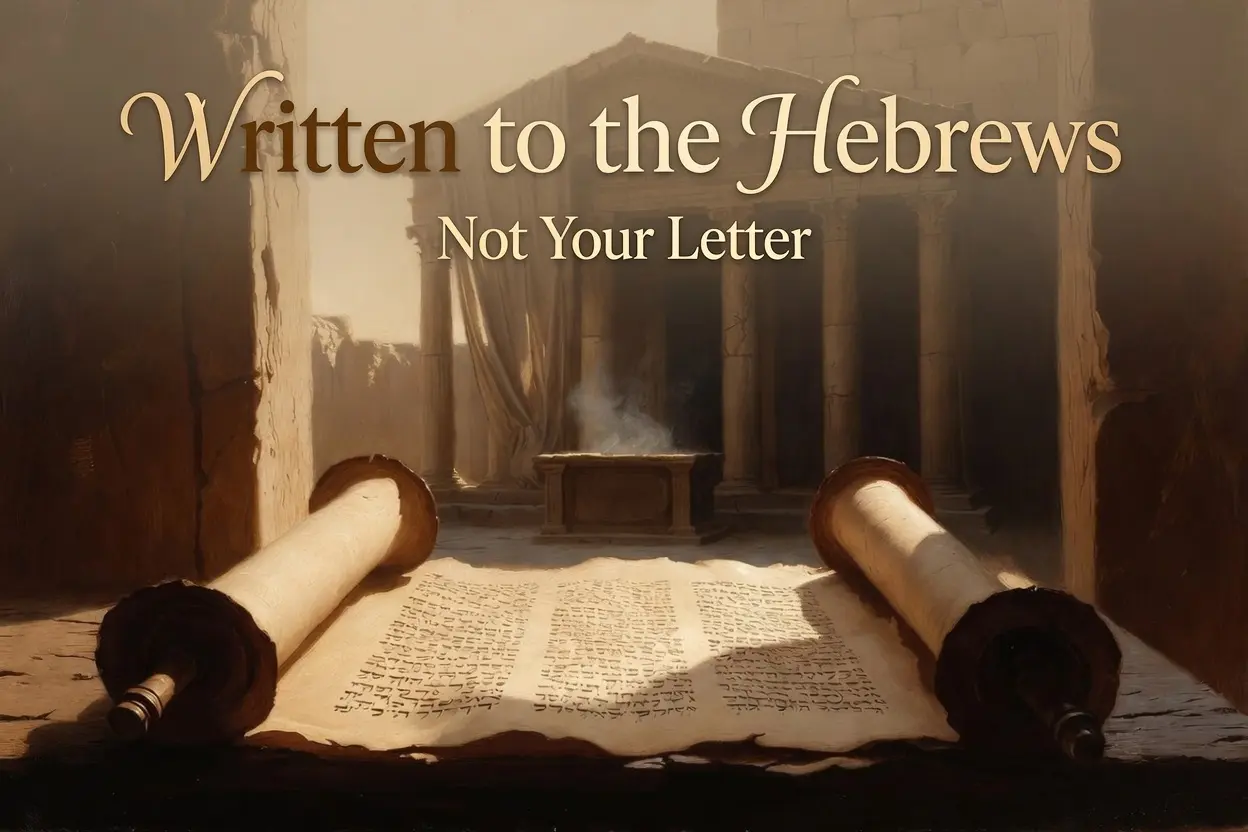
Few books in the Bible have caused more confusion for the believer than the epistle to the Hebrews. Its warnings about falling away have shaken assurance; its covenant language has been laid upon the church; its priesthood and sacrifices have been preached as though they described our worship today. And nearly all of that confusion traces back to one question that most readers never stop to ask. Before we ask what a passage means, we must ask to whom it was written. Paul commands it: "Study to shew thyself approved unto God, a workman that needeth not to be ashamed, rightly dividing the word of truth." (2 Timothy 2:15 KJV) Rightly dividing begins with the audience. So let us put the question plainly and let the King James Bible answer it: who was the book of Hebrews written to?
The popular assumption is that everything written after the cross belongs equally to "the church," and so Hebrews is read as a letter to the Body of Christ. But the book itself tells us otherwise from its first verse to its last. Hebrews was written to believing Hebrews — the remnant of Israel who had received Jesus as their Messiah and were in danger of drawing back to the temple under persecution. Its covenant, its priesthood, its warnings, and its hope are all calibrated to that audience and to their prophetic program. When we see this, the book stops fighting against Paul's gospel and takes its honored place in Israel's Scriptures.
The Author Question Has Hidden the Audience Question
The book of Hebrews has hosted so large a controversy over its human author that the more important question — its audience — has been almost entirely overlooked. Men have argued for centuries over whether Paul, or Barnabas, or Apollos, or some other hand wrote it. We need not settle that here — it is taken up in Did Paul Write Hebrews, and Why It Doesn't Matter — because authorship does not determine to whom a letter is addressed. A letter written by Paul to Timothy is still a letter to Timothy. The audience governs the application.
Yet the book does tell us one thing about its writer that settles its character regardless of his name. The author places himself among those who received the message at second hand:
"How shall we escape, if we neglect so great salvation; which at the first began to be spoken by the Lord, and was confirmed unto us by them that heard him." (Hebrews 2:3 KJV)
The salvation of Hebrews "began to be spoken by the Lord" in His earthly ministry and was "confirmed unto us by them that heard him" — that is, by the eyewitnesses of Christ's earthly ministry to Israel. This is the exact opposite of what Paul testifies about his own gospel:
"But I certify you, brethren, that the gospel which was preached of me is not after man. For I neither received it of man, neither was I taught it, but by the revelation of Jesus Christ." (Galatians 1:11-12 KJV)
Paul received the mystery directly from the ascended Christ, not from those who heard the Lord on earth. The writer to the Hebrews ministers a salvation that came down through the earthly eyewitnesses. Whoever held the pen, Hebrews is plainly not the revelation of the mystery given to Paul. That single contrast is enough to keep us from importing its covenant theology into Paul's doctrine for the Body of Christ.
The Letter Names Its Own Readers
The book has been known from antiquity by a single, fitting name: Hebrews. We need not lean on the caption printed above it in our Bibles — that heading, like the subscription at its close, is supplied by men and is no part of the inspired text. We have something better, for the letter names its own readers from the opening words. The writer addresses a people who already possessed the prophets, the fathers, the covenants, and the law:
"God, who at sundry times and in divers manners spake in time past unto the fathers by the prophets, Hath in these last days spoken unto us by his Son." (Hebrews 1:1-2 KJV)
"The fathers" are Israel's fathers. "The prophets" are Israel's prophets. This is a household that already had a covenant history with God, now being told that God had spoken further by His Son. The letter assumes the reader knows Moses, Aaron, the tabernacle, the priesthood, the sacrifices, and the feasts — and it reasons from them throughout. A Gentile in the Body of Christ has no such background, because we were "strangers from the covenants of promise" (Ephesians 2:12 KJV). But the readers of Hebrews are emphatically not strangers from those covenants — they are the covenant people themselves.
A People Still Waiting for a Salvation Yet to Come
Notice what salvation means for the readers of Hebrews. It is something still future, to be inherited:
"Are they not all ministering spirits, sent forth to minister for them who shall be heirs of salvation?" (Hebrews 1:14 KJV)
They "shall be" heirs of salvation. Their hope lies ahead of them, exactly as Peter wrote to the same scattered remnant of a salvation "ready to be revealed in the last time" (1 Peter 1:5 KJV). This is the prophetic pattern: Israel endures now and receives her salvation when the King returns to establish the kingdom.
Set that beside what Paul says is true of the Body of Christ. We do not wait to become heirs of a salvation still to be revealed; we are already saved, already sealed, already complete:
"In whom ye also trusted, after that ye heard the word of truth, the gospel of your salvation: in whom also after that ye believed, ye were sealed with that holy Spirit of promise." (Ephesians 1:13 KJV)
"And ye are complete in him, which is the head of all principality and power." (Colossians 2:10 KJV)
Two different relationships to salvation reveal two different audiences. Hebrews speaks to those still laboring toward a salvation to be received at the end; Paul speaks to those who possess it now in full.
The Whole Argument Compares Israel's Old Things to Better Ones
Run your eye through Hebrews and you will find one word threaded through the entire book: better. A better hope, a better covenant established upon better promises, a better sacrifice, a better country, a better resurrection. Christ is shown to be better than the angels, greater than Moses, and a High Priest superior to Aaron. But ask the obvious question: better than what? Better than the things the readers already had — the Levitical priesthood, the animal sacrifices, the earthly tabernacle, the Mosaic covenant. The entire force of the argument depends on an audience that possessed those old things and was tempted to go back to them.
"Then verily the first covenant had also ordinances of divine service, and a worldly sanctuary." (Hebrews 9:1 KJV)
The book is written to people for whom that "worldly sanctuary" and its service were a living temptation — a temple still standing, priests still ministering, sacrifices still being offered as the writer warns that the old order "is ready to vanish away" (Hebrews 8:13 KJV). The Body of Christ was never under that first covenant and its sanctuary, never had a Levitical priesthood, never offered an animal sacrifice. We have nothing of the "old things" to which the readers of Hebrews were tempted to return. The contrast that drives the whole epistle has no purchase on us, because we were never on Israel's side of it to begin with.
The Covenant of Hebrews Is Israel's New Covenant
This is the heart of the matter. The covenant that the entire middle of the book is built upon is named explicitly, and its parties are not left to guess:
"For finding fault with them, he saith, Behold, the days come, saith the Lord, when I will make a new covenant with the house of Israel and with the house of Judah." (Hebrews 8:8 KJV)
Hebrews quotes Jeremiah 31 at length and applies it to its readers. But Jeremiah's new covenant was promised "with the house of Israel and with the house of Judah" — not with the Gentiles, and not with the one Body in which there is neither Jew nor Greek. The new covenant is Israel's covenant. When Hebrews tells its readers they have come to "Jesus the mediator of the new covenant" (Hebrews 12:24 KJV), it is telling believing Israelites that the covenant promised to their nation is being confirmed to them through Christ. The Body of Christ is nowhere in that transaction. We are not party to the new covenant any more than a Gentile was party to the old one. To read Hebrews 8 as our charter is to claim a covenant God made with another people.
The Warnings of Hebrews 6 and 10 Belong to a Conditional Program
Here is where Hebrews has done the most damage to believers who do not rightly divide. Its warnings are real, severe, and have generated centuries of fear about losing salvation:
"For it is impossible for those who were once enlightened, and have tasted of the heavenly gift, and were made partakers of the Holy Ghost, And have tasted the good word of God, and the powers of the world to come, If they shall fall away, to renew them again unto repentance." (Hebrews 6:4-6 KJV)
"For if we sin wilfully after that we have received the knowledge of the truth, there remaineth no more sacrifice for sins, But a certain fearful looking for of judgment and fiery indignation, which shall devour the adversaries." (Hebrews 10:26-27 KJV)
And the readers' standing is repeatedly made conditional — held only "if" they endure to the end:
"But Christ as a son over his own house; whose house are we, if we hold fast the confidence and the rejoicing of the hope firm unto the end." (Hebrews 3:6 KJV)
"For we are made partakers of Christ, if we hold the beginning of our confidence stedfast unto the end." (Hebrews 3:14 KJV)
"Now the just shall live by faith: but if any man draw back, my soul shall have no pleasure in him." (Hebrews 10:38 KJV)
This is the same conditional, endurance-to-the-end message that Peter, James, John, and the Lord Himself pressed upon the little flock — abide, hold fast, continue, draw not back — because their salvation and inheritance were still ahead of them and their covenant was not yet fulfilled. It is a real warning to a real people in a real program where the promise could still be forfeited.
Now watch what happens when these warnings are aimed instead at the Body of Christ. The reader is forced onto the horns of a dilemma. Either the warnings stand exactly as written, and a believer truly can fall away and be lost — which is the honest conclusion of those who teach that salvation may be forfeited — or salvation is secure, in which case the warnings must somehow be made to mean something other than what they say. Most defenders of the security of the believer, rightly unwilling to surrender that security, take the second road. But the toll for that road is paid in the text itself: the plain words must be bent until they no longer warn of what they plainly warn of.
The attempts to do this are familiar, and each is offered, I do not doubt, in good conscience. Some treat the passage as merely hypothetical — the falling away of Hebrews 6 is said to be something that can never actually happen, so that the Holy Ghost is made to warn at length against an impossibility. Others say the people described were never truly saved — that men "once enlightened," who had "tasted of the heavenly gift, and were made partakers of the Holy Ghost," only sampled these things from the outside and were never really born of God, so that nothing real was ever in danger of being lost. Others grant that something is lost but insist it is only rewards, not salvation — that the loss is of crowns or fellowship, never of standing. Each of these is driven by a true instinct, that the saved cannot become unsaved. But each can be purchased only at the price of the words. The passage that says it is "impossible... to renew them again unto repentance" must be made to mean that no one will ever actually need renewing; those who "were made partakers of the Holy Ghost" must be reclassified as never having partaken at all; and the solemn "there remaineth no more sacrifice for sins" must be quietly downgraded to a loss of rewards. The book is kept on the church's shelf only by emptying it of the very meaning its words carry.
Right division asks for none of this. It lets every word stand at full strength and simply restores the address. To Israel's believing remnant — a people whose covenant was not yet fulfilled and whose salvation was still future — the warning is literal, fitting, and even kind: hold fast, draw not back, for there is no other sacrifice to fall back upon, and the kingdom is entered by enduring to the end. We do not soften the words; we situate them. The problem was never the language of Hebrews 6 and 10; it was the assumption that we are the ones being addressed.
But it is not the message Paul preaches to the Body of Christ, and the difference could not be sharper. We are not held "if we hold fast"; we are sealed by Another who holds us fast:
"And grieve not the holy Spirit of God, whereby ye are sealed unto the day of redemption." (Ephesians 4:30 KJV)
"There is therefore now no condemnation to them which are in Christ Jesus." (Romans 8:1 KJV)
"If we believe not, yet he abideth faithful: he cannot deny himself." (2 Timothy 2:13 KJV)
Where Hebrews warns that drawing back brings "no more sacrifice for sins," Paul announces that for us every trespass is already forgiven (Colossians 2:13) and that nothing shall separate us from the love of God in Christ (Romans 8:38-39). To take Hebrews 6 and 10 — written to a people whose salvation was conditional and future — and lay them on a believer who is sealed unto the day of redemption is to rob him of the very assurance Paul's gospel was given to supply. The warnings are not for us to fear; they are for us to understand, in their place, addressed to Israel's remnant under a covenant that could be forfeited.
The Hope of Hebrews Is Earthly, National, and Yet to Come
Even the hope of the book belongs to Israel's prophetic program. The readers look for a city and a kingdom that are still coming to the earth:
"For here have we no continuing city, but we seek one to come." (Hebrews 13:14 KJV)
"For unto the angels hath he not put in subjection the world to come, whereof we speak." (Hebrews 2:5 KJV)
The "city to come" is the New Jerusalem that descends to the earth (Revelation 21:2); the "world to come" is the kingdom age promised to Israel by the prophets. The believers of Hebrews are pressed to "labour" to enter into a "rest" still before them (Hebrews 4:1, 11) — the kingdom rest, not yet entered. This is an earthly and national hope, exactly the hope Peter held out to the same scattered remnant.
The Body of Christ has a different hope entirely. We do not seek an earthly city; our "conversation is in heaven" (Philippians 3:20 KJV), and we are already "raised us up together, and made us sit together in heavenly places in Christ Jesus" (Ephesians 2:6 KJV). Their hope is the kingdom come to earth; ours is to be caught up to be with the Lord and seated with Him far above all. Two hopes, two programs, two audiences.
Our Relationship to Hebrews: Spectators, Not Participants
Does this mean the Body of Christ should ignore the book of Hebrews? Not at all. "All scripture is given by inspiration of God, and is profitable for doctrine, for reproof, for correction, for instruction in righteousness." (2 Timothy 3:16 KJV) Hebrews is the inspired word of God, and there is no richer portrait anywhere of the finished, once-for-all sacrifice of Christ that ended the whole sacrificial system. We learn from it, we marvel at it, we are edified by what it reveals about the person and work of our Lord.
But we read it as those looking on, not as those addressed. Our relationship to its covenant content is that of a spectator, not a participant. We do not take its covenant, claim its priesthood, fear its warnings, or wait for its earthly hope. We take what agrees with and illuminates the finished work — the surpassing glory of Christ's one offering — and we leave with Israel what belongs to Israel: the new covenant, the kingdom rest, and the conditions of endurance her remnant was called to keep. That is what it means to rightly divide the word of truth.
Why This Matters
This is not a quibble over an ancient address line. It is the difference between trembling and resting. If Hebrews is written to me as a member of the Body of Christ, then my salvation hangs on holding fast to the end, I can sin myself past any remaining sacrifice, and my drawing back can leave God with no pleasure in me. That is a gospel of fear, and it is not the gospel Paul preached. But when I see that Hebrews was written to believing Israel — a people still awaiting a promised salvation, still under a covenant that could be forfeited, still laboring toward a kingdom rest — the warnings fall silent over my own standing, and Paul's assurance stands undimmed: I am complete in Christ, sealed unto the day of redemption, with no condemnation and nothing able to separate me from the love of God.
So who was the book of Hebrews written to? To the Hebrews — the believing remnant of Israel, the little flock of the Acts period, scattered from their city and tempted to go back to the temple, needing to be told that the better things were theirs by faith if they endured to the end. Read it that way, and the book stops warring against grace. It shines in its own place, and we keep our place in Christ, where grace has already set us.
© 2026 Edward R. Cross




Comments
No comments yet. Be the first to share your thoughts.
Leave a comment