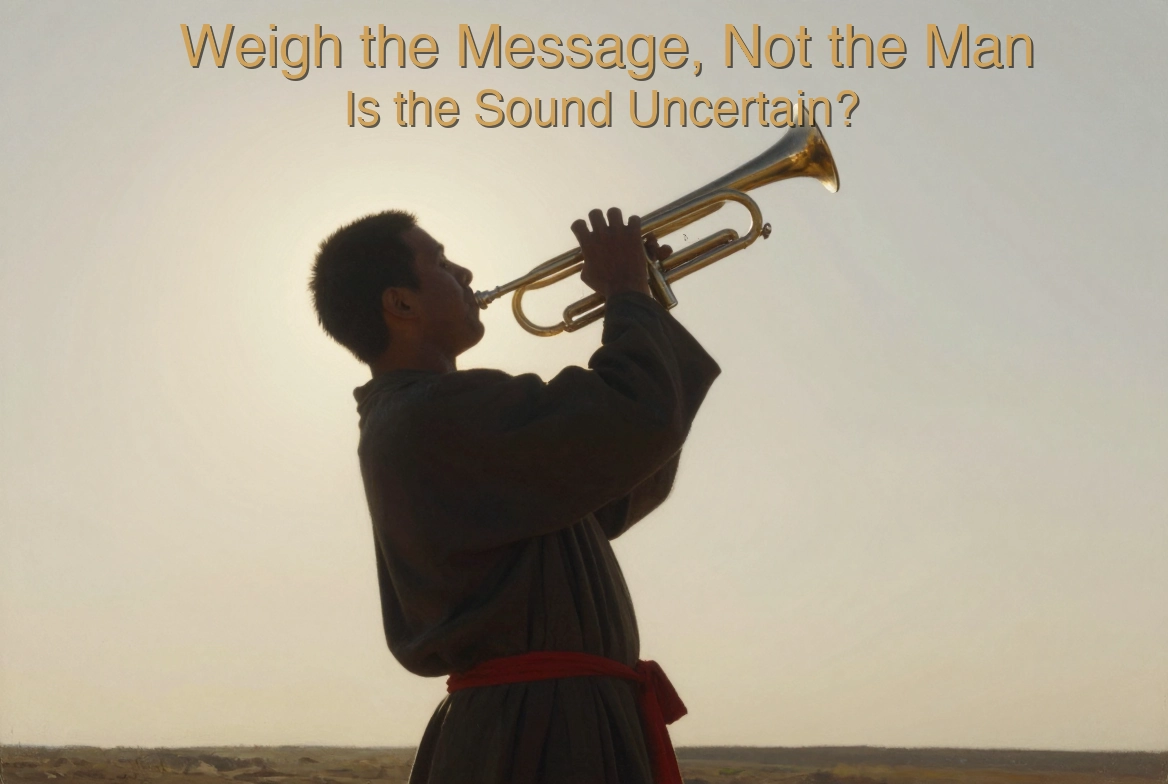
There is an old method for getting rid of a doctrine you cannot answer. You do not answer it. You go after the man who said it.
Sometimes this takes the form of outright invention — a rumor, an insinuation, a motive assigned to a man that he never held. More often it is subtler and more effective, because it is true. The man really did have a temper. He really did fail his family. He really did have a season he is ashamed of. The accuser does not have to make anything up. He simply points at the fault, lets it hang in the air, and the doctrine is buried without a single verse ever being opened.
That is the tactic. It is worth understanding, because it is being used on you, and because you may have used it yourself without recognizing what you were doing.
The tactic is not an argument, it is an evasion
Notice what the attack on the messenger never does. It never touches the text.
If a man teaches that the Body of Christ began with the apostle Paul, there is exactly one way to refute him: open the Scriptures and show that it did not. Show that the mystery was not kept secret. Show that Paul did not receive it by revelation. Show from the words on the page that he has misread them. That is refutation.
Producing the man's divorce record is not refutation. It is a change of subject dressed up as a rebuttal, and it works because most people never notice the substitution. They walk away with a bad feeling about the teacher and no idea whether the teaching was true.
This method has a long pedigree. When Satan wanted to bring Job down, he did not dispute God's assessment of the man — he could not, and he did not try. So he attacked the motive instead: "Doth Job fear God for nought?" (Job 1:9 KJV). Not the assessment is wrong, but the man has an angle. That is the whole method in a single sentence, and it was old when Job was young.
Job's friends worked the same ground from the other side, and Job named it exactly: "Will ye speak wickedly for God? and talk deceitfully for him?... He will surely reprove you, if ye do secretly accept persons" (Job 13:7, 10 KJV). Secretly. No one announces that he is weighing the man rather than the matter. He announces that he is defending truth.
They used it on the sinless Son of God
If the method actually measured anything, it would fail against a man with no fault in him. It did not fail. It was used on the Lord Jesus Christ constantly, and it worked.
They came at His trade: "Is not this the carpenter's son? is not his mother called Mary?" (Matthew 13:55 KJV). They came at His hometown: "Can there any good thing come out of Nazareth?" (John 1:46 KJV). They came at His associations and His appetite: "Behold a man gluttonous, and a winebibber, a friend of publicans and sinners" (Matthew 11:19 KJV). And when they had nothing left, they came at His sanity and His parentage: "Say we not well that thou art a Samaritan, and hast a devil?" (John 8:48 KJV).
Not one of those is an answer. Every one of them is an exit.
Take this in, because it settles the question by itself. The tactic was deployed at full strength against a man in whom there was no sin at all, and it still emptied the room. Therefore the tactic does not depend on the messenger having done anything wrong. It never did. It is a method of avoidance. Whatever it may tell you about the man it is aimed at — and sometimes the charge is perfectly true — it tells you nothing about whether he is right. It tells you a great deal about the argument he did not have.
God published the messenger's failures Himself
Now consider the men God actually used to carry His word, and notice something that is usually missed.
Noah walked out of the ark, the only preacher of righteousness left alive on the earth, and then "he drank of the wine, and was drunken; and he was uncovered within his tent" (Genesis 9:21 KJV).
Abraham, the father of the faithful, would not wait on God. Rather than believe the promise would come through Sarah, he took her handmaid: "And he went in unto Hagar, and she conceived" (Genesis 16:4 KJV). The friend of God settled for a shortcut.
Moses was told to speak to the rock. Instead "Moses lifted up his hand, and with his rod he smote the rock twice" (Numbers 20:11 KJV), and God's verdict was not softened for the man who wrote the law: "Because ye believed me not, to sanctify me in the eyes of the children of Israel, therefore ye shall not bring this congregation into the land which I have given them" (Numbers 20:12 KJV). The lawgiver died outside the land.
David, the man after God's own heart, took another man's wife and then had the husband killed to cover it. God did not describe it delicately: "thou hast killed Uriah the Hittite with the sword, and hast taken his wife to be thy wife" (2 Samuel 12:9 KJV).
Peter, who had walked with the Lord for three years, stood by a fire and "began he to curse and to swear, saying, I know not the man" (Matthew 26:74 KJV).
And Paul — the apostle of the Gentiles, the man to whom the mystery was committed — was a religious murderer. He says so himself: "Who was before a blasphemer, and a persecutor, and injurious" (1 Timothy 1:13 KJV). Luke records what that looked like on the street: "As for Saul, he made havock of the church, entering into every house, and haling men and women committed them to prison" (Acts 8:3 KJV).
None of that is softened here, and none of it should be. Drunkenness is drunkenness. Unbelief is unbelief. Adultery and murder are adultery and murder. These were real sins by real men, and God dealt with every one of them.
But here is the thing to see, and it is the hinge of this whole subject: nobody dug any of that up. Not one of those failures was exposed by an enemy. Every one of them was recorded, by name and in detail, in the very book those men were carrying. Moses wrote down Noah's drunkenness — and then wrote down his own disqualifying sin, in the book he himself penned, knowing it would be read aloud in Israel forever. David's adultery sits in the same volume as David's psalms. Paul names himself a blasphemer and a persecutor in his own epistles, in writing, under inspiration.
The Author of the message published the failures of His own messengers. And then He kept using them.
"All scripture is given by inspiration of God, and is profitable for doctrine, for reproof, for correction, for instruction in righteousness" (2 Timothy 3:16 KJV). All of it. Including the parts that make the messengers look bad. God did not consider the failure disqualifying to the record, or the record would read very differently.
If perfection were the requirement, there would be no Bible
Follow the accuser's rule to its end and see where it lands you.
If a man's sin invalidates the message he carries, then strike Genesis through Deuteronomy — the man who wrote them died under discipline for unbelief. Strike the Psalms — an adulterer wrote them. Strike both epistles of Peter — "Peter, an apostle of Jesus Christ" (1 Peter 1:1 KJV) is the same man who stood by a fire and swore he never knew the Lord. Strike all thirteen Pauline epistles — the man who wrote them hunted believers from house to house and consented to their deaths.
There is nothing left. Not one page.
That is not a rhetorical flourish. That is arithmetic. If the rule were true, we would have no Bible, and the accuser applying it would have nothing left to accuse anyone with. Nobody actually believes the rule. It gets applied selectively, to messages people already wanted to reject, which is the surest sign it was never a principle in the first place.
Even under the law, the test was the message
Someone will answer that this is a liberty peculiar to the age of grace — that under law God held His spokesmen to a stricter account, and a man's record counted for more. It is worth stopping on that, because it is not so. God has never, under any dispensation, made the messenger's record the test of his message.
Israel was given a test for a prophet, and it is a test of what he says. If the thing does not come to pass, he has spoken presumptuously: "When a prophet speaketh in the name of the LORD, if the thing follow not, nor come to pass, that is the thing which the LORD hath not spoken" (Deuteronomy 18:22 KJV).
Then a second test, and it is sharper still — because it holds even when the man's credentials are perfect. "If there arise among you a prophet, or a dreamer of dreams, and giveth thee a sign or a wonder, And the sign or the wonder come to pass, whereof he spake unto thee, saying, Let us go after other gods... Thou shalt not hearken unto the words of that prophet" (Deuteronomy 13:1-3 KJV).
Read that carefully. The sign came to pass. The man is a verified wonder-worker. And Israel is still to refuse him — on doctrinal grounds, because of what he said. Under the law, a validated miracle could not save a false message. The measure was always the word already given: "To the law and to the testimony: if they speak not according to this word, it is because there is no light in them" (Isaiah 8:20 KJV).
Now put Moses himself to the standard people use today. Before God ever sent him he had killed a man and hidden the body — "he slew the Egyptian, and hid him in the sand" (Exodus 2:12 KJV).
And his own people threw it in his face. When he stepped between two striving Hebrews the next day, the answer he got was not an argument but a record: "Who made thee a prince and a judge over us? intendest thou to kill me, as thou killedst the Egyptian?" (Exodus 2:14 KJV). There is the whole method again, and note that the charge was true. He had killed the Egyptian. There was nothing to deny and no slander to expose.
So watch what God did with a messenger His own people had already refused on the ground of his record. Stephen puts it in one sentence, and it is the plainest answer to this whole subject anywhere in Scripture:
"This Moses whom they refused, saying, Who made thee a ruler and a judge? the same did God send to be a ruler and a deliverer by the hand of the angel which appeared to him in the bush" (Acts 7:35 KJV).
This Moses whom they refused... the same did God send. The man they disqualified is the man God commissioned. Their verdict on his record did not so much as slow the appointment down, and the deliverance of the entire nation came through the very man they had ruled out.
Stephen adds the reason the refusal happened at all: "For he supposed his brethren would have understood how that God by his hand would deliver them: but they understood not" (Acts 7:25 KJV). The fault lay in the hearing, not in the man.
Nor did the difficulty end there. Moses' own objection to the commission was that he could not speak well: "I am slow of speech, and of a slow tongue" (Exodus 4:10 KJV), and again, "how then shall Pharaoh hear me, who am of uncircumcised lips?" (Exodus 6:12 KJV). God did not answer by improving his résumé. He gave him signs and sent him anyway.
And Stephen was not telling that story for its own sake. He was tracing a pattern to its end — a nation that made a habit of refusing the men God sent them: "To whom our fathers would not obey, but thrust him from them" (Acts 7:39 KJV), and then, "Which of the prophets have not your fathers persecuted?" (Acts 7:52 KJV). The line that begins with who made thee a prince and a judge over us ends at the rejection of the Just One. The habit of trying the messenger instead of the message is not a small fault. Followed far enough, it cost that generation everything.
Notice what that echoes. The complaint against Paul was "his speech contemptible" (2 Corinthians 10:10 KJV). The two greatest messengers of the two programs, the lawgiver and the apostle of the Gentiles, were both written off for the same reason — they did not speak well enough. Neither charge was ever an argument.
And the tactic itself appears under the law in its purest form, with God's own verdict attached. "And Miriam and Aaron spake against Moses because of the Ethiopian woman whom he had married" (Numbers 12:1 KJV). His marriage. His private life. Then the very next verse lets slip what the quarrel was actually about: "And they said, Hath the LORD indeed spoken only by Moses? hath he not spoken also by us?" (Numbers 12:2 KJV).
There it is, whole. The marriage was the pretext; the message and the authority behind it were the target. And God did not treat it as a legitimate inquiry into Moses' fitness — He judged the accusers. Meanwhile Aaron, who had made the golden calf and then told God's servant the most transparent lie in Scripture about it — "I cast it into the fire, and there came out this calf" (Exodus 32:24 KJV) — went on serving as high priest.
The Lord Jesus settled it for Israel in one sentence. Speaking of men whose corruption He then spent an entire chapter exposing, He said: "The scribes and the Pharisees sit in Moses' seat: All therefore whatsoever they bid you observe, that observe and do; but do not ye after their works: for they say, and do not" (Matthew 23:2-3 KJV).
Do what they say. Do not do what they do. That is this entire article, spoken by Christ, to Israel, under the law — and He said it about the worst men in the book.
Grace does not lower the standard — it explains the vessel
So far this has been an argument from example. Paul takes it further and gives us the doctrine underneath it, and it is not an excuse — it is the design.
"But we have this treasure in earthen vessels, that the excellency of the power may be of God, and not of us" (2 Corinthians 4:7 KJV). The vessel is common clay on purpose. A vessel of gold would draw the eye to the vessel. God chose pottery so that no one could mistake where the power came from — "That no flesh should glory in his presence" (1 Corinthians 1:29 KJV).
Watch what Paul does when his character is raised. He never denies the charge. He concedes it, and then he raises it higher than his accusers ever put it.
"This is a faithful saying, and worthy of all acceptation, that Christ Jesus came into the world to save sinners."
Every believer nods at that. It is one of the most quoted lines in the epistles, and it goes down easily because it is about somebody else. Now put back the four words Paul actually ended it with:
"This is a faithful saying, and worthy of all acceptation, that Christ Jesus came into the world to save sinners; of whom I am chief" (1 Timothy 1:15 KJV).
The apostle who wrote the epistles you build your doctrine on filed himself at the bottom of the list. Not among sinners — chief of them. And read the next verse, because Paul explains why God arranged it that way: "Howbeit for this cause I obtained mercy, that in me first Jesus Christ might shew forth all longsuffering, for a pattern to them which should hereafter believe on him to life everlasting" (1 Timothy 1:16 KJV).
For this cause. The record was the qualification. If God can save the man who was hauling believers to prison, there is no one outside the reach of that grace, and that is precisely the point God was making by choosing him. Paul's past is not an embarrassment attached to the message. It is the exhibit.
He says the same thing about his office: "For I am the least of the apostles, that am not meet to be called an apostle, because I persecuted the church of God. But by the grace of God I am what I am" (1 Corinthians 15:9-10 KJV). And again: "Unto me, who am less than the least of all saints, is this grace given, that I should preach among the Gentiles the unsearchable riches of Christ" (Ephesians 3:8 KJV).
So grace does not relax a standard the law enforced. The standard was never the man's record in the first place. What grace adds is the reason — it tells you why God entrusts His message to earthen vessels at all, and it makes the messenger's record the display case rather than the disqualification. Demanding a spotless vessel before you will listen is not high standards. It is a demand God has never made, in any age, of anybody.
Paul settles it outright: a bad motive does not make a true message false
If all of this were only inference from examples, someone could still argue with it. Paul does not leave it to inference. He states the principle flatly, and he states it in the hardest possible case.
Sitting in prison, Paul acknowledges that some men were preaching Christ with motives that were genuinely rotten — not mistaken, not immature, but malicious, and aimed at him personally: "Some indeed preach Christ even of envy and strife... The one preach Christ of contention, not sincerely, supposing to add affliction to my bonds" (Philippians 1:15-16 KJV). They were preaching in order to hurt him while he was chained.
Then comes the verdict: "What then? notwithstanding, every way, whether in pretence, or in truth, Christ is preached; and I therein do rejoice, yea, and will rejoice" (Philippians 1:18 KJV).
Paul is not excusing the envy. He is not calling their conduct acceptable, and neither should we. He is refusing to let their bad motive turn a true message into a false one. The message was Christ. Christ was still Christ coming out of a poisoned mouth.
That is the principle, from the apostle, in writing. It is about the doctrine, not about the people. If Paul would not let malice invalidate a true message about Christ, no one gets to let a messenger's failure invalidate the doctrine of the grace of God.
Paul was answered this way constantly, and he refused the ground
Nobody in Scripture took more of this than Paul, and how he responded is worth copying.
His critics at Corinth put it in writing, and they gave away the whole game while doing it: "For his letters, say they, are weighty and powerful; but his bodily presence is weak, and his speech contemptible" (2 Corinthians 10:10 KJV). Read that slowly. They concede the letters. The doctrine is weighty and they know it. Unable to touch the argument, they went after how he looked and how he sounded.
In court it turned uglier: "For we have found this man a pestilent fellow, and a mover of sedition among all the Jews throughout the world, and a ringleader of the sect of the Nazarenes" (Acts 24:5 KJV). Not one word about whether Christ rose from the dead. And when Paul preached before Festus, the governor reached for the oldest dismissal there is: "Paul, thou art beside thyself; much learning doth make thee mad" (Acts 26:24 KJV). He is crazy. Say it loudly enough and no one has to weigh what he said.
Paul will not fight on that ground. "But with me it is a very small thing that I should be judged of you, or of man's judgment: yea, I judge not mine own self... but he that judgeth me is the Lord" (1 Corinthians 4:3-4 KJV). He does not mount a defense of his character. He hands his character to the Lord and puts the doctrine back on the table.
And to the Galatians, who had turned on him for the plainest of reasons, he asks the question this whole article is really about: "Am I therefore become your enemy, because I tell you the truth?" (Galatians 4:16 KJV).
Magnify the office, never the man
Here is the distinction that holds all of this together, and it cuts in both directions.
Scripture magnifies the office and refuses to magnify the man. Paul says plainly, "For I speak to you Gentiles, inasmuch as I am the apostle of the Gentiles, I magnify mine office" (Romans 11:13 KJV). The office. Not himself. When men at Lystra tried to worship him, he tore his clothes and told them the truth about what he was: "Sirs, why do ye these things? We also are men of like passions with you" (Acts 14:15 KJV). Peter did the same when Cornelius fell at his feet: "Stand up; I myself also am a man" (Acts 10:26 KJV).
Men of like passions. That is an apostle's own description of himself, offered voluntarily, at the height of his ministry.
The world collapses the office into the man, and it does so in both directions. It exalts a man because his message is great, and it discards a message because the man is small. Both are the same error, and Scripture names it: "For there is no respect of persons with God" (Romans 2:11 KJV). Respecting persons is not only flattering the impressive man. It is also dismissing the unimpressive one. Both weigh the vessel instead of the treasure.
And David had already put both kinds of man on the scales and recorded what they weighed:
"Surely men of low degree are vanity, and men of high degree are a lie: to be laid in the balance, they are altogether lighter than vanity" (Psalm 62:9 KJV).
Read that slowly, because it is stronger than it first appears. The man of high degree does not merely tell a lie. He is one. Put the impressive man on the scale — the credentials, the following, the title, the platform, the air of authority — and the reading comes back a lie, because the impression he creates is not what he actually is. Nobody is what his reputation says. And the man of low degree fares no better: he is vanity, emptiness, nothing to weigh at all.
So both pans come up empty. That is exactly the point of this article, written a thousand years before Paul. If you weigh the impressive man you are weighing a lie, and if you weigh the unimpressive man you are weighing vanity, and neither reading tells you one thing about whether the doctrine is true. Put a man on the scales to settle whether a doctrine is true, and you have weighed the wrong thing. Scripture does give us a man to weigh, and we will come to it — but never for that question.
Notice what David does with that. He does not conclude that you should trust nobody and believe nothing. He turns from the scales to the only thing that holds weight — "Trust in him at all times; ye people, pour out your heart before him" (Psalm 62:8 KJV), and then, two verses on, "God hath spoken once; twice have I heard this; that power belongeth unto God" (Psalm 62:11 KJV). Men are lighter than vanity; God has spoken. Weigh what He said, not who carried it.
Right division draws this treatment because it cannot be answered from the text
Watch this happen the next time the mystery revealed to Paul comes up in conversation.
The answer will almost never be a verse. It will be a label. That is hyper-dispensationalism. That is Bullingerism. That is a cult. Stam was a heretic. Who is this man — where did he go to seminary? Nobody believed this before 1900.
Every one of those is doing the same work that "Can there any good thing come out of Nazareth?" (John 1:46 KJV) did. The label is not an argument. It is permission — permission for the hearer not to open his Bible, granted before he ever looks at Ephesians 3.
The objections themselves deserve answers, and they have them — worked through one at a time in Prove All Things: Answering the Objections to Mid-Acts. But notice the labels answer nothing that was actually claimed. Say that the mystery was "kept secret since the world began" (Romans 16:25 KJV), that it was "not made known unto the sons of men, as it is now revealed unto his holy apostles and prophets by the Spirit" (Ephesians 3:5 KJV), and that Paul "neither received it of man, neither was I taught it, but by the revelation of Jesus Christ" (Galatians 1:12 KJV) — and the reply comes back about a man who died in 1913. The verses stand there untouched while the conversation is conducted entirely about personalities.
There is a certain irony in it. The apostle this position is built upon is the one man in Scripture with a persecutor's record, and God chose him deliberately, and said why. The accuser who thinks Paul's past is an argument has walked straight into the middle of Paul's doctrine without recognizing where he is standing.
Paul heard the labels too, and he did not flinch at them. Standing before Felix he took the word his accusers used and kept right on walking: "But this I confess unto thee, that after the way which they call heresy, so worship I the God of my fathers, believing all things which are written in the law and in the prophets" (Acts 24:14 KJV). Which they call heresy. Paul did not spend his defense arguing about the label. He restated what he believed and where it was written.
When the label will not stick, they go after the man
Those labels misrepresent the teaching, and a man who knows his Bible can generally shake them off. When he does, the attack does not stop. It moves to him.
The charges arrive in a familiar order. He is divisive — look at the churches he has split. He is arrogant — he thinks he alone has the truth, that he is smarter than two thousand years of church history and every scholar in it. He is bitter — he left his denomination and he has been grinding that axe ever since. He is unaccountable — no ordination, no board, no covering, a self-appointed teacher answering to nobody.
Look closely at those, because most of them are not accusations of sin at all. They are the doctrine's effects, renamed as flaws in the man. A teaching that draws a line will divide people; that is what a line does. The only question worth asking is whether the line is in the book. Take the sharpest charge — he thinks everybody else is wrong — and notice it is not a claim about Scripture, it is a claim about arithmetic. It says the man is outnumbered. He may well be. So was Paul, at the end, when "all they which are in Asia be turned away from me" (2 Timothy 1:15 KJV). Being outnumbered is not being wrong, and counting heads is not searching the scriptures.
Then there is the heaviest form of it, the one that does the most damage. When a grace teacher actually falls — and some do, because they are men — the fall is used to indict the doctrine itself. See what that teaching produces. No law, no standards, so of course it ends there.
Paul had this exact charge aimed at his gospel, and he wrote it down: "And not rather, (as we be slanderously reported, and as some affirm that we say,) Let us do evil, that good may come?" (Romans 3:8 KJV). Slanderously reported. Men were telling the world what Paul's gospel produced, and Paul names the report a slander — not a misunderstanding, a slander.
Watch how he answers it, because this is the pattern. He does not soften grace by a hair to make the charge go away. He asks the accusation out loud and refutes it with doctrine: "What shall we say then? Shall we continue in sin, that grace may abound? God forbid. How shall we, that are dead to sin, live any longer therein?" (Romans 6:1-2 KJV). And again a few verses on: "What then? shall we sin, because we are not under the law, but under grace? God forbid" (Romans 6:15 KJV).
And sometimes the fall is real
Romans 3:8 answers a false report. But the harder case — and the honest one — is when the report is true.
Sometimes the man really did it. There is no slander to expose, no distortion to correct, no context that improves it. He fell, and everybody knows it, and the people pointing at him are pointing at something that actually happened.
Say so. Do not manage it, do not soften it into a season or a struggle, do not reach for the word mistake when Scripture has a shorter word. Sin is sin, and a teacher's sin has victims that a stranger's arguments never touch. Grace has an answer for a fallen man and it is not a cover-up: "Brethren, if a man be overtaken in a fault, ye which are spiritual, restore such an one in the spirit of meekness; considering thyself, lest thou also be tempted" (Galatians 6:1 KJV). Restoration, in meekness, with an eye on your own feet. That is the Pauline course, and it is a great deal harder than either excusing him or finishing him off.
Now ask the question this article keeps asking. What did the fall prove?
It proved that a man fell. It proved nothing whatever about whether the thing he taught is in the book. His collapse did not move a word on the page. The verses he expounded read exactly the same the morning after as they did the morning before, and they are either what he said they were or they are not — and the only way to find out is still to open them.
Test the accuser's rule on his own house and watch it come apart. If a teacher's fall disproves his doctrine, then every fallen law-preacher disproves law, every fallen Calvinist disproves Calvinism, and every denomination on earth stands refuted by its own scandals — and there have been plenty. Nobody applies the rule that way. It is produced against doctrines men already wanted rid of, and quietly shelved when the fallen man was one of their own.
There is one more thing to see, and it must not be turned into an excuse for anybody. When a teacher of grace falls, the fall is not evidence against what he taught about the flesh. It is a demonstration of it. Paul said the treasure was in earthen vessels and that the flesh profits nothing, and then a vessel cracked exactly where he said vessels crack. The man is answerable for it. But the doctrine he preached is the only thing in the world that had already told you this could happen — and the only thing that has an answer for it.
A man's failure never proved a doctrine false. If it did, the failures catalogued earlier in this article would have buried the law, the Psalms and the epistles together.
The word decides, not the man — and that cuts both ways
None of this means a teacher's life is irrelevant. Scripture will not let us say that.
God sets character qualifications for oversight: "A bishop then must be blameless, the husband of one wife, vigilant, sober, of good behaviour, given to hospitality, apt to teach" (1 Timothy 3:2 KJV). We are told to "mark them which cause divisions and offences contrary to the doctrine which ye have learned; and avoid them" (Romans 16:17 KJV), and warned about men who "serve not our Lord Jesus Christ, but their own belly; and by good words and fair speeches deceive the hearts of the simple" (Romans 16:18 KJV). Paul himself withstood Peter to the face when Peter's walk contradicted the gospel (Galatians 2:11-14).
So how do these fit together? Like this. A man's life governs whether an assembly should set him into office. It never settles whether what he said is true. Those are two different questions, and the whole force of the attack on the man depends on collapsing them into one.
And note carefully what those qualification lists are, because tradition has bent them into something Paul did not write. They are entrance qualifications. Paul frames them at the door — "If a man desire the office of a bishop, he desireth a good work. A bishop then must be blameless" (1 Timothy 3:1-2 KJV) — and gives them to Titus for the act of ordaining: "ordain elders in every city... If any be blameless, the husband of one wife" (Titus 1:5-6 KJV). They govern who is put in. Paul nowhere turns the list into a standing audit a sitting elder must keep re-passing, and he nowhere gives a procedure for deposing one. That silence is not a gap for tradition to fill. It is the shape of what he gave, which is why the one safeguard he does command sits at the front door: "Lay hands suddenly on no man" (1 Timothy 5:22 KJV).
What Paul prescribes for an elder who sins is not removal but a witnessed, public rebuke aimed at repentance — "Against an elder receive not an accusation, but before two or three witnesses. Them that sin rebuke before all, that others also may fear" (1 Timothy 5:19-20 KJV). Permanent disqualification, the black mark that never lifts, the man struck off and never restored — none of that is in Paul. It is a religious construct, and it is worth naming here because it is the engine that makes the attack on the man look principled. Take away the construct and the attack is left standing in the open as what it always was. The full case for reading those lists as entrance qualifications rather than a standing audit — and what Scripture actually does with a sinning elder — is set out in Rightly Dividing Church Leadership: The Bishop, the Elder, and the Pastor.
Look closely at how Scripture triggers even its own warnings. Romans 16:17 does not say mark them whose lives disappoint you. It says mark them which cause divisions "contrary to the doctrine which ye have learned" (Romans 16:17 KJV). The test is doctrinal. Same in the next epistle: "If any man teach otherwise, and consent not to wholesome words" (1 Timothy 6:3 KJV). Even where Scripture puts a teacher on trial, it opens the book first.
And the standard cuts the other way just as hard, which is where most of us are actually in danger. The mirror error is swallowing a false message because you like the man, trust the institution, or inherited the name on the building. Paul closes that door and puts himself on the wrong side of it to do it: "But though we, or an angel from heaven, preach any other gospel unto you than that which we have preached unto you, let him be accursed" (Galatians 1:8 KJV).
Though we. Paul submits Paul to the test. If the apostle of the Gentiles does not get a pass on the basis of who he is, no pastor, no denomination, no radio teacher, and no author gets one either — this one included.
Two questions about one man
Take a real case rather than a comfortable one, because both halves of this land at the same time and it is worth watching them stay separate.
Peter Ruckman was twice divorced and three times married. He published the details himself. His remarriage in 1972 split the church he was pastoring, a third of the congregation voting against him on the ground that he was no longer qualified to hold the office. He stayed in the pastorate all the same, and defended his position in print. None of that is an accusation dug up by an enemy; it is his own account.
Here is the first question, and it has to be stated precisely or it turns into the tradition we just took apart. The question is whether an assembly should have set that man into the office, or gone on with him — "A bishop then must be blameless, the husband of one wife" (1 Timothy 3:2 KJV). That is a real question, and it belonged to the congregation in front of him. A third of them voted it in 1972, and a church's liberty to decline to continue with a man is theirs.
But notice how much smaller that question is than the use it was put to. It is a question about who stands in a pulpit in Pensacola. It is not a verdict that follows a man for forty years and voids everything he ever wrote, because Paul gave no such verdict to pronounce. And "the husband of one wife" was never a marital-history sum in the first place — it sits in the same list as "no striker" and "not a brawler" (1 Timothy 3:2-3 KJV), which is fatal to the mechanical reading. A man who has beaten one wife for thirty years has only ever had one. The phrase is about a man's faithfulness and the purpose of his heart, and reading it as arithmetic produces a scorecard Paul never handed out.
Here is the second question, and it is a different one. Does the Authorized Version rest on a superior line of manuscripts?
That question is answered by manuscript evidence and by the Scriptures' own testimony about preservation. It is not answered by the marital history of any man who happens to be arguing it. Ruckman's divorces have no more bearing on the text of Scripture than his handwriting does.
But watch what actually happened among Baptists, because two errors were stacked on top of each other. First the traditional construct did its work — a divorce was treated as a permanent disqualification, which Paul never wrote. Then the disqualification was used to settle a question it could not reach: not should this man pastor, but is the Authorized Version the preserved word of God. For a great many, the marriages did all the work. The divorces became the reason to stop listening — and what went out with him, in a lot of cases, was the King James defense he was making, which was the one place he was most clearly right. He was a fierce and effective defender of the Authorized Version in an era when confidence in a settled text was being washed away, and that contribution was real. It got discarded along with the man, by people who never had to engage a single manuscript argument to be rid of it.
And Ruckman was wrong about a great deal. He taught things that simply cannot be got out of the text, stated speculation with the confidence of revelation, and answered right division with ridicule instead of Scripture. Those errors deserve a reply, and I have given one at length in Rightly Dividing or Wrongly Accusing: A Response to Ruckman's Attack on Mid-Acts Dispensationalism. Answering him took chapter and verse, his own books, and a great many hours in the KJV. It never once required mentioning his marriages — because his marriages were never the reason he was wrong.
That is the discipline, and it is harder than it sounds. Refute the error from the book. Weigh the man's life in the place, and only in the place, where the book tells you to weigh it. Never let the second do the first one's work.
Strip the man, keep the point. That rule is worked out across a whole field of defenders — the sound and the reckless together — in The Defenders of the King James: The Question Beneath the Manuscripts, and the case for the Authorized Version itself, argued on its own ground and needing none of these men's troubles to stand, is in Preserved, Not Re-Inspired: Why We Hold the King James.
Paul's own test is the sound, not the man
Paul gives us a picture of what actually decides whether a message should be acted on, and the character of the man delivering it never enters the calculation.
"And even things without life giving sound, whether pipe or harp, except they give a distinction in the sounds, how shall it be known what is piped or harped? For if the trumpet give an uncertain sound, who shall prepare himself to the battle?" (1 Corinthians 14:7-8 KJV).
Look at what Paul reached for. Things without life. A pipe, a harp, a trumpet — objects with no character to assess, no history to bring up, no reputation to protect. He deliberately picked illustrations from which the messenger has been removed entirely, and the whole passage still works, because the only variable that ever mattered is the one he names: is the sound certain?
He does not write if the trumpeter be a scoundrel, who shall prepare himself to the battle? The soldier hearing that call does not investigate the man with the horn. He cannot see him and does not need to. He listens to the sound, and if the sound is certain he takes up his weapons. What disables an army is an uncertain message. Paul's entire concern in the chapter is that what is spoken be understood — "except ye utter by the tongue words easy to be understood, how shall it be known what is spoken?" (1 Corinthians 14:9 KJV).
Now bring it out of the epistle and into a Tuesday. A man of thoroughly questionable character walks into a church in the middle of the country and says a tornado is coming.
Nobody appoints a committee. Nobody raises his divorce, his drinking, or the way he treated his brother. Every person in that building goes to the basement — and every one of them is right to.
Why does the character question never come up? Not because they have reasoned it through and concluded it is a fallacy. It never occurs to them, because they believe something is at stake. When the stakes are real, nobody has to be talked into ignoring the messenger. It is simply obvious.
That gives us the sharpest test in this whole subject, and it is a test of the hearer rather than the speaker. Weighing the messenger is what men do when nothing is at stake. Nobody in a burning building stops to ask about the character of the man shouting fire. So when the reply to a doctrine is a story about the man, you are watching the behavior of someone for whom the question was never urgent. That is a fact about the moment, not a verdict on his heart — he may have inherited the habit and never examined it. But the trumpet has been sounded and he has not moved.
And the sound is certain. "Christ died for our sins according to the scriptures; and that he was buried, and that he rose again the third day according to the scriptures" (1 Corinthians 15:3-4 KJV). There is nothing uncertain in that note. The only question left is whether a man will prepare himself.
Open the book yourself
There is a group in Scripture the Holy Ghost calls noble, and it is worth asking what earned them the word.
"These were more noble than those in Thessalonica, in that they received the word with all readiness of mind, and searched the scriptures daily, whether those things were so" (Acts 17:11 KJV).
They did two things. They gave the message an honest hearing — with readiness of mind, not with an ear tuned for a reason to dismiss it. And then they checked it, daily, against the Scriptures. Not against the speaker's reputation. Not against what their fathers held. Against the book.
Remember who was standing in front of them when they did it. Paul. The man with the persecutor's record, the unimpressive presence and the contemptible speech. The Bereans did not run a background check on the messenger. They opened the Scriptures and tested the message, and God called them noble for it.
That is an example, and a fine one. But we do not take our marching orders from an example in Acts — we take them from our apostle, and Paul gives the same charge as a plain commandment to the Body of Christ: "Prove all things; hold fast that which is good" (1 Thessalonians 5:21 KJV).
Notice who received that. The Bereans were called "more noble than those in Thessalonica" (Acts 17:11 KJV) — and it is to Thessalonica that Paul writes, telling them in so many words to do the very thing their neighbours had been commended for. Prove it. Test it. Then hold fast what stands.
That is your assignment. When you meet a teaching, ask one question first: is it so? Open the KJV, put the passage back in its paragraph and its chapter, and read every word — including the words the teaching needs you to skip. If it will not stand there, no man's charm or credentials can save it. If it will stand there, no man's failures can touch it.
And be clear about what you are doing when you do it, because this article has spent its length pulling one authority down and it has no intention of seating another in its place. Proving is not settling. The Bereans did not sit in judgment on Paul; they carried him to the text. Notice what they searched — not their own judgment, not the consensus of the synagogue, but "the scriptures" (Acts 17:11 KJV), to see whether those things were so. The settling belongs to the Book. It belongs to the Book whether the testing was done by a teacher you admire, by a man you have never met, or by you — and that last one is the one to watch, because a reader who has just been taught to distrust reputations is in the very position to mistake his own opinion for the verdict. Your conscience is where you answer. It is not where the matter is decided.
That habit takes some recovering, because most of us were trained out of it. The reflex to check the man before the text, to feel the weight of a name or an institution before we feel the weight of a verse, is learned — and it can be unlearned. Both halves of that are traced in Recognizing Religious Indoctrination and Recovering from Religious Indoctrination. And in the end no man can do the believing for you, nor keep you from it — as Can Anyone Make You Believe? puts it, the word goes to your own conscience, and there you answer for it alone.
And when the reply to a doctrine comes back as a story about the man instead of a verse about the matter, you have learned two things — and neither one is what the accuser intended to teach you.
You have learned that the message could not be answered. Had there been a verse, it would have come. A man with the text on his side reaches for the text; he does not reach for a rumor.
And you have learned something about the accuser himself — though here you must be careful to keep to what you actually saw. You did not read his heart. You watched him make a choice: the text was available to him and he reached past it for the man. That much he did in the open, unprompted, in front of you. Why he did it — whether from malice, or fear, or nothing worse than a habit he was taught and never examined — is precisely the sort of thing this article has no business pronouncing on, and Paul says as much: "judge nothing before the time, until the Lord come, who both will bring to light the hidden things of darkness, and will make manifest the counsels of the hearts" (1 Corinthians 4:5 KJV). The counsels of his heart are not your assignment. The choice he made in front of you is simply a fact.
And do not write the man off over it. Remember who wrote most of your New Testament, and what he was doing before the Damascus road. Job's friends did this very thing while sincerely believing they were defending God, and Job named it without claiming to see inside them: "He will surely reprove you, if ye do secretly accept persons" (Job 13:10 KJV). Notice who does the reproving in that sentence. Not Job. God.
Now comes the hard part, and it is the last thing this article asks of you. Knowing that, the temptation is to do to him precisely what he did to you — to file his conduct away and produce it the next time he opens his mouth on any subject. Do not. That would be to learn the tactic rather than to see through it, and you would have become the very thing you just watched.
Answer him the way Paul answered: refuse the ground, and put the word back in front of him. Open the book.
© 2026 Edward R. Cross









Comments
No comments yet. Be the first to share your thoughts.
Leave a comment