In a companion article on the defenders of the King James I let a caution stand without developing it: that soundness on the text is no guarantee of soundness everywhere, and that some teachers within the Mid-Acts grace movement venture out past what the Scripture states into speculation. That caution deserves a piece of its own, because the danger is real and it is near. The men who have most loved the rightly divided word are sometimes the very men most tempted to press it further than it goes — and a movement that prizes the deep things of God will always feel the pull to supply, out of its own reasoning, what God has not said.
This is not a call to timid teaching. It is a call to keep a line clear: the line between what God has plainly revealed and what men have built on top of it.
What sound doctrine is, and what speculation is
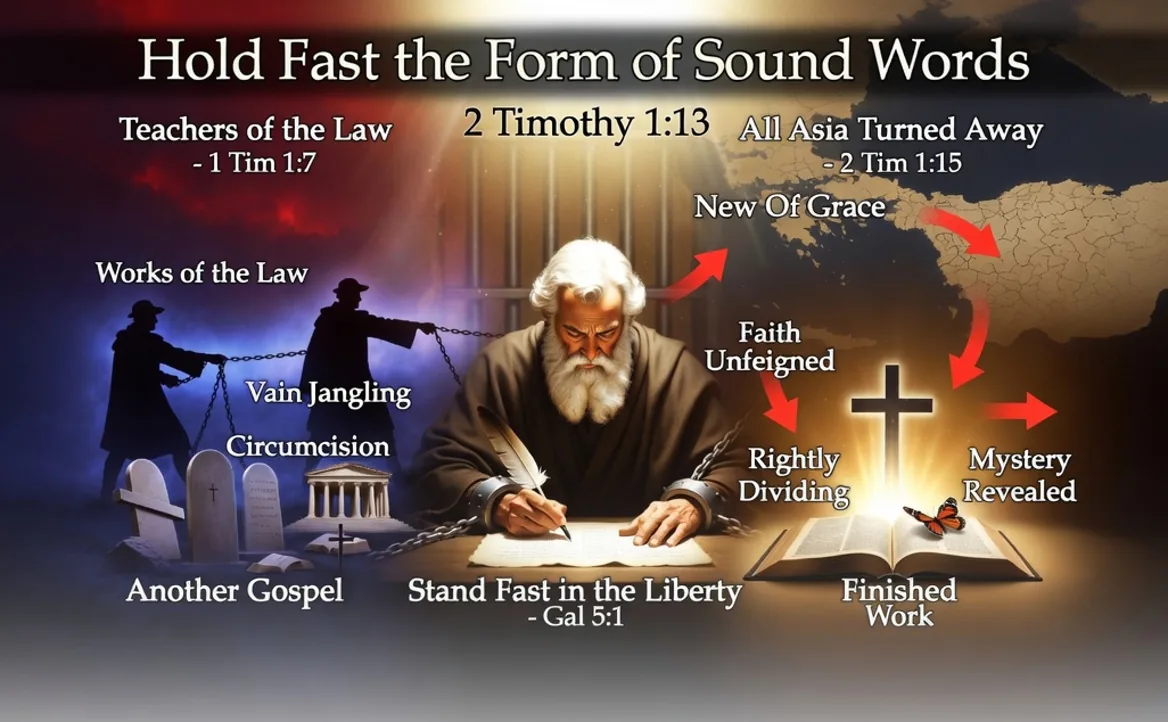
Sound doctrine is what God has said. It is the teaching that can be laid open from the words on the page, rightly divided, and shown to be there — not imported, not inferred at three removes, but stated. Paul charges Timothy to "Hold fast the form of sound words, which thou hast heard of me, in faith and love which is in Christ Jesus" (2 Timothy 1:13), and to be a workman "rightly dividing the word of truth" (2 Timothy 2:15). Sound doctrine has a form to it, a shape given by God, and our task is to hold that form — not to extend its outline wherever our curiosity runs.
Speculation is what men supply where God has kept silence. It is not always false and it is not always foolish; often it begins from a true text and reasons outward. But the moment the conclusion outruns what is written, it has changed in kind. It is no longer doctrine that can be proved; it is conjecture that can only be asserted. And conjecture asserted with the confidence of doctrine is exactly the thing Paul warns against — "that ye might learn in us not to think of men above that which is written" (1 Corinthians 4:6). The standard is what is written. Past that line a teacher may have an opinion, but he no longer has a "thus saith the Lord," and he must not pretend otherwise.
A test case: does the Body of Christ replace the angels?
It is sometimes taught in grace circles that the Body of Christ was formed to replace the angels — that we will take the place vacated by Satan and the angels who fell, filling their stations in the heavenly places. It is offered as the hidden purpose behind the mystery, the reason the Body was kept secret and seated where it is. The idea is not new, and it is not Pauline; in its developed form it traces most often to Augustine, who reasoned from a Neoplatonist frame that redeemed humanity would fill the gap left by the fallen angels. That it is old does not make it apostolic, and that it sounds profound does not make it written.
Set the claim beside the texts that are made to carry it. "Know ye not that we shall judge angels?" (1 Corinthians 6:3) — true, and remarkable; but to judge angels is not to replace them, and the verse says nothing of replacement. "To the intent that now unto the principalities and powers in heavenly places might be known by the church the manifold wisdom of God" (Ephesians 3:10) — the church displays God's wisdom before the angelic powers; it does not displace them. "That in the ages to come he might shew the exceeding riches of his grace in his kindness toward us through Christ Jesus" (Ephesians 2:7) — riches of grace shown to us, with not a word about angels at all.
Notice too that the claim rests on a premise of its own that is never stated: that the fallen angels held fixed governmental stations which now stand empty, waiting to be filled. Scripture does not grant even that much. Where it speaks of the angels that sinned, it speaks not of vacancies but of judgment: "For if God spared not the angels that sinned, but cast them down to hell, and delivered them into chains of darkness, to be reserved unto judgment" (2 Peter 2:4), and again, "the angels which kept not their first estate" are "reserved in everlasting chains under darkness unto the judgment of the great day" (Jude 6). God is not refilling a broken structure by fitting the Body into it; He is judging what fell. The replacement is required by the theory, not by the text.
Each text is true. Not one of them states that the Body replaces the angels. The doctrine is built in the gaps between the verses, by inference stacked on inference, and then taught as though it were the plain sense of the page. That is the precise motion this article is about. The reader who asks, simply, "Where does it say that?" will not be given a verse; he will be given a chain of reasoning. And a chain of reasoning is not the word of God.
This is also the very thing Paul warns the Colossians against — a man "intruding into those things which he hath not seen, vainly puffed up by his fleshly mind" (Colossians 2:18). Speculation about the unseen heavenly order is not a new temptation; it is an old one, and the apostle met it head on.
"Here a little, and there a little"
Pressed for the verse that warrants the method, the speculator will often reach for one: "For precept must be upon precept, precept upon precept; line upon line, line upon line; here a little, and there a little" (Isaiah 28:10). Here, it is said, is God's own pattern — gather the small pieces scattered through the Scriptures and assemble them into the larger truth. If the doctrine is not stated in any one place, it may still be built up out of many.
But the verse will not bear that use, and a reader who follows it in its own context will see why. Isaiah 28 is not teaching a method; it is pronouncing a rebuke. The chapter is against the drunken priests and prophets of Ephraim who had wearied of plain instruction — "the priest and the prophet have erred through strong drink" (Isaiah 28:7) — and the clipped, sing-song repetition of verse 10 is the mocking cadence of men who would not be taught, throwing the prophet's words back at him a syllable at a time. What it leads to is not understanding but ruin: "that they might go, and fall backward, and be broken, and snared, and taken" (Isaiah 28:13). To make this passage a charter for building doctrine is to take a description of judgment and wear it as a license.
A second text is enlisted to the same end, and with more apparent right to it. Paul writes, "Which things also we speak, not in the words which man's wisdom teacheth, but which the Holy Ghost teacheth; comparing spiritual things with spiritual" (1 Corinthians 2:13). That last phrase is repeated almost as a slogan, as though it named the practice of laying one verse beside another. But mark what the "things" are, and what Paul is doing with them. They are the hidden things he has just named — "the wisdom of God in a mystery, even the hidden wisdom" (1 Corinthians 2:7), the things which "God hath revealed them unto us by his Spirit" (1 Corinthians 2:10). Paul is not telling a reader how to study; he is telling us how he himself delivers what was revealed to him — not in man's words but in words the Holy Ghost teaches, fitting spiritual truths to the spiritual words given to carry them. The verse is about the inspired speaking of the mystery, not a rule for cross-referencing the Book. The exercise of comparing scripture with scripture is a good and proper one in its place; it simply does not rest on this text, and the text is not honored by being bent to it.
So where comparison is sound, the connections it draws are the ones the text itself makes, not the ones the interpreter supplies. The moment a man may join any verse to any other and call the result doctrine, the authority has quietly passed from what is written to the one doing the joining — which is the very thing Peter forbids: "no prophecy of the scripture is of any private interpretation" (2 Peter 1:20). Two men using that method will reach two doctrines, because the method has no fence in it. Right division is the opposite motion: not gathering fragments to fill a silence, but recognizing the distinctions God has already made, and letting each passage stand where He set it.
The marks of speculation
A teaching has crossed from sound doctrine into speculation when certain marks appear, and they are worth naming so they can be recognized.
It goes beyond what is written, resting finally not on a stated text but on an inference the text will allow but does not require. It tends to be built upward, each step leaning on the step below, so that the whole stands only if every link holds. It answers questions the Scripture never raises, filling silence rather than expounding speech. And it bears a particular fruit: not the "godly edifying which is in faith" but the endless questions Paul names — "Neither give heed to fables and endless genealogies, which minister questions, rather than godly edifying which is in faith: so do" (1 Timothy 1:4). Speculation breeds discussion that never settles, because it cannot be settled; there is no text to settle it.
There is also the form it now travels in, and here I add a personal observation. The teaching I set beside the texts above — that the Body of Christ replaces the fallen angels — I did not first meet in a book or from a pulpit, but in a meme: a single image of the kind passed hand to hand across social media, the words The Body of Christ will replace the fallen angels set in bold gold and silver over a dramatic picture of winged figures plunging into fire. There was a fuller article behind it, and I do not doubt the case was laid out there with verses and reasoning. But that is not what travels. What travels is the image — the claim asserted with such assurance, and dressed in such spectacle, that it wears the look of a settled truth long before anyone opens the piece behind it, if indeed they ever do. That is increasingly how speculation reaches the believer — not as something he sits down to weigh, but as something he is moved to share in passing. And the appearance of strength is not the substance of it. A picture cannot be cross-examined; it states a conclusion and moves on, and the reader is carried along by the confidence and the drama rather than the proof. The same question undoes it that undoes any speculation: where does it say that? A teaching small enough to fit on a slogan and quick enough to share in a moment may still be true — but the form itself proves nothing, and the believer who takes a bold image for a sound argument has let down his guard at the very point he ought to have raised it.
The surest mark of all is when the conjecture hardens into a test. A speculation held loosely, as a possibility, is one thing; the same speculation made a badge of soundness, a thing one must affirm to be counted faithful, is another and a worse thing. When what God never said becomes a fence around fellowship, the line has not merely been crossed — it has been moved.
When correction is turned aside
There is a second attitude that travels with the first, and it shows itself the moment the speculation is questioned. Raise the plain concern — where does it say that? — and the answer is seldom a verse. It is a deflection, and usually one of two. The first is that the teaching came from one of our own: a known right-divider, a sound brother, a man who has helped many, as though the standing of the teacher settled the truth of the doctrine. The second is that this is a non-essential, and in non-essentials we owe one another liberty and grace — so that the one raising the concern, and not the error itself, becomes the breach of charity.
Neither will stand. A man's reputation establishes his usefulness, not his doctrine; a teacher may be right in much and still overreach in this. And the appeal to a brother's standing is exactly the appeal Paul refused to make. When Peter erred at Antioch, Paul did not plead Peter's office or their shared labor; "I withstood him to the face, because he was to be blamed" (Galatians 2:11). If the chief among the apostles of the circumcision could be corrected openly for a wrong step, no teacher among us stands above the same testing. The question is never who said it, but whether it is written.
The appeal to "non-essentials" fares no better, and it is worth remembering where the phrase even comes from. The full motto — in essentials, unity; in non-essentials, liberty; in all things, charity — is neither Scripture nor ancient. It belongs to a Lutheran writer who went by the name Rupertus Meldenius, who set it down around 1627 amid the slaughter of the Thirty Years' War, pleading for peace among Protestants tearing one another apart. It is most often credited to Augustine, who never wrote it — and Augustine, as it happens, is the very man to whom the angel-replacement notion itself traces. So a saying coined to quiet a war, and wrongly draped in a church father's authority, is now pressed into service to quiet a question. Even granting its good intention, it settles nothing, for it hides a deeper sleight of hand. Charity is real and commanded — but charity "rejoiceth in the truth" (1 Corinthians 13:6); it does not shield error to keep the peace. And the very word non-essential smuggles in a new authority, for someone must decide which doctrines may be set aside, and the moment that someone is a man rather than the Scripture, the standard has quietly changed hands. Paul grants no such tier. He says, "Hold fast the form of sound words" (2 Timothy 1:13) — a form, a whole shape, not a core to be guarded and a margin to be negotiated. To call a speculation a non-essential and then forbid its correction is to protect the error twice: once in the teaching of it, and again in fencing it from the only thing that could try it. The grace truly owed a brother is not the grace that leaves him in his error, but the grace that loves him enough to ask, of his teaching as of any other, where does it say that.
The place for discussion, and the rule that governs it
None of this forbids the sanctified use of the mind. Believers may wonder together about what Scripture leaves open; they may weigh inferences and turn over possibilities, and there is profit in it when it is done honestly. The error is never that a question was asked. The error is in the labeling — in dressing a possibility as a certainty, an opinion as a doctrine, a man's reasoning as the revealed will of God.
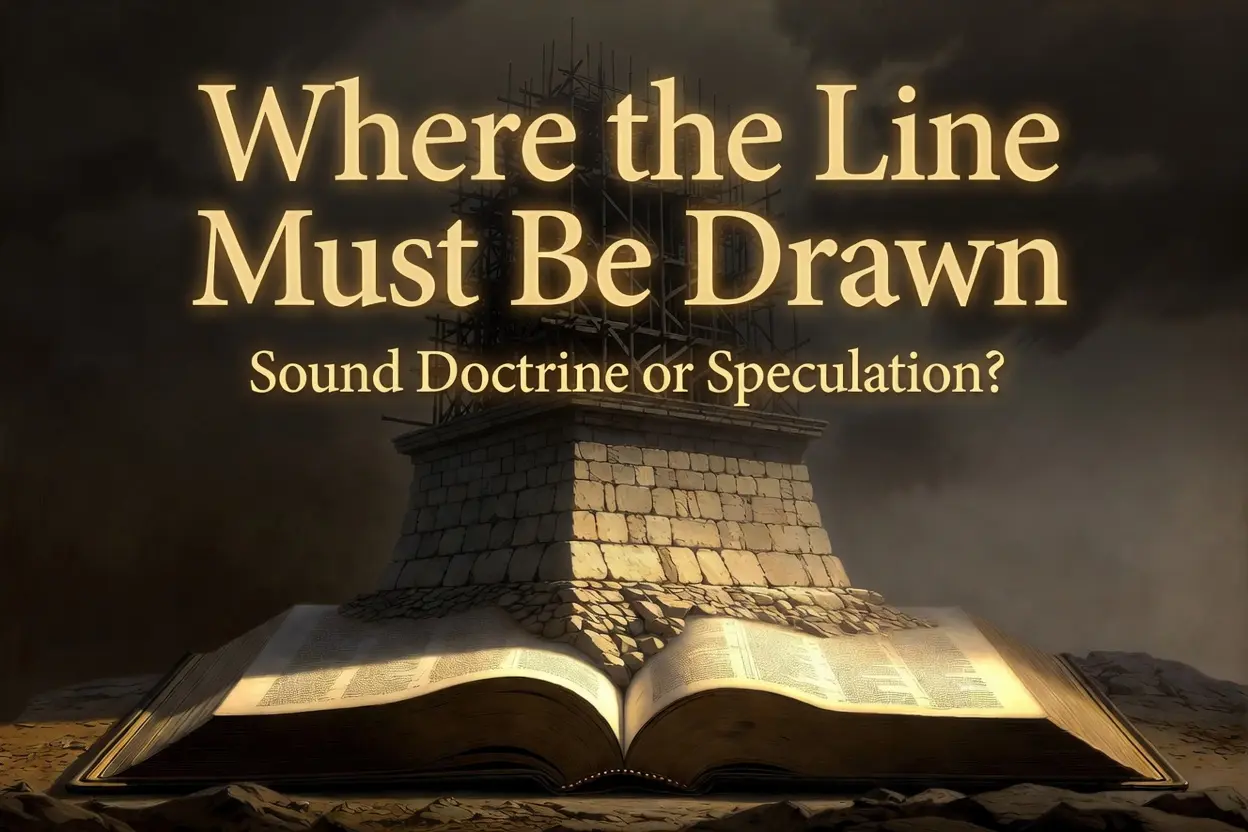
So the rule is simple, and Paul gives it more than once. Hold the form of sound words. Do not think above what is written. "But foolish and unlearned questions avoid, knowing that they do gender strifes" (2 Timothy 2:23). "But avoid foolish questions, and genealogies, and contentions, and strivings about the law; for they are unprofitable and vain" (Titus 3:9). Where God has spoken, speak with all boldness; where He has been silent, do not borrow His authority to fill the silence. Keep the two apart, and keep the line between them visible to those you teach — so that no one mistakes the scaffolding of our reasoning for the building God Himself has raised.
That is the whole of it. Sound doctrine is what God has said. Speculation is what we add. The first we hold fast and preach without apology; the second, if we entertain it at all, we name for exactly what it is, and never let it wear an authority that belongs to the word of God alone.
© 2026 Edward R. Cross





Comments
No comments yet. Be the first to share your thoughts.
Leave a comment