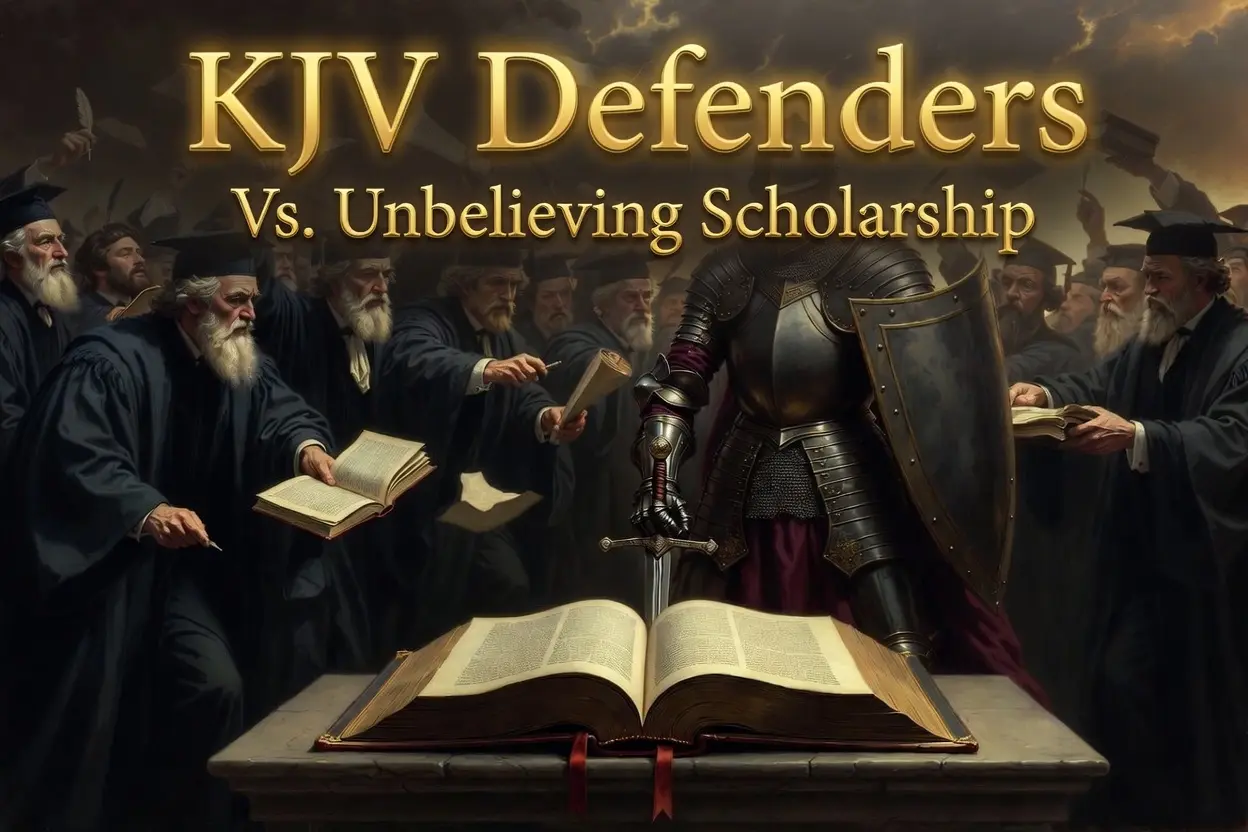
This is a companion to Preserved, Not Re-Inspired, and it needs a word of explanation at the outset. In that article I set out the case for holding the King James as the providentially preserved word of God in English, and I said plainly there that it was no catalogue of manuscript evidence. This piece is not one either — and the reason is the same, and worth stating outright, because it governs everything that follows. The manuscript debate, for all its interest, is not where this matter is finally settled. Underneath it lies a question more foundational still, and it is not a question about parchment. It is a question about God.
The question beneath the manuscripts
God holds His people accountable to His word. Scripture itself measures a man by it — man is to live "by every word that proceedeth out of the mouth of God" (Matthew 4:4 KJV) — and to His own people God says: study and rightly divide it (2 Timothy 2:15), be furnished by it unto all good works (2 Timothy 3:16-17), hold fast its sound words (2 Timothy 1:13). The whole Christian life is ordered around a book we are answerable to.
Now set that beside the modern claim that the text of that book is, and always will be, uncertain — still being reconstructed, still open to revision, never finally in hand. Put the two together and a question rises that the manuscript debate cannot answer and usually does not even ask: would God hold a man accountable to His word, and yet leave him never able to know that he actually has it? Would He command us to live by every word, and then so order things that no one on earth could say with confidence which words those are?
The God of Scripture would do no such thing. He is not the author of confusion (1 Corinthians 14:33). He is the God "that cannot lie" (Titus 1:2 KJV), and Abraham was "fully persuaded that, what he had promised, he was able also to perform" (Romans 4:21 KJV). To confess that He inspired His words but could not keep them — that He gave them and then lost them into a fog of competing copies — is not reverence. It is a low view of God dressed in scholarly modesty. The deepest objection to preservation is never really a manuscript; it is unbelief about the character and the power of the One who promised to preserve.
That is why preservation is, before it is anything else, a question of your view of God. Settle that, and the manuscript evidence falls into its proper, secondary place — useful, confirming, but not the ground you stand on. Refuse to settle it, and no quantity of evidence will ever be enough, because the man who will not trust God to keep His word will always find one more reading to doubt. This is why neither this piece nor the last attempts to weigh every variant. The argument is won or lost higher up than that.
Where to begin: the defenders in the grace stream
If preservation rests on the doctrine of God, then the men most worth reading are the ones who defend it there — who hold the King James as the preserved word while rightly dividing the word of truth, and who understand what that preservation means: that the King James holds the inspired word itself — the very words God breathed out, kept whole and handed down to us in English, not lost in transmission and not re-inspired in the translating. Within the Mid-Acts grace movement that company is not large, but it is sound, and it is the place to begin.
The clearest contemporary voice is Grace Ambassadors (Justin Johnson). His writing presses exactly the point made above — that to credit God with inspiring the Bible while denying that He preserved it is, in his phrase, the embarrassment of inspiration; and that a preserved word must be an identified word, a Bible in the hand and not a theory in a footnote. Articles such as "God's Preserved Words," "The Embarrassment of Inspiration," "In the Original Greek," and "7 Important Doctrines About the Bible" lay the doctrine out plainly and from Scripture, and they do it without surrendering right division. They can be read freely at graceambassadors.com.
Alongside it stands the Out of Tradition Into Truth ministry and Michael Hammond's book Why the King James, which works the same ground from the angle of authority: that confusion is not from God, that one body needs one Bible, and that the move from preservation to identification is the whole point. Hammond is careful where carelessness would cost — granting, for instance, that the men behind the modern critical text were Church of England, not Roman Catholic, on the principle that an accurate charge is stronger than a sensational one.
A third voice, and the most historically rigorous of them, is Bryan Ross of Grace Life Bible Church. Where Grace Ambassadors presses the doctrine and Hammond the matter of authority, Ross supplies the careful scholarship — the textual history, the collations, the record of how the preserved text came down to us — and he does it as a thoroughgoing grace man who teaches right division as plainly as he defends the King James. His own statement of the matter is the very one this article has been making: the verbal, plenary inspiration of the Scriptures together with the preservation of every word of that inspired Scripture, so that the King James stands as "the accurate and preserved word of God for English-speaking people." Works such as The King James Bible in America, The Word For All Ages: An Argument for the Inerrancy of the King James Bible, and his long study From This Generation For Ever defend the kept word on historical and textual ground without a trace of Ruckman's re-inspiration — preservation argued, not advanced revelation claimed. They can be read at gracelifebiblechurch.com. The same vein of careful, preserved-text scholarship runs through the King James Bible Research Council (kjbrc.org), which gathers like-minded men under the banner of "the enduring words of God" and is well worth knowing alongside his own work.
What makes these the right place to begin is not that they defend the King James most loudly but that they defend it most soundly. They give you the foundational argument — God's faithfulness to His own word — rather than a heap of manuscript trivia; they keep the canon closed and the inspired word preserved entire in the King James — God's breathing-out finished in the originals, never repeated in the translating; and they will not trade right division for a louder defense. Read these first, and read them most.
A fourth name belongs here, though with a word of caution attached. Richard Jordan, of Grace School of the Bible, has done as much as anyone in the movement to set the history of the English Bible before grace believers — lesson after lesson tracing the King James line of manuscripts against the modern line, taught from a settled Mid-Acts, right-division platform. For that labor on the text he is worth hearing. But he is to be read with discernment on two counts. He states the King James's authority in unusually strong terms — strong enough that the reader should listen carefully to be sure it is preserved inspiration, and not a fresh one, that he means. And his wider teaching ventures at points beyond what the text will plainly bear, into ground that sound men in the grace stream have had to correct — a speculative prophecy of the races read into Genesis, and the notion that Christ laid aside His deity in becoming man, among them. Take the English-Bible scholarship, and prove the rest.
A word of caution belongs here, and it holds for every name in this article. To commend a man's defense of the King James, or to borrow an argument from him, is not to endorse all that he teaches. No ministry mentioned here speaks for this one, and mention is no certificate of agreement on every point. The reader is to do with these what we are to do with all things: "Prove all things; hold fast that which is good" (1 Thessalonians 5:21 KJV).
And one caution further, particular to our own circle. Soundness on the text is no guarantee of soundness everywhere, and some teachers within the Mid-Acts grace movement venture out past the textual claims into speculation — building doctrines the Scripture nowhere states. To take one example, it is sometimes taught that the Body of Christ will replace the angels; the words of God say no such thing. The point is not that such matters may never be discussed; it is that a clear line must be drawn between what the Scripture plainly teaches and what is only conjecture built upon it. Sound doctrine is what God has said; speculation is what men supply where He has kept silence, and the two must never be allowed to wear the same authority. I take this up at greater length in a companion piece on speculative doctrines.
Fierce defenders to read with discernment: Ruckman, Riplinger, and their company
A word about how I come to these men. I spent more than forty years inside the Baptist world — raised in it, serving in it, and eventually ordained an independent Baptist minister — and I have told that story in No Longer A Baptist: Breaking Free of Religious Traditions. So the defenders in this section are no strangers to me. I read them for decades, and I admired them: when the scholarship grew embarrassed of the King James, these were the men who would not let it go, and their tenacity for the kept word was real and bracing. But the longer I stayed, the more a tension pressed that I could not finally answer from within that framework. I was taught from the first that the Bible is our final authority in all matters of faith and practice, and I believed it. What I came slowly to see was that the system did not mean it as plainly as it said it — that the framework itself, its statements of faith and its settled interpretations, quietly sat above the words on the page and was used to supplant their plain sense wherever they cut against it. The very tenacity these men showed for the King James was too often hitched to a tradition that set itself over the Scripture it claimed to defend. That is the discernment this section is about: I can honor their stand for the book and still part from the system that framed it.
There is another company of defenders that must be handled with more care, and yet cannot honestly be ignored. When much of evangelicalism quietly handed the King James over to the critical text, a few refused to let it go and contended for it with a vigor the calmer scholars never matched. The most prominent are Peter Ruckman and Gail Riplinger, and around them a wider company in the same stream — men such as William Grady and Samuel Gipp. Their zeal was real, and some of their arguments are genuinely useful — that no one holds an original of any book; that the modern text moves by omission; and, in Riplinger's better work, that the King James defines its own words from within. A reader is not wrong to profit from these. But each holds positions no sound believer in this stream should follow, and they must be read with that disclaimer plainly in view.
Peter Ruckman defended the King James ferociously — The Christian's Handbook of Manuscript Evidence, Sixty-six Reasons for Keeping Our Protestant Bible, A Survey of the Authorized Version, and a great deal more — but he was not of the grace movement, and attacked it by name, branding the Mid-Acts position "hyper-dispensationalism" and rejecting the very right division this ministry is built on. He held the church to two ordinances and taught that men in other ages were saved by works. Above all, his signature doctrine is the exact error the previous article refused: double inspiration — the claim that the English of 1611 carries "advanced revelation" found in no Greek manuscript at all, so that the English may correct the Greek and the Hebrew. Had he only claimed that the King James preserves a reading found in no extant Greek or Hebrew manuscript, there would be no argument at all — the originals themselves are no longer in hand, and the absence of a reading from every surviving copy does not prove it was absent from the original. To say the kept reading rests on what God first gave is simply the preservation we contend for. But his "advanced revelation" reaches past the originals altogether to assert additions to them — readings that, by his own admission, were never in the autographs, and so can be established neither by the "original" argument every side appeals to, nor by any standard for validating a fresh revelation, since no such standard exists. The very extravagance of the claim was part of its draw — a sensational boast that the English could correct the Greek will always turn more heads than the patient preservation argument, but turning heads is not the same as proving a point. That is re-inspiration, not preservation; it adds to a finished canon, and it cannot even be called a restoration, since by his own words the reading was never in the original. Add to this his speculative and divisive teachings — a pre-Adamic race and gap theory, fallen angels behind modern accounts of UFOs — and his racially charged writing on segregation, and the line to walk is clear. Read Ruckman, if at all, for his zeal for the kept word and his sharper textual observations; leave the man's errors firmly behind.
Gail Riplinger's New Age Bible Versions (1993) landed like a thunderclap, and it kept many from drifting. But as an argument it cannot be leaned on. Its method is guilt by association — tying every modern version to the New Age movement, to Rome, to the cults, by links the author frequently supplies herself — together with contrived word-games (what her critics dubbed her "acrostic algebra"), charts that document little, and a flat dismissal of the original languages, which she casts as a snare for the initiated rather than a help to the saint. The zeal is admirable; the proof is simply not there. Her sounder work is The Language of the King James Bible, which shows how the King James opens its own vocabulary in context — a real and usable insight, and the part of her labor worth keeping.
Like Ruckman, she holds the King James itself to be inspired — and there she is not wrong; her error lies in how. She holds it not merely preserved but freshly given, and she presses the point hardest against those who deny it: her booklet answering D.A. Waite assails him by name for teaching that the King James, as a translation, is not inspired. Waite's position did have a fault — careful as he was, he confined inspiration to the original-language words and would not grant that the inspired word, once preserved, is still the inspired word when it stands in English.
And Scripture closes that door against him. "All scripture is given by inspiration of God" (2 Timothy 3:16 KJV) — present tense, and said of scripture as such; and the "holy scriptures" Timothy had known from a child (2 Timothy 3:15) were copies, not the vanished autographs, yet Paul calls them scripture still. To be scripture is to be given by inspiration. And the step from copy to translation breaks no part of this, for a faithful translation sets down the very same God-breathed words in another tongue; it is the words God breathed, not the language He first breathed them in, that make a text scripture. So if the King James is scripture — and Waite will not deny that it is — then in that very name it is given by inspiration. Waite made inspiration a thing the autographs alone could hold; Paul makes it the property of scripture itself. This is the argument Timothy Morton presses soundly in Which Translation Should You Trust?: since all scripture is given by inspiration and the autographs are gone, the King James is the given-by-inspiration authority for English-speaking people. Morton is no grace man, and he leans on Ruckman among his sources, but on this point he has it exactly right.
Yet to deny inspiration to the English, as Waite does, is one error; to claim a fresh inspiration for it, as Riplinger does, is the opposite one. The answer to both is the framework set out above: preserved inspiration, the inspired word kept whole and carried over into English, neither denied to the King James nor created afresh in it. Waite recoiled from Ruckman into withholding inspiration from the English; Riplinger recoiled from Waite straight into re-inspiring it — out of the one ditch and clean into the other. Take the language, and leave the overreach.
Behind these two stands a wider company in the same stream, and two names recur. William Grady's Final Authority: A Christian's Guide to the King James Bible (1993) is a vigorous, full-length defense — strong on the history of the translators, the omissions of the critical text, and the case against the modern versions — and for that much of it earns a place on the shelf. But it is built on the Ruckman foundation: no right division, and a King James perfectionism that presses past preservation toward Ruckman's re-inspiration — the English correcting the originals rather than carrying them. Samuel Gipp's The Answer Book serves in a narrower way — some sixty common objections answered in short, quotable form, a handy first reply to the man who asks why the King James at all — but Gipp is an open defender of Ruckman and leans the same direction on inspiration. With both, the rule already stated holds: take the serviceable argument, and leave the system that produced it.
My own impression, after years of reading across this field, is that much of the quarrel among King James defenders is of just this kind — people talking past one another and then bolting to the extremes, when the settled answer was within reach the whole time. The extremes are the symptom of a missed foundation. Preserved inspiration is not some clever middle position staked out between Waite and Ruckman; it follows of necessity from the character of God — that the God who breathed out His words is fully able to keep them. He preserves what He inspired. That, and not the next chart or the louder boast, is the ground we stand on. Is the King James the inspired word of God? Yes — just not re-inspired; a preserved inspiration.
The rule for them all is the one this ministry uses everywhere: strip the man, keep the point. We are not shut up to a choice between surrendering the King James and going to extremes. To honor a fierce defense of the kept word, and to borrow its best arguments, lays no obligation on us to adopt its errors.
The third way, and the way forward
That, in the end, is what the grace defenders provide — a sober path between two ditches. On the one side runs the scholarship that holds the King James loosely, as merely the best of a shifting field, and so never quite possesses a final authority at all. On the other runs the Ruckman position that holds it so tightly it re-inspires it, correcting the Greek by the English and reopening the canon to do it. Between them lies the settled ground: the King James is the inspired word of God preserved, rightly divided — the breathing-out finished in the Scriptures first given, its words kept entire in our English, and the canon closed for good.
But notice where the argument finally came to rest. Not on a manuscript. On the character of God — faithful, unable to lie, able to perform what He promised, and not the author of confusion. "Let God be true, but every man a liar" (Romans 3:4 KJV). Settle that, read the defenders who begin there, and the long quarrel over the text may at last be laid down — so that the kept word can be put to the use it was given for: the sound doctrine the risen Christ committed to Paul for the Body of Christ.
So let the quarrel be laid down, and let us get on with the better work. We no longer need to argue the text in endless circles — we have it. What remains is to believe it: the preserved, inspired word of God, rightly divided, and to live under it as the final authority it is. And that carries a duty with it — to expose the false authorities that religious tradition keeps exerting over the Scriptures we are called to believe, the creed and the system and the settled "this is just what we believe" that quietly overrules the plain words on the page. We did not contend this long for the kept word only to hand its throne back to the traditions of men. Believe the book, rightly divided, and let it stand as the one authority it was ever meant to be.
© 2026 Edward R. Cross

Comments
No comments yet. Be the first to share your thoughts.
Leave a comment