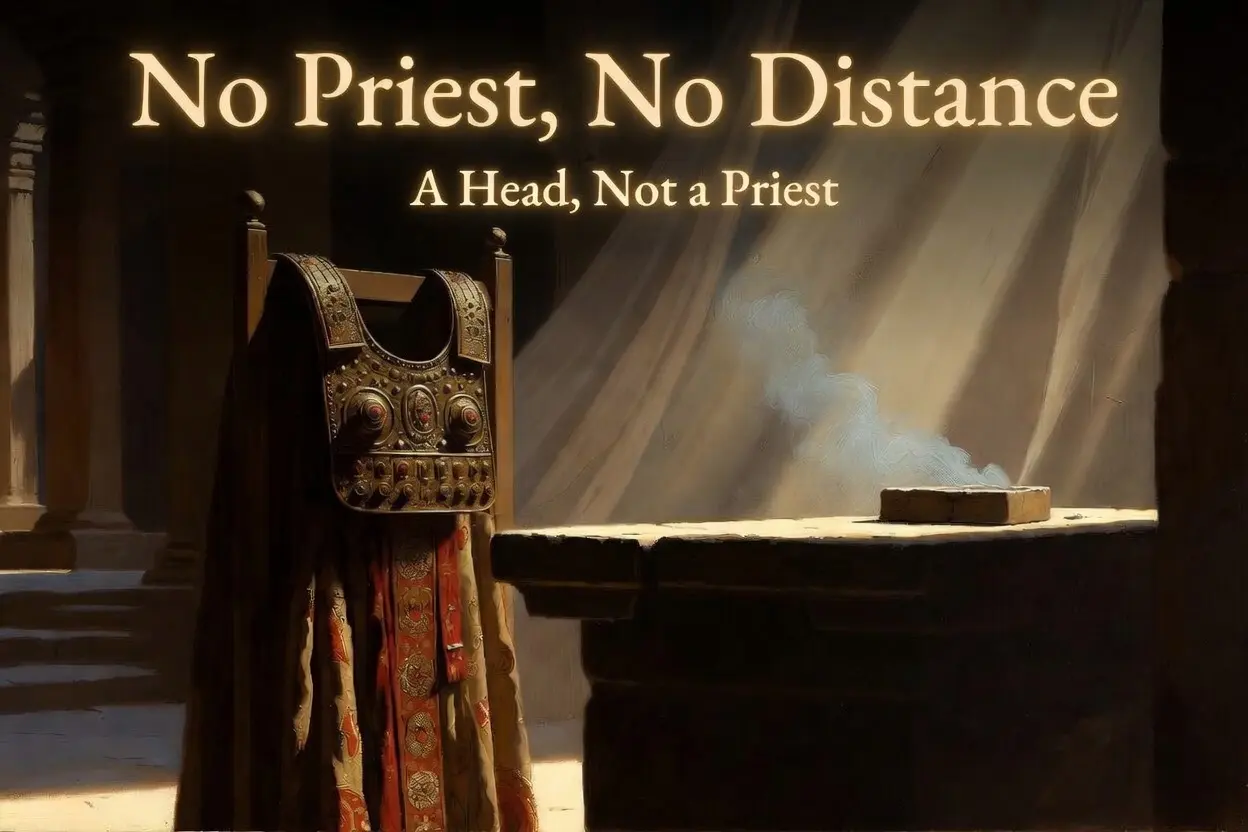
In a companion study we asked whether a member of the Body of Christ must come to a throne of grace to obtain mercy in a time of need, and we found that he need not — because he already stands in grace, complete in Christ and seated in Him at the right hand of God. But the exhortation to come, in Hebrews 4:16, rests on something just before it: "Seeing then that we have a great high priest..." (Hebrews 4:14). Israel is told to come to the throne because she has a High Priest. So this study takes up the other half of that picture. The throne study asked, must we come? This one asks, do we have — or need — a priest at all?
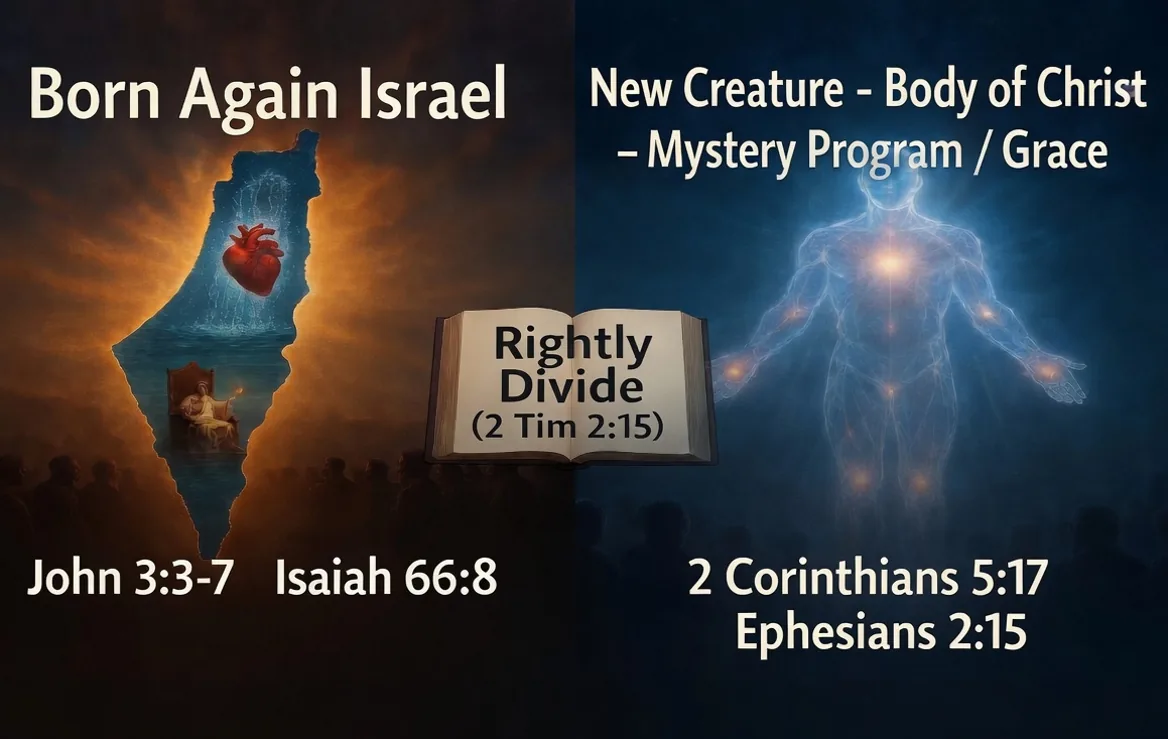
The popular answer is instant and unanimous: "Jesus is our Great High Priest," with Hebrews quoted as though it were written to the Body of Christ. But when Paul's revelation governs our understanding of our own standing, a more careful and far sweeter answer emerges. The priesthood of Christ in Hebrews is real and glorious — and it belongs to Israel's program, not to ours. Indeed, as we will see, the entire category of priesthood belongs to Israel: Christ is not robed as a priest toward the Body, and the Body is not built into a priesthood. What we have instead is a Head to whom we are joined and a redemption already finished.
"High Priest" Is a Word Paul Never Uses of Christ
Begin with a fact that ought to stop us in our tracks. The title "high priest," applied to Christ, appears in only one book of the post-resurrection Scriptures — Hebrews. Paul, given the revelation of the mystery for the Body of Christ, never once calls Christ our High Priest, or even our priest, in any of his thirteen epistles. Not in Romans, not in Ephesians, not in Colossians, where he piles up title after title to tell us who Christ is to us.
This is not an argument from a single missing word. Paul labors to name Christ's relationship to the Body — Head, Saviour of the body, our life, the One in whom we are complete. If the priesthood were that relationship, Paul of all men would have said so. He does not. What he gives instead is Mediator (1 Timothy 2:5) and intercession (Romans 8:34) — both true, and neither one a priesthood. The companion study on the throne of grace works out the mediator point in full: the word mediator is not Israel's exclusive property, but Christ mediates for the Body by His person and His ransom, not as the priest of a covenant we were never under. Here it is enough to mark the silence and let it stand: Paul never robes Christ as our Priest.
What a Priest Is For — To Offer Sacrifice for Sins
To see why that silence matters, ask what a priest actually does. Scripture tells us plainly:
"For every high priest taken from among men is ordained for men in things pertaining to God, that he may offer both gifts and sacrifices for sins." (Hebrews 5:1 KJV)
"For every high priest is ordained to offer gifts and sacrifices: wherefore it is of necessity that this man have somewhat also to offer." (Hebrews 8:3 KJV)
A priest exists to offer sacrifice for sins and to carry a people's cause into a sanctuary they may not enter themselves. The congregation stands outside; the priest goes in on their behalf. That distance is the very reason the office exists — a priest stands between God and a worshipper who cannot come on his own. And the whole office is bound to a covenant and its earthly sanctuary; the two come as a set:
"Then verily the first covenant had also ordinances of divine service, and a worldly sanctuary." (Hebrews 9:1 KJV)
A priest, then, means three things together: a continual offering for sins, a people held at a distance, and a covenant order to administer. Hold those three up against what Paul says is true of the Body of Christ, and not one of them survives.
The One Offering Is Finished — There Is Nothing Left to Offer
Take the first. A priest's defining work is to offer for sins; but Paul tells the Body that our sins are already forgiven — not being dealt with offering by offering, but pardoned in full, once, in Christ:
"In whom we have redemption through his blood, the forgiveness of sins, according to the riches of his grace." (Ephesians 1:7 KJV)
"And you, being dead in your sins and the uncircumcision of your flesh, hath he quickened together with him, having forgiven you all trespasses." (Colossians 2:13 KJV)
Mark the tense and the scope. Not sins God will forgive as we bring them; sins He hath forgiven — all trespasses, already. The single work a priest is ordained to perform is, for the Body of Christ, finished and done with. There is no altar still smoking, no offering still pending, nothing left for a priest to carry in. To station a High Priest over us, perpetually offering on our behalf, is to reopen a transaction that the blood of Christ already closed. We are not a people whose sins are being managed at a sanctuary; we are a people complete in him (Colossians 2:10), every trespass already forgiven before this present hour ever came.
A Priest Stands Between — But We Are Joined to the Head
Take the second thing a priest requires: distance. A priest is needed only where the worshipper must be kept outside. But the Body of Christ has no "outside," because we are not a congregation standing before Christ — we are members of His body:
"For we are members of his body, of his flesh, and of his bones." (Ephesians 5:30 KJV)
You do not appoint a priest to mediate between a body and its own head. The companion study lays this out at length — Israel relates to Christ as subjects to a King-Priest who approach a throne, while the Body relates to Christ as members to a Head in whom we are already seated. The same truth, seen from the priest's side, simply removes the office: there is no gap for a mediating priest to bridge when the members live by the Head's own life and are joined to Him forever.
And the Covenant Is Not Ours to Administer
Take the third. A priest serves a covenant — it is the order he ministers in, with its ordinances and its sanctuary. But the covenant Hebrews is built upon is the new covenant God expressly makes "with the house of Israel and with the house of Judah" (Hebrews 8:8), never with the Body of Christ. The companion study traces this at length; here the point is simply put. Where there is no covenant to administer, there is no priest to administer it. The Body was never placed under the covenant that the priesthood exists to serve, so the office has no work to do among us. Offering, distance, covenant — the three things that make a priest a priest — and for the Body of Christ not one of them remains.
Nor Is the Body a Priesthood
Here the division goes deeper than most realize. It is not only that Christ is not our priest; the Body of Christ is not built into a priesthood at all. This surprises people, because Peter's words are so often read onto the church:
"Ye also, as lively stones, are built up a spiritual house, an holy priesthood, to offer up spiritual sacrifices, acceptable to God by Jesus Christ." (1 Peter 2:5 KJV)
"But ye are a chosen generation, a royal priesthood, an holy nation, a peculiar people." (1 Peter 2:9 KJV)
But Peter is not writing to the Body of Christ. He writes "to the strangers scattered" of the dispersion (1 Peter 1:1) — Israel's believing remnant. And his "royal priesthood, holy nation" is a direct quotation of the promise made to that nation at Sinai:
"And ye shall be unto me a kingdom of priests, and an holy nation." (Exodus 19:6 KJV)
A "holy nation" can be only one nation, and a "royal priesthood" cannot describe the one new man in which there is neither Jew nor Gentile. This is Israel's calling — to be the priestly nation that ministers God's blessing to the Gentiles in the kingdom. That is why the priesthood of the redeemed is bound up with reigning on the earth:
"And hast made us unto our God kings and priests: and we shall reign on the earth." (Revelation 5:10 KJV)
The Body of Christ is never once called a priesthood, never told to offer sacrifices, never set apart as a holy nation — because our blessings are heavenly and our calling is union with the Head, not priestly ministry on the earth. So the whole priestly category stands or falls together. Christ is High Priest for Israel; the redeemed of Israel are a royal priesthood for the kingdom; and the Body of Christ is neither. We were given something other than priesthood, and better suited to our calling: completeness in Christ.
A Kingdom of Priests Needs a High Priest Over Them
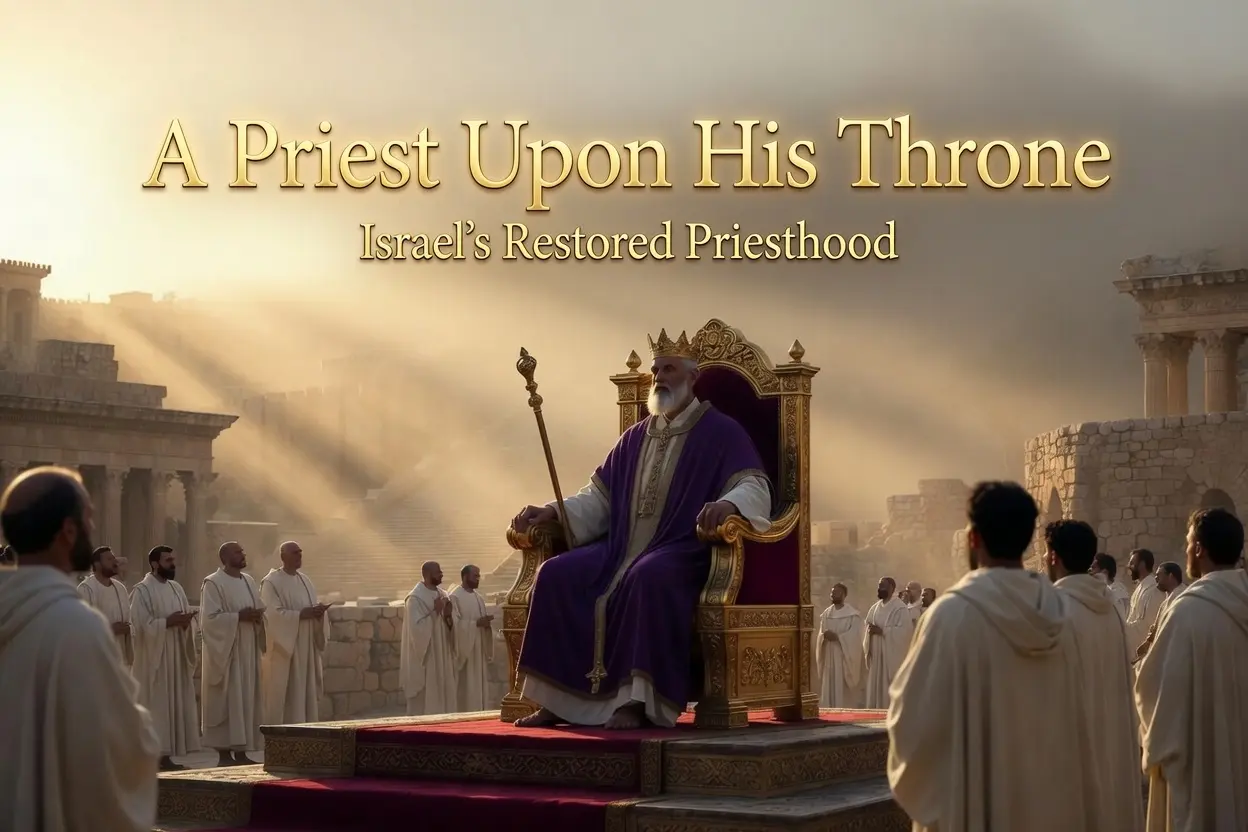
And this is exactly why the high priesthood of Christ has a real and necessary work to do — but in Israel's kingdom, not in the Body's calling. A kingdom of priests cannot stand without a high priest set over it; it was so under Moses, and it will be so again when the kingdom comes. For Israel's priesthood is not a finished thing but a future one, restored in the age to come, with a rebuilt temple and its worship resumed. And over that whole restored order reigns one who is High Priest and King together, the Branch who is "a priest upon his throne":
"Even he shall build the temple of the LORD; and he shall bear the glory, and shall sit and rule upon his throne; and he shall be a priest upon his throne: and the counsel of peace shall be between them both." (Zechariah 6:13 KJV)
There is the High Priest of Hebrews in His proper setting: a King-Priest after the order of Melchisedec, presiding over a kingdom of priests, a temple, and a restored worship. The office is indispensable — to Israel.
The Body of Christ has no part in any of it. We have no temple made with hands, no altar, no sacrifice, no Levites, no holy nation, no land. There is no priestly nation among us for a High Priest to preside over, and no temple service for Him to administer. The office that Israel's kingdom cannot do without is, for our calling, simply not in view — because we were made members of the Head, not a kingdom of priests beneath Him.
But Doesn't Paul Tell Us to Offer Sacrifices?
Here a fair objection arises. Paul does speak of sacrifice in his letters to the Body — so are we not, after all, priests who offer? Look at the places and the answer comes clear:
"I beseech you therefore, brethren, by the mercies of God, that ye present your bodies a living sacrifice, holy, acceptable unto God, which is your reasonable service." (Romans 12:1 KJV)
"...an odour of a sweet smell, a sacrifice acceptable, wellpleasing to God." (Philippians 4:18 KJV)
The first thing to see is that the word sacrifice does not by itself belong to the priesthood. We use it every day with no altar anywhere in view — a parent sacrifices for a child, a man sacrifices his ease or his money for a cause he loves. It simply means a costly giving, an offering up of something dear, and only sometimes is that offering a priestly one. So the mere appearance of the word in Paul settles nothing about an office. We have to ask what kind of offering he means.
Scripture itself uses the word this way again and again. I cite the next two lines only for the light they throw on the word — they are Israel's Scriptures, spoken in her worship and under her own program, not addressed to the Body of Christ — yet they show plainly that "sacrifice" in the Book often names a movement of the heart rather than an act at an altar. David calls a humbled heart a sacrifice:
"The sacrifices of God are a broken spirit: a broken and a contrite heart, O God, thou wilt not despise." (Psalm 51:17 KJV)
And the LORD Himself ranks plain obedience above the whole sacrificial system — which He could only do if the word reached well past the altar:
"...to obey is better than sacrifice, and to hearken than the fat of rams." (1 Samuel 15:22 KJV)
If a broken spirit can be called a sacrifice, and obedience can outweigh sacrifice, then the word was never the private property of priests and altars to begin with.
And when we ask what kind of offering Paul means, it is never the priest's kind. A priest is ordained "…offer both gifts and sacrifices for sins" (Hebrews 5:1) — a propitiatory offering, made on behalf of others, to answer their guilt before God. Paul's sacrifices are nothing of the sort. They are thanksgiving and self-giving: a believer presenting his own body in devotion, a church sending a gift to meet a need. No sin is being atoned for and nothing is offered on another's behalf. This is the worship of the already-reconciled, not the work of a mediator reconciling.
Notice, too, what Paul calls it — a living sacrifice. A priest never offers a living sacrifice; the whole Levitical pattern required the victim to be slain. The blood had to be shed, the life poured out, the body laid dead upon the altar. When Paul says living sacrifice he has deliberately stepped off the priestly altar altogether. The believer is not killed and offered for sin; he is presented alive, a continual living devotion. Had Paul meant to ordain us priests with offerings to make, living is the last word he would have chosen. He chose it precisely because our offering is not that kind of thing at all.
(And where "spiritual sacrifices" is joined to a working priesthood, the writer is Peter and the people are Israel — "an holy priesthood, to offer up spiritual sacrifices" (1 Peter 2:5) — which only confirms the line we have been drawing.)
So Paul never once reasons, "present your bodies a living sacrifice; therefore ye are priests." The inference is never drawn, because it does not follow. His sacrifice-language assumes the priesthood and its offerings for sin are finished in Christ, and borrows the old word to name something new and grateful: a life laid down in glad devotion to the One who has already done all the offering there is to do.
No Priest in the Body Means No Priestly Class
This has a sharp practical edge that Christendom has largely lost. If Christ is not robed as our High Priest and the Body is not a priesthood, then there is no priestly class among us either — no clergy standing between God and the believer, no holy man dispensing grace, no altar requiring a mediator. The point is built into the title itself. A high priest implies lower priests beneath him, for a high priest is a chief over an order. Israel had exactly that — a high priest set over a whole company of priests, and beyond them a priestly nation. But the Body of Christ has no such order. There are no lower priests among us for a High Priest to be high over, because according to the mystery there is no priest in the Body at all.
Paul confirms it by what he does and does not give the Body. He lists the gifts Christ gave the church — "apostles... prophets... evangelists... pastors and teachers" (Ephesians 4:11) — and there is no priest among them, because a priest's whole reason for being has been answered in our union with the Head. And he leaves us one mediator only:
"For there is one God, and one mediator between God and men, the man Christ Jesus." (1 Timothy 2:5 KJV)
One mediator — not a caste of them, not a man in a collar to absolve us, not a sacrament that conveys what the blood already conveyed in full. Every drift toward priests, altars, confessionals, and grace-dispensing rites quietly reintroduces the very distance Christ abolished for the Body, sending the believer to approach through a man what he already possesses directly in Christ.
This is no abstract danger; it is the engine of the great priestly systems of Christendom, and Rome is the clearest case. Her ministerial priesthood, her altar, and above all her Mass are built by importing the very thing we have been separating out — Israel's kingdom-and-temple program — and laying it upon the church. The "royal priesthood" that belongs to Israel is claimed for a clergy; the Aaronic pattern of an altar and a sacrificing priest is revived; and the Mass is offered as a re-presentation of the sacrifice of Christ, a continual offering made by a priest for the sins of the people. But that is exactly the office we have seen has no place here — and the Mass in particular collides head-on with the finished work, making perpetual what God pronounced once for all and reopening at an altar the very transaction the blood of Christ closed forever. The error is not malice in the worshippers — most have simply received what they were taught; it is a misplacing of programs, Israel's priesthood dragged across the line Paul was raised up to draw. Nor is it Rome alone. Wherever a sacrificing priest, a consecrated altar, or a man empowered to absolve appears in the church, the kingdom has been pulled forward into the Body, and a professed believer is sent back to approach God through a mediator that no one complete in his Head has any need of.
A Word to Fellow Grace Believers
It should be said honestly that this is debated within grace circles, and I write here not to opponents but to brethren. Some sincere Mid-Acts teachers do call Christ "our High Priest," resting the case chiefly on two things: the intercession of Romans 8:34, and the priesthood "after the order of Melchisedec," which — being older than Aaron and untied to the Law — is thought to reach across the dispensations to us. I understand the instinct, but I believe each point overreads the texts.
Take Romans 8:34 first. It names the ministry intercession, not priesthood — and in Paul's vocabulary intercession is no priestly word at all. He uses the very same expression of Elijah the prophet: "how he maketh intercession to God against Israel" (Romans 11:2). He ascribes it to the Spirit — and there he tells us plainly what intercession is, for the Spirit's intercession arises straight out of prayer and our weakness in it: "the Spirit also helpeth our infirmities: for we know not what we should pray for as we ought: but the Spirit itself maketh intercession for us with groanings which cannot be uttered" (Romans 8:26). Mark it well: the one place Paul unfolds intercession at length, he frames it wholly in terms of prayer — our not knowing how to pray, and the Spirit pleading on our behalf — and not in terms of an altar, a sanctuary, or an office. He commands the same of every believer: "supplications, prayers, intercessions... be made for all men" (1 Timothy 2:1). A prophet, the Spirit, and the whole praying church all make intercession, and not one of them is a priest. The word means pleading before God on another's behalf — the very stuff of prayer — and nothing more. To read "priest" into "maketh intercession" at Romans 8:34 is to supply the very term Paul declined to use.
Then the Melchisedec argument, which on a closer look cuts the opposite way. That this priesthood is not Aaronic does free it from the Levitical system — but freedom from Levi is not freedom from Israel. The Melchisedec order is the king-priest order, and a king-priest belongs to a kingdom. Its great text is a kingdom psalm:
"The LORD shall send the rod of thy strength out of Zion: rule thou in the midst of thine enemies... The LORD hath sworn, and will not repent, Thou art a priest for ever after the order of Melchizedek." (Psalm 110:2,4 KJV)
That is Christ reigning from Zion with His enemies beneath His feet — the very priest upon his throne we met in Zechariah 6:13. So the order does not lift the priesthood out of Israel's program; it roots it the more deeply in Israel's kingdom. Older than Aaron it is — but no less Israel's for that.
And there is a quieter argument that may be the strongest of all: if a Melchisedec high priesthood were the Body's possession, Paul would have told us. The whole doctrine is expounded in one book, Hebrews; the Body's standing was revealed not there but through Paul, who names every facet of Christ's relation to us and never once calls Him priest after any order. A truth that near the center of our standing would not be left out of the very epistles written to define it. The silence is no oversight; it is a boundary.
Suppose, finally, that someone still presses the word and insists Christ's offering of Himself was a priestly act. Even granting it, that act is finished. Our redemption is a completed thing — "we have redemption through his blood, the forgiveness of sins" (Ephesians 1:7) — secured once at the cross and sealed in us by the Spirit unto the day of redemption (Ephesians 4:30), not kept up by an ongoing ministry in a sanctuary. The priest of Hebrews "ever liveth to make intercession" because the remnant's salvation is still future and their covenant still being administered; the Body's salvation is already secured in full. So even on the most generous reading, no high-priestly office is being exercised over us today — the work such a title would name is already done.
The safest course, then, is also the most precise: speak of Christ toward the Body exactly as Paul speaks — Head, Mediator, the One who intercedes — and reserve "High Priest" for the program where Scripture itself places it.
Why This Matters
As with the throne of grace, this is not a quibble over a word; it strikes at completeness and assurance. If I still need a priest to offer for my sins and mediate my access, then my forgiveness is provisional and my nearness to God is conducted at arm's length, through a sanctuary I cannot enter. That is Israel's gracious arrangement under covenant — but it is not ours. Paul's revelation says the offering is finished, the trespasses are all forgiven, the distance is gone, and the union is complete.
So, does the Body of Christ need a High Priest? No — and the reason is the finished work of the cross. We were never a congregation kept outside, waiting for a priest to carry us in. We are members of His body, forgiven all trespasses, complete in Him, and joined to the Head — with no offering left to make and no distance left to bridge. Christ is our Head and our one Mediator, and He ever liveth — not to bring us near, but to keep us where grace has already set us: in Him.
© 2026 Edward R. Cross



Comments
No comments yet. Be the first to share your thoughts.
Leave a comment