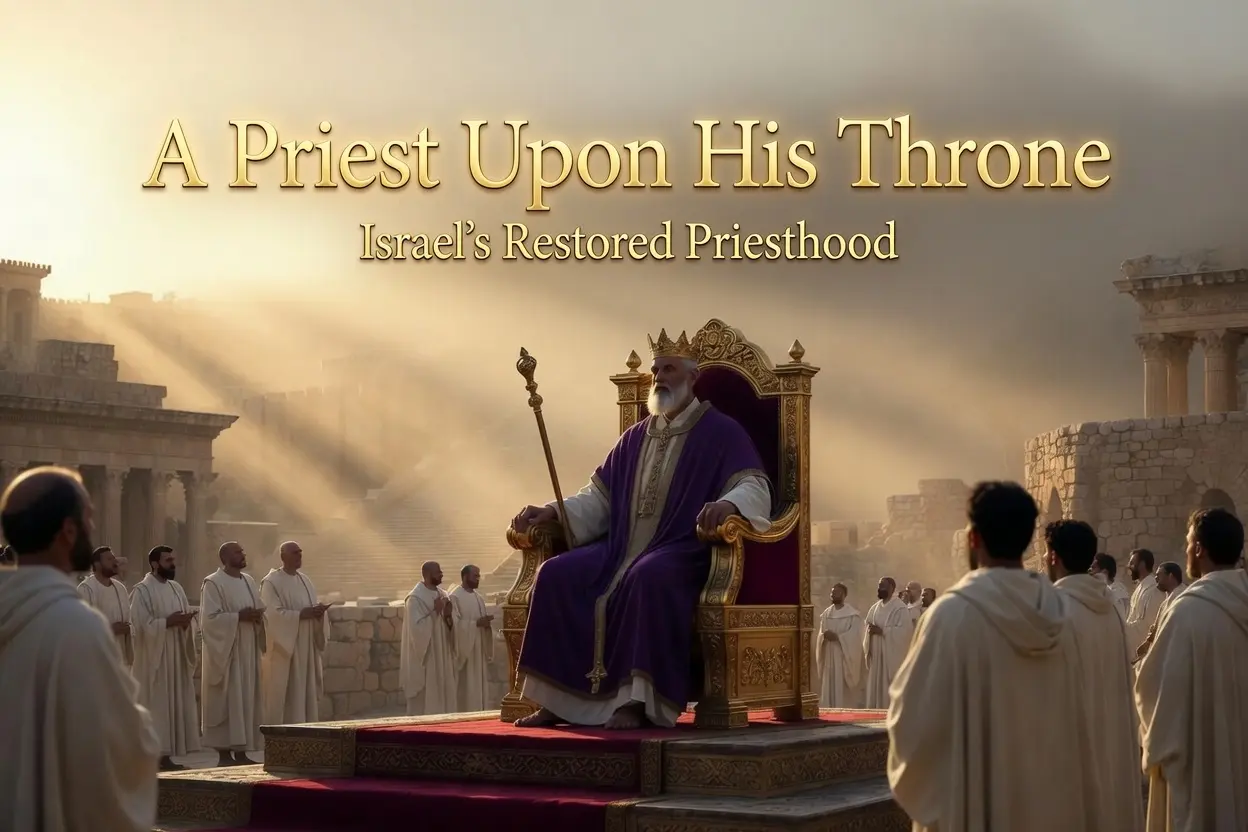
There is a knot in the Scriptures that few readers ever see untied. On one hand, the epistle to the Hebrews announces that the priesthood has been changed — the Levitical order set aside as weak and unprofitable, and a new priest raised up after the order of Melchisedec. On the other hand, the prophets promise that the priesthood of Levi is everlasting, that the sons of Zadok will minister in a rebuilt temple, and that sacrifices will be offered again in the age to come. Set those side by side and they look like a flat contradiction: the priesthood is finished, and the priesthood continues.
It is no contradiction. It is the architecture of Israel's kingdom, and when it is seen whole, two glories come into view at once — the glory of what is coming for Israel upon the earth, and (for those who rightly divide the word of truth) the glory of how entirely separate that program is from the Body of Christ. This study is about Israel's prophesied kingdom, not the mystery; about the earth, not the heavenlies. But it is worth seeing clearly, because the King who reigns at its center is our Saviour too.
Why Messiah Could Not Be a Priest After Aaron
Begin with a problem the Law itself created. Under Moses, kingship and priesthood were kept rigidly apart. The king was to come from Judah — "The sceptre shall not depart from Judah" (Genesis 49:10) — while the priest had to come from Levi, of the house of Aaron. The two offices never met in one man, and the boundary was guarded with fire. When King Uzziah, a man of Judah, presumed to enter the temple and burn incense, the priests withstood him and the LORD struck him with leprosy on his forehead:
"And Uzziah the king was a leper unto the day of his death, and dwelt in a several house, being a leper; for he was cut off from the house of the LORD." (2 Chronicles 26:21 KJV)
Here is the difficulty. Messiah is the Son of David, of the tribe of Judah. By the Law, He may sit on a throne, but He may not stand at an altar. If He is ever to be both King and Priest — and Israel's hope requires exactly that — He must hold a priesthood that does not descend from Aaron at all. He must have an older, higher order.
Melchisedec: A King-Priest in Salem
That order appears once in the books of Moses, long before Levi was born, in the person of a single man:
"And Melchizedek king of Salem brought forth bread and wine: and he was the priest of the most high God." (Genesis 14:18 KJV)
Mark what he is — "king of Salem" and "priest of the most high God" in one person, the two offices joined in a man who answered to no Levitical line because there was none yet. Hebrews unfolds the meaning of his very name and title:
"...first being by interpretation King of righteousness, and after that also King of Salem, which is King of peace." (Hebrews 7:2 KJV)
King of righteousness, King of peace — and Salem is Jerusalem. Righteousness and peace reigning from Jerusalem is not a vague ideal; it is the prophesied kingdom of Messiah in a single phrase. The order of Melchisedec is the order that seats a priest on a throne in the holy city. It exists to authorize precisely the King-Priest the Aaronic system forbade.
Psalm 110: The Throne-Priesthood of the Kingdom
This is why, when David looks down the centuries to his greater Son, he sees Him reigning and ministering at once. The great Melchizedek prophecy is a kingdom psalm from beginning to end:
"The LORD said unto my Lord, Sit thou at my right hand, until I make thine enemies thy footstool. The LORD shall send the rod of thy strength out of Zion: rule thou in the midst of thine enemies... The LORD hath sworn, and will not repent, Thou art a priest for ever after the order of Melchizedek." (Psalm 110:1–2,4 KJV)
The Lord ruling from Zion, His enemies made His footstool, and in the same breath sworn to be "a priest for ever after the order of Melchizedek." The Melchisedec priesthood is not a timeless office hovering above the dispensations; it is the reigning priesthood, fused to the throne. Zechariah saw the same and named it plainly — the Branch who shall build the temple and "sit and rule upon his throne; and he shall be a priest upon his throne" (Zechariah 6:13). A priest upon his throne: that is the order of Melchisedec, and that is the kingdom.
"The Priesthood Being Changed" — What Hebrews Sets Aside
Now we can read Hebrews rightly. When it speaks of the priesthood being changed, it is speaking of the supreme, mediatorial priesthood — the office that grounds a people's approach to God and is meant to bring them to perfection:
"If therefore perfection were by the Levitical priesthood... what further need was there that another priest should rise after the order of Melchisedec, and not be called after the order of Aaron? For the priesthood being changed, there is made of necessity a change also of the law." (Hebrews 7:11–12 KJV)
"For the law made nothing perfect, but the bringing in of a better hope did; by the which we draw nigh unto God." (Hebrews 7:19 KJV)
The point is sharp and limited. The Aaronic high priesthood could not make anything perfect; it could not finally bring the worshipper near. So the office that secures perfection and access passes from Aaron to Christ, after the order of Melchisedec, with a corresponding change of covenant. What Hebrews sets aside is the Levitical priesthood as the means of mediation — not God's standing pledge to maintain a ministering Levitical order in the age to come. Miss that distinction and the knot pulls tight; keep it, and the knot comes loose.
Yet the Sons of Levi Are Not Cast Off
For God's covenant with Levi does not lapse. To Phinehas He swore "the covenant of an everlasting priesthood" (Numbers 25:13), and through Jeremiah He bound the priesthood of the Levites to the throne of David in one unbreakable oath:
"David shall never want a man to sit upon the throne of the house of Israel; Neither shall the priests the Levites want a man before me to offer burnt offerings, and to kindle meat offerings, and to do sacrifice continually." (Jeremiah 33:17–18 KJV)
"...so will I multiply the seed of David my servant, and the Levites that minister unto me." (Jeremiah 33:22 KJV)
The same oath that guarantees David a Son upon the throne guarantees the Levites a place before the LORD. You cannot keep the one and discard the other; they stand or fall together. And the kingdom prophets say the Levites stand: the LORD will "purify the sons of Levi... that they may offer unto the LORD an offering in righteousness" (Malachi 3:3); and of Israel's brethren regathered "out of all nations" to Jerusalem (Isaiah 66:20), He declares, "I will also take of them for priests and for Levites, saith the LORD" (Isaiah 66:21). The ministering priesthood of Levi is not abolished forever; it is purified and restored.
Ezekiel's Temple and the Sons of Zadok
Ezekiel shows us that restored priesthood at work. In the great vision of the kingdom temple (Ezekiel 40–48), the priests who draw near to God are named:
"But the priests the Levites, the sons of Zadok, that kept the charge of my sanctuary when the children of Israel went astray from me, they shall come near to me to minister unto me, and they shall stand before me to offer unto me the fat and the blood, saith the Lord GOD." (Ezekiel 44:15 KJV)
There is even a graded restoration within the order. The faithful line of Zadok comes near to minister; the wider body of Levites who had gone astray bear their shame and are given the humbler service of the house (Ezekiel 44:10–14). A real temple, a real priesthood, real ministry — Israel's worship restored upon the earth, exactly as Jeremiah's oath required.
Two Priesthoods, One Order: The King-Priest Over the Sons of Zadok
Now both halves of the knot lie open in the hand, and they are not a contradiction but a hierarchy. The kingdom has two priesthoods serving at two levels:
Over all stands Christ, the High Priest after the order of Melchisedec — King and Priest together, reigning from His throne in Jerusalem, the supreme and final mediator whose office the Aaronic order could never supply. Beneath Him minister the restored sons of Zadok, the serving priesthood of the temple, conducting Israel's worship under the authority of their King-Priest. (The day-to-day administration of that worship falls to the Davidic prince of Ezekiel's vision, who provides the offerings and keeps the feasts — a subject of the kingdom, not its King, for he presents a sin offering even for himself, Ezekiel 45:22.) The first is the throne-priesthood that brings the worshipper near; the second is the ministering priesthood that attends the house. Hebrews changed the first; the prophets restore the second; and the second serves under the first. The Melchisedec order does not abolish Levi — it presides over a purified Levi. A kingdom of priests, with a working Levitical priesthood in the temple, and over the whole structure a priest upon his throne.
The Sacrifices Are Memorials, Not Propitiation
One question presses here: if Christ's offering of Himself is finished, what are sacrifices doing in Ezekiel's temple at all? The soundest answer is that they are memorial — they look back to the finished work of Calvary the way the Lord's table looks back today, teaching and commemorating the one sacrifice already accomplished, never adding to it or taking away sin. Nothing in the kingdom reopens what the cross closed.
Someone may press the objection harder: Ezekiel does not merely describe offerings — he calls them sin offerings, says they "make reconciliation for the house of Israel" (Ezekiel 45:17), and has their blood cleanse and purge the altar (Ezekiel 43:20). Does that language not make them propitiatory after all? It does not — and the book of Hebrews is the very place that proves it. Hebrews teaches plainly that animal blood never did what its language seemed to claim, for it never took sin away:
"For it is not possible that the blood of bulls and of goats should take away sins." (Hebrews 10:4 KJV)
What such blood actually accomplished was ceremonial — it sanctified "to the purifying of the flesh" (Hebrews 9:13) and stood as "a remembrance again made of sins every year" (Hebrews 10:3), a shadow pointing forward to the one offering that alone could cleanse the conscience. So even under Moses, sacrificial blood that "reconciled" and "purged" never reached the removal of sin; it cleansed the flesh and the sanctuary and kept the coming sacrifice in remembrance. Ezekiel, writing before that explanation was ever opened, uses the same language the Law had always used — and Hebrews tells us how much, and how little, that language ever carried. The kingdom offerings will "make reconciliation" in just the sense the Mosaic offerings did: they purify the temple and its order and call the finished sacrifice to remembrance. They do for the sanctuary what blood has always done; they do not touch the conscience or take away sin — for that, the cross has done once for all.
Details still invite humble study — the prophets do not spell out everything, and the role of Ezekiel's "prince" is debated. He prepares "for himself and for all the people of the land a bullock for a sin offering" (Ezekiel 45:22), and because he offers for himself he is plainly a Davidic administrator of the kingdom, not the sinless Christ. But the central matter is not in doubt: the memorial reading honors both the literal temple the prophets describe and the finished cross the gospel proclaims, keeping the kingdom worship in its place as commemoration, not propitiation.
And None of This Is the Body of Christ
Step back and see the whole, for the seeing is half the lesson. Israel's coming kingdom has a throne and a temple, a King-Priest and a ministering priesthood, a covenant and a land, sacrifices and a holy nation. Every piece of it is prophecy — the earth, Israel, the promised kingdom — the very thing the prophets foretold "since the world began" (Acts 3:21).
The Body of Christ stands wholly outside that architecture. We have no temple made with hands, no altar, no sacrifice, no Levitical line, no land, no throne to occupy. Our hope is not earthly but heavenly; our blessings are not in a restored Jerusalem but "in heavenly places in Christ" (Ephesians 1:3); and our relationship to the King-Priest is not that of worshippers approaching His throne but of members joined to our Head, complete in Him. The questions that trouble so many believers — whether the Body must approach a throne to find grace, or needs a priest to draw near to God — dissolve the moment this is seen: the priesthood, Melchisedec at the top and Zadok beneath, belongs to Israel's kingdom from end to end, and we were never placed within it.
So let the kingdom be the kingdom and the mystery be the mystery. The day is surely coming when a priest shall sit upon His throne in Jerusalem, when the sons of Zadok shall minister again, and when righteousness and peace shall reign from Salem over all the earth. It will be Israel's glory, and it will be glorious. But it is not our calling, and it is not our hope. We who believed Paul's gospel were blessed with all spiritual blessings in the heavenlies, joined to the Head, and seated in Him at the right hand of God, far above all — and there we already are.
© 2026 Edward R. Cross
Comments
No comments yet. Be the first to share your thoughts.
Leave a comment