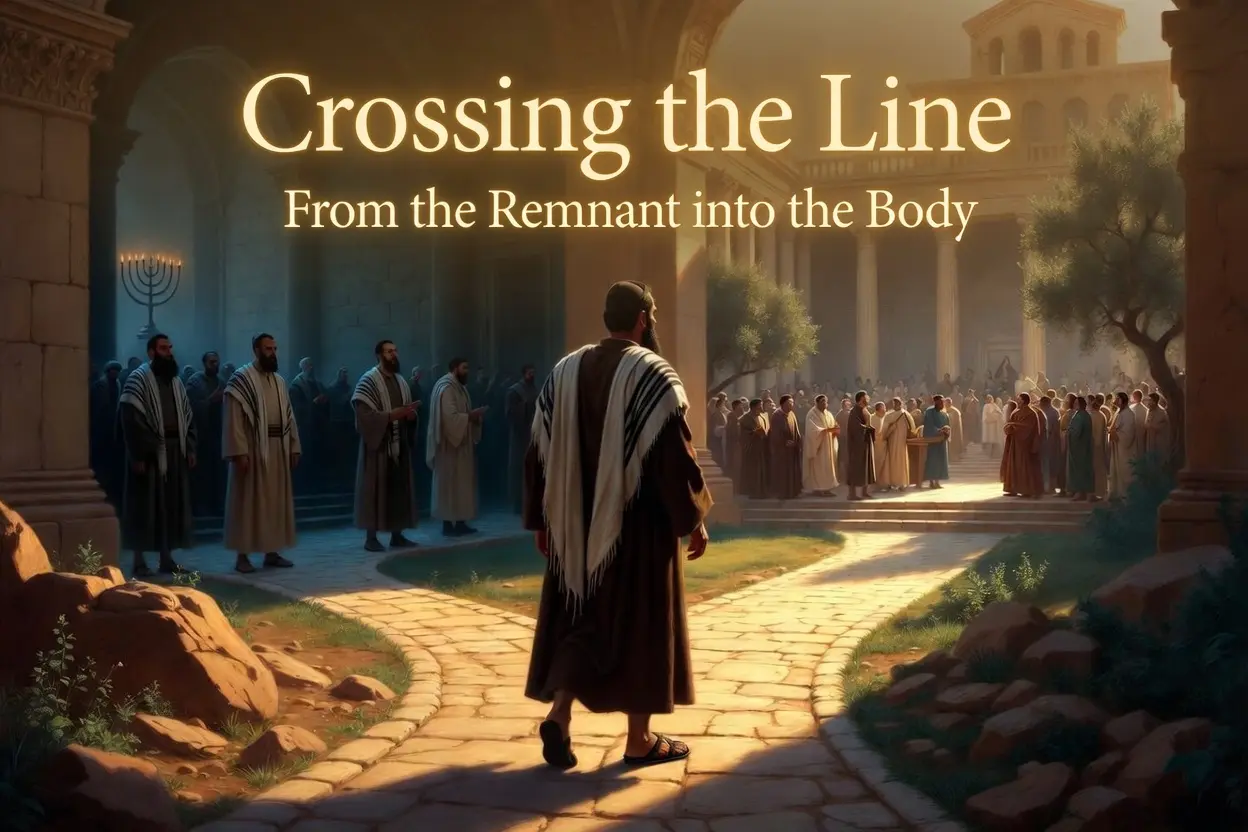
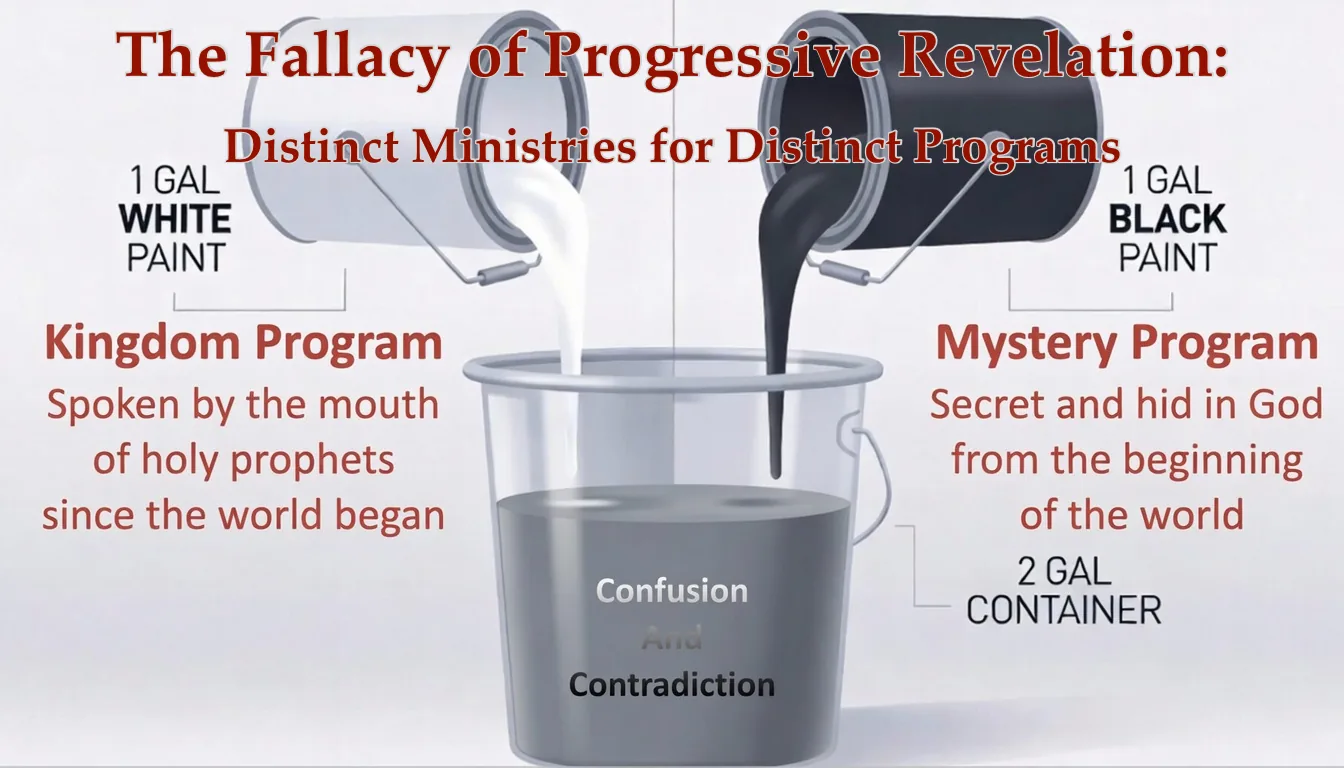
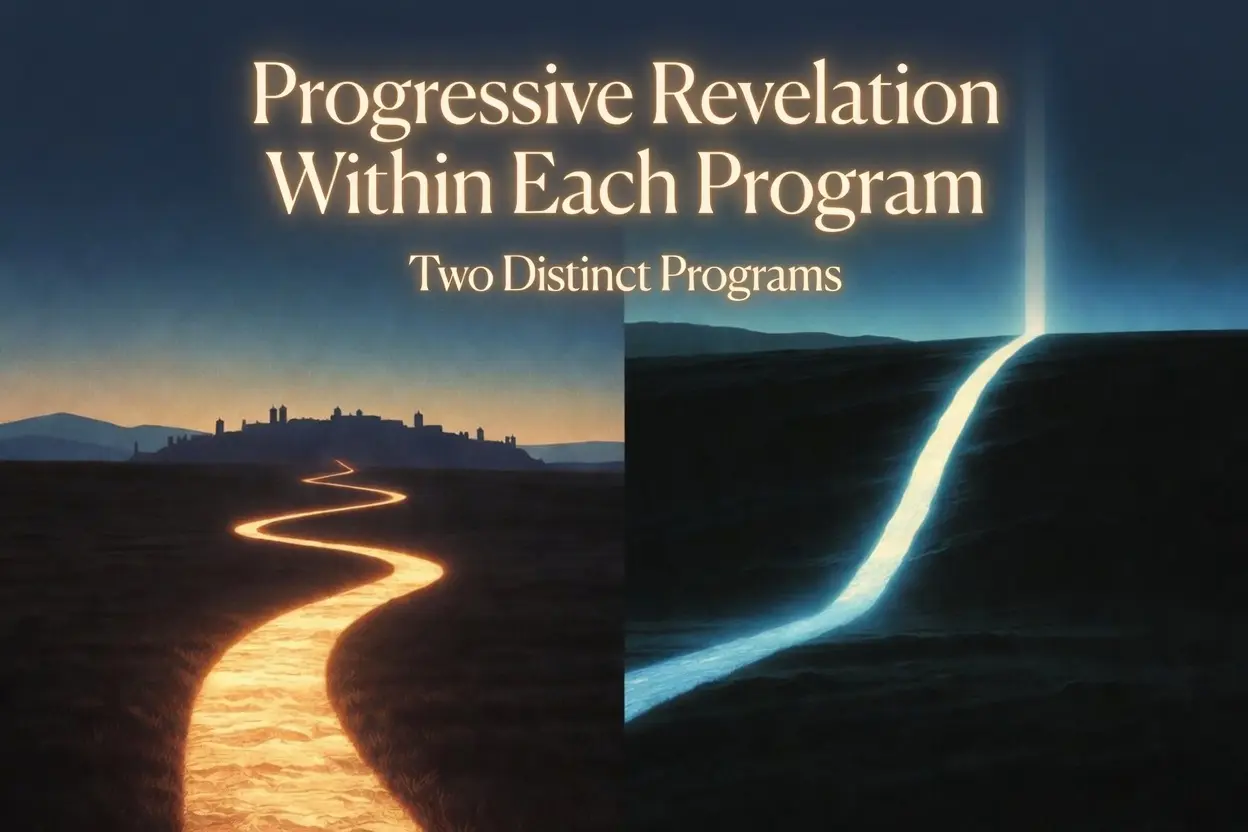
During the Acts period two of God's programs ran side by side. Israel's prophetic program had not yet been set aside; the believing remnant — the little flock — still looked for its kingdom, still kept the law, still gathered under the twelve. At the same time, Paul was preaching the mystery, and the Body of Christ was being formed out of believing Jews and Gentiles by the gospel of the grace of God. Most people sit clearly on one side of that line or the other. But some do not sit still so easily, and the sharpest cases of all are Barnabas and Silas.
Both were Jewish believers tied to the Jerusalem assembly. Barnabas first appears selling his land and laying the money at the apostles' feet in the earliest days of the Jerusalem church; Silas is named a chief man among the brethren there. Yet both end up at Paul's side, carrying the grace gospel to the Gentiles, free from the law, and both are called apostles. So which are they? Did they remain in Israel's kingdom remnant, or did they come into the Body of Christ? And behind their case stands the larger question this study means to answer: did any believer of the remnant cross that line at all?
Some hold that a believing remnant saint could never cross that line — that a man saved under one program is fixed there and cannot "change programs." There is a real truth being guarded by that instinct, and we will guard it too. But pressed as an absolute it does not survive the cases of Barnabas and Silas. The careful answer is that the programs never merged and the twelve were sealed forever to Israel's kingdom, yet individuals who were alive in the transition and believed the mystery were baptized into the one Body.
Barnabas and Silas are the sharpest cases, and we will weigh them first. But they press a further question at once: were they alone? Did that door open to others — and if so, how far?
What Does Not Transfer: The Twelve and the Kingdom Remnant
Begin with the truth the "can't change programs" instinct is right to protect. The programs themselves do not blend, and the twelve apostles never become apostles of the Body.
The twelve are fixed to Israel. The Lord sealed their portion before the mystery was ever revealed:
"And Jesus said unto them, Verily I say unto you, That ye which have followed me, in the regeneration when the Son of man shall sit in the throne of his glory, ye also shall sit upon twelve thrones, judging the twelve tribes of Israel." (Matthew 19:28 KJV)
Twelve thrones for twelve tribes. That is a kingdom assignment, earthly and national, and the church of one Body — which has no tribes — cannot receive it. The qualification for that office confirms how closed the circle was. When a replacement for Judas was sought, the man had to have been an eyewitness through the whole of Christ's earthly ministry:
"Wherefore of these men which have companied with us all the time that the Lord Jesus went in and out among us, Beginning from the baptism of John, unto that same day that he was taken up from us, must one be ordained to be a witness with us of his resurrection." (Acts 1:21–22 KJV)
No one converted later could ever meet that condition. The twelve are a fixed company, and their number does not grow. When Judas fell they did not add a thirteenth seat; they filled his one vacancy, that another might "take part of this ministry and apostleship, from which Judas by transgression fell" (Acts 1:25) — and the lot fell on Matthias, who was "numbered with the eleven apostles" (Acts 1:26), the circle standing again at twelve, and closed. That closedness cuts further than it first appears. If their number cannot grow, then no apostle named anywhere else in Scripture can belong to their ministry, for there is no seat left for him to fill. Every other apostle — Paul first of all — must hold a different apostleship altogether. The shut circle of the twelve is itself a proof of it: Paul's commission, and the Body's apostles with him, are a distinct thing, not an extension of theirs. Neither did they know the mystery; it was hid in God until it was revealed to Paul, and even at the end of his life Peter — one of the twelve — looked in on Paul's writings from outside the revelation and found them difficult:
"even as our beloved brother Paul also according to the wisdom given unto him hath written unto you; As also in all his epistles, speaking in them of these things; in which are some things hard to be understood." (2 Peter 3:15–16 KJV)
That is the portrait of a man who remained in his own program to the end. Peter shepherds the believing remnant, points them to the kingdom, and regards Paul's mystery as another man's deposit, hard to follow. Whatever we conclude about Barnabas and Silas, we are not going to conclude it about the twelve. They keep their thrones, and the kingdom remnant keeps its hope. There is no wholesale merger of the two peoples.
How Anyone Enters the Body: The Moment of Belief
Now set beside that the rule for how the Body of Christ is entered, for it is not the same rule at all. No one is born into the Body, and no one keeps a place in it by national descent. A person enters it at a single instant — the moment he believes Paul's gospel — and he enters it by the baptism of the Spirit:
"For by one Spirit are we all baptized into one body, whether we be Jews or Gentiles, whether we be bond or free; and have been all made to drink into one Spirit." (1 Corinthians 12:13 KJV)
Mark the breadth of it — whether we be Jews or Gentiles. The one thing the Spirit's baptism does not ask is which nation a man belonged to or what he was before. It asks only whether he has believed the gospel of the grace of God. And the raw material of this Body is not the already-righteous but the formerly-lost; God populates it out of the mass He has shut up under sin:
"For God hath concluded them all in unbelief, that he might have mercy upon all." (Romans 11:32 KJV)
This is why Paul calls himself the pattern. He was an unbelieving Jew, the chief of sinners, saved by sheer grace and made the first member and the model of all who would follow (1 Timothy 1:16). The Body is entered from unbelief, by grace, through faith in the mystery — and that door stood open to anyone alive while the transition ran, Jew or Gentile, remnant background or pagan background alike. The corporate kingdom remnant is not what comes through that door; but an individual who believes the mystery does, whatever he was before.
This even meets a fair objection. If the Body is entered out of unbelief, how does a believing remnant saint enter it — was he not already a believer? He was, in his own program: he had trusted his Messiah and looked for the kingdom. But Paul's gospel, the mystery, he had never believed, for it had not yet been made known to any man but Paul. As to that gospel he stood among the unbelievers still — and so he came in exactly as the pagan did, by believing what he had not believed before. A remnant past is neither a head start nor a barrier. The one door asks of every man the same faith in the same mystery.
Here the two rules meet without colliding. The kingdom remnant as a program does not transfer, and the twelve as a fixed office do not transfer. But a living person is not a program. A Jew who had once looked for the kingdom, if he heard and believed Paul's gospel during the overlap, was at that moment baptized by one Spirit into the one Body — exactly as the verse says.
The Body Had Many Apostles, Not Only Paul
If individual transition-era believers came into the Body, we should expect to find some of them named, and we do — among its very apostles. For the Body of Christ has apostles of its own, distinct from the twelve.
"And he gave some, apostles; and some, prophets; and some, evangelists; and some, pastors and teachers;" (Ephesians 4:11 KJV)
These church gifts were the foundation-layers of the new assembly:
"And are built upon the foundation of the apostles and prophets, Jesus Christ himself being the chief corner stone;" (Ephesians 2:20 KJV)
And these apostles and prophets knew the mystery — the very thing the twelve did not know — for Paul says it "is now revealed unto his holy apostles and prophets by the Spirit" (Ephesians 3:5). Paul was first of them and unique among them, the one to whom the dispensation was committed; but he was not the only one. He could not be everywhere at once, and the Spirit raised up others to lay the foundation alongside him. These are not the twelve of Israel's kingdom, who never knew the mystery and who are fixed to their thrones. They are a different company entirely — apostles of the Body.
It is true that the word apostle means simply a sent one, and the Body sent out many messengers. But that is not all that is being claimed here. The marker of a Body apostle is not the bare title but the office behind it: a man who knew the mystery (Ephesians 3:5) and helped lay the Body's foundation (Ephesians 2:20), gifted to the one Body by the ascended Christ (Ephesians 4:11). That office belonged to more men than Paul alone, and it is an office no member of the twelve ever held, for the twelve never knew the mystery they would have had to build on.
So the question about Barnabas and Silas is not whether a non-twelve man could be an apostle at all. He plainly could. The question is only whether these two belong to that company of the Body's own apostles — and the answer does not rest on the title alone but on the whole shape of their labor, which is marked all over with the mystery.
Barnabas: An Apostle Who Was Not One of the Twelve
Barnabas enters the record as a model member of the earliest Jerusalem church:
"And Joses, who by the apostles was surnamed Barnabas, (which is, being interpreted, The son of consolation,) a Levite, and of the country of Cyprus, Having land, sold it, and brought the money, and laid it at the apostles' feet." (Acts 4:36–37 KJV)
That is the believing remnant in its first days — all things common, the proceeds laid at the apostles' feet. And the language sets Barnabas plainly apart from the apostles in that moment: it is the apostles who surname him, and it is at the apostles' feet that he lays his gift — not at his own, as he must have done were he one of them. Here he is no apostle at all, but a remnant believer bringing his offering to the twelve. If anyone began on the kingdom side of the line, Barnabas did. And yet the same man is later called, without qualification, an apostle:
"Which when the apostles, Barnabas and Paul, heard of, they rent their clothes, and ran in among the people, crying out," (Acts 14:14 KJV)
He cannot be an apostle of the twelve. He never companied with the Lord from John's baptism to the ascension, so he could not meet the Acts 1 qualification; and the circle of that office was already closed — its one vacancy filled by Matthias, its number standing at twelve. And it is worth saying twice: it is not merely that Barnabas was not counted among the twelve. He could have no part in this ministry and apostleship at all (Acts 1:25); there was no seat in it for him, nor for any man converted after. Yet the Spirit plainly calls him an apostle. If he is an apostle and cannot be of the twelve, he is an apostle of the other kind — a Body apostle, one who knows and proclaims the mystery. That places him in the Body.
Everything else about his ministry agrees. When the pillars at Jerusalem recognized the grace given to Paul, they set Barnabas on Paul's side of the work, not their own:
"they gave to me and Barnabas the right hands of fellowship; that we should go unto the heathen, and they unto the circumcision." (Galatians 2:9 KJV)
Barnabas goes "unto the heathen" with Paul; James, Cephas, and John go to the circumcision. Paul names him as a fellow grace-laborer with the same apostolic liberty he himself had — "Or I only and Barnabas, have not we power to forbear working?" (1 Corinthians 9:6). And his ordinary practice was the practice of a grace man, eating freely with Gentiles; it was only under sudden pressure at Antioch that "Barnabas also was carried away with their dissimulation" (Galatians 2:13) — a man stumbling back toward what he had left, which only proves where he normally stood. A Body apostle, sent to the heathen, laboring in the mystery, living in grace liberty: Barnabas is in the Body of Christ. He is, moreover, named among the prophets and teachers at Antioch (Acts 13:1) — a foundation-layer of the Body on both counts, apostle and prophet alike.
Silas: From Chief Man in Jerusalem to Apostle of Christ
Silas runs the same course, and just as plainly. He too begins on the Jerusalem side — not a rank-and-file believer but a leader of the assembly:
"Then pleased it the apostles and elders, with the whole church, to send chosen men of their own company to Antioch with Paul and Barnabas; namely, Judas surnamed Barsabas, and Silas, chief men among the brethren:" (Acts 15:22 KJV)
A chief man among the brethren at Jerusalem — that is remnant standing if anything is. Yet when Silas joins Paul's labors, Paul folds him into the apostleship of the Body. Writing to Thessalonica, the letter opens from "Paul, and Silvanus, and Timotheus" (1 Thessalonians 1:1) — Silvanus being the name Paul and Peter use for the same Silas that Luke names in Acts — and a chapter later Paul speaks for all three together:
"Nor of men sought we glory, neither of you, nor yet of others, when we might have been burdensome, as the apostles of Christ." (1 Thessalonians 2:6 KJV)
As the apostles of Christ — Paul, Silvanus, and Timothy, the very company that had carried the gospel into Thessalonica and founded the church there together (Acts 17:1–4, 14–15). Whatever that verse means, it cannot mean Peter: he was nowhere near Macedonia; the apostles in view are plainly Paul's own grace company. Silas, the former chief man of the Jerusalem church, is here numbered among them. He did not carry a throne over from Israel's twelve; he came into the new creation and was given a place in the Body's foundation. And Scripture names him a prophet as well as an apostle (Acts 15:32) — set, like the foundation itself, among the apostles and prophets of the Body.
And Silas is not the only apostle in that sentence; Timothy stands in it too, and he is worth pausing on, for he shows something Barnabas and Silas do not. He was no Jerusalem remnant man at all — a disciple of Lystra, son of a Jewess but of a Greek father (Acts 16:1), brought into the Body under grace from the first. Yet here he is, numbered with Paul and Silas among the apostles of Christ. So the Body's apostolate was not merely former remnant leaders who had come over; it was its own foundation, and not all of it was drawn from the remnant. Some of its apostles had crossed from Israel's kingdom company, as Barnabas and Silas did; others, like Timothy, were never of that company but came in straight under grace. Epaphroditus leans the same way, and is a Gentile: Paul calls him the Philippians' own "messenger" (Philippians 2:25), and the word the King James gives there as messenger is the same it gives elsewhere as apostle. He may fairly be reckoned an apostle of the Body in that sense; and even a reader who would reserve the title for those expressly called apostles must still grant him a Gentile sent-one of the Body with no part whatever in Israel's kingdom. Either way he serves the point. (Paul greets in Rome a further pair, Andronicus and Junia, "who are of note among the apostles, who also were in Christ before me" (Romans 16:7), though that verse is disputed and should be held lightly.) The office was real, it was populated, and it belonged to the Body — never to the twelve.
Apollos: Taught the Way of God More Perfectly
If Barnabas and Silas show men crossing from the Jerusalem assembly into the Body, Apollos shows the crossing itself in slow motion — the one case where Luke lets us watch a man move from the old ground onto the new. He arrives a gifted believer who is nonetheless still standing in the prophetic stream:
"And a certain Jew named Apollos, born at Alexandria, an eloquent man, and mighty in the scriptures, came to Ephesus. This man was instructed in the way of the Lord; and being fervent in the spirit, he spake and taught diligently the things of the Lord, knowing only the baptism of John." (Acts 18:24–25 KJV)
"Knowing only the baptism of John" places him exactly. John's baptism belonged to Israel's preparation, the call to a nation to repent and be ready for its King — the very stream the believing remnant stood in. Apollos was fervent and able, but he was teaching up to the edge of the old program and no further. Then two of Paul's own grace co-workers took him in hand:
"whom when Aquila and Priscilla had heard, they took him unto them, and expounded unto him the way of God more perfectly." (Acts 18:26 KJV)
The way of God more perfectly — that is the mystery being opened to a man who had known only as far as John. And the result is told in one telling phrase: when he crossed into Achaia he "helped them much which had believed through grace" (Acts 18:27). He no longer labors at the edge of John's preparation; he labors among those who had believed through grace — the Body. From there Paul treats him as a settled fellow minister of the grace gospel, paired with himself in the planting of the church:
"Who then is Paul, and who is Apollos, but ministers by whom ye believed, even as the Lord gave to every man? I have planted, Apollos watered; but God gave the increase." (1 Corinthians 3:5–6 KJV)
Mark who stands inside that sentence and who does not. Paul asks "Who then is Paul, and who is Apollos, but ministers by whom ye believed" — and the two laborers he names are Paul and Apollos. Cephas is not among them. He is not one of the ministers by whom the Corinthians believed, and he is nowhere in the planting and watering of that church. Peter does appear later in the same chapter, but only when Paul reaches a different point: "let no man glory in men. For all things are yours; Whether Paul, or Apollos, or Cephas, or the world, or life, or death..." (1 Corinthians 3:21–22). There Cephas is listed among the things the saints possess and must not glory in — set beside the world, life, and death — not among the workmen who built the Body. The contrast is exact: Apollos is a minister by whom they believed; Cephas is a man they are told not to glory in. One is in the labor; the other is only in the list.
He is first a minister — a "minister by whom ye believed", a fellow workman who watered what Paul had planted in the one field — and that alone sets him plainly inside the Body, for his place hangs not on a title but on the gospel he believed and the field he labored in. But Paul does not leave him there; before the passage closes he draws Apollos up among the apostles by name. Follow the one word us through these two chapters. Paul and Apollos are the ministers of 1 Corinthians 3:5; Paul asks to be accounted with him among "the ministers of Christ, and stewards of the mysteries of God" (1 Corinthians 4:1); the figure of the planting and watering, he says, was "transferred to myself and to Apollos" (1 Corinthians 4:6); and that same us he names at the last "us the apostles", set forth of God "last, as it were appointed to death" (1 Corinthians 4:9). The pronoun never drops Apollos along the way — verse 6 pins it to him by name — so when it reaches the apostles, Apollos stands inside it.
Two things keep this from being a stretch. The word minister in verse 1 cannot hold Apollos below the apostles, for Paul stands in that very company of ministers and is himself an apostle; the two are one office here, not two ranks. And the hardships Paul goes on to list — "no certain dwellingplace", "working with our own hands", made "a spectacle unto the world" (1 Corinthians 4:9–12) — are the marks of the traveling apostle, which is exactly what Apollos was: Ephesus to Achaia, back into Paul's circuit, still on a journey in Titus 3:13.
And the same key that lets Apollos in keeps Cephas out, just as it should. The us of these chapters are "stewards of the mysteries of God" (1 Corinthians 4:1) — and Cephas was no steward of the mystery. Even when Paul "communicated unto them that gospel which I preach among the Gentiles" at Jerusalem (Galatians 2:2), the stewardship of it was never given over to him; his charge remained the gospel of the circumcision (Galatians 2:7), and to the end he found Paul's writings hard to follow. That is why Cephas never stands in this laboring company at all, but only back in the list of things the saints possess. The one chain numbers Apollos among the apostles of the Body because he was entrusted to labor in the mystery, and leaves Cephas among the possessions because it was never his to dispense.
And this was no passing association. Years later, writing to Titus, Paul is still arranging Apollos's travels and asking that nothing be wanting to him on his journey (Titus 3:13); he urges the Corinthians to receive him and presses him to come (1 Corinthians 16:12). A man who began knowing only the baptism of John ends, long after, as a settled apostle and minister of the grace gospel, watering the church Paul planted. That is not a remnant saint observed from across the line. That is a man taught the way of God more perfectly by Paul's own grace co-workers, sent to those who had believed through grace, and set to lasting work in the Body.
One caution belongs here, lest Apollos be confused with the men who appear right after him in the record — for they too knew only the baptism of John, yet they did not end where he did. At Ephesus Paul found about twelve disciples who had fallen even further behind; they had "not so much as heard whether there be any Holy Ghost" (Acts 19:2). And their bringing-forward looked nothing like Apollos's. He was advanced by doctrine and set to watering the grace field; these twelve received a Pentecostal induction:
"When they heard this, they were baptized in the name of the Lord Jesus. And when Paul had laid his hands upon them, the Holy Ghost came on them; and they spake with tongues, and prophesied." (Acts 19:5–6 KJV)
Water, the laying on of hands, the Spirit coming with tongues — that is the kingdom pattern given to the believing remnant of Israel, not the silent seal that marks the Body, where a man is sealed the moment he believes, without water, without hands, and without a sign (Ephesians 1:13). So the Ephesian twelve are best read as followers of John caught up into the remnant's Pentecostal experience during the overlap, not as members carried into the Body. The shared words "the baptism of John" prove no shared destination: Apollos came on to the mystery; these came up to Pentecost. Again the line holds — not where a man began, but what he came to.
And the Prophets of That Foundation
The foundation Paul names is not apostles only. It is "the foundation of the apostles and prophets" (Ephesians 2:20), and the mystery was made known "unto his holy apostles and prophets by the Spirit" (Ephesians 3:5). So the Body had prophets of its own as surely as it had apostles — "God hath set some in the church, first apostles, secondarily prophets" (1 Corinthians 12:28) — men gifted to speak the newly given mystery for the building up of the saints, under order and judgment (1 Corinthians 14:29–32).
And the same men we have followed stand among them. Silas is not only numbered with the apostles of Christ; he is expressly called a prophet: "And Judas and Silas, being prophets also themselves, exhorted the brethren with many words, and confirmed them" (Acts 15:32). Barnabas, too, is numbered among the prophets and teachers in the church at Antioch (Acts 13:1). The transition-era men who fill the apostolic half of the foundation fill the prophetic half as well — one more proof that they belonged to the Body whose foundation it was.
Nor were these two the whole of that company. The same verse names a fuller set — "certain prophets and teachers; as Barnabas, and Simeon that was called Niger, and Lucius of Cyrene, and Manaen... and Saul" (Acts 13:1) — and to see what kind of company it was, trace how the assembly that held them began. The men who first carried the word to Antioch were among those "scattered abroad upon the persecution that arose about Stephen" (Acts 11:19) — Jerusalem believers, not Paul's converts — and "some of them were men of Cyprus and Cyrene" who "spake unto the Grecians, preaching the Lord Jesus" (Acts 11:20); and "the hand of the Lord was with them: and a great number believed, and turned unto the Lord" (Acts 11:21). What they preached was not the revelation of the mystery. They could not have preached it: the mystery was given to Paul alone by the risen Christ (Galatians 1:11–12; Ephesians 3:3), and Paul was not yet among them. They were scattered men of the Jerusalem company, proclaiming the risen Lord Jesus as far as they had been given to know Him — the message of that early ministry, not the secret hid in God. So a great number at Antioch had already believed, and turned to the Lord, on that preaching — before ever Paul came among them.
What made the assembly the Body's was what came after. Barnabas arrived and "had seen the grace of God" (Acts 11:23); then Paul was brought in and "taught much people" there a whole year, until the disciples "were called Christians first in Antioch" (Acts 11:26). It became a grace church with Gentiles in its fellowship — the very thing that later drew the circumcision party down from Judaea to trouble it (Acts 15:1), and that Peter's withdrawal there betrayed (Galatians 2:11–12). The mystery had reached Antioch in Paul, and those gathered on the earlier preaching were carried on into it — much as Apollos was brought on from the baptism of John to the way of God more perfectly. And here is the crossing once more, no longer in a single man but in a whole assembly: a great number who had first believed on the remnant's preaching of the Lord Jesus, passing over by faith in the mystery into the Body of Christ. What Barnabas and Silas show one soul at a time, Antioch shows in a congregation. So the foundation of the Body at Antioch was Paul's own, and no other man's: "not where Christ was named, lest I should build upon another man's foundation" (Romans 15:20); "as a wise masterbuilder, I have laid the foundation" (1 Corinthians 3:10). The men of Cyprus and Cyrene had named the Lord Jesus there, but they had not laid the Body's foundation; Paul laid that himself, in his year of teaching the mystery — and he opened that mystery to the very people gathered there, the remnant-born among them, Barnabas included. That is how they crossed: not by his withholding the mystery from men of remnant stock, but by his bringing it to them, until those who believed it stood in the Body and the assembly was the Body's own.
And it is within that foundation, only after the year of teaching, that those prophets and teachers are named. They were no ministry Paul inherited; they were men the Spirit raised up in that grace church and, like Barnabas before them, called out of the believing remnant into the Body's work, then set apart by the Holy Ghost's own act: "Separate me Barnabas and Saul for the work whereunto I have called them" (Acts 13:2).
This points to how such men came to know the mystery at all — and it guards the singular place of Paul. The mystery was revealed, directly and by the risen Christ, to one man: "by revelation he made known unto me the mystery" (Ephesians 3:3). To the rest it did not come that way. It was "now revealed unto his holy apostles and prophets by the Spirit" (Ephesians 3:5) — and the Spirit's instrument was Paul's own teaching. Paul spoke "not in the words which man's wisdom teacheth, but which the Holy Ghost teacheth" (1 Corinthians 2:13), and through those Spirit-taught words the mystery passed to the men who labored with him. So the year at Antioch was no ordinary schooling: it was the Spirit making the mystery known through Paul, that the Body's apostles and prophets might have it — not each by a revelation of his own, which belonged to Paul alone, but all by the one Spirit who taught Paul and then taught through him.
But mark the difference between these and the prophets of Israel's program, for the word prophet covered both during the overlap. When Agabus came down "from Judaea" and took Paul's girdle to bind his own hands and feet, foretelling the arrest with "Thus saith the Holy Ghost" (Acts 21:10–11), he spoke in the old predictive manner of a prophet sent out from Jerusalem — the remnant's stream, not the Body's. The Body's prophets did a different work: they proclaimed the mystery that had been hidden, laying with Paul the foundation he had begun. And because that work was foundational, it did not go on. A foundation is laid once. When the revelation was complete and the word of God was full, the gift had finished its task — "whether there be prophecies, they shall fail... when that which is perfect is come, then that which is in part shall be done away" (1 Corinthians 13:8, 10). There are no apostles or prophets of the Body being given today, for the foundation they laid — Paul's completed epistles — stands finished and is not laid again.
Why This Is Not Program-Mixing
It must be said clearly, because the danger of blending the programs is real and this site exists to resist it: none of this merges the two peoples or softens the boundary between them. It does the opposite — it shows exactly where the boundary runs.
The boundary does not run between Jewish blood and Gentile blood, nor between a man's past and his present. It runs at the mystery believed. The kingdom remnant, as a corporate people with covenants and a coming kingdom, is not transferred into the Body of Christ; its promises remain Israel's. The twelve, as a fixed office over the twelve tribes, are not transferred either; they keep their thrones and never become apostles of the Body. What happened with Barnabas, Silas, and Apollos is not that a program changed owners, but that these men passed, by faith, out of the company that was being set aside and into the new creature that was being formed — which is precisely what the Spirit's baptism does to anyone who believes the gospel of grace.
Paul even has a name for the believing Jews among them: those of the remnant who came to walk by this new-creature rule he calls "the Israel of God" (Galatians 6:16) — not the church usurping Israel's place, as replacement theology imagines, but the faithful remnant who crossed into the one Body and now share its heavenly hope. That verse is taken up in full in the companion study, The Israel of God.
This also answers a worry that the argument might seem to invite: if the door stands open for some to cross, has it not been opened for all — so that one might claim every believing Jew, the twelve included, was swept into the Body? It has not. The door is opened by faith in the mystery, one soul at a time; it is not opened by Jewish blood, and it carries no whole company through by descent. A man crosses because he himself believes Paul's gospel — not because he is a Jew, and not because his neighbor believed.
The law settles it visibly. The believing remnant at Jerusalem were marked by their zeal for the law:
"Thou seest, brother, how many thousands of Jews there are which believe; and they are all zealous of the law:" (Acts 21:20 KJV)
That is how a man under the kingdom program lived — believing in Messiah, yet zealous of the law, waiting for the kingdom. It is not how Barnabas, Silas, and Apollos lived. They carried a law-free gospel to the heathen, ate at Gentile tables, and labored in the mystery. The contrast is the proof, and it is also the disproof of the wholesale claim. Had Israel's believing remnant been carried over as a body, there would be no law-zealous multitude left at Jerusalem at all — yet there were thousands of them, deep into the Acts period. They were believers, but they show no sign of having received Paul's gospel — holding Messiah and the law together, and so far from embracing his law-free message that the mere report he taught the Jews to "forsake Moses" troubled them, and the elders pressed him to prove he still kept the law himself (Acts 21:21–24). Peter, one of the very twelve, remained among them to the end, looking on Paul's letters as hard sayings; Barnabas, Silas, and Apollos became the other kind, laboring in the grace field with Paul. Individuals crossed. The remnant did not.
What It Means for Us
The lesson is not merely historical. It tells us where the line of the Body of Christ is drawn, then and now.
It guards us from two opposite errors. On one side stands the error of dragging the twelve and the kingdom remnant into the Body of Christ — making Peter a Body apostle, claiming Israel's thrones and covenants for ourselves, erasing the distinction God drew. The fixedness of the twelve and the law-zeal of the Jerusalem saints forbid it. On the other side stands the error of so hardening the programs that no one alive in the transition could ever cross from the old company into the new — a wall the Scripture itself steps over again and again: when it numbers Barnabas, Silas, and Apollos among the apostles and prophets of the Body, when it gathers a great company at Antioch out of the older preaching into the new creature, and when Paul blesses the crossed-over remnant by name as the Israel of God. The truth keeps both guardrails: the programs are distinct and the twelve are fixed, yet the door of the Body stood open to every soul who believed the mystery while the transition ran.
And that door is the same one we enter. No one comes into the Body of Christ by ancestry, by ritual, or by belonging to the right religious company. A man comes in the instant he believes the gospel of the grace of God, and at that instant the Spirit baptizes him into the one Body, complete in Christ. Barnabas came in that way, and Silas, and Apollos. So does everyone who has come in since.
© 2026 Edward R. Cross



Comments
No comments yet. Be the first to share your thoughts.
Leave a comment