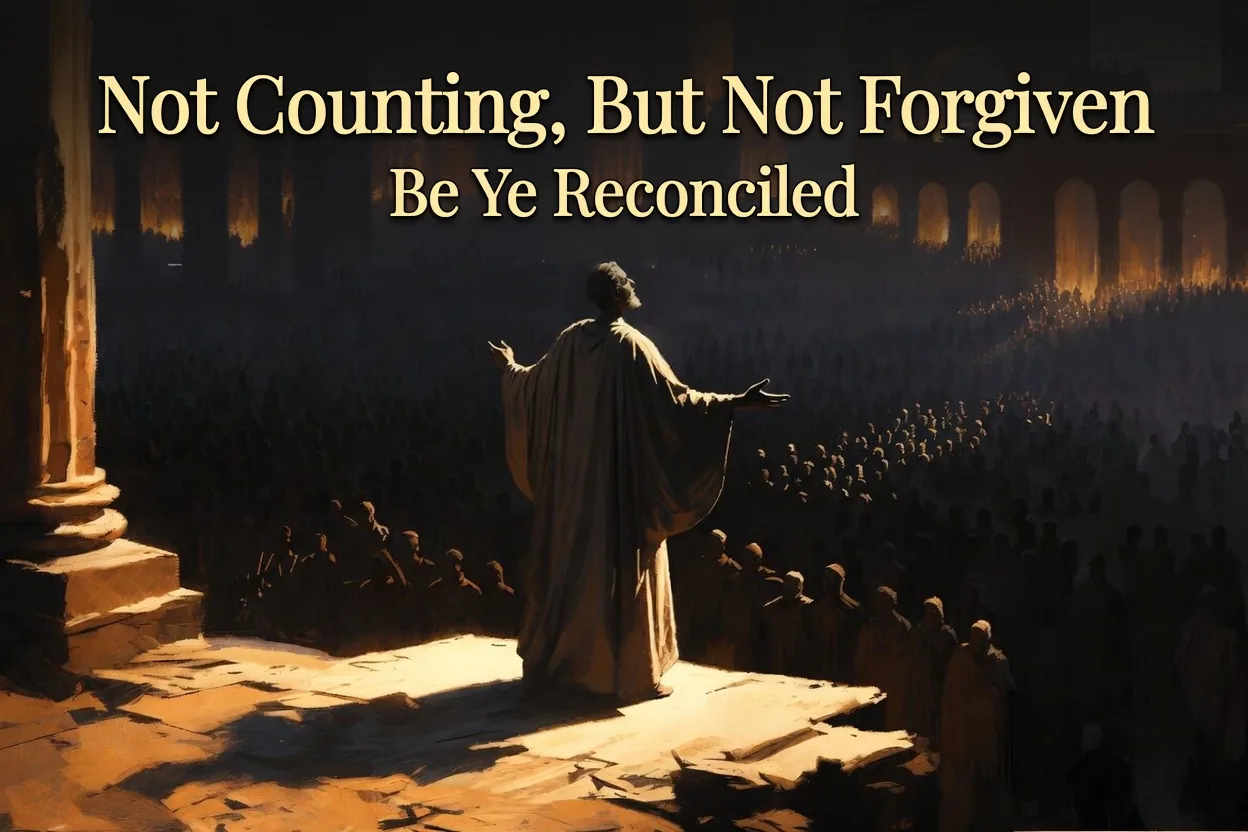
There is a verse in 2 Corinthians 5 that gets quoted often and understood rarely. "God was in Christ, reconciling the world unto himself, not imputing their trespasses unto them." People read that and reach two very different conclusions. Some read it as proof that every person alive is already forgiven — that God has wiped the slate clean for the whole human race, and the gospel is simply informing people of what is already true. Others read right past it without stopping to ask what it actually means for God to not be imputing trespasses — or when that changed.
Both groups are missing the same question. When did God stop counting trespasses? And what does it mean that He isn't?
The answer is one of the clearest demonstrations in Scripture of what the dispensation of grace actually is — and why Paul is not simply another preacher of an old message.
What Imputing Means
The word "imputing" is accounting language. To impute something to someone is to charge it to their account — to put it to their record and hold them responsible for it. Paul uses it in Romans 4:8 when he quotes David: "Blessed is the man to whom the Lord will not impute sin." David is describing the blessedness of the person whose sin is not charged to his account, whose record is clear before God. That is what imputing means: charging, counting, holding to account.
Paul also uses the word in Romans 5:13: "for until the law sin was in the world: but sin is not imputed when there is no law." Sin existed before Moses, but without the law there was no formal charging of it. God was not pressing the legal record in the same way. When the law came, the charge became specific and the account became formal.
So when Paul says God is "not imputing their trespasses unto them" in 2 Corinthians 5:19, he is making an administrative statement about how God is dealing with the world. God is not operating the wrath and judgment program. He is not pressing the charge. He is not demanding that sin be dealt with on Israel's covenant terms before He will speak to a person. He has dealt with sin in Christ — the account has been settled in the finished work of the cross — and He is now offering the benefit of that settlement to be received by faith.
What Was Happening Before
To understand what changed, you have to see what God was doing before. Under the kingdom program, sin was being pressed. Peter stood on the day of Pentecost and charged the nation of Israel directly: "ye have taken, and by wicked hands have crucified and slain" (Acts 2:23). The Spirit fell, the charge landed, and the response was, "Men and brethren, what shall we do?" (Acts 2:37). God was pressing the account.
A few chapters later Peter calls Israel to national repentance with specific consequences attached: "Repent ye therefore, and be converted, that your sins may be blotted out, when the times of refreshing shall come from the presence of the Lord" (Acts 3:19). Sin was being charged, and the terms for having it blotted out were being pressed — repentance, conversion, alignment with the coming kingdom.
That is what it looks like when God is imputing trespasses. The record is open, the charge is being brought, and there is a specific program for dealing with it. The wrath of God against sin is being made plain, and the path of relief is tied to Israel's national covenant framework.
The Change in Administration
2 Corinthians 5:18-21 describes an entirely different administration. Read the whole passage:
"And all things are of God, who hath reconciled us to himself by Jesus Christ, and hath given to us the ministry of reconciliation; To wit, that God was in Christ, reconciling the world unto himself, not imputing their trespasses unto them; and hath committed unto us the word of reconciliation. Now then we are ambassadors for Christ, as though God did beseech you by us: we pray you in Christ's stead, be ye reconciled to God. For he hath made him to be sin for us, who knew no sin; that we might be made the righteousness of God in him." (2 Corinthians 5:18–21)
Notice what God has done. He has reconciled us to himself by Jesus Christ. He has given to us — Paul and those with him — the ministry of reconciliation. He has committed unto us the word of reconciliation. The whole framework is one of God entrusting a message to Paul and sending him out as an ambassador.
The "not imputing their trespasses" sits exactly in the middle of that framework. It is not a declaration that the whole world is already forgiven. It is a description of the administration under which Paul is operating. God is not running the wrath program right now. He is not pressing the charge against a guilty world while Paul goes out to preach. He is holding the record and offering reconciliation instead.
But there is something even more precise in the verse that must not be passed over. Paul does not say God is simply not imputing trespasses. He says "God was in Christ, reconciling the world unto himself, not imputing their trespasses unto them." The non-imputation is the work accomplished in Christ. Christ's blood, Christ's death, Christ's resurrection — that is where the reconciliation was made, where the price was paid, where the sin-question was settled before God. The provision exists in Christ.
The problem is that the world is not in Christ. And Paul makes clear elsewhere that what God accomplished in Christ is only possessed by those who are in Christ. "In whom we have redemption through his blood, the forgiveness of sins" (Ephesians 1:7) — in whom. "In whom we have redemption through his blood, even the forgiveness of sins" (Colossians 1:14) — in whom. Redemption and forgiveness are located in Christ. They belong to those who are in Him. The unbeliever is not in Christ, which is exactly why he needs to be reconciled — he is standing outside the sphere where the work was accomplished.
That is why the very next verse still says, "we pray you in Christ's stead, be ye reconciled to God." If every person were already personally reconciled and forgiven, that appeal would be pointless. You do not beg a man to receive what he already possesses. The word of reconciliation still needs to be preached. The gospel still needs to be believed. Personal forgiveness is still received by faith, not announced as already accomplished. The world needs to get into Christ to receive what God accomplished in Christ.
Not Imputing and Not Guilty Are Not the Same Thing
This raises an obvious question. If God is not imputing trespasses, how can all the world still be guilty before God? Romans 3:19 says "that every mouth may be stopped, and all the world may become guilty before God." Paul wrote both statements. They do not contradict each other — but only if the distinction between guilt and imputation is kept clear.
Guilt is an objective standing before God — what a person is. Imputation is an administrative action — what God is doing with that guilt in His current dealings. God can decline to press the charge without erasing the record. The account is real. The standing is real. God is simply not prosecuting it through the wrath program right now.
And here the "in Christ" distinction becomes decisive. Romans 6:14 says "ye are not under the law, but under grace" — but that freedom belongs specifically to those who are in Christ. It is not a universal condition that extends to the unbelieving world. Those outside of Christ do not share it. They remain under the law's condemnation, which is exactly what Romans 3:19 establishes. Romans 8:1 confirms this from the other direction: "There is therefore now no condemnation to them which are in Christ Jesus." No condemnation — for those in Christ. The standing of those outside of Christ is left in no doubt.
This is the lawful use of the law. Paul says in 1 Timothy 1:8, "we know that the law is good, if a man use it lawfully." The lawful use of the law is not to put believers under it as a rule of life or to add it to grace as a condition of salvation. Paul makes clear in that same passage that the law is "made" for the lawless, the disobedient, the ungodly, and sinners (1 Timothy 1:9) — it is the instrument by which God establishes that every person outside of Christ stands guilty, every mouth is stopped, and no flesh can be justified. That is the law doing exactly what it was made to do.
So the world is not being imputed and is still guilty. Those two things are not in tension. God is not operating the wrath program right now — that is the administrative truth of "not imputing." But the world's standing before God has not changed. Every person outside of Christ remains under the law, guilty before God, condemned. The "not imputing" changes what God is doing. Only faith in the gospel — being placed in Christ — changes what a person is.
Provision and Application Are Not the Same Thing
There is a distinction that must be kept clear: provision is not personal application. Christ's blood accomplished everything necessary for the forgiveness of sins — the payment was full, the propitiation was complete, the work was finished. That is the provision. But the benefit of that provision is possessed by those who are in Christ by faith.
Romans 3:22 puts it plainly: "Even the righteousness of God which is by faith of Jesus Christ unto all and upon all them that believe: for there is no difference." The righteousness of God is "unto all" — the provision reaches everyone in its sufficiency. But it is "upon all them that believe" — the application is by faith. Those two phrases must be held together. Neither can be dropped without distorting the gospel.
Paul makes the same distinction in Acts 13:38–39: "Be it known unto you therefore, men and brethren, that through this man is preached unto you the forgiveness of sins: And by him all that believe are justified from all things." Forgiveness is preached through Christ — the basis is there. But "all that believe are justified" — the possession is by faith. Paul does not say all men are already justified. He says all that believe are.
Colossians 2:13 makes the personal application explicit: "And you, being dead in your sins and the uncircumcision of your flesh, hath he quickened together with him, having forgiven you all trespasses." Forgiveness is connected with being quickened together with Christ. That is the condition of the believer. The person still outside of Christ is still dead in trespasses and sins. Forgiveness is not a possession of the whole unbelieving world. It is a possession of those who are in Christ.
So when God is "not imputing" trespasses, He is not announcing that the whole world's record has been wiped. He is operating the dispensation of grace — the wrath program has been set aside, the provision has been made in Christ, and God is offering reconciliation freely through the gospel, calling all men everywhere to be reconciled to God by faith in the finished work of Christ.
When Did This Begin?
The administration of reconciliation — the ministry and the word of it — was committed to Paul. That is what 2 Corinthians 5:18 says: "hath given to us the ministry of reconciliation." This is not a timeless truth floating free of any historical moment. It is a description of the stewardship God gave to Paul at his conversion, the same dispensation of grace Paul describes in Ephesians 3:2 — "the dispensation of the grace of God which is given me to you-ward."
This began at Acts 9. When the risen Lord stopped Saul on the road to Damascus and commissioned him as a chosen vessel to bear the name of Christ before Gentiles, He was beginning the administration described in 2 Corinthians 5. Paul would become the ambassador. The word of reconciliation would be committed to him. The world would not be dealt with under Israel's wrath-and-repentance framework any longer, but under the terms of grace — not imputing, offering reconciliation, begging men through the preaching of the gospel to be reconciled to God.
This is also why the Body of Christ did not begin because Israel fell. Israel's fall is the historical context, not the doctrinal source. The mystery was hid in God before the world began. God was not improvising. He had always planned to reveal to Paul a message kept secret since the world began. When He did — at Acts 9 — the administration changed. The wrath-and-repentance program was set aside, the ministry of reconciliation was committed to Paul, and the ambassador went out with the word.
The Stakes of Getting This Right
If you flatten "not imputing their trespasses unto them" into automatic universal forgiveness, the gospel loses its urgency. The ambassador has nothing to offer that is not already owned. The appeal to "be ye reconciled to God" becomes a formality. Faith becomes nothing more than waking up to something already true.
If on the other hand you miss the administrative shift altogether — if you do not see that God has changed how He is dealing with the world — you will not understand your own position as a believer or your responsibility as an ambassador. God is not running the wrath program right now. He is not pressing the charge against a guilty world. He is holding the record and begging through us. That is the most remarkable thing — that God, who has every right to charge the world with its trespasses, has instead committed to Paul and to those who follow Paul the word of reconciliation, and is beseeching the world through us to be reconciled to Him.
That is what the dispensation of grace is. Not imputing. Offering. Beseeching. And it began when God gave the ministry of reconciliation to Paul.
"Now then we are ambassadors for Christ, as though God did beseech you by us: we pray you in Christ's stead, be ye reconciled to God." (2 Corinthians 5:20)
You are not announcing something the world already has. You are offering something the world urgently needs. And the God who is not counting their trespasses right now is the same God who will judge all things in due time. The window of reconciliation is open. The word is committed to us. Let's use it.
© 2026 Edward R. Cross








Comments
No comments yet. Be the first to share your thoughts.
Leave a comment