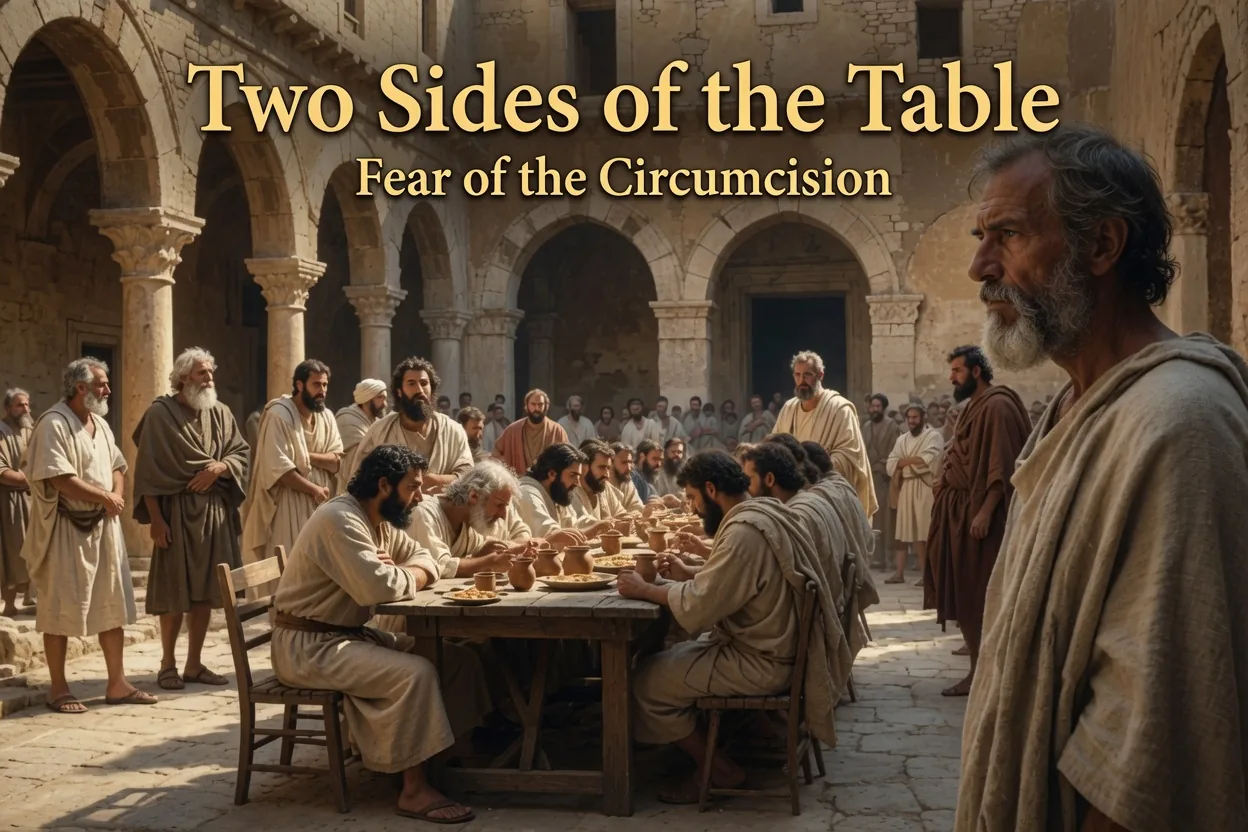
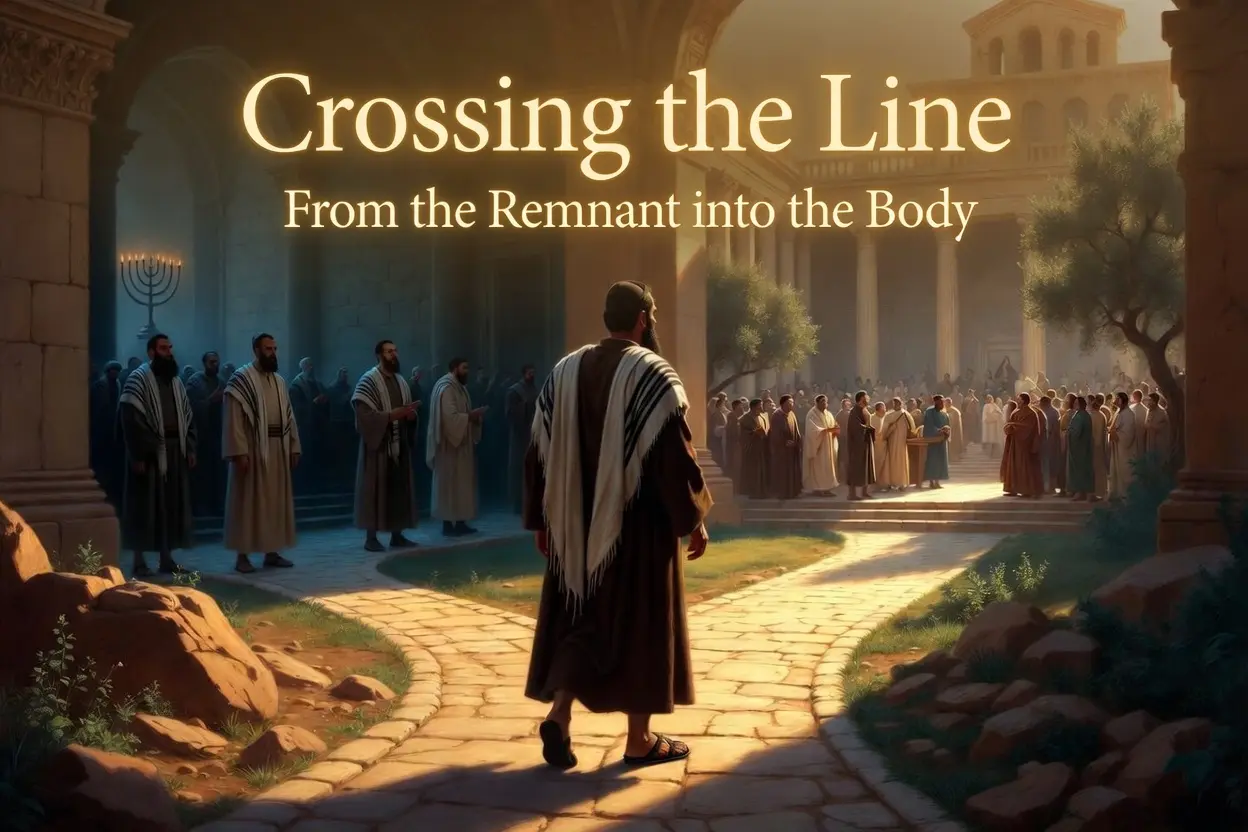
Most readers of Galatians treat the Antioch incident as a biographical interlude — a piece of evidence Paul uses to establish his apostolic independence before getting to the real doctrine. On that reading, the incident is illustrative: Paul once confronted Peter, which proves Paul was not under Peter's authority. Point made, move on.
That reading is not wrong, but it misses what Paul is actually doing. The confrontation at Antioch is not a biographical footnote. It is the concrete occasion from which Paul's fullest treatment of grace in all of Scripture directly flows. The rebuke Paul delivers to Peter in Galatians 2:14 is not separated from the doctrine of Galatians 2:15-21 and chapter 3. It is the opening statement of that doctrine. And the issue at stake was not only the question of how a Gentile is justified — it was the question of how a justified person is expected to live. That question is what Peter's behavior raised, and it is what Paul's rebuke addressed.
Understanding the incident fully requires working through four distinct questions. Why did Paul withstand Peter publicly rather than quietly? Why was Peter's behavior so inexcusable given what God had already shown him? Was Peter's failure doctrinal or something else entirely? And once those questions are answered — what was the deeper issue Paul's correction was defending?
What Happened at Antioch
The account is in Galatians 2:11-14:
"But when Peter was come to Antioch, I withstood him to the face, because he was to be blamed. For before that certain came from James, he did eat with the Gentiles: but when they were come, he withdrew and separated himself, fearing them which were of the circumcision. And the other Jews dissembled likewise with him; insomuch that Barnabas also was carried away with their dissimulation. But when I saw that they walked not uprightly according to the truth of the gospel, I said unto Peter before them all, If thou, being a Jew, livest after the manner of Gentiles, and not as do the Jews, why compellest thou the Gentiles to live as do the Jews?" (Galatians 2:11-14 KJV)
The scene divides cleanly into two phases. Before the men from James arrived, Peter was eating with the Gentile believers. After they arrived, he stopped. He withdrew. He separated himself. The word Paul uses for what the others did alongside him — "dissembled" — is the language of hypocrisy: acting a role that is inconsistent with what one actually knows and believes. Peter and the other Jewish believers were performing a separation that their own teaching did not require and that God had already directly overturned.
Paul's word for Peter is equally blunt: he was to be blamed. Not confused. Not mistaken. Blameworthy. The fault was not ignorance of a principle Peter had not yet grasped. The fault was acting against a principle God had already planted in him by direct, personal, unmistakable revelation.
What God Had Already Shown Peter
This is the element that gives the Antioch incident its full weight, and it is the element most often passed over. Peter did not arrive at Antioch as a man who had never been taught that Gentile acceptance was real. He arrived as a man to whom God had given a direct, personal experience of it years earlier.
The account is in Acts 10. Peter, praying on a rooftop in Joppa, fell into a trance and saw a sheet let down from heaven bearing all manner of creatures — unclean animals, things no faithful Jew would touch. And a voice said: "Rise, Peter; kill, and eat." (Acts 10:13). Peter refused. The voice answered: "What God hath cleansed, that call not thou common." (Acts 10:15). This happened three times before the sheet was received back into heaven.
Immediately afterward, messengers from Cornelius — a Roman centurion, a Gentile, uncircumcised — arrived to bring Peter to his household. The Spirit told Peter explicitly: "Arise therefore, and get thee down, and go with them, doubting nothing: for I have sent them." (Acts 10:20). Peter went. And when he arrived, before he had finished preaching, the Holy Ghost fell on all who heard the word — Gentiles, uncircumcised, without ceremony, without law, without anything but faith:
"While Peter yet spake these words, the Holy Ghost fell on all them which heard the word. And they of the circumcision which believed were astonished, as many as came with Peter, because that on the Gentiles also was poured out the gift of the Holy Ghost." (Acts 10:44-45 KJV)
What Peter witnessed at Caesarea was not a surprise to the kingdom program — it was its fulfillment. Peter himself had proclaimed at Pentecost that what was happening was the very thing Joel had foretold:
"But this is that which was spoken by the prophet Joel; And it shall come to pass in the last days, saith God, I will pour out of my Spirit upon all flesh: and your sons and your daughters shall prophesy, and your young men shall see visions, and your old men shall dream dreams:" (Acts 2:16-17 KJV)
All flesh. Not Jewish flesh only. The Spirit poured out on all flesh was the promise of the kingdom program, written in the prophets, proclaimed by Peter himself on the day the Spirit first came. Pentecost was the beginning of that fulfillment among the Jewish remnant. Cornelius's household was the same promise extending, within the kingdom program, to God-fearing Gentiles. When Peter recounted what had happened at Caesarea to the circumcision believers in Jerusalem, he made the connection himself: "And as I began to speak, the Holy Ghost fell on them, as on us at the beginning." (Acts 11:15). The same gift. The same beginning. The Cornelius event was not a novelty — it was Joel chapter 2 continuing to unfold through the kingdom apostle Christ had appointed for exactly this purpose.
Christ's own words had pointed here. Before His ascension He had told the apostles that the Spirit's power would carry the witness "unto the uttermost part of the earth" (Acts 1:8). The circumcision program was never bounded by Jewish ethnicity at its outer edges — the prophets had always made provision for the nations to be blessed through Israel, and for God-fearing Gentiles to be received. Peter had concluded as much at Caesarea: "Of a truth I perceive that God is no respecter of persons: But in every nation he that feareth him, and worketh righteousness, is accepted with him." (Acts 10:34-35). That was not the mystery of one Body — that was the prophetic program reaching the Gentile God-fearer on the same basis it always had. What was new was not the principle but the magnitude: the Spirit falling on them as He had on the Jewish believers at the beginning, confirming that the Gentile God-fearer stood accepted before God without waiting for circumcision to be administered.
This matters enormously for what happened at Antioch. When Peter withdrew from the Gentile table, he was not retreating from some newly received and imperfectly understood revelation. He was acting against something grounded in the very prophets he had preached since Acts 2 — the same Joel 2 promise he had quoted from memory before thousands at Pentecost, the same Christ who had told him the witness would go to the uttermost part of the earth, the same Spirit whose falling on Cornelius's household Peter himself had connected to the beginning. He had no ground to stand on, and he knew it.
Peter's conclusion from that event was explicit. When circumcision believers in Jerusalem challenged him for eating with the uncircumcised (Acts 11:3), he recounted the entire sequence and ended with a question that left no room for doubt:
"Forasmuch then as God gave them the like gift as he did unto us, who believed on the Lord Jesus Christ; what was I, that I could withstand God?" (Acts 11:17 KJV)
Peter already knew. He had not arrived at Antioch uncertain about whether Gentile believers were acceptable to God. He had not been quietly unsure whether table separation was still required. He knew that God had cleansed what he was now calling common again by his withdrawal. He knew that the Spirit had fallen on uncircumcised Gentiles on the same terms it had fallen on the Jewish believers at Pentecost. He had defended this before the Jerusalem believers and they had glorified God. And then, when men came from James, he acted as though none of it had happened.
This is why Paul does not describe Peter's failure as confusion. He describes it as fear: Peter withdrew "fearing them which were of the circumcision." The Cornelius experience did not fail to reach him. His own conscience did not fail him. His fear of the circumcision party overrode what he already knew, and he acted accordingly.
Peter's Sin Was Behavioral, Not Doctrinal
This distinction matters enormously for reading the incident correctly. Peter was not a Judaizer. He was not teaching that Gentiles needed to be circumcised to be saved. He was not importing circumcision-program doctrine into Paul's churches and calling it the gospel. He was a man who had received clear revelation from God, had defended it publicly in Jerusalem, and then failed to live consistently with it when social pressure arrived.
The word Paul uses is telling. He does not say the others were mistaken — he says they "dissembled." The same root is rendered "hypocrisy" elsewhere in Paul's letters. What Peter and the other Jewish believers were doing was a performance. They were acting out a separation before the men from James that their own teaching did not require and that God had already directly overturned. Peter was not confused about what God had shown him at Caesarea. He was afraid — afraid of the circumcision party, afraid of what the men from James would think, afraid of the social weight of that delegation.
That is a moral failure, not a doctrinal one. And the distinction matters because it changes what Paul's rebuke was asking of Peter. Paul was not telling Peter he had wrong doctrine. Peter's doctrine, within his own program, was already correct: God shows no respect of persons; Gentile God-fearers who receive the Spirit are accepted by Him; the wall of ceremonial separation between Jew and Gentile at table had been set aside by the very God who established it. Peter knew all of that. Paul's rebuke was demanding that Peter act consistently with what he already knew — that he stop allowing the social pressure of the circumcision party to override the revelation God had given him.
Peter's offense was that he sinned from cowardice. And cowardice, precisely because it operates against what the person already knows to be true, is not correctable by more information. It is correctable only by being named and confronted — which is what Paul did.
Why Paul Withstood Peter Publicly
Paul could have spoken to Peter privately. He chose not to. The text is deliberate: "I said unto Peter before them all." The confrontation was public, and that was not a failure of grace — it was the only response proportionate to the situation.
Peter's withdrawal had itself been public. He had not quietly informed someone of a private reservation. He had visibly separated himself from the Gentile believers in full view of the assembled community. The behavior was preaching a message whether Peter intended it to or not. What that behavior said, wordlessly, to every Gentile believer watching was this: your acceptance with Jewish believers is conditional. The wall is not down after all. When the right people arrive from Jerusalem, you go back to the far side of the table.
That message was false. It was not a message either program had authorized. The Jerusalem conference of Acts 15 had formally ruled that Gentile believers were not to be troubled with circumcision — "we trouble not them, which from among the Gentiles are turned to God" (Acts 15:19). The right-hand-of-fellowship agreement of Galatians 2:7-9 had recognized that Paul's gospel was distinct, complete, and sufficient for his people. Peter himself had been the one at the Jerusalem conference to appeal from his Cornelius experience against putting a yoke on Gentile believers. And now, in Antioch, his behavior was putting the yoke back on.
Because the error was public and because it directly affected the Gentile believers who were present, a public correction was required. A private word to Peter — had Peter privately corrected his behavior afterward — would have left every Gentile believer in that room still wondering what Peter's withdrawal had meant. Had Paul stayed silent, the implication would have been that even Paul's own conduct tacitly agreed with what Peter's behavior implied. Public error requires public answer. The doctrine of grace had been publicly compromised; it needed to be publicly recovered.
There was also the matter of Barnabas. Paul names him specifically: "insomuch that Barnabas also was carried away with their dissimulation." Barnabas was not a minor figure in Antioch. He was Paul's own co-laborer, his partner in the first missionary journey, himself called an apostle (Acts 14:14), the man who had vouched for Paul before the Jerusalem church when Paul's conversion was still being doubted (Acts 9:27). If Barnabas had been swept in, the sweep was broad. The entire Jewish contingent in the Antioch assembly had followed Peter's lead. The force of the social pressure was severe enough to carry even Barnabas. Paul withstanding Peter publicly was the only intervention with enough weight to reverse it.
Why Paul's Rebuke Did Not Reassign Peter
One further question must be addressed, because it is occasionally raised: does Paul's rebuke of Peter mean that Peter was wrong to be apostle of the circumcision? Does correcting Peter here amount to saying that the circumcision program itself was in error?
The answer is no — and the text does not support that reading. Paul never attacks the circumcision program in Galatians. He attacks the importation of the circumcision program into his gospel's territory. Those are not the same thing.
The circumcision program was God-ordained. Peter's commission to the circumcision was genuine and unrevoked. The believing Jewish remnant — thousands of them in Jerusalem alone, still zealous for the law (Acts 21:20) — was in its own program, under its own apostles, with its own ordinances still operative. None of that was in question at Antioch. Paul had formally acknowledged it in the right-hand-of-fellowship agreement: "we should go unto the heathen, and they unto the circumcision" (Galatians 2:9). The two programs operated by agreement. Paul's churches were his territory; the circumcision community was the Twelve's territory. Both were of God.
What Paul's rebuke demanded was something more specific: that Peter's behavior in a mixed setting — an assembly where Gentile believers of the mystery program were present — be consistent with what both programs had already agreed. The Jerusalem conference had established that Gentiles were not to be troubled. The fellowship agreement had recognized Paul's gospel as sufficient. Peter withdrawing from Gentile table fellowship in Antioch was violating the terms of the agreement his own program had ratified, and doing so in a way that visibly harmed the Gentile believers who were present. Paul was not reassigning Peter to the mystery apostleship. He was demanding that Peter honor what Jerusalem had already officially said.
After the rebuke, Peter remained the apostle of the circumcision. His commission was unchanged. His program continued. Nothing in the letter of Galatians suggests otherwise. The demand was behavioral, not programmatic.
More Than Salvation — How the Believer Lives by Grace
Now the deeper angle, and the one that carries the most weight for the Body of Christ today.
At Antioch, no one was arguing about whether the Gentile believers were saved. The Gentiles in that room had already believed Paul's gospel of grace. Their justification was not in question. No one was telling them that their faith was insufficient or that they needed additional works to secure their forgiveness. The argument was not about how they had been saved.
The argument was about how they were now expected to live.
Paul's rebuke is precise on this point: "why compellest thou the Gentiles to live as do the Jews?" The word is live. Not believe differently. Not be justified differently. Live differently — eat differently, observe different table customs, submit to a different set of behavioral ordinances as the governing structure of daily conduct. What Peter's withdrawal was communicating was that even for saved, justified, forgiven Gentile members of the Body of Christ, Jewish law practice was the standard for daily life in a mixed community. You may have been saved by grace. But you live by law.
Paul could not let that stand — not because it was the Judaizer heresy about justification, but because it was a different and equally dangerous error: the mistake that grace ends at salvation and law picks up for sanctification. That error did not originate at Antioch, and it has not died since. It is the persistent temptation of every believer who has rightly understood that justification is by faith to then assume that daily living must be governed by some form of rule-keeping, ordinance-observing, behavioral performance.
Paul's response to Peter becomes the opening statement of the answer to that mistake, and the language of living runs through the entire passage:
"I through the law am dead to the law, that I might live unto God. I am crucified with Christ: nevertheless I live; yet not I, but Christ liveth in me: and the life which I now live in the flesh I live by the faith of the Son of God, who loved me, and gave himself for me." (Galatians 2:19-20 KJV)
Notice what Paul does not say. He does not say: I was saved by faith, and now I live by law. He does not say: I was justified by grace, and now I am sanctified by performance. He says the life he now lives in the flesh — the daily, practical, embodied life — he lives by the faith of the Son of God. The same means by which he was justified is the means by which he now lives. Grace is not an entry point. It is the governing principle of the entire life.
And then the statement that closes the argument: "I do not frustrate the grace of God: for if righteousness come by the law, then Christ is dead in vain." (Galatians 2:21). Paul is not speaking here only of imputed righteousness at the moment of justification. He is speaking of the totality of the righteous life before God. If that life — justification and daily walk alike — can be achieved by law-keeping, the cross was unnecessary. It is an all-or-nothing statement. Either grace governs the whole life, or the cross accomplished nothing.
Paul presses this directly against his Galatian readers in the very next passage:
"O foolish Galatians, who hath bewitched you, that ye should not obey the truth, before whose eyes Jesus Christ hath been evidently set forth, crucified among you? This only would I learn of you, Received ye the Spirit by the works of the law, or by the hearing of faith? Are ye so foolish? having begun in the Spirit, are ye now made perfect by the flesh?" (Galatians 3:1-3 KJV)
Having begun in the Spirit, are ye now made perfect by the flesh? That is the precise error Peter's behavior was enacting and endorsing. You were saved by grace — begun in the Spirit. Are you now going to be sanctified, made complete, brought to maturity, governed in daily life by flesh — by law-keeping, ordinance-observing, performance-based conduct? The question answers itself, but only if you understand what grace actually means beyond its application at the moment of salvation.
Colossians states the same principle in a single verse: "As ye have therefore received Christ Jesus the Lord, so walk ye in him." (Colossians 2:6). As — by the same means — ye received Christ. You received Him by faith, apart from works, apart from law, entirely on the basis of what He accomplished. You are to walk in Him — to conduct your daily life — the same way. The reception and the walk operate on identical terms.
This is the doctrine Peter's behavior at Antioch was undermining. Not the doctrine of justification by faith in the abstract. The doctrine that grace covers the whole life — that the believer who has been crucified with Christ and now lives in Christ does not pick up a second governing principle for daily conduct once salvation is secured. There is no division in Paul's doctrine between a grace entry and a law life. The life is lived by the faith of the Son of God, beginning to end.
Paul's rebuke of Peter therefore carries a weight that exceeds the specific social situation at Antioch. It is the rebuke of every teaching that places the justified believer back under law-keeping as the standard for their practical life. It is the defense of a grace that does not stop at the door of justification. And it is the reason Galatians 2:11-14 is not a biographical footnote but the opening shot of the most complete treatment of living under grace that Paul ever wrote.
The Conclusion the Rebuke Demanded
Two truths about grace must both be held, and the Antioch incident presses both of them.
First: grace saves. The Gentile believers at Antioch were in the Body of Christ, fully forgiven, complete in Him, with no wall of partition remaining — "For he is our peace, who hath made both one, and hath broken down the middle wall of partition between us" (Ephesians 2:14). Peter's withdrawal implied the wall was back up. It was not. Paul withstood that implication in the strongest possible terms.
Second: grace governs. The believer who has been saved by grace does not then transition to a life governed by law or ceremony or performance. "For sin shall not have dominion over you: for ye are not under the law, but under grace." (Romans 6:14). Grace is not the ticket to a law-governed life. It is the governing principle of the entire life: entry, conduct, growth, and completion. The life lived in the flesh is lived — all of it — by the faith of the Son of God.
Peter failed both truths at Antioch. His withdrawal implied the first was incomplete: the Gentiles were not fully accepted. His compliance with the circumcision party's expectations implied the second was optional: daily life could be governed by a different standard than the grace that had saved him. Paul would not let either implication stand.
He was right to withstand it. He was right to do it publicly. And the doctrine that followed from his rebuke — running from Galatians 2:15 through the end of chapter 3 and beyond — remains the clearest statement in all of Paul's letters of what it means not only to be saved by grace but to live by it.
© 2026 Edward R. Cross

Comments
No comments yet. Be the first to share your thoughts.
Leave a comment