"Stand fast therefore in the liberty wherewith Christ hath made us free, and be not entangled again with the yoke of bondage." (Galatians 5:1 KJV)
What should a member of the Body of Christ wear to the assembly? It sounds like a simple question, but for generations it has been anything but simple. Dress standards have been wielded as spiritual measuring rods in fundamentalist and conservative circles, dividing churches, shaming congregants, and reducing genuine spirituality to the contents of a woman's closet or the cut of a man's collar. Pants on women. Ties on men. Head coverings. Skirt lengths. Sleeve lengths. The list is long, the enforcement zealous, and the biblical support — when examined honestly — surprisingly thin.
Paul was explicit about a great many things in his thirteen epistles. He addressed marriage, money, spiritual gifts, church order, race relations, and the deep mysteries of the Body of Christ's heavenly position. If dress codes for church attendance were a matter of spiritual significance for the Body of Christ, Paul would have said so. He did say something about apparel — and what he said is far simpler, and far more liberating, than the standards many churches have invented.
Paul's Actual Instructions on Apparel
Paul addresses clothing directly in one key passage:
"In like manner also, that women adorn themselves in modest apparel, with shamefacedness and sobriety; not with broided hair, or gold, or pearls, or costly array; But (which becometh women professing godliness) with good works." (1 Timothy 2:9–10 KJV)
This is the primary Pauline instruction on a woman's dress. Notice carefully what it says and what it does not say.
It does not specify a garment type. There is no prohibition of pants, no skirt length, no sleeve requirement, no color restriction. Paul does not tell women what to wear. He addresses how they adorn themselves — with modesty, with shamefacedness (a sense of propriety), and with sobriety (sound judgment). The negative examples he gives are not garments but adornments: braided hair elaborate enough to be a display, gold, pearls, and costly array — clothing chosen for its extravagance and its power to attract attention.
The context is a woman who professes godliness. Paul's concern is that her outward presentation should not contradict her inward profession. The adornment he commends is not a particular style of dress but good works. The woman who dresses to call attention to herself — whether through extravagance, sensuality, or lavish display — is prioritizing the outward over the inward. That is the principle. The application is one of Spirit-led wisdom, not a legally enforced dress code.
For men, Paul gives no comparable instruction on specific attire. He addresses the inner man — sobriety, sound doctrine, a walk worthy of the calling — but nowhere does he mandate particular garments for assembly.
The one instruction that does apply broadly to both men and women is the principle of walking worthy:
"I therefore, the prisoner of the Lord, beseech you that ye walk worthy of the vocation wherewith ye are called." (Ephesians 4:1 KJV)
Walking worthy encompasses all of life — including how we present ourselves. But worthy is defined by the calling, which is heavenly, spiritual, and positional. It is not a dress code.
Other Scripture on Apparel — A Necessary Disclaimer
Before drawing on other passages, a disclaimer is essential for those who rightly divide the word of truth.
The passage most often quoted alongside 1 Timothy 2:9 is 1 Peter 3:3–4:
"Whose adorning let it not be that outward adorning of plaiting the hair, and of wearing of gold, or of putting on of apparel; But let it be the hidden man of the heart, in that which is not corruptible, even the ornament of a meek and quiet spirit, which is in the sight of God of great price." (1 Peter 3:3–4 KJV)
This passage, though spiritually instructive, was not written to the Body of Christ. Peter wrote his epistles to "the strangers scattered throughout Pontus, Galatia, Cappadocia, Asia, and Bithynia" (1 Peter 1:1) — the dispersed Jewish remnant under the prophetic program. It is profitable for learning, as all scripture is (2 Timothy 3:16), but it is not addressed to us. We note that Peter's instruction agrees with Paul's in principle — the emphasis belongs on the inner person, not outward display — but we are careful not to build church law from a passage directed to a different audience.
Similarly, James 2:1–5 provides a striking illustration of the problem with clothing-based partiality:
"My brethren, have not the faith of our Lord Jesus Christ, the Lord of glory, with respect of persons. For if there come unto your assembly a man with a gold ring, in goodly apparel, and there come in also a poor man in vile raiment; And ye have respect to him that weareth the gay clothing, and say unto him, Sit thou here in a good place; and say to the poor, Stand thou there, or sit here under my footstool: Are ye not then partial in yourselves, and are become judges of evil thoughts? Hearken, my beloved brethren, Hath not God chosen the poor of this world rich in faith, and heirs of the kingdom which he hath promised to them that love him?" (James 2:1–5 KJV)
Again — James wrote to "the twelve tribes which are scattered abroad" (James 1:1), Israel's remnant. This passage is not our doctrinal instruction. But the insight is important: the assembly that judges people by what they are wearing has already gotten it exactly backwards. Dress standards that exclude, shame, or elevate based on clothing produce precisely the partiality James condemned.
How the Old Testament Is Misused to Establish Dress Standards
The most commonly cited biblical text used to enforce dress standards on the Body of Christ — particularly the prohibition of women wearing pants — is Deuteronomy 22:5:
"The woman shall not wear that which pertaineth unto a man, neither shall a man put on a woman's garment: for all that do so are abomination unto the LORD thy God." (Deuteronomy 22:5 KJV)
There is a foundational problem with this argument that must be stated plainly: the Bible says nothing about pants. The word pant appears in the Bible exactly five times, always as a verb, never as a noun. There is no biblical prohibition of pants because pants did not exist in the Hebrew world in which this command was given.
Hebrew men and women both wore tunic-style garments — long, robe-like shirts gathered at the waist with a girdle, sometimes with an outer robe or coat. Deuteronomy 22:5 was a prohibition of cross-dressing — a man deliberately adopting the distinctive appearance of a woman, or a woman making herself appear as a man. It was a command against gender confusion in appearance, not a mandate about specific modern garments that did not exist for another two thousand years.
The historical dishonesty becomes apparent the moment you ask why those who invoke this verse so zealously do not also insist that men dress as Hebrew men actually dressed. No one is demanding tunics, robes, and girdles. The selective application reveals that the argument is not a serious exegetical position — it is a cultural preference dressed up in Scripture.
And the dishonesty does not stop at verse 5. Those who hammer Deuteronomy 22:5 as a binding standard conspicuously skip verses 11 and 12 in the same chapter:
"Thou shalt not wear a garment of divers sorts, as of woollen and linen together." (Deuteronomy 22:11 KJV)
"Thou shalt make thee fringes upon the four quarters of thy vesture, wherewith thou coverest thyself." (Deuteronomy 22:12 KJV)
If Deuteronomy 22:5 is a binding standard for the Body of Christ today, why are blended fabrics acceptable? Why do men not wear fringes on the four corners of their garments? The answer, of course, is that these requirements are selectively applied — the first sign that what is really operating is not biblical conviction but cultural tradition using the law as a cover.
What Does the Bible Actually Mean by "Nakedness"?
Alongside the misuse of Deuteronomy 22:5, another cluster of Old Testament passages gets pressed into service to determine acceptable hem lengths, the permissibility of shorts, and the precise latitude at which a woman's skirt becomes sinful. These arguments hinge entirely on the word nakedness — but teachers who invoke it almost never let the Bible define its own term. When you do let the Bible define it, the argument for legislating hem lengths collapses entirely.
The most explicit biblical definition of nakedness in the context of clothing appears in the priestly instructions of Exodus:
"And thou shalt make them linen breeches to cover their nakedness; from the loins even unto the thighs they shall reach." (Exodus 28:42 KJV)
The Bible itself defines what it means by nakedness in a clothing context: the area from the loins to the thighs — the private parts, what undergarments cover. This is not a definition of shorts as nakedness. It is not a definition of a knee-length hemline as nakedness. The nakedness the priests were required to cover was their genitalia, which could potentially be exposed if they ascended the altar steps in their robes without the undergarment beneath.
This definition is consistent with how the word is used throughout Leviticus 18, where "uncover the nakedness" is the repeated phrase for sexual relations with a family member. The expression is a euphemism for sexual intimacy — it has nothing to do with hemlines.
Isaiah 47:2–3 is one of the passages most frequently cited to argue that the thigh must always be covered:
"Take the millstones, and grind meal: uncover thy locks, make bare the leg, uncover the thigh, pass over the rivers. Thy nakedness shall be uncovered, yea, thy shame shall be seen." (Isaiah 47:2–3 KJV)
This passage is a prophecy of judgment against Babylon — God describing the humiliation of a conquered empire stripped of her dignity and made to do the labor of a slave. The uncovering of the thigh here is the image of a captive woman being stripped and degraded by her conquerors. It is not a dress code. Using Isaiah 47 to establish that any exposure of the thigh in ordinary dress constitutes nakedness and shame is a gross misreading of context. By that logic, every woman who has ever knelt in prayer and let her skirt ride above the knee has been enacting the humiliation of Babylon.
Now consider what the Bible's own definition means for the question of shorts and hemlines. When a Hebrew man was working in the fields or traveling, he would gird up his loins — tuck the hem of his tunic into his belt — to give his legs free movement. This exposed the thigh routinely. It was so normal that "gird up thy loins" became idiomatic for get ready to work (1 Kings 18:46; Job 38:3; Jeremiah 1:17). The very people to whom the Mosaic Law was given regularly exposed the thigh in ordinary labor and travel, and it was not considered a violation of any standard.
If the thigh being visible constituted nakedness and sin in everyday life, the entire working culture of ancient Israel was in perpetual violation. The biblical definition of nakedness is far more precise than popular fundamentalist teaching suggests — and that precision leaves no room for legislating knee lengths, calf lengths, or the permissibility of shorts.
What is the actual conclusion the Bible's own definition leads to? Nakedness, in the clothing sense, is the exposure of the genitalia and the intimate private areas of the body. The application of modesty — which Paul does instruct in 1 Timothy 2:9 — involves not dressing in ways that are sensual, provocative, or attention-seeking. That is a Spirit-led judgment about effect and intent, not a geometric calculation of inches above the knee derived from misapplied Old Testament texts.
The History of Pants — Honesty Requires It
Those who use Deuteronomy 22:5 to prohibit women's pants often support their position with the historical claim that pants are inherently a man's garment, adopted by women only through feminist rebellion in the twentieth century. This argument requires a selective and misleading reading of history.
Pants did not originate in Western Europe as a men's garment. The earliest documented use of trouser-style garments dates to approximately 500 BC among the Iranian Scythians and the Achaemenid Persians — and Persian women were among their wearers. The Western adoption of trousers for men gained momentum only after the French Revolution in the late eighteenth century. In the mid-nineteenth century, pioneer women traveling West wore practical trouser-style garments as a matter of necessity. The fashionable "Turkish trousers" drawn from Middle Eastern women's dress were appearing in American fashion publications in the 1850s.
The argument that pants have always been exclusively a man's garment is historically false. It reflects a particular slice of Western cultural history that has been treated as universal and eternal. It is not.
Clergy Apparel
Among the most striking examples of Old Testament thinking imposed on the Body of Christ is the tradition of special clergy clothing. Robes, collars, vestments, miters, and stoles have no basis in Paul's epistles whatsoever. They are derived entirely from the Mosaic priesthood — a program that, as Paul declares in 2 Corinthians 3 and Galatians, has been done away in Christ.
The Body of Christ has no earthly priesthood. Every member is already "accepted in the beloved" (Ephesians 1:6), "made nigh by the blood of Christ" (Ephesians 2:13), and has "boldness and access with confidence by the faith of him" (Ephesians 3:12). There is no mediating priest standing between us and God, and therefore no priestly garment to mark that office.
Paul never dressed distinctively as a minister. He worked with his hands (Acts 18:3; 1 Thessalonians 2:9). He described himself as "the least of all saints" (Ephesians 3:8). The only putting on he commends for every believer — clergy and laity alike — is spiritual:
"But put ye on the Lord Jesus Christ, and make not provision for the flesh, to fulfil the lusts thereof." (Romans 13:14 KJV)
The garments that matter for the Body of Christ are put on by faith, not stitched by a tailor.
Standards Are Laws — and We Are Not Under the Law
A dress standard is a law. It is a rule by which your spirituality will be measured and judged by those who hold it. Paul addressed this directly when writing to the Colossians:
"Let no man therefore judge you in meat, or in drink, or in respect of an holyday, or of the new moon, or of the sabbath days: Which are a shadow of things to come; but the body is of Christ." (Colossians 2:16–17 KJV)
"Beware lest any man spoil you through philosophy and vain deceit, after the tradition of men, after the rudiments of the world, and not after Christ." (Colossians 2:8 KJV)
Dress standards imposed on the Body of Christ fall squarely into the category of tradition of men and rudiments of the world. They are not after Christ. The Body of Christ is not a community of people who dress alike to signal separation from the world. It is a community of people who are already complete in Him (Colossians 2:10), already accepted in the beloved (Ephesians 1:6), already blessed with all spiritual blessings in heavenly places in Christ (Ephesians 1:3). The new creature in Christ does not need a dress code to demonstrate identity. The identity is already secured — not by what we wear, but by who He is and what He has done.
Dress for Success: When the Boardroom Moved Into the Sanctuary
While the law has been the primary theological engine driving dress standards in conservative churches, it has had a powerful partner from a completely different direction — the secular world. Much of what passes for spiritual dress conviction in the church today is not biblical at all. It is borrowed wholesale from secular corporate culture and baptized with a thin coat of religious language.
In 1975, John T. Molloy published Dress for Success, a book that became enormously influential in the American corporate world. Its premise was straightforward: the way you dress determines how you are perceived, how seriously you are taken, and how far you will advance. Formal, professional dress communicates authority, credibility, and respectability. Casual dress communicates the opposite.
The church absorbed this philosophy with remarkable thoroughness. Wearing your best to church became the visible sign that you took God seriously. The man in the suit was the committed believer. The pastor in the expensive suit commanded authority from the pulpit. And the person who showed up in everyday clothing was communicating — whether they meant to or not — that they did not really care.
What almost no one noticed was that this standard came entirely from the corporate world, not from Scripture. The boardroom had successfully colonized the sanctuary, and the church had called it holiness.
The Sunday best tradition has deep roots in Western culture, but its theological justification is almost entirely circular. We wear our best because that is what we do, and we do it because wearing our best shows respect, and showing respect is what God requires, and wearing our best is how we show respect. At no point does a plain Pauline text appear in that chain. This is precisely the tradition of men and philosophy and vain deceit Paul identified as the enemy of the believer's liberty in Christ.
Moses and the Wing-Tips: The Absurdity of Dressing Up for God's Presence
Perhaps the most persistently repeated justification for formal church dress is this: we are coming into the presence of God to worship, and we should wear our best. It sounds reverent. But when you press this argument against the actual biblical record of what happened when human beings encountered the presence of God, it does not hold up for a single moment.
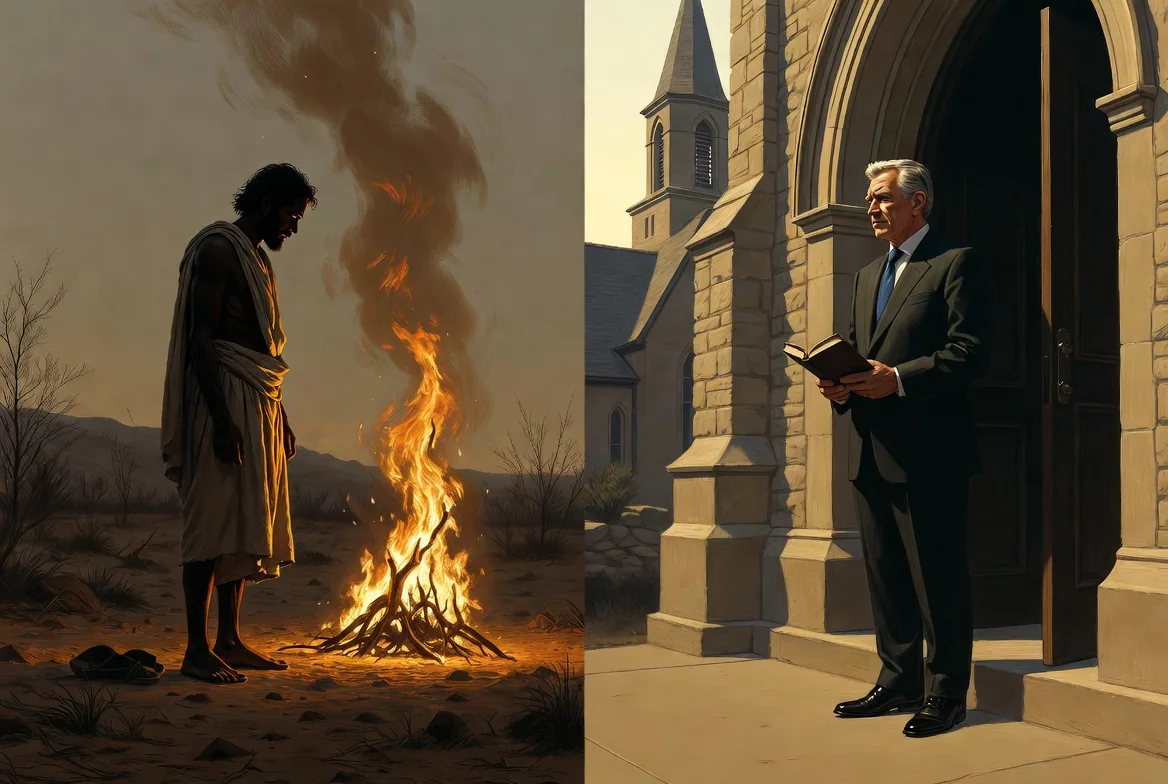
When Moses encountered the living God at the burning bush, he was not told to put on his finest garments. God's instruction was precisely the opposite:
"And he said, Draw not nigh hither: put off thy shoes from off thy feet, for the place whereon thou standest is holy ground." (Exodus 3:5 KJV)
Take off your shoes. Not: put on wing-tips. Not: go home and change into something worthy of the occasion. The response to standing in the holiness of God was not to add more carefully selected clothing. It was to remove what was there and stand before Him stripped of cultural formality.
Joshua received the same instruction before Jericho:
"And the captain of the LORD's host said unto Joshua, Loose thy shoe from off thy foot; for the place whereon thou standest is holy." (Joshua 5:15 KJV)
The appropriate posture before holiness is not careful, formal presentation of our best. It is the removal of what we have — a posture of vulnerability and surrender before the One who needs nothing from us.
Consider how the disciples encountered the risen Christ. Mary came to the tomb before dawn in whatever she was wearing. The disciples on the road to Emmaus were in their traveling clothes. Thomas was not instructed to clean up before touching the wounds. Peter dove into the sea in his fisherman's coat. The risen Lord met them exactly as they were. Paul met the risen Christ on the Damascus road in travel clothes, riding to persecute Christians. The Lord did not wait for him to change.
The argument that formal dress demonstrates reverence for God's presence collapses under the weight of Scripture. God is not impressed by our finest garments. He said so plainly:
"But the LORD said unto Samuel, Look not on his countenance, or on the height of his stature; because I have refused him: for the LORD seeth not as man seeth; for man looketh on the outward appearance, but the LORD looketh on the heart." (1 Samuel 16:7 KJV)
Man looks on the outward appearance. God does not. The dress standard that says wear your best to show God respect is built on the premise that God shares man's habit of judging by outward appearance. He does not. He never has.
The further irony is that the Sunday best tradition most often produces exactly what Paul warned against in 1 Timothy 2:9 — costly array and the drawing of attention to oneself through dress. The new creature is already accepted in the beloved (Ephesians 1:6), complete in Him (Colossians 2:10), and has bold access with confidence by faith (Ephesians 3:12). The access is already granted — not by what we wear, but by what Christ accomplished. If Moses had to remove his shoes to stand on holy ground, and we stand before God accepted in the righteousness of Christ, the appropriate response is not to put on our finest. It is to come as we are — stripped of pretense, standing on the ground of grace.
What the New Creature Actually Wears
Paul's instructions on the believer's walk are extensive and detailed. What he commends has nothing to do with specific garments and everything to do with the inner man:
"Put on therefore, as the elect of God, holy and beloved, bowels of mercies, kindness, humbleness of mind, meekness, longsuffering; Forbearing one another, and forgiving one another, if any man have a quarrel against any: even as Christ forgave you, so also do ye. And above all these things put on charity, which is the bond of perfectness." (Colossians 3:12–14 KJV)
Put on. The language of dressing is used — but what is being put on is mercy, kindness, humility, meekness, patience, forgiveness, and love. He returns to this imagery in Ephesians:
"That ye put off concerning the former conversation the old man, which is corrupt according to the deceitful lusts; And be renewed in the spirit of your mind; And that ye put on the new man, which after God is created in righteousness and true holiness." (Ephesians 4:22–24 KJV)
Put off the old man. Put on the new man. That is the dress code of the dispensation of grace.
The believer who comes to the assembly wearing modest, practical clothing appropriate to the occasion, with a heart adorned by the grace of God and a spirit clothed in the new man — that believer is dressed exactly as Paul instructed. Whether she is wearing a dress or trousers, whether he is wearing a suit or clean casual clothing, is a matter of personal liberty, cultural context, and practical wisdom. It is not a matter of salvation, spirituality, or standing before God.
Conclusion: Liberty, Not Legalism
The answer to how a believer should dress for church is both simpler and deeper than any dress standard can capture. Simpler, because Paul's actual instruction is brief and principle-based: dress modestly, without ostentation, without drawing attention to yourself through extravagance. Deeper, because the real clothing question is not about the outer man at all — it is about whether the inner man has been put on, whether the new creature is being walked in, whether charity is over all.
The Old Testament passages so earnestly invoked to enforce dress standards — Deuteronomy 22:5, the nakedness texts, the priestly garments — belong to Israel's program and have no binding authority over the Body of Christ. The law's ministry was glorious but it was done away. We are under grace.
Stand fast, therefore, in the liberty wherewith Christ hath made us free — and do not let any man entangle you again with a yoke of bondage, whether that yoke is a dress length, a trouser prohibition, or a clerical collar that belongs to a priesthood the blood of Christ has fulfilled and set aside.
"Stand fast therefore in the liberty wherewith Christ hath made us free, and be not entangled again with the yoke of bondage." (Galatians 5:1 KJV)
© 2026 Edward R. Cross







Comments
No comments yet. Be the first to share your thoughts.
Leave a comment