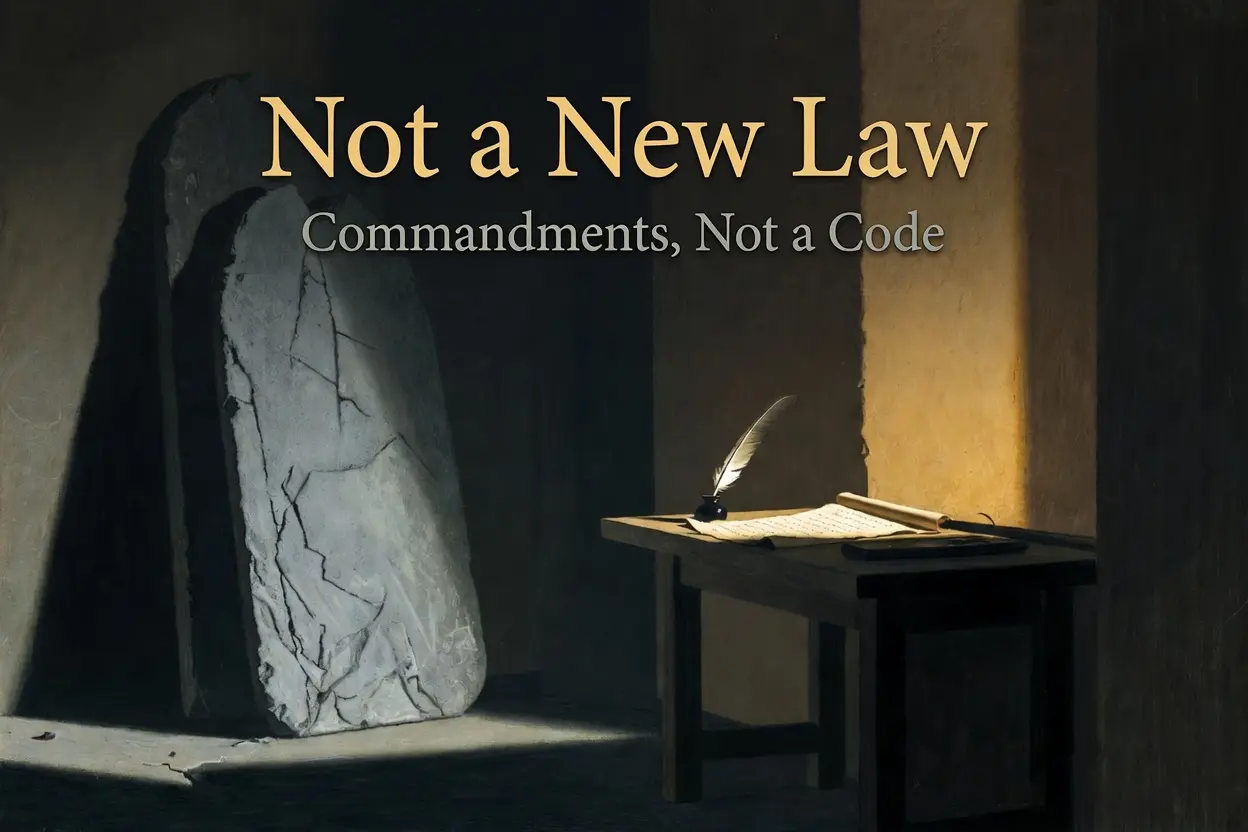
When Paul finishes correcting the disorder at Corinth, he sets his whole correction down on a single foundation of authority:
"If any man think himself to be a prophet, or spiritual, let him acknowledge that the things that I write unto you are the commandments of the Lord." (1 Corinthians 14:37)
That is a remarkable claim. The man who wrote more plainly than any other that we are "not under the law, but under grace" (Romans 6:14) here calls his own writings "the commandments of the Lord." To a religious mind that immediately raises a suspicion: has Paul simply traded Moses for himself? Has grace produced a new code, a Christian law to replace the old one? The answer is no — and seeing why the answer is no is one of the clearest windows into the dispensation of grace. This study works through three things: what Paul means by calling his writings the commandments of the Lord, what actually separates a commandment from a law, and why his commandments do not amount to a new law over the Body of Christ.
What "the commandments of the Lord" means
Paul does not say his writings resemble the Lord's commands, or are based on them. He says they are them. The words are the Lord's; Paul is the mouth. He could speak that way because of where his message came from:
"For I neither received it of man, neither was I taught it, but by the revelation of Jesus Christ." (Galatians 1:12)
"For ye know what commandments we gave you by the Lord Jesus." (1 Thessalonians 4:2)
The risen, ascended Lord gave Paul the truth for this present age directly. So when Paul commands, the Lord commands. That is why he can write to the same Corinthians, "Since ye seek a proof of Christ speaking in me" (2 Corinthians 13:3), and why he can tell Timothy that any other teaching is set against "the words of our Lord Jesus Christ, and to the doctrine which is according to godliness" (1 Timothy 6:3). The whole spread of Paul's epistles carries this weight — they are the Lord's directive will for the church which is His body. To reject them is not to differ with a man; it is to reject Christ.
So the authority is not in question. The question is what kind of authority it is — the authority of a law, or the authority of a commandment. Those are not the same thing, and Paul himself draws the line sharply.
Paul distinguishes a commandment from his own counsel
The first proof that "commandment" does not mean a fixed legal code is that Paul, in one chapter, separates a direct commandment of the Lord from his own Spirit-led judgment:
"And unto the married I command, yet not I, but the Lord, Let not the wife depart from her husband:" (1 Corinthians 7:10)
"Now concerning virgins I have no commandment of the Lord: yet I give my judgment, as one that hath obtained mercy of the Lord to be faithful." (1 Corinthians 7:25)
"But she is happier if she so abide, after my judgment: and I think also that I have the Spirit of God." (1 Corinthians 7:40)
A law does not work like this. Law is a static body of statutes; it does not bend to the case in front of it, and it never says "on this point I have no statute, but here is my counsel." Paul's "commandment" is the authoritative directive of a living Lord through a living apostle, applied to real situations — at times a flat command, at times the wise counsel of a faithful steward. That flexibility is not weakness; it is the mark that we are dealing with a Person's instruction to His household, not a code chiseled in stone.
What a law is
To see why Paul's commandments are not a new law, we have to be precise about what Scripture means by the law. In Paul, "the law" is not merely "any rule God gives." It is a defined thing with defined properties — the Mosaic system given to Israel — and it has a particular character.
A law is a covenant of performance. It puts life and acceptance on the far side of doing — "The man which doeth those things shall live by them" (Romans 10:5), "The man that doeth them shall live in them" (Galatians 3:12). Acceptance is the prize for keeping; condemnation is the wage for breaking. Paul calls it "the ministration of death, written and engraven in stones" and "the ministration of condemnation" (2 Corinthians 3:7, 9). It is a single, indivisible code, knitting together moral precept, ceremony, priesthood, ordinance, and the national life of Israel in the land — and that indivisibility belongs to the very nature of law, not to one program. By its own nature a law comes whole or not at all: to break it at a single point is to be "guilty of all" (James 2:10), and the man who takes up any part of it as binding makes himself "a debtor to do the whole law" (Galatians 5:3). It was, in its Mosaic form, "the handwriting of ordinances that was against us, which was contrary to us" (Colossians 2:14).
And a law commands without giving any power to obey. It could define righteousness but never produce it, because the responsible party was the flesh:
"For what the law could not do, in that it was weak through the flesh..." (Romans 8:3)
"...not of the letter, but of the spirit: for the letter killeth..." (2 Corinthians 3:6)
So a law, in the full Pauline sense, has four marks: it conditions life and standing on performance; it carries a sanction of curse and condemnation for failure; it is a covenant code addressed to the flesh; and it commands without enabling. Hold those four marks up against Paul's commandments and the whole question answers itself.
Mark one — a commandment in grace presupposes a standing already settled
The law said do, and you may live. Paul's commandments are written to people who already live — already justified, already "accepted in the beloved" (Ephesians 1:6), already "complete in him" (Colossians 2:10), already dead to the law itself:
"Wherefore, my brethren, ye also are become dead to the law by the body of Christ; that ye should be married to another, even to him who is raised from the dead..." (Romans 7:4)
A commandment given to a son who is already, permanently a son cannot be a law, because it has nothing to do with earning the standing. It governs how an accepted child walks, not whether he is accepted. The law put acceptance on the line at every point. Paul's commandments never put the standing on the line at all — the standing was settled at the cross and sealed by the Spirit before the first instruction was ever given.
Mark two — the consequence is the walk, never condemnation
Because a law conditions standing on performance, its penalty for failure is condemnation and curse — "Cursed is every one that continueth not in all things" (Galatians 3:10). Now ask what happens when a believer in the Body disobeys one of Paul's commandments. Does he come under condemnation? Paul says he cannot:
"There is therefore now no condemnation to them which are in Christ Jesus, who walk not after the flesh, but after the Spirit." (Romans 8:1)
The closing words — "who walk not after the flesh, but after the Spirit" — do not make the verdict conditional on how well a man walks; they describe the people the verdict has already fallen upon. Every believer in the Body is, by position, in the Spirit and not in the flesh: "ye are not in the flesh, but in the Spirit, if so be that the Spirit of God dwell in you" (Romans 8:9). The clause identifies the man in Christ; it does not put his freedom from condemnation back on trial at every step. The standing holds even when the walk stumbles.
What he loses is in the realm of the walk: reward at the judgment seat, fruitfulness and usefulness in service, the experiential enjoyment of his blessings — and, where the disobedience is open and persistent, he comes under the loving discipline of the assembly:
"Now we command you, brethren, in the name of our Lord Jesus Christ, that ye withdraw yourselves from every brother that walketh disorderly..." (2 Thessalonians 3:6)
"And if any man obey not our word by this epistle, note that man, and have no company with him, that he may be ashamed." (2 Thessalonians 3:14)
That is family discipline, not covenant sanction — and even then the assembly withholds its company to make the man ashamed and recover him; it does not, and cannot, sever his fellowship in Christ. The disorderly brother is still a brother (2 Thessalonians 3:15). Fellowship itself is a possession, not a wage: "God is faithful, by whom ye were called unto the fellowship of his Son Jesus Christ our Lord" (1 Corinthians 1:9) — and that call does not rise and fall with our walk. A rule whose breach can cost a man his reward and his usefulness but never his acceptance, his sonship, his seal, or his fellowship is, by definition, not a law in the covenant sense. The most that disobedience can reach is the walk; it can never touch the standing.
Mark three — these commandments come with the power the law never had
The law commanded and walked away; the flesh was left to perform and always failed. Paul's commandments arrive in a wholly different setting — the believer has a new nature, the indwelling Spirit, and serves out of life already given:
"But now we are delivered from the law, that being dead wherein we were held; that we should serve in newness of spirit, and not in the oldness of the letter." (Romans 7:6)
The defining defect of law — that it demands without supplying — is simply absent. Grace does not only instruct; it teaches and enables:
"For the grace of God that bringeth salvation hath appeared to all men, Teaching us that, denying ungodliness and worldly lusts, we should live soberly, righteously, and godly, in this present world;" (Titus 2:11-12)
Grace itself does the teaching the law could never do, and it works from the inside out. So even where a Pauline commandment and an old commandment of the law sound alike, they are not operating on the same principle. The law's word killed because it met only the flesh; the same moral substance, spoken now to a Spirit-indwelt son, becomes the welcome direction of a Father, carried by a power the law never possessed.
Mark four — the motive is liberty and love, not bondage and fear
The law operated by fear under threat — do or die. Paul's commandments operate in the opposite atmosphere:
"For, brethren, ye have been called unto liberty; only use not liberty for an occasion to the flesh, but by love serve one another. For all the law is fulfilled in one word, even in this; Thou shalt love thy neighbour as thyself." (Galatians 5:13-14)
"Owe no man any thing, but to love one another: for he that loveth another hath fulfilled the law... love is the fulfilling of the law." (Romans 13:8, 10)
Notice what Paul does with the moral substance of the law here. He does not re-impose the commandments as a code; he says their whole weight is comprehended and fulfilled in love that flows from a freed heart. The moral truth of the law reappears — but as the fruit of liberty, not the demand of a covenant. That is the difference between a son who keeps his father's word because he loves him and a servant who keeps the rules because he fears the lash.
"Not under law" and "the commandments of the Lord" are both true at once
Here is the balance Paul holds without contradiction. The believer is genuinely not under law:
"But if ye be led of the Spirit, ye are not under the law." (Galatians 5:18)
And yet the believer is genuinely not lawless. Paul describes himself as "not without law to God, but under the law to Christ" (1 Corinthians 9:21), and speaks of bearing one another's burdens as fulfilling "the law of Christ" (Galatians 6:2). But watch how he uses the word. "The law to Christ" and "the law of Christ" are not a re-codification of Sinai; they are his way of naming the rule of love and the directive will of Christ that govern a free man. He is careful: he is not without law to God — that is, not an antinomian who throws off Christ's authority — but he is equally not back under the law. The Body of Christ stands in exactly that place: under the full authority of the Lord's commandments, and entirely out from under law as a covenant of performance.
This is also why circumcision — a thing the law of Moses positively commanded — can be set aside while "the commandments of God" remain in force:
"Circumcision is nothing, and uncircumcision is nothing, but the keeping of the commandments of God." (1 Corinthians 7:19)
If "the commandments of God" meant the Mosaic code, that sentence would be self-contradictory, because circumcision was one of those commandments. Paul can dismiss the law's ordinance and in the same breath uphold "the commandments of God" only because the commandments now in force are not the old covenant code at all, but the present revealed will of God for the Body, delivered through the apostle of grace.
Why, then, Paul's commandments are not a new law
Pull the threads together. A law, in the sense that matters, conditions standing on performance, condemns and curses the one who fails, addresses the flesh as a covenant code, and commands without enabling. Paul's commandments do none of these. They are given to people whose standing is already perfect and permanent; their breach touches the walk — reward, usefulness, the joy of communion, the assembly's discipline — but never the standing (fellowship itself being a settled possession, 1 Corinthians 1:9); they come with the Spirit and the new man, supplying the very power the law lacked; and they are fulfilled in liberty and love rather than exacted under fear. To call them a "new law" is to smuggle back the one principle Paul died to — performance as the ground of acceptance — and to nail the Body again to a handwriting of ordinances that was already taken out of the way.
So both halves of Paul stand together without strain. "Ye are not under the law, but under grace." And: "The things that I write unto you are the commandments of the Lord." The first tells us the principle we live under; the second tells us the authority we live under. We obey the Lord's commandments not to gain a standing, but because we already have one — not as servants under a law of works, but as accepted sons walking, by the Spirit and in love, in the dispensation of the grace of God.
© 2026 Edward R. Cross








Comments
No comments yet. Be the first to share your thoughts.
Leave a comment