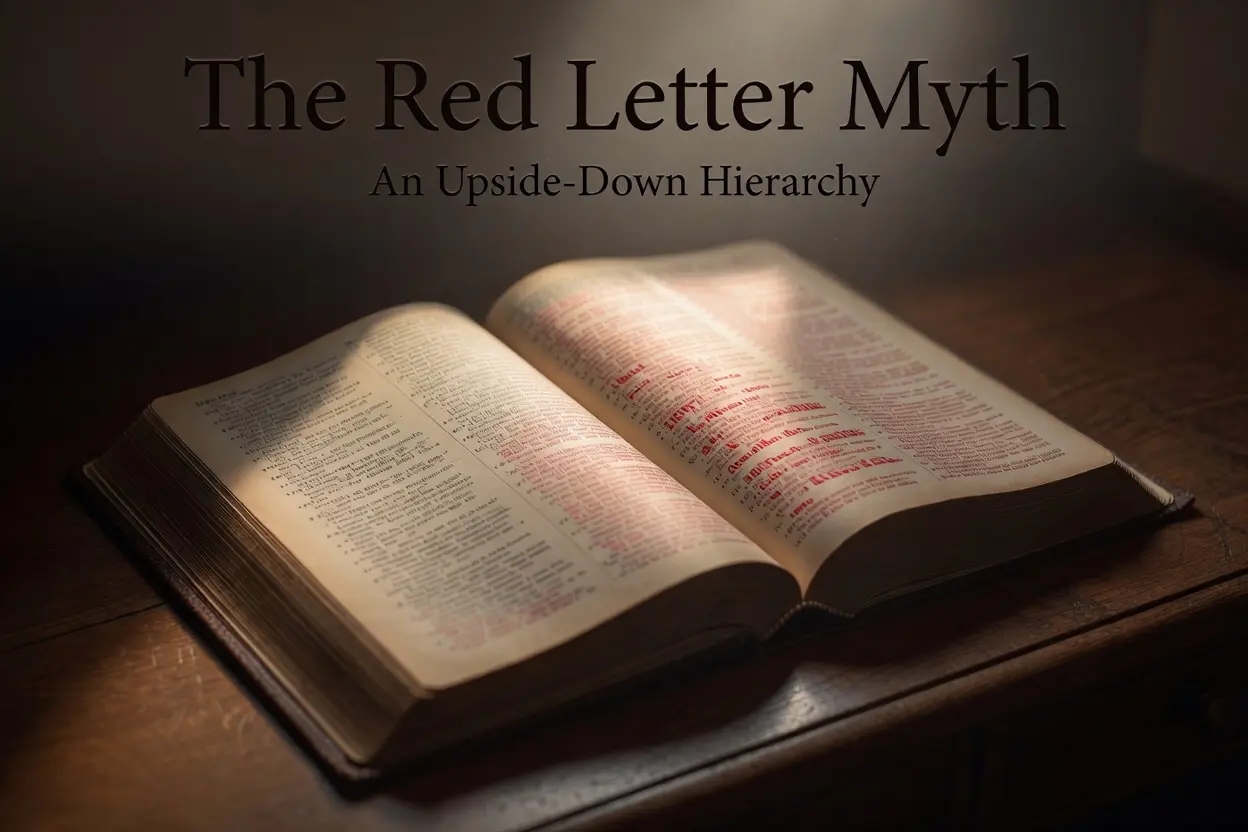
Open most any Bible printed in the last hundred years and you will find the words of the Lord Jesus set apart from the rest of the page in red ink. The intention is reverent, and the effect is powerful: the eye is trained, page after page, to treat the red as a class apart — the most authoritative, most immediate, most personally binding words in the book. Many a believer has come to feel, without ever quite saying it, that the red letters outrank the black ones, and that whatever the Savior said in red must surely govern his life more directly than anything written by the apostle Paul. That instinct is exactly where the trouble begins. The red-letter Bible is not a more spiritual Bible; it is a nineteenth-century printing decision that quietly teaches a hierarchy Scripture never authorized, and in doing so it works against the one thing the believer most needs in order to read his Bible rightly — rightly dividing the word of truth (2 Timothy 2:15).
A Printer's Innovation, Not an Apostle's Doctrine
The red letters are not ancient, and they are not apostolic. They are the idea of one man. Louis Klopsch, editor of The Christian Herald in New York, conceived the scheme in 1899 while at work on an editorial, his eye falling on the Lord's words at the cup — "This cup is the new testament in my blood, which is shed for you" (Luke 22:20 KJV). It struck him that the blood-bought words of Christ might fittingly be marked in the color of blood. That same year his magazine issued the first red-letter edition of the post-resurrection Scriptures, sixty thousand copies of it, and by 1901 the first full red-letter Bible was in print. To decide which words to redden, Klopsch consulted Bible scholars of his day and made editorial judgments about where Christ's speech began and ended.
That is the entire pedigree of the red letter. It is barely more than a century and a quarter old. It appears in no manuscript, in no ancient copy, and nowhere in the 1611 text of the Authorized Version itself. The apostles never saw a red letter; Paul never wrote one or read one. What looks, to the modern eye, like a mark of inspiration is in fact a publishing and devotional innovation laid over the inspired text long after it was complete. The ink is human. Only the words beneath it — all of them, red and black alike — are the words of God.
The False Premise Printed Into the Red
The deeper problem is not the age of the practice but the lie embedded in it. By coloring one set of words and leaving the rest plain, the format silently teaches that the spoken words of Christ in His earthly ministry are weightier, holier, and more authoritative than the rest of the Book. Scripture knows no such ranking.
"All scripture is given by inspiration of God, and is profitable for doctrine, for reproof, for correction, for instruction in righteousness." (2 Timothy 3:16 KJV)
Every line is equally God-breathed. The genealogies of Chronicles, the groanings of Job, the warnings of Jude, and the doctrine of Romans are no less the very words of God than the Sermon on the Mount. And more pointedly still, the words Paul wrote are themselves the words of the risen Christ:
"If any man think himself to be a prophet, or spiritual, let him acknowledge that the things that I write unto you are the commandments of the Lord." (1 Corinthians 14:37 KJV)
The red ink invents a top tier of Scripture and assigns the black letters of Paul to a lower one — when in truth the black letters of Paul are as much the commandments of the Lord Jesus as anything spoken in Galilee. A format that makes the believer feel otherwise is not honoring Christ's words. It is mis-teaching him about them.
And here the format does not merely flatten a distinction; it reverses one. For while no part of Scripture is more inspired than another, the words the risen Christ speaks through Paul are the weightier words for the Body of Christ today — not weightier in inspiration, but weightier in address and in binding authority over our walk. They are the words written to us, about our standing, our calling, and our rule of life in this present age. The Lord's words to Israel in the gospel records are true, holy, and profitable, but they were spoken to another people under another program; Paul's epistles are the direct and present commandments of our ascended Head to us. So if the red ink were marking the words that most govern the believer today, it would be flooding the pages of Romans through Philemon and leaving the four gospel records comparatively plain — the exact opposite of what every red-letter Bible on the shelf actually does. The format does not just teach a false hierarchy; it teaches it upside down.
The Very Verse That Inspired It Belonged to Israel
There is a quiet irony in the verse that sparked the whole enterprise. Klopsch was moved by the new testament in Christ's blood — but that new covenant is not the Body of Christ's covenant at all. It was promised, by name, to a particular people:
"Behold, the days come, saith the LORD, that I will make a new covenant with the house of Israel, and with the house of Judah." (Jeremiah 31:31 KJV)
The same promise is taken up again and applied to the same two houses (Hebrews 8:8). The new covenant is Israel's covenant, future and national; the members of the Body of Christ are nowhere placed under it. So the founding inspiration of the red-letter Bible was a covenant verse spoken within Israel's prophetic program — which turns out to be a fitting beginning, because that is precisely where the great mass of the red ink falls.
Where the Red Ink Actually Lands
Take any red-letter Bible and notice the geography of the color. It pools in Matthew, Mark, Luke, and John, and then again in Revelation — and it nearly drains away across Romans through Philemon, the very letters in which the doctrine for the Body of Christ is given.
That distribution is no accident, because the words of Christ in His earthly ministry were spoken to Israel, under the law, within her covenant program. He said so Himself: "I am not sent but unto the lost sheep of the house of Israel" (Matthew 15:24 KJV). Paul tells us the purpose of that ministry plainly — "Now I say that Jesus Christ was a minister of the circumcision for the truth of God, to confirm the promises made unto the fathers" (Romans 15:8 KJV) — and the Lord ministered "made under the law" (Galatians 4:4 KJV) the whole while. The red of Revelation belongs, likewise, to the prophesied tribulation and the kingdom to come, not to the present age of grace.
So consider what the format actually does to a reader. It paints in glowing color the Scriptures least addressed to him as his rule of life, and prints in plain black the Scriptures written directly to him — and then trains his reverence to flow toward the color. A tool meant to exalt Christ's words ends by inverting right division, teaching the member of the Body to prize Israel's kingdom instructions above his own apostle's doctrine.
A Red-Letter Hierarchy Breeds a Red-Letter Religion
This is not a harmless aesthetic. The hierarchy the ink teaches produces a reflex in practice — the "but Jesus said…" reflex, in which a verse in red is played like a trump card to overrule anything Paul wrote. I have answered that reflex verse by verse in "But Jesus Said… — Answering the Red-Letter Reflex", and the pattern there is always the same: kingdom terms of entry get pressed onto people they were never given to. Sell all that thou hast. He that shall endure unto the end shall be saved. If ye forgive not men their trespasses, neither will your Father forgive yours. Not every one that saith unto me, Lord, Lord. Each of these is laid, in red, upon believers who are saved by grace and complete in Christ — and the result is law where there should be liberty, fear where there should be assurance, and the gospel of grace itself obscured. The red-letter format does not create these errors out of nothing, but it lends them a powerful visual authority, making the words spoken to Israel under law look like the believer's own marching orders.
The Risen Christ Speaks — and the Format Prints Him in Black
Here is the sharpest inconsistency of all. The same Lord who spoke in Galilee did not fall silent at His ascension. He speaks now, from glory, through the apostle Paul — and those words, the most directly addressed to the Body of Christ of any in the Book, the format leaves entirely in black.
It was the risen, glorified Christ who arrested Saul on the Damascus road and made him a minister. It was that same Lord who gave him the gospel of grace: "the gospel which was preached of me is not after man. For I neither received it of man, neither was I taught it, but by the revelation of Jesus Christ" (Galatians 1:11-12 KJV). It was from the Lord that Paul received the doctrine he delivered — "For I have received of the Lord that which also I delivered unto you" (1 Corinthians 11:23 KJV) — and what he wrote stands as "the commandments of the Lord" (1 Corinthians 14:37 KJV).
If any words in all the Bible deserved a color to mark them out as the present and personal speech of the Lord Jesus to us, it would be these. Yet the red-letter edition gives them no color at all, and pours out its crimson instead upon His words to Israel — the earthly ministry to a nation under law, and the prophetic word of the kingdom yet to come. The format magnifies the voice of Christ to Israel and quietly buries His ascended voice to the Body — exactly backward for the age in which we live.
How to Use Your Bible Instead
The remedy is not to take a pen to your Bible and re-color it. The remedy is to stop letting a printer's ink do the dividing that God has assigned to the diligent workman. Do not sort your Bible by the color of the letters; sort it by the One addressed and the program in force — "rightly dividing the word of truth" (2 Timothy 2:15 KJV). Every word is given by inspiration and is profitable to you (2 Timothy 3:16); not every word is addressed to you as your rule of life. The question worth asking of any verse, red or black, is never what color is the ink but to whom was this spoken, and under what program — and that question the red letters cannot answer, because they were never designed to ask it.
Read the four gospel records with reverence and great profit; they give us the Savior's own voice to Israel, the confirming of the promises, the revealing of the Father, the cross and the empty tomb. But take your standing, your doctrine, and your daily walk from the letters the ascended Christ wrote to you through the apostle He raised up for this age — the black letters of Paul, which are no less His own. A red-letter Bible, mistaken for a guide, is an unreliable one. The reliable guide is right division. Honor every word the Lord spoke, locate it where He spoke it, and keep rightly dividing.
© 2026 Edward R. Cross








Comments
No comments yet. Be the first to share your thoughts.
Leave a comment