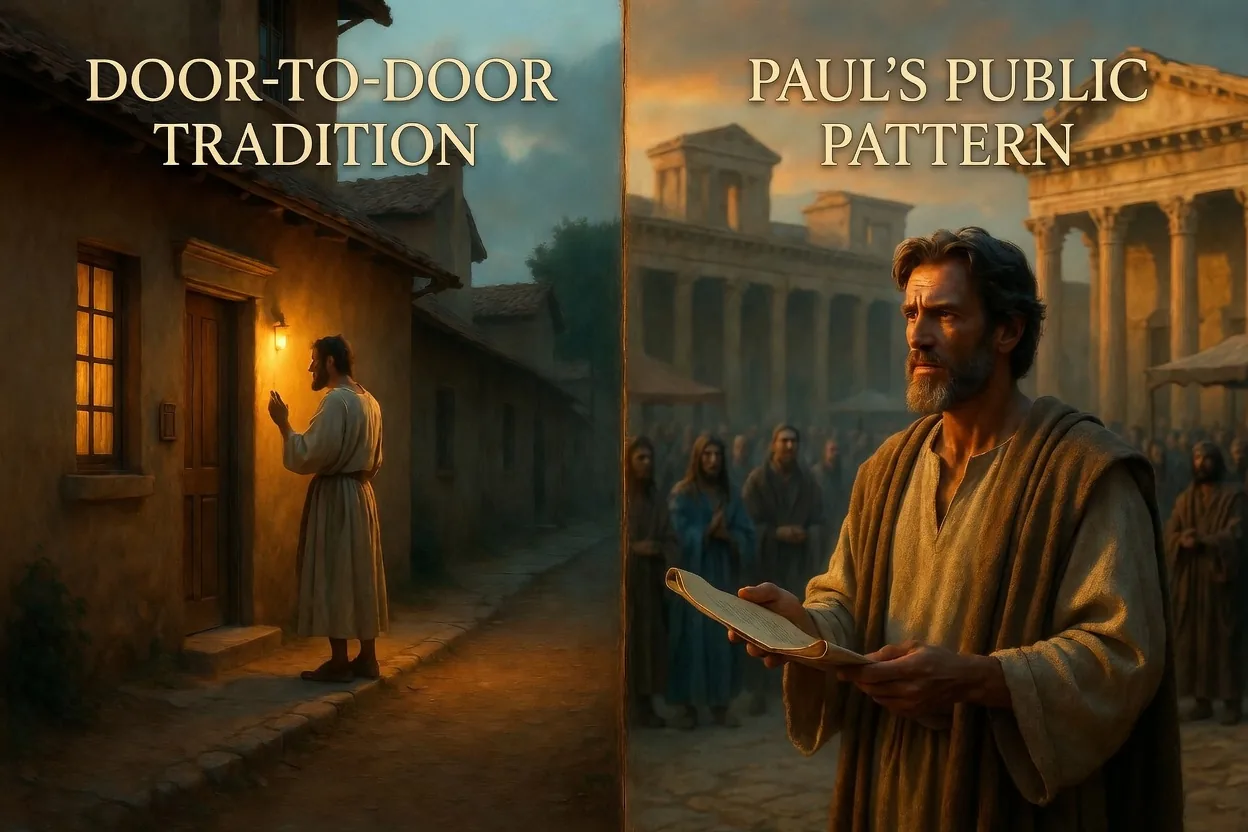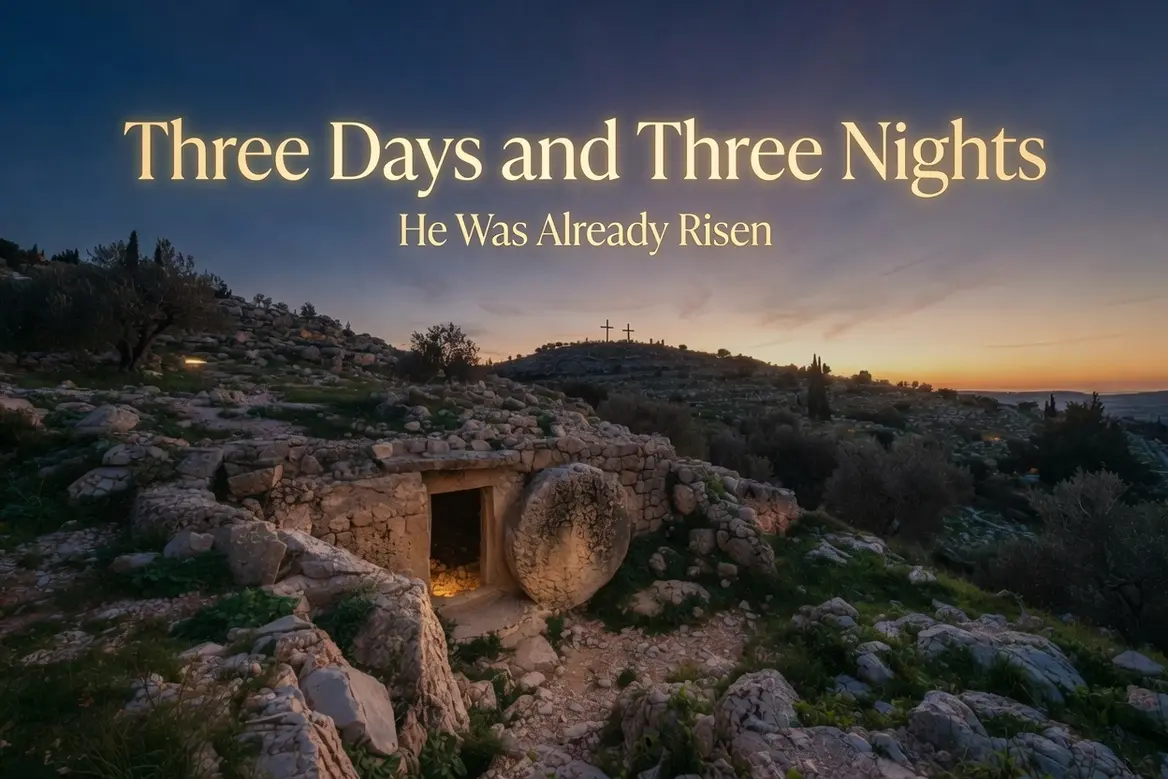
Every spring the same two phrases are repeated as though they were settled fact: Good Friday and Easter Sunday morning. Christ died on Friday, we are told, and rose at dawn on Sunday. The words are so familiar that most believers have never once stopped to lay them beside the text. They feel unquestionable — but repetition is not proof, and inherited language is not the same thing as Scripture.
When you do lay the tradition beside the plain words of the Gospels, it does not survive. The Lord Himself gave one sign by which He was to be identified, and a Friday-to-Sunday timeline cannot produce it. The accounts of the burial, the sabbath, the spices, and the empty tomb all fit together perfectly — but not on a Friday. They fit a Wednesday.
This is not a quarrel over a calendar square. The Lord made the timing a matter of proof. So let us set the slogans aside and weigh only what is written.
The Sign He Chose
When the scribes and Pharisees demanded a sign, Jesus refused them every sign but one:
"For as Jonas was three days and three nights in the whale's belly; so shall the Son of man be three days and three nights in the heart of the earth." (Matthew 12:40 KJV)
This is the backbone of the whole question. Of all the signs He could have named, He chose a measure of time — and He stated it with deliberate precision. He did not say "about three days." He did not say "parts of three days." He did not even say "three days" as a twenty-four-hour period with a night assumed inside it. He said specifically three days and three nights.
He made the duration of His burial the very sign of His Messiahship. If that measure fails, the sign fails — and that cannot be. So the measure must be allowed to mean what it says, and every proposed timeline must answer to it.
What the Sign Actually Says
A Friday-afternoon burial to a resurrection before dawn on Sunday cannot yield three days and three nights no matter how the hours are arranged. Count the nights, which is where the tradition breaks first. Friday night is one. Saturday night is two. There is no third night, because by the women's arrival before sunrise on the first day the tomb is already empty. At the very most the Friday view gives one full day, parts of two others, and only two nights.
The usual defense is to appeal to the phrase "on the third day" and argue that, in Hebrew reckoning, any part of a day may count as a whole day. Grant the point entirely — it still does not rescue Friday. Even if a partial day counts as a day, the nights remain. A night is not a part of a day; it is its own period of darkness, counted in its own right. Three of them are named, and the Friday view can supply only two.
The Lord did not merely say "on the third day," as He does elsewhere; here, at the one place He stakes His sign, He gave the fuller and stricter measure: three days and three nights. We are not free to trade the stricter statement for the looser one in order to keep a tradition.
The Hour of His Death
Begin where the count must begin — at the death and burial.
"And at the ninth hour Jesus cried with a loud voice, saying, Eloi, Eloi, lama sabachthani? which is, being interpreted, My God, my God, why hast thou forsaken me?" (Mark 15:34 KJV)
The ninth hour is about three in the afternoon. He did not die at sunset; He died in the afternoon, with daylight still remaining. That detail matters, because His body was then taken down and buried before the next day — a sabbath — began at sundown.
Buried Before Sundown
"And now when the even was come, because it was the preparation, that is, the day before the sabbath," (Mark 15:42 KJV)
"And that day was the preparation, and the sabbath drew on." (Luke 23:54 KJV)
He was buried in haste, before sundown, because a sabbath was about to begin. This is the starting line for the count of Matthew 12:40 — the body is in the heart of the earth before that sabbath opens.
John shows the same race against the clock. So pressed were they for time that they did not bear the Lord away to some family tomb but laid Him in the nearest grave to hand — "There laid they Jesus therefore because of the Jews' preparation day; for the sepulchre was nigh at hand." (John 19:42 KJV). Men do not reach for the closest tomb unless the sun is going down on them. The burial was crowded hard against the sabbath's edge — and the moment the stone was rolled to, before that sundown, the body was in the heart of the earth and the count had begun.
Here is where nearly everyone makes the leap that creates the whole error: they read "the day before the sabbath" and instantly think Friday, because the weekly sabbath is Saturday. But that conclusion only holds if the sabbath drawing on was the ordinary weekly sabbath. The text does not say so — and John tells us plainly it was not.
The Sabbath That Drew On Was a High Day
"The Jews therefore, because it was the preparation, that the bodies should not remain upon the cross on the sabbath day, (for that sabbath day was an high day,) besought Pilate that their legs might be broken, and that they might be taken away." (John 19:31 KJV)
John does not merely say a sabbath was coming. He adds a detail the others leave for him to supply: that sabbath day was an high day. A high day is not the weekly seventh-day sabbath; it is a feast sabbath. To see which one, let the law lay out its own calendar, for it sets two distinct appointments back to back:
"In the fourteenth day of the first month at even is the LORD's passover. And on the fifteenth day of the same month is the feast of unleavened bread unto the LORD: seven days ye must eat unleavened bread. In the first day ye shall have an holy convocation: ye shall do no servile work therein." (Leviticus 23:5–7 KJV)
Read the order closely, for it is decisive. The Passover is the fourteenth day. The Feast of Unleavened Bread is the fifteenth. And the rest — the holy convocation on which no servile work may be done — is laid not upon the Passover but upon the first day of Unleavened Bread, the fifteenth. Moses gives the same sequence again in Numbers:
"And in the fourteenth day of the first month is the passover of the LORD. And in the fifteenth day of this month is the feast: seven days shall unleavened bread be eaten. In the first day shall be an holy convocation; ye shall do no manner of servile work therein:" (Numbers 28:16–18 KJV)
Here is the point most readers have never weighed: the Passover itself, the fourteenth, was not a sabbath. It was a working day — the day the lambs were killed and everything made ready. The sabbath, the high day, is the fifteenth, the first day of Unleavened Bread. The fourteenth is precisely the preparation for it.
This unlocks the whole sequence. When Christ was crucified "on the preparation," He was crucified on the fourteenth — the Passover, the day of killing — and the high sabbath drawing on at sundown was the fifteenth. A high day fixed to the fifteenth of the month need not fall on a Saturday — and that year it did not. As the spice-witnesses will show in a moment, it fell on a Thursday; so the preparation before it — the Passover, the fourteenth — was the Wednesday, and the burial took place late that afternoon. The single assumption that "the day before the sabbath" must mean Friday is the only thing holding the traditional timeline together, and John, read alongside Moses, quietly removes it.
Two Sabbaths, Not One
That there were two sabbaths that week — first the feast sabbath, then the weekly sabbath — is not a guess. It is forced by comparing what the women did with the spices.
"And when the sabbath was past, Mary Magdalene, and Mary the mother of James, and Salome, had bought sweet spices, that they might come and anoint him." (Mark 16:1 KJV)
"And they returned, and prepared spices and ointments; and rested the sabbath day according to the commandment." (Luke 23:56 KJV)
Lay the two statements side by side and the order is plain. Mark says the women bought spices after a sabbath was past. Luke says they prepared spices and then rested on a sabbath. A sabbath, then buying and preparing, then a sabbath. That is not one sabbath with the buying somehow tucked inside it — no work could be done on a sabbath, neither buying nor preparing. It is two sabbaths with a working day between them.
That working day is Friday. The women could not shop on the high sabbath, so they waited until it was past, bought and prepared the spices, and then rested again on the weekly sabbath "according to the commandment." Every clause is honored, and nothing has to be forced. The two accounts that look contradictory on the Friday timeline fall into perfect order the moment two sabbaths are allowed to stand.
And see what this fixes, for it is more than a guess. The weekly sabbath is by definition the seventh day, Saturday; and the tomb was found empty on the first day, Sunday. Set the required working day between the two sabbaths and the whole week is determined, not chosen: the weekly sabbath is Saturday, the working day is Friday, the high sabbath is therefore Thursday, and the preparation on which Christ was crucified is the Wednesday before it. No other arrangement can carry two sabbaths, a working day between them, and an empty tomb at dawn on the first day. We have not selected this calendar; the witnesses compel it.
But Did He Not Eat the Passover?
Here a fair question arises, and it deserves a straight answer. The first three Gospels plainly say the Lord ate a Passover the night before He died. The disciples ask where to prepare it; He answers that He will keep it:
"Now the first day of the feast of unleavened bread the disciples came to Jesus, saying unto him, Where wilt thou that we prepare for thee to eat the passover? And he said... I will keep the passover at thy house with my disciples." (Matthew 26:17–18 KJV)
"And the first day of unleavened bread, when they killed the passover, his disciples said unto him, Where wilt thou that we go and prepare that thou mayest eat the passover?" (Mark 14:12 KJV)
"Then came the day of unleavened bread, when the passover must be killed." (Luke 22:7 KJV)
"With desire I have desired to eat this passover with you before I suffer:" (Luke 22:15 KJV)
This was no mere supper; it was a real Passover, kept and eaten before He suffered. Yet John, describing the morning of the crucifixion, says the rulers had not yet eaten theirs:
"Then led they Jesus from Caiaphas unto the hall of judgment: and it was early; and they themselves went not into the judgment hall, lest they should be defiled; but that they might eat the passover." (John 18:28 KJV)
So the Lord ate a Passover one evening; the rulers were still looking to eat theirs the next. To the modern reader, who pictures the whole nation sitting down to one synchronized meal at one hour, that looks like a contradiction. It only looks that way because the picture is wrong.
A national Passover at Jerusalem was vast beyond anything a single table suggests — a multitude past numbering, with lambs by the thousand to be killed, flayed, sprinkled, roasted, and divided. A work of that magnitude could not be done by everyone at one moment, and Scripture itself shows it never was. Not the eating only, but the very killing, was staggered.
This was not always so. At the first Passover the rite was kept house by house — "every man a lamb, according to the house of their fathers, a lamb for an house" (Exodus 12:3 KJV) — and "the whole assembly of the congregation of Israel" could "kill it in the evening" (Exodus 12:6 KJV) all at once, because each father killed his own lamb at his own door. Slain in ten thousand separate homes in the one evening, the nation kept it together with ease. But the law did not leave the rite in the home. The killing was afterward forbidden there and gathered to a single place: "Thou mayest not sacrifice the passover within any of thy gates... But at the place which the LORD thy God shall choose to place his name in, there thou shalt sacrifice the passover" (Deuteronomy 16:5–6 KJV). Once the lamb could be slain only at the central sanctuary, the home-evening simultaneity was gone. One altar cannot take the blood of a nation's lambs in a single hour.
So at the temple the killing itself became a labor spread across the day. The Levites bore "the charge of the killing of the passovers" for the whole multitude (2 Chronicles 30:17 KJV), slaying and flaying while the priests sprinkled the blood — "And they killed the passover, and the priests sprinkled the blood from their hands, and the Levites flayed them" (2 Chronicles 35:11 KJV). And the eating was divided the same way. Josiah's record shows the order plainly:
"And they roasted the passover with fire according to the ordinance: but the other holy offerings sod they in pots, and in caldrons, and in pans, and divided them speedily among all the people. And afterward they made ready for themselves, and for the priests: because the priests the sons of Aaron were busied in offering of burnt offerings and the fat until night; therefore the Levites prepared for themselves, and for the priests the sons of Aaron." (2 Chronicles 35:13–14 KJV)
The people were served first; the priests ate afterward, because they were busied in the labor of the offerings until night. One Passover, one congregation, yet two sittings at different hours — the people early, the priests late, divided by the sheer weight of the work.
That is precisely the situation in the Gospels: the Lord keeps the Passover with His disciples at His hour, while the chief priests, occupied through the night and morning with the very trial that condemned Him, had not yet come to theirs.
Nor is Josiah the only witness that the feast bent to circumstance. Under Hezekiah the whole nation kept it a full month late, "in the second month" (2 Chronicles 30:2 KJV), because the priests and people were not ready in the first; and a multitude "did... eat the passover otherwise than it was written" while God pardoned them (2 Chronicles 30:18 KJV). The law itself had built this give in from the beginning, appointing a second Passover, a full month afterward, for any who could not keep the first:
"...yet he shall keep the passover unto the LORD. The fourteenth day of the second month at even they shall keep it..." (Numbers 9:10–11 KJV)
So the Bible never presents the Passover as one instant the whole nation must strike together. It presents a feast kept across a span — some early, some late, some even a month apart — without any breach. The Lord eating with His disciples while the rulers ate later is not a crack in the record; it is the feast working exactly as Israel had always kept it.
And it had to be so, for He is the substance the lamb only pictured: "For even Christ our passover is sacrificed for us" (1 Corinthians 5:7 KJV). He kept the Passover at the opening of the day, and then, in the afternoon of that same day, He became the Passover — slain at the ninth hour, the very hour the lambs were dying in the temple, and buried before the high sabbath drew on. The meal and the sacrifice belong to one Passover day. He did not break the feast; He fulfilled it.
Laying the Week Out
Set every fact in sequence and the week assembles itself:
- Wednesday — the Passover, the fourteenth: the day of preparation. Christ dies about the ninth hour and is buried before sundown, as the high sabbath draws on.
- Thursday — the high sabbath: the fifteenth, the first day of Unleavened Bread, with its holy convocation. The women rest.
- Friday — the high sabbath now past, the women buy sweet spices and prepare them. An ordinary working day.
- Saturday — the weekly sabbath "according to the commandment." The women rest again.
- First day of the week — the women come early, while it is yet dark, and find the stone already rolled away and the tomb already empty.
Not one verse has to be bent to make this stand. Each account simply contributes its piece.
The Count That Fits
One thing must be settled before the count can be read rightly: how Scripture reckons a day. From the beginning the day is measured evening first, then morning — "And the evening and the morning were the first day" (Genesis 1:5 KJV) — and Israel kept her sabbaths the same way, "from even unto even" (Leviticus 23:32 KJV). The day opens at sundown with its night and runs to the next sundown. So in the Lord's sign a day and its night belong together, and the night is not an afterthought tacked on but the very head of the day.
Count it as Scripture counts it, from sundown, beginning with the burial before sundown on Wednesday:
- Night 1 — Wednesday sundown to Thursday dawn
- Day 1 — Thursday
- Night 2 — Thursday sundown to Friday dawn
- Day 2 — Friday
- Night 3 — Friday sundown to Saturday dawn
- Day 3 — Saturday
By the close of Saturday, before sunset, the full three days and three nights are complete — exactly, with nothing missing and nothing strained. This is the only count that pays the sign of Jonah in full coin.
What Then of the Third Day?
A reader who has followed the count this far will raise the natural objection: does not Scripture again and again say the Lord rose the third day? The angel said it — "the third day rise again" (Luke 24:7 KJV); the Lord foretold it — "be raised again the third day" (Matthew 16:21 KJV); and Paul makes it part of the gospel itself — "he rose again the third day according to the scriptures" (1 Corinthians 15:4 KJV). If the rising was on the third day, does that not point to a Friday cross, with Sunday as the third day, rather than a Wednesday?
First be clear what the third day measures. It is not counted from the moment He died on the cross; it is counted by the body's time in the grave. The sign itself fixes this: the Son of man would be three days and three nights "in the heart of the earth" (Matthew 12:40 KJV) — in the tomb. The resurrection is the grave opened and the body gone, so the reckoning runs from the burial, when the stone was rolled to, until the rising, when it was rolled away. Laid in the tomb before sundown Wednesday and raised before sundown Saturday, the Lord was in the heart of the earth the full three days and three nights, and rose on the third day, Saturday, exactly.
The men who set the watch confirm the anchor, for they reckon by the grave too. They came to Pilate the day after the cross, our Thursday, and asked that the sepulchre be made sure "until the third day" (Matthew 27:64 KJV), naming the very day they feared He would rise. Count from the day they secured the grave: Thursday the first, Friday the second, Saturday the third. Their watch was set to hold the tomb through the third day — and on that third day, Saturday, the grave opened. They guarded it to the very hour it failed.
Nor does this pit the word against the prophets, for Scripture uses the two forms as one. The same priests quote the Lord saying "After three days I will rise again" (Matthew 27:63 KJV) and in the next breath ask the grave be kept "until the third day" (Matthew 27:64 KJV) — after three days and the third day, one span. Mark gives the prediction in the first form, "after three days rise again" (Mark 8:31 KJV), and the prophet long before in the same reckoning, "After two days will he revive us: in the third day he will raise us up" (Hosea 6:2 KJV). So we take three days and three nights with full literal weight, because the Lord staked His sign upon it, and we read the third day as Scripture's own equal for it — the third day in the grave, ending Saturday before sunset.
One verse is pressed harder than the rest, and it is a different statement than the others. On the road to Emmaus, on the first day of the week, Cleopas says, "to day is the third day since these things were done" (Luke 24:21 KJV). This is not the third day in the grave but the third day since a set of deeds, and Cleopas names them — not the death only, but "how the chief priests and our rulers delivered him to be condemned to death, and have crucified him" (Luke 24:20 KJV). The last of those rulers' deeds was done the day after the crucifixion, when those same rulers came to Pilate "the next day, that followed the day of the preparation" and "made the sepulchre sure, sealing the stone, and setting a watch" (Matthew 27:62, 66 KJV). Count the days since: Friday the first, Saturday the second, the first day of the week the third. So today, Sunday, is the third day since the grave was sealed — the day it was found open. The verse enlisted to prove a Friday, read with all that Cleopas named, settles instead on the very week every other witness has drawn.
Why Friday Fails — and Thursday Too
Set the two rival days against the same evidence and watch them collapse.
Friday fails on every count. It cannot give three days and three nights; it gives at most parts of three days and only two nights. It leaves no room for two sabbaths, forcing John's "high day" to be ignored. It leaves no working day between sabbaths for the women to buy and prepare spices, so it cannot reconcile Mark 16:1 with Luke 23:56. And it must treat Sunday morning as the moment of the resurrection, when the text presents it only as the moment of discovery.
Thursday fares no better. A Thursday-afternoon burial would not complete three full days and three nights until Sunday before sunset — yet Christ was already risen before dawn on the first day. Thursday also strains the sabbath-and-spice sequence. It must be ruled out for the same reason Friday is: it cannot satisfy the literal measure the Lord gave.
Only Wednesday answers every witness at once — the high sabbath, the weekly sabbath, the working day between them, the women buying and preparing spices, the empty tomb at dawn, and above all the three days and three nights.
He Was Already Risen
One more correction the text quietly demands: Scripture nowhere says the Lord rose on Sunday morning. It says the tomb was found empty on Sunday morning. Those are not the same statement.
"In the end of the sabbath, as it began to dawn toward the first day of the week, came Mary Magdalene and the other Mary to see the sepulchre." (Matthew 28:1 KJV)
"The first day of the week cometh Mary Magdalene early, when it was yet dark, unto the sepulchre, and seeth the stone taken away from the sepulchre." (John 20:1 KJV)
"And he saith unto them, Be not affrighted: Ye seek Jesus of Nazareth, which was crucified: he is risen; he is not here: behold the place where they laid him." (Mark 16:6 KJV)
Notice the wording. Mary comes "when it was yet dark," and the stone is already taken away. The angel does not say He is rising; he says he is risen — a thing already finished. In every account, by the time anyone arrives, He is gone. A sunrise-Sunday resurrection is read into the text; it is never read out of it.
Place the rising where the count places it. If the burial was before sundown Wednesday and the sign means what it says, the three days and three nights close near sunset on Saturday. Once that sunset passes, the first day of the week begins. So the resurrection belongs near the close of the weekly sabbath — Saturday, before sunset — leaving the tomb already empty long before the women set out in the dark. He did not rise with the Sunday sun. He had already risen.
Then Is Good Wednesday a High Day for Us?
There is a danger hidden in a study like this. Having seen that the cross fell on a Wednesday and not a Friday, a reader may simply move the observance — take down the Good Friday and hang up a Good Wednesday in its place. That would be to miss the whole point. The error was never which square on the calendar was marked; it was the marking of a square at all.
The high days belonged to Israel. They were her feast sabbaths, appointed in her law, and Paul tells us plainly what they were — shadows:
"Let no man therefore judge you in meat, or in drink, or in respect of an holyday, or of the new moon, or of the sabbath days: Which are a shadow of things to come; but the body is of Christ." (Colossians 2:16–17 KJV)
A shadow is cast ahead of the body that throws it, and once the body has come the shadow has served its purpose. The holydays, new moons, and sabbaths were Israel's shadows of things to come; the substance is Christ. They were never laid upon the Body of Christ, and the Body is nowhere commanded to keep a single one of them — not the seventh-day sabbath, not the Passover, not a feast, and not an anniversary of the crucifixion under any name.
Indeed Paul's alarm runs the other way. To believers drifting back toward a religious calendar he wrote:
"But now, after that ye have known God, or rather are known of God, how turn ye again to the weak and beggarly elements, whereunto ye desire again to be in bondage? Ye observe days, and months, and times, and years. I am afraid of you, lest I have bestowed upon you labour in vain." (Galatians 4:9–11 KJV)
Days, and months, and times, and years — the whole apparatus of sacred dates — is the very thing he feared to see his converts take up. He would be no less afraid of a Good Wednesday than of a Good Friday. Among believers the question is one of liberty, never of law: "One man esteemeth one day above another: another esteemeth every day alike. Let every man be fully persuaded in his own mind." (Romans 14:5 KJV). A man is free to remember the cross on a Wednesday, on a Friday, or on every morning he is given; what no man may do is bind a day on another as a holy day the faithful must keep.
So the gain of this study is not a new day to observe but the truth of the text, and a Saviour preached rather than a season kept. We do not keep the day of the cross; we preach the cross. The whole question of sacred days I have set out at length in No Such Thing as a Christian Sabbath or Holy Day: Contradictions in Terms; here it is enough to say that correcting the day must never become an excuse to keep one.
Tradition or the Text
The Friday crucifixion and the Sunday-sunrise resurrection do not come from Scripture. They come from custom — a thing heard so often it is assumed to have been read. But "Good Friday" is found nowhere in the Bible, and neither is a dawn resurrection. What the Bible gives is a burial before a high sabbath, two sabbaths with a working day between, women who bought and prepared spices, an empty tomb in the dark, and a Lord who said He would be three days and three nights in the heart of the earth. All of it fits a Wednesday cross and a Saturday-evening rising. None of it fits the slogan repeated every spring.
This is simply what it looks like to read for yourself rather than to inherit a phrase. When the words of the Lord and the tradition of men disagree, the tradition must yield. He gave us a sign measured in days and nights. Let us count them as He gave them, and let the empty tomb be glorious enough without the help of a calendar that contradicts His own word.
© 2026 Edward R. Cross