This article has been revised. The revision notes at the end say what changed.
Few phrases are spoken with more feeling and examined with less care than pleading the blood. A believer hears of danger and says he will "plead the blood" over his house. A mother "pleads the blood" over a wayward child. A man troubled by a filthy thought is told to "plead the blood" until it lifts. The words sound reverent, and the blood of Christ is indeed the most precious thing in the universe. But feeling is not the same as instruction, and the honest question is not whether the blood is precious — it is — but whether God has anywhere told a believer to plead it as a spoken remedy. Where did the practice come from, and does Scripture, rightly divided, teach it in any dispensation?
Pleading is the wrong word
We should be fair to the people who use the phrase, because many mean something better than they say. When a sincere believer says he "pleads the blood," he is often reaching for a true thing — that his whole confidence before God rests on the finished sacrifice of Christ and on nothing in himself. That instinct is right. But even at its best it is not pleading, and the word matters. To plead is to press a case, to urge an appeal, to enter a suit that has not yet been granted — the posture of a suppliant still waiting on a verdict. That is the opposite of what the revelation of the mystery says about the believer's standing.
There is worse buried in the word than imprecision. To plead implies someone who must be moved — reminded of a fact he might overlook, urged toward a mercy he is reluctant to give, persuaded by the earnestness of the appeal to grant a hearing he would otherwise withhold. That is what pleading does before a human judge: the more feelingly a man pleads, the likelier he is to sway the bench. Carry that idea into prayer and it slanders the Father. It makes the value of the blood depend on how often and how fervently the believer names it, as though God needed reminding what His Son had done, or could be talked into a nearer welcome by insistence. But the Father is not reluctant, and the blood does not gain force by repetition. Its worth was fixed at the cross and is full the first moment faith rests on it; no amount of pleading adds to a hearing that grace has already made complete.
For the Body of Christ, access to the Father is not a plea repeatedly entered; it is a settled possession held by faith. "By whom also we have access by faith into this grace wherein we stand" (Romans 5:2 KJV). "For through him we both have access by one Spirit unto the Father" (Ephesians 2:18 KJV). "In whom we have boldness and access with confidence by the faith of him" (Ephesians 3:12 KJV). We have access. The son already brought inside his Father's presence does not stand at the door pleading his case; he has been carried in by the blood and is welcome there. So what the earnest believer is really reaching for when he says he "pleads the blood" is faith in the finished atonement and the access it purchased — and faith is not pleading. To call it pleading is to misdescribe a settled provision as an unsettled petition, and that very misnaming is the seed from which the ritual grows.
Strip away the good instinct and what remains under the phrase is the practice proper, and it is the one under examination here: the blood spoken as a formula. In this practice "the blood" is verbally applied — over rooms and doorframes, over travel and finances, over children, over the mind, over the devil himself — as though the saying of the words released a protecting or cleansing power that would not otherwise be at work. This is no longer faith resting on the cross; it is a ritual, and often a repeated one. It is this that the Bible is asked to support, and it is this that will not be found there.
Where it came from
The modern practice has a traceable history, and it is not the history most who use it would assume. The verbal "application" of the blood as protection and deliverance rose to prominence in early Pentecostalism — the 1906 Azusa Street revival and the healing and deliverance ministries that flowed out of it — where leaders would "plead the blood" over the sick and the afflicted. From there it passed into the deliverance movement and the Word of Faith teachers, where "I plead the blood" became a standing weapon against devils, sickness, and misfortune. The one biblical anchor everyone reaches back to is the Passover, where Israel put blood on the doorposts in Egypt.
It is worth noticing that the practice is not confined to charismatic circles. It is taught just as firmly by King-James-Only writers who would never call themselves Pentecostal. Peter Ruckman states it plainly — that John "tells you how to use the blood of Jesus Christ as a cleansing agent (1 John 1:7-9). We call this 'pleading the blood.'" He recommends it against intrusive thoughts: when the mind is assaulted, he says, "I need to 'plead the blood.'" Teachers trained in that same stream tell their hearers to "purge yourself by confessing and pleading the blood," and list "pleading the blood" among the steps for dealing with ground given to devils in a life. So the practice crosses lines that rarely meet — the Pentecostal deliverance meeting and the KJV-Only classroom teach the same thing here. That agreement is worth naming, because it means the error cannot be answered by tribe or temperament. It has to be answered by the text.
The type they lean on
Because the Passover is the anchor, the Passover is where the practice must be tested first — and the type undoes it.
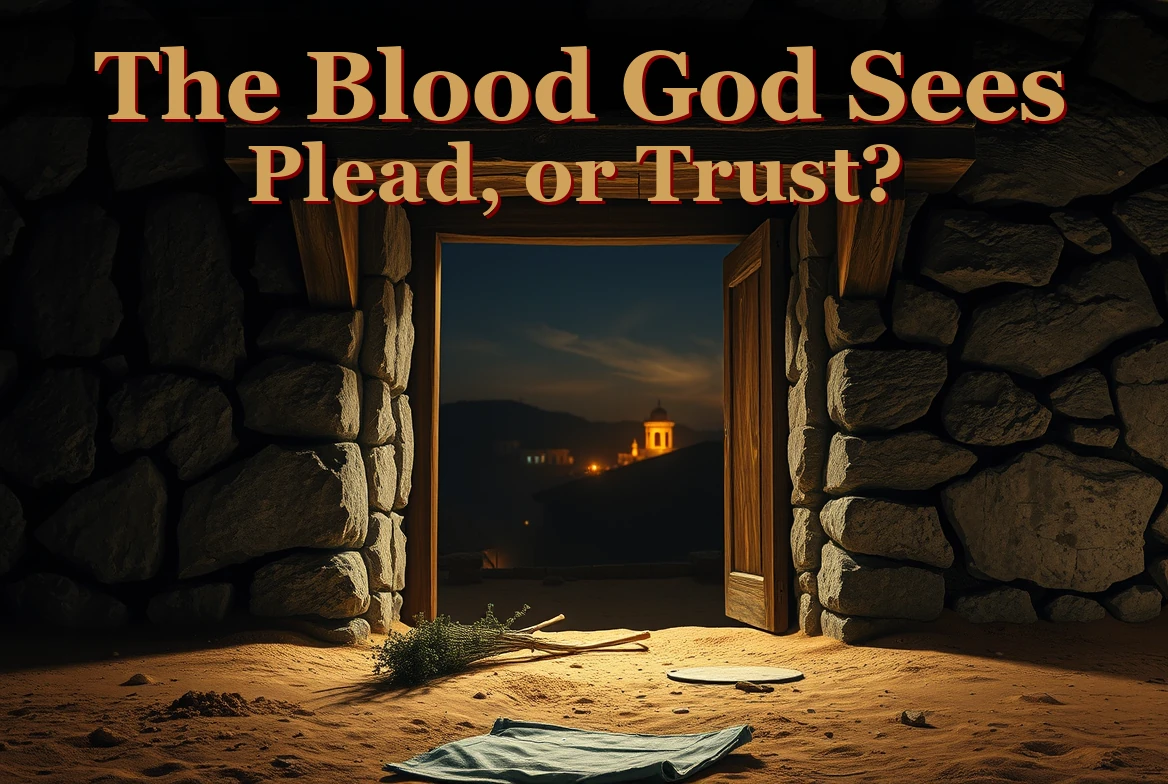
"And they shall take of the blood, and strike it on the two side posts and on the upper door post of the houses, wherein they shall eat it." (Exodus 12:7 KJV)
The blood was struck on the door — once, with a bunch of hyssop, at a specific command (Exodus 12:22). There was no chant over it, no formula spoken, nothing repeated. It was a single act of obedient faith. And the protection did not rest on anything Israel said; it rested on what God would see. Suppose the promise ran with its pivotal word left blank — and when I ___ the blood, I will pass over you — and suppose we filled that blank with "hear you plead." That would be the modern practice. But it is not the word God used. He said:
"And the blood shall be to you for a token upon the houses where ye are: and when I see the blood, I will pass over you, and the plague shall not be upon you to destroy you, when I smite the land of Egypt." (Exodus 12:13 KJV)
See, not hear. The Israelite inside the house did not stand at the door pleading; he sheltered under blood already applied and trusted God to see it — "when he seeth the blood upon the lintel… the LORD will pass over the door" (Exodus 12:23 KJV). Even the type everyone appeals to teaches the opposite of the practice: the blood is applied once by faith at God's word, and safety rests on God's seeing it, not on the believer's speaking it. If Passover proves anything about pleading the blood, it proves it is unnecessary.
Israel's program: fact, not formula
The two verses most often quoted for the practice both belong to Israel's prophetic program, and neither one is a command to apply the blood by speech.
The first is John's:
"But if we walk in the light, as he is in the light, we have fellowship one with another, and the blood of Jesus Christ his Son cleanseth us from all sin." (1 John 1:7 KJV)
Read it for what it says. It is a statement of what the blood does — it cleanseth, present and continuous — for those walking in the light. It is not an instruction to say anything over anything. John describes a fact; he does not hand out a formula. To turn "cleanseth us" into "plead it and it will cleanse" is to add a mechanism the verse never mentions and to make the blood's work wait upon the believer's words rather than upon Christ's finished offering.
The second is from the Revelation, and it is the favorite of the deliverance meeting:
"And they overcame him by the blood of the Lamb, and by the word of their testimony; and they loved not their lives unto the death." (Revelation 12:11 KJV)
Look at who they are and how they overcame. These are tribulation believers, and the verse tells us the whole shape of their victory: they overcame by the finished value of the blood, they held to their testimony, and "they loved not their lives unto the death" — that is, they were martyred. This is not a household protection chant; it is the record of saints who died rather than deny their Lord and were counted victors because the blood had already secured them. To lift "by the blood of the Lamb" out of a martyr's testimony in the tribulation and re-use it as a charm to keep trouble away from a Christian's home today is to read the verse backward. It describes men who lost their lives and overcame anyway.
The mystery: a finished possession
When we come to Paul — to whom the doctrine for the Body of Christ was given directly — the blood appears again and again, and every single time it is a possession already secured, to be believed and rested in, never a rite to be performed.
The blood is redemption and forgiveness, and so the ground of our acceptance: God "hath made us accepted in the beloved" (Ephesians 1:6 KJV), "In whom we have redemption through his blood, the forgiveness of sins, according to the riches of his grace" (Ephesians 1:7 KJV); "In whom we have redemption through his blood, even the forgiveness of sins" (Colossians 1:14 KJV). It is justification, received by faith: "Therefore being justified by faith, we have peace with God" (Romans 5:1 KJV), and "being now justified by his blood, we shall be saved from wrath through him" (Romans 5:9 KJV). It is peace: "having made peace through the blood of his cross" (Colossians 1:20 KJV). It is the very thing that has already brought the far-off Gentile near: "But now in Christ Jesus ye who sometimes were far off are made nigh by the blood of Christ" (Ephesians 2:13 KJV).
Notice the tense of it all — have, are made, being now justified. Not one of these tells the believer to apply the blood; each tells him what the blood has already accomplished for him. And Paul seals it with a single word the practice cannot survive: "For in that he died, he died unto sin once" (Romans 6:10 KJV). Once. The death was died once, and what it obtained is finished. A work God calls done cannot be helped along by being pleaded over a doorframe.
The epistle to the Hebrews says the same of that once-for-all entry — though here a word of caution is owed, for Hebrews is not part of the doctrine written to the Body of Christ. It is addressed to Hebrews, believers of Israel's program, and its authorship settles neither its audience nor our rule of practice. We do not rest the Body's doctrine upon it; we already have that, plainly, from Paul. But where Hebrews records a plain fact about the finished work of Christ, that fact is true wherever it is read, and it corroborates what Paul has already told us:
"Neither by the blood of goats and calves, but by his own blood he entered in once into the holy place, having obtained eternal redemption for us." (Hebrews 9:12 KJV)
Once, into the holy place; and the redemption it obtained is eternal — already obtained, not renewed by our repetition. The right response to a once-for-all, eternal redemption is not to re-apply it; it is to believe it and give thanks.
Paul's warfare has no such weapon
The practice presses hardest at exactly the point where Paul is most explicit — the believer's warfare — and this is where its absence is loudest. When Paul arms the Body for spiritual conflict, he lists the pieces one by one: truth, righteousness, the gospel of peace, faith, salvation, and the word of God (Ephesians 6:13-17). He leaves nothing out. And "plead the blood" is not there. If verbally applying the blood were the believer's weapon against the powers of darkness, the passage that names every weapon would name it. It does not.
The same silence answers the use of the practice against evil thoughts, where Ruckman and others recommend "pleading the blood" until the thought lifts. Paul tells the Body exactly how to deal with the invading thought, and it is not by speaking blood over it:
"Casting down imaginations, and every high thing that exalteth itself against the knowledge of God, and bringing into captivity every thought to the obedience of Christ." (2 Corinthians 10:5 KJV)
The thought is captured by being brought under Christ's obedience — met with truth, judged, refused, replaced — the work of a renewed mind, not of a repeated phrase. And behind that stands the settled fact that the war over the Body's ownership is already won: "Who hath delivered us from the power of darkness, and hath translated us into the kingdom of his dear Son" (Colossians 1:13 KJV), and on the cross Christ, "having spoiled principalities and powers, he made a shew of them openly, triumphing over them in it" (Colossians 2:15 KJV). The believer does not plead the blood to gain ground against an enemy; he stands on ground Christ has already taken.
The blood is not a magic word
At bottom the practice mistakes the nature of the thing it honors. It treats the blood as a word of power — a syllable that, correctly spoken, discharges an effect — when Scripture treats the blood as the price of a finished purchase. Paul tells the Body it was "bought with a price" (1 Corinthians 6:20 KJV) — and that price was the blood of God's own Son. To reduce something bought at such a cost to a protective charm, muttered over thresholds and repeated against fear, is not reverence; it is, however unintentionally, to handle holy things as the heathen handle their incantations — supposing they shall be heard for their much speaking. The blood needs no such help, and honors no such use.
For the believer to be delivered from the power of darkness cost the death of the Son of God. That deliverance is not renewed sentence by sentence; it was accomplished once and holds. The Christian who understands this stops trying to activate the blood and starts resting in what it already did.
Washed in the blood — whose language is it?
The same instinct that pleads the blood loves to sing it. "Are you washed in the blood, in the soul-cleansing blood of the Lamb?" "There is power, power, wonder-working power in the blood." "What can wash away my sin? Nothing but the blood of Jesus." The affection behind these songs is real, and the thing they mean to confess — that everything rests on Christ's sacrifice — is true. But washed in the blood is a particular figure of speech, and rightly divided it belongs to Israel's program, not to the Body of Christ.
It is John's language. He writes it to the seven churches — "Unto him that loved us, and washed us from our sins in his own blood" (Revelation 1:5 KJV) — and he sees it fulfilled in the tribulation multitude: "These are they which came out of great tribulation, and have washed their robes, and made them white in the blood of the Lamb" (Revelation 7:14 KJV). That is where the picture lives — in the Revelation, among the saints of the kingdom program.
Paul, giving the Body its own doctrine, does not put the Body in a blood-bath. When he speaks of the believer being washed, he assigns the washing to the Spirit and to the word: "but ye are washed, but ye are sanctified, but ye are justified in the name of the Lord Jesus, and by the Spirit of our God" (1 Corinthians 6:11 KJV); "by the washing of regeneration, and renewing of the Holy Ghost" (Titus 3:5 KJV); "the washing of water by the word" (Ephesians 5:26 KJV). For the Body the blood is named as the price — redemption, forgiveness, justification, propitiation, peace, nearness — not as the laver the believer keeps returning to. The Body member is redeemed and forgiven through the blood; he is washed by the Spirit and the word. That is not a small distinction; it is the difference between a figure God gave to Israel and the doctrine He gave through Paul.
And notice both the agent and the tense. When Paul does speak of the Body being washed, he never asks "Are you washed in the blood?" He states it as a finished fact, and he names the Spirit — not the blood — as the one who washed: "but ye are washed, but ye are sanctified, but ye are justified in the name of the Lord Jesus, and by the Spirit of our God" (1 Corinthians 6:11 KJV). Are — past, complete, settled; and washed by the Spirit, not in a fountain of blood to be returned to. The hymn's recurring question — Are you washed? Are you washed in the blood? — with its call to come again to the fountain and be washed anew, presses an Israelite figure onto the Body and teaches, softly and in a tune the heart loves, the very thing pleading teaches openly: that the blood must be gone back to and re-applied. But the Body was washed and justified in that one act, and now stands "complete in him" (Colossians 2:10 KJV). It does not need re-washing; it needs to believe it is clean.
None of this is to scorn a hymn a saint has sung with tears, or to lower by a hair the worth of the blood. It is only right division and right tense. Sing the finished work; rest in the once-for-all cleansing; but do not let a kingdom figure quietly reopen a fountain the mystery says you have already passed through.
What the believer actually does with the blood
So is there nothing to do with the blood? There is a great deal — but it is faith's work, not a formula's. And notice first what the believer does not have to do: he does not have to win his way into God's presence, or enter any holy place, for the blood has already brought him all the way in. He was "made nigh by the blood of Christ" (Ephesians 2:13 KJV), and raised up to "sit together in heavenly places in Christ Jesus" (Ephesians 2:6 KJV). His access is not a door he must still get through but a standing fact — "In whom we have boldness and access with confidence by the faith of him" (Ephesians 3:12 KJV). He does not plead his way in; he is already seated within. So what remains is simply to believe it: he remembers he was bought with the blood, reckons himself forgiven through it and washed by the Spirit, and lives as one who belongs to Another. And he gives thanks — endlessly — that peace, redemption, forgiveness, and nearness were all secured for him before he ever felt the danger he was tempted to plead against.
Rightly divided, then, the answer is plain. In no dispensation did God command a believer to plead the blood as a spoken remedy. At Passover He told Israel to apply it once and trust Him to see it. To the kingdom remnant He stated what the blood does and recorded how martyrs overcame by it. To the Body of Christ He revealed, through Paul, a blood that has already redeemed, justified, reconciled, and brought near — a finished purchase to be believed. The practice of pleading the blood, whether it comes wearing Pentecostal or King-James-Only dress, adds words to a work that Scripture calls once and eternal. The blood does not wait to be pleaded. It waits to be trusted.
Revision notes
2026-10-08. This article used the words "demons" and "demonic" in two places. It now says "devils," the King James word, for the reason given in Do You Believe Jesus Is the Son of God?, in the section on the devils' confession. The article also cited Romans 3:25, "through faith in his blood," as the proof that the blood is received by faith. That one clause is not made to carry the point here, and the point now rests on Romans 5, where we are justified both by faith (Romans 5:1) and by his blood (Romans 5:9), and on Ephesians 1:6–7; The Blood of Christ and the Preaching of the Cross: Why Paul Could Not Preach a Bloodless or Generic Death gives the reason in its note on Romans 3:25.
© 2026 Edward R. Cross



Comments
No comments yet. Be the first to share your thoughts.
Leave a comment