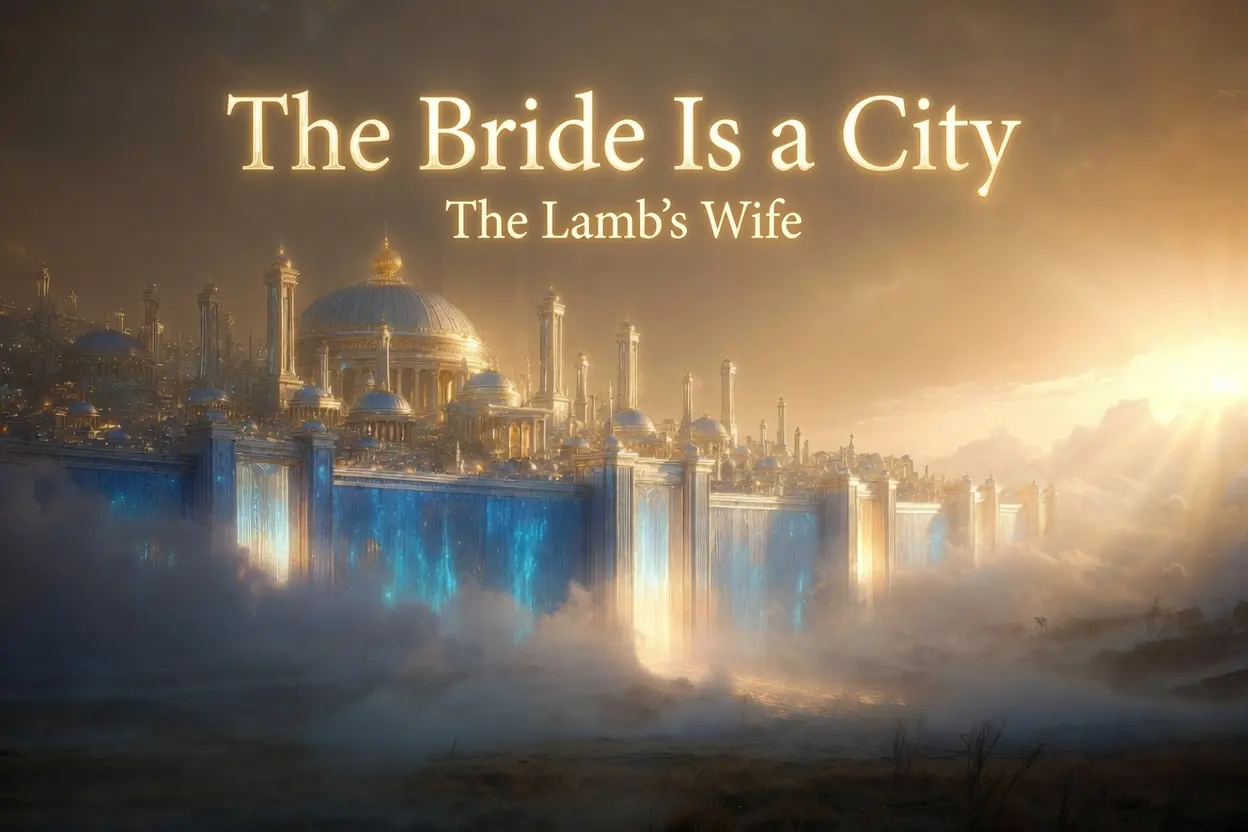
Few phrases are repeated more confidently in Christian teaching than the Bride of Christ. It appears on wedding programs and worship choruses, in sermons and book titles, almost always as a settled name for the church. We are told that the church is engaged to Jesus now and will be married to Him when He returns. It sounds tender, and it sounds biblical. But when we go to the text rightly divided, a surprising thing happens: the one place where Paul takes up marriage at length never calls us the bride at all — it calls us something nearer. And the only company in Scripture actually titled the bride, the Lamb's wife turns out to be a city, and that city belongs to Israel.
You can see where the phrase leads once it is taken as a literal identity. In Roman Catholicism a woman entering certain orders is married to Christ in an actual ceremony — a white gown, vows, even a ring — after which the veil marks her as His bride and accounts for her celibacy: there can be no other husband, for her husband is Jesus. The same instinct surfaces, more softly, in evangelical devotion, where an unmarried believer is consoled that she need not feel alone, because Jesus is her husband. Both grow from one root. Take a borrowed figure for a literal marriage, and the relationship between Christ and His own gets quietly reshaped into something Scripture never said it was. The cure is not to love the Lord less; it is to know rightly what we are to Him.
This is not a quarrel over a sentimental phrase. It is a question of identity. If we do not know what we are, we will reach for blessings, hopes, and covenants that were never addressed to us, and we will miss the closer thing that was. So let us take the passages slowly.
The passage everyone assumes settles it
The text presumed to make the church the bride is Ephesians 5. So let us watch what it actually does. Paul is instructing husbands and wives, and he reaches back to Christ and the church as the pattern:
"Husbands, love your wives, even as Christ also loved the church, and gave himself for it; That he might sanctify and cleanse it with the washing of water by the word, That he might present it to himself a glorious church, not having spot, or wrinkle, or any such thing; but that it should be holy and without blemish." (Ephesians 5:25-27 KJV)
Notice that the comparison so far is real but general — Christ loved, gave Himself, sanctifies, cleanses, presents. The bridal reading wants to stop here and supply the word bride. But Paul keeps writing, and the next verses tell us what kind of comparison this is:
"So ought men to love their wives as their own bodies. He that loveth his wife loveth himself. For no man ever yet hated his own flesh; but nourisheth and cherisheth it, even as the Lord the church: For we are members of his body, of his flesh, and of his bones." (Ephesians 5:28-30 KJV)
There it is. When Paul finally names what the church is in this passage, he does not say we are the bride who will one day be married. He says "we are members of his body, of his flesh, and of his bones" (Ephesians 5:30 KJV). The whole movement of the passage runs toward the body, not the bride. A man loves his wife as his own body, and the reason given is that we already are His body. The figure is not betrothal waiting on a wedding; it is a head and its own flesh.
And notice precisely which flesh Paul means, because this is where the bridal reading quietly switches positions. In these verses the church is not the wife being joined to a husband to become one flesh — the church is the man's own flesh. The standard a husband uses is his own body: "He that loveth his wife loveth himself. For no man ever yet hated his own flesh; but nourisheth and cherisheth it, even as the Lord the church" (Ephesians 5:28-29 KJV). The church is set in the place of the own flesh a man cherishes as himself, and Paul tells us why in the next breath: "For we are members of his body, of his flesh, and of his bones" (Ephesians 5:30 KJV). That is not the language of two persons becoming one in marriage; it is the language of identity — flesh and bone, one body. Watch the seat each party occupies. In the human picture the wife is a distinct person whom the husband loves as his own body: she is the one loved, and his own body is the measure of how he loves her. Paul does not put the church in the wife's seat. He puts the church in the place of the own body itself — the Lord cherishes the church as a man cherishes his own flesh, because, Paul says, the church does not merely resemble His body but is it. A wife is loved as if she were her husband's body; the church is His body, His own flesh. The comparison that keeps two persons distinct in a marriage collapses into identity for the church — one body with its Head, not two persons joined in a wedding.
Then Paul quotes Genesis to seal it:
"For this cause shall a man leave his father and mother, and shall be joined unto his wife, and they two shall be one flesh. This is a great mystery: but I speak concerning Christ and the church." (Ephesians 5:31-32 KJV)
Read carefully, this verse cuts the other way. The "great mystery" is the thing Paul just stated — "they two shall be one flesh" (Ephesians 5:31 KJV). Marriage itself, two distinct persons becoming one flesh, is the great mystery. But then comes the hinge word: "but I speak concerning Christ and the church." That but is a contrast, not a bridge. Paul is not saying, and this one-flesh marriage is what Christ and the church are. He is saying the opposite — however, when I speak of Christ and the church, I mean something other than that two-becoming-one. And we already know what he said concerning Christ and the church, because he said it back in verse 30: "we are members of his body, of his flesh, and of his bones." That is not two persons fused into one; it is members already belonging to a body that is His own flesh. The bridal reading has to turn the but into an and, so that the marital one-flesh becomes a picture of the church wedded to Christ. But Paul wrote but.
And the very next word seals the turn. Paul writes, "Nevertheless let every one of you in particular so love his wife even as himself; and the wife see that she reverence her husband" (Ephesians 5:33 KJV). Nevertheless — that is, having stepped aside in verse 32 to speak of Christ and the church, let me now come back to the matter at hand, the husband and the wife. The two hinge words frame verse 32 as a parenthesis: the but turns away from the marriage instruction to speak of Christ and the church, and the nevertheless turns back from Christ and the church to the marriage instruction. You do not turn away from a subject and then say nevertheless, back to it unless the thing in between was a different subject. So the mystery concerning Christ and the church sits between the two markers that hold it apart from the marriage in view — and that mystery, stated in verse 30, is that the church is His body, His own flesh. Marriage is two made one; the church is already one with its Head.
So the passage most often used to make the church the bride does the opposite. Pressed for the church's identity, it answers "members of his body" three times over — body, flesh, bones — and never once says bride. The same letter had already given the formal title: God "gave him to be the head over all things to the church, Which is his body, the fulness of him that filleth all in all" (Ephesians 1:22-23 KJV). The church which is His body. That is the name Paul uses.
An illustration is not a title
Someone will answer at once: but Paul does use marriage language for us elsewhere. He does, and the distinction we need is simple — an illustration is not a title. Paul illustrates the Body with many figures, and no one mistakes the figures for names. We are a building and a temple (Ephesians 2:21), a body with many members (1 Corinthians 12), soldiers (2 Timothy 2:3-4), God's husbandry (1 Corinthians 3:9). He even reaches for the figure of marriage. But a man may be called a lion in courage without being a lion; the figure teaches a quality, it does not assign an identity.
Take the two places people cite. First, Paul writes:
"For I am jealous over you with godly jealousy: for I have espoused you to one husband, that I may present you as a chaste virgin to Christ." (2 Corinthians 11:2 KJV)
Read who is doing what. Paul says I have espoused you, and I will present you. He is not the bridegroom — the bridegroom is named, to Christ — he is the father who betroths her. And here is what settles the verse: Paul is not literally anyone's father. He is their father only by a figure, the very figure he states elsewhere — "in Christ Jesus I have begotten you through the gospel" (1 Corinthians 4:15 KJV). He did not beget them; he is speaking in a picture. A figurative father betrothing a figurative virgin to a husband is, from first to last, an illustration. You cannot draw a literal title — the bride — out of a scene whose own espouser is admittedly a metaphor; to take the virgin literally while the father is a figure is to read one role in the tableau as fact and the rest as picture. The figurative father is the tell: the whole scene is a figure.
And the figure is spent at once, which is how illustrations behave. Paul's jealousy is not his own private feeling but godly jealousy — God's own jealousy, carried by His minister for the one Husband — and in the next breath he says what it guards: not a wedding, but their doctrine, "lest… your minds should be corrupted from the simplicity that is in Christ" (2 Corinthians 11:3 KJV), lest they receive "another Jesus" or "another gospel" (2 Corinthians 11:4 KJV). The espousal pictures undivided devotion to the true Christ; that is the lesson it is used up on. A title is never spent on a lesson — it simply names. So even in Paul's fullest marriage figure he never once calls the church the bride; the name he gives these very people is "ye are the body of Christ" (1 Corinthians 12:27 KJV). And he betroths them to one husband — a point we will need again.
Second, Paul writes that believers, having died to the law, "should be married to another, even to him who is raised from the dead, that we should bring forth fruit unto God" (Romans 7:4 KJV). But look at the argument. Paul is teaching freedom from the law, and he draws it from the law of the husband: a woman is bound to her husband only while he lives (Romans 7:1-3). The marriage figure is borrowed to prove that death dissolves a legal bond — we died, the old claim is gone, we belong now to the risen Christ. Here too the figure is spent the moment it is used: brought in to prove release from the law, then cashed out in the lesson it serves — "that we should bring forth fruit unto God." A title is not used up on a lesson; an illustration is. It is freedom from the law Paul teaches here, not a name for the church.
So Paul does use bridal and marital figures. He also uses building, body, temple, soldier, and farm figures. Only one of these is ever given as the church's standing identity, repeated as a formal title and built into doctrine — the body of Christ. We should not promote one illustration into a name the Spirit never made into a name.
And there is a plain fact of language that ought to weigh heavily. The phrase bride of Christ does not occur anywhere in Scripture, and the word bride never once appears in any of Paul's epistles to the Body. It is found in the law, in the prophets, in the Gospels spoken to Israel, and in the book of Revelation — Israel's ground from first to last — but never in the letters written to us. The nearest the Bible ever comes to the popular phrase is the bride, the Lamb's wife in Revelation 21:9, and we will see exactly whom that names. A title the Spirit never once wrote for us is a strange thing to make the center of our identity.
The wife in Scripture is Israel
If the Body is not the bride, who is the wife? Scripture answers without strain: the wife is Israel, and she is a wife by covenant. Long before the church, God spoke as a husband to a nation.
"For thy Maker is thine husband; the LORD of hosts is his name; and thy Redeemer the Holy One of Israel; The God of the whole earth shall he be called." (Isaiah 54:5 KJV)
He remembers their courtship in the wilderness — "I remember thee, the kindness of thy youth, the love of thine espousals, when thou wentest after me in the wilderness" (Jeremiah 2:2 KJV) — and He calls the bond by its proper name: "for I am married unto you" (Jeremiah 3:14 KJV). Ezekiel tells it the same way: "I sware unto thee, and entered into a covenant with thee, saith the Lord GOD, and thou becamest mine" (Ezekiel 16:8 KJV).
This was a true marriage, not a standing engagement, and Scripture proves it by what followed. A wife can commit adultery, and Israel did — only of a real wife could the LORD say, "she is not my wife, neither am I her husband" (Hosea 2:2 KJV). A wife can be divorced, and Israel was: "for all the causes whereby backsliding Israel committed adultery I had put her away, and given her a bill of divorce" (Jeremiah 3:8 KJV); "Where is the bill of your mother's divorcement, whom I have put away?" (Isaiah 50:1 KJV). And the law writes a bill of divorce only where there was first a completed marriage — only after a man "hath taken a wife, and married her" (Deuteronomy 24:1 KJV). Israel owns the bond herself: "I will go and return to my first husband" (Hosea 2:7 KJV). You do not return to a first husband you were never married to.
And He will take His adulterous wife back. Hosea was made to act it out — told to "love a woman… yet an adulteress, according to the love of the LORD toward the children of Israel" (Hosea 3:1), he buys her back for fifteen pieces of silver (Hosea 3:1-2). So the restoration is spoken as a re-betrothal: "I will betroth thee unto me for ever; yea, I will betroth thee unto me in righteousness… and thou shalt know the LORD" (Hosea 2:19-20 KJV). Israel's whole history as the wife runs in a single line — married in the wilderness, unfaithful, put away, redeemed, and to be brought home.
The thread is unmistakable, and it is held together by covenant. Israel is the wife because Israel has the covenants — "to whom pertaineth… the covenants" (Romans 9:4 KJV). The Body of Christ has no such marriage covenant, because the covenants were never made with us. We are a new creature, made known in a mystery kept secret since the world began. The wife was already taken, by oath, in the wilderness.
Married before the wedding — and the pattern is Israel's
It helps to remember how marriage worked in Scripture, because it answers a common objection. In Hebrew custom a marriage came in two stages. The betrothal, or espousal, was itself a binding marriage: the man and woman were husband and wife in law, unfaithfulness was adultery, and the bond could be broken only by a bill of divorce. The wedding came later — the bridegroom came for his bride, brought her to his house, and the feast and the life together began. The clearest proof is the plainest case. Mary was only "espoused to Joseph, before they came together", yet Joseph is called "her husband", he is "minded to put her away" — which would require a divorce — and the angel tells him to "take unto thee Mary thy wife" (Matthew 1:18-20 KJV). Betrothed, not yet brought home, and already married.
That two-stage pattern — married first, brought home later — is exactly Israel's. She was married to the LORD in the wilderness, put away for her adultery, redeemed, and her home-bringing is still future: "for I am married unto you… and I will bring you to Zion" (Jeremiah 3:14 KJV). The marriage of the Lamb is that day — not a first wedding of a woman never wed, but the redeemed wife at last brought to her husband's house. The whole bridal drama, every stage of it — covenant, adultery, divorce, redemption, and the home-bringing still to come — belongs to Israel.
The Bridegroom came to Israel
The bridegroom imagery of the Gospels tells the same story. The two realms this divides — the earthly hope of Israel and the heavenly calling of the Body — are set out in The Kingdom of God: Two Realms, Two Hopes, Two Inheritances. When John the Baptist's disciples grew jealous for their master, John answered, "He that hath the bride is the bridegroom: but the friend of the bridegroom, which standeth and heareth him, rejoiceth greatly because of the bridegroom's voice" (John 3:29 KJV). John sets himself as the friend of the bridegroom, not the bride — and a friend of the bridegroom is plainly not the bride. The bridegroom had come, and He had come to Israel, to whom John was sent. The Lord used the same figure of Himself in Israel's midst: His disciples are "the children of the bridechamber" who cannot mourn "as long as the bridegroom is with them" (Matthew 9:15 KJV); and the kingdom of heaven is likened to "ten virgins, which took their lamps, and went forth to meet the bridegroom" (Matthew 25:1 KJV). Every strand of the bride-and-bridegroom motif runs through Israel's program — the prophets, John, the kingdom parables, and at last the marriage of the Lamb in Revelation. It never crosses over into the mystery, because the Body was never on that side of the picture.
The Lamb's wife is the New Jerusalem
Now we can read Revelation without importing the church into it. There is exactly one company in all of Scripture formally titled the bride, the Lamb's wife, and the angel takes pains to show John precisely who she is:
"And there came unto me one of the seven angels… saying, Come hither, I will shew thee the bride, the Lamb's wife. And he carried me away in the spirit to a great and high mountain, and shewed me that great city, the holy Jerusalem, descending out of heaven from God." (Revelation 21:9-10 KJV)
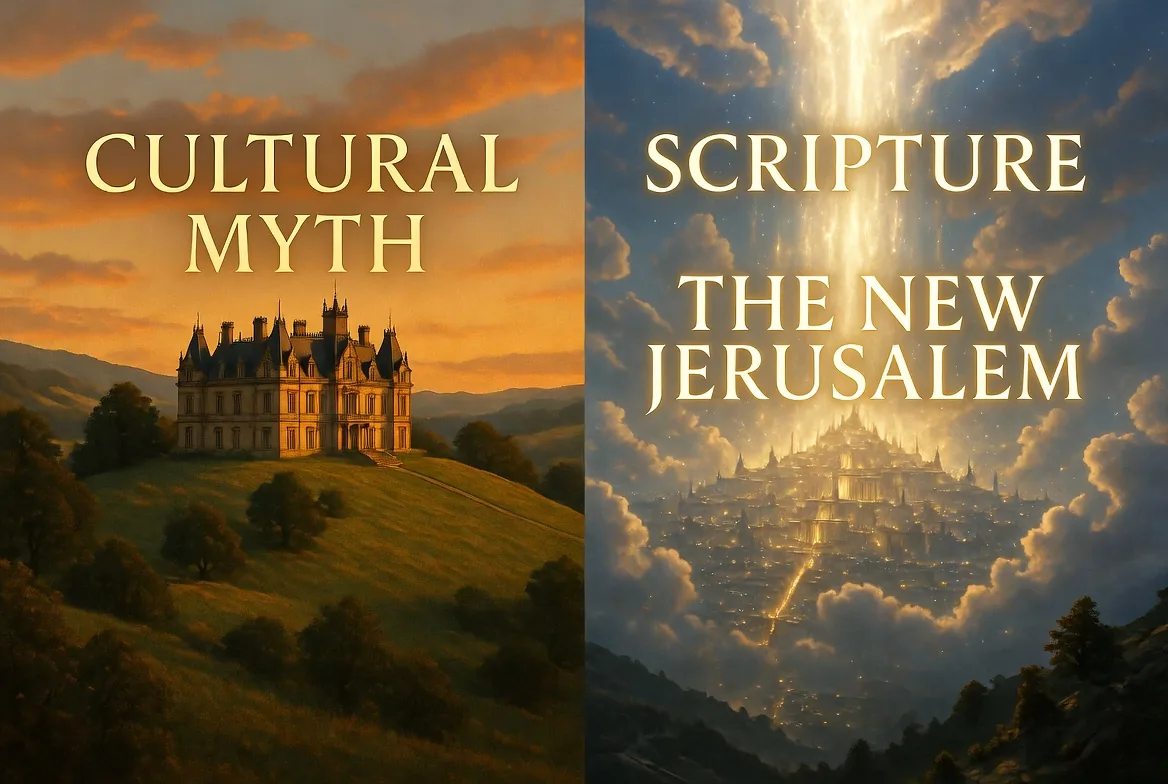
The bride is a city — and in Scripture a city stands for the people who dwell in her, as Jerusalem so often names not her walls but her inhabitants. When John is offered the Lamb's wife, what he is shown is the holy Jerusalem. And this city is stamped with Israel from gate to foundation — its twelve gates bear the names of the twelve tribes of Israel, its twelve foundations the names of the twelve apostles (Revelation 21:12-14), the very company promised twelve thrones to judge the twelve tribes (Matthew 19:28). To make the Body this bride, then, is to march the church of the mystery in through gates that bear Israel's tribal names — to turn us into Israel after all, which is the very confusion that rightly dividing the word of truth exists to undo. Earlier the same scene is described the same way: "I John saw the holy city, new Jerusalem, coming down from God out of heaven, prepared as a bride adorned for her husband" (Revelation 21:2 KJV). The city is prepared as a bride — Israel's covenant people, glorified.
Even the wedding scene keeps the Body out of the bridal role, and it does so in a way no grace believer can claim. At the marriage of the Lamb, "his wife hath made herself ready", and "to her was granted that she should be arrayed in fine linen, clean and white: for the fine linen is the righteousness of saints" (Revelation 19:7-8 KJV). The wife makes herself ready, clothed in the righteousness of saints — her own readiness, her own works. That is not how the Body comes to stand before Christ. We did not make ourselves ready; He makes us ready — "that he might present it to himself a glorious church, not having spot, or wrinkle" (Ephesians 5:27 KJV). The bride prepares herself; the Body is prepared by her Husband. And then a separate blessing is pronounced over yet another company: "Blessed are they which are called unto the marriage supper of the Lamb" (Revelation 19:9 KJV). There is the wife, and there are the guests invited to the supper — two distinct parties. The bride is not the same as those called to her wedding.
Does the Holy Spirit get a wife too?
Here the popular scheme tries one more move. Sensing that Israel is plainly the wife in the Old Testament, many teachers grant it — and then divide the persons of the Godhead to make room for a second wife: Israel is the wife of God the Father, and the church is the bride of the Son, the Lamb. It sounds clever. It also collapses the moment you ask it to be consistent.
If the Father has a wife and the Son has a wife, then what of the Holy Spirit? Does the Spirit get a wife as well? The question is not flippant; it is the test of the whole idea. The scheme treats the divine persons as three husbands shopping for three brides, and the instant you press it to its third member it shows itself absurd. No one is prepared to assign a bride to the Holy Spirit, and that refusal exposes the error: marriage in Scripture was never about distributing wives among the persons of the Trinity. There are not multiple husbands. There is one God, and the covenant marriage is to one husband.
And note who the husband of Israel actually is. Isaiah names Him: "thy Maker is thine husband; the LORD of hosts is his name; and thy Redeemer the Holy One of Israel" (Isaiah 54:5 KJV). The husband and the Redeemer are one — and the Redeemer, the Holy One, is the Lamb of Revelation. The Lamb is not a second deity acquiring His own separate wife alongside the Father's; the Lamb is the LORD who married Israel. So the Lamb's wife and the LORD's wife are not two women belonging to two husbands. They are one wife — Israel — belonging to the one God who redeemed her. Paul's own figure already guarded this: "I have espoused you to one husband" (2 Corinthians 11:2 KJV). One husband, not a committee of them.
The marriage was always God dwelling with His people
What, then, is this marriage about? Revelation tells us in the same breath it introduces the bride-city. The very next words after "prepared as a bride" define the whole point:
"And I heard a great voice out of heaven saying, Behold, the tabernacle of God is with men, and he will dwell with them, and they shall be his people, and God himself shall be with them, and be their God." (Revelation 21:3 KJV)
That is the marriage. It is God dwelling with His people. The whole long story of Israel as the wife was always pointing here — to the day the estranged wife is restored and her God comes to live with her. The prophets had promised exactly this reversal:
"Thou shalt no more be termed Forsaken; neither shall thy land any more be termed Desolate: but thou shalt be called Hephzibah, and thy land Beulah: for the LORD delighteth in thee, and thy land shall be married… as the bridegroom rejoiceth over the bride, so shall thy God rejoice over thee." (Isaiah 62:4-5 KJV)
Forsaken becomes Hephzibah — my delight is in her. Desolate becomes Beulah — married. The land itself is married. This is Israel's restoration, the covenant wife who was put away and is now brought home, and the new Jerusalem descending is the consummation of it. The marriage of the Lamb is the keeping of the promise made in the wilderness, the betrothal for ever of Hosea, fulfilled when God at last tabernacles with His covenant people on the new earth.
That hope is earthly and national in its setting — a city descending to dwell with men. It is Israel's hope, and it is glorious. It is simply not ours.
What the Body is instead — and why it is nearer
None of this leaves the Body of Christ with a lesser portion. It is worth saying plainly, because bride sounds like the higher honor and body like the consolation prize. The reverse is true.
A wife — even a betrothed one, already bound by covenant — is still a distinct person, joined to her husband but not yet brought home, not yet one flesh; the wedding still lies ahead of her. The Body is nothing of the kind. The Body is not a second party joined to Christ and waiting to be fetched — the Body is of Him. "We are members of his body, of his flesh, and of his bones" (Ephesians 5:30 KJV). He is the Head and we are His own body, the fulness of Him (Ephesians 1:22-23). You cannot get nearer than that, and there is no home-bringing still owed to us, because we were never a separate bride to be brought home. We are already "accepted in the beloved" (Ephesians 1:6 KJV), already raised and seated together with Him "in heavenly places" (Ephesians 2:6 KJV), already "one spirit" with the Lord (1 Corinthians 6:17 KJV). Our hope is not a wedding at which we are finally united to a King come down to reign on the earth; our hope is to "appear with him in glory" (Colossians 3:4 KJV), where He already is.
So when we decline the title bride, we are not surrendering intimacy — we are claiming a closer one, and we are leaving Israel her own promise undisturbed. The wife is the wife. The bride is the new Jerusalem. And the Body is the Body, members of His very flesh and bones. Rightly divided, each keeps its own glory, and ours is to be one with the Head, not betrothed to a Bridegroom we are still waiting to marry.
© 2026 Edward R. Cross


Comments
No comments yet. Be the first to share your thoughts.
Leave a comment