A previous article examined what Paul actually taught about the Christian Sabbath and holy days — that they were shadows whose substance has come in Christ, and that believers in the Body of Christ are not under them. While working on that article, a Facebook post surfaced making an objection that deserves its own careful response, because it is a plausible-sounding argument that circulates regularly in posts and memes.
The objection runs like this:
Paul did not teach believers to stop keeping days. He only said, "Don't let anyone judge you for keeping them." And since Paul elsewhere says the law is good, and that he delights in the law after the inward man, Paul was clearly supportive of the law as a guide for Christian living — including its calendar.
This argument has two moving parts: a misreading of Colossians 2:16 and a misreading of Romans 7. Each needs to be addressed directly. Beyond those two texts, the Jerusalem council's decision in Acts 15 — though not raised in the post — speaks directly to the underlying logic of the claim and deserves its own examination. When all of this is laid out, the objection does not hold.
The Direction of the Warning
The first error is getting the direction of Colossians 2:16 backwards. The verse reads:
"Let no man therefore judge you in meat, or in drink, or in respect of an holyday, or of the new moon, or of the sabbath days." (Col. 2:16)
The objector reads Paul as protecting the day-keeper from being judged for his observance. But that is not what the text says, and the "therefore" makes it plain. Every "therefore" in Scripture points backward. This one points back to verses 13-14:
"And you, being dead in your sins and the uncircumcision of your flesh, hath he quickened together with him, having forgiven you all trespasses; Blotting out the handwriting of ordinances that was against us, which was contrary to us, and took it out of the way, nailing it to his cross." (Col. 2:13-14)
The ordinances — the law, the calendar, the whole system — were nailed to the cross. Therefore: let no one come to you with those ordinances and judge you for not keeping them. The person Paul is defending is the one who is not keeping the days. The person Paul is warning against is the one who would come with the old calendar and pronounce a verdict on the free believer.
The meme gets the protection exactly backwards. Paul is not shielding the sabbath-keeper from criticism. He is shielding the liberated member of the Body of Christ from the judaizer.
Notice that the "therefore" reaches back to the nailing of the ordinances to the cross — not to a distinction about the motive for keeping them. The basis of the warning is not "these things are wrong if kept for salvation." The basis is "these things were nailed to the cross." That is a finished, objective fact about the ordinances themselves, entirely independent of what theological weight the observer attaches to them. If the ordinances were nailed to the cross, then the man who brings them to judge the believer stands condemned by that fact — regardless of whether he frames the observance as required for salvation or merely as a fitting expression of devotion. The cross settled the matter; it did not leave the door open for non-salvific calendar-keeping.
The Grammar of Colossians 2:16
The grammatical structure of the verse confirms the direction of Paul's concern. Paul lists "meat," "drink," "an holyday," "the new moon," and "the sabbath days" in a single grammatical sequence under one command: "Let no man judge you." Every item in that list is placed beyond the reach of the judaizer's verdict.
What the grammar establishes is non-imposition: none of these things — food, drink, days — can be made the grounds of judgment against the believer. Paul is not permitting the judaizer to come with his calendar and pronounce a verdict on the free believer, any more than he is permitting him to come with the dietary laws and do the same. The days and the dietary laws sit in identical grammatical positions, and the command to let no man judge applies equally to both.
Notice, however, what follows from this. Romans 14 shows that Paul genuinely allows for a private, conscience-driven observance of dietary distinctions and days — the weak brother who esteems one day above another is received, not condemned (Rom. 14:1-5). The grammar of Colossians 2:16 is fully consistent with that: "let no man judge you" cuts in every direction. The private keeper is not condemned for his conscience, and the free non-keeper is not condemned for his freedom. What the grammar forbids is judgment — in either direction. It does not by itself settle whether the days carry ongoing authority for the Body of Christ.
That question is answered by verse 17, and by the "therefore" reaching back to verses 13-14. The ordinances were nailed to the cross — that is the ground of the warning. The days have no authority not because the grammar puts them in a neutral zone, but because the cross already acted on them. The grammar tells us no one may judge. The "therefore" and the shadow/body argument tell us why: the substance has come, and the ordinances that pointed to it were nailed there with him.
The Threefold Defensive Frame
Zoom out from verse 16 and the pattern becomes impossible to miss. The entire section of Colossians 2:8-18 is structured around three warnings, each positioning the believer as the one being acted upon by an intruder:
"Beware lest any man spoil you through philosophy and vain deceit..." (v. 8)
"Let no man therefore judge you..." (v. 16)
"Let no man beguile you of your reward..." (v. 18)
Three times Paul says: watch out for the man coming at you. Three times the believer is the one being defended. The paragraph is a defense of the free believer against false teachers who would drag him back into ordinances already nailed to the cross. It is structurally impossible to read this section as protecting the right to observe what Paul is warning the believer to resist.
The Shadow and Its Substance
Verse 17 gives the reason the days no longer bind:
"Which are a shadow of things to come; but the body is of Christ." (Col. 2:17)
The argument is not primarily that the days were never a basis of salvation. The argument is about the nature of shadows. A shadow is cast by a body — it is the silhouette of something substantial. The feast days, new moons, and sabbath days were shadows projected by the coming reality: Christ himself. Paul says they pointed to "things to come" — future realities, not merely past types now obsolete. The seventh-day sabbath, hallowed from the creation week, was a prophetic picture of the coming dominion rest of God through Israel. That is why it carried such weight: it was not arbitrary; it was prophetic.
The Body of Christ is not waiting for that kingdom rest. Our rest is already complete in Christ.
"Ye are complete in him." (Col. 2:10)
Our sins are not being atoned for on a weekly, monthly, or yearly cycle. Our atonement is accomplished. The shadow exists to point to the substance. Once the substance is present, the shadow has done its work. To go on observing the shadow when the body that cast it is standing in the room is to turn from the substance back to its outline.
Notice also what this argument does not say. It does not say: "The days were never meant to be the basis of your salvation, so feel free to observe them for other reasons." It says: they were shadows, and the body is of Christ. The obsolescence of the days is rooted in the nature of shadows and the arrival of Christ — not in a narrow debate about salvation mechanics. This is why the argument is comprehensive and not merely soteriological. It applies to every member of the Body of Christ regardless of what theological weight they consciously assign to the observance.
Dead with Christ: The Whole Argument
The argument, however, runs through verse 23, and the extension is devastating to the objection.
"Wherefore if ye be dead with Christ from the rudiments of the world, why, as though living in the world, are ye subject to ordinances, (Touch not; taste not; handle not; Which all are to perish with the using;) after the commandments and doctrines of men? Which things have indeed a shew of wisdom in will worship, and humility, and neglecting of the body; not in any honour to the satisfying of the flesh." (Col. 2:20-23)
Paul's question is pointed: "why, as though living in the world, are ye subject to ordinances?" The key word is subject to. A believer is free to make personal choices about what he eats or how he orders his week — that is not Paul's concern here. What Paul addresses is the man who places himself under these things as a system, treating them as having spiritual authority over his life and conduct. That posture — being subject to ordinances as though they retain binding force for the one dead with Christ — is what Paul calls will worship: a human-generated framework of piety that has the appearance of wisdom but adds nothing to the completeness already possessed in Christ.
The objector frames day-keeping as extra devotion, a more serious walk, a sign of respect for God's law. Paul frames that exact instinct — the instinct to be subject to ordinances as a spiritual discipline — as will worship. It is a step downward from our complete position in Christ into a system where holiness comes at the end of a week rather than being already possessed in him every day. The freedom to make personal choices is never in question; what is in question is the claim that these ordinances carry spiritual weight for the member of the Body of Christ — and Paul's answer is that they do not.
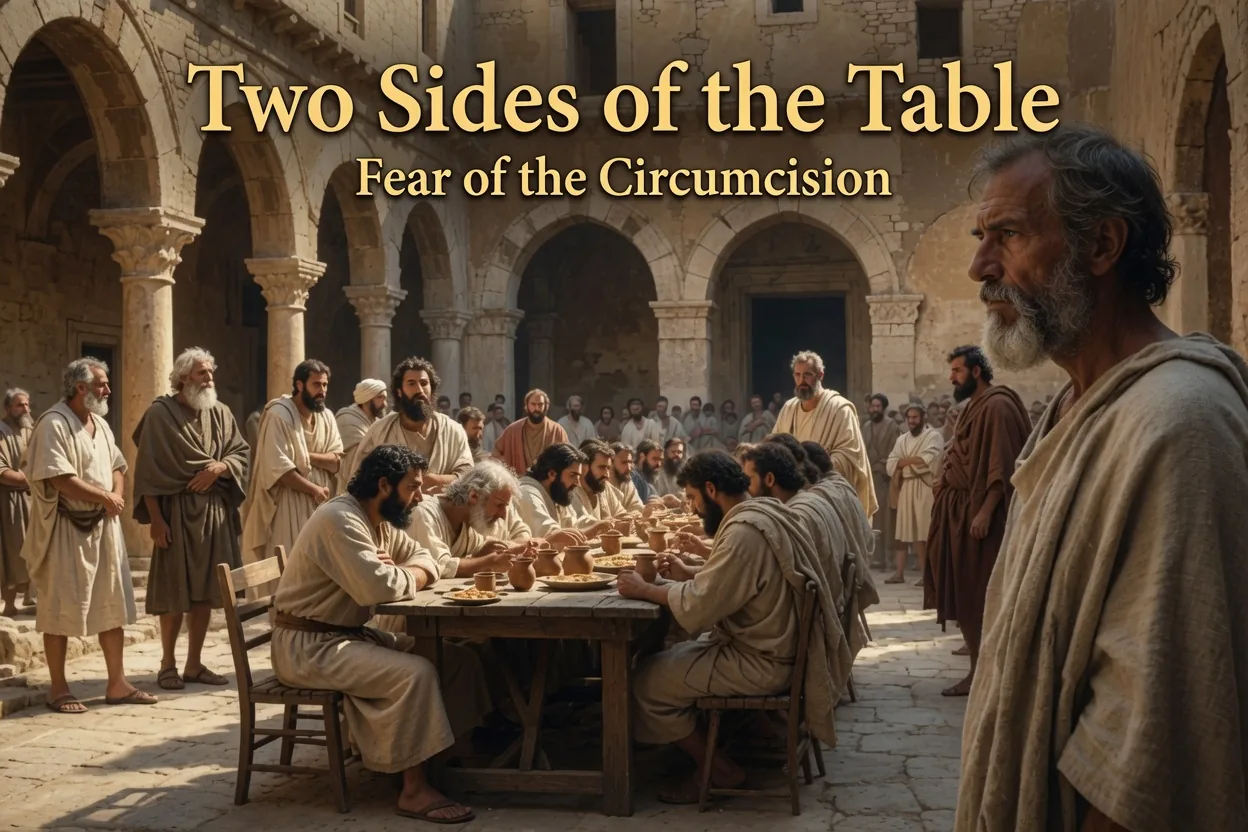
What Acts 15 Actually Decided
The Facebook post did not raise Acts 15, but the council's decision is directly pertinent to the underlying logic of the claim. The argument being made — that law observance is acceptable as long as it is not taught as a means of salvation — runs straight into the Jerusalem council's ruling on exactly that question.
The issue before the council is stated plainly in verses 1 and 5:
"Except ye be circumcised after the manner of Moses, ye cannot be saved." (v. 1)
"There rose up certain of the sect of the Pharisees which believed, saying, That it was needful to circumcise them, and to command them to keep the law of Moses." (v. 5)
The Pharisee believers were pressing law observance — the whole law, including its feast calendar — on Gentiles. The council's verdict was: "to lay upon you no greater burden than these necessary things" (v. 28) — blood, things strangled, fornication, meats offered to idols. The days were inside the rejected "keep the law of Moses" package. Their absence from the council's list is not silence — it is exclusion. They were part of what the council refused to impose.
Now consider what the council's decision reveals about the "as long as it's not for salvation" argument. The four restrictions placed on Gentiles were given as practical conduct guidance — their force was not confined to what one thinks about salvation. The council was addressing how Gentile believers were to live, not merely what they needed to believe to be saved. The days were part of the "keep the law of Moses" package the council expressly refused to impose. They were not overlooked; they were excluded. The council did not say "observe the days, but not for salvation" — it said nothing about the days at all, because the law as a manner of life for Gentile believers was the very thing being refused. The silence is not an argument from nothing; it is the silence of deliberate exclusion. The days fell on the rejected side of the council's ruling.
The council's own recorded deliberation makes the scope of the ruling explicit. Luke records Peter's contribution to the discussion: "why tempt ye God, to put a yoke upon the neck of the disciples, which neither our fathers nor we were able to bear?" (v. 10) We cite this not as Peter's doctrinal authority over the Body of Christ, but as the historical record of what was under consideration and what the council refused. The yoke being discussed is what was being weighed for Gentile necks — not a declaration that Jewish believers were free from the law. Acts 21:20 shows that thousands of Jewish believers continued zealous of the law, and Paul accommodated that reality. The council's concern was not to litigate the Jewish remnant's observance; it was to ensure the law was not imposed on Gentiles in any form. That is precisely the point: the question of Gentile obligation was settled by excluding the law entirely, days included. Nor does the matter end with the council itself. Paul's rebuke of Peter in Galatians 2 makes the same point in a living situation. Peter's error was not that he had begun teaching circumcision for salvation — it was that his behavior in withdrawing from Gentiles was "compelling the Gentiles to live as do the Jews" (Gal. 2:14). Paul confronted him for pressuring Gentiles into a Jewish manner of life, full stop — not merely for implying a salvation requirement. That rebuke stands as Paul's own verdict on the underlying logic of the claim: requiring or pressuring Gentiles to observe the manner of the law is wrong, regardless of the soteriological label attached to it.
It is also worth asking why these four particular things were considered necessary. They are not a random sampling from the Mosaic code. The prohibition on blood reaches back well before Moses — to the Noahic covenant:
"But flesh with the life thereof, which is the blood thereof, shall ye not eat." (Gen. 9:4)
Fornication is not a ceremonial restriction but a moral violation rooted in God's creation design for marriage, which Paul himself addresses repeatedly in his grace epistles as something entirely incompatible with the Body of Christ (1 Cor. 6:18; Eph. 5:3; 1 Thess. 4:3). Meats offered to idols and things strangled both connect to the blood prohibition and to the broader principle of avoiding entanglement with pagan worship. Significantly, Paul teaches on these very matters himself — not as reimposed law, but as grace instruction. These are things Paul was already inclined to teach, which reveals their character: they carry weight not as Mosaic ordinances but as practical wisdom grounded in deeper principles that precede and transcend the law.
The feast days carry no such grounding. They do not appear in the Noahic covenant. They are not rooted in creation order. Paul does not teach them in his grace epistles — he teaches against observing them. They are specifically Israel's prophetic ordinance, pointing to Israel's future under the kingdom program. That is precisely why the council's exclusion of them is principled rather than accidental.
There is also a pastoral dimension to the four restrictions that does not apply to the days. To understand it, we need to recognize the structure of the two believing communities during this transitional period. Remnant Jewish believers and Gentile believers largely had their own distinct assemblies. The Jerusalem agreement recorded in Galatians 2:7-9 makes this explicit: the right hand of fellowship was extended to Paul and Barnabas on the understanding that Paul would go to the Gentiles and Peter to the circumcision — distinct spheres of ministry reflecting distinct communities. Acts 21:20 confirms that thousands of Jewish believers in Jerusalem remained zealous of the law as their own community, entirely separate from Paul's Gentile churches. The existence of separate epistles written to each group further confirms this — not as doctrinal authority for the Body of Christ, but as evidence of the distinct audiences each apostle addressed. James writes to "the twelve tribes which are scattered abroad" (James 1:1); Peter to the Jewish diaspora scattered throughout Pontus, Galatia, Cappadocia, Asia, and Bithynia (1 Pet. 1:1); Paul's epistles to the Gentile assemblies and the Body of Christ. The addressees themselves tell the story: distinct letters to distinct recipients reflect distinct assemblies.
Yet the two spheres were not sealed off from one another. The bleed between them is visible even in Paul's Corinthian correspondence, where some in that Gentile assembly were identifying with Cephas — "I am of Paul; and I of Apollos; and I of Cephas" (1 Cor. 1:12). That the name of the apostle to the circumcision was being invoked in a Gentile assembly is itself evidence of the overlap. Paul's insistence that he was "not a whit behind the very chiefest apostles" (2 Cor. 11:5; 12:11) shows the tension was real and required direct address. The transitional overlap between the two spheres created exactly the kind of pressure that made Paul's defense of his own independent apostleship and distinct gospel necessary. Acts 15:1 opens with Jewish believers traveling to the Gentile assembly at Antioch and troubling them over circumcision. Galatians 2:11-14 shows Peter himself eating at table with Gentiles at Antioch — until certain came from James, at which point he withdrew. These incidents illustrate exactly the kind of regular contact between the two groups that made practical conduct guidance necessary.
When those two groups came into contact, the sensitivities of Jewish believers formed by a lifetime under the law were a real and present consideration. Gentiles eating blood or things strangled in the presence of Jewish brethren, or participating in meals connected to idol worship, would have created genuine offense and hindered the interaction between these two groups during that season.
Significantly, Paul himself is mindful of exactly this dynamic in his own grace epistles. In Romans 14-15 he addresses the strong and the weak, instructing those with knowledge not to use their liberty in a way that causes a brother to stumble: "if thy brother be grieved with thy meat, now walkest thou not charitably." (Rom. 14:15) In 1 Corinthians 8-10 he works through the question of meats offered to idols at length — not as a matter of law, but as a matter of love and conscience toward those whose background makes them vulnerable to offense. Paul's pastoral instruction did not ignore the reality of Jewish-Gentile interaction; it was shaped by it. The four restrictions of Acts 15 and Paul's grace teaching on these matters are not in tension — they reflect the same practical wisdom applied to the same transitional situation.
The feast calendar — and the broader question of law observance as a manner of living — stood on entirely different ground. It was not a matter of Gentile conduct causing offense to Jewish brethren; it was a matter of Jewish pressure being brought to bear on Gentile obligation. The council's refusal was not merely to exclude the calendar from the list of requirements. It was a refusal to impose the law as a way of life on Gentile believers in any form. The four restrictions addressed a real pastoral need arising from contact between two groups during a transitional season. The law as a manner of living for Gentiles was a burden the council explicitly would not place on them — and Paul's rebuke of Peter confirms that this refusal extended beyond formal council decisions to the everyday conduct of those who would, even without argument, pressure Gentiles to live as Jews.
The Weak Brother and the Judaizer
Romans 14 needs to be addressed directly, because it is the natural text an objector would reach for:
"One man esteemeth one day above another: another esteemeth every day alike. Let every man be fully persuaded in his own mind." (Rom. 14:5)
Paul genuinely accommodates the believer who privately esteems a day unto the Lord. That freedom is real. The weak brother's personal convictions about days or food are received with charity — stronger members are not to despise or judge him for them (Rom. 14:1-3). This is not a concession Paul makes reluctantly; it is the outworking of the principle that each believer stands before his own Lord (v. 4).
But the Romans 14 weak brother has a very specific profile. He privately holds his conviction. He minds his own conscience. He is not pressing his observance on others, not arguing that the calendar carries authority for all believers, and not pronouncing judgment on those who do not keep what he keeps. He esteems a day — he does not impose one.
The man posting the meme fits none of this description. His argument moves in a specific direction: he is not arguing for freedom in either direction — he is arguing that those who observe the calendar should not allow themselves to be judged for it. Paul, on his reading, endorsed the days as a valid manner of life so long as they were not kept for salvation, and the teacher who says otherwise is the one doing the judging Paul condemned. That is the thrust of the meme.
But notice what this does. By pressing the claim that Paul endorsed calendar observance as a valid way of life, the argument turns the teacher of grace into the very judge Paul warned against. The one who says the days carry no binding authority for the Body of Christ becomes, in this framing, a man condemning what God permits. The poster is not merely defending a personal conviction quietly held — he is publicly arguing that a particular reading of Paul is correct, and that any teaching to the contrary is the violation of Colossians 2:16. That is precisely the posture Paul feared: not a quiet brother honoring a day unto the Lord, but a public argument pressing the calendar on others as something Paul endorsed, backed by the threat that to disagree is to be the judge. The verse he wields as a shield against correction becomes a sword against the teacher of grace. The meme is not Romans 14. It is Galatians 4.
Paul Delights in the Law — Does That Make It the Believer's Director?
The second major strand of the objection is an appeal to Paul's own words in Romans 7:
"For I delight in the law of God after the inward man." (Rom. 7:22)
The reasoning goes: Paul delighted in the law; therefore the law is a valid director of the believer's conduct, including the keeping of its calendar. This moves from acknowledgment to prescription without warrant — and it misunderstands what the inward man is actually delighting in.
The law directed Israel's national covenant life — but that is not the function Paul has in view when he speaks of the inward man's delight. Paul's concern is what the law does in relation to the justified man, and on that point he is unambiguous. Romans 3:19-20 states it plainly:
"Now we know that what things soever the law saith, it saith to them who are under the law: that every mouth may be stopped, and all the world may become guilty before God. Therefore by the deeds of the law there shall no flesh be justified in his sight: for by the law is the knowledge of sin." (Rom. 3:19-20)
The law was given to stop every mouth — to make all the world guilty before God. And Romans 11:32 reveals the design behind that:
"For God hath concluded them all in unbelief, that he might have mercy upon all." (Rom. 11:32)
The law makes all guilty so that God can have mercy on all. That is the law's purpose toward the unrighteous. It is a diagnostic instrument of divine wisdom, not a rule of life for the justified.
When the inward man — the new creation in Christ — delights in the law of God, he is not expressing a desire to live under it. He is recognizing that the law perfectly accomplishes what God designed it to do. The regenerate man understands the law's holiness and the righteousness of its standard. He sees that the law is just in condemning the flesh. He affirms God's wisdom in using the law to stop every mouth. That recognition is what Paul calls delight. It has nothing to do with calendar observance.
Paul makes the governing statement of Romans 7 before he mentions the inward man's delight:
"But now we are delivered from the law, that being dead wherein we were held; that we should serve in newness of spirit, and not in the oldness of the letter." (Rom. 7:6)
And again:
"Wherefore, my brethren, ye also are become dead to the law by the body of Christ." (Rom. 7:4)
The believer's death to the law is established as the controlling fact of the chapter. The inward man's delight in verse 22 exists inside that governing frame — inside the very chapter that announces the believer's deliverance from the law. These are not in tension. They are the point. The law is holy and its purpose divine; the inward man recognizes and affirms that; and the believer is delivered from it as a governing system. To lift verse 22 out of that context and use it to argue for law observance is to turn Paul's argument against itself.
The chapter ends not with a man at peace under the Mosaic calendar but with a cry of conflict:
"O wretched man that I am! who shall deliver me from the body of this death? I thank God through Jesus Christ our Lord." (Rom. 7:24-25)
Delighting in the law did not give Paul rest. Christ did. The law had done its work — it revealed sin, stopped his mouth, made him guilty. What followed was not more law-keeping but liberation.
The Law's Function: Diagnosis, Not Direction
The confusion deepens when the objector treats the law's goodness as grounds for its use as a rule of life. Paul addresses this directly in 1 Timothy 1:8-9:
"But we know that the law is good, if a man use it lawfully; Knowing this, that the law is not made for a righteous man, but for the lawless and disobedient, for the ungodly and for sinners." (1 Tim. 1:8-9)
The law is good — but its lawful use is to expose sin in the unrighteous, not to direct the walk of the justified. It is not made for the righteous man. The man in Christ, declared righteous by faith, is not the law's intended audience as a rule of conduct. To use the law as a directory for the believer's life is to misuse it — to take an instrument designed to make mouths stop and apply it where mouths have already been stopped and grace has already spoken.
The Body of Christ is directed by the apostle Paul's teaching for this dispensation — the outworking of the mystery hidden in God and now revealed through Paul (Eph. 3:1-9; Col. 1:25-26). The calendar belongs to a different administration entirely.
"Christ is the end of the law for righteousness to every one that believeth." (Rom. 10:4)
This statement reaches further than salvation alone. Christ is the end of the law for righteousness — and righteousness encompasses the believer's standing before God, his acceptance, and the manner of his life and walk. The law is not merely set aside as a means of getting saved while remaining in force as a guide for living. It is ended for righteousness in every sense. The believer's standing is in Christ, not in law-keeping. The believer's manner of life is governed by Paul's grace teaching, not the Mosaic code. "The righteousness of the law" is "fulfilled in us, who walk not after the flesh, but after the Spirit" (Rom. 8:4) — accomplished through the Spirit's work in the one freed from the law, not through returning to it.
To say "Paul delights in the law, therefore the law directs the believer" is to confuse the law's diagnostic purpose with a directional one. The law reveals what the flesh is. Christ provides what the flesh cannot. Delight in the law is the regenerate man's recognition of its perfect design. It is not a call to live under it.
Galatians 4: Paul Names the Posture
Paul's own characterization of day-observance should end the debate. In Galatians 4:10-11 he writes:
"Ye observe days, and months, and times, and years. I am afraid of you, lest I have bestowed upon you labour in vain." (Gal. 4:10-11)
Note what Paul does not say. He does not say: "I am afraid that you are keeping these days in order to be saved." He says simply: "You are observing days." And he is afraid. He does not qualify his concern by asking what soteriological meaning they attach to the observance. The observance itself — as a practice, regardless of the label put on it — signals to Paul a turning back to what he calls "the weak and beggarly elements" (v. 9).
Two verses earlier, Paul addresses these same people as those who "desire to be under the law" (v. 21). He does not say they explicitly think they are earning salvation. He says their orientation — their desire — is toward being under the law. Day-keeping is, in Paul's own analysis, the expression of that desire. The objector wants to detach the observance from the orientation. Paul welds them together in the same paragraph.
Consider also what day-keeping implies about the cross. Paul says the believer is "accepted in the beloved" (Eph. 1:6) and "complete in him" (Col. 2:10) — not on the Sabbath, not at the end of the week, but now and always. To esteem one day as the holy day is implicitly to treat the other six as something less — which diminishes what the cross has already and permanently accomplished for the believer. The holiness the Sabbath once marked off for a day, Christ has secured for every day. Returning to the day is a retreat from the fullness of what he accomplished.
The Objection Summarized and Answered
The objection contains three false premises:
First: that Colossians 2:16 protects the day-keeper. It does not. It protects the non-keeper from the judaizer, because the ordinances were nailed to the cross. The "therefore" is decisive.
Second: that Paul's delight in the law endorses the law as a director of the believer's conduct. It does not. The law's function toward the justified man is the knowledge of sin, not his direction in righteous living. Paul delights in the law in the very chapter that announces the believer's death to it. Delight in a standard is not the same as governance by that standard.
Third: the underlying logic of the claim — that law observance carries ongoing authority for Gentile believers as long as it is not taught as a means of salvation — contradicts the Jerusalem council's ruling. The council excluded the days from what Gentile believers were to observe, not merely from what would save them. Peter called the law a yoke no one could bear, and the council refused to lay it on the Gentiles in any form.
The man in the meme is not a quiet Romans 14 weak brother keeping a day privately unto the Lord. He is pressing the calendar on others and judging those who do not keep it. Paul's word to that man is not Romans 14:5. It is Colossians 2:16 — not the endorsement of obligation reinforced by expectation he thinks it is, but the warning it actually is: "let no man judge you."
The warning runs in the opposite direction from the one he intends.
See also: "The Christian Sabbath and Holy Days: What Paul Really Taught" (followingpaul.org)
For further study: Justin Johnson, "You Do Not Need Holy Sabbath Days" and "What Is the Function of the Law?" — graceambassadors.com
© 2026 Edward R. Cross



Comments
No comments yet. Be the first to share your thoughts.
Leave a comment