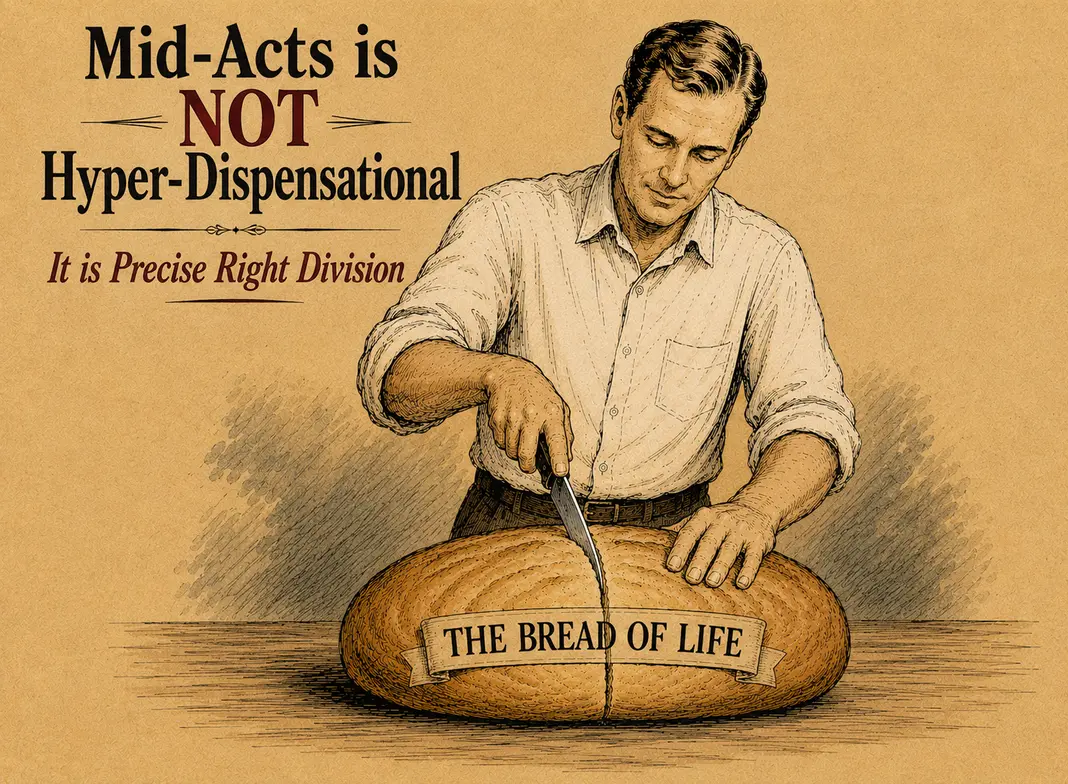
No book in the Bible is fought over more fiercely than Matthew. It is where a believer first discovers whether he will read his Bible as one flat message to everyone alike, or whether he will rightly divide the word of truth (2 Timothy 2:15) — for Matthew stands at the seam. Behind it lie the law and the prophets and a kingdom promised to Israel; ahead of it, in Paul, lies the mystery of the church which is Christ's body. Read Matthew as though it were addressed to the Body of Christ and almost everything in the Christian life comes out crooked: prayer, forgiveness, assurance, the walk, the very security of a soul. Read it in its own place, and every word stands.
The most instructive way to see the danger is not to watch a careless man, but a capable one who still gets it wrong. Peter Ruckman hands far more of Matthew back to Israel than mainstream Christianity ever will. He will take a passage the whole of respectable Christianity applies to the church and hand it straight back to Israel, and say so bluntly. And then, having done that, he reaches for a tool that quietly undoes the work — a method of "spiritual application" that pours the Body of Christ back into the very text he just removed it from. His Matthew is a case study not only in wrong division, but in how a skilled man arrives at it: not by refusing to divide, but by dividing and then blending. We will use him as our foil throughout, because his errors are the errors of the whole traditional system stated more plainly than the system usually dares to state them — and because the places where he gets it right show that the places where he gets it wrong were avoidable.
The line that decides everything
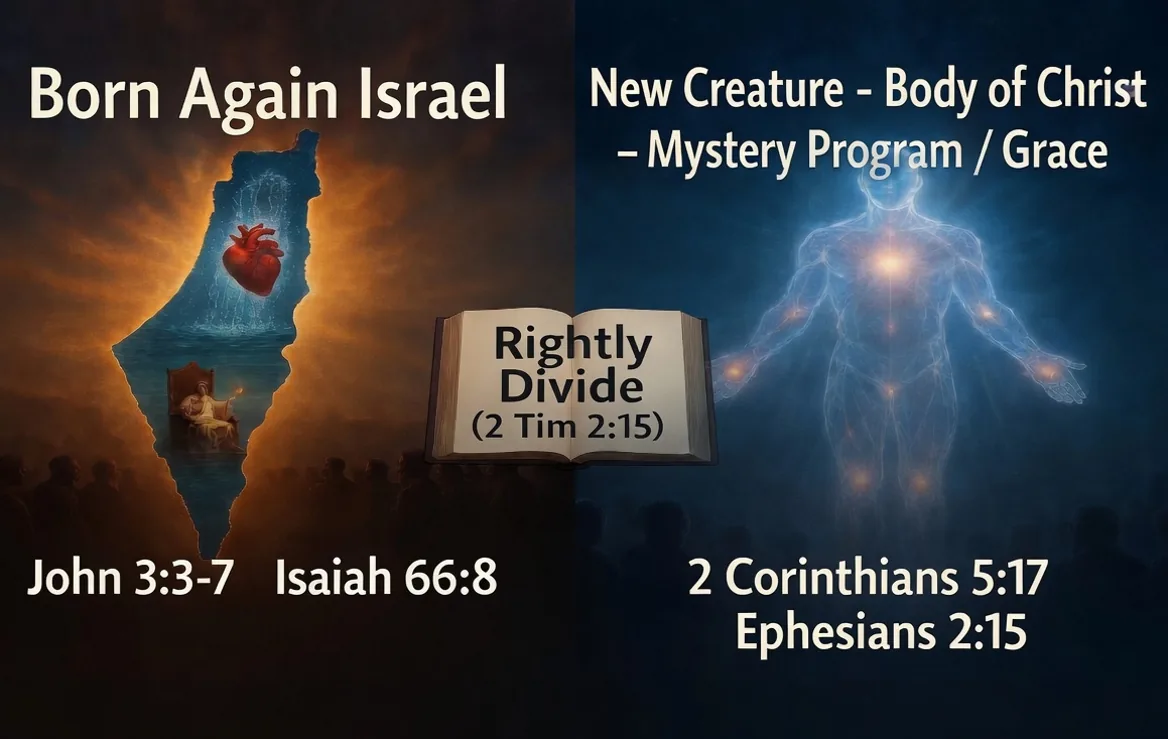
Every dispensationalist draws a boundary between Israel's program and the Body of Christ. The only question is where. Ruckman, following the Scofield tradition, draws it at Pentecost — Acts 2. For him the church which is Christ's body begins the day the Holy Ghost fell on the hundred and twenty. Right division as taught in the Grace Movement, and on this website, draws the line later and more precisely: the Body begins with the raising up of the apostle Paul, to whom alone the mystery of the one Body was committed (Ephesians 3:1–9), and whose gospel and apostleship were unknown while the Lord walked in Israel — "the gospel which was preached of me is not after man… but by the revelation of Jesus Christ" (Galatians 1:11–12 KJV).
That difference sounds small. It is not. Wherever the line sits, everything after it becomes "the church age" by the calendar, and any passage describing the long stretch between the King's rejection and His return gets swept, willy-nilly, onto the church's side of the ledger. But the boundary is only half the story. A man can put the boundary in the wrong place and still do little damage if he leaves each passage on its own side. Ruckman's deeper problem is a method that crosses whatever line he has drawn — and that method is worth understanding before we walk through the book, because it is the engine under every mistake that follows.
The method that unravels its own dividing
Ruckman works Matthew through a fixed, three-tier grid. He states it plainly at Matthew 18: a verse is to be "handled historically to an Old Testament Jew, doctrinally to a tribulation saint, and inspirationally to a New Testament Believer." Elsewhere he grants the governing principle himself: "all scripture is for the Christian, in the sense that he can learn something from it; but to misapply a passage, doctrinally, through willful ignorance (2 Timothy 2:15), is another matter." So by his own rule, the Body of Christ is to receive only the inspirational tier of any kingdom passage — never the doctrinal one.
It sounds careful. In practice it is the very blending we warn against, and it fails for three reasons.
First, it is needless. The believer is not left short of instruction, that he should have to go mining it out of Israel's passages. Paul was given the Body's doctrine directly and completely — "That the man of God may be perfect, throughly furnished unto all good works" (2 Timothy 3:17 KJV). If the walk is already furnished, a "spiritual application" drawn out of the Sermon on the Mount adds nothing the believer did not already have from Paul, plainly and without a riddle. Where a thing is fully supplied, to fetch it again from the wrong shelf is not diligence; it is disorder.
Second, it pollutes Paul. When a teacher says, "doctrinally this belongs to Israel, but spiritually the Christian should…," he drags the kingdom passage — its vocabulary, its figures, its conditions — up alongside Paul's clean doctrine and lets the two bleed together. Paul's teaching on prayer no longer stands on its own; it now arrives wearing the borrowed clothes of Matthew 7. The distinct thing God separated is quietly re-mixed, and the reader can no longer tell where Israel's kingdom ends and the Body's grace begins.
Third, it confuses the reader. The whole scheme only works for a man who carries Ruckman's three-tier filing cabinet in his head and can, on the fly, keep "doctrinal" and "inspirational" in separate drawers. The ordinary believer has no such cabinet. He hears "the Sermon on the Mount is for you in a spiritual sense" and does the natural thing — he takes it as for him, full stop, and the division just taught collapses in the hearing of it. A method that requires the teacher's private mental machinery to keep it safe is not safe.
None of this denies that the Scriptures were all written for our profit — "For whatsoever things were written aforetime were written for our learning, that we through patience and comfort of the scriptures might have hope" (Romans 15:4 KJV). But profit here is understanding: we read Matthew to know what God is doing with Israel, to behold the King, to marvel at the faithfulness of God to His covenant people, to learn how the two programs differ. That is a world away from quarrying Matthew for the rules of the Christian walk and then bolting a Pauline reference on to hold them up. We profit from Matthew by learning from it; we do not build the Body's doctrine or practice out of it. Keep that distinction in hand, and watch how consistently the traditional system — Ruckman its plainest voice — lets it slip.
The Sermon on the Mount: divided, then blended
Give the man his due, because on placement he is right, and right against the whole current of popular Christianity. Ruckman refuses to hand the Sermon on the Mount to the church. His words are blunt: it was preached "primarily for Jews only… before there was a church (Matthew 16) or any Christians (Acts 11)." "There are no Christians present. There are no born-again believers present… The discourse is not addressed to the church." And most pointedly: "When you attempt to apply the Sermon on the Mount to Christian people you split the body of Christ." He calls it "an Old Testament dissertation given to Jews, before the crucifixion, to delineate the rules and principles of the coming Millennial Kingdom," and notes that it is "nowhere given in the Bible as a plan of salvation for anyone in the church-age."
The text itself bears him out. The Sermon names its own standard — a righteousness that must "exceed the righteousness of the scribes and Pharisees" to "enter into the kingdom of heaven" (Matthew 5:20 KJV) — and it binds its hearers to a law it came not to abolish but to keep: "Think not that I am come to destroy the law, or the prophets: I am not come to destroy, but to fulfil" (Matthew 5:17 KJV). It sets its blessings on the meek who "inherit the earth," the pure who "see God," the persecuted whose reward is "in heaven" — the covenant hopes of Israel, not the heavenly seating of a Body still hidden in God. This is not the ground the Body of Christ stands on, and it costs Ruckman something to say so, because the Sermon on the Mount is the beloved possession of exactly the religion he is writing against.
And then he gives it back. Having removed the Sermon doctrinally, he lets it in again through the side door: "It is at Calvary that you get the power to live the 'Sermon on the Mount' in a spiritual sense," and the Sermon "contains indirect Christian doctrinal references and numerous inspirational helps." There it is — the blend. Why should the Body of Christ "live the Sermon on the Mount in a spiritual sense" at all? The believer's walk is not under-supplied. Paul tells him directly how to live — how to love, how to bear wrong, how to give, how to be angry and sin not (Ephesians 4:26), how to lay up treasure (1 Corinthians 3) — without a mountain, a millennial kingdom, or a law to fulfil. To send the believer back up the mount to "live it spiritually" is to hand him a kingdom text as a rule of life and trust him to strip the kingdom out of it as he goes — and most readers will not strip it out. They will simply conclude the Sermon on the Mount is theirs after all, which is precisely the error Ruckman spent pages refuting. The division was sound; the application dissolved it.
The law and the exceeding righteousness (Matthew 5)
It is worth pausing over the opening of the Sermon, because it is here that the popular church commits its plainest theft, and here that right division does its cleanest work. The Beatitudes are not the Body's charter; they are Israel's kingdom hopes. Their blessings are earthly and national — "Blessed are the meek: for they shall inherit the earth" (Matthew 5:5 KJV), "Blessed are the poor in spirit: for theirs is the kingdom of heaven" (Matthew 5:3 KJV) — the very inheritance the prophets promised the nation. The Body's blessings run the other direction: it is blessed "with all spiritual blessings in heavenly places in Christ" (Ephesians 1:3 KJV). To preach the Beatitudes as the Christian's own is to trade a seat in the heavenlies for a plot of earth.
And the standard the Sermon sets is the standard of the law, magnified rather than relaxed. The Lord did not come to loosen the law but to keep it whole: "I am not come to destroy, but to fulfil" (Matthew 5:17 KJV), down to the jot and tittle. He then raises the bar past the most zealous law-keepers alive: "except your righteousness shall exceed the righteousness of the scribes and Pharisees, ye shall in no case enter into the kingdom of heaven" (Matthew 5:20 KJV). That is entrance by a righteousness of performance — a performance exceeding the Pharisees'. Whole systems today, the Lordship gospel chief among them, quarry Matthew 5:17–20 to fasten the church back under the law, as though the believer's standing still turned on his obedience.
But the Body's righteousness is not its own and is not by law at all. It is Christ's, reckoned to the believer who does not work but believes: "But to him that worketh not, but believeth on him that justifieth the ungodly, his faith is counted for righteousness" (Romans 4:5 KJV); a righteousness "not having mine own righteousness, which is of the law, but that which is through the faith of Christ, the righteousness which is of God by faith" (Philippians 3:9 KJV). For the Body the law's whole demand is answered and finished in Another: "For Christ is the end of the law for righteousness to every one that believeth" (Romans 10:4 KJV). Even Ruckman half-sees it — he calls the Sermon "a dissertation on righteousness" and reaches for Romans 10 to explain it — yet leaves the Sermon standing as the kingdom's righteousness standard, which is exactly what it is, and exactly why it is not ours. The exceeding righteousness of Matthew 5 and the imputed righteousness of Romans 4 are two different righteousnesses belonging to two different programs; blend them and you have neither the law's honest demand nor grace's free gift.
The kingdom commission of Matthew 10: rightly divided
Before the parables, look at a place where Ruckman divides so cleanly that he indicts his own later practice. When the Lord sends out the twelve in Matthew 10, He fences the commission with a wall no honest reader can climb over: "Go not into the way of the Gentiles, and into any city of the Samaritans enter ye not: But go rather to the lost sheep of the house of Israel" (Matthew 10:5–6 KJV). Their message is not the gospel of the grace of God but "The kingdom of heaven is at hand" (Matthew 10:7 KJV), confirmed by kingdom signs no church-age preacher performs: "Heal the sick, cleanse the lepers, raise the dead, cast out devils: freely ye have received, freely give" (Matthew 10:8 KJV).
Ruckman sees it and says it without flinching. "The context of Matthew 10 is to Israel, and Israel only, and all attempts to force it on the Church, or the unconverted Gentile in this age, ends in farce." He drives the nail home on the signs: "No one in the church-age obeys or practices this commission, and no one is supposed to. And if they profess to, they are lying." And then the sentence that ought to have governed his whole commentary: "some of God's people are so anxious and zealous to accept the 'whole word of God' for ALL Christians, that they steal passages from Jews to appropriate them for themselves; this is a socially acceptable way to rob God, while professing to uphold the integrity of the scriptures."
That is exactly right, and it is exactly what the missionary movement has done with Matthew 10 and the popular church with the Sermon on the Mount — appropriating what was never given to it. Paul's gospel is a different message with a different content, received by a different revelation: "how that Christ died for our sins according to the scriptures; and that he was buried, and that he rose again the third day" (1 Corinthians 15:3–4 KJV). The commission of Matthew 10 heralds a kingdom at hand to a single nation; Paul is sent to all men with a finished cross. Hold the two apart, as Ruckman here insists, and the book breathes. The tragedy is that a man who could write that paragraph about Matthew 10 would, a few chapters later, "steal a passage from the Jews" himself — and call it the Body of Christ.
The unpardonable sin of Matthew 12: a terror that was never ours
No passage in Matthew has tormented more Christians than the sin against the Holy Ghost. Tender souls have lain awake for years certain they had committed it. That torment is manufactured entirely by wrong division, for the sin belongs to a moment and a nation the Body of Christ was never part of.
Read it in its place. The nation's leaders have just watched the Spirit of God cast a devil out through the Messiah, and they have ascribed the work to the devil: "This fellow doth not cast out devils, but by Beelzebub the prince of the devils" (Matthew 12:24 KJV). The Lord answers that this very sign is the kingdom breaking in upon them — "But if I cast out devils by the Spirit of God, then the kingdom of God is come unto you" (Matthew 12:28 KJV) — and only then pronounces the sin unforgivable, "neither in this world, neither in the world to come" (Matthew 12:32 KJV). Even Ruckman rightly refuses to let Rome turn "the world to come" into a purgatory beyond the grave: "The 'world to come' is described throughout both Testaments as the coming Millennial reign of Christ, on the earth." Just so. The whole transaction sits inside Israel's kingdom program — the King present, His Spirit working the signs of the kingdom, the nation's leaders officially crediting those signs to Satan. That is the blasphemy: a nation's formal, eyes-open rejection of the Spirit-attested Messiah in the day of His offer. It is not a stray blasphemous thought that intrudes on a believer, and it hangs over no member of the Body of Christ, who is sealed unto the day of redemption and forgiven all trespasses.
Here too Ruckman gets the placement largely right and then lets the blend creep in. Reaching to reassure the frightened, he writes that misjudging whether a work is of God or the devil "is a common failing among all born-again members of the Body of Christ, at least on occasions" — dragging the Body into a passage he has just, correctly, located in Israel's kingdom crisis. The reassurance is true; the method is careless. The Body of Christ does not belong in Matthew 12 at all — not to be threatened by it, and not to be comforted out of it. Our comfort is Paul's: a forgiveness already complete and a standing that no sin can forfeit. The remedy for the terror the churches have wrung out of this passage is not a gentler reading of it; it is right division, which takes the sword out of the passage by handing it back to the nation to whom it was spoken.
The prayer teachings: divided, then blended
The same pattern governs Ruckman's handling of prayer, and again the placement is excellent. He will not call the famous prayer of Matthew 6 the "Lord's Prayer": it is "not the 'Lord's prayer' at all, since the Lord never prayed it… a 'Disciples' Prayer' given to Old Testament, Jewish disciples before the crucifixion, resurrection, and church-age." He notes that "Our Father" (Matthew 6:9 KJV) "again refers to Israel… never given to a Gentile to pray," and that it is offered without appeal to the name of Jesus — the very thing the Lord later added for the disciples' own program (John 16:24). That case is made in full in our study Prayer in the Dispensation of Grace, and need not be repeated here; it is enough that even Ruckman locates the prayer in Israel's program, against the whole of a Christendom that recites it as its own.
But watch the blend return. On the "ask, seek, knock" of Matthew 7 he writes: "There is spiritual truth, however, found in Matthew 7:7-9, for the Pauline Epistles make it clear that the Christian prayer should keep on asking, seeking, and knocking (Philippians 4:6…)." Notice what he has done. If Paul already commands the believer to pray — "in every thing by prayer and supplication with thanksgiving let your requests be made known unto God" (Philippians 4:6 KJV) — then the detour through Matthew 7 accomplishes nothing except to attach a kingdom promise to a grace duty. The believer did not need Matthew 7 to learn to pray; he had Philippians 4. All the "spiritual application" does is teach him to read his prayer life partly out of a text spoken to Israel under her own King — and to a reader who cannot perform Ruckman's tier-sorting, it quietly re-opens the whole kingdom prayer program, in-Jesus'-name formulas and mountain-moving faith and all. Paul was sufficient. The application made him look insufficient.
The forgiveness teachings: divided, then blended, then mis-supplied
Forgiveness raises the stakes, and here Ruckman's work is right in front and doubly wrong behind. He correctly refuses to put the conditional forgiveness of the Sermon on the Mount onto the Body. Matthew hangs the Father's forgiveness on the petitioner's own forgiving: "But if ye forgive not men their trespasses, neither will your Father forgive your trespasses" (Matthew 6:15 KJV). Ruckman sees it plainly — "A Jew… (and again when He comes) obtains forgiveness on a CONDITIONAL basis." He does the same with the unforgiving servant of Matthew 18, delivered to the tormentors (Matthew 18:35): "the parable of Matthew 18 is to Old Testament Jews," he writes, and warns that if it is "set down in the church," Rome's purgatory walks in behind it. Good placement, and again against the mainstream, which preaches Matthew 6:14–15 straight at Christians as though a believer's pardon still hung on his performance.
Then comes the double slip. First the familiar blend: even here he cannot resist a "practical" carry-over of the duty into the church. But the graver error is the doctrine he substitutes. Having lifted the Body off Matthew's one condition (forgiving others), he fastens it to another: "no Christian is forgiven on the basis of forgiving others — he is forgiven, and cleansed, when he judges his own sin and confesses it to Jesus (1 Corinthians 11:30–33, 1 John 1:9)." So the believer's forgiveness is moved from one condition to a second — confessing each sin to be cleansed. That is not where grace leaves it. Under grace the Body's forgiveness is a finished fact, announced before the believer does anything at all: "having forgiven you all trespasses" (Colossians 2:13 KJV); "forgiving one another, even as God for Christ's sake hath forgiven you" (Ephesians 4:32 KJV). We forgive because we are already forgiven, freely and completely — not to keep a pardon topped up sin by sin. What self-judgment touches is the believer's walk — his peace, his joy, his fruitfulness — never the standing and the forgiveness he already possesses. Ruckman divides Matthew rightly, blends it back in a "practical" application, and then reaches for the wrong epistle to resupply the Body — leaving the believer's peace hanging on a confessional ledger the cross already closed.
Treasures, mammon, and the morrow (Matthew 6)
Beyond the Disciples' Prayer, the sixth chapter presses treasure, mammon, and anxiety upon its hearers, and here the blend runs at full flow. The commands are kingdom commands, spoken to Israel under her King: "lay up for yourselves treasures in heaven" (Matthew 6:20 KJV), "Ye cannot serve God and mammon" (Matthew 6:24 KJV), take no thought for food or raiment, and the summary "But seek ye first the kingdom of God, and his righteousness; and all these things shall be added unto you" (Matthew 6:33 KJV). Ruckman assigns them to the Sermon's Jewish setting and then applies each to the Christian anyway. Of the treasures he says the verses "have some application to the Christian," and defines the believer's treasures out of 1 Corinthians 3:12. Of the anxiety he says "the Christian is admonished along the same lines of this passage in 1 Timothy 6:6–11." And "seek ye first the kingdom of God" he reads as "a veiled hint that more than a Jewish Messianic Kingdom is approaching… leaning toward a spiritual standard," citing Romans 14:17. Three passages, three detours through the wrong shelf.
Every one of those Pauline references teaches the believer directly, without the Matthew stop. Paul, on his own authority, sets the believer's affection above — "Set your affection on things above, not on things on the earth" (Colossians 3:2 KJV) — and commands contentment plainly: "having food and raiment let us be therewith content" (1 Timothy 6:8 KJV). The Body did not need "take no thought" routed to it through 1 Timothy 6; it had 1 Timothy 6. And watch what the blend does to "seek ye first the kingdom of God." In the Sermon it is Israel's kingdom with its kingdom promise attached — "all these things shall be added" is the provision of a King to His nation. To make it "lean toward a spiritual standard" by importing Romans 14:17 — "the kingdom of God is not meat and drink; but righteousness, and peace, and joy in the Holy Ghost" (Romans 14:17 KJV) — is to smuggle the Body's present sphere into a verse spoken within Israel's own kingdom program. It is the identical move, in miniature, that produces Matthew 13 as the church age: the kingdom of heaven "leaning toward" the church. Where the treasures, the mammon, and the morrow concern the Body, Paul says so himself, plainly and without a riddle; where they are Israel's, they must be left Israel's.
The rich young ruler: what must a man do? (Matthew 19)
No passage exposes the gulf between the two programs more sharply than the rich young ruler, and none is more constantly turned into a modern gospel tract that preaches the exact opposite of grace. The man's question is the question of Israel's program: "Good Master, what good thing shall I do, that I may have eternal life?" (Matthew 19:16 KJV). The Lord does not answer as Paul answers a Philippian jailer. He answers on the man's own ground: "if thou wilt enter into life, keep the commandments" (Matthew 19:17 KJV); and then, to break him on the law he claimed to keep, "If thou wilt be perfect, go and sell that thou hast, and give to the poor… and come and follow me" (Matthew 19:21 KJV). Every word is do: keep, sell, give, follow.
The popular escape from this passage is to say the Lord did not mean what He said — that, reading the man's heart, He saw the man's god was his gold, and so prescribed "sell all" not as a real term of life but only as a probe to expose the idol and press him toward grace. It sounds pious, but look what it costs: it makes the Lord Jesus Christ speak an untruth. He said, plainly, "if thou wilt enter into life, keep the commandments" (Matthew 19:17 KJV). If keeping the commandments was not, in that man's program, a true way into life, then Christ answered a sincere question with a falsehood — and the sinless Son of God does not bait an honest inquirer with a promise He knows to be a lie. Right division alone keeps His words honest. Under the law, before the cross, the commandment genuinely was ordained to life: "this do, and thou shalt live" (Luke 10:28 KJV), "the man which doeth those things shall live by them" (Romans 10:5 KJV). The Lord told an Israelite under the law the exact truth of the law. The man's ruin was not that Christ tricked him; it was that he had not, in fact, kept it. He boasted, "All these things have I kept from my youth up" (Matthew 19:20 KJV), and the single command to sell exposed the covetous heart that had been breaking the law all along, so that "he went away sorrowful: for he had great possessions" (Matthew 19:22 KJV). Christ used the law lawfully, to convict — but He never lied to do it. It takes a failure to rightly divide to force the Saviour into a ruse; rightly divided, He is speaking the honest truth of one program, which is the very reason it is not the truth of ours.
That is not the gospel of the grace of God, and a plain right division of the passage is enough to prove it. Even Ruckman, whose Pentecost boundary we reject, lays this one out plainly: there is something a man must do before the crucifixion, something in the tribulation, something in the kingdom age — but "in this age there is something he must not do (Romans 4:5, Galatians 5:4); there is Someone on whom he must believe (Romans 10:9–13)." That is the whole matter. Paul does not tell the sinner to keep the commandments and sell his goods; he says "to him that worketh not, but believeth on him that justifieth the ungodly, his faith is counted for righteousness" (Romans 4:5 KJV), and "by grace are ye saved through faith… not of works, lest any man should boast" (Ephesians 2:8–9 KJV). To hand a lost man the rich young ruler as an evangelistic text — keep the commandments, sell all, follow — is to preach a different gospel, which is what the Lordship gospel does whenever it presses this passage into service. And the reward the Lord attaches for the disciples who had left all is Israel's, not the Body's: "ye also shall sit upon twelve thrones, judging the twelve tribes of Israel" (Matthew 19:28 KJV). Twelve thrones over twelve tribes is not the hope of the church which is His body; it is the government of the restored nation. The man who reveres these words while refusing Paul's gospel is what the old writers called an Ebionite — clinging to the words of Jesus on earth and rejecting the revelation God gave through the apostle of the mystery.
The Olivet Discourse, and a window cut for the church (Matthew 24)
The Olivet Discourse is prophecy, and Ruckman knows it. He states it well: "Matthew 24 deals primarily with the future tribulation, in a Jewish setting." The proof is in the chapter's own frame — it answers a set of Jewish questions the disciples asked as He sat on the mount: "Tell us, when shall these things be? and what shall be the sign of thy coming, and of the end of the world?" (Matthew 24:3 KJV) — the temple, the sign of His coming, the end of the age. The discourse runs on the title "Son of man," which Ruckman rightly notes "is not the designation for the Saviour in relation to the Christian awaiting the rapture." The signs, the abomination of desolation, the great tribulation, and the fig tree that is Israel all belong to the nation and the day of Jacob's trouble, not to the Body.
And then, having said all that, he cannot leave it alone. "In this passage between the paragraphs (verses 26–41)," he writes, "there may be some reference to the church age. If this seems to be heresy, let it be remembered…" — and he proceeds to read the rapture of the Body into the days of Noah. Enoch, "caught out before the flood" (Genesis 5:24), becomes a type of "the Body of Christ caught out"; and the "one shall be taken, and the other left" (Matthew 24:40 KJV) is made a picture of the church removed. He has taken the one discourse he just called "primarily the future tribulation in a Jewish setting" and cut a window in it for the church.
The passage forbids the reading in its own words. The ones "taken" are not caught up to glory; they are taken away in judgment, as the Lord says outright — the flood came "and took them all away" (Matthew 24:39 KJV). To be "taken" in verse 40, then, is to be swept off as the flood swept the world, while the one "left" is left safe, as Noah was left in the ark. The picture is the exact reverse of a rapture. And Ruckman's own better instinct refutes him: the "coming of the Son of man" here is the visible Advent in power to the earth, not the catching-away, which is a separate mystery Paul had to reveal, with its own trumpet and its own order — "the dead in Christ shall rise first: then we which are alive and remain shall be caught up together with them in the clouds, to meet the Lord in the air" (1 Thessalonians 4:16–17 KJV). The Olivet Discourse looks for the Son of man coming down in power to deliver Israel at the end of her tribulation; the Body looks for the Lord to descend into the air and catch it away before that day ever begins. To read the one into the other — to find "some reference to the church age" between the paragraphs of Israel's tribulation — is to blur the two comings the Scriptures labour to keep apart. A concession offered with "if this seems to be heresy" is a concession too far. The church which is His body is not in Matthew 24: not in its signs, not in its Noah, and not between its paragraphs.
The sheep and the goats: a judgment that is not ours (Matthew 25)
The scene of the sheep and the goats has been made the charter of the social gospel — salvation earned by feeding the hungry and clothing the naked — and it has terrified as many tender believers as the unpardonable sin, for it seems to weigh a man's eternity on his charity. Rightly divided, it does no such thing, because it is not the Body's judgment and not the church's age. It is the judgment of the living nations when the King returns to the earth: "Then shall the King say unto them on his right hand, Come, ye blessed of my Father, inherit the kingdom prepared for you from the foundation of the world" (Matthew 25:34 KJV). The nations are judged by their treatment of "the least of these my brethren" (Matthew 25:40 KJV) — the King's kinsmen, the messengers of the kingdom in the day of tribulation — and the sentence is entrance into, or exclusion from, the earthly kingdom.
Here again the mainstream import is the error, and here again even Ruckman sees it: "the sheep are not saved people from this age… they are not going to be saved by works; they are already saved by grace (Ephesians 2:8–10)"; the scene "is not the Last Judgment," for there are no books present and no resurrection, and "their judgment is the Judgment Seat of Christ, not the Last Judgment." Just so. The Body is saved already, apart from works, and its appearing before Christ is for the assessing of reward and service, never for entrance and never for condemnation — the subject of our study The Judgment Seat of Christ. To read Matthew 25 as the believer's own docket is to lose grace twice over: to make salvation hang on works of charity, and to confuse a throne set up on the earth over the nations with the believer's standing already sealed in the heavenlies. The compassion the passage commends is real and good; the salvation-by-it that men preach from it was never spoken to the Body of Christ.
Where the blend hardens into open error: the mysteries of Matthew 13
Everything so far has been the method working quietly — dividing, then bleeding a "spiritual" sense back across the line. In Matthew 13 the same instinct stops being subtle. Here Ruckman does not merely draw a devotional lesson for the Christian; he gives the Body of Christ the doctrinal tier outright, in flat violation of his own rule, and reads the parables as a literal portrait of the present church age.
He does not hedge. In his Reference Bible he writes that of the twelve parables illustrating "the mysteries of the kingdom of heaven," "the three that apply to the Body of Christ… are the Parable of the Sower and the Seed, the Parable of the Mustard Seed, and the Parable of the Leaven." The leaven hidden in three measures of meal becomes, in his commentary, "the Body of Christ in its three professing groups: Roman Catholic, Greek Orthodox, and Protestant," corrupted by false doctrine. The Body of Christ, named outright, planted in the middle of the kingdom parables.
He did not invent this; he inherited it. It is the reading of the Scofield Reference Bible, the book that trained the tradition. Scofield's own note says the seven parables "describe the result of the presence of the Gospel in the world during the present age… the mingled tares and wheat, good fish and bad, in the sphere of Christian profession. It is Christendom." So when Ruckman makes the leaven the corruption of the Body, he is only saying plainly what mainstream dispensationalism had already taught. This is not a Ruckman eccentricity; it is the common property of the whole traditional school — which is why it deserves a careful answer rather than a sneer.
And it answers itself the moment the text is allowed to speak. Start with the objection that props the system up: Jesus spoke of mysteries too, so Paul's mystery is nothing new. But a shared word is not a shared thing. The Lord named His subject — the "mysteries of the kingdom of heaven" (Matthew 13:11), the kingdom the disciples still expected for Israel: "Lord, wilt thou at this time restore again the kingdom to Israel?" (Acts 1:6 KJV). Paul names a different subject — "the mystery of Christ," "the fellowship of the mystery" concerning the church which is His body (Ephesians 3:4, 9). One mystery is about the kingdom; the other about the Body. The labels do not match.
The decisive difference is the direction each mystery runs. The kingdom mysteries were spoken to conceal. It is stated on the spot, when the disciples ask why He speaks in parables at all: "Therefore speak I to them in parables: because they seeing see not; and hearing they hear not, neither do they understand" (Matthew 13:13 KJV); and again, "unto them that are without, all these things are done in parables" (Mark 4:11 KJV). A parable was a curtain, not a window. Paul's mystery runs the opposite way — hidden not to stay hidden but to be published: "And to make all men see what is the fellowship of the mystery, which from the beginning of the world hath been hid in God" (Ephesians 3:9 KJV); "made known to all nations for the obedience of faith" (Romans 16:26 KJV). A secret designed to be kept from the crowd cannot be the same secret designed to be preached to every creature. They travel in opposite directions.
The cross settles it beyond argument. Paul says the mystery of the Body was hidden so completely that the powers of this world never saw it — and had they seen it, they would have acted otherwise: "which none of the princes of this world knew: for had they known it, they would not have crucified the Lord of glory" (1 Corinthians 2:8 KJV). If the mystery of the Body had been let out in the Matthew 13 parables — which the Lord then explained plainly to the twelve in the house — the princes of this world would have had it, and the crucifixion the whole mystery depends upon would never have happened. So the mystery had to stay hidden in God, not lie in plain view inside a parable. Matthew 13 cannot be it.
Read for what they say, the parables sit comfortably in Israel's prophetic program, and — this is the point the traditional reader misses — they unveil the hidden, spiritual side of the kingdom, not a mystery Body. When the mustard seed grows into an unnatural tree in whose branches the birds lodge, the birds are what the Lord already said they were in the same chapter: the wicked one snatching the seed (Matthew 13:4, 19). When the woman hides leaven in the meal, leaven is what it is everywhere in Scripture — corruption, and specifically false doctrine, as the Lord Himself defines it a few chapters on, where the leaven He warns of is "the doctrine of the Pharisees and of the Sadducees" (Matthew 16:12 KJV). For this is the very thing that makes them mysteries: they open the unseen side of the kingdom — the side that, as the Lord told the Pharisees, "cometh not with observation" but is "within you" (Luke 17:20–21 KJV). The visible, glorious reign Israel looked for was held back; but the kingdom's inward, spiritual working went on out of sight — the word sown into hearts, the wheat and the tares grown up together before any harvest parts them, the leaven of false doctrine spreading quietly through the professing mass. That inward kingdom was entered — then, as it will be by the remnant in the tribulation to come — by the new birth: "Except a man be born again, he cannot see the kingdom of God" (John 3:3 KJV); and it will be set up in open glory when the King returns. It is Israel's kingdom throughout, the seen and the unseen alike, and it is not the Body of Christ.
And we are not guessing, because the Lord interpreted the wheat and the tares Himself, plainly, to His disciples: "the harvest is the end of the world; and the reapers are the angels" (Matthew 13:39 KJV), and "Then shall the righteous shine forth as the sun in the kingdom of their Father" (Matthew 13:43 KJV). That is the sorting at the end of the age, when the King returns to set up the kingdom — not the rapture of the Body, which Paul had to reveal as a separate mystery of its own ("Behold, I shew you a mystery", 1 Corinthians 15:51 KJV). Even the blindness quoted in the chapter belongs to Israel: Ruckman calls Isaiah's prophecy of it "the temporary rejection of Israel throughout the Church Age," but Paul names it exactly and keeps it Israel's — "blindness in part is happened to Israel, until the fulness of the Gentiles be come in" (Romans 11:25 KJV). The treasure and the pearl press the same kingdom's surpassing worth on the generation to whom it was offered — a matter taken up on its own in The Pearl of Great Price, and not repeated here. In every parable the subject is fixed in the opening line: the kingdom of heaven is like. The church is never in the sentence.
The rest of the imports
Once you see the machine at work, the other intrusions come into focus. They are all the same mistake in different clothes — the "spiritual application" tier promoted to doctrinal weight, so that the Body of Christ ends up as the literal subject of a passage spoken to Israel. It is worth walking through them, because together they show that the Matthew 13 error was not a single slip but a habit.
The bridegroom's fast (Matthew 9). When John's disciples ask why the Lord's disciples do not fast, He answers with a wedding: the children of the bridechamber cannot mourn while the bridegroom is with them, but "the days will come, when the bridegroom shall be taken from them, and then shall they fast" (Matthew 9:15 KJV). Ruckman calls this "a reference on the coming 'body of Christ.'" But the saying is about fasting under the law and the nation's response to Messiah present and Messiah "taken away" at the cross; John himself, who asked it, is "the friend of the bridegroom" (John 3:29), a man of Israel's kingdom program. To read the mystery Body — hidden in God, unknown to John — into a question about fasting is to find the church wherever the word "bridegroom" appears.
The leaven again (Matthew 16). Having made leaven the corruption of the Body in Matthew 13, Ruckman carries the reading into Matthew 16:6, "a crucial verse in the history of the church… as it is related to the Body of Christ." But the Lord defines this leaven Himself, and it is not the Body's corruption — it is Israel's false teaching: "the doctrine of the Pharisees and of the Sadducees" (Matthew 16:12 KJV). The error of Matthew 13 breeds a second error in Matthew 16.
The labourers in the vineyard (Matthew 20). The parable opens, as all its fellows do, "For the kingdom of heaven is like unto a man that is an householder, which went out early in the morning to hire labourers into his vineyard" (Matthew 20:1 KJV). Ruckman says it "can be transferred into the church-age… remembering that in this age, the Kingdom of Heaven is in a mystery form (see Matthew 13)," so the whole workday becomes a chart of church history. But the penny for all, the murmuring of the first-hired, and the closing "the last shall be first" are the language of reward and order within the kingdom — the sovereign dealing of God with those who labour for Him — not a timeline of the Body of Christ. The reading is only possible because Matthew 13 was mis-read first; it inherits the error.
The bride, and the resurrection body (Matthew 22 and 25). At the royal wedding and the ten virgins, Ruckman does something subtler. He correctly says the guests and the virgins are not the Body — but only because he has already seated the Body in the bride's chair: "the body of Christ is spoken of as a chaste virgin," and "the 'bride of Christ' (see Revelation 19:8–10; 21:9) speaks of a body of believers, who are now in Christ's body… as Eve was in Adam's body." So the church is kept off the guest list only to be married to the Lamb — the very error answered in our study The Lamb's Wife: the Lamb's wife is the New Jerusalem, which is Israel, and the church which is His body is a body, not a bride. He extends the same import to the resurrection saying of Matthew 22:30, where those raised "neither marry, nor are given in marriage, but are as the angels of God in heaven" (Matthew 22:30 KJV); he makes this "the body we will receive at the coming in the air." But the Body's resurrection was revealed to Paul as its own mystery, with its own signal and its own likeness — "the dead in Christ shall rise first" (1 Thessalonians 4:16 KJV), fashioned "like unto his glorious body" (Philippians 3:21 KJV). Matthew 22:30 answers a Sadducee's trick question about marriage in Israel's resurrection; it is not the charter of the rapture.
The church built on the rock (Matthew 16:18). Finally, even the "church" the Lord promised to build becomes, in Ruckman's Baptist ecclesiology, a local assembly of the twelve that becomes the Body of Christ at Pentecost — Matthew made the cradle of the church by the calendar again. Whatever that promised assembly is, Paul is emphatic that the Body was no assembly of the twelve but a secret kept in God until it was revealed through him; a church you can point to in Matthew 16 is by definition not the church that was still a mystery in Ephesians 3.
The Great Commission and the water (Matthew 28)
Of all the imports this is the one Ruckman presses hardest, and the one where he most openly deserts his own method, so it deserves its own treatment. The Great Commission was spoken to eleven Jewish apostles whose ministry, all through the early chapters of Acts, never once left Israel; and its terms are the terms of the kingdom program from the first word to the last. Christ commands them to "Go ye therefore, and teach all nations, baptizing them in the name of the Father, and of the Son, and of the Holy Ghost" (Matthew 28:19 KJV), and then — the clause the traditional church hurries past — "Teaching them to observe all things whatsoever I have commanded you: and, lo, I am with you alway, even unto the end of the world" (Matthew 28:20 KJV).
Ruckman himself lists the difficulties, and they are fatal to his own conclusion. He grants that "all things whatsoever I have commanded you" would bind the church to footwashing, healing the sick, cleansing lepers, raising the dead, going to Israel only, keeping the Sabbath, abstaining from pork, and living out the Sermon on the Mount — the very things he everywhere else hands back to Israel. He grants that this is not the same commission as Mark 16, and that its "end of the world" is nearly always the end of the tribulation, not the end of a church age. And then, having laid out the whole case against himself, he overrides it and keeps verse 19's water for the church anyway. But a commission is a seamless whole. No man may pocket the baptizing of verse 19 and leave the leper-cleansing and Sabbath-keeping of verse 20; the "therefore" and the "all things" bind them into one charge. To keep the water is to keep the entire kingdom program that comes tied to it.
The baptism itself refuses the transfer. The Trinitarian formula of Matthew 28 — "in the name of the Father, and of the Son, and of the Holy Ghost" — is never once used in the book of Acts, where the apostles baptized "in the name of Jesus Christ for the remission of sins" (Acts 2:38 KJV) in preparation for the kingdom. Not even the Acts baptisms match the words of Matthew 28, let alone anything in Paul. And Paul is the decisive witness against the whole scheme, for he was given a different commission by direct revelation, and it was expressly not a commission to baptize: "I thank God that I baptized none of you, but Crispus and Gaius" (1 Corinthians 1:14 KJV), and plainly, "For Christ sent me not to baptize, but to preach the gospel" (1 Corinthians 1:17 KJV). The Body has one baptism, and it is not water: "There is one body, and one Spirit… One Lord, one faith, one baptism" (Ephesians 4:4–5 KJV) — the Spirit's placing of the believer into the Body the moment he believes, "For by one Spirit are we all baptized into one body" (1 Corinthians 12:13 KJV). Even Ruckman concedes that this "one baptism" of Ephesians 4:5 is the Spirit's work and not water; he simply asserts that water continues alongside it — a pattern Paul nowhere commands his churches. The full case that water baptism belonged to Israel's program and the transitional Acts period, and that the one baptism for the Body is the Spirit's, is set out in our study Why Water Baptism Is Not for Today; and the argument of his booklet, point by point, is answered in Rightly Dividing or Wrongly Accusing: A Response to Ruckman's Attack on Mid-Acts Dispensationalism.
What marks Matthew 28 as the clearest case of all is the direction of his reasoning. He does not begin with the text and arrive at the church; he begins with the Baptist ordinance he is determined to keep and works backward to Matthew 28 to defend it — the exact reverse of rightly dividing the word of truth. He will not apply to this passage the very rule he applied to the Sermon on the Mount only three chapters after admitting the commission is loaded with Israel's signs and Israel's law. And in Hyper-Dispensationalism the veneer of caution drops entirely: there he sets down as an error to be refuted the proposition that "Matthew 28:19–20 is limited to the tribulation," calls it "pure conjecture," and attacks Cornelius Stam by name for teaching that the commission does not bind the Body. The knife that so cleanly cut the Sermon out of the Body is laid down the moment his own tradition is on the table.
The method is the mistake
Step back and the shape is unmistakable. The man who so cleanly removes the Sermon on the Mount, the kingdom commission, the Disciples' Prayer, and the law's conditional forgiveness keeps depositing the Body of Christ back into Matthew — quietly through a "spiritual application" in chapters 5 through 7, and openly as literal doctrine in chapters 9, 13, 16, 20, 22, 24, and 28. It is not carelessness; a careless man could not have written the paragraph on Matthew 10 about robbing God by stealing the Jews' passages. It is a method — the three-tier grid — that is built to reach back across whatever line he has drawn.
And that is the heart of the matter. The dual application is not a safety valve that keeps the blend in check; it is the blend. The "safe" inspirational tier and the "unsafe" doctrinal tier are the same machine running at two speeds. Grant that a kingdom passage may be handed to the Christian "spiritually," and you have already conceded the principle that produces Matthew 13 as the church age — you have only to press a little harder on the same lever. There is no need to press it at all. The Body of Christ has its own apostle and its own doctrine, delivered whole and unmixed: Paul, who received it not from man but by the revelation of Jesus Christ (Galatians 1:12), and who furnishes the man of God unto all good works (2 Timothy 3:17). We do not need the Sermon on the Mount to teach us to walk, or Matthew 7 to teach us to pray, or Matthew 6 to teach us to forgive, or Matthew 10 to send us out, or Matthew 12 to frighten us. Paul teaches all of it, plainly, in language written to us and about us. To route the Body's doctrine through Israel's pages is not devotion; it is the pollution of the pure Pauline stream, and the confusion of every reader who cannot un-mix what the teacher has mixed. "Be ye followers of me, even as I also am of Christ" (1 Corinthians 11:1 KJV) — the pattern for the Body's life is the apostle of the Body, not the Sermon on the mount of Israel's King.
What is at stake
This is no quarrel over a chart. Everything the blending touches loses something. If the church is in the Matthew 13 parables, the mystery was never a mystery — it was published to a crowd and explained to twelve men, and Paul's boast that it was "hid in God" collapses, and the hiddenness the cross depended on is gone. If the Disciples' Prayer is the Body's prayer, the believer is left reciting for a kingdom already offered and refused. If Matthew's conditional forgiveness — or a confessional substitute for it — is the Body's rule, his pardon is never quite settled, always one unconfessed sin from arrears. If the sin against the Holy Ghost is a live danger to a sealed believer, then the Spirit's seal is no seal at all, and men will spend their lives afraid of a judgment that fell on another nation in another program. And if even the passages a teacher rightly assigns to Israel are then re-applied "spiritually" to the Christian, the believer is handed a Bible he cannot trust to mean what it says to whom it says it, and a Paul whose sufficiency has been quietly diluted with borrowed kingdom water.
Rightly divided, each keeps its glory. The mystery stays a mystery, truly hidden and truly revealed through one apostle. The commission keeps its signs, and the Body keeps its unsigned gospel of a finished cross. Prayer keeps its better promise — a God "able to do exceeding abundantly above all that we ask or think" (Ephesians 3:20 KJV). Forgiveness keeps its freedom, a finished thing on the ground of the finished work. And the frightened believer keeps his peace, because the sword of Matthew 12 was never pointed at him. The book of Matthew keeps its integrity too — every word doing its appointed work for the people to whom it was addressed, the believing remnant of Israel, waiting for their King. The tragedy of a wrongly divided Matthew is not only that it burdens the Body with what was never given to it; it robs Israel's book of the glory that is its own, and it dilutes the very Pauline doctrine it borrows to fill the gaps. Give Matthew back to Israel, and give the Body back to Paul — whole, unmixed, and each to its own place — and both come out whole.
© 2026 Edward R. Cross
Comments
No comments yet. Be the first to share your thoughts.
Leave a comment