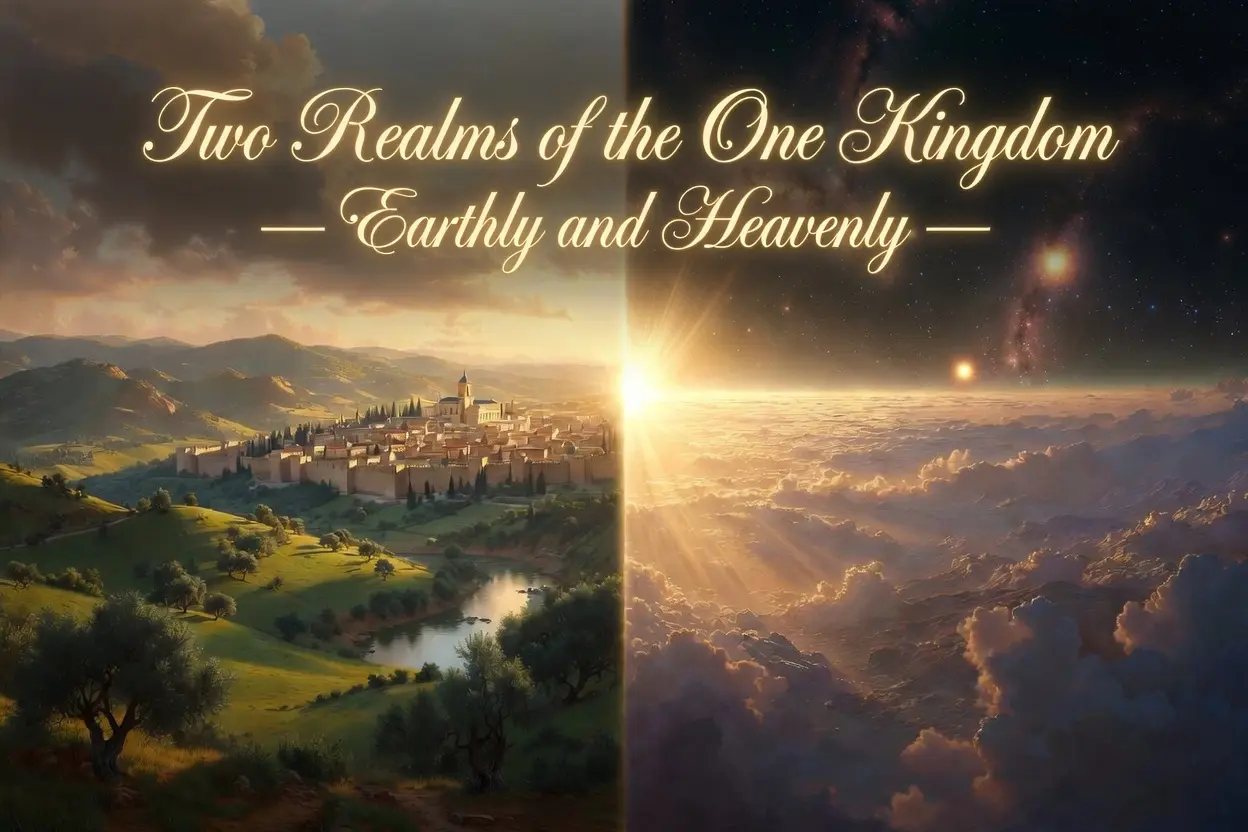
Few phrases in Scripture are flattened as quickly as "the kingdom of God." A reader meets the words and assumes one thing: one kingdom, one people, one destiny, one hope, gathered at last into one place. And so the believer is told he is bound for a golden city, that he will inherit the earth, that he will reign from Jerusalem with the twelve — promises piled together as though they all described the same future for the same people. But they do not. When the word of truth is rightly divided, the kingdom of God is seen to embrace two realms — one heavenly and one earthly — with two peoples, two hopes, and two inheritances. The confusion that troubles so many believers about their future comes almost entirely from collapsing the two into one. The clarity God offers comes from letting them stand apart, each in its own glory.
This distinction surfaces the moment one studies the sealing of the Spirit and asks what inheritance the seal secures. Paul says flesh and blood cannot inherit the kingdom of God — yet flesh and blood plainly does inherit the kingdom promised to Israel. The same words, "kingdom of God," cannot mean the same realm in both places. Pull on that thread, and the whole two-realm structure of God's purpose comes into view.
One kingdom, two realms
Begin with the breadth of Christ's dominion, for it is wider than most teaching allows. The reign of Christ was never meant to be confined to one sphere. God's declared purpose is to head up all things in His Son, and Paul names the two domains expressly:
"That in the dispensation of the fulness of times he might gather together in one all things in Christ, both which are in heaven, and which are on earth; even in him" (Ephesians 1:10 KJV)
Both which are in heaven, and which are on earth. That is the shape of the whole purpose of God in Christ — two realms, gathered up under one Head. The same double sweep runs through Paul's writing wherever he describes the reach of the cross and the throne. All things were created by Christ, "that are in heaven, and that are in earth" (Colossians 1:16); by Him God will "reconcile all things unto himself... whether they be things in earth, or things in heaven" (Colossians 1:20); at His name every knee shall bow, "of things in heaven, and things in earth" (Philippians 2:10); and "the whole family in heaven and earth" is named of Him (Ephesians 3:15).
So the kingdom of God is not too small to hold two realms; it was designed to hold them. There is a company that belongs to the heavenly sphere of that kingdom and a company that belongs to the earthly sphere, and Christ is Lord of both. Right division does not divide the kingdom against itself; it recognizes the two realms the King Himself has appointed and refuses to confuse what belongs to the one with what belongs to the other.
The earthly realm: Israel, the land, and the throne of David
The kingdom most of the Bible speaks of is earthly, and there is no embarrassment in saying so. It is the kingdom promised to Israel through the prophets — a restored nation in her land, a rebuilt temple, a redeemed earth, and the Son of David reigning visibly from Jerusalem over the house of Jacob. The angel's promise to Mary is the kingdom-program hope in a single breath:
"He shall be great, and shall be called the Son of the Highest: and the Lord God shall give unto him the throne of his father David: And he shall reign over the house of Jacob for ever; and of his kingdom there shall be no end" (Luke 1:32-33 KJV)
A literal throne, a literal house of Jacob, a literal everlasting reign on the earth. This realm is entered and possessed even by flesh-and-blood people in their natural bodies. The kingdom-program promise is exactly that the meek "shall inherit the earth" (Matthew 5:5), that the righteous "shall inherit the land, and dwell therein for ever" (Psalm 37:29). To the nations gathered at His return the King will say, "Come, ye blessed of my Father, inherit the kingdom prepared for you" (Matthew 25:34) — and those sheep enter the kingdom alive, in the bodies they were judged in. The renewed earth of that kingdom is peopled by mortals who live ordinary lives within it: "the child shall die an hundred years old" (Isaiah 65:20). In that first, millennial phase men are born, marry, grow old, and die in the earthly kingdom. It is a realm of natural human life under the King's righteous rule — restored, at peace, free from the curse, but natural still.
And these mortals are not the whole of that realm, for over them God sets a resurrected company. The earthly kingdom is not forbidden glorified participants — it is simply not confined to them. At Christ's return the just of the prophetic ages are raised (Daniel 12:2; Hebrews 11:35), and the tribulation martyrs "lived and reigned with Christ a thousand years" (Revelation 20:4) in the first resurrection — an order distinct from the catching-away of the Body. So the earthly realm holds both at once: resurrected remnant rulers in glorified bodies and a mortal people in natural ones, dwelling together on the renewed earth.
And the earthly realm has a further stage beyond the thousand years. When that millennial reign gives way to the new earth, death itself is done away — "there shall be no more death" (Revelation 21:4) — and the crowning glory of the realm descends to it from heaven. The holy city is not a destination men climb to; it comes down to dwell among God's earthly people:
"And I John saw the holy city, new Jerusalem, coming down from God out of heaven, prepared as a bride adorned for her husband. And I heard a great voice out of heaven saying, Behold, the tabernacle of God is with men, and he will dwell with them, and they shall be his people" (Revelation 21:2-3 KJV)
Note who the city belongs to. Its gates bear "the names of the twelve tribes of the children of Israel" (Revelation 21:12), and its foundations "the names of the twelve apostles of the Lamb" (Revelation 21:14) — the twelve appointed to sit on thrones judging the twelve tribes. Through it "the nations of them which are saved shall walk in the light of it: and the kings of the earth do bring their glory and honour into it" (Revelation 21:24). Tribes, apostles, nations, kings of the earth — this is the earthly realm of the kingdom of God, the prophetic program brought to its glorious end on a renewed earth. It is Israel's hope, and it is real, and it is not the Body's.
The heavenly realm: the Body of Christ, seated above
Over against the earthly realm stands a sphere of the kingdom the prophets never described, because it was hid in God until it was revealed to the apostle Paul. The Body of Christ is not promised a land, a throne in Jerusalem, or a portion in the descending city. Her calling is heavenly from first to last. Every blessing Paul names for the Body is set in the heavens:
"Blessed be the God and Father of our Lord Jesus Christ, who hath blessed us with all spiritual blessings in heavenly places in Christ" (Ephesians 1:3 KJV)
"And hath raised us up together, and made us sit together in heavenly places in Christ Jesus" (Ephesians 2:6 KJV)
The Head of this realm is already there, "set... at his own right hand in the heavenly places, Far above all principality, and power" (Ephesians 1:20-21), and the members are reckoned seated there in Him. Our citizenship is filed in heaven, not on earth: "For our conversation is in heaven; from whence also we look for the Saviour, the Lord Jesus Christ" (Philippians 3:20). Our hope is "laid up for you in heaven" (Colossians 1:5), and that hope is a Person — "Christ in you, the hope of glory" (Colossians 1:27) — not a plot of ground or a mansion on a golden street. When the Lord comes for this company, they are not received into a city descending to earth; they are "caught up together... in the clouds, to meet the Lord in the air" (1 Thessalonians 4:16-17). A heavenly people, caught up to a heavenly Lord, into the heavenly realm.
And lest anyone think the word kingdom is being borrowed for this sphere by inference only, Paul names it outright, and in the very language of preservation. Facing his death, he writes:
"And the Lord shall deliver me from every evil work, and will preserve me unto his heavenly kingdom: to whom be glory for ever and ever. Amen" (2 Timothy 4:18 KJV)
His heavenly kingdom. Not the throne of David, not the land, not the city coming down — a heavenly kingdom, and Paul's settled expectation was to be preserved unto it. The word marks the same security the seal of the Spirit secures: the believer is kept, guarded, carried safely through to the realm appointed him. Paul did not hope to earn his way into the earthly kingdom of Israel; he knew he would be preserved unto the heavenly kingdom of the Body's Head. The upper realm has a name from Paul's own pen, and it is kingdom — God's heavenly kingdom.
This is not a lesser hope than Israel's; it is a different one, and a higher sphere. The earthly people will be blessed gloriously on a renewed earth. The heavenly people are blessed in the heavenly places, far above all principality and power, in Christ their Head. Two realms of the one kingdom — and the Body belongs wholly to the upper.
Two realms, two inheritances
Here is the surest proof that the two realms must never be melted into one, and it is the very point at which most confusion is exposed. The two realms require two different kinds of body, because the conditions of entrance are not the same.
The earthly realm receives natural bodies exactly as they are. The mortals who enter Israel's kingdom do so in flesh and blood, and flesh and blood is at home there — it lives, marries, ages, and dies on that renewed earth. But of the heavenly realm Paul says the opposite, in words that cannot be softened:
"Now this I say, brethren, that flesh and blood cannot inherit the kingdom of God; neither doth corruption inherit incorruption" (1 Corinthians 15:50 KJV)
Read that against Matthew 5:5 and Matthew 25:34 and the distinction leaps off the page. Flesh and blood manifestly does inherit the kingdom promised to Israel — the meek inherit the earth, the nations inherit the kingdom prepared, mortals fill the land. And that earthly kingdom bears the very name Paul uses — it too is called the kingdom of God, with the risen patriarchs and prophets seated in it:
"...when ye shall see Abraham, and Isaac, and Jacob, and all the prophets, in the kingdom of God... And they shall come from the east, and from the west, and from the north, and from the south, and shall sit down in the kingdom of God" (Luke 13:28-29 KJV)
So the kingdom Paul says flesh and blood cannot inherit must be a different realm entirely. The verse's own second clause names what kind of realm it is: a sphere of "incorruption," into which "corruption" cannot pass. The heavenly realm of the Body of Christ is incorruptible, and no corruptible body may enter it. That is why the bodily change is not optional but necessary — "this corruptible must put on incorruption, and this mortal must put on immortality" (1 Corinthians 15:53). The earthly realm asks no such change; the heavenly realm cannot be entered without it.
So the two realms call for two bodies. The earthly people will dwell on the earth in natural bodies under a restored creation; the heavenly people will be changed into the likeness of their Head — "Who shall change our vile body, that it may be fashioned like unto his glorious body" (Philippians 3:21). Even our eternal dwelling is of a different order: not a room in a city, but the glorified body itself, "a building of God, an house not made with hands, eternal in the heavens" (2 Corinthians 5:1). One realm receives flesh and blood — and holds glorified remnant rulers besides; the other admits incorruption alone and cannot have any flesh and blood in it at all. The separating line runs one way only: the earthly realm is not forbidden the glorified body, but the heavenly realm cannot contain the natural one. Two doors, two bodies, two peoples — and no honest reading can fit them through the same gate.
Already in the kingdom, not yet glorified into it
It would be a mistake, though, to think the Body of Christ merely waits outside the heavenly realm for a future admission. As to our standing we are already within it. Paul speaks of our place in the kingdom in the past tense, as a thing already done:
"Giving thanks unto the Father, which hath made us meet to be partakers of the inheritance of the saints in light: Who hath delivered us from the power of darkness, and hath translated us into the kingdom of his dear Son: In whom we have redemption through his blood, even the forgiveness of sins" (Colossians 1:12-14 KJV)
Made meet — qualified — for the inheritance. Translated already into the kingdom of God's dear Son. Having redemption and forgiveness now. The believer in the Body of Christ does not stand at the border petitioning for entry; he has already been carried across it by the Father's own act. By position he is seated in the heavenly places this very hour (Ephesians 2:6). What remains is not entrance by title but entrance in body — the day when the corruptible puts on incorruption and the man enters the incorruptible estate of the realm his spirit already belongs to. We are translated into the Son's kingdom now; we are glorified into its heavenly, incorruptible fulness then. The standing is present and settled; the bodily consummation is the certain thing still ahead.
The earthly realm has its own version of this "now and not yet," though it must be handled with care, because the two timelines overlap in our day. A believing Jewish remnant has embraced the grace of God in this present time, while the nation as a whole is set aside until "the fulness of the Gentiles be come in", after which "all Israel shall be saved" and the kingdom is set up on the earth (Romans 11:25-26). Here is the care the passage requires: a Jew saved today is not thereby made an heir of that earthly kingdom. The remnant who believe Paul's gospel in this present time are not gathered into the prophetic program at all — they are baptized into the one Body and carry the same heavenly calling as every Gentile member. Israel's national salvation and earthly kingdom still wait for the day the nation as a whole turns to her Messiah, after the Body is complete and caught away. The point holds in both directions: the realm a believer belongs to is settled by the program he was saved under, not by his nationality.
What goes wrong when the two are flattened into one
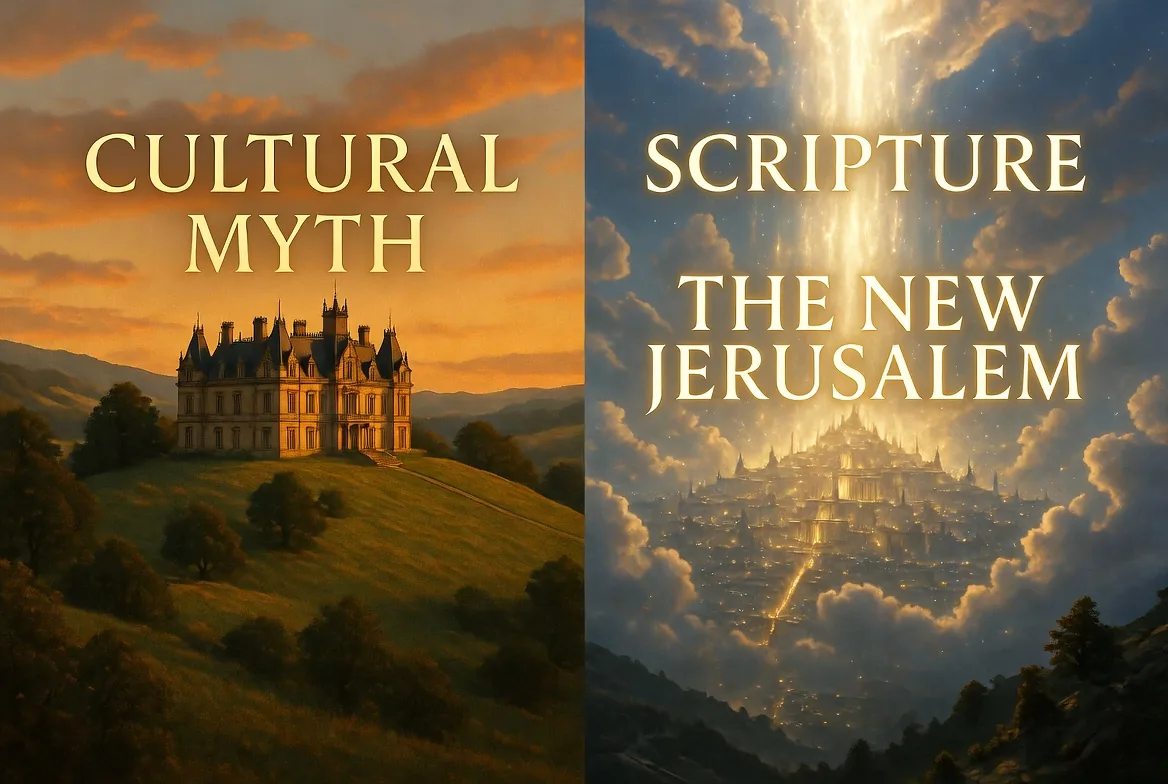
When the two realms are collapsed, both peoples lose what is actually theirs, and the believer is left straining after a hope that was never his. Tell the Body of Christ that her destiny is a mansion in the New Jerusalem, and you have moved a heavenly people into an earthly city that belongs to the twelve tribes and the twelve apostles of the Lamb — robbing her of the higher hope of being seated in the heavenly places with her Head, and saddling her with a promise whose foundations bear other men's names. Tell Israel that her promises were only ever "spiritual," that the throne of David and the land and the kingdom on earth were figures for a disembodied heaven, and you have emptied the prophetic program of the very thing God swore to perform. Each error is the same error from a different side: one kingdom, one people, one destiny — the flattening that right division exists to undo.
Keep the two realms distinct, and every promise lands where God placed it. The earth-dwelling nation receives her earth, her city come down, her reigning King. The heavenly Body receives her heavenly places, her glorified body, her Head far above all. Neither inheritance is diminished by the other; both are magnified, because both display the reach of the one Christ who is Lord over heaven and earth alike.
One God over both realms
So the kingdom of God is broad enough to hold a heaven and an earth, and Christ is King of both. He will reign over the house of Jacob on a renewed earth, and He reigns now over a heavenly people seated in Him far above all principality and power — and in the dispensation of the fulness of times He will "gather together in one all things in Christ, both which are in heaven, and which are on earth" (Ephesians 1:10). The earthly people will glorify Him on the earth; the heavenly people will glorify Him in the heavens; and the whole family in heaven and earth will be named of the one Father.
The believer's task is not to claim the other realm's promises, but to know his own — to see plainly which sphere of the kingdom he was placed in, and to rest in the glory God has appointed for it. If you were saved under the gospel Paul preached, your hope is not the city coming down; it is the Christ you will be caught up to meet, and the incorruptible body in which alone you can inherit the heavenly realm where, by His grace, you are already seated.
© 2026 Edward R. Cross
Comments
No comments yet. Be the first to share your thoughts.
Leave a comment