There is a single command in all of Scripture that tells the believer to divide the word of truth. It comes late, it comes once, and it comes through one man. Before that man, no prophet, no psalmist, no apostle of Israel, and not even the Lord Jesus in His earthly ministry was ever told to do it. The instruction simply does not exist in the earlier Scriptures — not because the men of old were careless, but because there was, as yet, nothing to divide.
That absence is worth sitting with, because it overturns a great deal of what passes for dispensational teaching. We are often told that the church has always recognized a series of ages or dispensations stretching back to the garden, and that to divide the Bible into such periods is simply the historic Christian way of reading it. But if the dividing of the word were the native task of every age, we would expect the command to appear somewhere — in Moses, in the prophets, in the gospels. It never does. It waits. It waits for the apostle Paul, and it waits for a reason. Until his revelation, the word of truth ran in a single direction toward a single destination, and a single stream needs no one to divide it.
The Command That Appears Only Through Paul
Here is the command, set down exactly as the Holy Ghost gave it:
"Study to shew thyself approved unto God, a workman that needeth not to be ashamed, rightly dividing the word of truth." (2 Timothy 2:15)
Notice three things about where this sentence sits. It is written by Paul, the apostle of the Gentiles, who said of his gospel, "For I neither received it of man, neither was I taught it, but by the revelation of Jesus Christ" (Galatians 1:12). It is written to Timothy, a worker in the churches of the mystery, not to Israel under her covenant. And it is written near the very end of Paul's life, in his last epistle — after the whole body of his doctrine had been given. The command to divide is not the opening note of the Bible. It is one of the closing instructions of the man God raised up last.
Now search backward for any equal command, and you will not find it. God told Noah to build an ark. God told Abraham to leave his country. God told Israel to keep the sabbath, to bring the sacrifices, to drive out the nations. The Lord Jesus told His disciples to go to the lost sheep of the house of Israel, to preach the kingdom, to heal the sick. In all of it — chapter upon chapter of commandment — no one is ever told to divide the word, to sort what God said to one people in one age from what He said to another. The reason is not that division was forbidden. The reason is that, until Paul, the word of God had only one channel and only one mouth, and you do not need to be told to separate a river from itself.
Someone may answer that the duty was there all along under another name — that every faithful man was bound to handle the word of God correctly, and that this is all "rightly dividing" amounts to. But look closely at the difference, for everything turns on it. The older Scriptures do command faithfulness with the word: "Ye shall not add unto the word which I command you, neither shall ye diminish ought from it" (Deuteronomy 4:2); "Add thou not unto his words, lest he reprove thee" (Proverbs 30:6). Israel was to keep the word, guard the word, meditate on the word day and night, neither adding to it nor taking from it. Not once, in all of that, was Israel told to divide it. And that silence is the whole point, because to handle a thing faithfully and to divide a thing are not the same act. A man can handle a single cup of water with perfect care and never once divide it, for there is nothing in it to part. The command Paul gives is not "handle the word with reverence" — that command was old. It is divide the word: set this apart from that, send the one truth here and the other there. And a man is told to divide only when there are two things to be kept apart. The very verb assumes what no earlier age had yet been given — a line running through the word of truth.
A Word Picture: The Dividing of the Waters
Most of us have never heard the word watershed used the way I am about to use it, so let me make it plain before I make it spiritual.
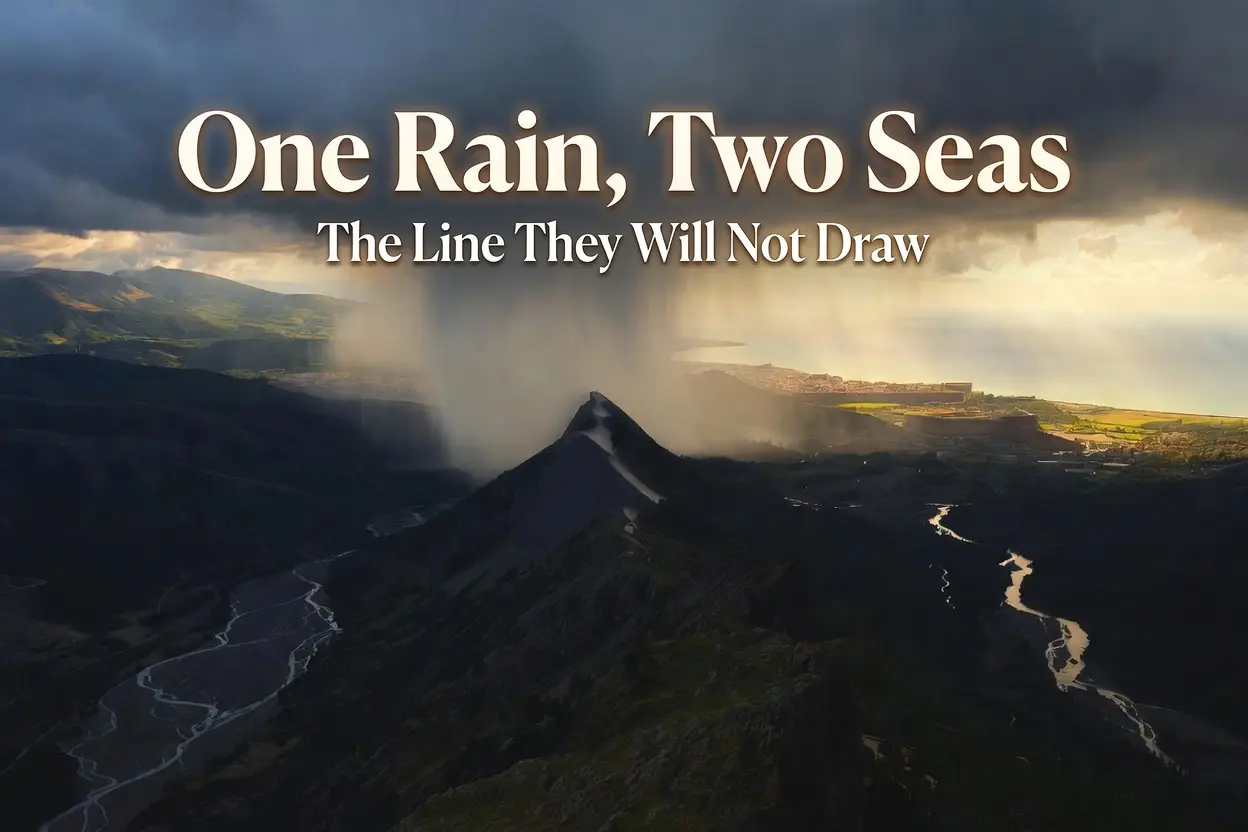
Stand on the ridge of a steep roof in a rainstorm. The rain falls along that peak in a single line, but it does not stay together. The drops that land an inch toward the front run off the front of the house; the drops that land an inch toward the back run off the back. They came from the same cloud and struck the roof a hair apart — yet they end in different places, because a ridge ran between them.
Now make that roof a mountain range. There is a line that runs down the spine of a continent — men call it the Great Divide — and it does the same thing on an unimaginable scale. Rain that falls on one side gathers into creeks and rivers and at last empties into one ocean. Rain that falls on the other side, sometimes only a few feet away, runs the opposite direction and empties into a different ocean a thousand miles off. Two raindrops can begin side by side and never meet again — not because the water is different, but because a dividing line lay between them and sent them to two different seas.
That dividing line is called a watershed. And that is the very picture the apostle hands us when he commands us to be "rightly dividing the word of truth" (2 Timothy 2:15). Take the mapping slowly. The rain is the word of truth — all of it inspired, all of it from the same God, every drop "given by inspiration of God, and is profitable" (2 Timothy 3:16). The two oceans are the two destinations toward which God is working: an earthly kingdom promised to the nation Israel, and a heavenly calling reserved for the Body of Christ. And the ridge between them — the line that decides which truth runs to which destination — is the very thing Paul tells us to handle rightly.
Keep the picture, because it answers an objection before it can be raised. Someone will say that streams in nature do not stay apart; tributaries join, and rivers run together to the sea. True enough — which is exactly why the ridge matters. Where there is no dividing line, the waters do merge, and that merging is the whole problem we are describing. The command to rightly divide is the command to respect the ridge, so that what God sent toward Israel's earthly hope is not allowed to flood into the Body's heavenly calling, and what He revealed for the Body is not poured back over the prophetic promises of the kingdom. Erase the dividing line and you do not get clarity. You get a flood, and the flood ruins both fields.
Four Thousand Years on One Slope
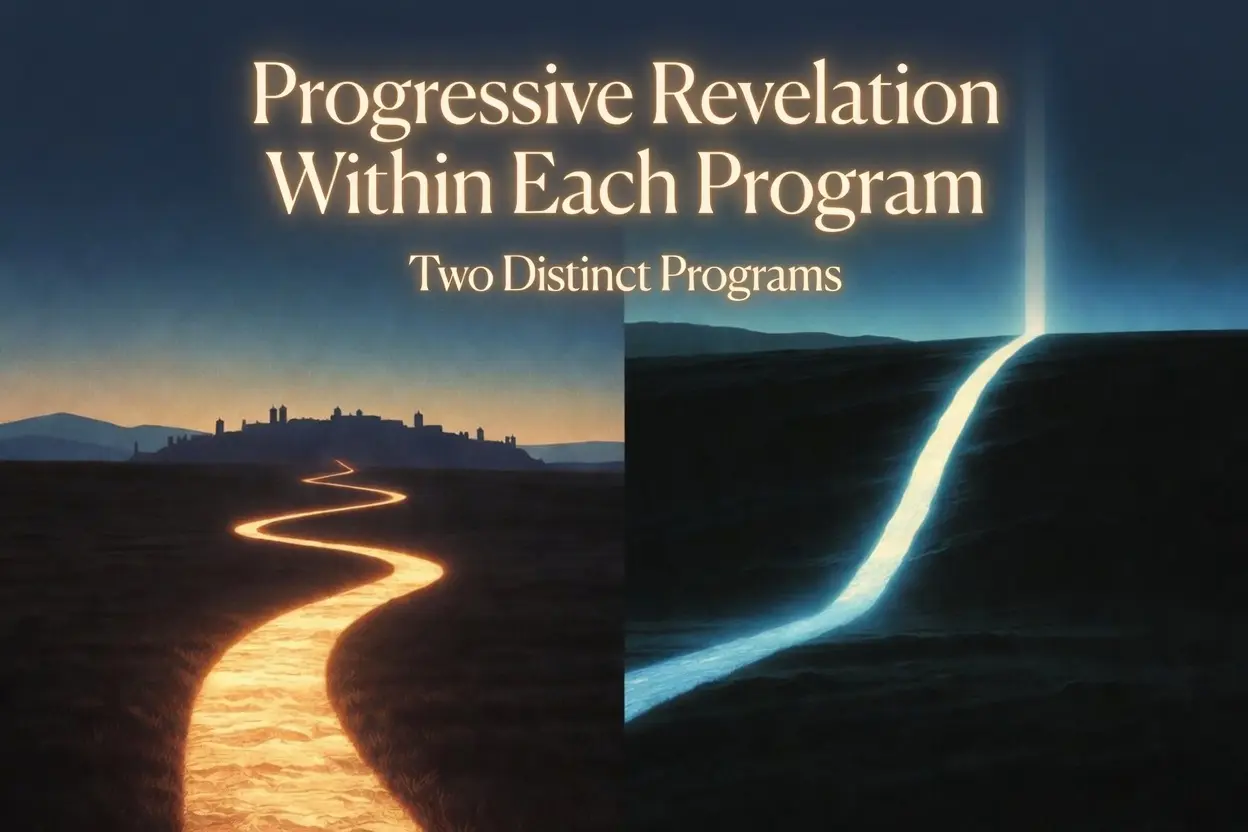
Now hear why this study carries the title it does. For four thousand years there was no ridge to see. Every drop of revelation God gave ran downhill in one direction, toward one sea — the earthly kingdom promised to Israel. There was no second slope, because God had given no revelation that ran the other way.
Trace it and you will find it is so. The garden was an earthly paradise. The promise to Abraham was a land, a seed, and a nation in that land. The law governed that nation's life in that land. The throne of David was a literal throne in literal Jerusalem. And the prophets, when they lifted their eyes to the farthest horizon, saw a kingdom on the earth — the wolf and the lamb, the desert blossoming, the nations streaming up to Zion, Messiah reigning from David's throne over a restored Israel. From Genesis to Malachi the water runs one way. The hope is earthly, the people are national, the throne is in Jerusalem, and the destination never changes. Peter, preaching after Pentecost, was still describing that same single stream when he spoke of "the times of restitution of all things, which God hath spoken by the mouth of all his holy prophets since the world began" (Acts 3:21). The prophetic word was spoken — out loud, from the beginning, in one continuous current toward the kingdom on the earth.
Someone will point to the patriarchs and answer that their hope was already heavenly, for Abraham "looked for a city which hath foundations, whose builder and maker is God" (Hebrews 11:10), and they "desire a better country, that is, an heavenly" (Hebrews 11:16). So they did — but mark where that city comes to rest. The heavenly Jerusalem of Israel's hope is not a seat in the heavens where the saints abide forever; it is a city God prepares above and then brings down, descending out of heaven to a new earth as the capital of a redeemed creation. Its source is heavenly; its resting place is the ground. That is a world away from the calling later revealed to Paul, in which the Body of Christ is seated in the heavenly places themselves. The patriarch's better country still settles, at the last, upon the earth. The water had not yet found a second sea.
This is also why the believer can read genuine development across those ages and never once need to divide them. Revelation did unfold from Adam to the prophets; God said more to Abraham than to Noah, and more through Isaiah than through Moses. But that was progress within a single stream, the way a river gathers depth as it descends — not a parting of the waters toward a second sea. A man does not need to be told to divide a single current; it has only one place to go. So the disciples, even as they asked the risen Lord, "Lord, wilt thou at this time restore again the kingdom to Israel?" (Acts 1:6), were still standing on the one slope, looking toward the one sea their fathers had always looked toward. There was nothing yet to divide.
The Dispensations Men Count — and the Sea They All Share
This is the very place where traditional dispensationalism gives itself away, and it is worth looking closely, because the men who built it were not fools and saw much that was true.
C. I. Scofield, in his popular booklet Rightly Dividing the Word of Truth, set out seven dispensations: Innocence in the garden, Conscience after the fall, Human Government after the flood, Promise from Abraham, Law from Sinai, Grace in the present age, and the Kingdom to come. Clarence Larkin, in his Dispensational Truth, drew nearly the same seven across his famous charts. And there is something right in this. Scripture really does mark off changing administrations; God really has dealt with man under differing arrangements; the word dispensation is Paul's own. To recognize that the rules under which Adam lived were not the rules under which Israel lived is not error. It is the beginning of sense.
But ask one question of Scofield's seven, and the whole scheme shows its seam. Ask of each: where is it heading? Innocence is an earthly garden. Conscience and Human Government are stages of a fallen race still on the earth, awaiting the promise. Promise, Law, and the coming Kingdom are the rising and falling and final flood-tide of one national, earthly, prophetic hope — Abraham's seed, in Abraham's land, under Abraham's God, reigned over at last by David's greater Son from David's throne. Strip the labels away and every one of those periods drains to the same sea: the kingdom on the earth. They are not seven streams running to seven destinations. They are seven bends in one river, and the river was always running to Jerusalem.
That is the quiet admission buried in the system. Traditional dispensationalists count the dispensations, but they cannot divide them — not really — because there is no ridge between any two of them. Each flows into the next. They mark the bends and call them divisions, but a bend in a river is not a watershed. The water never changes seas. And so, having no true dividing line in hand, they do the only thing left to do: they drop the Body of Christ into the same channel and let it run on to the same earthly destination, starting the church at Pentecost under Peter's kingdom preaching, carrying Israel's water baptism and Israel's signs along with it, and marching the church straight into a millennial kingdom that the prophets had always promised to the nation. They named seven dispensations and blended all seven, because all seven were heading to the same place.
Larkin came closer than Scofield, and honesty requires us to say so. On his charts the present age appears as a mystery parenthesis — an unforeseen interval, unseen by the prophets, dropped into the prophetic timetable between Israel's past and Israel's future. That is a real insight, and it is more than Scofield granted. But notice what Larkin does with the space once he has drawn it. He sketches the second channel on the chart, and then he pipes the first stream's water straight through it. The parenthesis is born at Pentecost. It is filled with water baptism, with the gifts and signs given to Israel. And though both Larkin and Scofield grant the church a rapture and a heavenly season, both still bring her down again with Christ to reign in the earthly kingdom promised to the nation — her calling folded into Israel's, her throne set on Israel's ground. Even the heavenly portion they allow the church drains, at the last, into the same earthly sea. The dividing line that should have sent this water to a different sea is drawn on the diagram and erased in the doctrine. Larkin's church is cosmetically divided and operationally blended. He saw that a ridge belonged there; he would not let it actually part the waters.
As the men at Grace Ambassadors have put it, dispensational truth did not begin with Scofield, does not depend on Scofield, and does not end with Scofield — it rests on the necessary divisions found in the Scripture itself. The charts are not the authority. The text is. And the text places the one ridge that matters not at the flood, nor at Sinai, nor at Bethlehem, but at the revelation of the mystery to Paul.
The Watershed: When a Second Sea Appeared
Everything changes with one man, because with one man a second slope appears for the first time.
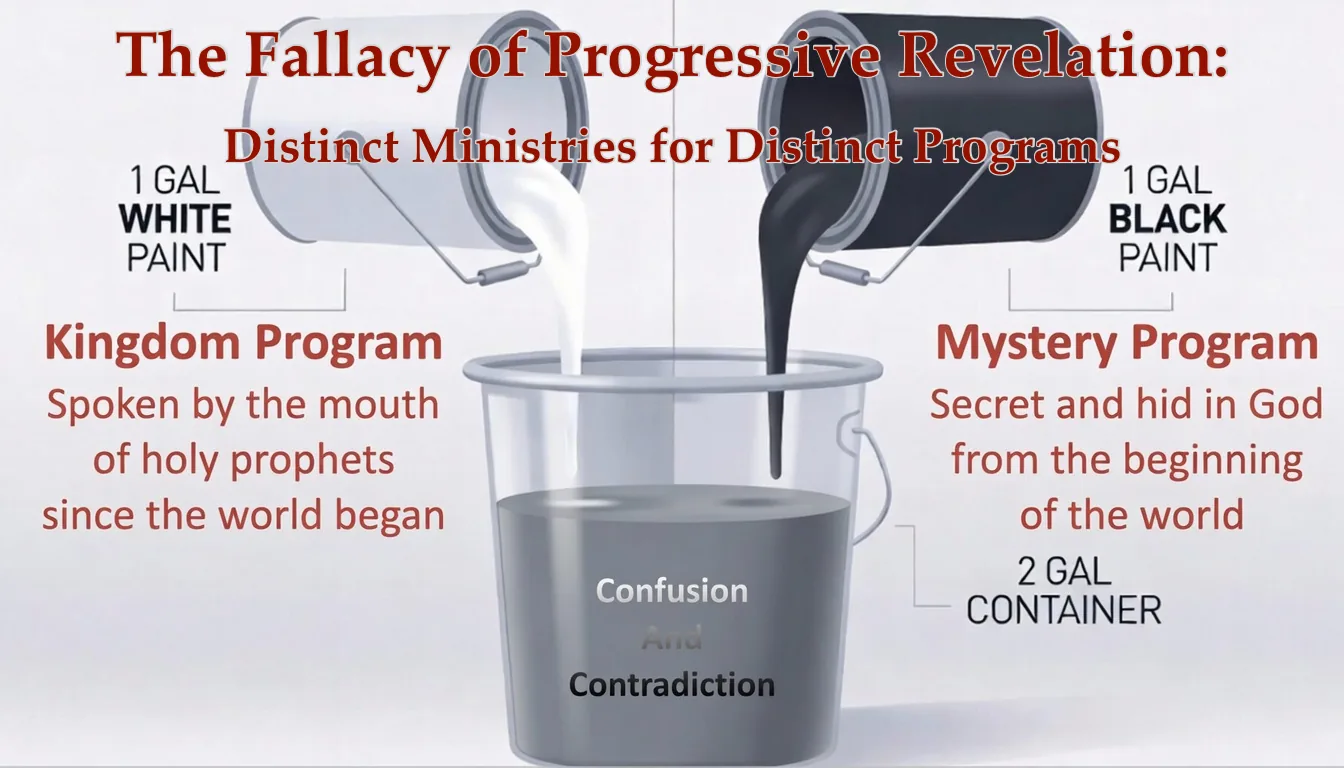
Paul did not receive a deeper version of the kingdom hope. He received something that had never been revealed to anyone — a message "kept secret since the world began" (Romans 16:25). Set the two phrases side by side and the ridge stands up between them. The prophetic word was "spoken... since the world began" (Acts 3:21); the mystery was "kept secret since the world began" (Romans 16:25). One was shouted from the beginning; the other was hidden from the beginning. They cannot be the same water, for one ran in the open down every prophet's page, and the other was sealed in God until He opened it to Paul.
And what was hidden in it was a second destination. Not a throne in Jerusalem but a seat in the heavenlies: God "hath raised us up together, and made us sit together in heavenly places in Christ Jesus" (Ephesians 2:6). Not an earthly inheritance in a promised land but "all spiritual blessings in heavenly places in Christ" (Ephesians 1:3). Not the nation Israel restored, but a new thing — Jew and Gentile together, "fellowheirs, and of the same body" (Ephesians 3:6) — a company whose "conversation is in heaven" (Philippians 3:20). This was the administration committed to Paul, "the dispensation of the grace of God which is given me to you-ward" (Ephesians 3:2), a truth "which in other ages was not made known unto the sons of men, as it is now revealed unto his holy apostles and prophets by the Spirit" (Ephesians 3:5) — the very mystery "which hath been hid from ages and from generations, but now is made manifest to his saints" (Colossians 1:26).
Mark the timing, for it is the whole point of this study. Make sure you do not hear the ridge as something Paul invented. It had been there in the purpose of God all along — "the fellowship of the mystery, which from the beginning of the world hath been hid in God" (Ephesians 3:9). The high ground was always in His counsel; it was simply unseen, unmarked, with no revelation yet flowing down its far side. What Paul received was not the making of the ridge but the unveiling of it. And the moment it was unveiled, there were two slopes where men had only ever known one — two streams, two seas, the earthly kingdom of prophecy and the heavenly calling of the mystery, running now in two directions from one revealed dividing line.
That is when the command had to come. Not before — there was nothing to divide. But now, with two destinations fed from one Bible, a workman must know which side of the ridge a given word belongs to, or he will carry it to the wrong sea. So in his last letter Paul lays the charge on Timothy, and through Timothy on us: rightly divide. The command and the second stream arrive together, because the one created the need for the other. The dividing line and the order to respect it are born in the same revelation.
Two Verses, Two Seas
See now why the dividing line is not a fine point for scholars but a daily necessity for any honest reader. On a true watershed two raindrops can strike the ridge side by side — alike in every way, falling from one cloud — and still be carried to opposite seas, not because the drops differ but because the ridge runs between them. So it is in the book. Two verses can speak to the very same subject, sound nearly alike, and still run to different destinations, because likeness of subject is not sameness of program. The nearness that fools the reader is not nearness on the page — the verses may sit whole books apart — but nearness of theme: two passages about forgiveness, two about how to be saved, two about being kept to the end, each pair so plainly on one topic that the reader never dreams they were addressed to two different peoples.
These waters can run astonishingly near. In the sermon on the mount the Lord taught Israel to pray, "And forgive us our debts, as we forgive our debtors" (Matthew 6:12), and only two verses on He fixed the terms: "For if ye forgive men their trespasses, your heavenly Father will also forgive you: But if ye forgive not men their trespasses, neither will your Father forgive your trespasses" (Matthew 6:14–15). That is pardon held out on condition, in the kingdom program, to a people under the law. Yet to the Body of Christ Paul writes the very opposite order of things — "forgiving one another, even as God for Christ's sake hath forgiven you" (Ephesians 4:32) — forgiveness already finished, made the ground of our kindness rather than the wage of it. Two passages on the one subject of forgiveness, alike enough that a reader takes them for a single teaching, and they empty into two different seas. Pour Matthew's condition over Ephesians' accomplishment and you have flooded the Body's settled pardon with Israel's if.
The same nearness carries the same danger into the most important question a man can ask — how to be saved. Peter, on the day of Pentecost, told Israel, "Repent, and be baptized every one of you in the name of Jesus Christ for the remission of sins" (Acts 2:38). Paul, to the Body, wrote, "For by grace are ye saved through faith; and that not of yourselves: it is the gift of God: Not of works, lest any man should boast" (Ephesians 2:8–9). Both are the word of God, and both are true on their own slope — one spoken to a nation being summoned to her King, the other to a people being shown a finished work. But the reader who empties Acts 2 into Ephesians 2 has carried Israel's water clean across the ridge and called it the gospel. It runs the same way with endurance: "he that shall endure unto the end, the same shall be saved" (Matthew 24:13) is spoken to Israel passing through her tribulation, while the Body is already "sealed unto the day of redemption" (Ephesians 4:30). Demand the first of a believer who is kept by the second, and you have flooded a sealed standing with a survivor's fear.
This is what it is to mistake likeness of subject for sameness of program. The reader who does not see the ridge running between such verses pours Israel's water into the Body's sea, and then calls the flood "the plain reading of Scripture." He takes a promise of earthly restoration and presses it on the church; he takes a sign given to provoke Israel and demands it of believers today; he reaches into the kingdom gospel for the terms of his salvation and never notices he has crossed the ridge. It feels like reverence — he is only obeying everything he reads. But a man cannot obey everything he reads, for the Bible is full of instructions that conflict with one another precisely because they were given on opposite slopes. To build the ark and to flee to the mountains, to keep the sabbath and to let no man judge you respecting it, to sell all and follow, and to labour with your hands that you may have to give — these are not contradictions in the word. They are different waters, sent to different seas, by the one God who marked the ridge between them.
The Line They Will Not Draw
Here, then, is the exposure, and it is gentle but it is firm. Traditional dispensationalism is not wrong to see dispensations; it is wrong in the one division it refuses to make. It will divide the Bible by periods of time — innocence, conscience, government, promise, law — and never by destination. It will count the ages and decline to part the seas. It grants seven administrations and yet, because every one of the first six drains to the earthly kingdom, it quietly lets the seventh, the Body of Christ, drain there too. The very ridge that the revelation of the mystery raised up — the one dividing line that actually sends two streams to two different oceans — is the single line the system will not draw.
And that refusal is telling. A scheme that genuinely came from the text would carry the text's own command on its face; it would be built to divide, because the only verse that names the task names dividing. Instead, traditional dispensationalism names many dispensations and blends them all, and in doing so it shows its origin. It is a framework laid over the Scriptures, not the framework the Scriptures hand us. The Bible's own dividing line falls in exactly one place — at Paul's mystery — and it is exactly that line the tradition steps around.
Rightly Dividing Is Obedience
So we return to the title, and to the strange silence behind it. There was no rightly dividing before Paul, and there was no command to rightly divide before Paul, for the simplest of reasons: there was only one stream, running to one sea, and a single current asks no one to part it. The men of old were never told to divide the word because, in their day, the word was not yet divided. It was all one slope, all one descent toward the kingdom that the prophets had promised since the world began.
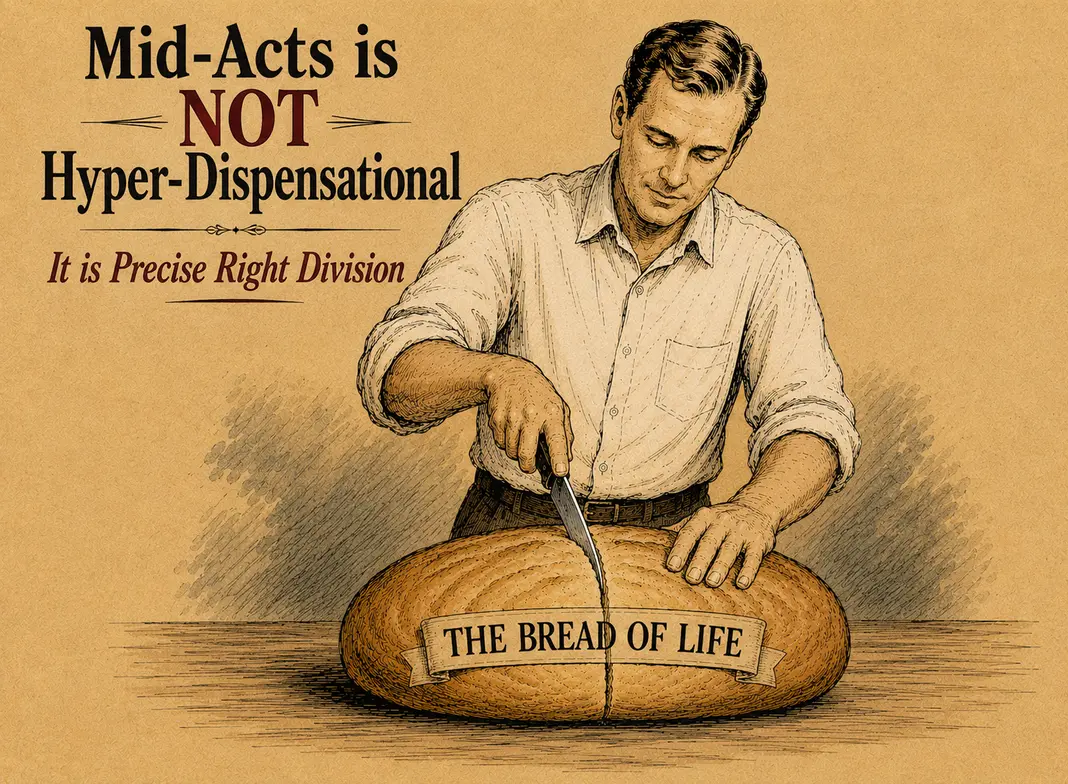
Then God unveiled the ridge. He gave to one apostle a secret kept in Himself from the foundation of the world, and with it a destination no eye had seen and no prophet had named — a people seated in the heavenlies, complete in Christ, with a hope laid up where Christ Himself is seated. And on the day that second sea appeared, the command appeared with it. "Rightly dividing the word of truth" is not a clever method imposed on the Bible by men who like charts. It is the plain duty of anyone who has seen the dividing line that God Himself raised up in Paul. To respect that ridge — to send each word to the sea God sent it to — is not to cut up the Scriptures. It is to keep them. It is, in the end, simply obedience.
See also: "Rightly Dividing or Wrongly Accusing: A Response to Ruckman's Attack on Mid-Acts Dispensationalism"
See also: "The Fallacy of Progressive Revelation: Distinct Ministries for Distinct Programs"
© 2026 Edward R. Cross

Comments
No comments yet. Be the first to share your thoughts.
Leave a comment