Ask most believers where the line falls between Israel's program and the Body of Christ, and they will reach for a single verse — a seam in the text where one thing stops and another starts. Some put that seam at the cross. Some put it at Pentecost. Some, having learned that Paul is the apostle of the present age, put it at the very end of Acts, where Israel is pronounced blind and salvation is sent to the Gentiles. Each of these answers assumes the same thing: that the dispensational boundary is one line, a single moment before which everything belongs to Israel and after which everything belongs to the Body.
That assumption is the reason the question is so often answered wrongly. The boundary is not a line. It is a corridor — a bounded stretch of time with a wall at each end. The mystery began at one wall, when the risen Christ arrested Saul on the Damascus road. The transitional overlap of the two programs ended at the other wall, when Israel was cast away in Rome and the ministry to the Jew first ceased. Between those two walls runs the book of Acts, and almost every confusion about where Acts ends and the mystery begins comes from collapsing that corridor into a single point — either pulling the far wall forward to the cross or Pentecost, or pushing the near wall back to the close of Acts.
A companion study on this site, Not Everything Paul Did Is What We Do: Transitional Elements in His Acts-Period Ministry, surveyed the practices that belonged to the overlap and have since ceased. But it raised a question it did not stop to settle: if the overlap ended, where exactly did it end, and why there? This article answers that question. It locates both walls of the corridor, defends each against the error that would move it, and shows why the dispensation of grace stands today on the far side of a boundary that is fixed, finished, and not to be reopened.
The Question Hides an Assumption
Where does Acts end and the mystery begin? sounds like a single question. It is really two, and they have two different answers.
The first question is: when did the mystery — and the Body of Christ it forms — begin? The answer is Acts chapter nine, with the conversion and commission of Paul. The second question is: when did the transitional overlap of the two programs end, so that the dispensation of grace stood alone in unmixed operation? The answer is Acts chapter twenty-eight, with Israel's national setting-aside in Rome.
These are not rival answers to the same question. They are the two walls of the same corridor. The mystery did not wait until Acts 28 to begin; Paul preached it from the day he was saved. And the book of Acts did not record an Israel-only world right up to its final chapter; the Body of Christ was already being formed through Paul's gospel for some twenty-five years before that chapter was written. The corridor has a beginning and an end, and to confuse the two — to treat the closing of the overlap as the opening of the dispensation — is to misread the whole structure of God's present purpose.
So this study will take the walls in turn. It will affirm the front wall briefly, because other studies on this site have already established it in detail. It will spend its strength on the back wall, because that is the wall Transitional Elements left standing without explanation, and because it is the wall most often either ignored or moved.
The Front Wall: The Mystery Began at Acts Nine
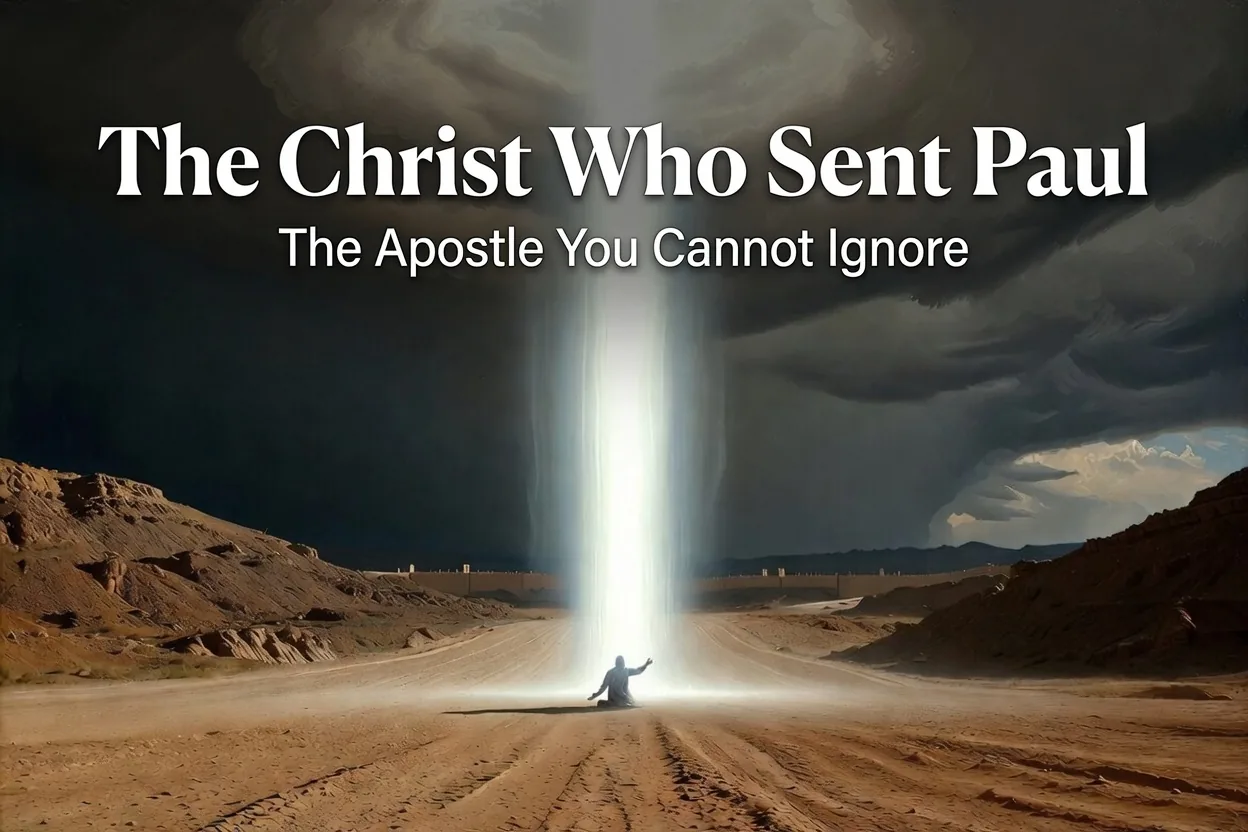
The Body of Christ began where Paul began. The dispensation of grace was not in administration in the Gospels, was not inaugurated at the cross, and was not poured out at Pentecost. It commenced when the ascended Lord appeared to the chief of sinners and made him the pattern of all who would afterward believe.
"Howbeit for this cause I obtained mercy, that in me first Jesus Christ might shew forth all longsuffering, for a pattern to them which should hereafter believe on him to life everlasting." (1 Timothy 1:16 KJV)
"In me first" settles the front wall. Paul was the first member of the Body, the first to be saved by the gospel of the grace of God, the first steward of the mystery committed to him by direct revelation of Christ rather than handed down from the twelve. The administration that governs the Body cannot be dated apart from the people that administration governs; they began together, at the same revelation, given to the same apostle. This site treats that question fully in When the Church Began — When Grace Was Given and Begun Together: The Body of Christ and the Dispensation of Grace, and the reader who wants the front wall proved verse by verse should turn there.
For our purposes the point is simply this: the corridor opens at Acts nine. Everything that follows in the book of Acts — Paul's journeys, his synagogue preaching, his signs, his collection for Jerusalem — happens inside the corridor, with the Body of Christ already in existence and the mystery already being preached. That is the front wall, and it must be kept in view, because half of the confusion about the boundary comes from forgetting that the mystery was already running long before Acts ends.
Two Programs on Parallel Tracks
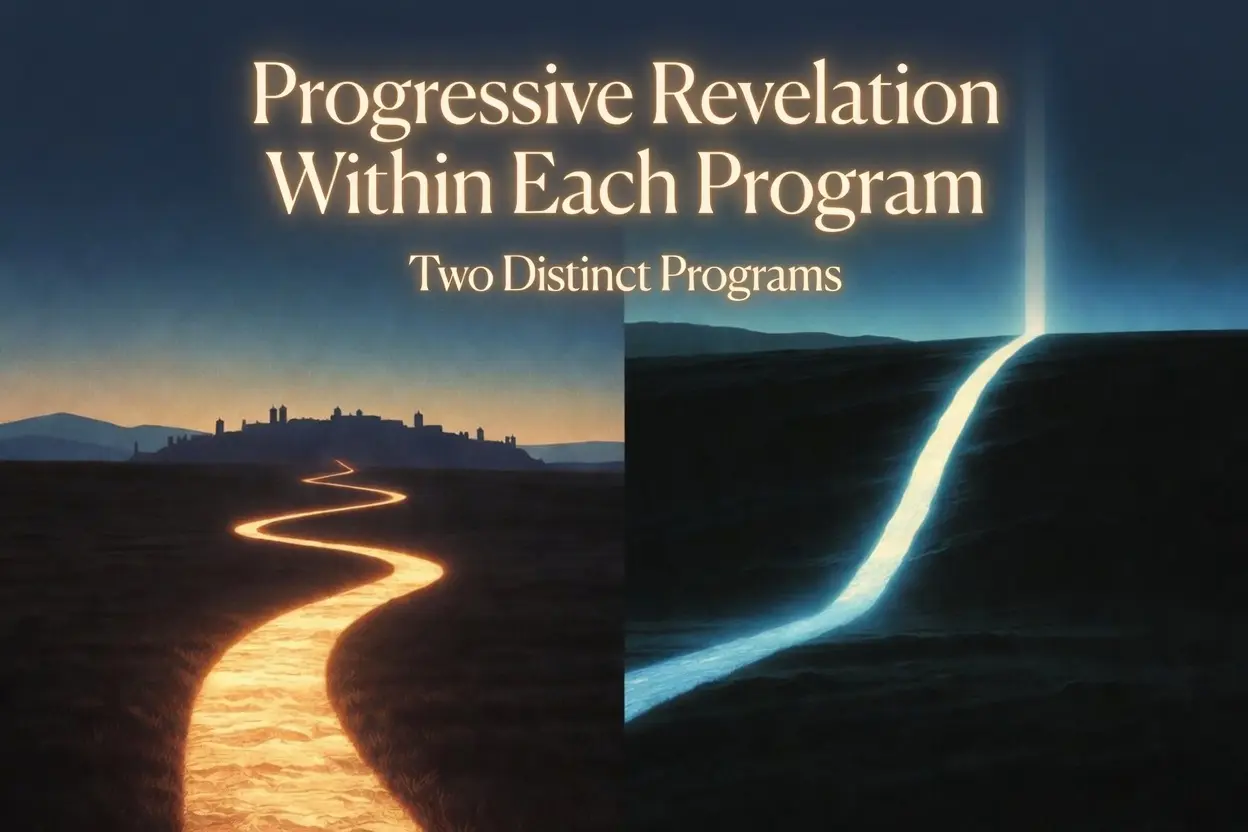
What makes the book of Acts a corridor rather than a clean line is that two of God's programs were running at once inside it. This is the single fact that, once grasped, unlocks the whole period.
Israel's prophetic program did not stop the day Paul was saved. Peter and the eleven continued their ministry to the circumcision. The believing Jewish remnant — the little flock — continued to look for the restoration of the kingdom to Israel. The Jerusalem assembly continued zealous of the law (Acts 21:20). That program had been spoken since the world began, and through the Acts period it was still running on its track — Peter ministering to the circumcision, the believing remnant still being ministered to under the twelve, the little flock still holding the kingdom hope — not yet brought to its close. (Just where the kingdom ceased to be offered to the nation, as distinct from where the program was finally set aside, is taken up below; the point here is simply that the prophetic track was still in motion alongside Paul's.)
At the same time, on a separate track, Paul was preaching a message that had been kept secret since the world began — the mystery of the one Body, in which there is neither Jew nor Gentile, with a heavenly calling and a settled standing in Christ. Two messages, two apostleships, two destinies, running side by side. The right hands of fellowship in Galatians acknowledged exactly this arrangement: two commissions, not one.
"And when James, Cephas, and John, who seemed to be pillars, perceived the grace that was given unto me, they gave to me and Barnabas the right hands of fellowship; that we should go unto the heathen, and they unto the circumcision." (Galatians 2:9 KJV)
This overlap is what the word transition means in mid-Acts study. It is not that the message was half-formed, or that the mystery was being revealed in installments that only finished at the close of Acts. Paul had the full mystery from the beginning. The transition was not in the message; it was in the situation — two programs occupying the same stretch of history at once. And precisely because it was an overlap of two things, it could end: one track could be brought to a stop while the other continued. That is what happens at the back wall.
Israel's Decline in Three Words: Fall, Diminishing, Casting Away
Here a distinction must be drawn that careful right division insists upon and careless reading runs together. It is tempting to imagine that everything concerning Israel happened at once — that the nation was offered the kingdom, fell, was blinded, and was set aside all in a single stroke at the close of Acts. It did not. Paul gives Israel's decline three distinct words in one passage, and each falls at a different point.
"I say then, Have they stumbled that they should fall? God forbid: but rather through their fall salvation is come unto the Gentiles, for to provoke them to jealousy. Now if the fall of them be the riches of the world, and the diminishing of them the riches of the Gentiles; how much more their fulness?" (Romans 11:11–12 KJV)
"For if the casting away of them be the reconciling of the world, what shall the receiving of them be, but life from the dead?" (Romans 11:15 KJV)
The fall comes first, and it comes early. Israel had rejected the Father through the prophets and the Son at the cross; the nation's spiritual fall is sealed when it rejects the testimony of the Holy Ghost through Stephen — "ye do always resist the Holy Ghost" (Acts 7:51). This is where the offer of the kingdom to the nation closes. Peter's early appeal — "Repent ye therefore, and be converted… And he shall send Jesus Christ" (Acts 3:19–20) — is the kingdom held open to a repenting Israel, and at Stephen's stoning that appeal is refused with finality. The mark of it is plain in the record: the Holy Ghost is last seen in Jerusalem at Acts 7:55, the Spirit leaves the city in darkness in Acts 8, and in Acts 9 the risen Christ turns to save the chief of the persecutors and raise up a new apostle out of due time. It is Paul's own testimony that "through their fall salvation is come unto the Gentiles" — the fall occasions the apostle of the Gentiles. So the kingdom offer does not run to the end of Acts. It closes at the fall, at Acts seven, and the corridor opens at Acts nine precisely because Israel has fallen.
The diminishing comes next, and it is the corridor — the long overlap from Acts nine to Acts twenty-eight. Here a vital point must not be missed: what Paul carries to the Jew first through this stretch is not a renewed kingdom offer but the gospel of grace — and he calls that order a necessity. At Pisidian Antioch, turning to the Gentiles only after the Jews thrust the word from them, he declared:
"It was necessary that the word of God should first have been spoken to you: but seeing ye put it from you, and judge yourselves unworthy of everlasting life, lo, we turn to the Gentiles." (Acts 13:46 KJV)
The word of God here is Paul's own grace gospel, and its first hearing was owed to the Jew — not because the kingdom was being re-offered to the nation, but as the divinely appointed order of grace's going forth through this period. When Jerusalem rejected the Spirit at Stephen, the nation was rejecting the kingdom; when Jews from city to city now thrust Paul's word from them, they were rejecting grace. The synagogue-first pattern was God's longsuffering, extending to the fallen nation's individuals a first hearing of the mystery gospel — to provoke Israel to jealousy (Romans 11:11, 14) and to save the Jews who believed, by grace, into the Body of Christ. The believing remnant of Israel — the little flock, the remnant according to the election of grace (Romans 11:5) — is not what Paul's gospel gathered. That remnant belonged to Israel's prophetic program; it was gathered under Christ and the twelve, and the twelve went on ministering to it even past Acts 28 — Peter still writing to the scattered flock, charging them to endure for their kingdom hope. What the boundary suspended was Israel's national program and its gathering, which awaits its resumption in the tribulation, not the care of the flock already called. Through the whole corridor Israel is being diminished, reduced, not yet finally cast off.
The casting away comes last, at the back wall, when Paul gathers the chief of the Jews in Rome and they will not be persuaded:
"Be it known therefore unto you, that the salvation of God is sent unto the Gentiles, and that they will hear it." (Acts 28:28 KJV)
This is national in scope in a way the earlier turnings were not. Paul had turned to the Gentiles before, at Pisidian Antioch (Acts 13:46) and at Corinth (Acts 18:6), but those were local, and in the next city he resumed the synagogue pattern. At Rome there is no next city. He stands at the capital of the world, before the leaders of the Jewish community at the empire's center, and pronounces over the nation the judicial blinding of Isaiah 6. With that, the "to the Jew first" ministry ceases, Israel's prophetic program goes into abeyance, and the overlap closes. This is the casting away — not cancelled, for "all Israel shall be saved" at the Deliverer's coming (Romans 11:26), but suspended.
So three words, three points: the fall at Acts seven, where the kingdom offer to the nation ends; the diminishing through Acts nine to twenty-eight, where grace goes to the Jew first; the casting away at Acts twenty-eight, where the overlap closes. The back wall of the corridor is the casting away, and it falls there because that is the point at which the thing that made the period transitional — Israel's continuing national program — is the very thing set aside.
The Blindness That Remains: "In Part" Until the Fulness of the Gentiles
One thing must be guarded carefully here, because it is easy to overstate. The casting away at Acts 28 is not the moment Israel becomes totally blind. Paul's word is exact: "blindness in part is happened to Israel, until the fulness of the Gentiles be come in" (Romans 11:25). The blindness is in part — partial — and it is temporary, lasting only until the fulness of the Gentiles. It does not move from partial to total at the close of Acts. It is the standing condition of this entire dispensation, and it is still in part today.
This is plain from the timing of the words themselves. Paul wrote Romans before he ever reached Rome — before Acts 28 — and there he already speaks of the blindness as a present, accomplished fact: "the election hath obtained it, and the rest were blinded" (Romans 11:7). The blindness was already operating in part during the corridor. And it continues in part after the corridor, for the same chapter holds it open "until the fulness of the Gentiles be come in" — a fulness not yet come. The blindness, then, brackets the whole age unchanged in its character: partial when it set in, partial now, partial until this dispensation closes.
What does in part mean? Two things at once, and both forbid us to call it total. It is partial in extent — the bulk of the nation is blinded, but a remnant is always excepted; the election obtains it still. And it is partial in duration — it is a temporary judicial condition, not Israel's final state. This is why the present blindness has never erased the opportunity of the individual Jew: any Jew who believes the gospel of grace today is saved at once, not into Israel's postponed kingdom but into the Body of Christ. The nation is set aside; the person is not shut out.
So we must be careful to say what changed at Acts 28 and what did not. What changed was the ministry pattern and the program — the "to the Jew first" order ended and Israel's prophetic clock was stopped. What did not change was the degree of the blindness. It was in part before Acts 28 and it remains in part after, and it will be lifted not at any point in Acts but only when the fulness of the Gentiles is come in, and "so all Israel shall be saved" (Romans 11:26). The back wall closes an overlap; it does not deepen a blindness.
Why Acts, and Not the Epistles
If the corridor closes at Acts 28, it follows that the book of Acts is the historical record of the transition itself, and the epistles written from the far side of the wall describe the settled dispensation. The mid-Acts and grace reference standards put it plainly: Acts is a transition book, not a doctrinal manual for the Body of Christ.
This is why we do not build the doctrine and practice of the Body out of the narrative of Acts. Acts shows us the corridor — two programs in motion, signs being given, the synagogue pattern in force, the gift of the Spirit coming with variation and delay and the laying on of hands. It is a true and inspired record of a period that was, by design, mixed. To lift a practice out of that mixed period and bind it on the Body today is to anchor present obedience to a vanished situation.
The prison epistles, by contrast, are written after the wall. Paul writes Ephesians, Philippians, Colossians, and Philemon from a world in which Israel has been set aside, the synagogue pattern has ceased, and the mystery program stands alone. There the picture is unmixed: one baptism, one Body, one hope of the calling, the believer sealed with the Spirit the instant he believes, complete in Christ, with no synagogue to visit first, no signs to seek, no collection for Jerusalem, no national offer pending. This is not a different gospel from the one Paul preached at the start of the corridor; it is the same gospel, now seen in the clear air on the far side of the boundary, with the transitional scaffolding taken down.
So when we want to know how the Body of Christ is to walk, we read the man on the far side of the wall — all of Paul's epistles, read in the light of the completed transition — and we read Acts as the record of how God brought us to that side.
Guarding the Back Wall: Acts 28 Did Not Begin the Body
Here a serious error must be answered, because it stands at the very wall we are defending. There are those who, rightly seeing that something decisive happens at Acts 28, conclude that the Body of Christ and the dispensation of grace did not begin until then — that Paul's earlier epistles belong to a still-Jewish period and only the prison letters contain the true mystery of the Body. This is the Acts 28 position, and it is not the mid-Acts position.
The mistake is to confuse the closing of the overlap with the opening of the dispensation. Acts 28 ended the transition; it did not start the program that had been running through the whole transition. The proof is that Paul's letters written before Acts 28 already teach, as present and accomplished realities, the very things the Acts 28 scheme says had not yet begun.
Romans, written before Paul ever reached Rome, already declares Israel's fall and the going of salvation to the Gentiles as accomplished fact, and already names Paul as the Gentiles' apostle.
"I say then, Have they stumbled that they should fall? God forbid: but rather through their fall salvation is come unto the Gentiles, for to provoke them to jealousy." (Romans 11:11 KJV)
"For I speak to you Gentiles, inasmuch as I am the apostle of the Gentiles, I magnify mine office:" (Romans 11:13 KJV)
If salvation had already come to the Gentiles, and Paul was already magnifying his office as their apostle, in a letter written before the close of Acts, then Acts 28 cannot be the beginning of Gentile salvation, of the Body, or of the dispensation of grace. It is the historical confirmation of what was already doctrinally true.
Press the alternative and it breaks. From Acts nine to the prison epistles is roughly a quarter of a century in which men and women were being baptized by one Spirit into the one Body. Under what administration did they stand? Paul tells them, in his earliest letters, that they were not under the law. If they were not under law, and the dispensation of grace had not yet begun, then a whole generation of Body members stood under no administration at all — and Scripture knows no such gap. If they were not under law, they were under grace, for there is no third place to stand. The Acts 28 position must invent an administrative vacuum the Bible never describes. The back wall is the end of the transition, not the birth of the Body.
Guarding the Front Wall: Pentecost Did Not Begin the Body
The opposite error moves the front wall the other way, pulling the beginning of the Body back to Acts 2 and the day of Pentecost. This is the traditional position, and it collapses the corridor from the front just as the Acts 28 scheme collapses it from the back.
Pentecost fulfilled prophecy; it did not reveal a mystery. Peter stood up and said, "this is that which was spoken by the prophet Joel" (Acts 2:16) — this is that, the fulfilment of something long foretold to Israel, not the unveiling of something kept secret since the world began. The mystery, by definition, was not the subject of prophecy; it was hid in God (Ephesians 3:9). What was poured out at Pentecost was the promise to Israel; the Body of Christ was still unrevealed, still future, still waiting for the apostle to whom it would be committed.
The two Spirit-events make the point. At Pentecost and through the Acts period, the gift of the Holy Ghost came with variation, delay, and the laying on of hands — the Samaritans believed and were baptized yet received the Spirit only when Peter and John came down (Acts 8:14–17); Cornelius's household received the Spirit while Peter was still speaking (Acts 10:44). But the baptism that forms the Body is uniform and immediate:
"In whom ye also trusted, after that ye heard the word of truth, the gospel of your salvation: in whom also after that ye believed, ye were sealed with that holy Spirit of promise." (Ephesians 1:13 KJV)
After that ye believed, ye were sealed — no waiting, no laying on of hands, no second experience. The Pentecostal outpouring belonged to Israel's program; the sealing of the one Spirit into the one Body belongs to the mystery. To start the Body at Acts 2 is to import Israel's prophesied promise into a program that had not yet been revealed, and to leave the front wall standing in the wrong place.
Not Acts 2. Not Acts 28. The Body begins at Acts nine, and the transition that began with it closes at Acts twenty-eight.
The Evidence the Overlap Has Closed
That the back wall has truly fallen is shown by what stops on the far side of it. Every practice that belonged to the overlap — every accommodation that existed because Israel's program was still running — disappears once the nation is set aside. Transitional Elements surveys these in detail; here it is enough to see them together as a single line of evidence that the corridor has closed.
The synagogue-first pattern, pressed in city after city through the whole Acts record, never appears again. There is no "to the Jew first" ordering in the prison epistles, no instruction to seek out the synagogue, no national offer held open. The confirming signs that authenticated Paul's apostleship to a sign-seeking nation fade from view — the same Paul who raised the dead at Troas now leaves Trophimus sick at Miletum and prescribes wine for Timothy's stomach. The sign gifts that filled three chapters of correction in First Corinthians are simply absent from Ephesians and Colossians. The water baptism Paul performed early, and was already pulling back from, gives way to the one baptism that is the Spirit's alone. The Jewish observances — the vow, the feast, the temple purification — and the collection for the poor saints at Jerusalem find no place in the settled instruction for the Body.
None of these things is forbidden mid-corridor; each was fitting while the overlap lasted. But every one of them ends, and their disappearance is not accidental. It is exactly what we should expect if the program that called for them has been set aside. The silence of the prison epistles on these matters is the echo of the back wall closing. Where the overlap is gone, the marks of the overlap are gone with it.
Progressive Revelation Within the Corridor
This boundary clarifies a truth that is constantly abused — progressive revelation. The phrase is true in one sense and false in another, and the corridor is what tells them apart.
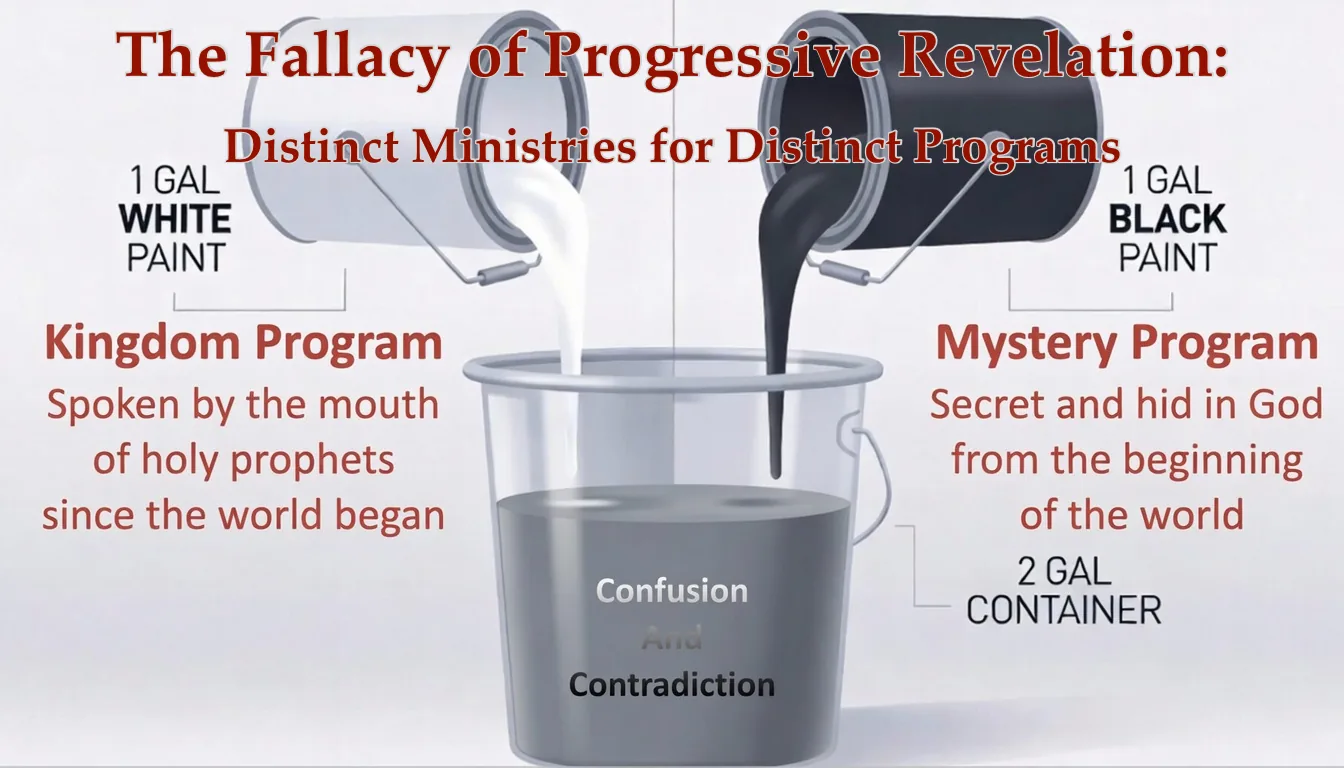
It is false to say that revelation progressed from Christ's earthly ministry to the twelve and then on into Paul, as though one continuous stream simply widened over time. That is not progression; it is the blending of two distinct programs, and it is the very error mid-Acts study exists to resist. Paul did not receive the next instalment of what Peter taught. He received an independent revelation, kept secret since the world began, given by the risen Christ — a new thing, not a development of the old.
But it is true, and beautiful, to say that revelation progressed within the mystery committed to Paul, across the length of the corridor. The Lord unfolded the mystery to Paul over time, so that the early epistles, written while the overlap was still in force, address a world of synagogues and signs and Judaizing pressure, while the prison epistles, written after the wall, set out the heavenly position in its fullest light. The fuller light of Ephesians and Colossians is not a later beginning — Paul says he is writing of the mystery he "wrote afore in few words" (Ephesians 3:3) — but it is a fuller explanation, given as the corridor closed and the unmixed dispensation came into view.
So progressive revelation runs along the corridor, not into it from Israel's program. It begins at the front wall, when the mystery is first committed to Paul, and it reaches its written fulness as the back wall falls. The companion study The Fallacy of Progressive Revelation presses this distinction at length; the boundary is what makes the distinction visible. Get the corridor right, and you will never again confuse the unfolding of the mystery to one apostle with the merging of two programs that God kept apart.
Reading on the Right Side of the Boundary
What does the boundary ask of us in practice? It asks that we read every passage on its proper side of the wall, and that we take our doctrine and walk from the far side, where we stand.
When we read the Gospels, we are reading the ministry of Christ to the circumcision, before the corridor opens. When we read Acts, we are reading the corridor itself — the true record of a transitional period in which two programs overlapped, and from which we draw history, not doctrine. When we read the believing remnant's portion of the post-resurrection Scriptures, addressed to Israel's saints, we are reading what belongs to the prophetic track. And when we read Paul — all of Paul, from Romans through Philemon, in the light of the completed transition — we are reading the man God set on the far side of the wall to be our pattern and our apostle.
This is what right division comes to in the end: knowing which side of the boundary a verse stands on, and refusing to drag the practices of the corridor into the dispensation that lies beyond it. The believer who insists on water baptism because Paul baptized in Acts, who seeks tongues because they filled the Corinthian assembly, who waits and seeks for a Spirit he has already been sealed with, is living as though the corridor were still open — as though the back wall had never fallen. But it has fallen. The salvation of God has been sent to the Gentiles. Israel's program is in abeyance. The transition is finished, and we stand in the unmixed dispensation of the grace of God.
"Whereof I am made a minister, according to the dispensation of God which is given to me for you, to fulfil the word of God; Even the mystery which hath been hid from ages and from generations, but now is made manifest to his saints." (Colossians 1:25–26 KJV)
The mystery began at the front wall, with the chief of sinners on the Damascus road. The transition closed at the back wall, with the nation set aside in Rome. Between them lies the book of Acts, and beyond them lies the open ground where the Body of Christ has stood ever since. Find the walls, keep them where God set them, and the whole shape of the present dispensation comes clear. Where does Acts end and the mystery begin? The mystery began at Acts nine, the transition ended at Acts twenty-eight — and we live, complete and sealed, on the far side of that finished boundary.
© 2026 Edward R. Cross


Comments
No comments yet. Be the first to share your thoughts.
Leave a comment