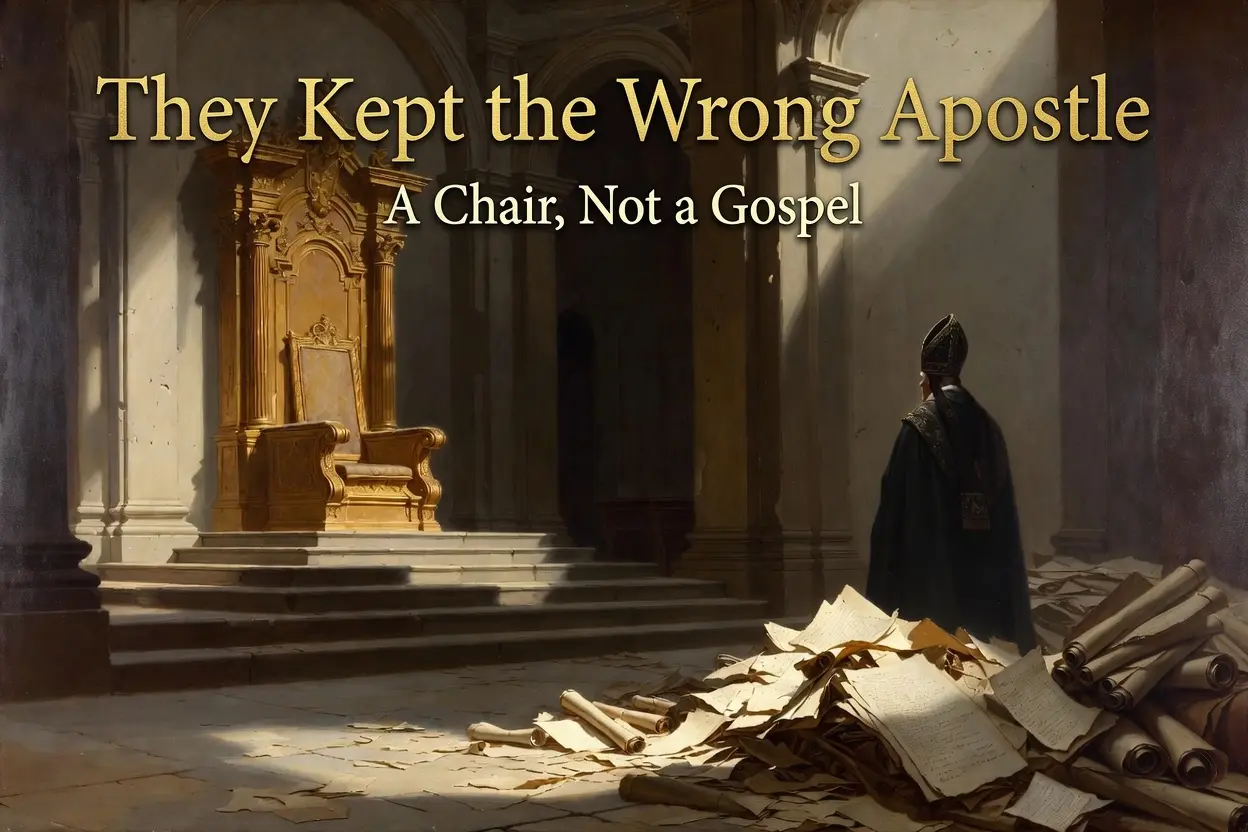
Two companies of believers stood on the earth as the apostolic age drew to its close, and within a single generation both were torn by a departure. One company had been given the gospel of the grace of God through the apostle Paul. The other was the believing remnant of Israel, the little flock that held Messiah and the law together and waited for the kingdom. The first company turned away from its apostle. The second was hollowed out from within by men who, as John says, went out from us, but they were not of us. None of it caught Paul unaware. He did not say such men might come; he said they would. To the elders at Ephesus he gave no anxious guess but a flat prediction: after his departing "grievous wolves" would "enter in among you, not sparing the flock", and "of your own selves shall men arise, speaking perverse things, to draw away disciples after them" (Acts 20:29-30 KJV). Mark what the wolves were finally after. A wolf among sheep means slaughter, and Paul does say the flock would not be spared; yet the end he names is stranger than slaughter. Their aim was not to scatter the flock to the winds, nor to stamp the faith from the earth, but to "draw away disciples after them" — to take the followers for themselves. The assemblies would go on. The religion would go on. What would not go on was Paul. The flock would be kept — only kept after another man. He said shall, and the centuries that followed are the proof that he saw clearly.
These are usually told as two unrelated stories, if they are told at all. They are not unrelated. They are two strokes of the same hand, and what rose in the vacuum they left behind was a religion that did a very strange thing: it kept the wrong apostle. It enthroned Peter, whom it had no claim to, and it forsook Paul, whom it was bound to follow. To see how that happened, and what became of the remnant and their families, we have to lay the two departures side by side.
A Word Before We Begin: Two Kinds of Statement in This Study
Before a single conclusion is drawn, the reader must be told what kind of thing he is reading at each turn, because this study deliberately joins two very different sorts of statement, and they do not carry the same weight.
The first kind is Pauline doctrine — the truth committed to the apostle Paul and written down in his epistles. This is not opinion and not reconstruction. It is the word of God, given by inspiration and kept for us by preservation: that the mystery was revealed to Paul, that his is the gospel of the uncircumcision and Peter's the gospel of the circumcision, that the twelve hold a fixed earthly office over Israel, that Israel is set aside but not cast away, that any man crosses into the Body only by faith in the gospel of grace. Where this study rests on the plain statements of Paul's epistles, rightly divided, it claims to be standing on ground that does not move. The reader is meant to test it by the Scriptures and, finding it there, to hold it.
The second kind is historical reconstruction — a view of what appears to have transpired after the apostolic age, and why. When this study speaks of how the institutional church drifted, who took up Peter's name, how Rome came to claim his chair, or what the silence of the early record implies, it is no longer quoting chapter and verse but reading the aftermath in the light of what Paul foretold. History is not inspired and it was given no promise of preservation. The records are partial, written largely by the side that prevailed, and open to honest dispute at the level of detail. So these portions are offered as a reasonable account of the wreckage Paul predicted — not as a thirteenth epistle, and not as a thing to be believed because it is written here.
Keep the two apart as you read, and the line is easy to hold: the doctrine is the standard, and the history is the application of the standard to the visible past. Where the two are kept distinct, neither is harmed — the doctrine loses none of its certainty by sitting beside a careful surmise, and the surmise is kept honest by never pretending to the authority of the text. What follows leans its whole weight on the first kind, and uses the second only to show how exactly the first was borne out.
Two Departures, Two Peoples
Start by keeping the two companies apart, because almost every error in church history begins by blending them.
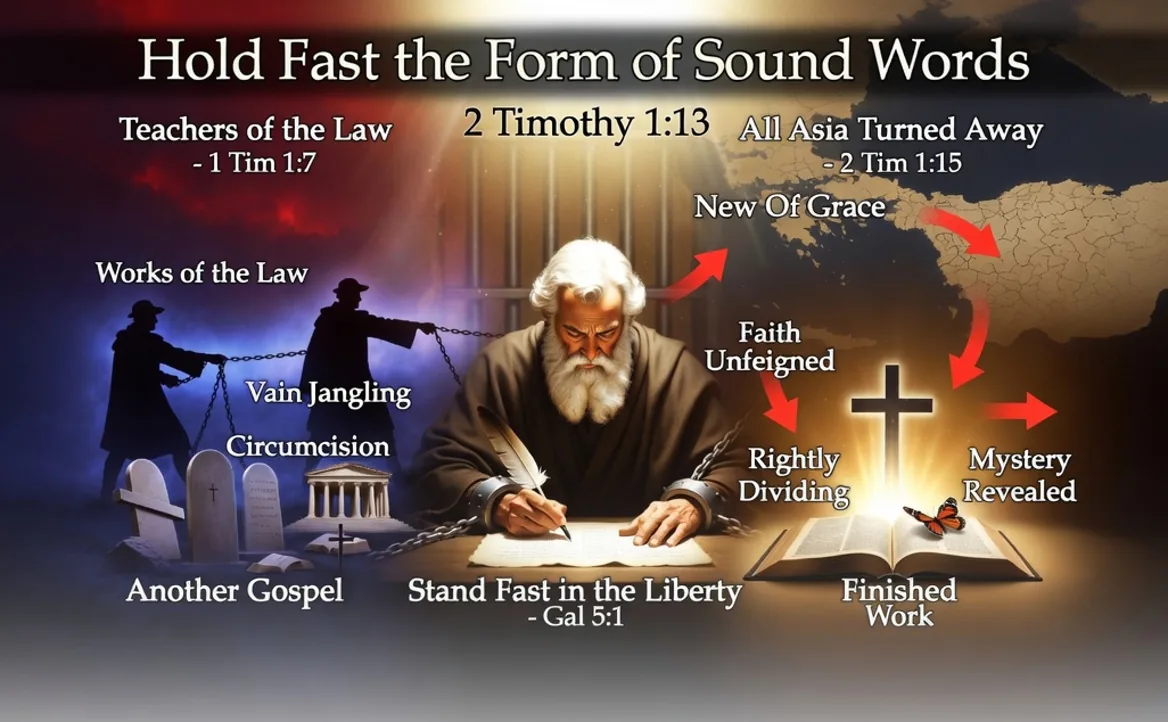
The first departure is the forsaking of Paul. It is the most painful thread in his last letters, and it is not a vague decline but a documented fact, written from a Roman prison by a man facing the sword:
"This thou knowest, that all they which are in Asia be turned away from me; of whom are Phygellus and Hermogenes." (2 Timothy 1:15 KJV)
All Asia — the very region where Paul had labored hardest. And not only the unnamed crowd:
"For Demas hath forsaken me, having loved this present world, and is departed unto Thessalonica." (2 Timothy 4:10 KJV)
"At my first answer no man stood with me, but all men forsook me." (2 Timothy 4:16 KJV)
As noted at the outset, this was no surprise to Paul. He had foretold it as a certainty, and named both directions it would come from — the wolves from without and the risen men from within:
"For I know this, that after my departing shall grievous wolves enter in among you, not sparing the flock. Also of your own selves shall men arise, speaking perverse things, to draw away disciples after them." (Acts 20:29-30 KJV)
To forsake Paul was never merely to drop a man from one's affections. It was to let go of the revelation of the mystery, for the risen Christ gave that revelation to him alone: "by revelation he made known unto me the mystery" (Ephesians 3:3 KJV). When the churches released their own apostle, they released the only deposit that kept them from sliding back into law, ritual, and works. This first departure — the early drift away from Paul's sound words, the teachers of the law, the wolves and the drawing-away of disciples — is traced in full in the companion study, Teachers of the Law: The Early Departure from Pauline Doctrine. Here we set it beside the other departure that ran alongside it.
The second departure is the apostasy inside Israel's believing remnant. John, writing to that company, describes men leaving it:
"Little children, it is the last time: and as ye have heard that antichrist shall come, even now are there many antichrists... They went out from us, but they were not of us; for if they had been of us, they would no doubt have continued with us: but they went out, that they might be made manifest that they were not all of us." (1 John 2:18-19 KJV)
Peter describes the same corruption rising within the same company:
"But there were false prophets also among the people, even as there shall be false teachers among you, who privily shall bring in damnable heresies, even denying the Lord that bought them." (2 Peter 2:1 KJV)
So the two departures must not be confused. One was a defection from the Body's program — believers turning back from the grace and mystery committed to Paul. The other was a defection from Israel's program — apostates going out from the believing remnant. Different peoples, different hopes, different defections. And yet they happened in the same hour, and their effects converged.
The Seed of Both: Another Jesus, Another Spirit, Another Gospel
Why did two distinct companies fall at the same time? Because the same method was used on both, and Paul had named it years before. Writing to Corinth, he reached back to the garden:
"But I fear, lest by any means, as the serpent beguiled Eve through his subtilty, so your minds should be corrupted from the simplicity that is in Christ. For if he that cometh preacheth another Jesus, whom we have not preached, or if ye receive another spirit, which ye have not received, or another gospel, which ye have not accepted, ye might well bear with him." (2 Corinthians 11:3-4 KJV)
Mark the pattern, because it is the seed of every departure in both companies. The serpent did not march into the garden denying God. He questioned the word — "Yea, hath God said" — then flatly denied it — "Ye shall not surely die" — and then offered a counterfeit that flattered the hearer — "ye shall be as gods" (Genesis 3:1, 4-5 KJV). The battlefield was never the body; it was the mind, the realm of what is true. And the counterfeit was not a different deity announced under a different name. It was another Jesus, another spirit, another gospel — the real names worn over a substituted substance, close enough to be received without alarm.
That is exactly how both companies were taken, though the counterfeit wore a different face in each. The men who drew disciples away from Paul did not curse Christ; they preached a Jesus who required circumcision and law-keeping to complete what grace had begun — another Jesus by addition. The men who went out from the remnant reached the same end by the opposite road. They did not announce themselves as antichrists, but Peter names precisely what they were doing — "denying the Lord that bought them" (2 Peter 2:1 KJV), putting another in the place of the Lord's Christ (Luke 2:26) — and John names the spirit behind it: the liar "that denieth that Jesus is the Christ" (1 John 2:22 KJV). Add law to Christ or deny Him for another — either way the true Christ is exchanged for a false one. In each case the word was first questioned, then denied, then overlaid with a self-serving imitation. Satan does not need to erase the gospel. He only needs to add an and to it — faith and works, grace and law, the mystery and the earthly kingdom program — and call the result by the old, trusted names. Two companies, one serpent, one method. This is why the departures were simultaneous: they were not two accidents but one campaign.
And the method has a final form still ahead. The spirit that denies the true Christ is the same spirit that will at last receive the false — "this is that spirit of antichrist, whereof ye have heard that it should come; and even now already is it in the world" (1 John 4:3 KJV). The Lord foretold the end of it to Israel: "I am come in my Father's name, and ye receive me not: if another shall come in his own name, him ye will receive" (John 5:43 KJV). That other is the man of sin, who "as God sitteth in the temple of God, shewing himself that he is God" (2 Thessalonians 2:4 KJV) — the counterfeit of the true "God was manifest in the flesh" (1 Timothy 3:16 KJV). His hour belongs to the prophetic program, after the Body is taken and God resumes His dealing with Israel and the nations; but the heart that will fall for him is the very one already among us — the heart that, offered the Lord's Christ, prefers another. Whoever will not have the true Jesus has, in the end, only made room for the false.
Why the Early Record Is Nearly Silent on Paul's Gospel
Here the two departures explain something that troubles many honest readers: if Paul's gospel of the mystery is the truth for this age, why is the early post-apostolic record so thin on anyone holding it? Why do the surviving voices so quickly speak of bishops, sacraments, law-keeping, and works, and so rarely of the finished work and the new creature complete in Christ?
The answer is written plainly into Paul's own last letters. The silence is not evidence that his gospel was a later invention; it is the fruit of the forsaking. If "all they which are in Asia be turned away from me" (2 Timothy 1:15 KJV) during Paul's own lifetime, then the religion that survived into the next generation was, by and large, the religion that had won — the blended, law-tinged message of the men who drew the disciples away — not the mystery that had been abandoned. Paul foretold the very preference that would shape the record:
"For the time will come when they will not endure sound doctrine; but after their own lusts shall they heap to themselves teachers, having itching ears; And they shall turn away their ears from the truth, and shall be turned unto fables." (2 Timothy 4:3-4 KJV)
A record kept by the side that prevailed will naturally preserve the doctrine of the side that prevailed. That the early centuries speak in the accents of the wolves rather than the flock is precisely what Paul said to expect. It is no argument against the truth he was given; it is the casualty list of the war he described. The specific evidence of how the so-called church fathers carried that blended religion forward is laid out in the companion study already named; the point here is only that the silence has a cause, and the cause is the forsaking itself.
There is a plain consequence in this, and it is worth saying out loud. What is handed down to us as "the history of the Christian church" is, for most of its length, the history of the apostate church. The councils and the creeds, the fathers and the cathedrals, the long unbroken line of bishops — that is the record of the institution that forsook Paul, not of the Body that kept his gospel. The faithful who held the grace of the mystery left few monuments; the system that displaced them wrote the books. So to appeal to "church history," or to "the historic church," against the rightly divided gospel of Paul is, more often than not, to call the defectors to the witness stand against the very apostle they deserted. The pedigree is real enough — but it is the pedigree of the departure, not of the truth.
The Wrong Apostle Enthroned
Now the strange thing. Out of that vacuum a new religious order rose, and at its head it set not Paul but Peter — and it has called Peter its first head ever since. This is the deepest irony of church history, and right division exposes it at a glance.
Peter was an apostle. But his office was fixed, and it was not over the Body of Christ. He was one of the twelve to whom the Lord said:
"Verily I say unto you, That ye which have followed me, in the regeneration when the Son of man shall sit in the throne of his glory, ye also shall sit upon twelve thrones, judging the twelve tribes of Israel." (Matthew 19:28 KJV)
Twelve men, twelve thrones, twelve tribes — a closed and earthly office belonging to Israel's kingdom program. And the division of labor between Peter and Paul was settled openly, by the apostles themselves:
"But contrariwise, when they saw that the gospel of the uncircumcision was committed unto me, as the gospel of the circumcision was unto Peter." (Galatians 2:7 KJV)
"They gave to me and Barnabas the right hands of fellowship; that we should go unto the heathen, and they unto the circumcision." (Galatians 2:9 KJV)
Peter to the circumcision; Paul to the heathen. There is no Scripture in which Peter's office is handed to a successor, and there could not be, for the twelve are a numbered company with their own thrones. So the claim that the bishop of Rome inherits Peter's chair is program-mixing twice compounded: it takes an office that belonged to Israel's earthly kingdom, declares it transferable when Scripture never does, and then plants it at the head of a Gentile religious empire whose gospel is salvation by works. (How the line of Roman bishops was actually constructed is a matter of later tradition, not of Scripture, and is best held loosely; the doctrinal error does not depend on the genealogy but on the category.)
Nor was this reversal an invention of later centuries. The instinct that would one day crown Peter and shelve Paul was already stirring while Paul lived, and he had to meet it head-on. His apostleship was openly questioned. At Corinth they weighed him by his appearance and found him wanting — "his letters, say they, are weighty and powerful; but his bodily presence is weak, and his speech contemptible" (2 Corinthians 10:10 KJV) — and he had to put the plain question to them: "Am I not an apostle? ... have I not seen Jesus Christ our Lord?" (1 Corinthians 9:1 KJV). The partisan ranking had begun too, men sorting themselves under one name or another — "I am of Paul; and I of Apollos; and I of Cephas" (1 Corinthians 1:12 KJV) — as though Paul were merely one apostle on a list and not the apostle given to them.
To all of it Paul gave one answer: he stood second to none. "I suppose I was not a whit behind the very chiefest apostles" (2 Corinthians 11:5 KJV); "in nothing am I behind the very chiefest apostles, though I be nothing" (2 Corinthians 12:11 KJV). And as for the Jerusalem men themselves — the very three a later church would lift above him — Paul had already weighed the comparison and set it aside:
"But of these who seemed to be somewhat, (whatsoever they were, it maketh no matter to me: God accepteth no man's person:) for they who seemed to be somewhat in conference added nothing to me." (Galatians 2:6 KJV)
The pillars added nothing to Paul because they had nothing to add: his gospel came "not after man" but "by the revelation of Jesus Christ" (Galatians 1:11-12 KJV). And mark what those same pillars did when they saw that grace — "James, Cephas, and John, who seemed to be pillars" perceived it and gave Paul the right hand of fellowship, owning his separate field (Galatians 2:9 KJV). Here is the sharpest edge of the whole matter. The reversal the later church performed — Peter enthroned, Paul shelved — overturns the very thing the three apostles themselves acknowledged with their own hands. They confessed Paul's distinct, heaven-given apostleship and sent him to the heathen with their blessing; the men who later claimed to sit in Peter's seat denied it. To make Peter the head and Paul a footnote is not to follow the pillars at all — it is to undo them.
Set the whole thing side by side, then. The church should have held Paul — its own apostle, who magnified his office for its sake ("I am the apostle of the Gentiles, I magnify mine office", Romans 11:13 KJV) and pressed his words as binding ("the things that I write unto you are the commandments of the Lord", 1 Corinthians 14:37 KJV). It should have honored Peter rightly, as the apostle to the circumcision, without claiming his throne. Instead it did the exact reverse: it enthroned the apostle it had no claim to and forsook the apostle it was bound to follow. The forsaking of Asia is the cause; the chair of Peter is the monument raised over the empty place where Paul's gospel should have stood.
And what filled that empty place was not merely a new figurehead but a new message. The chair could not be kept without the gospel being lost, for the two apostles carried two different things: Peter the gospel of the circumcision, bound up with Israel's law and kingdom, and Paul the gospel of the grace of God for the Body. To seat the circumcision apostle over the church of the mystery is, of necessity, to drag the law back in — and the law brought back upon the Body is exactly what Paul branded another gospel. The seed he had feared at Corinth — "another Jesus ... another spirit ... another gospel" — came at last to full flower: a salvation by sacraments and works and law-keeping, faith with an and fastened to it, preached from the very seat that claimed Peter's name. And against that, Paul had pronounced sentence in advance, and twice over, that none might think he spoke it in haste:
"But though we, or an angel from heaven, preach any other gospel unto you than that which we have preached unto you, let him be accursed. As we said before, so say I now again, If any man preach any other gospel unto you than that ye have received, let him be accursed." (Galatians 1:8-9 KJV)
So the enthroning of the wrong apostle and the preaching of another gospel are not two errors but one. A church that would not keep Paul could not keep Paul's gospel; having let go the apostle of grace, it had nothing left to preach but the law the Body was never under — and to be justified by that law, Paul says, is to be "fallen from grace" (Galatians 5:4 KJV). The wrong apostle and the other gospel came in together, and they have kept company ever since.
And the turn by which this church came to power is stranger than all the rest. For its first three centuries, no one who bore the name of Christ — and no Jew — had a friend in Rome. The empire and its Caesars made war on Jew and Christian alike, and the careful line we have drawn between the two programs meant nothing to a magistrate or a mob: it mattered not whether a man was a remnant Jew waiting for the kingdom or a member of the Body resting in grace — if he was a Jew, or if the name of Christ was fastened to him, Rome's sword found him. Paul himself died under that sword, and so, by every account, did Peter; the two companies bled together under the one Rome. Then came the strangest stroke of all: that same Rome, which had spared neither, at length laid down the sword and embraced the deserters who had let the gospel go. The persecutor became the patron — and the empire that had killed the apostle lived to crown the men who claimed his colleague's seat.
Neither Remnant nor Body: the Religion of the Defectors
Set the religion that resulted beside the two true programs, and it matches neither. It was not the faith of the believing remnant — though it helped itself to that program's furniture wholesale: a priesthood, an altar, a sacrifice offered over and over, a holy city, a sacred calendar, all lifted out of Israel's earthly order and fastened onto the age of grace where they had no place. Neither was it the gospel of the grace of God committed to Paul, which it had already let go. What this church embraced was a third thing — the religion of the defectors: the very blend that the men who forsook Paul and the men who went out from the remnant had stitched together between them. The two departures did not merely empty the field; they left a mongrel faith lying in it, part law and part grace and whole to neither, and that is the faith the rising institution took up and crowned. It is the reason nothing in that system can be rightly divided: it was born of the refusal to divide — assembled out of pieces torn from two programs by men who had abandoned both.
And it did not stop at borrowing Israel's furniture; in the end it laid hold of Israel's very name. The same system that had shut out the nation declared itself the true Israel of God — heir to the covenants, the promises, and the prophecies, with the cast-off nation written clean out of them. This is the confusion at its height, and the Scriptures already weighed forbid it: God "hath not cast away his people which he foreknew" (Romans 11:2 KJV), and Israel's blindness is "in part" and only "until the fulness of the Gentiles be come in" (Romans 11:25 KJV). The Body of Christ does not become Israel, and Israel is not replaced by the Body. Paul's single use of the phrase runs the other way altogether: the Israel of God (Galatians 6:16) is the believing remnant who crossed by faith into the Body, not a Gentile institution seizing the name of a nation God has only set aside for a season. To wear Israel's name while denying Israel's future is the defectors' error carried to its end — the refusal to divide, hardened into a creed.
Let it be said clearly, lest the frame be misread: none of this makes Peter an apostle of the Body, and none of it drags the twelve into this dispensation. The point is the opposite. The twelve are fixed in Israel's program, which is exactly why Rome's claim on Peter is illegitimate, and exactly why the church that made that claim had already lost its bearings — it no longer knew which apostle was given to it.
What Became of the Remnant and Their Families
If the Body's people forsook Paul, and the institution that followed seized Peter's name, what became of the believing remnant of Israel itself — the godly Jews who loved Messiah, and their children?
Scripture settles the principle, though it does not trace individual bloodlines, and we will not pretend it does. Three things happened.
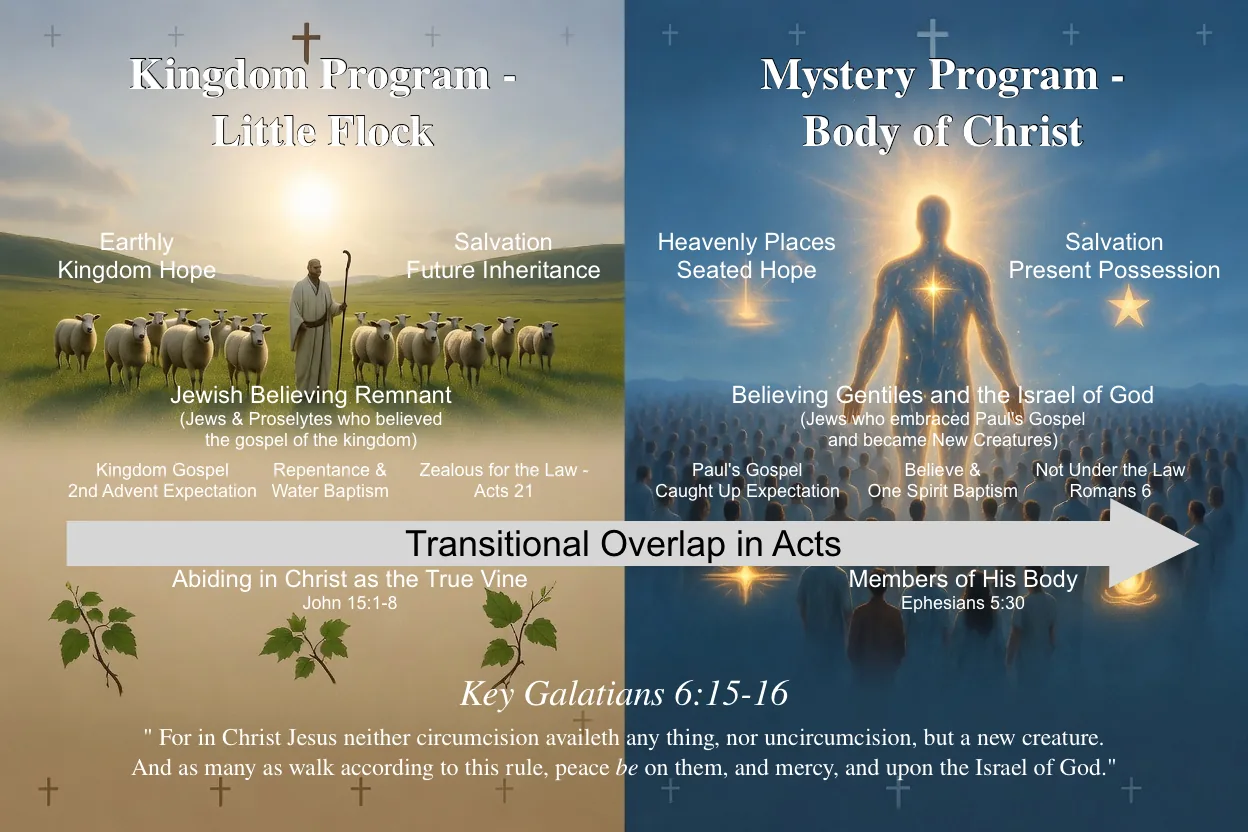
First, individuals crossed. Any remnant believer who heard and believed Paul's gospel during the overlap passed by faith out of the company being set aside and into the one Body — Barnabas, Silas, Apollos, the great company gathered at Antioch. That door opened by faith in the mystery, one soul at a time, never by Jewish descent and never by whole families carried through on a forefather's faith. This crossing is the subject of its own study, Did Any Remnant Believer Cross Into the Body of Christ?; the short of it is that such believers and their households simply became part of the Body, their descent thereafter meaning nothing for standing.
Second, the law-zealous majority did not cross. Deep into the Acts period the believing remnant at Jerusalem was still marked by the law:
"Thou seest, brother, how many thousands of Jews there are which believe; and they are all zealous of the law." (Acts 21:20 KJV)
These were genuine believers in their Messiah, living under the kingdom program, waiting for the kingdom. By the time Jerusalem fell, the kingdom already stood postponed, and that company and its generations passed off the stage of the present dispensation. Their line was not destroyed — God preserved it — but it went into abeyance along with the program to which it belonged.
Third, the apostates became the leaven. The men who went out from us (1 John 2:19) and the false teachers among them (2 Peter 2:1) did not vanish; they fed the corrupting, antichrist stream that helped produce the counterfeit religion already described.
The decisive thing, and the comfort in it, is that Israel's program is postponed, not cancelled. God did not throw away the remnant when their nation was scattered:
"I say then, Hath God cast away his people? God forbid... God hath not cast away his people which he foreknew." (Romans 11:1-2 KJV)
"That blindness in part is happened to Israel, until the fulness of the Gentiles be come in. And so all Israel shall be saved." (Romans 11:25-26 KJV)
The believing seed of Israel is preserved against a day still future. When the fulness of the Gentiles is come in and this present dispensation closes, God resumes His covenant dealing with His people, and a believing remnant rises again to carry the kingdom gospel to the coming of the King. As for those of the old remnant who crossed over by faith into the one Body, Paul has a name for them — not the church usurping Israel's place, but the faithful who believed the mystery: "peace be on them, and mercy, and upon the Israel of God" (Galatians 6:16 KJV).
So the remnant was neither absorbed wholesale nor abandoned. Its true members either crossed into the Body by faith in Paul's gospel or were set aside with their program, kept by God for the day He takes up that program again.
But God Left Not Himself Without Witness
For long centuries, it appears, the witnesses to Paul's gospel were all but silenced. As the apostate church rose to prominence and power, those who held the simple gospel of grace were pushed to the margins and into obscurity, their voices buried under the weight of the institution — which is exactly why, as we have seen, the surviving record speaks so little of them. To read that silence as the absence of truth, however, is to mistake a buried seed for a dead one.
For God has never left Himself without a witness:
"Nevertheless he left not himself without witness, in that he did good, and gave us rain from heaven, and fruitful seasons, filling our hearts with food and gladness." (Acts 14:17 KJV)
Paul spoke that of God's witness in creation, but the principle reaches wider: God does not surrender His truth to oblivion. His preacher could be bound — yet, as Paul wrote from his own prison, "the word of God is not bound" (2 Timothy 2:9 KJV). The mystery had once been "hid in God" (Ephesians 3:9 KJV), kept secret "from ages and from generations" (Colossians 1:26 KJV) until He chose to reveal it; and what God had hidden and then revealed, men might bury again, but they could not destroy. The thirteen epistles were preserved through every dark stretch, waiting to be read.
It helps to picture the plain mechanics of those centuries, for they were nothing like ours. There was no printing press. For roughly fourteen hundred years after Paul, every copy of his epistles was made by hand, slowly, one at a time, at great labor and cost; so copies were few and precious, and the ordinary believer never owned a Bible at all. These were not people with a completed book lying on the table to be opened at will. From the very first it had been otherwise than we tend to imagine: Paul's letters were read aloud in the assembly and passed from one congregation to the next — "when this epistle is read among you, cause that it be read also in the church of the Laodiceans" (Colossians 4:16 KJV); "I charge you by the Lord that this epistle be read unto all the holy brethren" (1 Thessalonians 5:27 KJV). The word was meant to be heard and obeyed, and in an age of hand-copied manuscripts that hearing depended wholly on who held the few copies and what they chose to do with them.
And from the common people those Scriptures were very nearly kept altogether. By every account they were shut away — locked in a tongue the ordinary man could not understand, chained behind the walls of monasteries, their reading forbidden to the masses — so that for generations the people had no way to weigh what they were taught against what Paul had written. A gospel of works and sacraments is always safest where the epistles of grace cannot be opened.
Nor was that preserved word only ink on hidden pages; it had living bearers — though history has remembered most of them through the slanders of the men who hunted them. All down the dark centuries there ran a thin and much-maligned line of companies that would not bow to the sacramental system of Rome: the Paulicians of Armenia and Asia Minor, who treasured and copied the very epistles of Paul; the Waldenses of the Alpine valleys, who carried the Scriptures in the common tongue and refused the priest, the mass, and purgatory; the Lollards who followed Wycliffe, the Bohemians who followed Hus, and at the last the Anabaptists, drowned and burned by Catholic and Protestant alike for holding that a man is joined to Christ by faith and not by a font. Let it be measured by our own rule, that the history is not the doctrine: these were not men who had recovered the rightly divided gospel of Paul in its fulness. They held the truth in part and mingled with error, and what records survive of them were written largely by their enemies, who painted them blacker than they were — so that even now the honest reader must labor to tell the believer from the heretic among them. But one thing runs through the whole line, and it is the thing Rome could not forgive: a people who went back to the Book above the church, and found in it a salvation by grace through faith that the system around them had buried. Hear it confessed at the stake. As eighty believers were given to the flames at Strassburg in 1212, their elder, a man named John, declared: "We are all sinners, but it is not our faith that makes us so... but we expect the forgiveness of our sins, and that without the help of men, and not through the merit of our own works" (recorded in E. H. Broadbent, The Pilgrim Church). That is not the voice of Rome; it is the old gospel of grace, spoken from a burning pile six full centuries before the modern pulpit imagines it was first recovered.
And mark how the persecution itself testifies. A dead seed draws no plowman's hatred; it is the living shoot that is trodden down. The malice was not careless but minute, reaching even to the smallest kindness shown a prisoner: under the inquisitors, Foxe records, "to convey to those who were confined, a little straw, or give them a cup of water, was called favouring of the heretics," and the very bones of the dead "were dug up and burnt, as examples to the living" (Foxe, Book of Martyrs). That Rome spent whole centuries hunting these companies, burning their books along with their bodies, is not the mark of a truth safely buried but of a truth that would not stay buried — breaking the surface in one valley and then another, in one generation and then the next, no matter how often it was struck back into the ground.
The persecuted knew this of themselves, and said it better than their enemies could deny it. One of their own chronicles, kept by the hunted Anabaptists of Austria, looked back across the wreck of the centuries and confessed that God had never let His witness fail: "God did not let His Church disappear altogether... if at times scarcely two or three could be found, yet the Lord, according to His promise, has never forsaken them... So the kingdom of Christ, from the Apostles' time until now, has wandered from one nation to another, until it has come to us" (quoted in The Pilgrim Church). They claimed more than the record can prove — an unbroken, visible succession from the apostles — and we need not follow them that far; it is enough that the lamp was never wholly dark, and that in every age some hand was found to hold it until the hour came when it could blaze abroad.
Then, from within the apostate church itself, the word began to break out — and it broke out by means God had newly placed within men's reach. The freshly invented printing press could multiply the Scriptures faster than any institution could collect them or forbid them, and faithful men set themselves to translate the word out of the clerical tongue into the language of the common people. For the first time in the long story, Paul's epistles could pass into ordinary hands by the thousand. The Protestant Reformation, whatever else may be said of it, recovered the buried heart of Paul's gospel: that a man is justified by faith, freely, by grace, and not by the works of the law. Driven back to Romans and Galatians, Luther and those who followed struck at the works-righteousness that had reigned for a thousand years and labored to put the Scriptures back into the language and the hands of the people. It was a true recovery, and a costly one.
And recovery is the right word, for it was not the discovery of any new truth. Nothing was added to the word; the doctrine did not develop. What surfaced in the Reformation had stood in Paul's epistles the whole time — justification by faith, grace apart from works, the finished work of the cross — closed off for centuries only because men had shut the book, not because the truth was not yet there to be read. The Reformers did not invent a gospel; they unsealed one. When the page was opened again, the truth that met them was the same truth Paul had written with his own hand, untouched by the dark between.
But let it be measured honestly, in keeping with our own rule about doctrine and history. The Reformation recovered the grace of Paul's gospel without yet recovering the full rightly dividing of it. The Reformers brought back justification by faith, but they carried much of the old religion forward with them — its calendar, its blended reading of Scripture, its mingling of Israel's program with the Body's — and the clear distinction of the mystery, Paul's separate apostleship, and the dispensation of grace came into focus only later, as others kept following the thread back to Paul. That fuller recovery, and the line of witnesses through whom the pure grace of Christ was never wholly lost, is traced in the companion study already named. The point here is simpler and surer than any genealogy of it: the same God who kept Israel's remnant against a day still future kept also a witness to the gospel of grace through the long night. He left not Himself without witness — so that the truth buried with Paul has, in every age since, found someone to carry it.
The Same Two Errors, Still With Us
This is not a tour of ancient ruins. The two departures and the one counterfeit are the standing temptations of every generation, and the test that exposes them has not changed.
The test is the one Paul gave Corinth: another Jesus, another spirit, another gospel. The danger is rarely a Christ openly denied. It is a Christ subtly added to — a gospel that keeps the trusted names while substituting works for the finished work, law for liberty, ritual for the new creature complete in Him. That is what drew Asia away from Paul; that is what hollowed out the remnant; that is what was crowned when the wrong apostle was enthroned. And it still comes wrapped in the language of righteousness and deeper commitment, which is the only disguise it has ever needed.
And here is the deepest reason it is so seldom caught: we look for deception in the wrong shape. We picture it with horns — open wickedness, the worship of the devil, a Christ plainly denied — and so we never see the thing Paul actually warned us to watch for:
"For such are false apostles, deceitful workers, transforming themselves into the apostles of Christ. And no marvel; for Satan himself is transformed into an angel of light. Therefore it is no great thing if his ministers also be transformed as the ministers of righteousness." (2 Corinthians 11:13-15 KJV)
Mark every word. Satan does not approach as himself; he comes "transformed into an angel of light." His ministers do not announce themselves as servants of darkness; they are transformed "as the ministers of righteousness." The great deception is not a black mass; it is a beautiful sermon. It is not the worship of the devil; it is another Jesus — preached by earnest men who exalt good works, who speak movingly of holiness and commitment and obedience, and who by every word of it draw the soul away from resting in the finished work and back onto its own performance. The lie does not come hissing; it comes preaching. It wears the robe and quotes the Book. That is precisely why so few flee it: it looks like the very thing they were seeking, and a man does not run from an angel of light.
The safeguard is also unchanged. We hold fast the apostle given to us, and the gospel committed to him, and we refuse the and that the serpent has always offered. The light Paul preached was nearly extinguished in his own lifetime, and the institution that followed lit a different lamp and called it his; but God left not Himself without witness, and in every generation since, some have opened the epistles again and found waiting there the simplicity that is in Christ — the same truth, never altered, only shut up for a season by the hands of men. May we be among them — knowing which apostle is ours, and standing fast in the liberty wherewith Christ hath made us free.
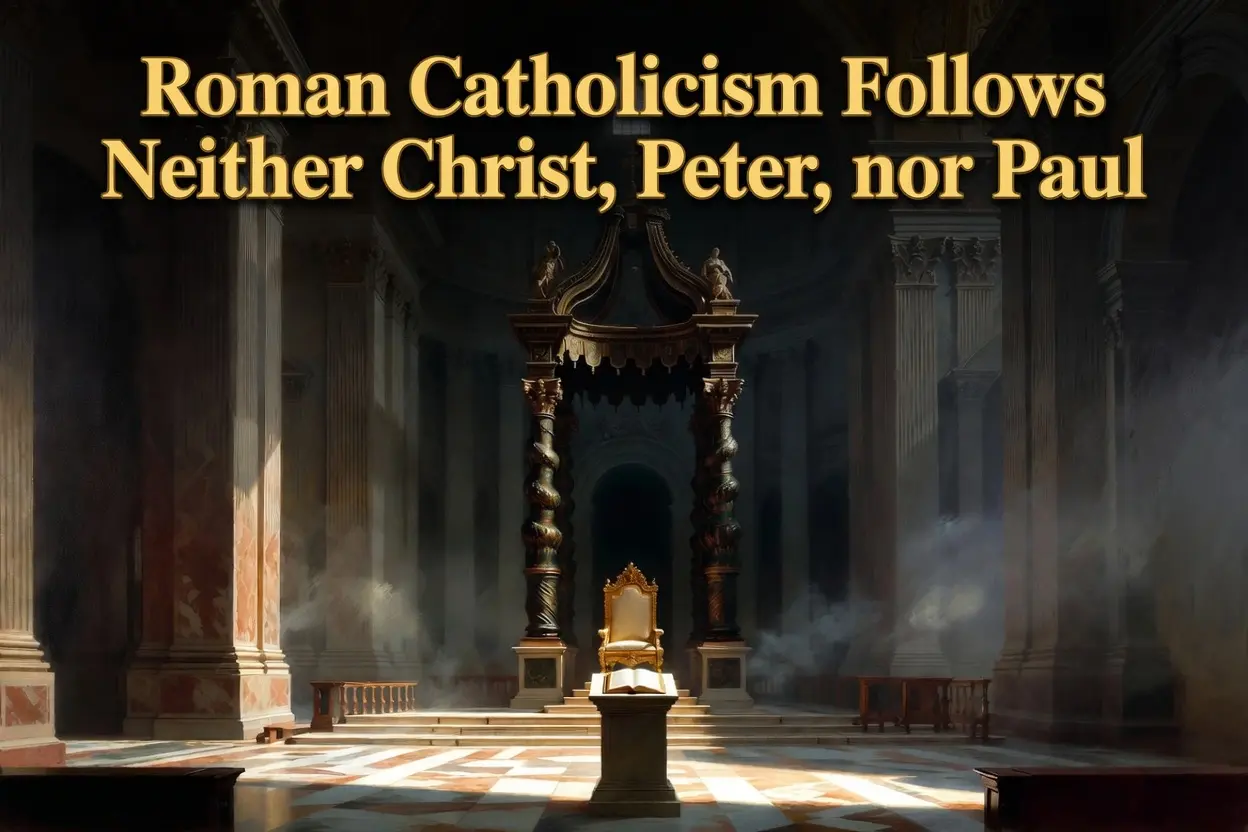
And for this same right division turned upon the greatest monument the counterfeit ever raised — the church that to this day claims Christ, Peter, and Paul at once, and follows none of the three — see the companion study, Roman Catholicism Follows Neither Christ, Peter, nor Paul.
© 2026 Edward R. Cross

Comments
No comments yet. Be the first to share your thoughts.
Leave a comment