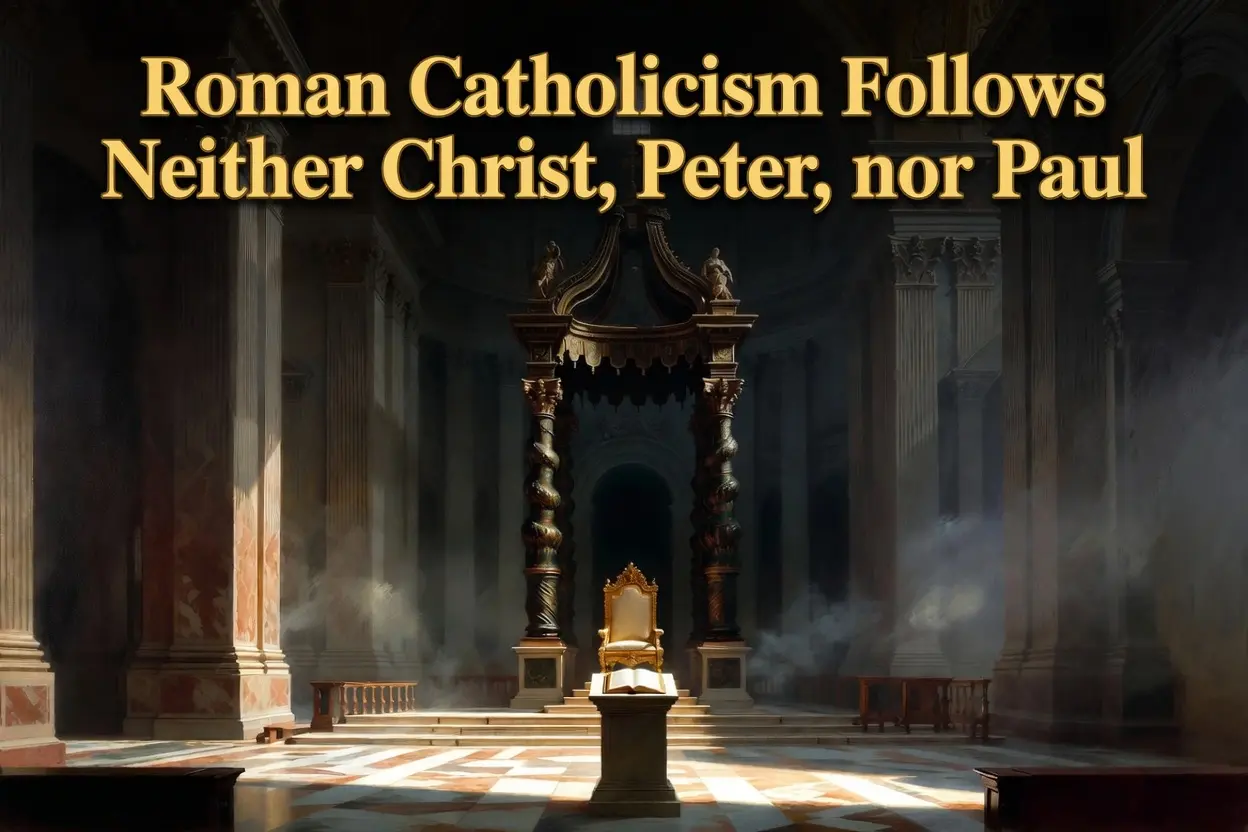
The Roman Catholic Church — Rome, for short — is bold where most religions are timid. It does not claim to follow one authority; it claims to follow three. It calls its head the vicar of Christ, so it claims the Lord Himself. It seats that head in the chair of Peter and traces an unbroken line of succession back to the apostle, so it claims Peter. And when it wants a Scripture for justification, sacrament, or office, it will reach into the epistles and quote Paul. Christ, Peter, Paul — the Roman Church says all three are hers.
The claim is worth taking seriously, because it can be tested. Put the Christ of Scripture, the Peter of Scripture, and the Paul of Scripture on the table, one at a time, and ask a simple question of each: does Rome follow this one? What comes back is not a near miss on any of the three. It is a clean miss on all three. Rome follows a fourth thing, and that fourth thing is the reason it can wear the names of the other three while obeying none of them.
Before going further, one thing must be said plainly and meant. The subject here is a system of doctrine, not the millions of sincere people inside it, many of whom love the Lord as far as they have been shown Him and have never once been handed the distinctions this study will draw. The aim is not to score against them. It is to lay the three authorities side by side so that anyone — Catholic, Protestant, or neither — can see for himself what happens to the word of God when its parts are melted together instead of rightly divided.
The one tool the whole argument turns on
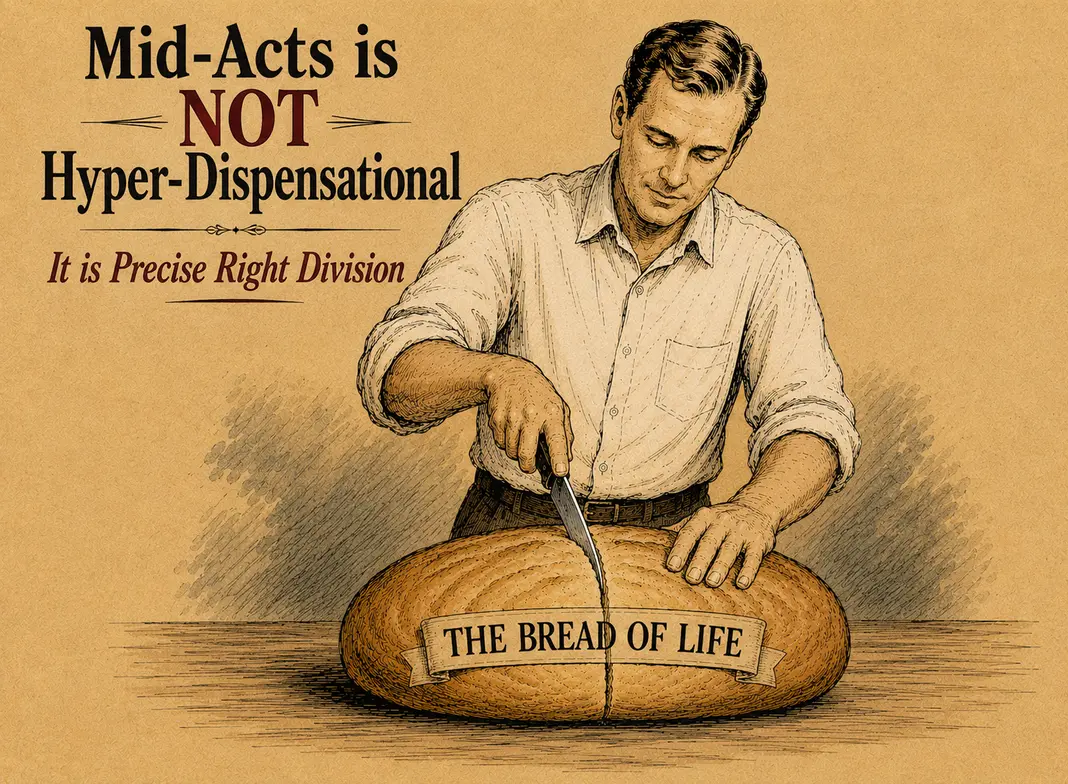
There is a single instruction in all of Scripture that tells the believer what to do with the word of God as a whole, and it is Paul's: "Study to shew thyself approved unto God, a workman that needeth not to be ashamed, rightly dividing the word of truth" (2 Timothy 2:15 KJV). To rightly divide is to recognize that God has not run one undifferentiated program from Genesis to Revelation, but has dealt with Israel under prophecy and law, and now deals with the Body of Christ under the revealed mystery of grace. The two are not enemies; they are not the same. What God commanded through Peter to a covenant nation is not automatically what God commands through Paul to the Body of Christ.
Keep that tool in hand, because it is the exact tool Rome laid down. Nearly every error that follows is the same mistake wearing a different robe: material that belongs to Israel's earthly program is lifted out of its place and installed as the permanent machinery of a Gentile church. Watch it happen three times.
Not Christ
Rome's boldest word is vicar — a stand-in, one who acts in the place of Christ on the earth. But which Christ does Rome stand in for? Look closely and it is always the Christ of the earthly ministry: the Sermon on the Mount read as church law, the Upper Room read as a perpetual altar, the Gospels mined for sacraments. Rome fastens itself to the Lord as He walked among Israel and freezes that moment into a religion.
Here is what that Christ said He was doing. Paul, looking back, names the whole earthly ministry in one line: "Now I say that Jesus Christ was a minister of the circumcision for the truth of God, to confirm the promises made unto the fathers" (Romans 15:8 KJV). Read it slowly, because every word carries freight. A minister — He served. Of the circumcision — not the uncircumcised nations, but Israel. For the truth of God — to vindicate God's faithfulness. To confirm the promises — the covenants already made. Unto the fathers — Abraham, Isaac, Jacob, and the prophets. The earthly Jesus came to Israel, on covenant business, to make good what God had sworn to the fathers. He was offering a nation its promised kingdom.
Now notice what the verse does not say, because that is where Rome went wrong. It does not say He came to found a Gentile priesthood. It does not say He came to institute an altar in Rome, or to plant a chair over the nations, or to hand a sacramental system to the whole world. Every one of those things Rome reads into the earthly ministry; not one of them is in it. Rome claims to stand in for Christ, and then puts words in His mouth He never spoke to a program He was not addressing.
So the first claim fails in a way most critics never notice. It is not merely that Rome adds to Christ. It is that Rome does not even follow the earthly King on His own terms. His kingdom offer was to a nation, with a throne and a land and covenants (Acts 1:6). Rome kept the trappings — an altar, a priesthood, holy days, a sacred city — and swapped out the nation for an institution, then called the institution "the kingdom." You cannot be the vicar of a King whose kingdom you have quietly replaced. Rome follows a Christ of its own construction, and not the Christ who spoke.
And a deeper miss lies folded inside the first. The Christ who walked in Galilee did not stay there; He died, rose, ascended, and became the living Head of a new thing — God "gave him to be the head over all things to the church, Which is his body" (Ephesians 1:22-23 KJV) — and from heaven that risen Christ made known a secret He had told no one before, committing it to Paul (Ephesians 3:2-3). That is the Christ of the present hour: no longer the minister of the circumcision confirming Israel's promises, but the glorified Head governing His Body through the apostle He raised up for it. And this Christ Rome will not have. It knows Him only after the flesh, frozen in the days of His earthly ministry — the very thing Paul says the Body must not do: "though we have known Christ after the flesh, yet now henceforth know we him no more" (2 Corinthians 5:16 KJV). To cling to the earthly Christ and refuse the revelation the ascended Christ gave through Paul is not to follow Christ more closely; it is to stop following Him at the cross and to miss all He has said and done since. Rome venerates the Christ of the manger and the mount, and turns its back on the Christ at the right hand of God.
Not Peter
The second claim is the load-bearing one, because everything else in Rome rests on it. Take away Peter's chair and the papacy has no floor. And the whole chair is built on a single verse: "That thou art Peter, and upon this rock I will build my church; and the gates of hell shall not prevail against it" (Matthew 16:18 KJV). Rome reads it as a charter: Peter is the rock, the rock is the foundation, the foundation is a perpetual office, and that office sits in Rome.
Try the verse first the way Rome hears it — "upon this rock I will build my church" — and it does sound like a stone being laid, a man being made a foundation. Now restore the verse to its setting, and the reading collapses. Two verses earlier Peter had said something, and the "rock" is the something, not the someone. Peter had just confessed: "Thou art the Christ, the Son of the living God" (Matthew 16:16 KJV). That is the rock — the confessed Christ — and it is Christ building His assembly upon Himself. Paul settles the identity of the Rock for anyone still guessing, using the same figure and refusing to leave it open: "and that Rock was Christ" (1 Corinthians 10:4 KJV). The Rock is never the apostle. It is the One the apostle named.
And there is a second thing in Matthew 16 that Rome walks straight past. The word is "church" — a called-out assembly — and it is spoken by Israel's Messiah, inside Israel's program, to a Jewish disciple, before the Body of Christ had been made known to anyone. Whatever assembly the Lord meant here, it is not the Gentile institution Rome built, because that Body was still an unrevealed secret at the time these words were spoken. Rome takes a promise made inside the earthly kingdom program and hands it to a Roman bureau. The office it claims is not weakly supported by the verse; it is simply not in the verse.
Rome leans just as hard on the verse that follows, where the Lord adds, "And I will give unto thee the keys of the kingdom of heaven: and whatsoever thou shalt bind on earth shall be bound in heaven" (Matthew 16:19 KJV). From this it claims for the pope the power to admit and to shut out, to bind and to loose, and to absolve. But look what the keys are of — the keys of the kingdom of heaven, Israel's promised kingdom, with the Body nowhere in the sentence. And watch Peter actually use them, for the record shows him do it: he turned the key to open the kingdom to Israel at Pentecost, and turned it again to open the door to the Gentiles, so that he could say at Jerusalem that God had chosen that "the Gentiles by my mouth should hear the word of the gospel" (Acts 15:7 KJV). But a key opens a door once; it is not an office passed down. When Peter had opened the kingdom to Jew and Gentile alike, the keys had done their work, and there was no lock left for a successor to turn. As for the binding and loosing, it is the language of the kingdom assembly's discipline, and the Lord spoke it again to the whole company, not to Peter alone, in Matthew 18 — never a private papal power over the conscience of the Body.
Set the exegesis aside, though, and let the man himself answer. Rome says Peter ruled the church as its first infallible head. Watch the real Peter:
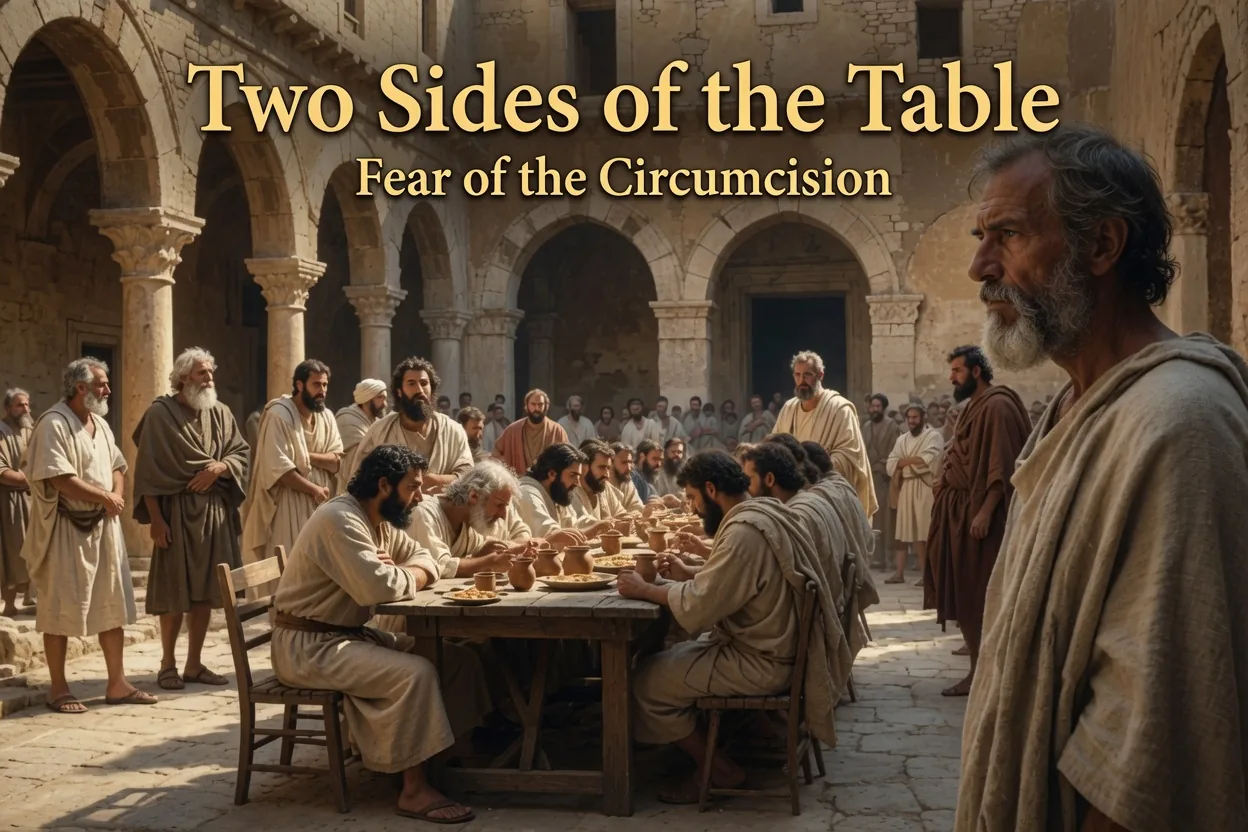
He kept the law and went to his own nation. When the apostles sorted out their spheres, the record is explicit: "the gospel of the uncircumcision was committed unto me, as the gospel of the circumcision was unto Peter" (Galatians 2:7 KJV), and they "gave to me and Barnabas the right hands of fellowship; that we should go unto the heathen, and they unto the circumcision" (Galatians 2:9 KJV). Peter's field was the circumcision — Israel. He was never assigned the nations at all.
He had a wife. Paul mentions it in passing as a plain fact: "Have we not power to lead about a sister, a wife, as well as other apostles, and as the brethren of the Lord, and Cephas?" (1 Corinthians 9:5 KJV). Cephas is Peter. The man Rome makes the founder of a celibate priesthood was a married man, and no one thought it strange.
He preached a coming earthly kingdom and looked for it, exactly as the prophets had — a salvation tied to Israel's covenants and Israel's King (1 Peter 1:10-11), the same kingdom the apostles were still asking about at the ascension: "Lord, wilt thou at this time restore again the kingdom to Israel?" (Acts 1:6 KJV).
He ranked himself among the elders, not over them, and forbade the very lordship Rome exercises in his name. Writing to shepherds, he calls himself "also an elder" and charges them to take the oversight "Neither as being lords over God's heritage, but being ensamples to the flock" (1 Peter 5:1,3 KJV). The man Rome enthroned as lord of the whole church expressly refused to lord it over even a local flock, and set himself beside the other elders, not above them.
He would not so much as let a man kneel to him. When Cornelius "fell down at his feet, and worshipped", "Peter took him up, saying, Stand up; I myself also am a man" (Acts 10:25-26 KJV). Set that beside the kneeling, the ring, and the reverence rendered to the man Rome calls Peter's successor, and the gap between the real apostle and the office built on his name is the full width of the gospel.
And then the verse that ends the argument. Rome's claim is not merely that Peter led, but that Peter's chair cannot err. Yet here is Paul: "But when Peter was come to Antioch, I withstood him to the face, because he was to be blamed" (Galatians 2:11 KJV). Read it as it stands. Peter was to be blamed — he was in the wrong. And Paul withstood him to the face — openly, publicly, over the truth of the gospel. An apostle who can be publicly corrected for compromising the gospel is not an apostle who reigns from an unerring seat. One verse dissolves both supremacy and infallibility together: if Peter could be wrong enough to need Paul's public rebuke, Peter's "chair" cannot be what Rome says it is.
Nor was Peter ever the bishop of Rome. Paul, writing to Rome and later from near it, tells us plainly he labored "not where Christ was named, lest I should build upon another man's foundation" (Romans 15:20 KJV) — and he claimed to be "in nothing... behind the very chiefest apostles" (2 Corinthians 12:11 KJV). There is no Petrine see in the record; it is a later invention read back into a silence. Rome claims Peter and then contradicts the Peter it claims — married where Rome is celibate, sent to Israel where Rome rules the nations, correctable where Rome is infallible, looking for a kingdom Rome traded away.
Not Paul
If Rome fails to follow the Christ it stands in for and the Peter it seats, one might expect it at least to follow Paul, whom it quotes. It fails here most thoroughly of all — and this is the deepest failure, because Paul is the apostle whose doctrine actually governs this present time.
Paul is the one genuinely sent to the nations: "For I speak to you Gentiles, inasmuch as I am the apostle of the Gentiles, I magnify mine office" (Romans 11:13 KJV). Peter had the circumcision; Paul had the heathen. If Rome is a Gentile church — and it is — then the apostle it is bound to follow is Paul, not Peter. Yet the man Rome should be reading is the man Rome most completely buries. Lay Rome's system beside Paul's gospel and they contradict at every joint.
On how a sinner is justified. Paul: "Being justified freely by his grace through the redemption that is in Christ Jesus" (Romans 3:24 KJV), and again, "For by grace are ye saved through faith; and that not of yourselves: it is the gift of God: Not of works, lest any man should boast" (Ephesians 2:8-9 KJV). Freely. By grace. Through faith. Not of works. Rome answers with a lifelong system of sacraments, merits, and penances that dispense grace by the ceremony — the exact "works, lest any man should boast" that Paul shut the door on. Paul warned where that road ends: "Christ is become of no effect unto you, whosoever of you are justified by the law; ye are fallen from grace" (Galatians 5:4 KJV).
On who mediates. Paul: "For there is one God, and one mediator between God and men, the man Christ Jesus" (1 Timothy 2:5 KJV). One. Not a priesthood standing between the believer and God, not a confessional, not a treasury of merit administered by an office. Rome inserts a whole apparatus of mediators into the single seat Paul says belongs to Christ alone.
On the sacrifice. This is the sharpest point, and it turns on one small word: once. Paul says it of the cross in his own hand: "in that he died, he died unto sin once: but in that he liveth, he liveth unto God" (Romans 6:10 KJV). Once — and never again; the dying is behind Him, the living before Him. He speaks of it always as a single, completed act, Christ having given Himself "an offering and a sacrifice to God" one time (Ephesians 5:2 KJV). The fullest exposition of that one finished offering stands in the epistle to the Hebrews — a book whose writer Scripture never names, and one addressed to the believing Hebrew remnant rather than to the Body, so it is no part of the doctrine given to us through Paul. Yet it presses the very once the whole of the post-resurrection Scriptures confess, and no honest reader can miss the force of it: Christ was "once offered to bear the sins of many" (Hebrews 9:28 KJV), "the offering of the body of Jesus Christ once for all" (Hebrews 10:10 KJV), "one sacrifice for sins for ever", after which He "sat down on the right hand of God" (Hebrews 10:12 KJV), "for by one offering he hath perfected for ever them that are sanctified" (Hebrews 10:14 KJV). Once. One. For ever. He sat down, because the work was finished. The Mass, by definition, is that sacrifice offered again — a perpetual re-presenting of Christ upon an altar by a priest. But a sacrifice that must be repeated is a sacrifice that has perfected no one, and a High Priest who has sat down does not rise to bleed afresh. If Christ's one offering perfected His people "for ever," there is nothing left to re-offer.
Rome's own definition seals the case against her. The Council of Trent calls the Mass an unbloody sacrifice: Christ, its defenders explain, is not slain afresh but re-presented, offered again without the shedding of blood. Yet Scripture has already ruled on a bloodless offering: "without shedding of blood is no remission" (Hebrews 9:22 KJV). By Rome's own admission the Mass sheds no blood; by God's own word, where no blood is shed no sin is remitted. So the Mass, measured by Rome's account of it, remits nothing at all — it cannot. The altar in Rome contradicts the finished cross.
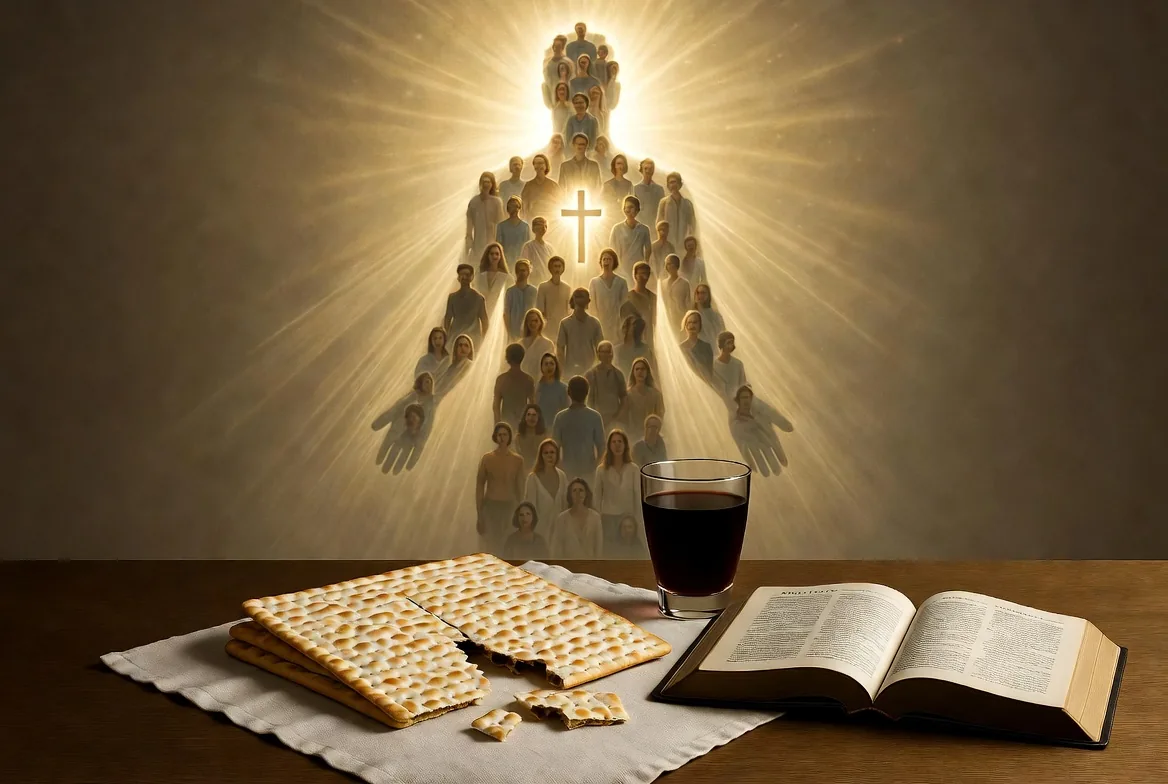
And the same collapse of figure into fact produces the wafer. Rome teaches that at the priest's word the bread becomes the literal body of Christ, reading "this is my body" (Matthew 26:26 KJV) as a bare statement of chemistry. But the Lord spoke those words reclining at the table, His body whole and unbroken before their eyes, the bread in His own hand; the bread in His fingers plainly was not the body that held it. He was speaking as He always spoke, in figure — He is "the door" (John 10:9 KJV) and "the true vine" (John 15:1 KJV), yet no one supposes He turned to timber or grew leaves, and Paul says of another emblem that "that Rock was Christ" (1 Corinthians 10:4 KJV) without a grain of literal stone in it. The bread represents; it does not become. Rome took a figure and forged a miracle out of it, then built a priesthood to work the miracle daily — one more office reared upon one more verse wrenched from its plain sense.
On ordinances and holy days. Paul: "Blotting out the handwriting of ordinances that was against us, which was contrary to us, and took it out of the way, nailing it to his cross" (Colossians 2:14 KJV) — therefore "Let no man therefore judge you in meat, or in drink, or in respect of an holyday, or of the new moon, or of the sabbath days: Which are a shadow of things to come; but the body is of Christ" (Colossians 2:16-17 KJV). Rome runs on the very calendar of obligatory feasts, fasts, and holy days that Paul says no man may impose. The shadows were nailed to the cross; Rome took them down and hung them back up.
At every joint, then, Rome is the photographic negative of Paul: works where he says grace, priests where he says one Mediator, a repeated sacrifice where he says once, a binding calendar where he says liberty. It quotes the apostle of the Gentiles and teaches the reverse of him. This is not following Paul. It is what Paul spent his ministry resisting.
The additions — every one of them a work added to a finished salvation
The three legs already settle the matter, but a study like this would feel incomplete without touching the distinctives most people picture when they think of Rome. What is striking, once the legs are in place, is that these are not a scattered list of unrelated errors. They are all the same error: each one is a work bolted onto a salvation Scripture calls finished, and each one only stands because the programs have been fused.
Mary as co-redeemer and mediatrix. Rome makes her a channel of grace and a co-worker in redemption. But redemption is "in Christ Jesus" (Romans 3:24 KJV), the propitiation is set forth in Him — God "hath set forth to be a propitiation through faith in his blood" (Romans 3:25 KJV) — and the mediator is "one... the man Christ Jesus" (1 Timothy 2:5 KJV). There is no second seat beside Him to give her.
And her very title gives the source away. Scripture never once crowns Mary; it never calls her queen of anything. The lone queen of heaven in all the Bible is a pagan goddess the women of Judah baked cakes to — an idolatry for which God gave the nation up to judgment: they burned incense and poured drink offerings "to make cakes to the queen of heaven, and to pour out drink offerings unto other gods, that they may provoke me to anger" (Jeremiah 7:18 KJV; and again Jeremiah 44:17-25). Follow the plain logic. That title is not drawn from the word of God — it is nowhere given to Mary there — so Rome drew it from somewhere else; and the one place the name does appear, it is fixed to false worship under the wrath of God. A crown the Bible hangs on an idol has been lifted onto the mother of the Lord, and the borrowing tells you which well Rome was drinking from. And the well is ancient. The worship of a queen of heaven is among the oldest idolatries in the world — kin to the "Tammuz" the women wept for in the door of the LORD's own house (Ezekiel 8:14 KJV), and to the Diana of Ephesus, "whom all Asia and the world worshippeth" (Acts 19:27 KJV) — the same mother-goddess idolatry cropping up under many names, and come to rest at last, in Rome, upon Mary.
Mary's perpetual virginity. Rome holds that Mary remained a virgin her whole life — before, during, and forever after the birth of Christ — and so bore no other children. The record says otherwise in plain words. Of Joseph it is written that he "knew her not till she had brought forth her firstborn son" (Matthew 1:25 KJV): the word till marks the end of a thing, and a firstborn is the first of others to follow — neither term fits a woman who stayed a virgin and bore one child only. And the others are named. His own townsmen ask, "is not his mother called Mary? and his brethren, James, and Joses, and Simon, and Judas? And his sisters, are they not all with us?" (Matthew 13:55-56 KJV) — four brothers named, sisters in the plural, all set beside "his mother". Mark sets down the same scene and the same names, the crowd calling Him "the son of Mary, the brother of James, and Joses, and of Juda, and Simon" and asking, "are not his sisters here with us?" (Mark 6:3 KJV) — two Gospels, one household. Nor was the matter left for the Gospels to disclose; the Spirit had foretold it in a psalm of Messiah, who says, "I am become a stranger unto my brethren, and an alien unto my mother's children" (Psalm 69:8 KJV). Not merely brethren, but my mother's children — Mary's own — and estranged from Him for a season, exactly as John records: "For neither did his brethren believe in him" (John 7:5 KJV). Prophecy, Gospel, and family record speak with one voice against the dogma.
To keep Mary a perpetual virgin, Rome must turn these brothers into cousins, or into Joseph's children by some earlier marriage — reading the plain family of the household out of the text to guard a tradition the text never taught. It is the fourth master again in miniature: where the word and the tradition collide, the word is made to give way.
Purgatory and indulgences. Both assume the believer still owes a debt of suffering after death, payable by time, penance, or purchase. Paul's gospel leaves no such debt. He tells the Body it is already "complete in him" (Colossians 2:10 KJV), and that God has purposed through the cross "to present you holy and unblameable and unreproveable in his sight" (Colossians 1:22 KJV). A believer already complete in Christ, already presented unblameable, owes nothing to a fire — there is no leftover penalty for a cleansing pit to collect. And Rome's own proof text will not bear the load. Purgatory leans on Paul's words that a man may be "saved; yet so as by fire" (1 Corinthians 3:15 KJV) — but read the passage whole and it is the judgment seat, not a cleansing pit. The "fire shall try every man's work of what sort it is" (1 Corinthians 3:13 KJV); it is the believer's works that are tested, some standing for reward and some burned for loss, while the man "himself shall be saved" straight through it. The fire tries works and settles rewards; it never touches sin and it never purges the man. Rome reads a payment for sin into a passage that is about the gain or loss of service.
Confession to a priest for absolution. Rome routes forgiveness through an ordained man, and its warrant is the Lord's word to the eleven: "Whose soever sins ye remit, they are remitted unto them" (John 20:23 KJV). But mark to whom that was spoken. It was said to Israel's apostles, inside Israel's kingdom program — the same men promised twelve thrones to judge the twelve tribes — not to a Gentile priesthood in the dispensation of grace. Lift that authority out of its place and install it as a standing sacrament, and you have committed the identical error that runs through all of Rome: a grant made to the kingdom apostles wrenched loose and bolted onto the Body of Christ. Paul, the apostle actually sent to us, never once appoints a priest to absolve a sinner, for the plain reason that under grace the trespasses are already gone — God "having forgiven you all trespasses" (Colossians 2:13 KJV), "even as God for Christ's sake hath forgiven you" (Ephesians 4:32 KJV). Past tense, already done, on the ground of the cross, not the ground of a repeated ritual. No priest on earth grants what God has already given.
And here the Protestant fares no better than the Catholic; he has only sent the priest home. He spurns the confessional and the man inside it, yet still makes the forgiveness of a believer's sins hang on his confessing them, one by one, to be forgiven — resting the whole transaction on "If we confess our sins, he is faithful and just to forgive us our sins" (1 John 1:9 KJV). But that word was written to the believing remnant of Israel, where it restates the covenant law of forgiveness; it is not the ground the Body stands on. So the two systems commit one error with a single difference of address: the Catholic confesses to a priest and the Protestant confesses to God, but both treat forgiveness as a transaction the believer must keep repeating to obtain, and neither rests in the complete forgiveness already given to the Body of Christ — "having forgiven you all trespasses" (Colossians 2:13 KJV), finished at the cross before the believer confessed anything.
A celibate priesthood. Rome forbids its clergy to marry and calls it holiness. Paul calls the forbidding itself a mark of apostasy: "in the latter times some shall depart from the faith, giving heed to seducing spirits, and doctrines of devils... Forbidding to marry, and commanding to abstain from meats" (1 Timothy 4:1-3 KJV). The very policy Rome wears as a crown, Scripture files under departure from the faith.
Here again the Protestant escapes only the half of it. He rightly throws off the celibacy and the priestly caste — but he keeps the priesthood itself; he only hands it to everyone, teaching that all believers are now priests. His proof text is Peter's: "ye are... a royal priesthood, an holy nation, a peculiar people" (1 Peter 2:9 KJV). Yet Peter is quoting Israel's own charter — "ye shall be unto me a kingdom of priests, and an holy nation" (Exodus 19:6 KJV) — and speaking it to the believing remnant of that nation, not to the Body. Paul, the apostle to the Gentiles, never once calls a member of the Body a priest; the word is simply absent from the church's doctrine. So Rome builds a caste of priests and the Protestant makes a nation of them, and both have installed in the Body an office it was never given. In this dispensation the Body has no priesthood at all, special or universal; it comes to God through the one Mediator already named, and needs no priest besides.
Praying to saints, and calling a man "father" and "holy father." The Lord's own words cut against the titles: "call no man your father upon the earth: for one is your Father, which is in heaven" (Matthew 23:9 KJV). And "Holy Father" is worse than a borrowed title — it is God's own. The words fall from the Lord's lips a single time in all of Scripture, and there He is praying to God: "Holy Father, keep through thine own name those whom thou hast given me" (John 17:11 KJV). Rome hands to a man the address the Son reserved for the Father. And prayer in this dispensation is directed to God through the one Mediator, not to Mary and not to the departed.
Notice the pattern one last time. Not one of these can survive contact with a finished work and a single Mediator. They exist only because Rome refused to let the cross be final and refused to let Christ mediate alone — which is to say, they exist because the word of truth was not rightly divided.
The oldest religion
Step back from the separate errors and a shape shows through them, older than Rome by thousands of years. The borrowed crown on Mary is the clue, for Rome did not invent her religion; she inherited it. There has really only ever been one man-made religion in the world, and it began at Babel. There men set out to build "a tower, whose top may reach unto heaven" and to "make us a name" (Genesis 11:4 KJV) — a road of their own devising up to God, and a name earned by their own hands. That is the mold every false religion has been poured into since: man climbing up to heaven by his works, in the place of God coming down to man in grace. Strip the robes off any of them and the same frame stands underneath.
Out of Babel that religion scattered with its peoples, and it carried a goddess with it — the mother of heaven we have already met behind Rome's Mary: the queen of heaven Israel baked her cakes to, the Tammuz wept for in the temple, the Diana of Ephesus, the mother-and-child of Egypt and of Rome — the same idolatry breaking out under a hundred names. And Scripture puts a name on the whole system. In the prophetic word it stands revealed as a woman with a title written upon her forehead — "MYSTERY, BABYLON THE GREAT, THE MOTHER OF HARLOTS AND ABOMINATIONS OF THE EARTH" (Revelation 17:5 KJV) — seated upon "seven mountains" (Revelation 17:9 KJV), the seven hills that have named one city for as long as men have drawn maps.
Let this be said plainly, in keeping with right division: the Revelation is prophecy, and that judgment falls in the day of the Lord upon a system standing in Israel's future — it is not aimed at the Body of Christ, nor at this present age. We do not read it to fix a date on Rome. We read it because it names the thing for what it is — a mystery religion, a mother with a brood of harlot daughters, riding the powers of the earth — and because it shows the works-worship that began at Babel running on to its last and ripest form. Rome is not that final Babylon; she is its nearest likeness now, the old religion of the tower wearing, for a season, a Christian face.
And the essence never changes through any of its forms: salvation by the works of men. The tower climbed toward heaven, the cakes baked for the queen of heaven, the mysteries of Diana, the sacraments and penances and merits of Rome — each one is the sinner doing something to reach a God who, in the gospel of grace, has already come the whole way down to him. That is why Rome's apparatus is no medieval novelty but the oldest religion on earth in fresh vestments; and it is why grace is its only true opposite, and the rightly dividing of the word its only cure. The wonder is not that such a religion exists in the world. The wonder is how it came to wear the name of Christ — and that is the last thing left to answer.
The fourth master
So the tally comes in. Rome does not follow the Christ it claims to stand in for, because it replaced His kingdom-to-a-nation with an institution and put words in His mouth. It does not follow the Peter it seats, because the real Peter was married, sent to Israel, correctable, and looking for a kingdom Rome traded away. It does not follow the Paul it quotes, because at every point of doctrine — justification, mediation, sacrifice, liberty — it teaches the reverse of him. Three authorities named, three authorities missed.
Then whom does Rome follow? Itself — its own accumulated tradition, the sediment of centuries of councils, decrees, and customs. And she did not merely lay that tradition down beside Scripture as an equal; she set it over Scripture as the master. On paper the two are named one deposit of faith, but in the working of it the church's tradition is the final court: it decides what the written word is permitted to mean, and where the plain sense of the text and the tradition collide, it is the text that must give way. That is why no chapter and verse has ever moved Rome off a single dogma — she has reserved to herself alone the right to say what the Bible is allowed to say. Tradition is the fourth master, and it is the master that made the other three impossible. Because once tradition is permitted to fuse Israel's program with the Body's, to read the earthly kingdom into a Gentile church and Peter's chair into a Roman bureau and the law's shadows into the age of grace, you no longer have Christ or Peter or Paul. You have a single sacramental machine that borrows their names and answers to none of them.
Watch how the fourth master installs itself, for the move is always the same. Rome first argues that Scripture by itself is not enough — you cannot even know which books are inspired, it says, without an infallible church to tell you. Then, with no verse to bridge the gap, it slides from an infallible church, to that infallible church, to the Roman Catholic church, until an indefinite article has quietly hardened into a proper name. Having first made the Bible insufficient, Rome presents itself as the one indispensable guide, the interpreter you cannot do without. But the guide was never in doubt. It is the Spirit of God leading a believer through the word he was told to study and rightly divide (2 Timothy 2:15). A church that must first make Scripture insufficient in order to make itself necessary has told you plainly which master it serves — and it is not Christ, nor Peter, nor Paul.
That ancient religion did not have to break the church open; the church unbarred the door itself. Paul met the first attempt on the Body in its infancy, in the "false brethren unawares brought in, who came in privily to spy out our liberty which we have in Christ Jesus, that they might bring us into bondage" (Galatians 2:4 KJV) — men who preached a Jesus to be completed by circumcision and law. It is the flesh's native religion: faith with an and fastened to it — grace and law, the cross and the sacrament, the finished work and something the sinner must still supply. When the post-apostolic church forsook Paul, it lost the very apostle who had barred that addition; and the works-religion it then let back in was given centuries to set and harden, until it stood full-grown as the church of Rome. How that departure ran, and how God nonetheless kept a witness to grace through the long night that followed — the hunted companies who copied Paul's epistles and refused the priest and the purgatory, down to the Reformation that recovered his gospel without yet recovering the full rightly dividing of it — is traced in the companion study, The Church that Kept the Wrong Apostle. Rome, then, is not a fresh error but that first error grown to full stature; and the same and still turns up in gentler dress wherever a ceremony is made a means of grace, so that even the churches that came out of Rome often carried a fragment of her out with them. The war is always the one war: the flesh cannot bear to be saved for nothing, and grace will be saved by nothing else.
Which is exactly why this is more than an argument about Rome. Rome is the largest and oldest monument to a single mistake — the refusal to rightly divide the word of truth — but she has never been alone in it. Her sister in the East, the Greek and Eastern Orthodox communion, cast off the pope and kept everything the papacy had grown out of: a priesthood by succession, a liturgy offered up as a sacrifice, the veneration of Mary and her perpetual virginity, and the same tradition seated above the Scriptures. It refused the son and kept the family religion. Nor are the daughters free of it. The churches born of Rome at the Reformation came out of her with her features in their faces — a table still called a means of grace, an infant still brought to the font as though water could do the work of faith, a calendar of holy obligation, and forgiveness still handled as a thing transacted again and again rather than a possession already given. They left the mother's house; most did not leave the mother's blood. Their Reformation was a true recovery, costly and God-given — but a partial one, for it brought back the grace of Paul's gospel without yet bringing back the rightly dividing of it, and whatever is not rightly divided keeps the old leaven working. So the failure is not one church's peculiar sin but a family trait, running wherever the two programs are fused — in the mother, the sister, and the daughters alike. The remedy is not a better tradition. It is the tool Rome set down. Take up "rightly dividing the word of truth" (2 Timothy 2:15 KJV), keep Israel's program and the Body's distinct, let the cross be finished and Christ mediate alone — and Christ, Peter, and Paul stop contradicting the church that claims them, because for the first time the church is actually listening to what each of them said.
Paul drew the line himself, and it still holds: "though we, or an angel from heaven, preach any other gospel unto you than that which we have preached unto you, let him be accursed" (Galatians 1:8 KJV). The measure was never a chair, a council, or a crown. The measure is the gospel Paul preached — and by that measure, the choice was never really between churches. It was always between tradition and the word of God, rightly divided.
Come out from among them
Set the whole picture in order and one last thing stands out. Right now, in this present day of grace, the gospel of grace and the religions of works stand in the earth side by side: the one in which God has done the whole work and the sinner rests in a finished cross; the other in which the sinner labors, offers, and merits his own way up toward heaven — Rome and her kindred the largest house of it, but every fusion of the programs a smaller room in the same house. And Paul's gospel — grace through faith, apart from works, held out freely to all, to Jew and Gentile alike — is the treasure of this present time, and of no other.
For a day is coming when it will not be. When the Lord descends and the Body of Christ is "caught up together with them in the clouds, to meet the Lord in the air" (1 Thessalonians 4:17 KJV), every soul saved by Paul's gospel — everyone who rested in the finished work rather than his own — is taken out of the world in a moment. And when the grace-people are gone, the gospel that saved them is gone with them, and the works-religion is left to fill the whole earth. It will ripen into that last, combined Babylon — the harlot seated on "peoples, and multitudes, and nations, and tongues" (Revelation 17:15 KJV), who has "made all nations drink" (Revelation 14:8 KJV), riding the world's power until the beast turns and devours her (Revelation 17:16). Even those whom God saves in that day — the sealed remnant of Israel, "an hundred and forty and four thousand of all the tribes of the children of Israel" (Revelation 7:4 KJV), and the "great multitude, which no man could number, of all nations" (Revelation 7:9 KJV) who come in the kingdom way, as Gentile proselytes taking hold of the skirt of the Jew (Zechariah 8:23) — are saved by grace still — "through the grace of the Lord Jesus Christ we shall be saved" (Acts 15:11 KJV). But mark that word shall, for it carries the deeper difference between their day and ours. To them salvation is a promised inheritance, held out ahead and entered by a faith that endures to the end; to the Body it is a present possession — we are saved, sealed, and complete, now. It is grace in both — but there a grace still to be obtained, here a grace already received and kept; salvation set before them as a prize, salvation already in our hand. That grace — apart from works, freely given and freely kept — belongs to this present day, and to no other.
But return now to that coming day, and to the doomed city. Before her plagues fall, a voice from heaven cries to God's own people caught within her, "Come out of her, my people, that ye be not partakers of her sins, and that ye receive not of her plagues" (Revelation 18:4 KJV). Mark it, and rightly divide it: that call is spoken to those people — Israel's believing remnant and the proselytes gathered to her — in that day, on the ground of escaping a wrath the Body was never appointed to bear, for "God hath not appointed us to wrath" (1 Thessalonians 5:9 KJV). It is their verse, and not ours.
Ours is Paul's, and it is spoken now: "come out from among them, and be ye separate, saith the Lord, and touch not the unclean thing; and I will receive you" (2 Corinthians 6:17 KJV) — of every system that keeps "a form of godliness, but denying the power thereof: from such turn away" (2 Timothy 3:5 KJV). Not to flee coming plagues, but to leave a lie for the truth: to come out of the religion of the altar re-offered, the priest, the penance, and the merit, and to rest — wholly, finally, and forever — where a man is saved "Not by works of righteousness which we have done, but according to his mercy" (Titus 3:5 KJV). Come out of works, and into grace. Come off your own labor, and onto His finished cross.
And go down to the root of it, for the thing to be left behind is not only Rome's altar; it is your own righteousness. Every works-religion, hers and every other, is at last a man clinging to a righteousness of his own making — a goodness he has done, a merit he has stored, a record he means to plead — and the single demand of grace is that he let it go. Paul had more of that religious righteousness than any priest in Rome, and he counted the whole of it "but dung, that I may win Christ, And be found in him, not having mine own righteousness, which is of the law, but that which is through the faith of Christ, the righteousness which is of God by faith" (Philippians 3:8-9 KJV). There is the true coming-out. It is to stop, as Israel would not, "going about to establish their own righteousness", and to submit at last "unto the righteousness of God" (Romans 10:3 KJV) — for "Christ is the end of the law for righteousness to every one that believeth" (Romans 10:4 KJV). It is to cease bringing God a righteousness of your own at all, and to receive instead a righteousness not your own: the spotless righteousness of Christ Himself, reckoned to the account of every man the moment he believes, so that the sinner is "made the righteousness of God in him" (2 Corinthians 5:21 KJV) — nothing of his own doing, all of it a gift. That is what it is to be found in Christ: not standing before God in the tattered robe you wove, but clothed head to foot in a righteousness He gave.
So come out — not merely from a church, but from yourself; not from her altar only, but from your own works and your own worth — and be found in Him. That is the only coming-out that finally matters, and this, while grace is still preached in the earth, is the day to make it.
© 2026 Edward R. Cross
Comments
No comments yet. Be the first to share your thoughts.
Leave a comment