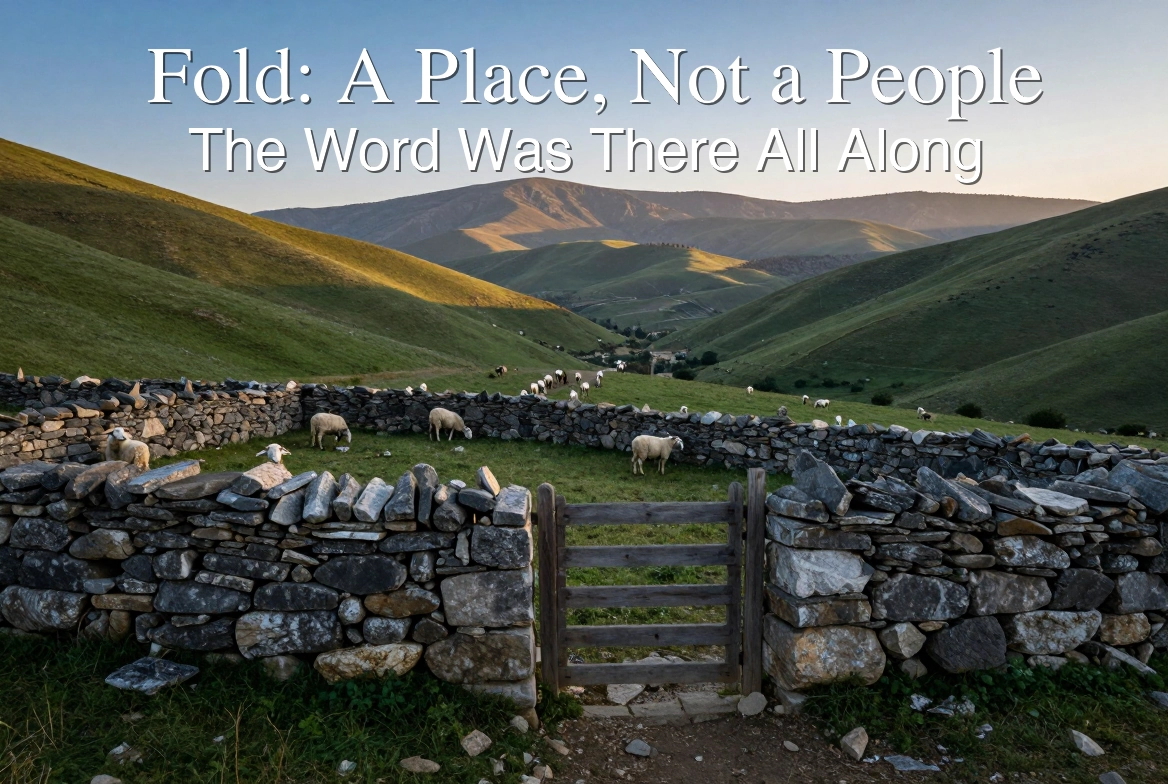
One sentence in the tenth chapter of John has been made to carry more freight than any other in the chapter, and it is a short one:
"And other sheep I have, which are not of this fold: them also I must bring, and they shall hear my voice; and there shall be one fold, and one shepherd." (John 10:16 KJV)
Who are they? Most readers have been told they are Gentiles — that the Lord was looking past Israel to the nations, and that the one fold is the church. Others, and among them careful men who rightly divide, answer that they are Israel's own scattered, the tribes driven among the heathen and promised a regathering.
I have taught the first of those readings on this site, and I am correcting it. That is the plainest way to begin, and the reason for the correction is not that better men hold the other view. It is that the dispute turns on a word neither side had stopped to define — and once it is defined, the verse settles itself.
The word is fold.
The passage, and where He was standing when He said it
Before the identity of the sheep, the setting. John tells us the Lord spoke these things as a figure, and that His hearers missed it: "This parable spake Jesus unto them: but they understood not what things they were which he spake unto them" (John 10:6). So we are reading a picture, and pictures have parts that mean things.
John also tells us where He was standing:
"And it was at Jerusalem the feast of the dedication, and it was winter. And Jesus walked in the temple in Solomon's porch." (John 10:22–23 KJV)
Jerusalem. The temple. A feast. He is inside Judah, speaking to Jews, at the center of the nation's worship — and the saying divided them: "There was a division therefore again among the Jews for these sayings" (John 10:19).
Hold that location. A man standing in the temple who speaks of sheep not of this fold is speaking from somewhere, and the somewhere is not incidental to what he means.
The fold and the sheep are not the same set
Here is the observation that makes the whole question askable, and most treatments of the verse walk straight past it.
The sheep are inside an enclosure. It has a door and a doorkeeper (John 10:1–3). Sheep go in and out of it to feed: "I am the door: by me if any man enter in, he shall be saved, and shall go in and out, and find pasture" (John 10:9). That is a pen with a gate, not a metaphor for a nation.
And the fold contains creatures that are not sheep. The Lord says so, to men standing inside the national enclosure with Him:
"But ye believe not, because ye are not of my sheep, as I said unto you. My sheep hear my voice, and I know them, and they follow me:" (John 10:26–27 KJV)
They were Jews. They were in the temple. They were inside everything that made Israel Israel — and He tells them they are not His sheep. Paul puts the same truth in one line about the same nation: "For they are not all Israel, which are of Israel" (Romans 9:6). Within the fold, a remnant are His.
So the mark of a sheep is not national. It is the voice, four times over in this chapter — "the sheep hear his voice" (John 10:3), "they know his voice" (v. 4), "they shall hear my voice" (v. 16), "My sheep hear my voice" (v. 27) — and the negative of it: "a stranger will they not follow" (John 10:5).
Now notice what this costs the reading I have taught, because it must be said before anything is claimed. If the fold is a pen and not a people, then not of this fold is not a statement about ancestry and not a statement about covenant standing. A Gentile is not of that fold. Neither is an Israelite living in Babylon. The phrase by itself excludes nobody and includes nobody — which is exactly why the word has to be defined before the verse can be read.
Scripture defines a fold as a place, never as a people
Let the Bible say what a fold is — and let us count by the word itself rather than by the phrases a man happens to think of looking for, which is how these searches usually go wrong.
Fold, folds, sheepfold and sheepfolds stand in sixteen verses. One of those is not our word at all but the verb, and has nothing to do with sheep: "as a vesture shalt thou fold them up" (Hebrews 1:12). That leaves fifteen verses and seventeen occurrences of the noun, and here is every one of them.
Folds are built, alongside houses: "We will build sheepfolds here for our cattle, and cities for our little ones" (Numbers 32:16), repeated at Numbers 32:24 and 32:36. Reuben abode among them (Judges 5:16). Goats come out of them — "nor he goats out of thy folds" (Psalm 50:9). David was taken from them: "He chose David also his servant, and took him from the sheepfolds" (Psalm 78:70). Shepherds make them, and in a desolated Babylon they will not: "neither shall the shepherds make their fold there" (Isaiah 13:20). A sea coast becomes them (Zephaniah 2:6). A named region becomes one:
"And Sharon shall be a fold of flocks, and the valley of Achor a place for the herds to lie down in, for my people that have sought me." (Isaiah 65:10 KJV)
Not one of these is a people. Not one is a covenant. Not one is a nation. Every occurrence is an enclosure or a pasture-ground — something built, entered, left, made, or become.
And when Scripture speaks of Israel's fold, it puts it on the map:
"I will feed them in a good pasture, and upon the high mountains of Israel shall their fold be: there shall they lie in a good fold, and in a fat pasture shall they feed upon the mountains of Israel." (Ezekiel 34:14 KJV)
Their fold is on the mountains of Israel. It is a location, and it is in the land.
That is the definition, and it was available the whole time. A fold is where a flock is kept and fed. It is a place.
A flock is not a fold, and six verses use both words to say so
A man may grant that a fold is a place and still suppose that one fold comes to the same thing as one company — that the sheep and the pen amount to the same idea in the end. Scripture will not let the two words blur. It sets them side by side six times, and every time it holds them apart.
"the flock shall be cut off from the fold, and there shall be no herd in the stalls" (Habakkuk 3:17 KJV)
Flock is to fold as herd is to stalls. The animals are one thing; what holds them is another. Nobody reads stalls as a name for cattle.
"And I will gather the remnant of my flock out of all countries whither I have driven them, and will bring them again to their folds; and they shall be fruitful and increase." (Jeremiah 23:3 KJV)
The flock is what is gathered; the folds are where it is brought. And mark the plural — their folds. That plural is not a difficulty and it is not loose; it is the first half of a pattern the next section will finish. For now the verse is being asked for one thing and gives it plainly: the flock is the animals, the folds are the ground they are brought to.
The rest run the same way. Micah has the flock "in the midst of their fold" (Micah 2:12) — inside it. Isaiah has a region become "a fold of flocks" (Isaiah 65:10) — a place belonging to animals. Zephaniah has "folds for flocks" (Zephaniah 2:6) — the pen exists for the sheep. And Judges has a man lingering "among the sheepfolds, to hear the bleatings of the flocks" (Judges 5:16) — you stand among the pens and you hear the animals.
Nor is this a pattern drawn from six verses only. The words flock and flocks stand a hundred and ninety-one times in Scripture, and not once is a flock a place. Three of those are introduced by a preposition that could look locative, and all three prove to be membership rather than location — a brown sheep "in the flock of Laban" (Genesis 30:40), a man who has "in his flock a male" (Malachi 1:14). The third names both at once and settles it:
"And Jacob sent and called Rachel and Leah to the field unto his flock," (Genesis 31:4 KJV)
To the field — that is where they went. Unto his flock — that is what was waiting there. The place-word in the sentence is not flock.
One fold is one place — and the number follows the shepherd
Those two findings together — that a fold is a place, and that a flock is not a fold — fix what one fold can mean. It has long been read as one merged people — Jew and Gentile made a single company, which is then called the church. But the word has never once meant a company. One fold is one place: all His sheep, gathered out of the countries into which they were driven, standing at last in the same pen under the same shepherd.
And Ezekiel had already said it in the singular. In the middle of that same regathering — the sheep sought out, delivered from all the places of their scattering, brought again to their own land — he names the fold:
"I will feed them in a good pasture, and upon the high mountains of Israel shall their fold be: there shall they lie in a good fold" (Ezekiel 34:14 KJV)
Their fold. A good fold. Singular, and unmistakably a place — a pasture, on named mountains, in a named land. So one fold and one shepherd was not a figure coined at the feast of dedication. It was Israel's own promise in Israel's own words, and how much else of John 10 comes out of that one chapter is shown further on. Nine verses later the same chapter supplies the other half of the Lord's sentence — and it does so in a form that settles the number question with it.
Because the number turns out not to be loose at all. Of the seventeen occurrences of the noun, eight are plural and nine singular — and the fold is numbered with the man who keeps it.
Jeremiah and Ezekiel make one promise in one form of words, and Scripture makes it in these two places and nowhere else:
"And I will set up shepherds over them which shall feed them" (Jeremiah 23:4 KJV)
"And I will set up one shepherd over them, and he shall feed them, even my servant David" (Ezekiel 34:23 KJV)
One construction; one difference; and the difference is the number of the shepherd. Now watch each prophet's fold agree with his own shepherd. Jeremiah, who is given shepherds, brings the flock again to their folds (23:3). Ezekiel, who is given one shepherd, says it in the singular — "their fold", "a good fold" (34:14). And Jeremiah holds both levels inside two verses: many shepherds over many folds, and over them all one King — "a righteous Branch" who "shall reign and prosper" (Jeremiah 23:5).
(A likely inference, and offered as nothing more: the restored land is divided "according to the twelve tribes of Israel" (Ezekiel 47:13), and a fold is plainly a district — Sharon becomes one, and a sea coast becomes folds for the remnant of Judah. So the plural folds may well be the tribal portions, each under its own shepherd. Scripture never puts the two words in one verse, so this is not put forward as a finding.)
So John 10:16 does not adjust a number. It takes Ezekiel's pair whole — one fold, one shepherd — and the Lord standing in the temple is claiming to be the one shepherd Ezekiel was promised. The fold comes with the Shepherd.
And what that one is set against, the verse says in its own sentence. It is not set against many folds — the plural was never the question. It is set against a two the Lord has just named in the same breath: "other sheep I have, which are not of this fold." This fold, and sheep not of it. That is a division, and one fold is the end of it. The word is doing precisely what one does in the prophet He is preaching from — "they shall be no more two nations, neither shall they be divided into two kingdoms any more at all" (Ezekiel 37:22). Not a census of pens. The close of a breach.
One honest note, because a careful reader will find it. John 10:16 says not of this fold, and of can carry belonging as easily as position. So a man may press the preposition and say the phrase means not belonging to this company.
Two other passages put of with this noun, and both settle it the other way. Goats come "out of thy folds" (Psalm 50:9) — out of a pen. The flock stands "in the midst of their fold" (Micah 2:12) — inside a pen. In each the preposition is doing position, not membership. John 10:16 is the only place the bare of stands straight against the noun, so a man is free to press it; but he is asking a word that means a place in every one of its other sixteen occurrences to change sense at the single point where a doctrine hangs on it — and he is doing it against the only two precedents there are. It is far likelier that a sheep is said to belong to a pen, which is exactly what a sheep does.
John 10 is built out of the shepherd prophecies, and every one of them is about scattering and regathering
The Lord did not invent this picture at the feast of dedication. He took it from the prophets, and His hearers had those prophets by heart. Read them and John 10 stops being obscure.
Ezekiel 34 is the shepherd chapter. It opens on false shepherds who feed themselves and not the flock (34:2–4) — the thief and the hireling of John 10. It states the consequence: "And they were scattered, because there is no shepherd" (Ezekiel 34:5), and "my flock was scattered upon all the face of the earth, and none did search or seek after them" (Ezekiel 34:6). Then God Himself takes the work up:
"As a shepherd seeketh out his flock in the day that he is among his sheep that are scattered; so will I seek out my sheep, and will deliver them out of all places where they have been scattered in the cloudy and dark day. And I will bring them out from the people, and gather them from the countries, and will bring them to their own land, and feed them upon the mountains of Israel." (Ezekiel 34:12–13 KJV)
He will "seek that which was lost, and bring again that which was driven away" (Ezekiel 34:16). And the chapter ends with the shepherd Himself: "And I will set up one shepherd over them… even my servant David" (Ezekiel 34:23).
Jeremiah 23 says the same thing in the same order. Woe to the pastors that scatter the flock (23:1–2), then the promise:
"And I will gather the remnant of my flock out of all countries whither I have driven them, and will bring them again to their folds; and they shall be fruitful and increase." (Jeremiah 23:3 KJV)
Shepherds are set over them (23:4), and the chapter closes on a King — "I will raise unto David a righteous Branch, and a King shall reign and prosper" (Jeremiah 23:5).
Ezekiel 11 had already given the picture of sheep who are His and are not in the pen: cast far off among the heathen, scattered among the countries, God a little sanctuary to them there, and then "I will even gather you from the people, and assemble you out of the countries where ye have been scattered" (Ezekiel 11:17).
Ezekiel 37 supplies the outcome, and the wording is the closest of all. Two sticks, Judah and Joseph, become one in the hand: "And I will make them one nation in the land upon the mountains of Israel; and one king shall be king to them all: and they shall be no more two nations" (Ezekiel 37:22), and then — "and they all shall have one shepherd" (Ezekiel 37:24).
Micah 2:12 gathers the remnant "as the flock in the midst of their fold." Jeremiah 31:10 states the whole thing in a sentence: "He that scattered Israel will gather him, and keep him, as a shepherd doth his flock." (Jeremiah 31:10) Isaiah 40:11 — "He shall feed his flock like a shepherd."
And the scattering language was on the Lord's own lips about His own disciples, quoting Zechariah: "I will smite the shepherd, and the sheep of the flock shall be scattered" (Matthew 26:31, from Zechariah 13:7).
Every one of these passages is about Israel's flock, driven out, and brought back.
Them also I must bring
Now set three phrases beside each other and let them do their own work.
Jeremiah 23:3 — "will bring them again to their folds."
Ezekiel 34:16 — "bring again that which was driven away."
John 10:16 — "them also I must bring."
Sheep that belong to Him, presently outside the fold, brought in. And the result matches the prophets exactly: one fold, and one shepherd against Ezekiel 34:23 and 37:24's one shepherd, and Ezekiel 37:22's one nation, no more two.
That is not an echo. It is the same promise, spoken by the Shepherd who made it.
Christ did speak of Gentiles in the kingdom — and the table is not the fold
Here an objection has to be met, and met at full strength, because it is a good one and I have felt its weight.
It will not do to argue that the other sheep must be Israelites because the Lord was sent only to Israel. He was sent only to Israel — "I am not sent but unto the lost sheep of the house of Israel" (Matthew 15:24), and "Go not into the way of the Gentiles… But go rather to the lost sheep of the house of Israel" (Matthew 10:5–6). And He still spoke of Gentiles in the kingdom. After a Gentile centurion's faith drew from Him "I have not found so great faith, no, not in Israel" (Matthew 8:10), He said this:
"And I say unto you, That many shall come from the east and west, and shall sit down with Abraham, and Isaac, and Jacob, in the kingdom of heaven. But the children of the kingdom shall be cast out into outer darkness: there shall be weeping and gnashing of teeth." (Matthew 8:11–12 KJV)
Luke records the same with four directions rather than two (Luke 13:28–29). So the limitation was on His sending, not on His speech about what was coming. A man may be sent to one house and still tell you who will be at the table.
The same honesty is owed to the Canaanite woman. The exchange about the children's bread and the dogs (Matthew 15:26–27) is often quoted for its fence and stopped there. It does not stop there. It ends: "O woman, great is thy faith: be it unto thee even as thou wilt" (Matthew 15:28), and her daughter was healed. A Gentile asked, and was answered.
So nothing forbids a Gentile reading of John 10:16 in principle. What decides it is that sitting down at a table is not the same thing as being folded with a flock.
Watch how the prophets place the nations in the kingdom. They come up, and they come up repeatedly:
"And it shall come to pass, that every one that is left of all the nations which came against Jerusalem shall even go up from year to year to worship the King, the LORD of hosts, and to keep the feast of tabernacles." (Zechariah 14:16 KJV)
Year to year — with penalties on the families of the earth that come not up (Zechariah 14:17–19). Isaiah has the nations "flow unto it" and say "Come ye, and let us go up to the mountain of the LORD" (Isaiah 2:2–3). All flesh comes to worship from one new moon to another (Isaiah 66:23). In Zechariah 8 they say "Let us go speedily to pray before the LORD" (8:21), and the ten men who take hold of a Jew's skirt say "We will go with you" (8:23). And of the sons of the stranger God says "Even them will I bring to my holy mountain, and make them joyful in my house of prayer" (Isaiah 56:7).
And when Isaiah describes what the strangers do in that day, Israel is always thee:
"And the sons of strangers shall build up thy walls, and their kings shall minister unto thee… therefore thy gates shall be open continually; they shall not be shut day nor night; that men may bring unto thee the forces of the Gentiles." (Isaiah 60:10–11 KJV)
They build, they minister, they bring, they go up, they go with. None of that is being folded. A fold is where a flock lies down — "there shall they lie in a good fold" (Ezekiel 34:14), "the flock in the midst of their fold" (Micah 2:12). Pilgrims coming up for a feast and returning home are doing something else entirely.
But that must not be pressed one inch further than Scripture presses it, because Scripture makes room for a second case. The nations as nations come and go. An individual stranger who settles among them is another matter, and he may be taken in:
"And it shall come to pass, that ye shall divide it by lot for an inheritance unto you, and to the strangers that sojourn among you, which shall beget children among you: and they shall be unto you as born in the country among the children of Israel; they shall have inheritance with you among the tribes of Israel." (Ezekiel 47:22 KJV)
Isaiah says the same in fewer words: "the strangers shall be joined with them, and they shall cleave to the house of Jacob" (Isaiah 14:1). And Isaiah 56 speaks of "the sons of the stranger, that join themselves to the LORD, to serve him" (Isaiah 56:6). So visitors and never residents is too tidy, and I will not defend it. Some Gentiles may join the fold, and Scripture says so plainly.
But read the next verse and see what kind of joining it is: "in what tribe the stranger sojourneth, there shall ye give him his inheritance" (Ezekiel 47:23). He is given a portion inside a tribe. He is reckoned as born in the country. He enters the one fold as a man is taken into a household — he does not arrive as the other half of a merger.
Which brings the whole matter to a point, and the point is narrower than it may have seemed. Scripture gives us Gentiles coming up to the fold, year by year, to worship. It gives us Gentiles joined to the fold, settled among the tribes and counted as native. What it never once gives us is a second fold — a separate company of God's own sheep, kept elsewhere, waiting to be merged with Israel's so that two become one.
Close the door where Scripture closes it, and no further. It does not close the door on a Gentile entering. It closes the door on there being another pen.
A company of sheep already His, already outside, waiting to be brought in as a company — only Israel's scattered answer to that. And that is precisely what John 10:16 describes.
The children of God scattered abroad
The same chapter's argument is confirmed a chapter later, by an enemy who did not know he was prophesying. Caiaphas said it was expedient that one man die for the people, and John comments:
"And this spake he not of himself: but being high priest that year, he prophesied that Jesus should die for that nation; And not for that nation only, but that also he should gather together in one the children of God that were scattered abroad." (John 11:51–52 KJV)
Two things in that sentence are usually rushed.
First, the children of God was Israel's own title in that day. "Israel is my son, even my firstborn" (Exodus 4:22). "Ye are the children of the LORD your God" (Deuteronomy 14:1). "I am a father to Israel, and Ephraim is my firstborn" (Jeremiah 31:9). A first-century reader hearing children of God in a prophecy about gathering did not reach for the nations.
Second, scattered abroad is the vocabulary of the dispersion. James writes "to the twelve tribes which are scattered abroad" (James 1:1). Peter writes "to the strangers scattered throughout Pontus, Galatia, Cappadocia, Asia, and Bithynia" (1 Peter 1:1). At Pentecost the dispersion is physically present — "there were dwelling at Jerusalem Jews, devout men, out of every nation under heaven" (Acts 2:5).
And the Jews themselves used both terms in one sentence, distinguishing them: "will he go unto the dispersed among the Gentiles, and teach the Gentiles?" (John 7:35). The dispersed among the Gentiles are one thing. The Gentiles are another. The book knows the difference.
Now the honest part. Verse 52 opens "And not for that nation only" — a widening, and it must not be trimmed off, as it often is when this verse is quoted. But widening past that nation does not by itself reach the Gentiles. On the reading argued here it is satisfied by Israelites living outside the land — which is exactly the company John 10:16 has in view. The clause proves a widening. It does not prove which widening.
The Gentile reading, at its strongest
I held this reading and taught it. It deserves to be stated as its best defenders state it, and not as a straw man.
Not of this fold reads naturally as a different pen, not as a scattered portion of the same flock. John's Gospel moves steadily outward: the Samaritans believe in chapter four; Greeks come saying "Sir, we would see Jesus" (John 12:21); and the Lord says "And I, if I be lifted up from the earth, will draw all men unto me" (John 12:32). The prophets promise a Gentile ingathering in the plainest terms — the sons of the stranger joined to the LORD and brought to the holy mountain, "for mine house shall be called an house of prayer for all people" (Isaiah 56:7); "the Gentiles shall come to thy light" (Isaiah 60:3); a servant given "for a light to the Gentiles" (Isaiah 49:6); "in thee shall all families of the earth be blessed" (Genesis 12:3); ten men out of all languages taking hold of a Jew's skirt (Zechariah 8:23). And one verse names two companies in a single breath:
"The Lord GOD which gathereth the outcasts of Israel saith, Yet will I gather others to him, beside those that are gathered unto him." (Isaiah 56:8 KJV)
That is a strong case, and every verse in it is true.
Here is why it does not carry John 10:16.
Isaiah 56:8 is granted, not disputed. God does gather two companies. Nothing in this study denies a Gentile ingathering; the question is only whether John 10:16 is the verse that announces it. A passage proving that Gentiles are gathered somewhere does not prove they are gathered here.
The order in those very prophecies tells against it. Isaiah 60:3 has the Gentiles coming to Israel's light, which requires Israel to be shining first. Zechariah 8 puts the two in sequence in one chapter — God saves His people from the east country and the west country and brings them to dwell in Jerusalem (8:7–8), and only then do many people and strong nations come to seek the LORD there (8:20–23). Israel gathered first; the nations after. John 10:16's bringing is the first movement, not the second.
And the idiom tells against it decisively. Every fold-gathering passage in Scripture is about Israel's scattered being brought back to their folds. There is no passage anywhere in which Gentiles are brought to a fold. Not one.
And the two that one fold ends are named. This is the reading's strongest instinct and the place it comes closest: it hears a two-becoming-one in the verse, and it is right to. Something is being made one, out of a division that was real. But the Lord is preaching from Ezekiel, and Ezekiel says which two:
"take thee one stick, and write upon it, For Judah, and for the children of Israel his companions: then take another stick, and write upon it, For Joseph, the stick of Ephraim" (Ezekiel 37:16 KJV)
Judah and Joseph. Two kingdoms out of one nation, torn apart by sin and rejoined by mercy — and the promise attached to them is the one John 10:16 echoes: no more two nations, no more two kingdoms, one king, and "they all shall have one shepherd" (Ezekiel 37:24). So the two-becoming-one is real, and it is not the two this reading requires. It was answered before it was asked.
The Gentile ingathering is real, and it is future, and it is glorious. It is simply not what this verse is about.
Whoever they are, they are not the Body of Christ
This must be said, because it is the point that matters most for a believer today, and it holds on either reading of the verse.
The one new man of Paul's gospel was not in this picture at all, and could not have been, because it had not been revealed. It was "hid from ages and from generations" (Colossians 1:26), "kept secret since the world began" (Romans 16:25), and "in other ages was not made known unto the sons of men, as it is now revealed unto his holy apostles and prophets by the Spirit" (Ephesians 3:5).
And the difference is not merely one of timing. Look at what Paul says God made, and mark the adjective:
"Having abolished in his flesh the enmity, even the law of commandments contained in ordinances; for to make in himself of twain one new man, so making peace;" (Ephesians 2:15 KJV)
New. Something that did not exist before. Whereas Ezekiel 37 joins two sticks that were one nation to begin with — an old kingdom and an old kingdom, divided by sin and reunited by mercy. There is nothing new in Ezekiel 37. It is a restoration. Ephesians 2 is a creation.
The middle wall of partition is broken down for the Body (Ephesians 2:14); in Israel's kingdom it stands, and the nations come up to a temple that has courts.
And there is a shorter road to the same place, and the word study has already paved it — a fold is a place, and a flock is not a fold. A fold is not a people, so one fold cannot describe the making of one people — not here and not anywhere. The dispensational argument above is sound and worth having on its own account; but John 10:16 was ruled out as a description of the one new man before that argument was ever reached, by the plain meaning of a noun.
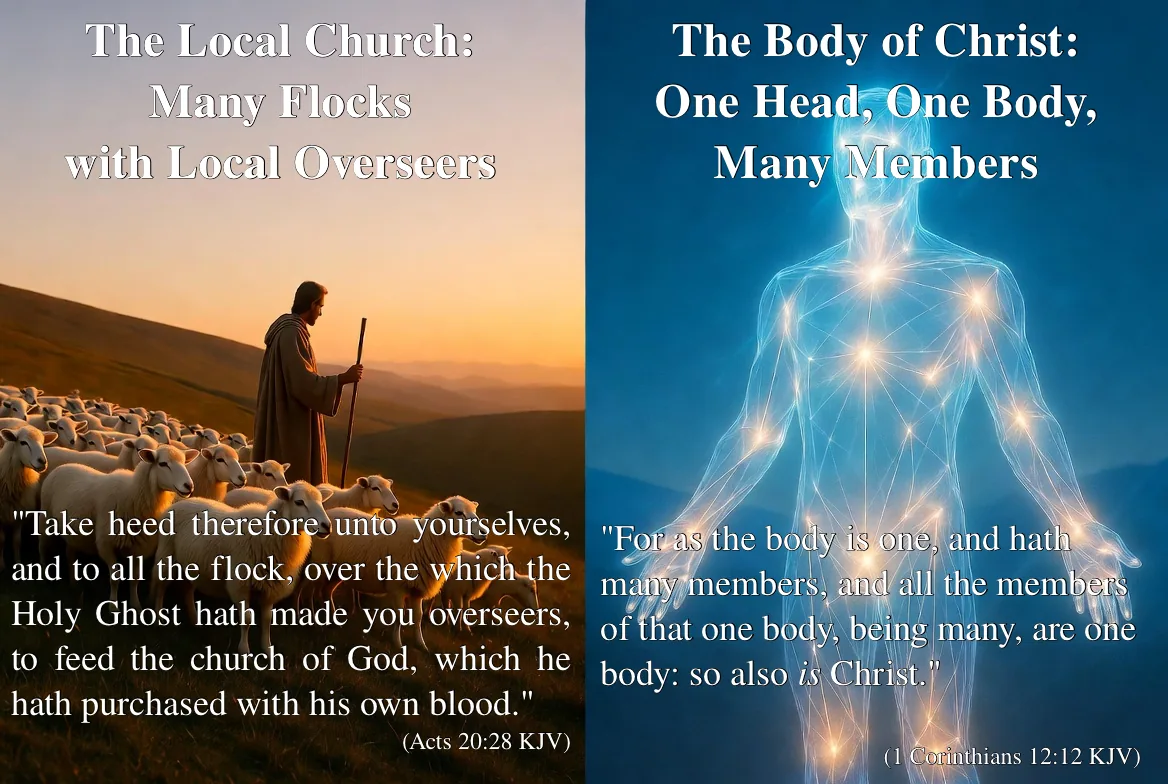
And here a careful reader will stop me, because Paul does use the word. To the Ephesian elders he said:
"Take heed therefore unto yourselves, and to all the flock, over the which the Holy Ghost hath made you overseers, to feed the church of God, which he hath purchased with his own blood." (Acts 20:28 KJV)
And again of the wolves, "not sparing the flock" (Acts 20:29).
But mark whom he is addressing and what he puts in their charge. He is speaking to the elders of one city, and the flock is the one "over the which the Holy Ghost hath made you overseers" — their own congregation. No elder at Ephesus was overseer of the Body of Christ. Paul is doing what any faithful man does with the people in front of him: calling them his flock.
And that is the only kind of use he ever makes of the language. Across the thirteen epistles the count is worth seeing whole. Sheep stands once, and it is a quotation of a psalm — "we are accounted as sheep for the slaughter" (Romans 8:36, from Psalm 44:22). Flock stands once, in an illustration drawn from ordinary working life, alongside a soldier and a vinedresser (1 Corinthians 9:7). Shepherd, lamb and pasture do not appear at all. And the word fold appears neither in Paul's epistles nor anywhere in the book of Acts.
So the man who was given the revelation of the Body had the whole shepherd vocabulary lying ready to hand, and used almost none of it — while the one word this study is about he never used at all. A fold is a thing on the ground, and the blessings he had to describe were "in heavenly places in Christ" (Ephesians 1:3). He was given another word for us, and it was body. That case is made at length in Rightly Dividing the Sheep and Shepherd Metaphor in Scripture.
So whichever way a man reads John 10:16, he must not read himself into it.
What this gives the preterist, which is nothing
There is a use being made of these verses that ought to be named. It is argued in preterist circles — carried to a point that some are now calling Israel Only preterism, a label used here as those answering the reading use it, and not one any man is shown claiming for himself — that because Christ was sent to Israel, and because the other sheep were Israelites, and because the children of God scattered abroad were Israelites, therefore Scripture concerns Israel and nobody else, and there is no gospel for a Gentile at all.
The first three of those are largely right. The conclusion does not follow from them, and does not even touch them.
Granting that the other sheep are Israel's dispersed yields nothing whatever about who may be redeemed now. Those are two different questions, and the second is answered from Paul, not from John 10. That argument is made in full in Redemption Is Not a Covenant Remedy.
And the gathering has not happened. There is no one king over an undivided nation on the mountains of Israel. Judah and Ephraim are not one stick in the hand of the LORD. The righteous Branch has not reigned and prospered in the earth (Jeremiah 23:5). Read as a finished thing, the prophecy has no fulfillment to point at; read as a future thing, it stands exactly where the prophets left it.
And the nations are not shut out of God's purpose by any of this. They come to the light of a risen Israel, and they come by the thousands. Reading John 10:16 rightly costs a Gentile nothing, because the verse was never about who may be saved. It is about where Israel's flock will be pastured.
The word was there the whole time
If you have read this far wondering how a question so long disputed can be settled by a noun, that is the point worth carrying away.
The two readings had argued about the sheep for generations without asking what a fold is. Scripture answers in fifteen places and never varies: it is a thing you build, enter, leave, or become. Sharon becomes one. Reuben sat among them. David was taken from them. In a desolated Babylon no shepherd will make one. And Israel's own is on the mountains of Israel, where the flock lies down.
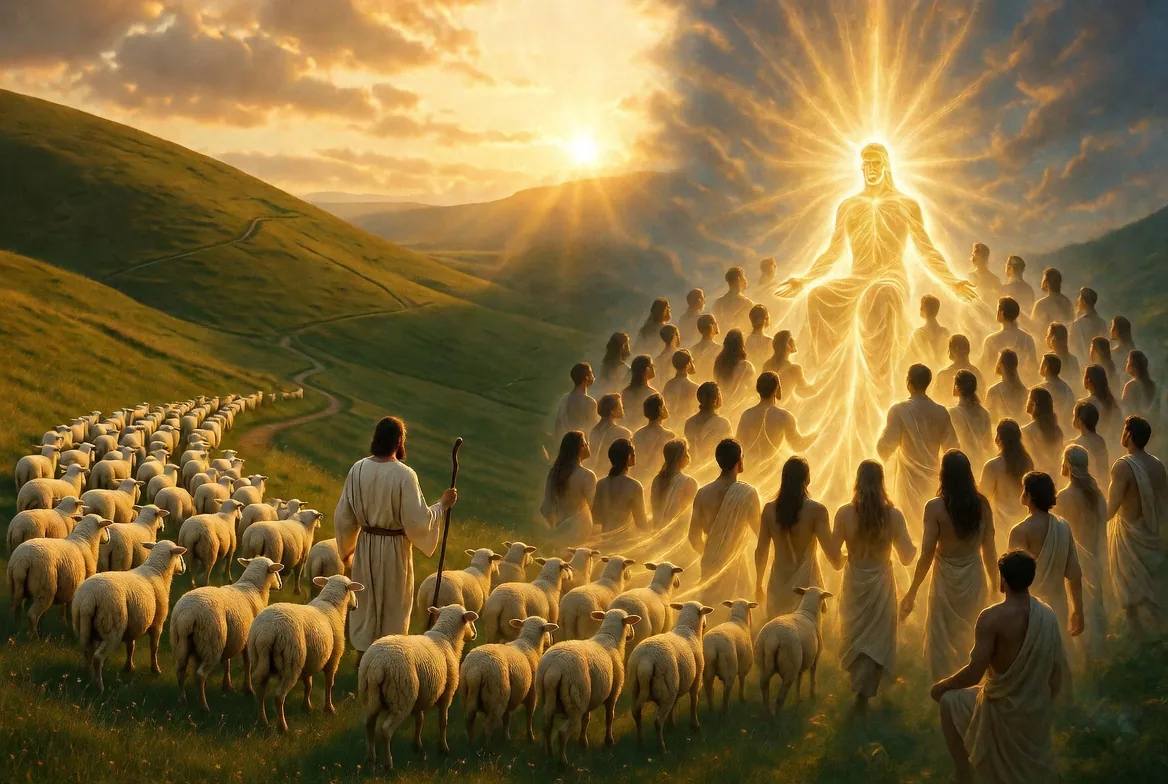
Define the word, and the sentence reads itself. Other sheep, His own, presently outside the pen, to be brought in — as Jeremiah said, gathered out of all countries and brought again to their folds; as Ezekiel said, sought out and delivered from all the places where they were scattered; and then one fold, and one shepherd, and no more two.
You were not careless if you read it the other way. I did, in print, and I have taught it. The Gentile reading is old, it is held by careful men, and every verse its defenders bring is a true verse. It fails on one thing only: it asks a word to mean a people when Scripture never once uses it that way.
And that needs saying carefully, because a reader may wonder how the men can be commended in one breath and their reading refused in the next. A man may honor the Scripture and still hold a reading the Scripture will not bear. There is no contradiction in it. Honoring is the posture of a man toward the Book; conformity is a property of a reading; and the two are not the same thing. It is the ordinary condition of everyone who studies, which is why a correction need carry no insult — I have received this one myself, and gladly.
What cannot be said is that both readings honor the text. They cannot, and the claim empties the words of meaning the moment it is made. Where two readings contradict each other, the text is honored by whichever one it will bear.
Read the whole sentence, and then go and find out what its words mean. "Study to shew thyself approved unto God, a workman that needeth not to be ashamed, rightly dividing the word of truth" (2 Timothy 2:15).
© 2026 Edward R. Cross

Comments
No comments yet. Be the first to share your thoughts.
Leave a comment