"Even the mystery which hath been hid from ages and from generations, but now is made manifest to his saints: To whom God would make known what is the riches of the glory of this mystery among the Gentiles; which is Christ in you, the hope of glory." (Colossians 1:26–27 KJV)
The question of when the Church began is not a minor point of curiosity. It is a load-bearing question. Get it wrong and everything built on top of it will be crooked — your understanding of your own identity, your position before God, how salvation works in this present time, and what Paul's ministry was actually for. Get it right and right division starts making sense of passages that have confused readers for centuries.
The traditional answer — repeated in nearly every denomination — is that the Church began on the Day of Pentecost in Acts 2. Peter preached, three thousand were saved, the Holy Ghost came, and the Church was born. This is the story almost everyone learned. It feels natural. It seems to fit the narrative of Acts. And it is wrong.
There is another answer, offered by Peter Ruckman and those who follow his approach, that has an air of sophistication about it. Ruckman acknowledged that something happened with Paul but argued that people were already "in Christ" before Paul ever preached — and therefore the Body of Christ predated Paul's ministry. He pointed to Romans 16:7 as proof. This argument deserves a careful examination rather than a dismissal, because it uses a real verse and sounds like it is defending Scripture. It does not, however, say what Ruckman claimed it said.
The mid-Acts Pauline answer is this: the Body of Christ — the Church in the fullest mystery sense — began with Paul. The dispensation of the grace of God was committed to Paul. The mystery that defines our identity, our position, and our calling was kept secret since the world began and was revealed specifically and exclusively to Paul. No one before Paul was a member of the Body of Christ in the sense that Paul's epistles describe, because that Body is the mystery — and a mystery kept secret cannot constitute anyone before it is revealed.
Let's walk through it carefully.
The Word Church Does Not Always Mean the Body of Christ
Before anything else, a terminological assumption needs to be cleared away — because it is the root of most of the confusion.
When people ask "when did the Church begin?", they are usually assuming that the word church is a technical term that always and only refers to the Body of Christ as Paul describes it. On that assumption, finding the word "church" anywhere in Scripture means you have located the Body of Christ. Find it in Acts 2 and you have your answer: the Body started at Pentecost.
The assumption is wrong. The word "church" simply means a called-out assembly. It is not a technical term exclusive to the mystery Body, and the Scripture demonstrates this plainly.
Stephen, in his address before the council in Acts 7, uses the word to describe something that existed fourteen centuries before Pentecost:
"This is he, that was in the church in the wilderness with the angel which spake to him in the mount Sina, and with our fathers: who received the lively oracles to give unto us." (Acts 7:38 KJV)
The church in the wilderness. Israel — assembled at Sinai, organized as a nation under Moses, called out of Egypt by God — is called a church. If the word "church" automatically identified the Body of Christ, then Moses was the first leader of the Body of Christ, Mount Sinai was its founding moment, and the law of Moses was its founding charter. Nobody believes that. But the text is there: Israel in the wilderness was a church, a called-out assembly of God's people under God's appointed leader, receiving God's word.
There is an even more direct example, and it comes from the Lord Jesus Himself. During His earthly ministry — before the cross, before the resurrection, before Pentecost, before Paul — the Lord said:
"And I say also unto thee, That thou art Peter, and upon this rock I will build my church; and the gates of hell shall not prevail against it." (Matthew 16:18 KJV)
I will build my church. Present tense intention, future-pointing activity. The Lord was already in the process of building His church during His earthly ministry to Israel. If the word "church" means the Body of Christ in its mystery sense, then the Body of Christ was under construction before the crucifixion even occurred.
But that is impossible on its face. The Body of Christ is constituted "by the cross" (Ephesians 2:16) — the cross is the ground on which it stands. It is headed by a risen, ascended, and glorified Christ:
"Which he wrought in Christ, when he raised him from the dead, and set him at his own right hand in the heavenly places, Far above all principality, and power, and might, and dominion, and every name that is named... And hath put all things under his feet, and gave him to be the head over all things to the church, Which is his body." (Ephesians 1:20–23 KJV)
The Body of Christ has a Head who is at the right hand of the Father in heavenly places — a position He occupied only after His resurrection and ascension. There is no mystery Body of Christ without a risen, glorified, ascended Head. There is no Body without the cross to constitute it. Jesus building His church in Matthew 16 was doing so before any of those events had occurred.
What the Lord was building in Matthew 16 was the prophetic assembly of Israel — the congregation of His kingdom program, those who would receive Messiah and inherit the promises. He was ministering, as Paul confirms, exclusively to the circumcision:
"Now I say that Jesus Christ was a minister of the circumcision for the truth of God, to confirm the promises made unto the fathers." (Romans 15:8 KJV)
Jesus' earthly church-building was the Israel program — confirming promises made to the fathers, ministering to the lost sheep of the house of Israel (Matthew 15:24), laying the groundwork for a prophetic kingdom assembly. It was a real church. It was His church. But it was not the mystery Body of Christ that Paul reveals in Ephesians and Colossians, because that Body requires the completed cross, the risen Head, and the revealed mystery — none of which existed in Matthew 16.
Just two chapters later, in the same pre-cross, pre-resurrection context, the Lord used the word again in a dispute resolution instruction:
"And if he shall neglect to hear them, tell it unto the church: but if he neglect to hear the church, let him be unto thee as an heathen man and a publican." (Matthew 18:17 KJV)
Tell it to the church. The Lord is describing a process for handling personal offenses between disciples — go alone first, then take witnesses, then bring the matter before the church as the final court of appeal. If "church" here means the Body of Christ, then the Body of Christ was functioning as a formal disciplinary body during the Lord's earthly ministry, before the cross, before the resurrection, before Pentecost, and before Paul. That is not a coherent position.
What the instruction fits perfectly is the Jewish assembly model. Bringing disputes before the congregation for judgment was a practice deeply embedded in Israel's legal culture — elders at the gate, matters settled within the community rather than before Gentile courts. The Lord is giving His disciples, who were Jews operating within that framework, instructions consistent with their program. The church He points them to is the Israel assembly — the called-out congregation of His followers within the Jewish context.
Notice also that the process itself is different from what Paul prescribes for the Body of Christ in this dispensation. Paul deals with disputes in 1 Corinthians 6, where he rebukes believers for going to law before unbelievers and calls them to find wise men within the assembly to judge between them — not as a formal three-step escalation process but as an expression of wisdom and grace. The underlying principle is the same (settle it among yourselves), but the framework is Paul's, not Matthew 18's. Matthew 18 belongs to the Israel program. First Corinthians 6 belongs to the mystery Body. They are different instructions for different assemblies under different programs — and the word "church" in both contexts simply describes the called-out assembly in view, not a single uniform entity across all Scripture.
The same word is used of a thoroughly secular gathering in Acts 19, when the riot in Ephesus produced a disorderly mob. The town clerk, trying to calm them down, refers to the assembly three times:
"The assembly was confused; and the more part knew not wherefore they were come together." (Acts 19:32 KJV)
"But if ye inquire any thing concerning other matters, it shall be determined in a lawful assembly." (Acts 19:39 KJV)
"And when he had thus spoken, he dismissed the assembly." (Acts 19:41 KJV)
A riotous Ephesian crowd is called an assembly — the same word translated "church" elsewhere. Nobody argues that the Ephesian mob was the Body of Christ. The word simply describes an assembled group. The character, calling, and program of the assembly is determined by context and doctrine, not by the presence of the word itself.
This matters enormously for the question before us. When you read of the Jerusalem assembly in Acts 2 through 7, you are reading about a real assembly of God's people — genuine believers, with genuine faith in Messiah, genuinely filled with and empowered by the Holy Ghost. Calling them a "church" is accurate. They were a called-out assembly. But the word alone does not tell you which program they belonged to, whose apostle they followed, or what doctrine governed their identity and hope. Those questions are answered by the content — the gospel preached, the ordinances practiced, the hope proclaimed, the apostle given — and when you examine the content, the Jerusalem assembly is unmistakably Israel's church, the prophetic remnant, the little flock of the kingdom program.
It is not the mystery Body of Christ that Paul describes in Ephesians and Colossians. Not because the people were not real believers. But because the program was different, the apostle was different, the doctrine was different, and the hope was different.
The question is never just "where do we find the word church?" The question is always "which program, which apostle, which doctrine?" Keep that distinction in front of you and a great deal of the confusion evaporates on its own.
Grace Was in God Before It Was Administered Through Paul
The first thing to establish is that "when grace was given" and "when the dispensation of grace began" are not quite the same question. Grace is not a new invention. Grace is an attribute of God. God has always been gracious. He saved Old Testament saints by His grace, through faith, just as He saves today (Hebrews 11). Noah found grace in the eyes of the LORD (Genesis 6:8). The issue is not when grace existed — it is when the present dispensation of the grace of God was committed to Paul as a stewardship.
Paul is explicit:
"If ye have heard of the dispensation of the grace of God which is given me to you-ward." (Ephesians 3:2 KJV)
"The gift of the grace of God given unto me by the effectual working of his power." (Ephesians 3:7 KJV)
The dispensation — the stewardship, the administration — of the grace of God was given to Paul. Not to Peter. Not to the twelve. Not to the Jerusalem assembly. To Paul. And it was given to him for us — for the Gentiles, for those who would later believe on his word. This is not Paul being arrogant. It is Paul faithfully reporting what he was told. He was made a minister of this grace according to the gift given to him.
Similarly, the mystery that defines the Body of Christ — the one new man, Jews and Gentiles together in one body as fellow-heirs — was hid in God from before the foundation of the world:
"And to make all men see what is the fellowship of the mystery, which from the beginning of the world hath been hid in God, who created all things by Jesus Christ." (Ephesians 3:9 KJV)
Hid in God. Not hid in Scripture where a careful reader could find it. Not hid in an obscure prophecy waiting to be decoded. Hid in God — in the divine counsel, in the unrevealed purpose of the Godhead. It was never spoken of before. It was never typed or foreshadowed in a way that revealed it. It was simply not yet disclosed.
This is why Paul can say in Romans 16:25 that the mystery was "kept secret since the world began." Since the world began. Not since Moses. Not since Abraham. Since the world began. No prophet, no patriarch, no psalmist, no apostle before Paul knew this. The secret was kept from them, not hidden in their writings waiting to be discovered.
A program that was hidden in God cannot have had members before it was revealed. You cannot be a member of a body that has not yet been constituted. You cannot participate in a dispensation before it has been dispensed. The Body of Christ, as Paul reveals it, began when the mystery was revealed — and the mystery was revealed to Paul.
Pentecost Was the Fulfillment of Prophecy — Not the Beginning of Mystery
The Day of Pentecost in Acts 2 is one of the most significant events in all of Scripture. But to understand it correctly, you must understand what it was for and what program it belonged to. Peter tells us plainly:
"But this is that which was spoken by the prophet Joel; And it shall come to pass in the last days, saith God, I will pour out of my Spirit upon all flesh: and your sons and your daughters shall prophesy, and your young men shall see visions, and your old men shall dream dreams." (Acts 2:16–17 KJV)
Peter does not say, "This is something entirely new that was never spoken of." He says, "This is that which was spoken by the prophet Joel." Pentecost was prophesied. It was anticipated. It belonged to the prophecy program — God's purpose spoken since the world began (Acts 3:21), now being fulfilled on the stage of Israel's history.
Joel's prophecy was addressed to Israel in the context of national repentance and kingdom restoration. It was the pouring out of the Spirit in connection with Messiah's reign, the signs in heaven and earth, and the coming of the great and notable day of the Lord. Peter applied it to what was happening in Acts 2 as the kingdom offer was being made to the nation of Israel. The Spirit came. Signs confirmed it. Three thousand believed. The early community was formed. All of this was prophetic fulfillment — the down payment on a kingdom that would have arrived if Israel had nationally repented.
Pentecost was the climax of prophecy, not the birth of mystery.
The baptism of the Holy Ghost that fell on those disciples in Acts 2 was the fulfillment of what the Lord had promised:
"For John truly baptized with water; but ye shall be baptized with the Holy Ghost not many days hence." (Acts 1:5 KJV)
And what John himself had said:
"I indeed baptize you with water unto repentance: but he that cometh after me is mightier than I, whose shoes I am not worthy to bear: he shall baptize you with the Holy Ghost, and with fire." (Matthew 3:11 KJV)
This baptism — fire from heaven, wind filling the house, tongues as of fire sitting upon each of them, speaking in other tongues — was spectacular, visible, and designed to be. It was a kingdom confirmation sign. The Jews required a sign (1 Corinthians 1:22), and God gave them exactly what the prophets had promised. The Spirit descended. The kingdom was on offer. Repent, be baptized, receive the gift of the Holy Ghost, and the promised kingdom restoration would follow.
This is also why the Pentecost experience was not quietly personal. It was public. It was visible. It was audible. Devout Jews from every nation under heaven heard the disciples speaking in their own native languages (Acts 2:5–11). This was a sign to the unbelieving Jewish world that God was moving. It was Isaiah 28:11 being enacted — the kind of sign-confirmation that belonged to the prophetic program.
None of this is the mystery. None of this is the Body of Christ in the Pauline sense. It is glorious. It is real. It is Scripture. But it belongs to a different program.
The Baptism of the Holy Ghost vs. Baptism by the Spirit in the Mystery
This distinction is not a minor technicality. It is one of the clearest examples of why rightly dividing the word of truth is not optional.
The baptism of the Holy Ghost at Pentecost was the promised anointing poured out on believing Israel as a sign confirming the kingdom offer. It was characterized by visible, dramatic signs — wind, fire, tongues. It was external confirmation. It was prophesied by Joel. It was announced by John the Baptist. It was promised by the Lord Jesus before His ascension. It fell on people who were already believers — disciples who had walked with Christ. It was the Spirit coming upon and filling those in the upper room as a kingdom confirmation event.
Note carefully what Peter preached as the response:
"Repent, and be baptized every one of you in the name of Jesus Christ for the remission of sins, and ye shall receive the gift of the Holy Ghost. For the promise is unto you, and to your children, and to all that are afar off, even as many as the Lord our God shall call." (Acts 2:38–39 KJV)
The promise was to Israel and their children — "to all that are afar off" referring to dispersed Jews, not to Gentiles as the Body of Christ. This was Peter calling the nation to national repentance in light of the kingdom offer. Baptism was part of the response. Remission of sins was tied to this call to repentance directed specifically at Israel.
Baptism by the Spirit in the mystery is a completely different operation. Paul explains it in 1 Corinthians 12:13:
"For by one Spirit are we all baptized into one body, whether we be Jews or Gentiles, whether we be bond or free; and have been all made to drink into one Spirit." (1 Corinthians 12:13 KJV)
And he declares in Ephesians 4:5 that there is now only one baptism. Not two. One. Water is gone. Signs are gone. Kingdom confirmation is gone. The one baptism that constitutes the Body of Christ is the Spirit's work of placing the believing sinner into the one Body at the moment of faith in the gospel of grace.
Consider the differences side by side:
The baptism of the Holy Ghost at Pentecost was visible and audible — every witness could see and hear the signs. Baptism by the Spirit in the mystery is entirely invisible — no sound, no fire, no tongues, no external sign whatsoever. You believe Paul's gospel and the Spirit places you into the Body. Period.
The Pentecost event was for Israel — confirmed to Jewish believers as the fulfillment of their national promises. Spirit baptism in the mystery unites "Jews and Gentiles" in one body in which those national distinctions are no longer operative. There is "neither Jew nor Greek" in this Body (Galatians 3:28). The very category that Pentecost confirmed has been done away in the new man.
Pentecost's baptism was prophesied — Joel, John the Baptist, the Lord Jesus all announced it. Spirit baptism into the mystery Body was kept secret since the world began — nobody announced it beforehand, nobody foresaw it, nobody typed it.
Pentecost's result was disciples empowered for the kingdom witness to Israel. The Spirit baptism of the mystery results in the constitution of the Body of Christ — every believer placed into Christ, seated with Him in heavenly places, complete in Him.
The baptism of the Holy Ghost in Acts was repeatable as the Spirit confirmed the word to different audiences during the transitional period — Jews in Jerusalem (Acts 2), Samaritans (Acts 8), Cornelius's Gentile household (Acts 10). Each of these events served a confirmatory purpose during the transition. Spirit baptism into the mystery Body, by contrast, happens identically, instantly, and without signs every time anyone believes Paul's gospel — from the first convert to the last.
These are not the same event wearing different clothes. They are operations belonging to two distinct programs.
When Did the Body of Christ Actually Begin?
The Body of Christ — the mystery Body, the one new man, the assembly Paul addresses in his epistles — began when the mystery was revealed to Paul and the dispensation of grace was committed to him.
Paul was not an addition to an already-existing Body. He was not an upgrade to a program already running. He received something entirely new:
"How that by revelation he made known unto me the mystery; (as I wrote afore in few words, Whereby, when ye read, ye may understand my knowledge in the mystery of Christ) Which in other ages was not made known unto the sons of men, as it is now revealed unto his holy apostles and prophets by the Spirit." (Ephesians 3:3–5 KJV)
In other ages it was not made known. Not partially known. Not foreshadowed and then clarified. Not known at all. That is the plain force of the words, and we should let them mean what they say.
Paul was explicit that he did not receive his gospel from any man, did not learn it from the twelve, and was not building on the Jerusalem assembly's foundation:
"But I certify you, brethren, that the gospel which was preached of me is not after man. For I neither received it of man, neither was I taught it, but by the revelation of Jesus Christ." (Galatians 1:11–12 KJV)
When Paul went up to Jerusalem after three years in Arabia (Galatians 1:18), he did not go to receive doctrine from Peter. He went to see Peter personally, and he stayed fifteen days — a visit between apostles, not a student before a teacher. Paul was not trained by the twelve. He was not ordained by the Jerusalem church. He was not an extension of the Acts 2 Pentecostal community. He was a man who received his commission, his gospel, and his doctrine directly from the risen and glorified Lord Jesus Christ.
This matters enormously because it tells us that Paul's ministry and message did not grow out of Pentecost. It was given separately, by direct revelation, for a different program.
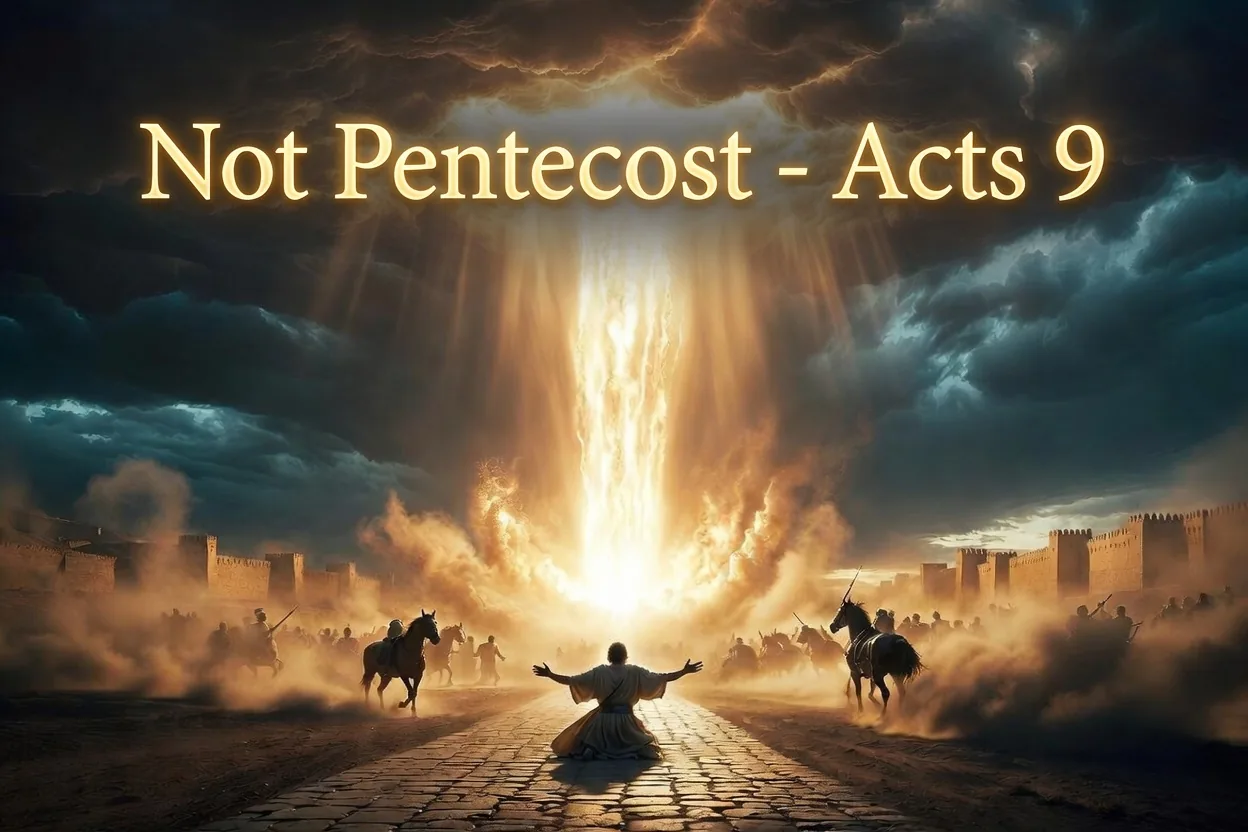
The transition is marked in Acts. Paul's conversion is recorded in Acts 9. The risen Lord appears to him on the Damascus road. He is struck blind. He is told, "I am Jesus whom thou persecutest" (Acts 9:5). He is called as the chosen vessel to bear the name of Christ before Gentiles, and kings, and the children of Israel (Acts 9:15). From that moment, a new stewardship is in motion.
The Body of Christ did not exist before Paul's conversion and commissioning because the mystery was not yet revealed. Abraham was not in the Body of Christ. The disciples at Pentecost were not in the Body of Christ. The three thousand souls in Acts 2 were not members of the mystery Body. They had received remission of sins through faith in Messiah — but they were not participants in the mystery Body that Paul's epistles describe. They were the remnant of Israel, believing in their Messiah, awaiting the kingdom. Their program is prophetic. Paul's program is the mystery.
Addressing Ruckman: Were People In Christ Before Paul?
Peter Ruckman argued that people were already "in Christ" before Paul's ministry began, and therefore the Body of Christ — or at least the concept of being "in Christ" — predated Paul. His main proof-text was Romans 16:7:
"Salute Andronicus and Junia, my kinsmen, and my fellowprisoners, who are of note among the apostles, who also were in Christ before me." (Romans 16:7 KJV)
There it is, says Ruckman: Andronicus and Junia were in Christ before Paul. Therefore people were already incorporated into whatever "in Christ" means before Paul came along. Therefore Paul did not begin the Body of Christ.
This argument proves too little, and it ignores how Scripture uses the phrase "in Christ."
First, what does "in Christ before me" actually mean? It means that Andronicus and Junia had come to faith in Christ — they were believers — prior to Paul's conversion. Paul was converted on the Damascus road in Acts 9. Andronicus and Junia had apparently believed on Christ before that point, whether during Jesus' earthly ministry, at Pentecost, or in the early Acts period. Paul is simply noting that they came to faith in Christ before he did. He is describing the chronological order of their conversions, not the theological category of their standing.
Second, does "in Christ" always mean "a member of the mystery Body of Christ"? It does not, and reading Paul's epistles carefully makes this clear. The phrase "in Christ" is used in a broad sense throughout Scripture to mean "a believer, one who has trusted in Christ, one whose faith rests in the Messiah." When Paul writes to the church in Ephesians 1 about every spiritual blessing "in Christ" and being "seated in heavenly places in Christ," he is using the phrase in the precise mystery Body sense. But when he says Andronicus and Junia were "in Christ before me" in a passing remark about their seniority as believers, he is using it in the general sense of "they were believers before I was."
The Old Testament saints had faith toward the same Messiah — their faith looked forward to the one who was to come. Abraham believed God and it was counted to him for righteousness (Romans 4:3). Was Abraham a member of the mystery Body of Christ? No. He is the father of the circumcision program. He has a distinct hope, a distinct promise, a distinct program — the promises of the land and the earthly nation. Being saved through faith in God's provision does not make you a member of the mystery Body.
Third, Ruckman's argument proves too much if followed consistently. If "in Christ before Paul" means "in the mystery Body before Paul," then Paul himself must be admitting that the Body existed before him and he was simply a late addition to it. But Paul never describes himself that way. He describes himself as the founder of the Body's revelation, the wise masterbuilder who laid the foundation (1 Corinthians 3:10), the man to whom the mystery was first committed (Ephesians 3:3). He describes his position as the first in whom Christ Jesus showed the full pattern of long-suffering:
"Howbeit for this cause I obtained mercy, that in me first Jesus Christ might shew forth all longsuffering, for a pattern to them which should hereafter believe on him to life everlasting." (1 Timothy 1:16 KJV)
Paul is the pattern. His salvation is the model — not a later example of something already established. He is first, and those who come after believe on his pattern.
If Andronicus and Junia being "in Christ before Paul" made them pre-Paul members of the mystery Body, then every Old Testament believer would have to be included too, since they all had faith toward the coming Christ before Paul. But the mystery was hid from them. The Body of Christ was not their program. Having faith counted for righteousness toward God's promised provision does not automatically enroll you in the mystery Body that was hidden until Paul.
Fourth, consider the nature of the mystery Body itself. Paul describes it this way:
"For he is our peace, who hath made both one, and hath broken down the middle wall of partition between us; Having abolished in his flesh the enmity, even the law of commandments contained in ordinances; for to make in himself of twain one new man, so making peace." (Ephesians 2:14–15 KJV)
One new man. Not Israel's program extended to Gentiles. Not the kingdom offer broadened. A new man — something that did not exist before. Jews and Gentiles together in one body, with the middle wall abolished, the law of commandments set aside, national distinction eradicated. This new man was created in Christ — it did not pre-exist. It was not present at Pentecost, where the apostles preached exclusively to Jews. It was not present in the early chapters of Acts, where Peter's ministry was still circumcision-focused. It came into existence when the mystery was revealed and the one new man was constituted.
Andronicus and Junia, having come to faith prior to Paul, were believers under the prophetic program — the remnant of Israel, justified by faith in Messiah. When the mystery was revealed and the dispensation of grace was committed to Paul, they — like Paul himself — were transitioned into the new position. But their pre-Paul faith was prophetic faith. It was not the mystery Body faith that Paul defines in Ephesians and Colossians, because that Body was hid in God until Paul revealed it.
Fifth, the mystery was not merely unrevealed — it was not yet constituted. A sharper form of Ruckman's argument is this: things can exist before they are revealed. The Trinity existed before the doctrine was fully articulated. Salvation by faith existed before Paul systematized it. Why couldn't the Body of Christ have existed — quietly, unannounced — before Paul disclosed it?
The answer lies in a distinction the text itself makes. There is a difference between what is planned and what is operative. A secret can be kept about something already real. But Ephesians 3:9 does not say the mystery was merely hidden from men's awareness while it was already running. It says the mystery was "hid in God" — not hid from men about something they were already participants in, but held in the unrevealed divine counsel, not yet put in motion at all. The hiding place was God Himself. This is not a disclosure problem. It is a timing problem — a divine purpose held in reserve until the moment God chose to put it into operation through Paul.
The distinction matters practically. A dispensation is not just information — it is an administration. It requires a steward to administer it, a gospel to define entry into it, and the Spirit's work to constitute membership in it. The dispensation of grace had no steward before Paul — God gave that dispensation to Paul (Ephesians 3:2). It had no distinct gospel before Paul — Paul received his gospel by direct revelation, not from the twelve (Galatians 1:12). And it had no Spirit baptism constituting its Body before Paul's ministry, because "by one Spirit are we all baptized into one body" (1 Corinthians 12:13) — and that Spirit baptism into the mystery Body began with Paul's preaching of the mystery.
You cannot be in a body that the Spirit has not yet begun to baptize people into. You cannot be under a dispensation that has no steward yet. You cannot be a participant in a program that God has held in reserve and not yet put in motion. The Body of Christ is not a category of "the saved under any program" — it is a specific administrative reality constituted by the mystery revelation. Before that revelation was given to Paul and put into operation, the Body was hid in God. After that revelation, it was — and is — being constituted every time anyone believes Paul's gospel.
Sixth, "by the cross" is not the same as "at the cross." Ephesians 2:16 states that Christ reconciled both Jew and Gentile "unto God in one body by the cross." Some read this and conclude that the one body was therefore constituted at the moment of the crucifixion — and therefore it pre-dates Paul's ministry entirely. This is a misreading of the preposition.
"By the cross" identifies the ground or instrument of the reconciliation, not the moment of constitution. The cross is what made the one new man possible. The cross abolished the enmity — the law of commandments contained in ordinances — that stood between Jew and Gentile. Without the cross, the wall could not have come down. Without the cross, there could be no one new man. In that sense, everything the mystery Body is rests on what the cross accomplished.
But "by the cross" does not mean "at the cross." The cross is the basis; Paul's revelation is the administration that puts that basis into effect. Consider the parallel: every believer is redeemed by the blood of Christ (Ephesians 1:7), but no individual is redeemed at the moment the blood was shed. Redemption was accomplished at Calvary; it is applied when a sinner believes the gospel. The ground and the administration are not the same event. In the same way, the cross is the ground on which the one new man stands, but the one new man was constituted when the mystery was revealed through Paul and the Spirit began baptizing believers into that one Body. The cross made it possible. Paul's stewardship made it operative.
Seventh, "in Christ" under the kingdom program meant to be in the vine — not in the body. This is perhaps the sharpest answer to the "in Christ before Paul" argument, because it does not merely say the phrase is used broadly — it shows that the kingdom program had its own distinct union metaphor, and it is not the body metaphor at all.
The night before His crucifixion, the Lord Jesus gave His disciples an extended teaching on their union with Him. He did not describe it using the body. He described it using the vine:
"I am the vine, ye are the branches: He that abideth in me, and I in him, the same bringeth forth much fruit: for without me ye can do nothing. If a man abide not in me, he is cast forth as a branch, and is withered; and men gather them, and cast them into the fire, and they are burned." (John 15:5–6 KJV)
I am the vine. Ye are the branches. That is the kingdom program's picture of union with Christ — branches growing from a vine, dependent on it for life and fruitfulness. The condition of that union is abiding. The fruit of that union is visible works. The consequence of failing to abide is being cast forth, withered, gathered and cast into the fire.
This is not the body metaphor. In Paul's mystery Body, believers are members — placed into the body by Spirit baptism (1 Corinthians 12:13), not grafted in as branches that can be cast off. The body metaphor describes an organic unity in which every member has a fixed position, a given function, and a permanent place. There is no body-member equivalent of being cast forth and cast into the fire. Paul's mystery Body is sealed, secure, and complete in Christ — positional and permanent from the moment of faith.
The distinction between the vine and the body is not cosmetic. It reflects two genuinely different kinds of union with Christ belonging to two different programs. The vine is the kingdom program's figure — Israel connected to Messiah in a relationship requiring faithfulness and bearing fruit, with the possibility of being cut off. The body is the mystery program's figure — Gentiles and Jews placed into Christ by the Spirit, no longer branch and vine but member and head, with no threat of being cut off because the placement is by God's act, not by human faithfulness.
So when Ruckman points to Andronicus and Junia being "in Christ before Paul," the question must be asked: in Christ in what sense? The disciples before the cross were in Christ as branches in the vine. They were in the kingdom program's union — the vine union the Lord described in John 15. They were not yet in the body, because the body is Paul's mystery figure, constituted after the cross and the ascension, administered through Paul's revelation. Being "in Christ" before Paul means being in the vine. It does not mean being in the body. The phrase can be used in both contexts, but the underlying program determines which union is in view.
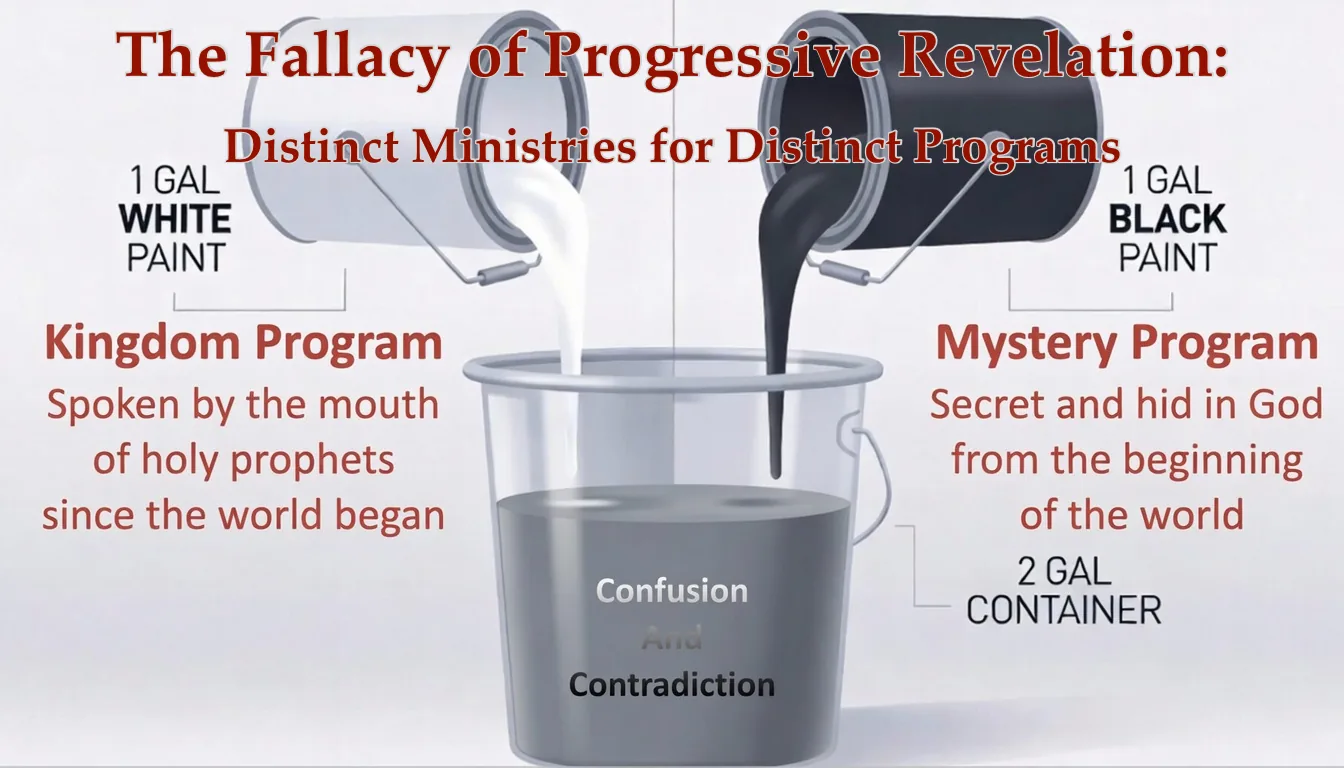
Ruckman's argument, in the end, confuses standing before God with dispensational position — and it fails to reckon with the fact that standing before God was not identical in every program either.
Old Testament saints had their faith counted for righteousness (Genesis 15:6; Romans 4:3), but their sins were covered — held over, not yet finally dealt with. The cross had not yet occurred. Hebrews 9:15 explains that Christ's death was "for the redemption of the transgressions that were under the first testament." (Hebrews 9:15) Their sins were covered provisionally, pending the cross that would retroactively satisfy the debt. They were not sealed, not seated in heavenly places, not members of the mystery Body. Their program was earthly — promises of land, nation, and kingdom. Their hope was prophetic.
Kingdom believers in the Acts period — the remnant of Israel who believed at Pentecost — had remission of sins. The word remission means sent away, suspended, held at a distance. Peter's promise in Acts 2:38 offered remission of sins in connection with repentance and water baptism. But remission is not the final word in the kingdom program. Peter's very next sermon makes the complete picture plain:
"Repent ye therefore, and be converted, that your sins may be blotted out, when the times of refreshing shall come from the presence of the Lord." (Acts 3:19 KJV)
The blotting out of sins is future-tense, conditional on national repentance, and tied to the coming of the Lord and the times of refreshing — the kingdom arriving. Remission was the present possession; blotting out was still coming. Kingdom believers were not yet in a state of permanently finished, irrevocably settled sin-account. Their full justification awaited the completion of the kingdom program.
Paul's salvation is categorically different. He quotes David in Romans 4, describing the blessedness of the man God justifies apart from works:
"Blessed is the man to whom the Lord will not impute sin." (Romans 4:8 KJV)
Will not impute sin. Not sins remitted pending the kingdom. Not sins covered until the cross completes the account. Will not impute — a permanent, settled, non-imputation of sin that is the present possession of the believer in this dispensation the moment he trusts the gospel. Paul's own commentary on this is Romans 8:1: "There is therefore now no condemnation to them which are in Christ Jesus." (Romans 8:1) Now. No condemnation. Not remission with blotting out still pending. Not covered and waiting for the cross to settle it. The account is permanently closed against every charge for the one who believes Paul's gospel.
It is worth being precise about 2 Corinthians 5:19, which says "God was in Christ, reconciling the world unto himself, not imputing their trespasses unto them." (2 Corinthians 5:19) This verse is describing what God accomplished at the cross as the ground of the gospel offer — the reconciliation God provided in Christ is the basis on which He now sends the appeal. The very next verse confirms that reconciliation is still being offered, not automatically received: "We pray you in Christ's stead, be ye reconciled to God" (2 Corinthians 5:20). The world's trespasses are not imputed in the sense that the cross has fully addressed them as an obstacle — God is not refusing the offer because the debt could not be met. But unbelievers are not individually reconciled until they receive the word of reconciliation by faith. The non-imputation of Romans 4:8 is the believer's personal present possession; the reconciling work of 2 Corinthians 5:19 is the ground on which that possession rests.
This is why the tense matters so much. Kingdom believers could say their sins were remitted — past transaction, present suspension, future blotting out pending. Paul's believers say "by grace are ye saved" (Ephesians 2:8) and "now no condemnation" (Romans 8:1) — present tense, complete, nothing pending.
The mystery Body is not simply "believers under any program with a right standing before God." It is the specific assembly constituted by the mystery revelation given to Paul — defined by permanent non-imputation of sin, Spirit baptism into the one Body, sealing until the day of redemption, present seating in heavenly places, and completeness in Christ as a present possession. None of those belong to Abraham's program. None of them belonged to the Pentecost believers before the dispensation of grace was committed to Paul. Ruckman collapses all of this into a single undifferentiated category of "in Christ," but the programs themselves will not cooperate with that flattening.
The Dispensation of Grace: A Stewardship Committed to One Man
The phrase "the dispensation of the grace of God" is Paul's own term for what was given to him (Ephesians 3:2). A dispensation is a stewardship — an ordered administration of divine affairs during a specific period, committed to a specific steward. The dispensation of the grace of God is the present age in which God deals with mankind through Paul's gospel and Paul's revelation of the mystery.
This dispensation did not exist in Acts 2. Peter was not its steward. The twelve were not its apostles. The Jerusalem church was not its foundation. Paul calls himself a "wise masterbuilder" who laid the foundation (1 Corinthians 3:10), and that foundation is the revelation committed specifically to him. He did not lay it on top of Peter's foundation. He laid a new one — not new in the sense of a different Christ, but new in the sense of a different administration of what Christ accomplished.
The timing is important. Paul's conversion came after the ascension, after Pentecost, and after the early Acts period was already underway. The Lord interrupted history to appear to Paul — not as the humbled earthly Messiah but as the glorified, risen, heavenly Lord. This post-resurrection, post-ascension, glorified appearance to Paul was the appropriate beginning for a new program built on the completed work of the cross and the exaltation of Christ. The twelve had walked with Christ in the flesh during His kingdom ministry. Paul knew Him only as the exalted, glorified Head of the mystery Body:
"Wherefore henceforth know we no man after the flesh: yea, though we have known Christ after the flesh, yet now henceforth know we him no more." (2 Corinthians 5:16 KJV)
The new creature (2 Corinthians 5:17) knows Christ after the Spirit, not after the flesh. Paul's ministry was built on the risen, glorified, heavenly Christ — the Christ whose victory at the cross had made the mystery possible, whose exaltation had opened the heavenly position that the Body of Christ now enjoys.
The dispensation of grace is administered through Paul. That is not an overstatement; it is what the text says. Ephesians 3:2 says it directly: the dispensation of the grace of God was given to Paul. Colossians 1:25 says Paul was made a minister "according to the dispensation of God which is given to me for you, to fulfil the word of God." (Colossians 1:25) The word of God is fulfilled through Paul. The mystery is made manifest through Paul. The grace administration runs through Paul.
This is not to say Paul had no predecessors in faith. Abraham had his faith counted for righteousness (Genesis 15:6). David had his transgression forgiven and his sin covered (Psalm 32:1). Peter had remission of sins under the kingdom offer to Israel. Each had a genuine standing before God in the terms of his own program. But none of them possessed what Paul describes as the Body of Christ's present position — permanent non-imputation, sealed until the day of redemption, seated in heavenly places, complete in Christ now. That position belongs to this dispensation. It did not exist before Paul, because it was hidden until Paul. The dispensational administration that defines the present age — the one in which Gentiles are fellow-heirs in the mystery Body, in which the law of Moses is set aside, in which there is no more "to the Jew first," in which Christ is in you the hope of glory — began when the mystery was revealed and committed to Paul, and not one moment before.
Not Acts 2. Not Acts 28. Acts 9.
It is worth addressing briefly where the mid-Acts position places the beginning of Paul's distinct ministry, because there are those who push it to the end of Acts — the Acts 28 position — arguing that the full mystery wasn't operative until Paul pronounced Israel's blindness in Rome.
The Acts 28 position is not the mid-Acts position. Mid-Acts Pauline teaching holds that Paul's mystery ministry began with his conversion and commission in Acts 9. The Body of Christ was being constituted through Paul's preaching from the beginning of his ministry. His early epistles — Romans, Galatians, 1 and 2 Corinthians — contain the full mystery of Christ and are equally applicable to the Body of Christ today. The mystery was not being revealed in installments that only became complete with the prison letters. Paul received the full revelation by revelation of Christ (Galatians 1:12) from the beginning.
What changed at Acts 28 was not the mystery but the context. During the Acts period, while Paul preached the mystery, the prophetic program was still running on a parallel track. Peter's circumcision ministry was still active. The synagogue pattern was operative — Paul went to the Jew first in every city. Signs were still confirming the word. When Acts 28:28 came, those contextual elements ended. Israel was set aside nationally. The synagogue pattern ceased. The prophetic program went into abeyance. Paul's prison epistles, written after that declaration, reflect the pure mystery in full operational clarity with no further prophetic overlap.
But the mystery was already Paul's message before Acts 28. The Body of Christ was already being constituted before Acts 28. Those in Paul's Acts-period assemblies were already members of the mystery Body, already complete in Christ, already seated in heavenly places — because that is what Paul preached to them from the beginning. Acts 28 did not create the mystery; it ended the transitional overlap.
The Sealing of the Spirit: Secured the Moment You Believe
One further distinction is worth pressing because it shows just how different the Body of Christ's experience of the Spirit is from what the prophetic program offered.
In the Acts period, the gift of the Holy Ghost was sometimes delayed and always variable in its manner of coming. In Acts 8, the Samaritans had believed and been baptized in the name of the Lord Jesus through Philip's preaching, but had not yet received the Holy Ghost — Peter and John came down from Jerusalem and laid hands on them to impart it (Acts 8:14–17). In Acts 10, the Spirit fell on Cornelius's household while Peter was still preaching, before water baptism had even occurred. Different timing, different order, different occasion — all within the same transitional period.
Variation. Delay. Laying on of hands. Visible signs as confirmation throughout.
Paul's revelation for the Body of Christ is nothing like this. The Spirit is received the moment the gospel is believed:
"In whom ye also trusted, after that ye heard the word of truth, the gospel of your salvation: in whom also after that ye believed, ye were sealed with that holy Spirit of promise." (Ephesians 1:13 KJV)
After that ye believed — ye were sealed. Not after water baptism. Not after an elder laid hands on you. Not after a period of waiting and seeking. The moment you believe the gospel, the Spirit of God seals you. The word "sealed" speaks of ownership, security, and authentication. God stamps His seal on the believer instantly and permanently.
There is no record in Paul's epistles of any believer being told to seek the Spirit, wait for the Spirit, or worry whether they had received the Spirit. That is because in this dispensation of grace, the Spirit is given to every believer at the moment of faith without exception and without variation. This is not the Pentecostal experience of Acts 2, which was a dramatic outward event signaling the beginning of the kingdom confirmation. This is the quiet, permanent, guaranteed sealing of the Holy Spirit that belongs to every member of the Body of Christ.
Anyone telling you that you need a second experience, that you need to speak in tongues to confirm you have the Spirit, that you need to seek the baptism of the Holy Ghost after salvation — is importing Acts 2 into the mystery Body. They are taking an event that belonged to the kingdom confirmation program and imposing it on believers who are already sealed, already complete, already seated in heavenly places.
"And ye are complete in him, which is the head of all principality and power." (Colossians 2:10 KJV)
Complete. Not incomplete and waiting for a second experience. Complete. Right now. In Him. That is what the mystery reveals — and it is the direct consequence of understanding that the baptism of the Holy Ghost at Pentecost and the Spirit baptism of the mystery are two distinct things belonging to two distinct programs.
The Jewish Church and the Body of Christ Are Doctrinally Incompatible Programs
There is a practical test for whether the Body of Christ predates Paul, and it is more damaging to the pre-Paul position than any single verse. The test is this: if the Body of Christ was already running at Pentecost, then the doctrines Peter preached and the practices the Jerusalem assembly followed are the doctrines and practices of the Body of Christ. You do not get to keep the founding event and quietly drop its founding instructions. If Acts 2 is the birth of the Body, then Acts 2:38 is the Body's gospel. If the Jerusalem assembly is the founding church, then the Jerusalem assembly's practice is the founding pattern.
And that is exactly where the confusion multiplies without resolution.
The gospel. Peter's Pentecost message was: "Repent, and be baptized every one of you in the name of Jesus Christ for the remission of sins, and ye shall receive the gift of the Holy Ghost." (Acts 2:38 KJV). Paul's gospel is: "Moreover, brethren, I declare unto you the gospel which I preached unto you... how that Christ died for our sins according to the scriptures; And that he was buried, and that he rose again the third day according to the scriptures." (1 Corinthians 15:1, 3–4 KJV). Peter's message connects remission of sins to water baptism plus repentance. Paul's message connects salvation to faith in the death, burial, and resurrection of Christ, with no water ordinance attached. These are not the same gospel. Galatians 2:7–9 confirms it explicitly — the gospel of the circumcision was committed to Peter, and the gospel of the uncircumcision was committed to Paul. If the Body of Christ started with Peter, Paul's gospel is either a contradiction or a redundancy. It is neither. It is a different administration.
Water baptism. The Jerusalem church practiced water baptism for the remission of sins (Acts 2:38). Three thousand were baptized on the day of Pentecost (Acts 2:41). The Samaritans were baptized (Acts 8:12). Cornelius and his household were baptized (Acts 10:48). This was not an optional gesture of public declaration — in that program it was bound directly to remission of sins and the reception of the Holy Ghost. If that assembly is the Body of Christ, water baptism is required for salvation. There is no principled way to say "the Body started at Pentecost" and also say "water baptism is not required today." Either Acts 2:38 speaks to the Body of Christ and you are obligated to practice water baptism for the remission of sins, or it belongs to a different program. You must choose. Most people who say the Body started at Pentecost will not follow their own premise to its logical conclusion because they sense — rightly — that water baptism for remission of sins contradicts Paul's grace gospel. That sense of contradiction is right division knocking on the door.
Signs, wonders, and communal life. The Jerusalem assembly operated in a climate of extraordinary miraculous confirmation. The apostles performed "many wonders and signs" (Acts 2:43). The believers "sold their possessions and goods, and parted them to all men, as every man had need" (Acts 2:44–45). Later, in Acts 4:32–35, the community of Jerusalem believers had all things common, with the apostles distributing to every man according to his need, and no one saying that anything he possessed was his own. If that assembly is the founding Body of Christ, then communal property and the sale of personal possessions are the founding economic pattern. Where is that in Paul's epistles? Nowhere. Paul teaches grace giving — "Every man according as he purposeth in his heart, so let him give; not grudgingly, or of necessity: for God loveth a cheerful giver." (2 Corinthians 9:7 KJV). Not "sell your possessions and give to the common fund." A cheerful, purposed gift from what you have. Different instruction. Different program.
Tongues as evidence. Tongues accompanied the receiving of the Holy Ghost at key moments in the Acts period — at Jerusalem (Acts 2:4), at the house of Cornelius (Acts 10:44–46), and at Ephesus (Acts 19:6). For this reason, many who hold a Pentecost-beginning of the Body argue that tongues are the evidence of receiving the Spirit. If the Body began at Pentecost, the pattern set there is the pattern for the Body. But Paul's epistles flatly contradict this. He declares there is one baptism (Ephesians 4:5). He tells the Corinthians that not all speak with tongues (1 Corinthians 12:30) — the very opposite of a universal evidence. He states that tongues will cease (1 Corinthians 13:8). He says tongues are a sign "not to them that believe, but to them that believe not" (1 Corinthians 14:22) — specifically a sign for unbelieving Israel. If the Body started at Pentecost, tongues as universal evidence is an inescapable conclusion. If Paul is right that tongues were a sign for unbelieving Israel and have ceased, then Pentecost was a different program. You cannot have both.
The hope. The Jerusalem assembly looked for an earthly kingdom. The disciples had asked the Lord before His ascension: "Lord, wilt thou at this time restore again the kingdom to Israel?" (Acts 1:6 KJV). That question was not corrected as a wrong expectation — it was deferred. Peter, preaching at Pentecost and in his early sermons, called Israel to national repentance so that the Lord would "send Jesus Christ, which before was preached unto you: Whom the heaven must receive until the times of restitution of all things, which God hath spoken by the mouth of all his holy prophets since the world began." (Acts 3:20–21 KJV). The hope was restoration — the restitution of all things, the earthly kingdom promised to Israel through the prophets. Paul's hope for the Body of Christ is entirely different: "For our conversation is in heaven; from whence also we look for the Saviour, the Lord Jesus Christ." (Philippians 3:20 KJV). An earthly restoration of Israel's kingdom and a heavenly calling are not the same hope. If the Body began with Peter's message, the Body's hope is the earthly kingdom. If Paul's Body has a heavenly hope, it is a different program.
Law-keeping. Decades after Pentecost, the Jerusalem church was still keeping the law of Moses. When Paul arrived in Jerusalem toward the end of his Acts-period ministry, James told him: "Thou seest, brother, how many thousands of Jews there are which believe; and they are all zealous of the law." (Acts 21:20 KJV). These were believers — genuine converts from among Israel — and they were zealous of the Mosaic law. This was not a failure or a spiritual immaturity in the Jerusalem assembly. It was the appropriate continuation of their program. They were the prophetic remnant of Israel, the little flock of the kingdom program, for whom the law was still operative. Paul's word to the Body of Christ is the opposite: "Ye are not under the law, but under grace." (Romans 6:14 KJV). "Christ is the end of the law for righteousness to every one that believeth." (Romans 10:4 KJV). These two positions — thousands of believers zealous for the law, and believers declared not under the law — cannot both be the doctrine for the same Body of Christ at the same time.
The tense of salvation. One of the most revealing differences between the two programs is found not in what is commanded but in what tense salvation is described. Under the kingdom program, salvation is consistently spoken of in the future tense — it is something coming, something to be received upon certain conditions being met. The Lord Jesus said: "He that believeth and is baptized shall be saved; but he that believeth not shall be damned." (Mark 16:16 KJV). "But he that shall endure unto the end, the same shall be saved." (Matthew 24:13 KJV). Peter at Pentecost: "Whosoever shall call on the name of the Lord shall be saved." (Acts 2:21 KJV). Shall be saved. Future. Conditional on endurance. Conditional on baptism. Conditional on calling.
Paul's epistles speak of salvation in the present tense — a present possession, already received, already accomplished:
"For by grace are ye saved through faith; and that not of yourselves: it is the gift of God." (Ephesians 2:8 KJV)
"Therefore being justified by faith, we have peace with God through our Lord Jesus Christ." (Romans 5:1 KJV)
"There is therefore now no condemnation to them which are in Christ Jesus." (Romans 8:1 KJV)
"For the preaching of the cross is to them that perish foolishness; but unto us which are saved it is the power of God." (1 Corinthians 1:18 KJV)
Ye are saved. We have peace. Now no condemnation. Us which are saved. Present tense. Accomplished. Possessed. Not conditional on enduring to the end, not tied to water baptism, not dependent on future faithfulness. The grace salvation Paul proclaims is a present reality — already true of every believer the moment they trust the gospel.
This is not a minor difference in expression. It is a programmatic difference. The kingdom program's future-tense salvation reflects its conditional structure — endurance, faithfulness, and national repentance mattered to how that program would resolve. Paul's present-tense salvation reflects the finished work of the cross applied the moment of faith — there is nothing left to complete, nothing left to secure, nothing left to earn.
If the Body of Christ began at Pentecost, then "he that endureth to the end shall be saved" is doctrine for the Body of Christ, and the security of the believer is conditional on making it to the end. But Paul says we are saved — right now, irrevocably, sealed with the Holy Spirit of promise (Ephesians 1:13) until the day of redemption (Ephesians 4:30). The tense of salvation alone is sufficient to show that these are different programs with different structures, different conditions, and different bases of assurance.
The point is not that the Jerusalem believers were unsaved or were doing something wrong. The point is that they were operating under a different program, with different doctrines, a different hope, different practices, and a different apostle. They were Peter's church. Their doctrines came from the circumcision program. And those doctrines are incompatible with Paul's mystery Body doctrine at every point of contact.
This is not confusion — it is clarity, once the programs are rightly divided. The moment you say the Body of Christ started with Paul and belongs to Paul's epistles alone, every one of these apparent contradictions resolves. Water baptism belonged to the prophetic program. Tongues were a sign for Israel. Communal property-sharing was a kingdom-readiness expression of the Israel remnant. Law-keeping was appropriate for those still in the prophetic program. The earthly kingdom hope was Israel's hope. None of it belongs to the Body of Christ. None of it is in Paul's completed revelation of the mystery.
But if you insist the Body started at Pentecost, you are stuck choosing which of Peter's doctrines to keep and which to quietly drop — with no principled basis for either choice. That is not right division. That is tradition managing the chaos that comes from mixing two programs.
Why This Matters More Than a Debate Point
Someone might object: does it really matter when the Church began? Isn't the important thing just to be saved?
Yes, you must be saved. That comes first. But the question of when the Church began carries massive practical weight for how you live as a believer.
If you think the Church began at Pentecost, you will look to Acts 2 as your model. You will seek the tongues experience. You will practice water baptism for the remission of sins or at least as a required step of obedience. You will expect signs and wonders to confirm your faith. You will preach the kingdom gospel alongside the grace gospel, blurring the line between repentance for Israel and the free grace that saves today. You will build on a mixed foundation that blends Peter and Paul, law and grace, prophecy and mystery — and you will produce exactly the kind of doctrinal confusion that fills every denomination in Christendom.
If you think people were already in the mystery Body before Paul (following Ruckman), you will minimize what is unique about Paul's revelation. You will treat the mystery as a continuation of an existing program rather than as something hidden until Paul. You will fail to let the word "mystery" carry its full weight — hidden, not just unfulfilled. You will end up with a diluted Paul, a Paul who is one voice among many rather than the specific apostle to whom the present dispensation was committed.
But if you see clearly that the mystery Body of Christ — with its heavenly position, its completeness in Christ, its freedom from all ordinances, its one-new-man constitution of Jews and Gentiles in one body — began with Paul, then everything else becomes clean. You know where to look for your doctrine. You know why Paul says "follow me" (1 Corinthians 11:1; Philippians 3:17). You know why Paul's epistles are your marching orders, not the Sermon on the Mount or Peter's Pentecost sermon or the kingdom commission of Matthew 28.
You know who you are. You are a member of the Body of Christ, baptized by the Spirit into that body the moment you believed, sealed with the Holy Spirit, complete in Him, seated with Him in heavenly places, possessing every spiritual blessing already (Ephesians 1:3). Not waiting. Not seeking. Not performing. Complete.
That is the glorious truth that flows from getting the beginning right.
The Charge: Stand Where Paul Stood
Paul wrote these words from a Roman prison, knowing his execution was near:
"Hold fast the form of sound words, which thou hast heard of me, in faith and love which is in Christ Jesus." (2 Timothy 1:13 KJV)
The form of sound words. The pattern of doctrine committed to Paul. The mystery of Christ as Paul revealed it. This is what we are to hold — not the pattern of Pentecost, not the kingdom offer to Israel, not the Acts 2 experience. The form of sound words heard from Paul.
The Body of Christ began when that form of sound words was first committed — when the mystery was revealed to the chief of sinners on the Damascus road, when the dispensation of grace was given to Paul for us. Andronicus and Junia having believed before Paul's conversion does not change that — their faith was counted for righteousness before the mystery was revealed, but the mystery Body is not constituted by pre-Paul faith. Three thousand souls receiving remission of sins at Pentecost under Peter's kingdom message does not change that — remission under the prophetic program is not the permanent non-imputation of the dispensation of grace. Peter receiving the keys of the kingdom of heaven does not change that — the keys of the kingdom are kingdom authority, given to open the prophetic program to Israel, and they have nothing to do with the mystery committed to Paul. Kingdom keys and mystery stewardship are two different things given to two different apostles for two different programs.
The Body of Christ is Paul's epistles' Church. It began with Paul's revelation. It is sustained by Paul's doctrine. And it will be completed when the Lord Jesus Christ comes in the air to receive it — this Body He purchased with His own blood, constituted through the mystery of grace, complete in Him even now.
Hold fast to that. Don't drift back to Pentecost. Don't settle for a blended gospel that mixes Peter and Paul. Stand where Paul stood — in the pure grace of the dispensation committed to him — and you will stand on the only ground that is solid in this present age.
© 2026 Edward R. Cross




Comments
No comments yet. Be the first to share your thoughts.
Leave a comment