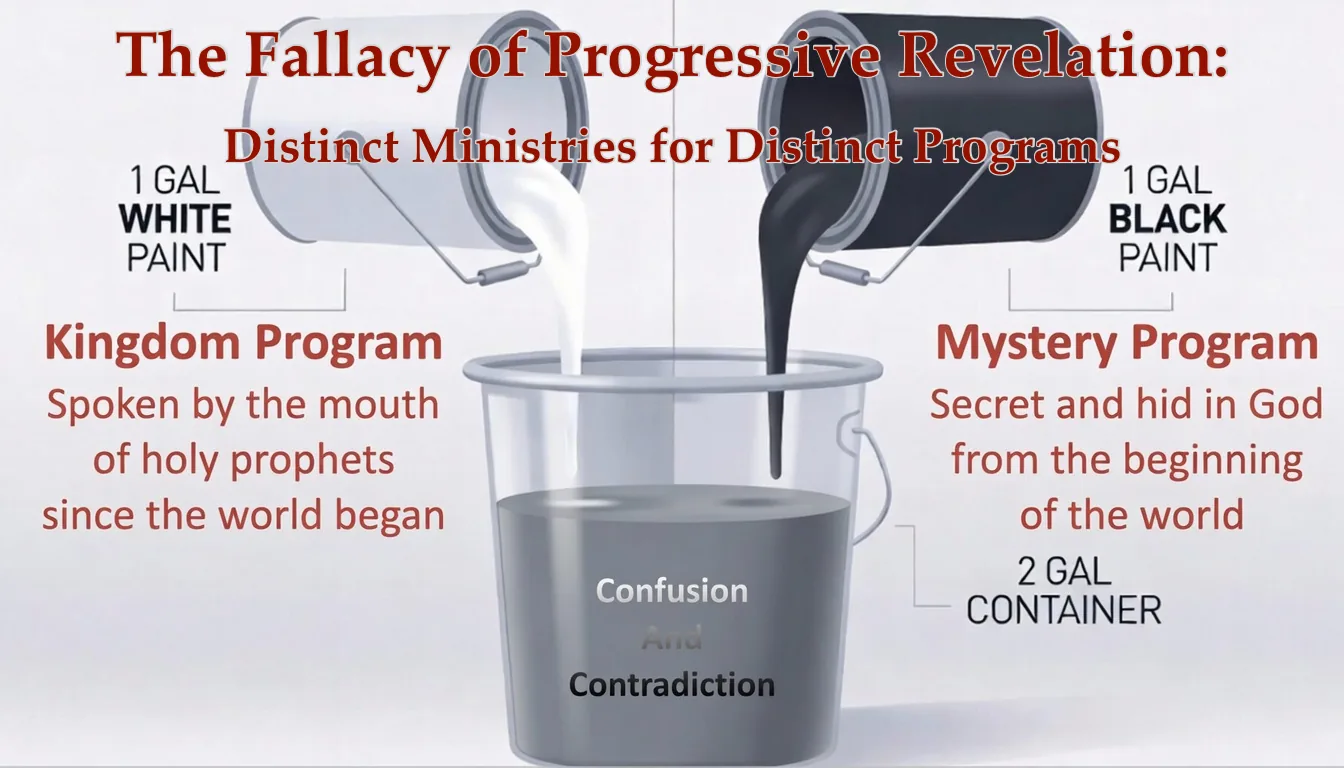
One of the most important disciplines in mid-Acts dispensational Bible study is the ability to distinguish between what Paul did during the Acts period and what he instructs the Body of Christ to practice once the mystery has been fully revealed. These are not the same thing, and conflating them produces significant doctrinal confusion.
Paul's ministry unfolded across a period of dramatic transition. From his conversion in Acts 9 through the close of the book of Acts in chapter 28, two programs overlapped. Israel's prophetic program — the kingdom offer through Peter and the circumcision ministry — was still running its course. At the same time, Paul's mystery ministry to the Body of Christ was already underway. Paul always preached the mystery. From the moment Christ appeared to him on the Damascus road, his message was distinct from Peter's. Peter preached prophecy to the circumcision; Paul preached the mystery to the Gentiles. These were never the same message.
This is the heart of what makes mid-Acts dispensational teaching distinct. All of Paul's epistles — including Romans, Galatians, 1 and 2 Corinthians, and 1 and 2 Thessalonians — contain the mystery of Christ and apply to the Body of Christ today. The doctrine for the church is found in all of Paul's writings, not only the prison letters.
What changed at Acts 28 was not Paul's message, but the context in which he operated. Throughout the Acts period, while Paul preached the mystery, he also functioned within a world where Israel's prophetic program was still active. He went to the synagogue first. He performed signs that authenticated his apostleship to Jewish audiences. He made contextual accommodations to Jewish sensibilities. He organized a charitable collection for the Jewish saints in Jerusalem. He operated alongside a still-running prophetic program. When Acts 28:28 came — when Paul declared that the salvation of God was being sent to the Gentiles because Israel had nationally rejected it — those contextual accommodations ended with it. The practices were transitional; the message never was.
What follows is a survey of those transitional elements — things Paul did and accommodated in Acts and the Acts-period context — that were characteristic of the overlap and are not the ongoing pattern for the Body of Christ now that the overlap has ended.
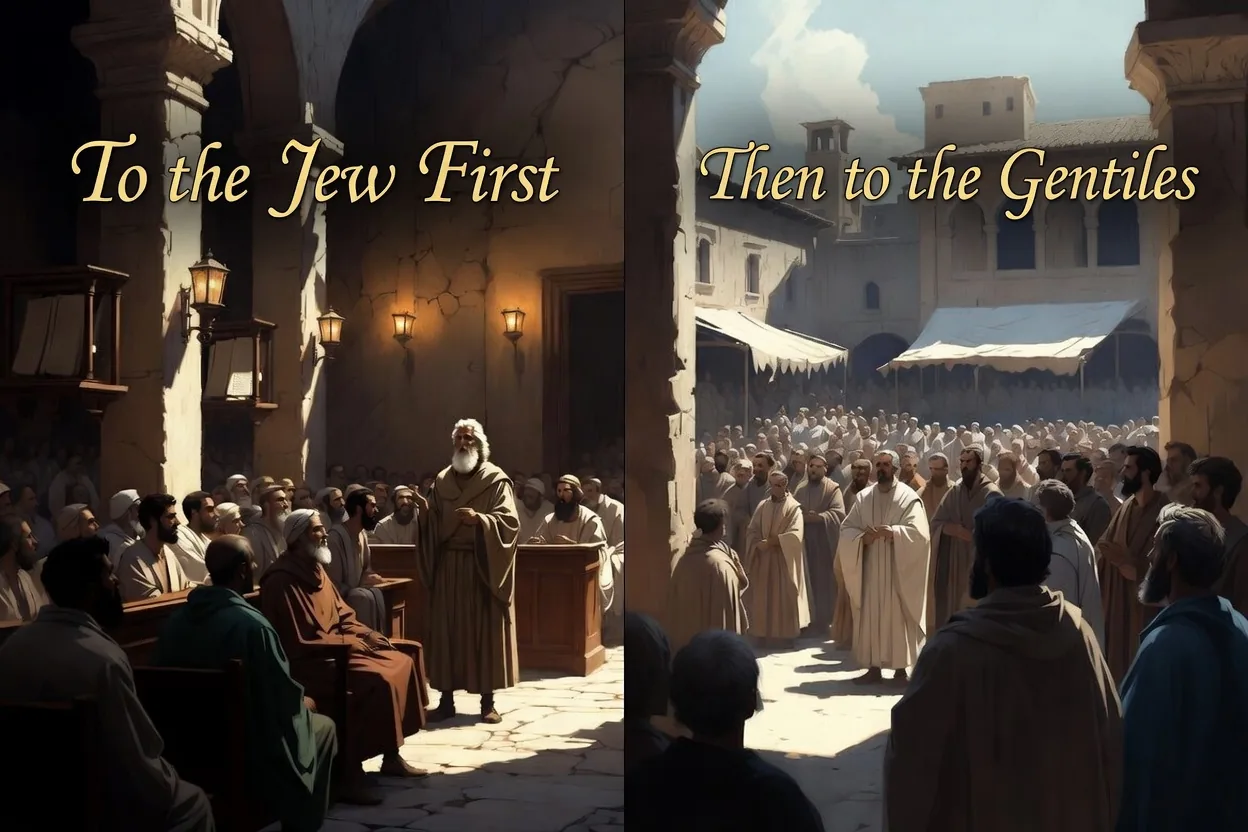
To the Jew First: The Synagogue Pattern
The most consistent feature of Paul's missionary methodology throughout the Acts period was his unfailing practice of going to the Jewish synagogue first upon arriving in any new city. The record is explicit and repeated:
- Salamis: "they preached the word of God in the synagogues of the Jews" (Acts 13:5)
- Antioch in Pisidia: "they came to Antioch in Pisidia, and went into the synagogue on the sabbath day" (Acts 13:14)
- Iconium: "they went both together into the synagogue of the Jews" (Acts 14:1)
- Thessalonica: "Paul… went in unto them, and three sabbath days reasoned with them out of the scriptures" (Acts 17:1–2)
- Berea: "these were more noble than those in Thessalonica, in that they received the word with all readiness of mind, and searched the scriptures daily" (Acts 17:11)
- Athens: "disputed he in the synagogue with the Jews" (Acts 17:17)
- Corinth: "he reasoned in the synagogue every sabbath, and persuaded the Jews and the Greeks" (Acts 18:4)
- Ephesus: "he went into the synagogue, and spake boldly… disputing and persuading the things concerning the kingdom of God" (Acts 19:8)
Paul articulated the theological basis for this pattern in his letter to the Romans: "For I am not ashamed of the gospel of Christ: for it is the power of God unto salvation to every one that believeth; to the Jew first, and also to the Greek." (Romans 1:16 KJV)
Paul himself stated this necessity explicitly at Pisidian Antioch when the Jews rejected his message: "It was necessary that the word of God should first have been spoken to you: but seeing ye put it from you, and judge yourselves unworthy of everlasting life, lo, we turn to the Gentiles." (Acts 13:46 KJV) The word necessary is significant — this was not optional or merely strategic. It was a divinely ordered obligation during the Acts period.
The "to the Jew first" principle was not Paul's personal preference — it was the contextual order of his ministry during the Acts period. As Paul moved through the Gentile world he gave unbelieving Jews in every city the first opportunity to hear the grace gospel. His message to them was the same mystery gospel he preached everywhere — not the kingdom offer, which belonged to Peter's circumcision ministry. Paul kept his grace gospel separate from the circumcision program under the Galatians 2:7–9 agreement, and the gospel of the grace of God was never taught in Jerusalem among the believing remnant. This is why Paul could write so passionately in Romans 9–11, expressing his deep desire for his kinsmen to be saved by the same grace, and explaining through the mystery why God had not cast away His people.
But this pattern had a terminal point. When Paul arrived in Rome and gathered the Jewish community to hear him, and they hardened against the gospel, Paul pronounced the end of the "to the Jew first" pattern with words drawn from Isaiah:
"Be it known therefore unto you, that the salvation of God is sent unto the Gentiles, and that they will hear it." (Acts 28:28 KJV)
This declaration — echoing similar declarations made at Antioch in Pisidia (Acts 13:46) and Corinth (Acts 18:6) that had applied locally and were followed by Paul returning to the synagogue in the next city — was now final and dispensational in scope. The earlier "we turn to the Gentiles" statements at Acts 13 and 18 were local and temporary; the proclamation in Acts 28 carried a different weight. Each time Paul moved to a new city he resumed the synagogue pattern, continuing to give unbelieving Jews their first access to the grace gospel. Acts 28:28 marks the point where that pattern ended and Israel's prophetic program went into abeyance. The "blindness in part" described in Romans 11:25 was not a new thing at Acts 28 — Paul had already named it as Israel's present condition before he ever reached Rome — and it did not deepen to total blindness there. It remains in part to this day, until the fulness of the Gentiles be come in. What ended at Acts 28 was the synagogue pattern and the active prophetic program, not the degree of Israel's blindness.
The synagogue visitation pattern, the "to the Jew first" order, ceased with Acts 28. Paul's prison epistles, written after this declaration, contain no instruction to go to the synagogue, no "to the Jew first" ordering, and no mention of a national offer to Israel. The transition was complete.
Signs, Wonders, and Miracles
Throughout the Acts period, Paul performed extraordinary miracles that authenticated his apostleship to audiences who required visible confirmation — particularly the Jewish community, for whom signs were a covenantal expectation (1 Corinthians 1:22). The record in Acts is extensive:
- At Lystra, Paul healed a man lame from birth (Acts 14:8–10)
- At Philippi, Paul cast an evil spirit out of a slave girl (Acts 16:16–18)
- At Troas, Paul raised Eutychus from the dead after a fatal fall from a window (Acts 20:9–12)
- On the island of Malta, Paul shook a viper into the fire with no ill effect, and the islanders watched for him to swell up and drop dead — he did not (Acts 28:3–6)
- At Ephesus, "God wrought special miracles by the hands of Paul: So that from his body were brought unto the sick handkerchiefs or aprons, and the diseases departed from them, and the evil spirits went out of them" (Acts 19:11–12)
Paul himself catalogued these signs when defending his apostleship to the Corinthians: "Truly the signs of an apostle were wrought among you in all patience, in signs, and wonders, and mighty deeds." (2 Corinthians 12:12 KJV)
The language is instructive: signs of an apostle. These miracles were not the normal expectation for every believer in every assembly. They were the credentials God gave Paul so that his apostleship and his new gospel would be validated during the period when Israel still had every right to demand visible confirmation. The writer of Hebrews articulates the purpose exactly: the great salvation that began with the Lord was "confirmed unto us by them that heard him; God also bearing them witness, both with signs and wonders, and with divers miracles, and gifts of the Holy Ghost, according to his own will" (Hebrews 2:3–4 KJV).
Once Paul had fulfilled the word of God — once the mystery was completely written down and delivered — the confirming signs had served their purpose. The evidence that they were already fading appears in Paul's own later ministry. He told Timothy to take wine for his stomach and frequent infirmities rather than healing him (1 Timothy 5:23). He left Trophimus sick at Miletum (2 Timothy 4:20). These are not the actions of a man who still operated in the full healing ministry of the Acts period. The signs had served their transitional purpose and were withdrawing as the dispensation came into its full clarity.
The Sign Gifts: Tongues, Prophecy, and Knowledge
The Acts-period epistles, particularly 1 Corinthians, address a full complement of sign gifts operating in the early assemblies: tongues, interpretation of tongues, prophecy, word of wisdom, word of knowledge, gifts of healings, working of miracles, discerning of spirits (1 Corinthians 12:8–10). Paul had to devote three full chapters — 1 Corinthians 12 through 14 — to governing these gifts, correcting their abuse, and placing them in proper perspective.
The presence of these gifts in the Acts-period assembly was not accidental. They were the continuation of the kingdom confirmation signs that had accompanied the preaching of the gospel to Israel from Pentecost onward. Tongues in particular were a sign for unbelieving Israel — Paul himself established this by quoting Isaiah 28:11–12:
"In the law it is written, With men of other tongues and other lips will I speak unto this people; and yet for all that will they not hear me, saith the Lord. Wherefore tongues are for a sign, not to them that believe, but to them that believe not." (1 Corinthians 14:21–22 KJV)
Tongues were a sign to unbelieving Israel specifically — a supernatural confirmation that God was still speaking to His covenant people even through a foreign medium. When the synagogue-first pattern of Paul's ministry ended at Acts 28 and the prophetic program went into abeyance, the purpose for this sign gift ceased with it.
Paul was explicit that these gifts were temporary:
"Charity never faileth: but whether there be prophecies, they shall fail; whether there be tongues, they shall cease; whether there be knowledge, it shall vanish away." (1 Corinthians 13:8 KJV)
The reason given is the coming of "that which is perfect" (1 Corinthians 13:10) — the completion of the written revelation of the mystery. Once Paul had fulfilled the word of God by delivering the full revelation, the sign gifts which belonged to the transitional confirmation period ceased as that period closed.
Notably, Paul's prison epistles contain no instruction regarding tongues, no chapters governing the exercise of prophecy in the assembly, no lists of sign gifts to be sought or regulated. The gifts that demanded three chapters of correction in 1 Corinthians are simply absent from the mature revelation of Ephesians, Colossians, Philippians, and Philemon. Their absence is itself instructive.
Water Baptism: A Practice Paul Was Pulling Back From
Water baptism presents one of the clearest examples of a transitional practice in Paul's ministry. In the earliest Acts period, Paul baptized converts. He baptized Crispus, Gaius, and the household of Stephanas at Corinth (1 Corinthians 1:14–16). But even as he reported these baptisms, he expressed relief that he had not baptized more — and gave the reason:
"For Christ sent me not to baptize, but to preach the gospel: not with wisdom of words, lest the cross of Christ should be made of none effect." (1 Corinthians 1:17 KJV)
This is a remarkable statement. Paul was given a commission that specifically did not include baptism as a central element. He did not say water baptism was wrong in that context — it was still operating as part of the transitional overlap with Israel's program. But it was not his commission. Christ sent him to preach the gospel, not to baptize.
The doctrinal explanation for why water baptism belongs to Israel's program rather than the Body of Christ emerges fully in the prison epistles. Paul declares in Ephesians 4:5 that there is now one baptism for the Body of Christ — not water, but the Spirit baptism that places every believer into the one Body at the moment of faith (1 Corinthians 12:13; Ephesians 4:4–5). The water ritual that John the Baptist administered, that Peter called Israel to at Pentecost, and that Paul performed in the transitional period was the prophetic ordinance connected to Israel's repentance and kingdom program. The one baptism for the Body of Christ is entirely spiritual — it was accomplished by the Spirit the moment the gospel was believed.
The trajectory is unmistakable: early in the Acts period Paul was baptizing, but with restraint and stated discomfort; in the prison epistles the water ordinance is absent and one Spirit baptism stands alone.
Jewish Observances: Transitional Accommodations
Several of Paul's actions during the Acts period involved accommodating Jewish religious observances in ways that reflected the transitional overlap of the two programs rather than the full liberty of the present dispensation.
The circumcision of Timothy (Acts 16:3) is the most striking. Timothy was the son of a Jewish mother and a Greek father, and Paul "took and circumcised him because of the Jews which were in those quarters: for they knew all that his father was a Greek." (Acts 16:3) Paul circumcised Timothy not as a spiritual requirement but as a pragmatic accommodation to Jewish sensibility in the regions where they would be ministering. This is in sharp contrast to Paul's fierce refusal to circumcise Titus under pressure from false brethren (Galatians 2:3–5), where the principle of grace was being challenged doctrinally. The Acts 16 circumcision was a transitional concession to the contextual Jewish setting; the Galatians 2 refusal was a doctrinal stand.
The Nazarite vow (Acts 18:18) — Paul shaved his head at Cenchreae because he had a vow. This was a Jewish religious practice under the Mosaic law. Nothing in Paul's epistles instructs the Body of Christ to take Nazarite vows. It was a transitional act consistent with the Jewish context of his ministry at that time.
Keeping the feast (Acts 18:21) — Paul told the Ephesians, "I must by all means keep this feast that cometh in Jerusalem." (Acts 18:21) The feast observance was part of his pastoral connection to the Jewish community during the transitional period. The prison epistles contain no instruction to keep feasts and explicitly warn against being judged in respect of feast observance (Colossians 2:16).
The Jerusalem vow and purification (Acts 21:23–26) — At the urging of James and the Jerusalem elders, Paul joined four men in paying for purification rites at the temple to demonstrate to the Jewish community that he was not teaching Jews to abandon the law. Paul complied not because it was doctrine for the Body of Christ, but to keep his grace gospel ministry separate from Jerusalem's circumcision program — consistent with the Galatians 2:7–9 agreement. It was this act of conciliation at the temple that led to his arrest.
The Collection for Jerusalem
During the third missionary journey, Paul organized an extensive charitable collection across the Gentile churches of Macedonia and Achaia for the poor saints in Jerusalem. He addressed it in 1 Corinthians 16:1–4, devoted two full chapters to it in 2 Corinthians 8–9, and reported on its purpose in Romans 15:25–27:
"But now I go unto Jerusalem to minister unto the saints. For it hath pleased them of Macedonia and Achaia to make a certain contribution for the poor saints which are at Jerusalem. It hath pleased them verily; and their debtors they are. For if the Gentiles have been made partakers of their spiritual things, their duty is also to minister unto them in carnal things." (Romans 15:25–27 KJV)
The collection was a concrete expression of the transitional relationship between the Jewish remnant still under the prophetic program and the Gentile members of the Body of Christ. After Acts 28, there is no instruction in the prison epistles for Gentile churches to make special contributions to Jewish believers in Jerusalem. The collection was a transitional expression of an interprogram relationship that no longer defined the dispensational moment once the overlap ended. The principle of grace giving (2 Corinthians 9:7) remains; the specific Jerusalem collection does not.
Visions and Direct Divine Communication
Throughout the Acts period, Paul received direct visions and divine communications that guided his movements and ministry:
- The Macedonian vision that redirected his itinerary (Acts 16:9–10)
- The vision at Corinth assuring him to stay and keep speaking (Acts 18:9–10)
- The appearance of the Lord in Jerusalem confirming his testimony and pointing him to Rome (Acts 23:11)
- The angelic message during the storm at sea (Acts 27:23–24)
- Paul's own reference to "visions and revelations of the Lord" including his catching up to the third heaven (2 Corinthians 12:1–4)
These visions were guidance and direction from the risen Christ — directing Paul's itinerary, assuring him in difficult circumstances, and confirming his testimony. The mystery itself had been committed to Paul by direct revelation from Christ early in his ministry (Galatians 1:12; Ephesians 3:3), not gradually unfolded piece by piece through visions. The visions in Acts were not doctrinal revelation expanding the mystery but divine direction for a man moving through a complex transitional world.
What was still underway during the Acts period was the writing down and delivering of the complete mystery to the churches — the commission Paul described as "to fulfil the word of God" (Colossians 1:25). Once that written Word was complete and delivered through Paul's full body of epistles, the need for supplementary divine direction through visions ended. The complete written Word now stands as the sufficient and final revelation. God speaks today through the rightly divided written Word, not through new visions or direct divine communications.
"All scripture is given by inspiration of God, and is profitable for doctrine, for reproof, for correction, for instruction in righteousness: That the man of God may be perfect, throughly furnished unto all good works." (2 Timothy 3:16–17 KJV)
The Acts-Period Epistles: The Same Mystery, a Different Context
A word of clarification is essential here, because a significant error — sometimes called the Acts 28 position — treats Paul's earlier epistles as containing less mystery doctrine than the prison letters, or as not being equally applicable to the Body of Christ today. That is not the mid-Acts Pauline position.
All of Paul's epistles — Romans, Galatians, 1 and 2 Corinthians, 1 and 2 Thessalonians, and the prison letters alike — are equally the mystery doctrine of the Body of Christ. The doctrine for the church today is found in all of them. Paul preached the same gospel of grace and the same mystery of Christ from the beginning of his ministry. He was not gradually working his way toward a fuller revelation that only arrived with the prison letters.
What the Acts-period epistles reflect is not a less-complete mystery but a different ministry context. Paul was writing to assemblies that existed while the synagogue pattern was still in force, while sign gifts were still operating in the transitional overlap, while Judaizers were actively attacking the grace gospel. The content of those epistles addresses those specific contextual conditions — not because the mystery was incomplete, but because those were the battles on the ground.
Consider the distinction:
1 Corinthians addresses sign gifts and a church in considerable doctrinal confusion still working through what it meant to be a Gentile assembly in a Jewish-dominated world. The three-chapter treatment of gifts governing (chapters 12–14) belongs to the transitional period when those gifts were active — Paul is correcting their misuse, not establishing them as a permanent fixture. The mystery doctrine of the Body of Christ is fully present throughout 1 Corinthians; what is transitional is the gift context being addressed. (The Lord's Supper also appears in 1 Corinthians 11 but belongs to a different category entirely — it is a Body of Christ ordinance received directly from the Lord and is not transitional. It is addressed there because of Corinthian abuse, not because it was ceasing.)
Romans 9–11, written while the "to the Jew first" pattern was still operative, discusses Israel's fall, the remnant, and the mystery of Israel's temporary blindness. This is not Acts-period theology that expires — it is fully applicable mystery doctrine. Israel's fall, the Gentiles being used to provoke them to jealousy, the future hope for all Israel — these are permanent revelations in Paul's mystery corpus. What changes at Acts 28 is not the doctrinal content of Romans 9–11 but the active synagogue context in which Paul was operating when he wrote it.
Galatians, written in the heat of battle against Judaizers, reflects the doctrinal combat of the transition — Paul defending grace against those who wanted to reimpose the law. This is not a less-complete epistle. It is the full mystery gospel being defended under fire.
The Hardening of Israel and Acts 28
Romans 11:25 — "blindness in part is happened to Israel, until the fulness of the Gentiles be come in" (Romans 11:25) — is permanent mystery doctrine. It is not a transitional statement that expired; it is the revealed explanation of Israel's current condition and future hope that belongs to the Body of Christ's understanding of God's program.
What was transitional was Paul's synagogue-first pattern — going to unbelieving Jews in every city and giving them first access to the grace gospel before moving to the Gentiles. This pattern operated alongside the still-running prophetic program of Peter's circumcision ministry during the Acts period overlap. That pattern ended at Acts 28:28 when Paul quoted Isaiah 6 to the assembled Jewish community in Rome and declared:
"Be it known therefore unto you, that the salvation of God is sent unto the Gentiles, and that they will hear it." (Acts 28:28 KJV)
With that declaration, the synagogue visitation pattern ceased. Israel's prophetic program went into abeyance. The "to the Jew first" ordering of Paul's ministry ended. Paul's subsequent prison epistles contain no synagogue visits, no collection for Jerusalem, no Nazarite vows — the contextual accommodations that had reflected the ongoing Jewish overlap were no longer needed.
But the doctrine of Romans 9–11 — Israel's fall, the mystery of their blindness, their future salvation — remains fully in force as mystery revelation for the Body of Christ to understand. The content of those chapters did not expire at Acts 28. What expired was the active synagogue pattern those chapters described as still in operation.
What This Means for Right Division
Understanding these transitional elements is not academic. It has direct practical implications for how we read and apply Paul's writings.
When someone insists that water baptism is still required because Paul baptized people in Acts, they are anchoring a present practice to a transitional moment rather than to the completed mystery revelation.
When someone argues that tongues are still valid because Paul spoke in tongues and 1 Corinthians 14 governs their use, they are treating a transitional practice as a permanent doctrine — confusing what Paul was correcting in the Acts-period context with what Paul prescribes for the ongoing Body of Christ.
When someone builds their church around the sign gifts of 1 Corinthians 12 without recognizing that those gifts belonged to the transitional overlap period and have ceased, they are anchoring present practice to a contextual accommodation rather than to the full pattern across all of Paul's epistles.
When someone insists that believers should still pray for special visions and direct divine communication rather than relying on the complete written Word, they are living as though the transition were still underway — as though Paul had not already declared that he had fulfilled the word of God in delivering the completed mystery (Colossians 1:25).
The rule is consistent: the transitional elements were practices and contextual accommodations that reflected the overlap of two programs during the Acts period. They were not the mystery message itself, which was always Paul's gospel from the beginning of his ministry. Once the overlap ended at Acts 28, those accommodations ended with it. What remains — in every epistle Paul wrote — is the mystery of Christ, fully applicable to the Body of Christ today.
"Whereof I am made a minister, according to the dispensation of God which is given to me for you, to fulfil the word of God; Even the mystery which hath been hid from ages and from generations, but now is made manifest to his saints." (Colossians 1:25–26 KJV)
The word of God has been fulfilled. The mystery has been made manifest. The transition is complete. All of Paul's epistles — from Romans through Philemon — stand as the revealed mystery of Christ for the Body of Christ today. Study them all. Rightly divide the practices of the Acts period from the doctrine that runs consistently through every letter Paul wrote, and you will find that the message never changed. Only the context did.
© 2026 Edward R. Cross




Comments
No comments yet. Be the first to share your thoughts.
Leave a comment