"Study to shew thyself approved unto God, a workman that needeth not to be ashamed, rightly dividing the word of truth." (2 Timothy 2:15 KJV)
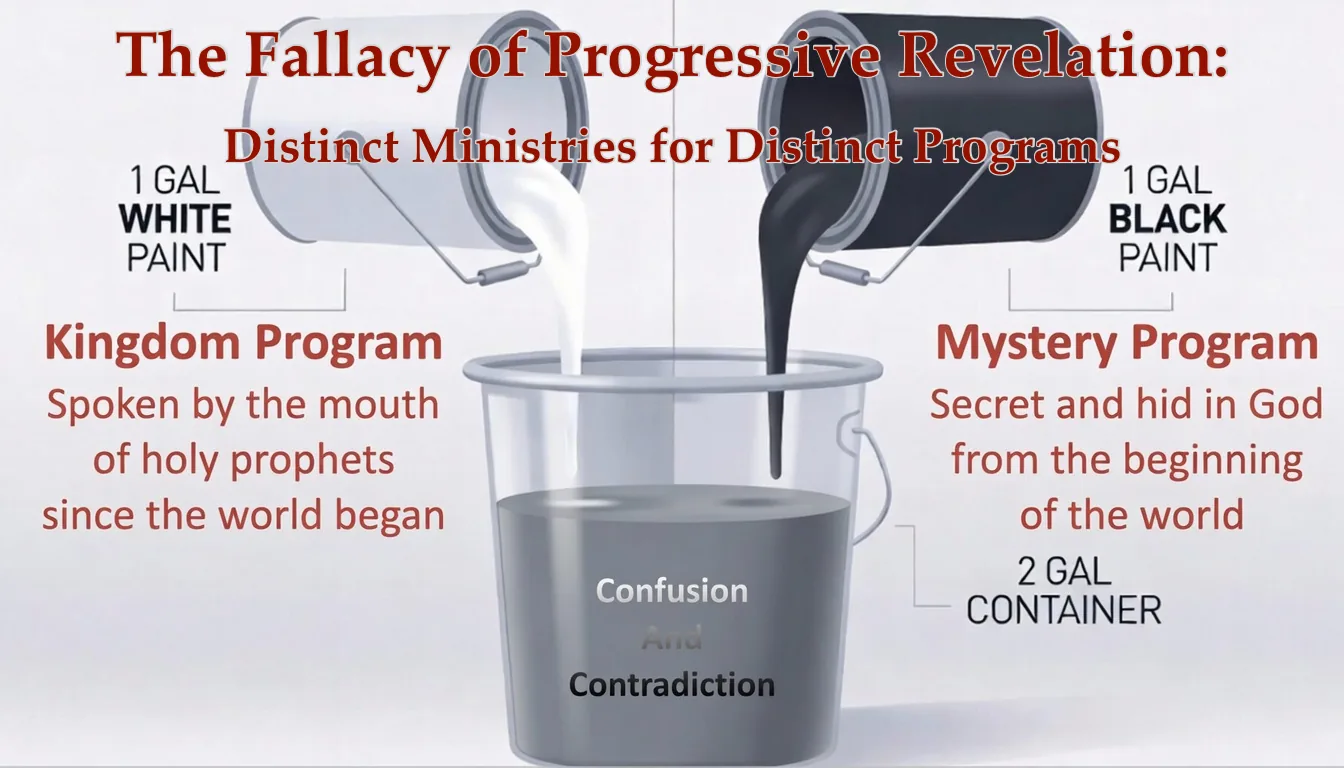
In an earlier study, "The Fallacy of Progressive Revelation: Distinct Ministries for Distinct Programs", we exposed the fallacy of stretching "progressive revelation" across God's two programs — as though Christ's earthly ministry to the Twelve simply matured, stage by stage, into the mystery committed to Paul. Here I want to set the matter on a firmer foundation by stating the principle positively, because once it is seen plainly it settles a great many objections at once.
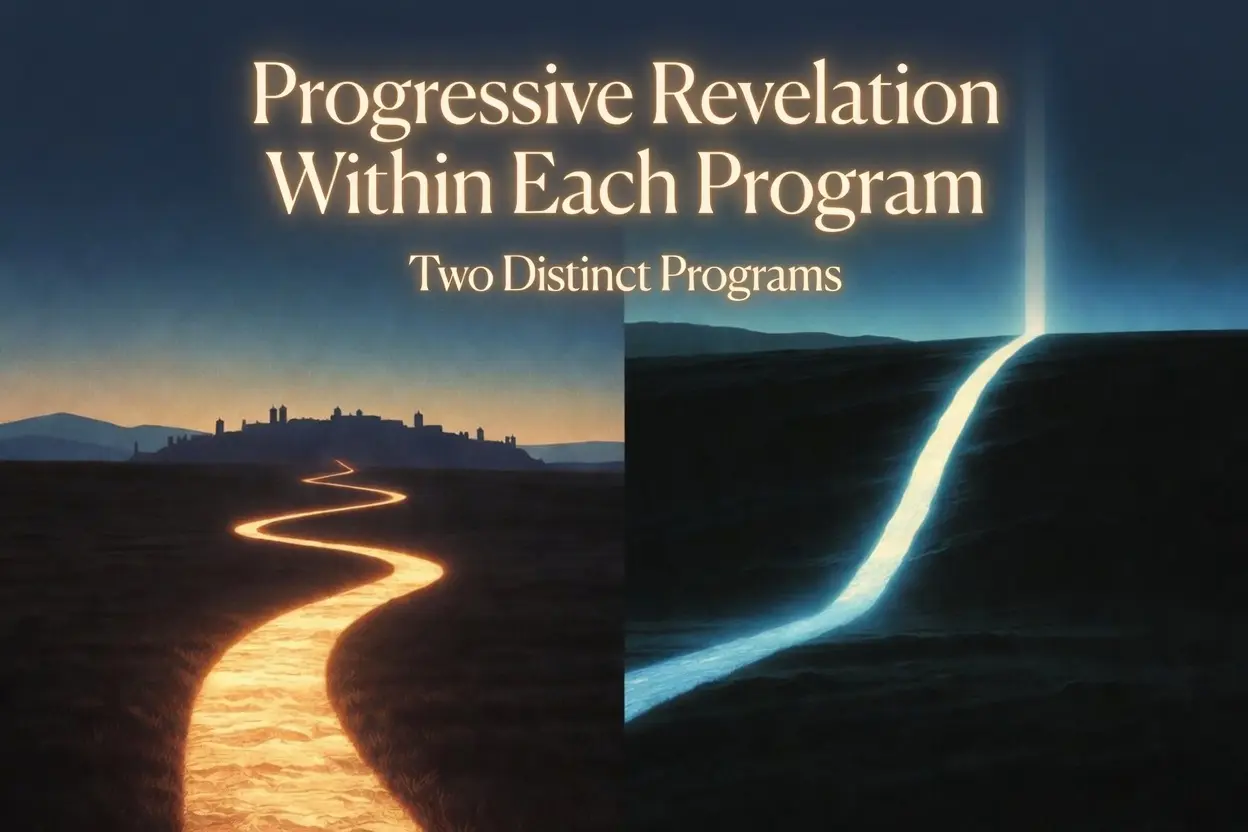
Here is the principle: there is real progressive revelation within each program, but there is no progressive revelation between the programs. The kingdom program God unfolded by degrees across the ages. The mystery, by contrast, Paul preached in its substance from the very start of his ministry — yet even that revelation was opened to him in ever-fuller measure, deepening in its expression from his earlier epistles to the prison epistles. So there is genuine progression within each program. But the one program never grows into the other. The kingdom program does not ripen into the mystery, and — just as importantly — the mystery does not ripen back into the kingdom. Each has its own beginning, its own line of development, and its own appointed end. A workman who keeps these two lines distinct will not be ashamed; a workman who splices them together will hand his readers a tangle.
Let us take it up in order: what progressive revelation truly is; how it operates within the kingdom program — including the mysteries of the kingdom and how traditional dispensationalism borrows from them; how it operates within the mystery program; why the kingdom does not morph forward, and why the mystery does not morph back; and then the test case that exposes the whole error — Christ's command to keep the law, given after the cross in the Great Commission; why the commission's reach to "all nations" and the conversion of Cornelius still belong to the kingdom program; why the Gentiles were never put under the law and what the council of Acts 15 actually settled; and the other commands that would have to be abrogated if the two programs were really one.
What Progressive Revelation Truly Is
Progressive revelation simply means that God did not disclose everything at once. He spoke "at sundry times and in divers manners" (Hebrews 1:1), adding light to light along a single line of purpose. That is true and scriptural. The error is not in the word "progressive" but in treating God's two distinct purposes as though they were one continuous line, so that whatever comes later automatically cancels and replaces whatever came before. That is not progression along one road. That is jumping the rails from one road to another and pretending it was always the same road.
So the question is never merely, "Did this come earlier or later?" The question is, "Which program does this belong to?" Time alone does not tell us. A command given after the cross may belong wholly to the kingdom program; a truth hidden since the world began may be revealed in the middle of the book of Acts. We must follow the program, not merely the calendar.
Progression Within the Kingdom Program
The kingdom program has its own beautiful unfolding, and it is genuinely progressive. God promised an earthly kingdom to Israel through the prophets, "which God hath spoken by the mouth of all his holy prophets since the world began" (Acts 3:21). Within that single program He added covenant upon covenant, promise upon promise, until the King Himself appeared.
Part of that progression is the movement toward a new covenant — but note carefully whose covenant it is:
"Behold, the days come, saith the LORD, that I will make a new covenant with the house of Israel, and with the house of Judah." (Jeremiah 31:31 KJV)
That covenant is made "with the house of Israel", and the post-resurrection Scriptures written to the believing remnant confirm it in the very same words: "I will make a new covenant with the house of Israel and with the house of Judah" (Hebrews 8:8). The new covenant is a forward step within the kingdom program. It is not the mystery, and it is not the charter of the Body of Christ. We who are members of the Body are not under that covenant; we are "complete in him" (Colossians 2:10) by the dispensation of grace committed to Paul. So when men speak of Israel passing from the old covenant toward the new, they are describing real progression — but it is progression along Israel's road, not a bridge over to ours.
The Lord Jesus carried that same program forward when He began to open "the mysteries of the kingdom of heaven" (Matthew 13:11). After the leaders of the nation began to reject their King, He gathered His disciples and taught them in a series of parables — the sower, the tares, the mustard seed, the leaven, the hid treasure, the pearl, and the dragnet — how the promised kingdom would actually proceed. The prophets had foretold the kingdom arriving in open glory at Messiah's appearing. They had not foretold that the King would be rejected and the kingdom held in abeyance while the word of the kingdom was sown like seed across a mixed field, growing quietly from small beginnings, and only afterward brought in with power. That interval — the kingdom in hidden, seed-form before it comes in glory — is what these parables disclose. Matthew says as much:
"All these things spake Jesus unto the multitude in parables; and without a parable spake he not unto them: That it might be fulfilled which was spoken by the prophet, saying, I will open my mouth in parables; I will utter things which have been kept secret from the foundation of the world." (Matthew 13:34-35 KJV)
Why call them mysteries at all? In two senses. First, they had been "kept secret from the foundation of the world" — not because the prophets never spoke of the kingdom, but because this particular feature of it, the rejection of the King and the long delay before His glory, had not been laid open to view. Second, and just as deliberately, the Lord spoke them in parables in order to conceal them from the unbelieving nation while revealing them to the believing remnant:
"Unto you it is given to know the mysteries of the kingdom of God: but to others in parables; that seeing they might not see, and hearing they might not understand." (Luke 8:10 KJV)
The very same parable that fed the little flock blinded the scoffer. A mystery, in this sense, is a truth hidden from outsiders and entrusted to insiders — here, to the disciples who would carry the kingdom hope forward. The parables teach them what to expect: coming persecution, the necessity of faithful work and endurance, fruit-bearing as the mark of the genuine, and a kingdom whose open arrival would be delayed by the nation's unbelief (Matthew 13:18-23).
And this is exactly where the mysteries of the kingdom must never be confused with the mystery revealed to Paul. The difference is not merely a shared word; it is the whole substance. These are the "mysteries of the kingdom" — they concern Israel's earthly kingdom, its timing, and the terms of entering it. Paul's is the "mystery of Christ" (Ephesians 3:4) — it concerns the Body of Christ and a heavenly calling. The mysteries of the kingdom were spoken on earth by the minister of the circumcision and were meant to stay hidden from the world; Paul's mystery was revealed from heaven by the ascended Christ and is to be "made known to all nations" (Romans 16:26). The Lord did not, in any parable, disclose the secret Paul would later preach — for had the princes of this world known it, "they would not have crucified the Lord of glory" (1 Corinthians 2:8). And mark the difference even in the way each was concealed. The secret of the parables had been "kept secret from the foundation of the world", yet it was a secret a prophet could utter — Matthew tells us the Lord's parables fulfilled what "was spoken by the prophet" (Matthew 13:35), quoting Psalm 78:2. It lay within the reach of prophetic Scripture. Paul's mystery did not; it was "hid in God" (Ephesians 3:9), never the subject of any prophet at all. So even the near-identical language — things "kept secret since the world began" (Romans 16:25) — must not be flattened into one secret. The parables are kingdom truth, spoken by a prophet and belonging wholly to the prophetic line; the mystery was hid in God, and no prophet ever spoke it.
That unfolding did not even halt at the cross. When the risen Lord walked with the two on the road to Emmaus, He did not hand them a new program; He opened the old one wider — "beginning at Moses and all the prophets, he expounded unto them in all the scriptures the things concerning himself" (Luke 24:27). To the gathered disciples He said that all things written "in the law of Moses, and in the prophets, and in the psalms" (Luke 24:44) concerning Him must be fulfilled, and "then opened he their understanding, that they might understand the scriptures" (Luke 24:44-45). What He opened to them was prophetic Scripture — even His own suffering and resurrection stood written there (Luke 24:46) — not the mystery, which no prophet had ever written. For forty days He went on "speaking of the things pertaining to the kingdom of God" (Acts 1:3). And when, fully instructed, the apostles asked, "Lord, wilt thou at this time restore again the kingdom to Israel?" (Acts 1:6), He did not correct their hope but only its timing: "It is not for you to know the times or the seasons" (Acts 1:7). After every eye-opening the risen Christ gave them, they still looked for Israel's kingdom — and He let the expectation stand. The program had not morphed; it had only been opened more fully to those who would carry it forward.
And that progression continues right on through the book of Acts and out into the remnant epistles. The little flock who looked for the kingdom (Luke 12:32; Acts 1:6), the apostleship of the circumcision confirmed at Jerusalem (Galatians 2:9), the warnings and the covenant hope of Hebrews, James, the epistles of Peter, John, and Jude — all of these carry the kingdom program forward toward its appointed consummation. They are later than Matthew, but they are not Pauline. They are the maturing of Israel's line, not a graduation out of it.
How Traditional Dispensationalism Borrows From the Kingdom Parables
It is worth seeing how the blending actually happens, because traditional, Acts-2 dispensationalism does not deny these parables — it appropriates them. Having begun the church at Pentecost and lost the clean Mid-Acts division, it must find the present age and the Body of Christ somewhere in the Gospels, and Matthew 13 is a favorite quarry. Two examples show the move plainly.
Take the parable of the sower. It is commonly preached as a portrait of how people respond to the gospel of grace today — the four soils representing four kinds of hearers of the grace message, with the lesson that we must sow widely and hope for good ground. It preaches well, and there is a devotional truth about hard and receptive hearts. But the Lord Himself tells us what the seed is, and it is not the gospel of the grace of God: "When any one heareth the word of the kingdom, and understandeth it not..." (Matthew 13:19). The seed is "the word of the kingdom", and the whole parable is one of the "mysteries of the kingdom" (Matthew 13:11). Its frame is fruit-bearing and endurance — the marks of genuine kingdom discipleship for Israel — not the free gift received by faith apart from works that Paul preaches to the Body. To run the gospel of grace through this parable is to quietly import kingdom conditions into a message that has none, and to make a kingdom parable carry Pauline freight it was never given.
Rightly placed, the parable explains the reception of the word of the kingdom in Israel during the Lord's earthly ministry — why that proclamation met the hard wayside, the stony ground that withers "when tribulation or persecution ariseth because of the word" (Matthew 13:21), and the thorns of "the care of this world, and the deceitfulness of riches" (Matthew 13:22), so that it largely failed to take root in the nation. The good ground is the believing remnant, he that "heareth the word, and understandeth it; which also beareth fruit" (Matthew 13:23) — the very marks of genuine kingdom discipleship in those who endure and enter. Read that way, every word of it is true and precious in its own place.
Take, too, the parable of the pearl of great price. A long tradition makes the merchant Christ and the pearl the church — the Body of Christ — for whom He "sold all that he had, and bought it" (Matthew 13:46), a beautiful picture, we are told, of Christ giving Himself for the church. But a parable the Lord expressly calls a "mysteries of the kingdom of heaven" (Matthew 13:11) cannot be secretly about the Body of Christ, because the Body was not the subject of any parable at all. It was "hid in God" (Ephesians 3:9), "hid from ages and from generations" (Colossians 1:26), and revealed only later to Paul. The Lord did not disclose that secret on earth — "had they known it, they would not have crucified the Lord of glory" (1 Corinthians 2:8). So to find the church in the pearl is to do the very thing this study warns against: to read the mystery backward into a kingdom parable, splicing the two programs together at the exact point Christ kept them apart.
Rightly placed, the pearl belongs to "the kingdom of heaven" and teaches the surpassing worth of that coming kingdom — the treasure for which a man will gladly part with everything he owns to obtain it. That is precisely the cost of entrance the Lord pressed upon Israel: "whosoever he be of you that forsaketh not all that he hath, he cannot be my disciple" (Luke 14:33). Far from picturing the free grace given to the Body, the parable sets forth a kingdom term of entry — the wholehearted forsaking of all to gain the kingdom — which is one more proof that these parables belong to Israel's program and not to ours.
Notice that both moves assume what they need to prove — that the kingdom parables already contain, or progress into, the mystery. They do not. The parables develop the kingdom program along its own line; the mystery came independently, from heaven, through Paul. Once that is seen, Matthew 13 stops being a quarry for grace-age doctrine and takes its rightful place as kingdom truth for Israel.
Progression Within the Mystery Program
The mystery program has its own unfolding as well, and here too the progression is real. Paul did not receive every detail in a single moment on the Damascus road. The Lord told him plainly that more was coming: "for I have appeared unto thee for this purpose, to make thee a minister and a witness both of these things which thou hast seen, and of those things in the which I will appear unto thee" (Acts 26:16). The revelation was given over time, and it deepened from his earlier epistles to the prison epistles, where the heavenly position, the one new man, and our completeness in Christ come into fullest expression.
But here we must be careful, for the Acts 28 position seizes upon this very point and pushes it too far. It argues that because the fullest expression of body truth appears in the prison epistles, the earlier epistles — Romans, the Corinthian letters, Galatians, and the rest — do not yet contain the dispensation of grace or the Body of Christ at all. That is a serious error, and it is the mirror image of the fallacy we are opposing. Fuller explanation is not a later beginning. Paul told the Romans, before Acts closed, "So we, being many, are one body in Christ, and every one members one of another" (Romans 12:5). He told the Corinthians, before Acts closed, "For by one Spirit are we all baptized into one body" (1 Corinthians 12:13), and "Now ye are the body of Christ, and members in particular" (1 Corinthians 12:27). The Body did not begin in Acts 28; it began with Paul, and Romans 16:25 shows the mystery already preached "according to the revelation of the mystery, which was kept secret since the world began."
So the progression within the mystery program is a deepening of light upon a Body that already existed from Paul's commission onward — not the late arrival of a Body that was supposedly absent from the earlier letters. The core of the mystery was revealed early; it found its fullest expression later. Both halves of that sentence must be held together.
The Kingdom Program Does Not Morph Forward Into the Mystery
This was the burden of our earlier article, so I will state it briefly. The kingdom program was not transformed into the mystery; it was postponed. Paul says "blindness in part is happened to Israel, until the fulness of the Gentiles be come in" (Romans 11:25), and "so all Israel shall be saved" (Romans 11:25-26). A program that has been set aside and will be taken up again has plainly not been converted into something else. The earthly kingdom promises remain intact, awaiting Israel's national salvation. The mystery was inserted between Israel's fall and her future restoration — not distilled out of her program. We will put this to the proof below, in the plainest test Scripture affords: the law Christ commanded the Twelve to keep even after the cross.
The Mystery Program Does Not Morph Back Into the Kingdom
The same fence must be set on the other side, and this is where many otherwise careful students stumble. Just as the kingdom does not flow forward into the mystery, the mystery does not flow backward into the kingdom. The Body of Christ will not, at some later point, be folded into Israel's earthly hope, made subject to her covenant, or required to take up her ordinances. Our calling is heavenly and our standing is settled: "who hath blessed us with all spiritual blessings in heavenly places in Christ" (Ephesians 1:3); "complete in him" (Colossians 2:10).
There is also a structural reason the Body can never be folded back in. This present dispensation does not close by the Body sliding into Israel's program; it closes by the Body being caught up to its heavenly place — "caught up together with them in the clouds, to meet the Lord in the air" (1 Thessalonians 4:17) — and changed into the likeness of Christ, "who shall change our vile body, that it may be fashioned like unto his glorious body" (Philippians 3:21). We are removed to glory; only then does God resume Israel's kingdom program where it was set aside. The mystery is not converted into the kingdom. It is completed and gathered home, and the prophetic clock starts again from where it stopped.
Watch how the backward-morph error works in practice. It reaches back into Israel's program and drags her ordinances forward onto the Body of Christ — water baptism, sabbath-keeping, holy days, tithing, dietary rules, a Levitical priesthood and altar — as though the grace once revealed could mature back into law. Paul names this for what it is and forbids it: "Let no man therefore judge you in meat, or in drink, or in respect of an holyday, or of the new moon, or of the sabbath days: which are a shadow of things to come; but the body is of Christ" (Colossians 2:16-17). To pull Israel's shadows onto the Body is not progression; it is regression, and it robs the believer of the very liberty Paul fought to defend (Galatians 5:1). The Body keeps moving in its own line — "unto a perfect man, unto the measure of the stature of the fulness of Christ" (Ephesians 4:13) — never doubling back into Israel's.
The Test Case: Christ's Command to Keep the Law in the Great Commission
Here is the single clearest test of whether the programs blend, and it deserves to be felt in full force. The Lord Jesus, during His earthly ministry to Israel, bound the law itself upon His hearers in the plainest terms:
"Think not that I am come to destroy the law, or the prophets: I am not come to destroy, but to fulfil. For verily I say unto you, Till heaven and earth pass, one jot or one tittle shall in no wise pass from the law, till all be fulfilled. Whosoever therefore shall break one of these least commandments, and shall teach men so, he shall be called the least in the kingdom of heaven: but whosoever shall do and teach them, the same shall be called great in the kingdom of heaven." (Matthew 5:17-19 KJV)
There is no mistaking what the "least commandments" are: He has just named them the commandments of "the law", of which not one jot or tittle shall pass till all be fulfilled.
Those who blend the programs answer this by saying the law was nailed to the cross, so this command bound Israel only for the short span between the Sermon on the Mount and Calvary. But that answer collapses on a single fact: after the cross, after the resurrection, the risen Christ commissioned the Twelve with these words:
"Go ye therefore, and teach all nations, baptizing them in the name of the Father, and of the Son, and of the Holy Ghost: Teaching them to observe all things whatsoever I have commanded you: and, lo, I am with you alway, even unto the end of the world. Amen." (Matthew 28:19-20 KJV)
"All things whatsoever I have commanded you" reaches back and gathers up everything He had taught them — including Matthew 5:17-19, His charge that not one jot or tittle of the law should pass and that the least commandment must not be broken. If the law had been canceled at the cross, the risen Lord would not, days later, have commanded the Twelve to go on teaching the nations to observe all that He had commanded. The command to keep the law is therefore carried across the cross and past it, into the post-resurrection commission. That is impossible to explain if Christ's program simply ended at Calvary and progressed into Pauline grace. It is perfectly natural once we see that the kingdom program continued forward on its own track — through the cross, through Pentecost, through the book of Acts — even as the mystery program was being launched separately through Paul.
What, then, of the texts the blenders lean on — the handwriting of ordinances "nailing it to his cross" (Colossians 2:14), the law of commandments "abolished in his flesh" (Ephesians 2:15)? Read them where they stand. Both are written to the Body of Christ, and both speak to our standing: the law has no claim upon us who are complete in Christ. They settle the law's relation to the Body; they do not dissolve Israel's national program, which was postponed, not abolished. The cross freed the Body from the law through Paul — and that is a truth about the Body, not a repeal of the kingdom program.
And the believing remnant in Jerusalem understood it exactly so. Years after the cross, James and the elders could say to Paul, "thou seest, brother, how many thousands of Jews there are which believe; and they are all zealous of the law" (Acts 21:20). Zealous of the law — after the cross, after Pentecost — and not rebuked for it, because they stood within the kingdom program where the law still had its place. The cross did not abolish Israel's program; it postponed it. Meanwhile Paul could write to the Body of Christ, "ye are not under the law, but under grace" (Romans 6:14). Two commissions, two rules of life, running side by side — exactly what we should expect if the programs are distinct, and utterly inexplicable if one had simply progressed into the other.
"All Nations" and Cornelius: Gentile Blessing in the Kingdom Program
A fair reader will press the very words just quoted. If the Great Commission sends the Twelve to "teach all nations" (Matthew 28:19), and Mark records "preach the gospel to every creature" (Mark 16:15), does that not already carry the kingdom program out to the Gentiles, collapsing the distinction we are drawing? It does not — and seeing why sharpens the whole point. The reach of the kingdom commission to the nations is the prophesied blessing of the Gentiles through a believing Israel. It begins where prophecy said it must, "beginning at Jerusalem" (Luke 24:47), to the Jew first, with Israel as the mediatorial nation by whom the families of the earth are blessed — "in thee shall all families of the earth be blessed" (Genesis 12:3); "ten men... shall take hold of the skirt of him that is a Jew, saying, We will go with you: for we have heard that God is with you" (Zechariah 8:23). That the commission widened from the Lord's earlier charge — "Go not into the way of the Gentiles" (Matthew 10:5) — to "all nations" is itself a step of progression within Israel's own program, not a leap into Paul's. For Paul's commission is something else entirely: not Gentiles blessed under Israel, but Jew and Gentile made "one new man" (Ephesians 2:15), "fellowheirs, and of the same body" (Ephesians 3:6), with a heavenly calling and no nation standing between them and God. "All nations" in the kingdom commission is Israel's prophesied errand to the world; it is not the mystery.
This brings us to the case always raised at this point: Cornelius. Here, it is urged, a Gentile receives the Spirit in Acts 10 — surely this is the Body of Christ beginning, or the two programs merging. But look closely. It is Peter, not Paul, who ministers, and the mystery had already been committed to Paul (Acts 9; 1 Timothy 1:16), not to Peter. Peter preaches the kingdom gospel — the word God sent unto Israel, remission of sins in Jesus' name (Acts 10:36-43) — and he is still keeping the law, confessing it "an unlawful thing for a man that is a Jew to keep company, or come unto one of another nation" (Acts 10:28). Cornelius is no pagan but a devout God-fearer whose "prayers" and "alms" had come up for a memorial before God (Acts 10:2-4). The Spirit falls upon them as at Pentecost — "the like gift" (Acts 11:17) — and Peter commands them to be baptized with water (Acts 10:47-48), the very ordinance Paul says he was not sent to administer. Most telling of all, Peter grounds the whole episode in prophecy: "To him give all the prophets witness" (Acts 10:43). A thing to which all the prophets bore witness cannot be the mystery, for the mystery was hid in God and witnessed by no prophet at all.
And Peter's reluctance to go at all is itself instructive. It was no failure to know that God would one day bless the Gentiles — every Jew knew the prophets had foretold it, which is why the God-fearing Cornelius honored Peter as a Jew, the appointed channel of that blessing (Genesis 12:3). Nor was it a reversal of prophecy. Rather, the separation God had set between Israel and the nations was still in force, and the prophetic order put Israel's restoration first; Peter had simply not yet seen that God would, in this transitional hour, receive a believing Gentile directly, and that he must therefore "not call any man common or unclean" (Acts 10:28). The vision corrected Peter's understanding within his own program; it did not hand him a new one.
So what does Acts 10 actually do? It teaches Peter that God is "no respecter of persons" and that a believing Gentile may be received without first becoming a Jewish proselyte (Acts 10:34-35) — and that lesson did, in time, equip Peter to recognize and own Paul's distinct ministry. But it is not the mystery being revealed, and it is no "mystery of the kingdom" either, for the blessing of the Gentiles was never a secret — only ever a prophecy. The Body of Christ did not begin in a centurion's house in Caesarea. It began with Paul — and it was no truth the prophets had glimpsed and failed to grasp; it was never given to them at all, but "hid in God" (Ephesians 3:9) until He made it known through Paul: "Christ in you, the hope of glory" (Colossians 1:27), a people whom God "made... sit together in heavenly places in Christ Jesus" (Ephesians 2:6).
Then Why Were the Gentiles Not Put Under the Law?
This raises the objection that presses hardest right here, and it deserves a full answer. If the risen Lord charged the Twelve to teach all nations "to observe all things whatsoever I have commanded you" (Matthew 28:20) — the law included — then why were Gentile believers like Cornelius not placed under that law? And does not the council of Acts 15, which refused to lay the law upon them, show that the kingdom program had already given way to grace? The question sounds forceful, but it rests on an assumption that will not survive a careful look at whose law it ever was.
The law was never given to the Gentiles in the first place. It was Israel's. To the Israelites "pertaineth... the giving of the law" (Romans 9:4); they were the nation set apart, the people who "shall not be reckoned among the nations" (Numbers 23:9); and the Gentiles, by contrast, stood "aliens from the commonwealth of Israel, and strangers from the covenants of promise" (Ephesians 2:12). So the kingdom commission's charge to keep the law bound those to whom the law had been given — believing Israel, who, as we have already seen, remained zealous of it long after the cross. That the Gentiles were not put under a law that was never theirs is no contradiction at all; it was the arrangement of the law itself from the beginning. The Twelve kept the law; the Gentiles, never under it, were not made to keep it.
Acts 15 makes the point unmistakable. Certain men from Judaea had been teaching the Gentile converts, "Except ye be circumcised after the manner of Moses, ye cannot be saved" (Acts 15:1) — the very attempt to drag Israel's law onto the nations. Peter answered that to do so would be "to put a yoke upon the neck of the disciples, which neither our fathers nor we were able to bear," (Acts 15:10) confessing instead, "we believe that through the grace of the Lord Jesus Christ we shall be saved, even as they" (Acts 15:10-11). James gave the sentence that they "trouble not them, which from among the Gentiles are turned to God" (Acts 15:19), laying on them "no greater burden" than a few necessary things for fellowship in that transitional hour (Acts 15:20, 28-29) — not the law of Moses, the very yoke Peter had just refused to impose.
What was settled there was not that grace had swallowed up the kingdom program, but that two programs were running side by side. The Jerusalem apostles recognized that the Gentiles would be established on the doctrine Christ had committed to Paul — without law and without circumcision — and they gave Paul and Barnabas the right hand of fellowship, binding themselves to the circumcision (Galatians 2:7-9). The Twelve kept the kingdom commission and its law; Paul was owned as the apostle of the uncircumcision with his greater gospel. Acts 15 is therefore no embarrassment to right division. It is one of its plainest monuments — the hour the leaders of both ministries openly acknowledged that God was carrying on two distinct programs at once.
Other Commands That Would Have to Be Abrogated
The Great Commission is not the only command that exposes the blending. If the kingdom program had truly progressed into the mystery, a whole catalog of the kingdom program's commands and practice — much of it from the lips of Christ Himself — would have to be quietly canceled to make room for Paul's. Consider how directly they collide:
Christ commanded the Twelve, "Go not into the way of the Gentiles, and into any city of the Samaritans enter ye not" (Matthew 10:5). Paul was sent the opposite way: "I am the apostle of the Gentiles" (Romans 11:13). One command would have to be erased for the other to stand — unless they belong to two programs.
Christ commanded, "Sell that ye have, and give alms" (Luke 12:33), and the Jerusalem believers did exactly that, holding "all things common" (Acts 2:44-45). Paul commanded the Body the reverse pattern of ordered, personal labor: "let him labour, working with his hands" (Ephesians 4:28), and "if any would not work, neither should he eat" (2 Thessalonians 3:10).
Christ commanded water baptism in the Great Commission (Matthew 28:19). Paul said, "For Christ sent me not to baptize, but to preach the gospel" (1 Corinthians 1:17), and declared "one baptism" for the Body (Ephesians 4:5).
Christ's program provided bodily healing on demand for the believing remnant — "let them pray over him, anointing him with oil... and the Lord shall raise him up" (James 5:14-15). Yet Paul, walking in the mystery program, "Trophimus have I left at Miletum sick" (2 Timothy 4:20), and counseled Timothy a little wine for his stomach's sake (1 Timothy 5:23).
Christ taught Israel to pray "Thy kingdom come" (Matthew 6:10), fixing their hope on the earthly kingdom. Paul fixes the Body's hope elsewhere: "our conversation is in heaven" (Philippians 3:20).
In every one of these cases, the only way to make a single progressive line work is to abrogate these kingdom commands — many of them the very words of the Lord Jesus — treating them as expired the moment Paul opens his mouth. But the kingdom's commands to Israel are not expired; they are reserved. They belong to a program that has been postponed, not abolished, and they will stand again when the kingdom comes. We do not have to cancel a word the Lord Jesus spoke. We simply have to rightly divide — to recognize that He spoke those things as "a minister of the circumcision for the truth of God, to confirm the promises made unto the fathers" (Romans 15:8), while the marching orders for the Body of Christ come from the apostle to the Gentiles.
Two Lines, Two Limits, One Faithful God
Set side by side, the picture is clean. The kingdom program runs from the prophets, through Christ's earthly ministry and the mysteries of the kingdom, through the cross and Pentecost and the book of Acts, into the remnant epistles, and on to Israel's future restoration — developing all the way, never becoming the mystery. The mystery program runs from Paul's commission, through his earlier epistles, into the fullness of the prison epistles — developing all the way, never collapsing back into the kingdom. Real progression within each. No progression between them.
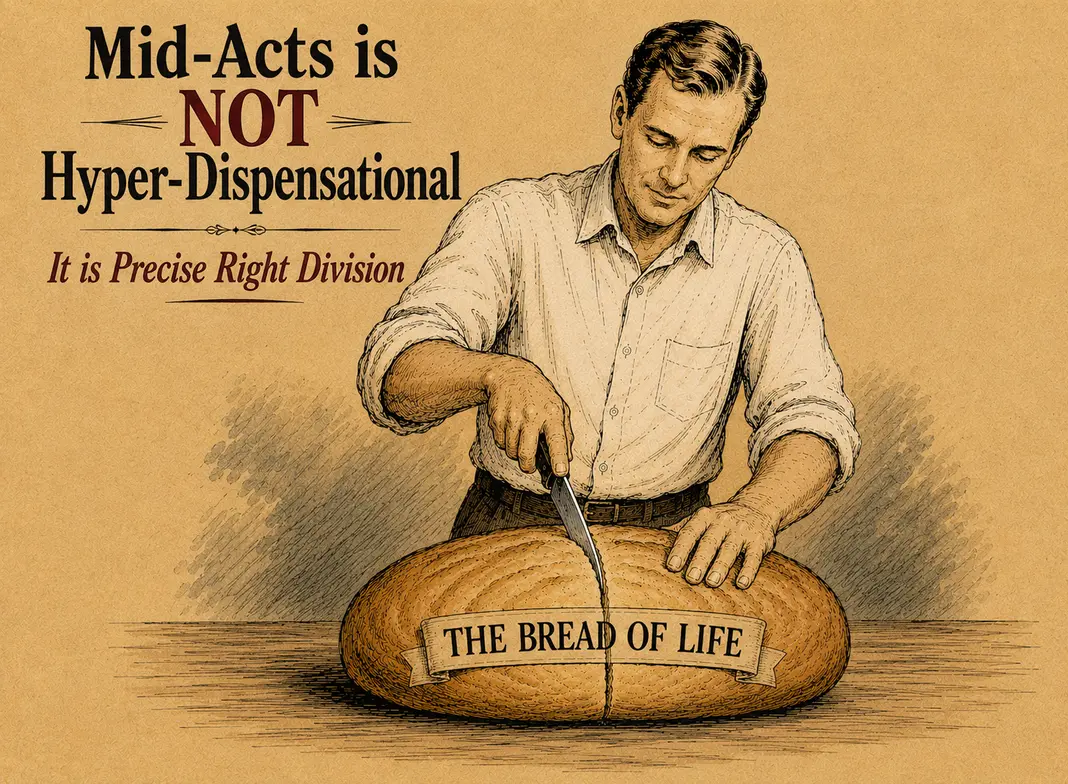
This is not cutting up the Bible; it is honoring every word of it in its place. The God who spoke "at sundry times and in divers manners" is not the author of confusion. He kept His promises to Israel intact for the day He will keep them, and He committed to Paul a grace kept secret since the world began for us who believe today. Keep the two lines distinct, refuse to let either morph into the other, and the whole counsel of God stands in beautiful order.
"Now to him that is of power to stablish you according to my gospel, and the preaching of Jesus Christ, according to the revelation of the mystery, which was kept secret since the world began." (Romans 16:25 KJV)
Keep rightly dividing.
© 2026 Edward R. Cross





Comments
No comments yet. Be the first to share your thoughts.
Leave a comment