
I see it on Facebook most weeks now, and it seems to be increasing. Someone puts up the four letters everybody in those threads knows — OSAS, once saved, always saved — or simply says plainly that a believer in the Body of Christ cannot lose his salvation. Within an hour the replies have arrived. The same handful of verses. The same heat. The same closing question, delivered as though it settled everything: so a man can be saved and then live however he pleases?
I have answered the verses elsewhere, at length, and I am not going to answer them again here. What I want to look at is something the verses cannot account for — the temperature. I have watched men disagree about the timing of the rapture and the identity of the two witnesses without any of this heat in it. Eternal security is different, and there is a reason. The passages are the occasion of the objection. They are not what is driving it.
What is driving it is self-righteousness. And once you see that, the whole argument changes shape.
The charge is about other men, not about the one making it
Watch the form the charge takes. I have yet to hear a man say I am afraid I would sin if I believed this. It comes the other way round: people will sin if you teach this. The man raising it does not place himself among those who would take the doctrine and run. He is standing outside the group he is warning you about, looking in.
That posture is the tell, and it is worth naming before anything else, because it explains why the argument so seldom turns on evidence. A man arguing about a text can be answered with a text. A man defending a position he occupies is not reached the same way, because what he is protecting is not a reading. It is a rank.
Paul heard this objection, which tells you what he was preaching
The charge is not new, and it is not the invention of internet theologians. Paul met it, and he met it so predictably that he wrote it into his argument as an anticipated question:
"What shall we say then? Shall we continue in sin, that grace may abound?" (Romans 6:1 KJV)
He did not have to raise that. Nobody stops mid-argument to refute an objection his teaching does not provoke. The question is in Romans because Romans is the kind of gospel that produces it — a righteousness reckoned to a man who has not worked for it, apart from the deeds of the law, to the ungodly. Preach that and somebody will accuse you of opening the door to sin.
So the objection is not evidence against the doctrine. It is a mark of identification. The charge is aimed at a gospel of grace because that is the only kind of gospel it fits — you cannot accuse a works-salvation of making room for sin. And that cuts both ways, so it should be said plainly: if what you teach has never once been called dangerous, it is worth asking whether you have actually said what Paul said.
Note also how Paul answers it, because it is not how most defenders of grace answer it:
"God forbid. How shall we, that are dead to sin, live any longer therein?" (Romans 6:2 KJV)
Not because you might lose it. Not because God is watching. He answers with what the man now is. The restraint under grace is identity, never jeopardy — and Paul says the same thing again when he sets liberty and the flesh side by side: "For, brethren, ye have been called unto liberty; only use not liberty for an occasion to the flesh, but by love serve one another." (Galatians 5:13) The guard against the flesh is not the fear of forfeiture. It is knowing whose you are and what you were called to. I have worked that out in Can a Saved Person Continue in the Works of the Flesh?, which answers the practical half of the objection.
But the practical half is not the real half.
What the objector is actually defending
Paul names the thing exactly, and he names it about men who were sincere, zealous, and wrong:
"For they being ignorant of God's righteousness, and going about to establish their own righteousness, have not submitted themselves unto the righteousness of God." (Romans 10:3 KJV)
Read that slowly, because every clause is doing work. They are not ignorant of righteousness — they are ignorant of God's righteousness. They are not idle — they are going about, busy, industrious, at labor on the project. And what stops them submitting is not unbelief in the abstract. It is that they already have a righteousness of their own, and a man holding one will not put it down to receive another.
Now put that man in front of a gospel that justifies the ungodly without works. What has he lost? Not his salvation — he never had it on those terms. He has lost the distance. The whole value of a righteousness you assembled yourself lies in the fact that other men did not assemble one. Erase the difference between you and the man you have been looking down on, and the ledger you have been keeping all these years is worth nothing.
That is the offense. It is not that grace permits sin. It is that grace levels the ground. The man who kept the rules and the man who did not are handed the same righteousness, on the same terms, and neither of them made it. I have watched the same mind work on a different verse in The Hope of the Gospel, where it takes the if of Colossians 1:23 and turns a promise into a probation.
The Lord drew the portrait, in a parable spoken to Israel — "unto certain which trusted in themselves that they were righteous, and despised others" (Luke 18:9) — and it is the despising that matters here:
"The Pharisee stood and prayed thus with himself, God, I thank thee, that I am not as other men are, extortioners, unjust, adulterers, or even as this publican." (Luke 18:11 KJV)
The doctrine of that parable belongs to Israel and to the kingdom program; I am not importing it into Paul. But the heart it exposes is not confined to any dispensation, and it is standing in the comment threads. Notice that the Pharisee's prayer contains no request. It is a comparison. He has come to God to have a ranking confirmed, and every item on his list is somebody else's sin.
Paul asks the one question that dismantles the whole arrangement:
"For who maketh thee to differ from another? and what hast thou that thou didst not receive? now if thou didst receive it, why dost thou glory, as if thou hadst not received it?" (1 Corinthians 4:7 KJV)
If everything you have was given, there is nothing left to compare. And a man who has taken that verse in has lost the very thing his objection was defending, because it depended on there being something in him that made him a safer recipient than the next man.
"Where is boasting then? It is excluded." (Romans 3:27) Excluded — not reduced, not moderated. There is no version of Paul's gospel with a small amount of boasting left in it, which is precisely why a man committed to boasting must find some way to make salvation partly his own achievement. Making it losable is the simplest way to do it. If it can be forfeited by conduct, then keeping it is a performance, and a performance can be compared.
Put the objection to its own test
There is a question worth asking the man who tells you grace will produce sinners, and it is not a clever debating trick. It is Paul's own move:
"Therefore thou art inexcusable, O man, whosoever thou art that judgest: for wherein thou judgest another, thou condemnest thyself; for thou that judgest doest the same things." (Romans 2:1 KJV)
The question is simply: do you sin?
Ask it kindly and ask it directly, and watch what happens. The answer will almost never be a plain yes. It will be a qualification — not the way they do, not habitually, not as a lifestyle, not without repenting. Every one of those qualifiers is an attempt to keep the ledger open, because a plain yes closes it. A man who admits he sins, and who holds that sin costs a man his salvation, has just sentenced himself.
This is what Paul means by inexcusable. Not that the judge is worse than the men he judges, but that his own standard has nowhere to put him. The law was given to produce exactly that result, and it still does. A man's religion is enough to condemn him; only God's grace is enough to save him.
And there is no cruelty in asking. It is the kindest question available, because until a man is out from under his own verdict he cannot rest anywhere.
The difference is not that works saved them and faith saves us
There is a shorthand that turns up in the defense of grace, and it needs to be put down, because it is imprecise and it hands the objector a real point: the notion that Israel's people were saved by working and we are saved by believing. Stated that way it is a caricature, and a well-read opponent will take it apart in a sentence.
The law did define a righteous man by his doing. That is the law's own language, not an accusation against Israel, and it is the whole subject of Rightly Dividing the Righteous Man, where I have set out what that righteousness was and what it was not. But no man was ever reconciled to God on the strength of his obedience, and Paul settles that with the Jews who had the law from the cradle:
"Knowing that a man is not justified by the works of the law, but by the faith of Jesus Christ, even we have believed in Jesus Christ, that we might be justified by the faith of Christ, and not by the works of the law: for by the works of the law shall no flesh be justified." (Galatians 2:16 KJV)
And his proof of justification by faith is not something that begins after the cross. He reaches back behind the law to get it:
"For what saith the scripture? Abraham believed God, and it was counted unto him for righteousness." (Romans 4:3 KJV)
Abraham, centuries before Sinai, counted righteous upon believing God. Faith is not the innovation, and works are not the thing that made Israel's program different from ours. So put the caricature down. The real distinction lies somewhere else entirely, and it is sharper than the one it replaces.
The difference is what faith presently holds
Here is the actual distinction, and it is a matter of tense and of tenure.
In Israel's prophetic program, salvation is spoken of as something coming — an inheritance, held in reserve, received at the end:
"To an inheritance incorruptible, and undefiled, and that fadeth not away, reserved in heaven for you, Who are kept by the power of God through faith unto salvation ready to be revealed in the last time." (1 Peter 1:4–5 KJV)
Ready to be revealed. Not yet delivered. Peter says it again four verses later, and he calls it the end of their faith rather than its beginning: "Receiving the end of your faith, even the salvation of your souls." (1 Peter 1:9) The salvation of the soul stands at the far end of their believing, still to be handed over. That is why endurance appears in their program as a term of the arrangement and not as an intrusion into it: a salvation still ahead of a man can be spoken of as something he must reach.
Paul writes in the opposite tense from the first page to the last:
"For by grace are ye saved through faith; and that not of yourselves: it is the gift of God: Not of works, lest any man should boast." (Ephesians 2:8–9 KJV)
Are saved. Already. Not shall be, not are being, not may yet be. And it is not one verse — the whole vocabulary runs that direction: "Who hath delivered us from the power of darkness, and hath translated us into the kingdom of his dear Son" (Colossians 1:13); "Who hath saved us, and called us with an holy calling, not according to our works" (2 Timothy 1:9). Delivered. Translated. Saved. Called. Every one of them finished business.
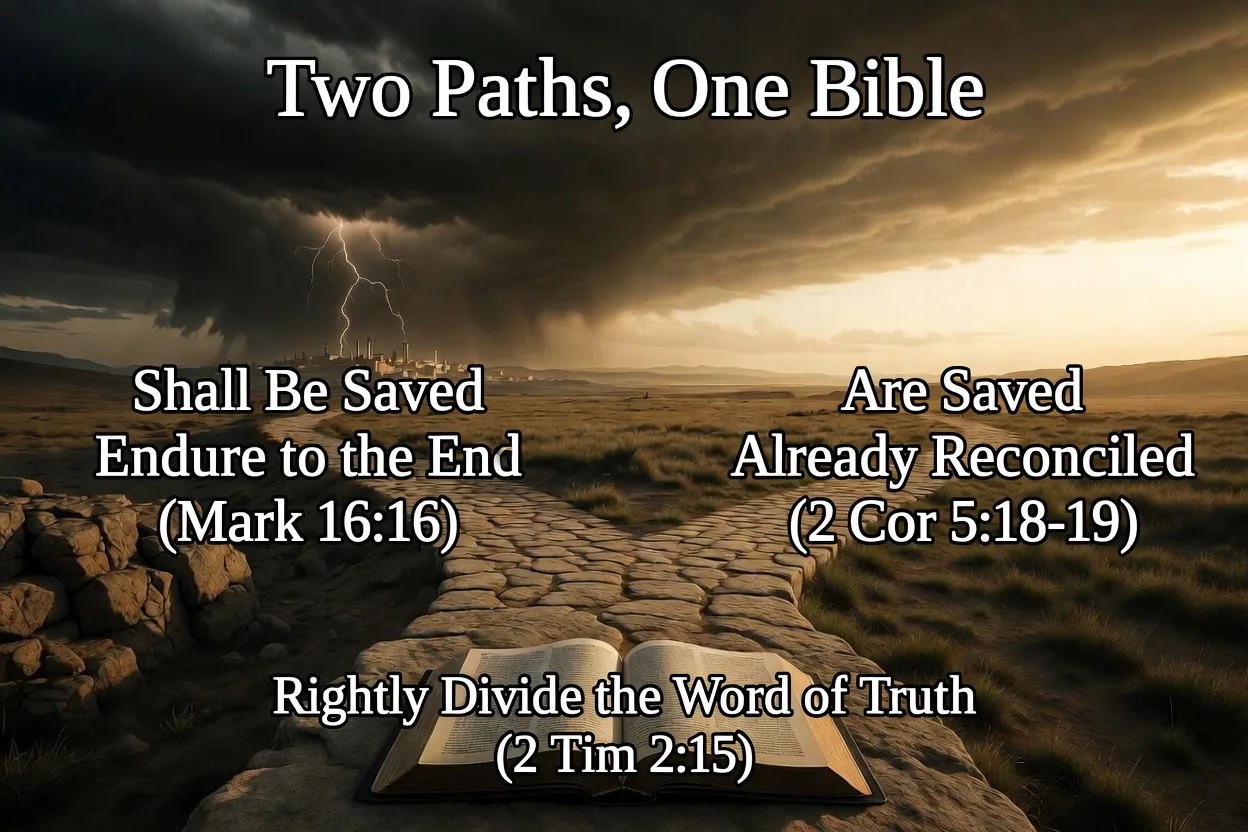
I have laid the tense argument out in full in Shall Be Saved vs. Are Saved: Two Programs, Two Tenses, One Divided Word.
What the kingdom warnings actually threaten
It would be convenient at this point to say that the kingdom saint who fails to endure loses a reward and keeps his salvation. It would also be false, and it would patronize a program God ran in full earnest. In that program the thing hanging on endurance is the salvation itself.
Peter's clause already settled what is at the end of that road, and it is not a prize on top of a salvation already held. It is the salvation. So when the Lord tells Israel what will carry a man through the tribulation — "But he that shall endure unto the end, the same shall be saved" (Matthew 24:13) — the noun in that sentence means what it says. And the warnings written to that remnant are pitched at exactly that height:
"For if we sin wilfully after that we have received the knowledge of the truth, there remaineth no more sacrifice for sins, But a certain fearful looking for of judgment and fiery indignation, which shall devour the adversaries." (Hebrews 10:26–27 KJV)
No more sacrifice, and fiery indignation. That is not a diminished crown. To Sardis the promise runs "I will not blot out his name out of the book of life" (Revelation 3:5), and a promise not to blot out a name is spoken to people for whom blotting out is a real category. Hebrews 6:4–6 describes men once enlightened, who tasted the heavenly gift and were made partakers of the Holy Ghost, and it does not treat their falling away as hypothetical.
So give the objector his verses at full strength. Do not blunt them and do not reduce them to a lost reward — that reading is not kinder to the text, it is simply wrong, and a man who knows those passages will hear the evasion in it. He is right that they are deadly. He is wrong about one thing only, and it is the thing that settles the argument: whom they were written to. A program in which salvation is received at the end can warn a man that he may not receive it. A program in which salvation was handed over at the beginning has nothing of that kind left to threaten.
How those warnings stand together with Christ's promise that His sheep shall never perish — external security that is real and absolute, alongside the genuine danger of departing by one's own will — is worked out in They Shall Never Perish.
We have an inheritance too, and it is not the same inheritance
Here is where the two programs part company for good. The Body of Christ is not without an inheritance — "In whom also we have obtained an inheritance" (Ephesians 1:11) — and because one English word covers both, the difference between them has been allowed to go unnoticed. It should not be. These are not two portions of one estate. They are inheritances of two different kinds, in two different realms, received in two different bodies.
Israel's is earthly. That is not a slight on it; it is what was promised, and it is glorious. "Blessed are the meek: for they shall inherit the earth" (Matthew 5:5). To the nations the King will say, "Come, ye blessed of my Father, inherit the kingdom prepared for you from the foundation of the world" (Matthew 25:34). A land, a restored nation, a throne in Jerusalem. And when Peter calls that inheritance "reserved in heaven for you" (1 Peter 1:4), heaven is naming where it is kept, not where it is spent — it is brought down to them at the end.
Ours is heavenly, and it cannot be entered in the body we now have. Paul says so in words that leave no room:
"Now this I say, brethren, that flesh and blood cannot inherit the kingdom of God; neither doth corruption inherit incorruption." (1 Corinthians 15:50 KJV)
Weigh that against the two verses above. Flesh and blood plainly does inherit the kingdom promised to Israel — mortals fill that land, marry in it, and die in it. So the realm Paul says flesh and blood cannot inherit is a different realm altogether, and his second clause names what kind: one of incorruption, which corruption cannot enter. Ours is not a portion of ground anywhere. It is "all spiritual blessings in heavenly places in Christ" (Ephesians 1:3). Both realms, and the two bodies they require, are traced out in The Kingdom of God: Two Realms, Two Hopes, Two Inheritances.
And the two are held on opposite terms — which is the whole point for our argument. Theirs is received at the end of faith by those who endure. Ours has a deposit already paid down on it:
"In whom ye also trusted, after that ye heard the word of truth, the gospel of your salvation: in whom also after that ye believed, ye were sealed with that holy Spirit of promise, Which is the earnest of our inheritance until the redemption of the purchased possession, unto the praise of his glory." (Ephesians 1:13–14 KJV)
An earnest is a down payment — money of the same kind as the full sum, handed over in advance so the buyer cannot withdraw. A deposit that could be taken back would guarantee nothing, which is why the earnest and a losable salvation cannot stand in the same sentence.
Then follow it one step further, because this is the hinge. If our inheritance cannot be entered by flesh and blood, and God has already put money down on it, then the body that cannot enter must be changed — and Paul says exactly that, in the language of necessity: "For this corruptible must put on incorruption, and this mortal must put on immortality" (1 Corinthians 15:53). Not may. Not might, if he holds out. The certainty of the inheritance is what makes the change obligatory. Their inheritance waits on their endurance; ours has bound God to alter our very bodies in order to deliver it.
The seal runs across the whole distance
And the deposit is not left unattended. The seal that carries it has a stated terminus, and the place Paul chooses to say so is what makes it decisive:
"And grieve not the holy Spirit of God, whereby ye are sealed unto the day of redemption." (Ephesians 4:30 KJV)
That sentence sits in the middle of a passage about a believer's sin. Paul is discussing corrupt speech and bitterness and wrath, and this is the verse he chooses to put there. If sin could unseal a man, the warning would have written itself. Instead Paul's answer to grieving the Spirit is that the sealing runs to the day of redemption regardless — which is the one thing the objector's whole system cannot allow. The seal, the earnest, and the must laid on our bodies are three parts of one guarantee, and I have traced them together in The Seal of the Holy Spirit.
Then set beside it a sentence Paul wrote with no condition attached to it anywhere:
"If we believe not, yet he abideth faithful: he cannot deny himself." (2 Timothy 2:13 KJV)
There is no clause in that verse about how long the not-believing lasts.
The question was never whether salvation can be lost
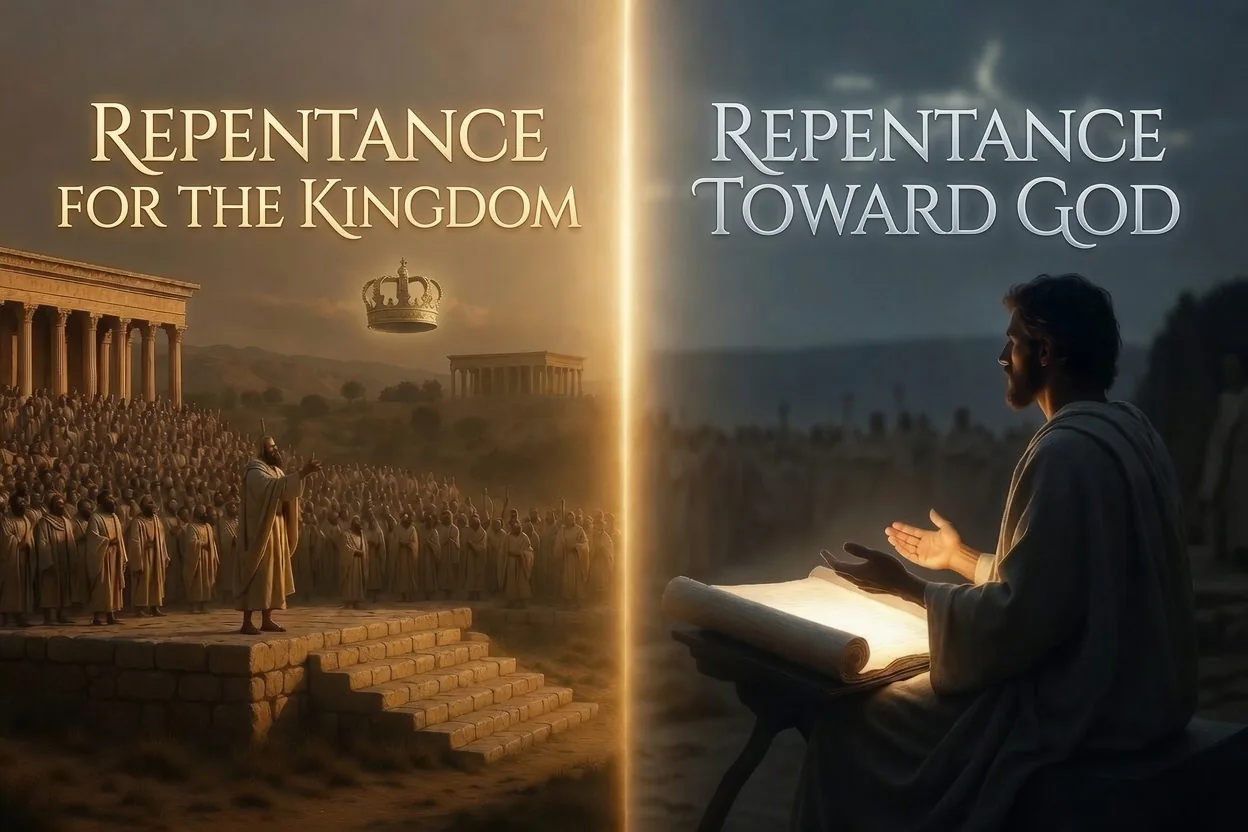
Put the two programs side by side and the argument turns out to have been misframed from the start. Can salvation be lost? is not one question with one answer. It is a question that cannot be answered until you say whose salvation, held on what terms, in which program.
A salvation still to be received at the end can be missed, and the passages that say so mean every word of it. A righteousness already imputed cannot be un-imputed, because the man never earned it and therefore has nothing to fail at. And a verdict already rendered does not expire — which is really all that once saved, always saved means. It is not a second doctrine sitting beside justification, and it never needed a name of its own. It is what justification means once you notice that God does not reverse Himself.
And notice where Paul anchors it — not in the believer at all:
"Knowing that Christ being raised from the dead dieth no more; death hath no more dominion over him. For in that he died, he died unto sin once: but in that he liveth, he liveth unto God." (Romans 6:9–10 KJV)
That is the paragraph in which Paul tells the believer to reckon himself dead indeed unto sin, but alive unto God (Romans 6:11). The reckoning is not a claim about the strength of your grip; it is a claim about what happened to Christ, and the two are joined. He died once, and death has no further hold on him. Whatever your standing is joined to, it is joined to that.
To the man who opposes this
If you have read this far and you are the one who has been making the argument, I would rather speak to you directly than about you.
I am not accusing you of hypocrisy, and I am not saying your concern for holiness is fake. It is not. The concern is right, and Paul shared it — he simply refused to secure it by leaving a man's salvation in doubt. What I am saying is narrower and harder: check what you are protecting. If the thing you cannot bear is that a careless man might be as saved as you are, then the argument you are having about verses is not the argument you are actually in. The verses can be settled — they have been, and they will bear the weight — but settling them will not touch that.
And there are two things worth weighing honestly.
The first is that the position you are defending has terms, and Paul stated them without leaving room to hold both:
"And if by grace, then is it no more of works: otherwise grace is no more grace. But if it be of works, then is it no more grace: otherwise work is no more work." (Romans 11:6 KJV)
"I do not frustrate the grace of God: for if righteousness come by the law, then Christ is dead in vain." (Galatians 2:21) There is no blended arrangement on offer. A salvation kept by your conduct is a salvation earned by your conduct, whatever the front end of it was called, and Paul says that arrangement empties the cross.
The second is that a man's standing is not established or destroyed by the doctrine he is currently defending. If you believed the gospel of the grace of God at some point — Christ died for your sins, was buried, and rose again, and you rested on that and nothing else — you were sealed then, and you are sealed now, and this article has not put that in question. What is in question is your doctrine, not your standing. There is a real difference, and I want you to have it, because a man can be secure and badly taught at the same time. Most of us have been.
But do not miss what is on offer if you have never rested there. A righteousness you are still constructing will not hold, and you already know it will not hold, which is why the question do you sin? is so uncomfortable to answer plainly. The offer is to stop building.
And to the believer who keeps meeting this
You are not going to win these arguments by out-quoting the man, because the verses are not what is in his way. Answer them anyway — carefully, in their own context, with their own audience named — but do not expect the verses to do what only grace can do.
And guard your own heart while you do it, because there is a trap laid on your side of this too. The contempt is contagious. It is entirely possible to defend a doctrine of pure grace with a spirit that has quietly started keeping a ledger of its own — one that ranks men by how well they rightly divide, which is the same disease in better clothes. "For I say, through the grace given unto me, to every man that is among you, not to think of himself more highly than he ought to think" (Romans 12:3). That was written to believers, and it was written to us.
So rest. Your salvation is not on trial, and it was never yours to keep. Then take the man's verses seriously enough to divide them properly, take the man himself seriously enough to ask him plainly about his own sin, and leave the verdict where Paul leaves it: "Who art thou that judgest another man's servant? to his own master he standeth or falleth. Yea, he shall be holden up: for God is able to make him stand." (Romans 14:4)
He shall be holden up. Not by his grip, and not by yours.
© 2026 Edward R. Cross






Comments
No comments yet. Be the first to share your thoughts.
Leave a comment