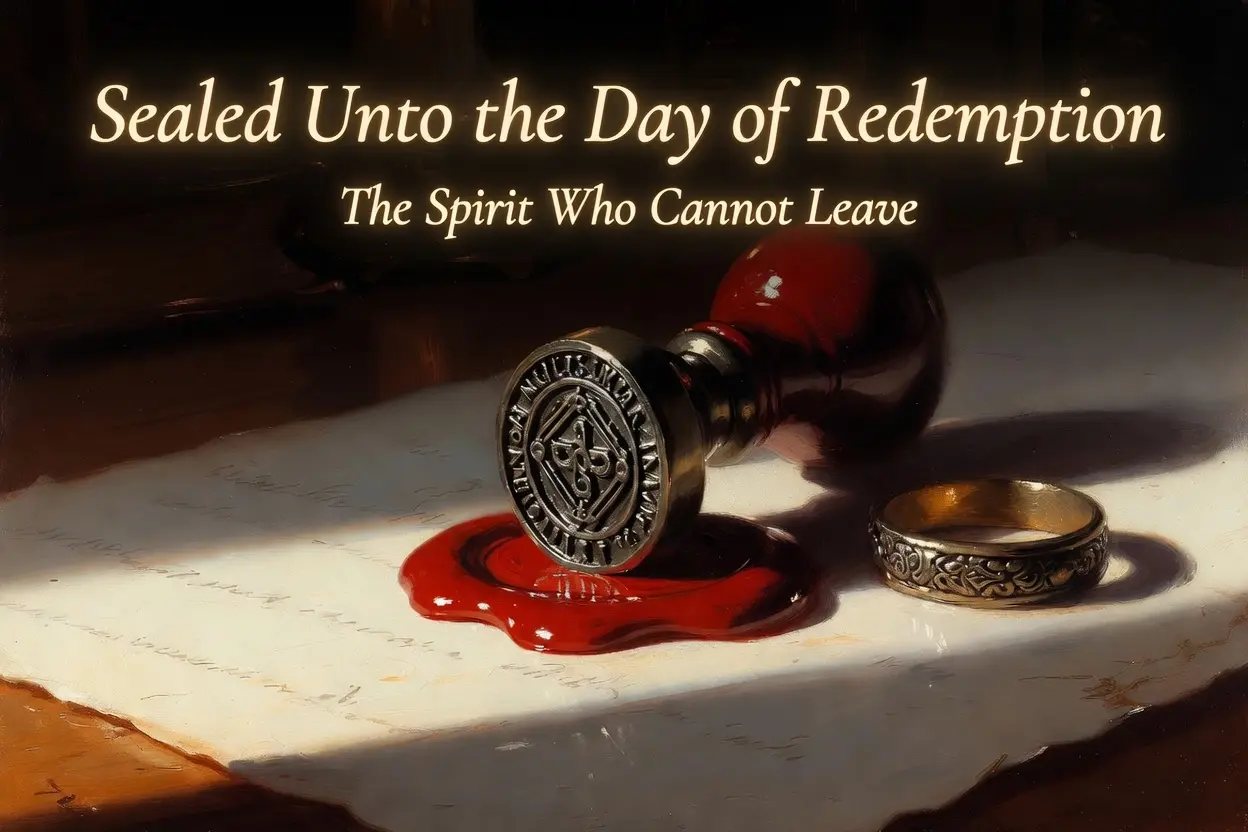
There is a truth that so many of the things we hold dear quietly rest upon that we seldom stop to look at it by itself. When we say the believer's standing is settled, that no charge can be laid against him, that nothing can separate him from the love of God, that the judgment seat cannot touch his salvation — we are leaning, every time, on a single fact Paul states twice and then assumes everywhere: the member of the Body of Christ has been sealed with the Holy Spirit. It is the load-bearing wall behind the whole house of our assurance. So it is worth standing in front of it, plainly, and asking what it is, what it guarantees, and what the one warning attached to it actually means.
Two verses carry the doctrine, and they belong together:
"In whom ye also trusted, after that ye heard the word of truth, the gospel of your salvation: in whom also after that ye believed, ye were sealed with that holy Spirit of promise, Which is the earnest of our inheritance until the redemption of the purchased possession, unto the praise of his glory." (Ephesians 1:13-14 KJV)
"And grieve not the holy Spirit of God, whereby ye are sealed unto the day of redemption." (Ephesians 4:30 KJV)
Everything this study takes up is contained in those two passages: what the seal is, what it secures, and how a man can grieve the very Spirit by whom he is kept.
What a seal does
The Bible's own use of the word tells us what a seal is for, and the picture is consistent. A seal marks ownership, it authenticates, and it secures a thing so that it cannot be tampered with or reversed. When Esther's decree went out, it went "sealed with the king's ring," and the reason given is exactly the point: "the writing which is written in the king's name, and sealed with the king's ring, may no man reverse" (Esther 8:8). A sealed matter is a settled matter. When Darius shut Daniel in the den, "the king sealed it with his own signet, and with the signet of his lords; that the purpose might not be changed" (Daniel 6:17). When Christ's enemies wanted His tomb made permanent, they went "sealing the stone, and setting a watch" (Matthew 27:66).
In each case a seal does three things at once. It declares whose the thing is — the king's, the lord's. It carries the full authority of the one who pressed it. And it fixes the matter beyond change: what is sealed may not be reversed, the purpose may not be altered. Keep that threefold picture in mind, because it is precisely what Paul says God has done with every believer. We bear God's mark of ownership, stamped with His own authority, fixed beyond reversal. "The foundation of God standeth sure, having this seal, The Lord knoweth them that are his" (2 Timothy 2:19).
And here is the point that gives a seal all its force, often missed because it seems so obvious: a seal is only as strong as the one who set it. A merchant's seal can be broken by a magistrate; a magistrate's by a king; a king's by a stronger king. The decree sealed with Esther's ring could not be reversed because behind the ring stood the throne of Persia, and no power in that realm was higher. A seal, in other words, borrows the whole weight of its owner's authority, and it cannot be undone by anyone who lacks a greater authority than his. Now lift the picture to its height and ask the question Paul means us to ask: when the seal is God's own Spirit, set by God's own hand, who is left in heaven or earth with the standing to break it? "If God be for us, who can be against us?" (Romans 8:31). There is no higher court to appeal the verdict, no greater hand to tear off the mark. The seal that the highest God has pressed is, by the very nature of a seal, the one seal in the universe that no one is able to reverse.
"After that ye believed, ye were sealed"
Notice first when the sealing happens, and who does it. Paul lays it out in order in Ephesians 1:13. There is hearing — "after that ye heard the word of truth, the gospel of your salvation." There is believing — "after that ye believed." And then, on the heels of believing, there is sealing — "ye were sealed with that holy Spirit of promise." The sealing is not a second blessing sought afterward, not a reward for spiritual progress, not a crisis experience reached by some believers and missed by others. It follows belief as immediately and certainly as the king's seal follows the writing of his decree. The moment a person trusts the gospel of the grace of God, he is sealed.
And mark the tense: "ye were sealed." It is done. Paul does not exhort the Ephesians to get sealed, or to keep themselves sealed, or to pray that the seal will hold. He tells them flatly that it already happened to them — past, finished, complete. This is the settled language Paul reaches for again and again to describe what God has done for the Body of Christ. We have redemption (Ephesians 1:7). We were sealed (Ephesians 1:13). The work was God's, and God finished it.
This is also why the sealing is universal among us. Paul does not say the mature were sealed, or the faithful, or the few. He writes to all the saints at Ephesus and tells them, every one, that they were sealed when they believed. There is no two-tier Body of Christ — some sealed and some not. To be in Christ at all is to be sealed in Him.
The seal is the Spirit Himself
What did God press upon the believer to mark him as His own? Not a feeling. Not a gift of utterance. Not an outward sign others can watch for. God gave the Holy Spirit Himself: "ye were sealed with that holy Spirit of promise." The seal is a divine Person, taking up residence within the believer. Paul says the same to the Corinthians — God "hath also sealed us, and given the earnest of the Spirit in our hearts" (2 Corinthians 1:22). In our hearts. The mark of ownership is not stamped on the outside where it might be rubbed away; it is set within, where God Himself now dwells.
This is no figure of speech. Paul means that the body of the believer has literally become the dwelling place of God: "know ye not that your body is the temple of the Holy Ghost which is in you, which ye have of God, and ye are not your own? For ye are bought with a price" (1 Corinthians 6:19-20). The seal is not a token kept in a drawer; it is the living God resident in the very person He has purchased. And this indwelling is not the privilege of an advanced few. It is the dividing line of belonging itself: "if any man have not the Spirit of Christ, he is none of his" (Romans 8:9). There is no such thing in Paul's gospel as a member of the Body without the Spirit, for to be Christ's is to have His Spirit within. Every believer is a sealed temple, or he is not Christ's at all.
This is the great change the mystery brought in. Under Israel's program the Spirit came upon selected men from the outside — poured on a prophet, a priest, a king, for a task — and the same Spirit could be withdrawn. That is the whole weight of Saul's tragedy: "But the Spirit of the LORD departed from Saul" (1 Samuel 16:14). It is why David, having sinned grievously, could pray, "take not thy holy spirit from me" (Psalm 51:11). That was a fitting prayer under that program, where the Spirit's presence with a man was real but conditional and removable.
It is not a prayer the member of the Body of Christ can pray. We are not anointed upon and liable to be stripped; we are sealed within and kept. To ask God to take His Spirit from us is to ask Him to break His own seal, unmark His own property, and reverse what He has declared irreversible. The Spirit is no longer the temporary equipment of an office. He is the permanent guarantee of a person.
"Of promise" — but not Israel's promise
The phrase deserves a closer look, because it is here that traditional teaching quietly imports Pentecost into Paul. There is indeed a "promise of the Spirit," but in the Scriptures it is Israel's covenant promise, and it has a definite shape. The prophets foretold an outpouring — "I will pour out my spirit upon all flesh" (Joel 2:28), "I will pour my spirit upon thy seed" (Isaiah 44:3) — and its New Covenant form, "I will put my spirit within you, and cause you to walk in my statutes" (Ezekiel 36:27). That is the promise Peter handles at Pentecost: Christ "having received of the Father the promise of the Holy Ghost, he hath shed forth this, which ye now see and hear" (Acts 2:33); "ye shall receive the gift of the Holy Ghost. For the promise is unto you, and to your children" (Acts 2:38-39). The Lord Himself called it "the promise of my Father," and bound it to a waiting: "tarry ye in the city of Jerusalem, until ye be endued with power from on high" (Luke 24:49). Mark its features. It is national and covenantal — to Israel and her seed. It is conditional — repent and be baptized. It is openly attended by signs. And it is the New Covenant enabling, the Spirit put within to make a man keep the statutes.
That last feature is the one that closes the door, and it deserves to be stated plainly rather than assumed. The promise of the indwelling, statute-keeping Spirit is the very substance of the New Covenant, and the New Covenant was made, by its own terms, with one named people: "Behold, the days come, saith the LORD, that I will make a new covenant with the house of Israel, and with the house of Judah... I will put my law in their inward parts, and write it in their hearts; and will be their God, and they shall be my people" (Jeremiah 31:31-33). Israel and Judah are the parties named; the Body of Christ is nowhere in the contract. Paul never once places the Body under that covenant — he calls us instead the recipients of the mystery, a thing those covenants never spoke of. So the prophesied Spirit, who is the inward writing of a covenant made with Israel, cannot be the explanation of a sealing given to Gentiles who were strangers to Israel's covenants altogether. The Body of Christ is not under the New Covenant; that promise, with all its national, conditional, sign-attended shape, is simply not the promise that seals us.
So when Paul writes that we were sealed "with that holy Spirit of promise," the phrase must take its meaning from his context, not from Joel or the early Acts. And Ephesians defines the promise it has in view — a different promise.
Within the chapter, the Spirit is "of promise" because He is the earnest of the inheritance: "we have obtained an inheritance" (1:11); the Spirit "is the earnest of our inheritance until the redemption of the purchased possession" (1:14); "the riches of the glory of his inheritance in the saints" (1:18). The phrase looks forward to verse 14, not back to Pentecost. He is the Spirit of promise because He guarantees a promised inheritance — heavenly, and the believer's own.
The decisive evidence lies just past chapter one. Paul reminds these very Gentiles that they "were... strangers from the covenants of promise" (Ephesians 2:12). Israel's covenant promises — the prophesied Spirit among them — were exactly what we once stood outside of. The sealing that comes to us, then, cannot be admission into a covenant promise we were strangers to. And in the next chapter Paul names the promise that is ours. The mystery "in other ages was not made known unto the sons of men" (3:5), and in it:
"That the Gentiles should be fellowheirs, and of the same body, and partakers of his promise in Christ by the gospel:" (Ephesians 3:6 KJV)
There is the distinct promise, stated outright — "his promise in Christ by the gospel," partaken not by entering Israel's covenants, but through the gospel Paul preached. If the inheritance and its sealing belong to what "was not made known" in other ages, then the promise behind the seal cannot be the promise the prophets openly published to Israel. It answers to the mystery, which was hid in God.
One verse seems to bridge the two, and it should be faced honestly: "that we might receive the promise of the Spirit through faith" (Galatians 3:14). But the burden there is faith against law, not Pentecost against the mystery. Paul's question a few verses earlier is "Received ye the Spirit by the works of the law, or by the hearing of faith?" (Galatians 3:2). "Of promise" stands over against of works: the Spirit comes as a free gift on the principle of faith, just as "by grace are ye saved through faith... not of works" (Ephesians 2:8-9). That defends how the Spirit is received; it does not fold the Body into Israel's outpouring.
And the manner of the giving settles it. Israel was told to "tarry... until ye be endued," and received on condition. The Body is sealed in the instant of believing — "after that ye believed, ye were sealed" — with no tarrying, no water, no sign-gift effusion. The kingdom promise of the Spirit was the prophesied, covenantal, signs-attended outpouring upon Israel, the New Covenant earnest that makes a man walk in the statutes. "That holy Spirit of promise" is the Spirit who is the earnest of the mystery's promised heavenly inheritance — "his promise in Christ by the gospel" — received by faith as a free gift, given once and permanently the moment we trust Paul's gospel.
The earnest of the inheritance
Paul does not leave the seal as a bare mark; he tells us what it secures. The indwelling Spirit "is the earnest of our inheritance until the redemption of the purchased possession" (Ephesians 1:14). An earnest is a down payment — the first installment of a purchase, handed over as a binding pledge that the rest is surely coming. It is money of the same kind as the full sum, given in advance so the buyer cannot back out. It is not a sample of a different thing; it is the front end of the very thing promised.
So God has not merely promised us an inheritance and asked us to wait in hope. He has put down a deposit, and the deposit is the Holy Spirit living in us. The inheritance in view is the Body's own heavenly portion — not Israel's earthly land, nor her national kingdom under Messiah, but the place prepared for us in the heavenly places — and the Spirit we now have is the first portion of it, the guarantee in hand that the whole is secured. And the One who gave the earnest has staked His own name on completing the transaction. As surely as a seal may not be reversed, an earnest must be honored — the buyer who paid it has bound himself to pay the rest. This is why the very idea of an earnest rules out a Spirit who could be withdrawn: a down payment that might be taken back at any moment would guarantee nothing at all. A withdrawable earnest is no earnest. The guarantee is only a guarantee because it cannot be undone.
How long does the guarantee run? "Until the redemption of the purchased possession." The seal does not expire at our next failure or our worst week. It runs until the purchase is fully redeemed — and to see why that is so far off, and why the seal must therefore span so much, we have to see that Scripture speaks of two redemptions for the believer, one already finished and one still to come.
The first is the redemption of the soul, and it is a present, accomplished fact. "In whom we have redemption through his blood, the forgiveness of sins" (Ephesians 1:7) — not shall have, but have, the moment we believed. The guilt is gone, the account is cleared, the man himself is justified and forgiven. That part of the purchase is paid in full and needs nothing added.
But there is a second redemption still outstanding — the redemption of the body. The believer's very body was bought at the cross: "ye are bought with a price" (1 Corinthians 6:20); it is the "purchased possession" of Ephesians 1:14. Yet it has not yet been taken into possession. It still ages, still weakens, still dies; it is not yet the body God paid for it to become. So Paul says we who "have the firstfruits of the Spirit, even we ourselves groan within ourselves, waiting for the adoption, to wit, the redemption of our body" (Romans 8:23). That redemption arrives at the Lord's coming for His own, when "this corruptible must put on incorruption, and this mortal must put on immortality" (1 Corinthians 15:53), when He "shall change our vile body, that it may be fashioned like unto his glorious body" (Philippians 3:21). That is the day of redemption — the day the purchased possession is at last claimed and glorified.
Now lay the seal across that span. Between the redemption of the soul (already ours) and the redemption of the body (still ahead) lies the whole of the believer's life on earth, with all its failures and weakness. And the seal is set to run the entire distance: the Spirit is given as the firstfruits and earnest now, and remains the guarantee until the body is redeemed then. The Spirit is the firstfruits; the redemption of the body is the harvest. The seal carries us, unbroken, from the one to the other — across every mile of ground on which we might have feared to be lost.
But this raises the question on which the whole comfort of the seal finally turns. The seal runs "until the redemption of the purchased possession" — so everything depends on whether that day is certain to come. A guarantee that runs until an event is only as sure as the event itself. If the redemption of the body were a mere possibility, a thing that might or might not arrive, then a seal that runs unto it would be anchored to nothing, and our assurance would hang on a maybe. So we have to ask plainly: is the believer's glorified body a hope, or a certainty?
Hear how Paul says it, and weigh the verb: "For this corruptible must put on incorruption, and this mortal must put on immortality" (1 Corinthians 15:53). Not may. Not might, if the believer holds out. Must. It is the language of fixed necessity — of a thing that cannot fail to happen, that God has bound Himself to bring to pass. And mark that the necessity is so complete the King James carries the one must across into the second clause as a supplied word, lest we miss that the mortal is under the very same obligation as the corruptible: both alike must be changed. This is the strongest word Paul could have reached for. He does not hope the corruptible will put on incorruption; he declares that it has no choice.
Why must it? First, because the inheritance demands it. "Flesh and blood cannot inherit the kingdom of God; neither doth corruption inherit incorruption" (1 Corinthians 15:50). A corruptible body simply cannot enter the inheritance God has guaranteed us; the two are incompatible. And since God has already pledged the inheritance — has put down the earnest and bound His name to deliver it — the body that cannot enter it must be changed so that it can. The certainty of the inheritance makes the change a necessity. The earnest in our hand and the must on our body are the two halves of one guarantee.
Second, because God has appointed us to this very end and has staked the Spirit on it. "Now he that hath wrought us for the selfsame thing is God, who also hath given unto us the earnest of the Spirit" (2 Corinthians 5:5). God did not merely permit our glorification as a happy possibility; He wrought us for the selfsame thing — fashioned us for it on purpose — and then handed over the earnest of the Spirit as His receipt that He will finish what He shaped us for. The down payment is given precisely against this must. And the power that performs it is not in doubt: the change comes "according to the working whereby he is able even to subdue all things unto himself" (Philippians 3:21). The same omnipotence that will subdue all things stands behind the must — it will no more fail of our bodies than it will fail of the universe.
Third, because the very Spirit who seals us is the One who will raise us. "He that raised up Christ from the dead shall also quicken your mortal bodies by his Spirit that dwelleth in you" (Romans 8:11). The seal is not a passive stamp waiting idly for the last day; the Sealer is the Quickener. The Spirit indwelling you now as the earnest is the Spirit who will quicken your mortal body then. So the guarantee and its fulfilment are not two strangers hoping to meet — they are the same Person, already resident, who will Himself carry you into the day He guarantees.
And mark what Paul's word that "flesh and blood cannot inherit the kingdom of God" quietly proves about which inheritance he has in view. He cannot be speaking of the earthly kingdom promised to Israel, for flesh and blood most certainly does inherit that. The kingdom-program promise is exactly that the meek "shall inherit the earth" (Matthew 5:5); to the nations the King will say, "inherit the kingdom prepared for you" (Matthew 25:34); and the millennial earth will be peopled by mortals who marry, bear children, and die — "the child shall die an hundred years old" (Isaiah 65:20). Corruptible men by the multitude enter and possess that kingdom in their natural bodies. So the realm Paul says flesh and blood cannot inherit is a different inheritance entirely — the heavenly, incorruptible portion of the Body of Christ, into which no corruptible body is admitted. The second clause settles it: the dividing line is "corruption" against "incorruption." The earthly kingdom receives natural bodies as they are; the Body's heavenly inheritance demands the changed body — and so the must is not laid on Israel's earthly hope at all, but on us, whose inheritance is incorruptible.
Yet do not hear this as though we stood altogether outside the kingdom, waiting to be let in. As to our standing we are already inside it: "Giving thanks unto the Father, which hath made us meet to be partakers of the inheritance of the saints in light; Who hath delivered us from the power of darkness, and hath translated us into the kingdom of his dear Son: In whom we have redemption through his blood, even the forgiveness of sins" (Colossians 1:12-14). Every verb is past and done. We have been made meet — qualified — for the inheritance. We have been translated into the kingdom of God's dear Son; the believer does not await admission to that kingdom, he has already been carried into it. We have redemption and forgiveness now. This is the same shape we have met at every turn: the standing is present and settled, while the bodily consummation waits. What the day of redemption brings, then, is not our first entrance into the kingdom by title — that is already ours — but our entrance into its incorruptible estate in body, the flesh at last brought into agreement with the position the man already holds in Christ. We are translated into the Son's kingdom now; we are glorified into the incorruptible inheritance of it then. And the seal spans precisely that interval — set upon a man already in the kingdom by standing, and keeping him until he enters it in a body that must put on incorruption.
Put it together, and the seal stands on solid ground at both ends. It does not run out before the day, for it is fixed "unto the day of redemption." And the day cannot fail to come, for that day rests on a must — a divine necessity God has wrought us for, pledged the Spirit against, and will perform by His own almighty power. The believer is sealed unto an appointment that cannot be canceled, until "this corruptible shall have put on incorruption, and this mortal shall have put on immortality," (1 Corinthians 15:54) and at last "Death is swallowed up in victory" (1 Corinthians 15:54). The seal holds; the must arrives; and between them no member of the Body of Christ can be lost.
And this redemption of the body is nothing less than our glorification — the final link in the chain Paul traces from eternity to eternity: "whom he did predestinate, them he also called: and whom he called, them he also justified: and whom he justified, them he also glorified" (Romans 8:30). Notice that glorification stands there in the past tense, alongside calling and justifying — not shall glorify, but "them he also glorified." A thing still future to us is spoken of as already done, because in the purpose of God it is as fixed as the calling and the justifying that already lie behind us. The same God who began the chain finishes it; not one link is left to chance, and the last link is our glory.
But mark the word the seal presses us toward, the word that turns a private hope into a shared inheritance: that glory is together. We are "heirs of God, and joint-heirs with Christ; if so be that we suffer with him, that we may be also glorified together" (Romans 8:17). The redemption of the body is not parcelled out to believers one by one down the centuries, each glorified alone in his own hour. It comes to the whole Body of Christ in a single instant, all at once: "We shall not all sleep, but we shall all be changed, In a moment, in the twinkling of an eye, at the last trump" (1 Corinthians 15:51-52). The dead members and the living members enter glory in the same breath — "the dead in Christ shall rise first: Then we which are alive and remain shall be caught up together with them... to meet the Lord in the air" (1 Thessalonians 4:16-17). Caught up together. Glorified together. When "Christ, who is our life, shall appear, then shall ye also appear with him in glory" (Colossians 3:4) — and not a solitary "thou," but the whole sealed Body appearing with her Head at once.
This is the fitting end of the very "together" Paul has already used of our standing. God "hath quickened us together with Christ", "hath raised us up together, and made us sit together in heavenly places in Christ Jesus" (Ephesians 2:5-6). We were made alive together, raised together, seated together — and we shall be glorified together. The seal that each member carries is not the pledge of a private salvation that happens to be shared; it is the earnest of the one inheritance of the one Body, the deposit in every member guaranteeing the glory of the whole. No member is sealed unto a lonely redemption. We are sealed unto a day when the entire Body of Christ, dead and living together, puts on incorruption in the same moment and is glorified together with the Lord who bought it.
Sealed unto the day of redemption
This is exactly what Paul says again in Ephesians 4:30, and it is the verse most worth lingering over, because it is the one usually misread. The whole sentence is: "And grieve not the holy Spirit of God, whereby ye are sealed unto the day of redemption."
Before we touch the grieving, look at what the verse asserts about the seal, because it is stated as settled fact even inside a warning. By whom are we sealed? The Spirit. Until when? "Unto the day of redemption." That is the term of the seal, and it is fixed. Not "unto your next sin." Not "as long as you do not grieve Him." Not "provided you keep short accounts." The duration is stated without condition: the seal runs all the way to the day of redemption. Paul could not have chosen language that more plainly rules out a seal that comes and goes with our conduct. The same Spirit who marks us also keeps us marked — to the end.
It is a homely picture, but a faithful one: God seals the believer much as you would seal up a jar of preserves. The contents are shut in, kept, and not opened or tampered with until the appointed time. The believer is sealed in and preserved exactly so — held intact, untouched by what would spoil him, until the day of redemption when the seal is at last broken open and the full inheritance comes out. The sealing is for keeping, and the keeping is God's.
What it means to grieve the Spirit, and what it cannot mean
Now the warning itself. "Grieve not the holy Spirit of God." Here is the truth that this study most exists to make plain, so let it be said directly: the very verse that warns us not to grieve the Spirit is the verse that guarantees the seal cannot be lost. Paul did not write, "grieve not the Spirit, lest ye be unsealed." He wrote, "grieve not the Spirit, by whom ye are sealed unto the day of redemption." The clause that follows the warning is not a threat. It is the believer's security, stated in the same breath. The reason grieving Him is so serious is precisely that He is not going anywhere.
So what does grieving the Spirit touch, if not the seal? It touches fellowship, not standing — the walk, not the union. Read the verse in its own paragraph and the answer is unmistakable. The warning does not stand alone in some doctrinal vacuum; it is set in the middle of a list of very ordinary, very practical sins of conduct, and the list both before and after it tells us exactly what grieving the Spirit means. Just above: "putting away lying, speak every man truth with his neighbour" (Ephesians 4:25); "let not the sun go down upon your wrath"; "let him that stole steal no more"; "let no corrupt communication proceed out of your mouth" (Ephesians 4:25-29). Just below: "let all bitterness, and wrath, and anger, and clamour, and evil speaking, be put away from you, with all malice" (Ephesians 4:31). The warning about grieving the Spirit falls right into the center of that catalog, and so it is filled out by it. To grieve the Spirit is concrete and recognizable. It is the lie told to a brother. It is the grudge carried to bed and kept overnight. It is the sharp, cutting word; the rotten speech; the simmering bitterness; the temper let loose. These are not abstractions — they are the daily failures of the believer's tongue and temper, and Paul says the indwelling Holy One feels them.
That is what makes the warning weighty rather than vague. A Person lives in you — the very Spirit of God, holy, set against every one of those things — and your conduct is lived out, every day, in His immediate presence. To carry on in bitterness and corrupt speech is not to break some impersonal rule; it is to grieve a Guest who is holy and who is right there. Paul names the same reality from another angle to the Thessalonians: "Quench not the Spirit" (1 Thessalonians 5:19). Grieve Him, quench Him — these are the two things Paul warns the sealed believer he can do to the Spirit by a careless walk. Mark well what is not on the list. Neither word is lose. We can sadden the Spirit; we can stifle His working in us; we cannot un-have Him. The walk can wound Him; it cannot evict Him.
But notice carefully what the grieving does and does not do. It grieves the Spirit; it does not drive Him out. The contrast with Saul is the whole point. There the Spirit departed. Here the Spirit is grieved — and remains, still sealing, still the earnest, still the guarantee, to the day of redemption. A guest who is grieved is still in the house. Indeed, see what the sealing has done to the very nature of the Spirit's response to our sin: He is grieved because He cannot leave. Under the old program His response to disobedience was to depart; under the seal He cannot depart, so when we walk in the works of the flesh He does not withdraw — He grieves. The sorrow itself is the proof of His permanence. A Spirit who could leave would simply leave; a Spirit who has sealed us stays, and is wounded. This is why the believer who has sinned does not pray David's prayer, "take not thy holy spirit from me." He cannot lose the Spirit, and he does not need to beg to keep Him. What he is called to is not to recover a lost standing but to stop wounding a present Helper — to put away the things that grieve the One who will never leave. The relationship that sin disturbs is the fellowship of a son with an indwelling Father's Spirit, not the security of his sonship.
This is the very thing that makes grieving the Spirit such a tender matter rather than a terrifying one. If sin could unseal us, grieving Him would be the gateway to ruin, and the Christian life would be lived in dread of the next slip. Because sin cannot unseal us, grieving Him is instead the grief of love within a settled relationship — the sadness a faithful friend feels, not the exit of a departing one. We are moved to put away bitterness and corrupt speech not to keep from being cast off, but because the One who has sealed us, and will keep us to the day of redemption, is dishonoured by them.
"Be filled with the Spirit" — not more of Him, but more of you
Here a fair question arises, and it is worth answering plainly, because the wrong answer reaches back and unsettles everything the seal has secured. If we are sealed once and indwelt fully, what of Paul's command, "be filled with the Spirit" (Ephesians 5:18)? Does the call to be filled not imply that we are running low — that we hold only some of the Spirit and must seek more of Him? If it did, the seal would be a half-measure after all, and our assurance would depend on topping up a supply that drains.
But filling is not the seal, and it runs in the opposite direction. The seal settles how much of the Spirit we have, and the answer is all of Him: the whole Person of the Holy Ghost indwelling, permanently, in every believer. You cannot be more indwelt than indwelt, more sealed than sealed, more owned than owned. There is no further measure of the Spirit to obtain — "if any man have not the Spirit of Christ, he is none of his" (Romans 8:9); we have Him, entire. Filling does not address how much of Him we have at all. It addresses how much of us He has. To be filled with the Spirit is not for the believer to get more of the Spirit, but for the Spirit to get more of the believer — to have the run of a yielded life, governing the thoughts, the tongue, the will, the walk.
Paul makes this unmistakable by saying the same thing two ways. The command to be filled comes wrapped in its results — "speaking to yourselves in psalms and hymns and spiritual songs... giving thanks always for all things" (Ephesians 5:19-20) — and the parallel passage in Colossians produces those very same results from a different cause: "Let the word of Christ dwell in you richly in all wisdom; teaching and admonishing one another in psalms and hymns and spiritual songs" (Colossians 3:16). Set the two side by side and the lesson is plain: to be filled with the Spirit is to let the word of Christ dwell in you richly. The Spirit fills the believer not by a fresh descent from heaven but by the truth He has already given — the revelation committed to Paul — saturating the mind and taking command of the life. Filling rises and falls with our yielding to that Word. The seal never moves at all.
So filling is no second blessing, no fresh outpouring, nothing that adds to the seal or shores up a standing — the standing was finished and sealed before the believer ever yielded a single day. A sealed man who walks unyielded is still wholly sealed; he is simply not filled, for the Spirit he grieves he also stifles. And that joins the three things Paul says of the indwelling Spirit and the believer's walk: "grieve not" (Ephesians 4:30), "quench not" (1 Thessalonians 5:19), and "be filled" (Ephesians 5:18). Every one of them is about the walk; not one is about the seal. The believer's variable is never how much of the Spirit he has — that was fixed forever the day he believed — but how much of himself he has surrendered to the Spirit who already, and permanently, fills the house as its sealed and rightful owner.
The wall the rest of the house leans on
Stand back now and see why this one doctrine carries so much. If the Spirit seals the believer the moment he believes, permanently, as God's own mark of ownership and the down payment on the whole inheritance, then a great deal follows at once, and follows necessarily.
It means the believer's standing is settled and cannot be charged. "Who shall lay any thing to the charge of God's elect? It is God that justifieth. Who is he that condemneth?" (Romans 8:33-34). A sealed man is owned property, marked by God, beyond reversal — and there is no case to be opened, no charge to be heard, where God Himself has set His seal and pronounced the man His own.
It means nothing can separate us from the love of God, because the guarantee of our keeping was never our grip on God but God's seal upon us. When Paul reaches his great conclusion that "neither death, nor life... shall be able to separate us from the love of God, which is in Christ Jesus our Lord" (Romans 8:38-39), he is not expressing a hope; he is reading off the necessary result of a finished sealing. What could detach us? Not even life — not our own continuing existence with all its failures — for the One who holds us is not holding by our strength but by His own mark, which no power is great enough to break.
It means the judgment seat of Christ can deal with our service but never our souls. We appear there to have our work examined and rewarded, not our salvation re-tried, for that was sealed before we ever stood in view of that seat. A sealed inheritance is not the thing being weighed when the believer's work is weighed.
And it means the warnings of apostasy that belong to Israel's program — of a Spirit that can depart as it departed from Saul, of a standing that endurance must maintain, of names that can be blotted out — were never spoken to the Body of Christ, because our union with our Head is of a different and sealed kind. Those warnings are real, and they are weighty, in the program to which they belong. They simply do not describe a sealed man.
Take away the seal and every one of these assurances wobbles; each of them is finally resting on this one fact. Leave the seal where Paul puts it, and they all stand together, because they are all the same truth seen from different sides.
That is why the seal of the Spirit is not a side topic but a foundation. "The Lord knoweth them that are his" (2 Timothy 2:19). He knows His own because He has marked His own — within, with His own Spirit, with His own authority, beyond reversal, unto the day of redemption. The believer's task is not to keep the seal from breaking. It is to walk worthy of the One whose seal he bears, and to grieve Him not.
© 2026 Edward R. Cross



Comments
No comments yet. Be the first to share your thoughts.
Leave a comment