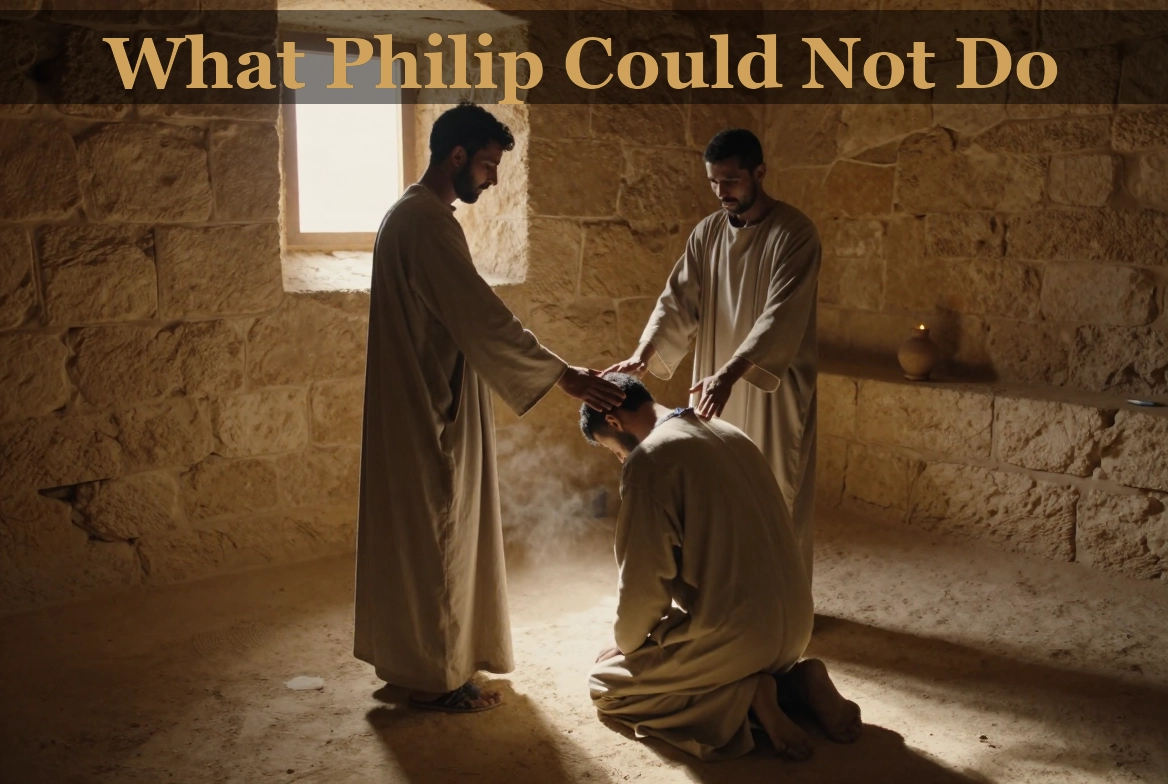
There is a man in the eighth chapter of Acts who could do almost everything, and the one thing he could not do tells us more than everything he could.
His name is Philip. Not the apostle Philip — the other one, one of the seven chosen in Acts 6. Follow what Luke says about him and the list is remarkable. He was a man "of honest report, full of the Holy Ghost and wisdom" (Acts 6:3 KJV), which is the standard the whole seven had to meet. He had been set before the apostles themselves and they had laid hands on him — "Whom they set before the apostles: and when they had prayed, they laid their hands on them" (Acts 6:6 KJV). When Jerusalem stoned Stephen and the persecution scattered the church — "they that were scattered abroad went every where preaching the word" (Acts 8:4 KJV) — Philip was one of those scattered. He went down to Samaria and "preached Christ unto them" (Acts 8:5 KJV). Devils went out at his word, and the sick got up: "For unclean spirits, crying with loud voice, came out of many that were possessed with them: and many taken with palsies, and that were lame, were healed" (Acts 8:7 KJV). A city believed him and he baptized them — "they were baptized, both men and women" (Acts 8:12 KJV). Even Simon the sorcerer believed and followed him about, astonished at "the miracles and signs which were done" (Acts 8:13 KJV).
Preaching, devils cast out, healings, signs, baptisms, the Spirit's fulness, and the hands of the twelve apostles laid on him personally. Whatever else Philip lacked, it was not power, and it was not authorization.
And the Holy Ghost did not come.
That needs saying slowly, because it is the hinge of the whole chapter and it is very easy to read past. A city heard the word preached by a man full of the Holy Ghost. They believed it. They were baptized, men and women together. And Luke breaks into his own sentence with a parenthesis, the way a man does when he is heading off the question his reader is about to ask: "(For as yet he was fallen upon none of them: only they were baptized in the name of the Lord Jesus.)" (Acts 8:16 KJV)
Not upon a few of them. Not upon the ones who were slower to believe. Upon none of them.
So believing had not brought it. Baptism had not brought it. Philip's preaching had not brought it, nor his miracles, nor his hands. And Jerusalem evidently found the situation as strange as Luke expects us to, because when word reached the apostles they did not send instructions back to Philip. They sent men.
Something was missing at Samaria that a Spirit-filled, miracle-working evangelist could not supply, and that had to be carried there by somebody else. The question the chapter puts to us is simply this: what was it, and who had to bring it? Luke answers both, and he does not make us guess.
What Jerusalem Had to Send
Word got back to the city, and what Jerusalem did about it is the answer to the first half of the question.
"Now when the apostles which were at Jerusalem heard that Samaria had received the word of God, they sent unto them Peter and John: Who, when they were come down, prayed for them, that they might receive the Holy Ghost: (For as yet he was fallen upon none of them: only they were baptized in the name of the Lord Jesus.) Then laid they their hands on them, and they received the Holy Ghost." (Acts 8:14-17 KJV)
Two of the twelve got up and went down to Samaria themselves — and what had not happened in all the days of Philip's preaching happened when their hands were on those people.
And we are not left to guess what the missing thing was, because Luke steps out of the story and names it in his own voice — using a word he could easily have avoided:
"And when Simon saw that through laying on of the apostles' hands the Holy Ghost was given, he offered them money," (Acts 8:18 KJV)
Not through laying on of hands. Not through the hands of Peter and John. Through laying on of the apostles' hands. Luke names the office. And the man watching understood it as a definite power resident in definite men, because he tried to buy it:
"Saying, Give me also this power, that on whomsoever I lay hands, he may receive the Holy Ghost." (Acts 8:19 KJV)
Simon was wrong about a great many things and Peter told him so — "Thy money perish with thee" (Acts 8:20 KJV). But notice what Peter does not correct. He does not tell Simon he has misread the scene. He rebukes the offer, not the observation. Simon had seen exactly what he thought he had seen: a power that these men had and that the man who had baptized him did not.
The Control Case
What makes Acts 8 so useful is that it rules out every explanation except one.
It was not that the Samaritans had not believed — they had. It was not that they were unbaptized — they were baptized. It was not that the preacher lacked the Spirit — he was full of the Holy Ghost before he ever left Jerusalem. It was not that he lacked power — devils obeyed him. It was not that he lacked standing — the apostles had laid their hands on him and sent him out.
Take away every variable and one is left: Philip was not an apostle. Everything else that could be supposed to matter, he had.
This is what makes him worth writing an article about. Philip is the control case. In any other chapter you could argue that the Spirit came at the preaching, or at the believing, or at the water, and there would be no way to separate the causes. In Acts 8 they are separated for us. The believing happened. The water happened. The Spirit did not come until apostolic hands were laid on, and Luke says so himself, in his own words, rather than leaving us to work it out.
What the Apostles Did Not Come For
There is an obvious objection to all of this, and the answer is in the narrative rather than in an argument. Someone will say the apostles came to Samaria to authorize the work — that Philip had crossed into new territory and Jerusalem sent men to approve it, and the Spirit's coming was the seal on their approval rather than the gift of their hands.
Watch what happens two chapters later, when Peter really does cross a line.
To get him to the house of Cornelius it takes a vision, and the vision has to be given "thrice" (Acts 10:16 KJV). Even then Peter "doubted in himself what this vision which he had seen should mean" (Acts 10:17 KJV), and the Spirit has to speak to him directly and tell him to "go with them, doubting nothing: for I have sent them" (Acts 10:20 KJV). Arriving, Peter says the boundary out loud: "Ye know how that it is an unlawful thing for a man that is a Jew to keep company, or come unto one of another nation" (Acts 10:28 KJV). And when he gets home he is put on the defensive — "they that were of the circumcision contended with him, Saying, Thou wentest in to men uncircumcised, and didst eat with them" (Acts 11:2-3 KJV).
Now put Samaria beside that. There is no vision. There is no objection. There is no hesitation of any kind, and nobody contends with anybody afterward. The apostles hear, they send, Peter and John go. And on the way home they are so far from having crossed a forbidden line that they stop and do more of it — "and preached the gospel in many villages of the Samaritans" (Acts 8:25 KJV).
That tells us two things, and Peter's own conduct is what tells us.
First, the line that needed heaven's intervention to cross lay between Samaria and Caesarea, not between Jerusalem and Samaria — and the reason is not obscure. Peter names the barrier himself at Cornelius's door: it is unlawful for a Jew to "come unto one of another nation." Samaria was not another nation. It was Israel's own country, and its chief city was Israel's own capital, built by an Israelite king who "bought the hill Samaria of Shemer for two talents of silver" and "called the name of the city which he built, after the name of Shemer, owner of the hill, Samaria" (1 Kings 16:24 KJV). There "Ahab the son of Omri reigned over Israel in Samaria twenty and two years" (1 Kings 16:29 KJV). The Assyrian captivity carried the northern tribes away and planted foreigners in their room, but it did not empty the land of Israelites — Hezekiah's messengers afterward went "through the country of Ephraim and Manasseh", and "divers of Asher and Manasseh and of Zebulun humbled themselves, and came to Jerusalem" (2 Chronicles 30:10-11 KJV); in Josiah's day money was gathered "of Manasseh and Ephraim, and of all the remnant of Israel" (2 Chronicles 34:9 KJV).
So when the Lord named the stages of the witness — "in Jerusalem, and in all Judaea, and in Samaria, and unto the uttermost part of the earth" (Acts 1:8 KJV) — Samaria stood in that list as Israelite ground, and no fresh authorization was needed to go there. Cornelius was another matter entirely, and the record marks the difference at every step. Acts 8 is not the Gentiles coming in; Luke puts that at Caesarea, where "the Gentiles had also received the word of God" (Acts 11:1 KJV).
Whether Philip's hearers were Samaritans only, or included Israelites of the northern tribes whose fathers had held that country since Omri built its capital, the account does not say — and nothing here depends on it. Luke calls them the people of Samaria, and later the Samaritans. If some of Philip's hearers were of Israel, the case only sharpens — an Israelite audience, a Spirit-filled preacher, a real baptism, and still no Holy Ghost until apostles came down.
Second, and this is the point: if the visit had been about authorization, we would see the marks of it. We would see a boundary weighed, a reluctance overcome, a decision defended at Jerusalem. Acts 10 and 11 show us exactly what that looks like when it happens. Acts 8 has none of it. What Acts 8 has instead is a stated purpose, and Luke states it before either apostle does anything: "Who, when they were come down, prayed for them, that they might receive the Holy Ghost" (Acts 8:15 KJV).
They did not come to approve a work. They came to do the one thing the man who had done the work could not.
But the List Runs Further Than Samaria
That argument leaned on where Samaria stands in the Lord's list of stages, and someone will answer that the list does not stop there. It ends "and unto the uttermost part of the earth" (Acts 1:8 KJV) — and another commission says "Go ye into all the world, and preach the gospel to every creature" (Mark 16:15 KJV). If the Gentiles were in the commission from the first day, the objection runs, then no line had to be crossed to reach Cornelius either, and the contrast we have just drawn is no contrast at all.
Both verses say what he says they say, and neither is being denied here. The uttermost part of the earth is the Gentiles. The nations were in view from the beginning, and the prophets had said so for centuries.
But now ask why the verse is shaped the way it is. If the point were simply that the witness should go everywhere, one word would have carried it — and that is exactly how it reads when that is the point. Look again at the second verse the objection just used. All the world. Every creature. Nothing in it is staged, and no station is named. So his own proof text tells us something about the other one: when the Lord meant everywhere, He was perfectly able to say everywhere. In Acts 1:8 He does not. He names four places and sets them in a line — Jerusalem, Judaea, Samaria, the uttermost part of the earth — and He names them in the one arrangement that runs outward from the temple. God does not name four stations where one word would do, and He is not filling space. Either the four names carry an order, or they carry nothing at all and the verse would have been better written shorter. And Luke has the Lord saying both halves in a single breath elsewhere — "among all nations, beginning at Jerusalem" (Luke 24:47 KJV). The scope and the starting point, in one sentence. The scope was never the question. The starting point is the whole point.
But a list of stages is not a permit issued all at once. It is an order, and it is prophecy's own order: Jerusalem, then Judaea, then Samaria, then the nations — Israel first and the nations after. That is why Jerusalem heads the list and the uttermost part ends it. And the route by which the nations were to be reached ran through a risen Israel, not around her: "And the Gentiles shall come to thy light, and kings to the brightness of thy rising" (Isaiah 60:3 KJV) — and "ten men shall take hold out of all languages of the nations, even shall take hold of the skirt of him that is a Jew, saying, We will go with you: for we have heard that God is with you" (Zechariah 8:23 KJV). Take hold of the skirt of him that is a Jew. The Gentile comes in by taking hold of an Israel that is already standing.
And there is something in the Matthew commission itself that the objection always leaves out. It is usually quoted as far as teach all nations and stopped there. The sentence does not stop there:
"Go ye therefore, and teach all nations, baptizing them in the name of the Father, and of the Son, and of the Holy Ghost: Teaching them to observe all things whatsoever I have commanded you" (Matthew 28:19-20 KJV)
Observe all things whatsoever I have commanded you. The men are sent out bound to the observance — and what He had commanded them runs down to the smallest thing in the law. He had said so as plainly as it can be said:
"Think not that I am come to destroy the law, or the prophets: I am not come to destroy, but to fulfil. For verily I say unto you, Till heaven and earth pass, one jot or one tittle shall in no wise pass from the law, till all be fulfilled. Whosoever therefore shall break one of these least commandments, and shall teach men so, he shall be called the least in the kingdom of heaven" (Matthew 5:17-19 KJV)
Not one jot. Not one tittle. Not one of the least commandments. That is the freight all things whatsoever I have commanded you is carrying, and the twelve are sent to teach the nations to observe it. He had said the same of the men in Moses' seat — "All therefore whatsoever they bid you observe, that observe and do" (Matthew 23:3 KJV). So the commission that names all nations in one clause keeps the twelve under the law in the next one. It releases them from nothing. It sends them out still holding it. (The fuller case, including why the Gentiles of that commission are blessed under Israel rather than made fellowheirs with her, is laid out in Progressive Revelation Within Each Program.)
And the law is precisely what stood between Peter and a Gentile house. We have already heard him say it on the doorstep, and the word he chose is worth going back for. He did not call it awkward, or unfamiliar, or a thing his brethren would misunderstand. He called it unlawful. Ten chapters after Pentecost he was still keeping the table as carefully as he ever had — "Not so, Lord; for I have never eaten any thing that is common or unclean" (Acts 10:14 KJV) — so the commission plainly had not released him from the diet either. And notice what God uses to move him. Not a re-reading of the commission. A vision of clean and unclean beasts — the law's own categories, overruled from heaven three times over. That is the size of what had to happen before one Gentile house could be entered. A man who already holds a standing warrant does not need one issued from the sky.
And here the line has to be drawn exactly, because it is finer than it is usually made out to be. The barrier was never the hearing. It was the house. Gentiles could and did hear. The Pentecost crowd is listed as "Jews and proselytes" (Acts 2:10 KJV), and the preaching in Jerusalem was done in the open where anyone in the street could stand and listen. What Peter names at the door is not an audience but a fellowship — keep company, or come unto one of another nation. And the charge Jerusalem brought against him, quoted earlier, names the same two things, neither of them preaching: thou wentest in to men uncircumcised, and didst eat with them. Went in, and ate.
Even the Gentiles knew where that line ran. A centurion who wanted his servant healed would not ask the Lord under his roof — "Lord, I am not worthy that thou shouldest come under my roof: but speak the word only, and my servant shall be healed" (Matthew 8:8 KJV). He asks for the word at a distance, because the word at a distance broke nothing.
And Cornelius is a threshold from one end of the account to the other. The angel's instruction is "to send for thee into his house, and to hear words of thee" (Acts 10:22 KJV), and Peter's own report of it is "we entered into the man's house" (Acts 11:12 KJV). So preach the gospel to every creature was never the sentence that had to give way. Going in was. The commission could stand exactly as written and Peter still could not walk through that door — which is why heaven had to open it, and why nothing of the kind was needed to walk into Samaria.
And it was not Peter's private scruple. Years later, at the far end of the record, Jerusalem is exactly where it always was — "how many thousands of Jews there are which believe; and they are all zealous of the law" (Acts 21:20 KJV).
So press the objection and watch what it costs. If the uttermost part of the earth and every creature had already thrown the Gentile door open in the apostles' hands, then the whole of Acts 10 and 11 is spent on nothing — the sheet let down three times over, the six witnesses brought along, the hearing at Jerusalem afterward.
But the men standing in the room settle it, and Luke does not leave us to guess at what they expected. He tells us what they felt, and he tells us the exact thing they felt it about:
"And they of the circumcision which believed were astonished, as many as came with Peter, because that on the Gentiles also was poured out the gift of the Holy Ghost" (Acts 10:45 KJV)
These are not bystanders. They are believing Jews who came with Peter — men under the same commission, who had heard all nations and every creature with their own ears.
Now be exact about what staggered them, because it was not the bare thought that God would one day bless a Gentile. Any Jew with the prophets open in front of him knew that much, and this section granted it at the outset. What no commission had told these men to expect was what they were looking at. The gift of the Holy Ghost — the very thing that had marked Israel at Pentecost — poured out on uncircumcised men, directly, with no proselyte door passed through on the way, before a drop of water had been fetched, and while Israel herself still stood unrisen and her kingdom unrestored. And that promise about the nations coming to Israel's light, quoted earlier in this section, opens with a condition. Read what stands in front of it: "Arise, shine; for thy light is come, and the glory of the LORD is risen upon thee" (Isaiah 60:1 KJV). The rising comes first, and Israel had not risen. Her light had been held out and refused in Jerusalem, and here were Gentiles receiving anyway, in a soldier's house, while the apostle was still in the middle of a sentence — "While Peter yet spake these words, the Holy Ghost fell on all them which heard the word" (Acts 10:44 KJV).
And that is what the objection cannot get past. It says the commission had already authorized what happened at Caesarea. The men holding that commission, standing in the room, did not recognize it — and Luke names them by the one mark that divided them from the men receiving the gift: they of the circumcision which believed. No man is astonished by what he was commissioned to go and do.
Jerusalem said the same thing afterward, when the report reached it. They did not say at last. They said it as men saying something new: "Then hath God also to the Gentiles granted repentance unto life" (Acts 11:18 KJV). And both sentences turn on the same small word — also. That is the word of something being added, not of something arriving on schedule.
Michael Hammond states the same thing about Peter, and states it as the text does. The record itself shows that Peter "did not naturally move in that direction as his ordinary calling. It required special intervention." A standing commission is not a special intervention. The one is what a man already has; the other is what has to be sent from heaven because he has not got it.
What the men did with the commission shows how they held it. When the persecution scattered the church, Luke stops to say who stayed: "they were all scattered abroad throughout the regions of Judaea and Samaria, except the apostles" (Acts 8:1 KJV). And those who were driven out went well past Israel's borders and still kept the message inside Israel — "travelled as far as Phenice, and Cyprus, and Antioch, preaching the word to none but unto the Jews only" (Acts 11:19 KJV). Phenice, Cyprus and Antioch are Gentile territory, and the word went there to Jews only. The later stage was never entered in the prophetic order, because the order had already failed at the name that heads it. Jerusalem did not believe.
And none of this touches Samaria, which is the point. Samaria is the third name in that list and not the fourth. Judaea is the southern tribes; Samaria is the northern; both are Israel, and Israel is the stage the apostles were standing in when they came down. The objection is about a later item on the list — and that item is answered at Caesarea, by a vision, a voice, six witnesses and a hearing at Jerusalem. Samaria got none of those, because Samaria needed none of those.
But Was It Not Just the Keys?
There is one more explanation of the journey that has to be dealt with, because it is widely taught and many a reader will have met it long before he met this article. It runs like this: the Lord gave Peter the keys of the kingdom, and Peter used them — turning one at Pentecost to let the Jews in, and another later to let others in, so that Samaria is simply the next door being unlocked. On that telling, Peter came down because it was his key to turn, and the coming of the Holy Ghost is the door swinging open rather than anything his hands conveyed.
It is a tidy picture. Take it to the text and four things happen to it.
First, the verse that gives the keys says in the same sentence what they are for.
"And I will give unto thee the keys of the kingdom of heaven: and whatsoever thou shalt bind on earth shall be bound in heaven: and whatsoever thou shalt loose on earth shall be loosed in heaven." (Matthew 16:19 KJV)
Binding and loosing. The Lord does not hand over a figure of speech and leave us to furnish it; He says what the keys do, and it is governmental — authority to declare a thing forbidden or permitted, to admit or to shut out, with heaven standing behind the ruling. That is what a key is everywhere else in Scripture too. The key of the house of David is laid on a steward's shoulder so that "he shall open, and none shall shut; and he shall shut, and none shall open" (Isaiah 22:22 KJV). The lawyers had "taken away the key of knowledge" and used it to keep men out — "ye entered not in yourselves, and them that were entering in ye hindered" (Luke 11:52 KJV). A key opens and shuts, and the man holding it decides.
And that same authority is given again two chapters later, and not to Peter only — to the disciples, in a passage about a trespassing brother and telling it to the church: "Verily I say unto you, Whatsoever ye shall bind on earth shall be bound in heaven: and whatsoever ye shall loose on earth shall be loosed in heaven" (Matthew 18:18 KJV). Whatever the keys were, the power they name was not one man's private possession.
Second — and this is the thing that ought to settle it — the keys are nowhere associated with the giving of the Holy Ghost. Not in Matthew 16, not anywhere. Search the Bible for a verse with a key in it and the Spirit in it, and there is no such verse. The eight places a key appears say nothing about the Holy Ghost; the places that speak of the Spirit poured out, falling, coming or given say nothing about a key. The two subjects never touch, in any book, in either Testament.
That is where the explanation fails, because the Spirit's coming is precisely what has to be explained at Samaria. It was not the believing that waited, nor the baptizing; both had already happened under Philip. The one thing that waited was the Holy Ghost — and an authority to bind and to loose is not an authority to bestow the Spirit. Scripture never once says it is.
Third, the word is not even in the book. Read the Acts from end to end and you will not find key or keys in it once — not at Pentecost, not in Samaria, not at Caesarea. No door is said to be unlocked, no key is said to be turned, and Peter is never once described as using one.
Fourth, there is a door of faith in the New Testament, and the Bible says whose it was.
"And when they were come, and had gathered the church together, they rehearsed all that God had done with them, and how he had opened the door of faith unto the Gentiles." (Acts 14:27 KJV)
That is Paul and Barnabas, come back from Iconium and Lystra and Derbe. It is the only place in Scripture where the door of faith is said to be opened to the Gentiles, and Peter is not in the sentence. The same figure follows Paul afterwards — "a great door and effectual is opened unto me" (1 Corinthians 16:9 KJV), and a prayer for "a door of utterance, to speak the mystery of Christ" (Colossians 4:3 KJV). Wherever Scripture speaks of an opened door in this connection, it is an opportunity to preach, and it belongs to Paul.
And there is one thing more against it, which the next stretch of the story supplies by itself. Paul never received the keys of the kingdom. He was not at Caesarea Philippi, he was not among the twelve, and he says of himself that he came "as of one born out of due time" (1 Corinthians 15:8 KJV). Now watch what he does at Ephesus.
The Same Test at Ephesus, With the Opposite Result
Eleven chapters after Samaria the same elements appear again, in a different city, with a different man.
"When they heard this, they were baptized in the name of the Lord Jesus. And when Paul had laid his hands upon them, the Holy Ghost came on them; and they spake with tongues, and prophesied. And all the men were about twelve." (Acts 19:5-7 KJV)
Twelve men, baptized, and then hands laid on them and the Holy Ghost given. It is Samaria again in miniature — except for one thing. Nobody is sent for. No word goes up to Jerusalem. No delegation comes down. The man standing in Ephesus lays his own hands on them and the Spirit comes.
That is the whole argument of this article in two chapters. The thing Philip could not do, Paul does alone. And Paul does it in Gentile territory, with no reference to the twelve, on his own authority — and, to finish the matter left hanging a moment ago, with no key of any kind in the account. If the keys explain Samaria, nothing explains Ephesus; and it is the same event twice. What the two chapters have in common is not a key. It is an apostle, a pair of hands, and a record that stops to say so.
Paul put the matter in exactly those terms himself, when his apostleship was under challenge:
"Truly the signs of an apostle were wrought among you in all patience, in signs, and wonders, and mighty deeds." (2 Corinthians 12:12 KJV)
There is such a thing, then, as a sign of an apostle — an act that marks the man who does it. That is Paul's own category, and it is the only place in the Bible the phrase occurs. It is why he can write, without boasting, "For I suppose I was not a whit behind the very chiefest apostles" (2 Corinthians 11:5 KJV). And it is why he can remind Timothy of "the gift of God, which is in thee by the putting on of my hands" (2 Timothy 1:6 KJV) — my hands, named, in the same way Luke named the apostles' hands in Samaria.
(Keep that verse clear of its neighbour. First Timothy 4:14 speaks of a gift given "with the laying on of the hands of the presbytery", which is a different act by different men. Paul's own hands are what 2 Timothy 1:6 names.)
And Jerusalem itself weighed him by that very measure. When the Gentile question came to a head and the whole assembly met, Luke records what quieted the room — and it was not an argument:
"Then all the multitude kept silence, and gave audience to Barnabas and Paul, declaring what miracles and wonders God had wrought among the Gentiles by them." (Acts 15:12 KJV)
Miracles and wonders wrought by them. That is the same category Paul names to the Corinthians — signs, and wonders, and mighty deeds — and here it is laid before the apostles and elders as the credential of a ministry they had not commissioned and could not have commissioned. They did not examine him to see whether he had companied with them from the baptism of John. They listened to what God had done by his hands.
And Paul tells us what came of that meeting, in his own account of it:
"And when James, Cephas, and John, who seemed to be pillars, perceived the grace that was given unto me, they gave to me and Barnabas the right hands of fellowship; that we should go unto the heathen, and they unto the circumcision." (Galatians 2:9 KJV)
Read what they shook hands on. Not that Paul would assist with their work. Not that he would be added to their number. Two spheres, named in a single clause — we unto the heathen, and they unto the circumcision. And Paul had stated the ground of it a verse earlier: "he that wrought effectually in Peter to the apostleship of the circumcision, the same was mighty in me toward the Gentiles" (Galatians 2:8 KJV). One God, two apostleships — and in both men it was the working that showed it.
So this is Jerusalem acknowledging a ministry it had not originated. And notice who is doing the acknowledging. Two of the three named as pillars are Cephas and John — the same Peter and John who had to be sent down to Samaria, because there was a thing needed there that no one else present could do. Those two men sat and heard another man report what God had wrought by his hands, and then gave him their right hands on a field of his own.
None of this makes Paul a thirteenth member of the twelve. He never numbers himself among them — and in the one place he mentions them at all, he puts himself outside the reckoning and after it. The risen Lord was seen "of Cephas, then of the twelve", and after that "of all the apostles", and then, separately and last, "he was seen of me also" (1 Corinthians 15:5, 7, 8 KJV). The phrase the twelve occurs once in his thirteen letters, and he is not in it. The company at Jerusalem he calls "them which were apostles before me" (Galatians 1:17 KJV) — men he travelled away from rather than joined.
What the signs make him is an apostle, and that is the whole of the claim. A man outside the twelve doing what only apostles could do is not an awkwardness in the record. It is the demonstration.
But Did Anyone Get Baptized at All?
Everything above assumes that when Luke writes "When they heard this, they were baptized in the name of the Lord Jesus", he means twelve men at Ephesus went into the water. That has been challenged, and not by an opponent of right division. It has been challenged by men who divide the word rightly, and they are owed a straight answer rather than a quiet detour.
The challenge says verse 5 is not Luke narrating anything. It is Paul still talking — describing what John's hearers did back at Jordan years before — and nobody at Ephesus is baptized at all. Cornelius Stam states it plainly: the mistake, he says, springs from the notion that verse 5 records a rebaptism, "while in reality it is the continuation of Paul's explanation in Verse 4. In Verse 5 Paul recalls the response of John's hearers to his message."
He gives nine arguments for it. Eight of them ask why God did not arrange matters differently, or are true without touching verse 5. One argues from the wording of the verse itself, and it is a fair question fairly put:
"If the popular interpretation of Verse 5 were correct it would more probably read: 'When they heard this, Paul baptized them . . .' or 'they were baptized again. . . .'"
Why the passive? If Paul baptized these men, why does Luke not say so?
It deserves an answer, and there are two, from different directions. The first is a matter of reading Luke. The second is a matter of reading Stam.
First: Ask Luke How He Writes
The argument is a claim about probability — what the verse would more probably say. That is a claim about Luke's habits, and habits can be counted. So let us count them, and you can check every line of it in your own Bible.
Go through the book of Acts and find every place Luke reports a baptism as something that happened. There are ten. Here they are, in order, with the words he used:
- Pentecost — "Then they that gladly received his word were baptized" (2:41).
- Samaria — "they were baptized, both men and women" (8:12).
- Simon the sorcerer — "when he was baptized, he continued with Philip" (8:13).
- Samaria again, in Luke's aside — "only they were baptized in the name of the Lord Jesus" (8:16).
- The Ethiopian eunuch — "and he baptized him" (8:38).
- Saul of Tarsus — "and arose, and was baptized" (9:18).
- Lydia — "And when she was baptized, and her household" (16:15).
- The Philippian jailor — "and was baptized, he and all his, straightway" (16:33).
- The Corinthians — "many of the Corinthians hearing believed, and were baptized" (18:8).
- The twelve at Ephesus — "they were baptized in the name of the Lord Jesus" (19:5).
Now read down that list and look only at the verbs. Were baptized. Were baptized. Was baptized. Were baptized. He baptized him. Was baptized. Was baptized. Was baptized. Were baptized. Were baptized.
Nine of the ten say that men were baptized. One says that a man baptized. And in the nine, Luke never once names who did it — not Peter baptized them at Pentecost, not Paul baptized them at Corinth, not anywhere.
There is exactly one exception, and it proves the rule rather than breaking it. At the desert road Luke writes "and he baptized him" (Acts 8:38). Read the sentence before it: "they went down both into the water, both Philip and the eunuch". Two men are standing in the water. A passive there would leave the reader unable to tell which one baptized the other. Luke goes to the active voice at precisely the point where the passive would be unreadable — and nowhere else in the book.
So the sentence Stam calls more probable is a sentence Luke never writes. Search the whole New Testament for a man made the subject of the verb baptize and you will find John the Baptist, you will find Philip in the water with the eunuch, and you will find Paul writing in the first person in his own letter. You will not find an apostle baptizing anybody in the book of Acts. The construction Stam expects occurs no times. The construction Luke actually used occurs nine.
Now apply his rule where the answer is not in dispute. Nobody denies that somebody baptized three thousand people on the day of Pentecost, and no one denies it less than Stam, whose first argument depends on that baptism being real. Yet Luke names no administrator at all. By the rule of argument seven, Acts 2:41 would more probably read "Peter baptized them" — and it does not. If the passive voice proves that nothing happened at Ephesus, it proves that nothing happened at Pentecost.
Look also at the nearest parallel in the book. At the house of Cornelius an apostle is standing there, with every authority to act, the Holy Ghost already fallen, water called for — and Luke writes "And he commanded them to be baptized in the name of the Lord" (Acts 10:48 KJV). Not Peter baptized them. If Luke will not write that sentence with Peter in the room, there is no ground for expecting it with Paul in the room.
Two smaller things finish it. Luke knows perfectly well how to name an administrator while keeping the passive verb — "were baptized of him", "was baptized of John" — and that form stands seven times in the Gospels, twice in Luke's own. In Acts he uses it not once. And the alternative wording Stam offers, "they were baptized again" — the phrase baptized again is not in the Bible anywhere, in any book, in any order. A wording Scripture never uses cannot be the wording we should have expected here.
The question was, why the passive? The answer is that there is no why to give, because Luke made no choice here. The passive is the only way he ever writes it.
And once that is seen, the count stops merely defending and starts saying something. Go back through those places and ask a second question of each: when Luke writes that men were baptized, is he reporting something happening in front of him, or reaching back to something that happened elsewhere? Set Ephesus itself aside first — that is the verse on trial, and a verse cannot be entered as evidence for its own reading. Nine are left. Pentecost, Samaria, Simon, the eunuch, Saul, Lydia, the jailor, the Corinthians — eight of the nine are events happening at that moment in the story. Only one looks backward at all, and it reaches four verses, inside the same episode, to a baptism Luke had just finished narrating himself, performed by a man named in the same paragraph.
So the reading that makes Acts 19:5 a backward glance asks that clause to do what it does nowhere else in the book: to reach out of Acts altogether and into the Gospels, past a change of administrator, to an event the Acts never records — and to do it in a sentence where Luke is telling the story, not quoting a speaker. Every other time Luke tells us men were baptized, he means then and there.
And Ask Luke One More Question: Who Did the Baptizing?
The objection said the verse ought to have read Paul baptized them. It is worth asking why Luke never writes that sentence about anybody — and the answer, once the ten places are laid side by side, is that he does not need to.
Go through them again and watch who is standing there. Pentecost: Peter has been preaching, and it is his word they received. Samaria: "they believed Philip preaching", and Simon "continued with Philip". Damascus: Ananias has just come into the house. Philippi: Lydia "attended unto the things which were spoken of Paul", and of the jailor it is said that Paul and Silas "spake unto him the word of the Lord". Corinth: Paul has been reasoning in the synagogue every sabbath. In all ten, the man who has been preaching is standing in the passage. Luke's way is to name the preacher and then report the baptism plainly, without naming him twice.
Two of the ten can be checked against an answer we hold independently. At the desert road Luke abandons the passive and says it outright — "he baptized him" — and the he is Philip, the man on stage. And at Corinth, where Luke writes only that the Corinthians "believed, and were baptized", Paul names the baptizer himself in his letter to that church: "I thank God that I baptized none of you, but Crispus and Gaius", and "And I baptized also the household of Stephanas" (1 Corinthians 1:14, 16 KJV).
That second case also marks the limit of what this shows. Luke says "many of the Corinthians hearing believed, and were baptized" (Acts 18:8 KJV) — many. Paul's list is short, and he adds "besides, I know not whether I baptized any other", giving the reason a verse later: "For Christ sent me not to baptize, but to preach the gospel" (1 Corinthians 1:16, 17 KJV). So most of that many went into the water at other men's hands — and there were other men to do it, named in the chapter: Aquila and Priscilla, and Silas and Timotheus come down from Macedonia.
Which is the useful thing, not an awkward one. Luke's plain passive means the baptism happened under the ministry of the man he has put on the page. It does not always mean that man's own hands, and the record tells us plainly when it does not.
Read Ephesus the same way, and be exact about it, because the city was not empty. Paul had brought Priscilla and Aquila there and "left them there" (Acts 18:19 KJV); they were still there when Apollos came through, and it was they who "expounded unto him the way of God more perfectly" (Acts 18:26 KJV). No verse says they ever left, and later, writing from that very city, Paul sends their greetings — "Aquila and Priscilla salute you much in the Lord, with the church that is in their house" (1 Corinthians 16:19 KJV). So there were other hands in Ephesus.
What the passage does not do is put any of them in the room. "Then said Paul" in verse 4; "And when Paul had laid his hands upon them" in verse 6. Paul is the only man Luke puts in the scene, and the baptism of verse 5 falls between those two sentences. So the baptism is Paul's ministry beyond question, and whose hands went into the water is a thing the record does not say — about these twelve, or about most of the Corinthians, or about the three thousand at Pentecost.
And that is not a gap in the account. Set the two things side by side and the pattern is unmistakable. Luke reports a baptism ten times and names the man who performed it once — and that once is Philip, who was no apostle, named only because two men were standing in the water together. Luke reports hands laid on believers with the Holy Ghost given twice, and he names the men both times: Peter and John, sent down from Jerusalem, and Paul at Ephesus. At Samaria the names are not the end of it; the office itself is put into the sentence — "through laying on of the apostles' hands the Holy Ghost was given".
Luke does not tell you who baptized. He always tells you whose hands.
Someone will point to Caesarea, where the Holy Ghost fell on Cornelius's household while Peter was still speaking and no hand was laid on anyone at all. Look again at how the men in the room took it — the same astonishment we weighed earlier for a different reason. They "were astonished" (Acts 10:45), and the believing Jews who had come with Peter could not believe what they were seeing. Earlier that told us they had not been sent out expecting it. Here it tells us something further: it was not the ordinary way of things. It was a departure so plain that the witnesses were staggered by it, and Peter spent the whole of the next chapter explaining himself in Jerusalem. A thing that astonishes the men who watch it is not the rule. It is the exception, and it is announced as one — God going out of the established order to show Peter that something was changing, and to prepare him for what He would do through another man later.
And that last point should be said outright, because a great deal has been built on that house. The mystery was not learned at Caesarea. What Peter carried away from it is exactly what he says he carried away: that God is no respecter of persons, and that He "put no difference between us and them, purifying their hearts by faith" (Acts 15:9 KJV). He did not come away with one new man, or with Gentiles made "fellowheirs, and of the same body" (Ephesians 3:6 KJV). Not a syllable of that is spoken in Acts 10, nor in Acts 11 when he defends himself, nor in Acts 15 when he recalls the day years afterward. The mystery came by revelation, and it came to one man — "by revelation he made known unto me the mystery" (Ephesians 3:3 KJV) — a thing "which from the beginning of the world hath been hid in God" (Ephesians 3:9 KJV) and therefore in no prophet's book for anyone at Caesarea to recognize. The men in that room glorified God for something the prophets had promised. They had nothing to say about anything that had been hid. (Where that line falls is taken up in Where Does Acts End and the Mystery Begin?.)
Why is the record built that way? Because the water never required an apostle and the hands always did. Anybody could baptize, and Philip did, and Philip's baptisms were real — and there Philip stopped. Nobody but an apostle is ever shown giving the Holy Ghost, and Simon, watching, understood exactly what he was looking at and tried to buy it. So the first name is not needed and is not given, and the second is needed and is given every time, from Pentecost to Ephesus, without a word of explanation anywhere. The silence is not indifference and the naming is not emphasis. Each is exactly what the case required. They are not two habits of a writer. They are one doctrine, showing through what had to be said and what did not.
Second: Ask Stam
That would be enough. But the chapter itself supplies something stronger, and it comes out of a footnote.
Earlier in the same chapter he faces a difficulty of his own. He holds that these twelve had already been regenerated, sealed, baptized by the Spirit into Christ and His Body, and indwelt — all of it before Paul ever met them. That is not where this study lands, and the difference is worth naming plainly rather than passing over: water, the laying on of hands, and the Spirit coming with tongues is the kingdom pattern given to the believing remnant of Israel, not the silent seal that marks the Body, where a man is sealed the moment he believes, without water, without hands and without a sign. These twelve are better read as followers of John caught up into the remnant's Pentecostal experience during the overlap — the case is set out in Did Any Remnant Believer Cross Into the Body of Christ?.
But what he does next with his own position is the point, and it stands whether one shares that position or not. Holding that all this had happened to them, he has to explain why Luke says nothing about it. His answer is a good one:
"While all this had in fact taken place in these believers, nothing is said of it here since the theme of Acts is the fall of Israel, not the formation of the Body. This is an instance of the selective principle in divine inspiration."
Weigh the principle carefully, because the principle is sound whoever is using it. On his own reading, a real thing happened to these twelve men, and Luke does not mention it — not because it did not happen, but because it is not what the book is about.
Then, three pages later, argument seven asks us to conclude that because Luke did not word verse 5 a certain way, no baptism took place.
Both cannot stand. In the footnote, Luke's silence about a real event proves nothing whatever. In argument seven, Luke's choice of voice proves an event did not occur. And argument seven is nothing but an inference from what Luke would have written — which is the one inference his own selective principle forbids. The strongest answer to Stam's seventh argument is Stam's own rule of interpretation, and he is right about the rule.
There is a second place where the chapter works against itself, and this one turns on a comparison he makes of his own accord.
Start with the two verses, because they are not merely similar:
"only they were baptized in the name of the Lord Jesus" (Acts 8:16 KJV)
"they were baptized in the name of the Lord Jesus" (Acts 19:5 KJV)
The same ten words, and they stand together nowhere else in the Bible.
In Samaria nobody argues about what they mean. Philip had put those people under the water; Luke is reminding us of it; then the apostles came down, laid hands on them, and the Spirit was given. At Ephesus the identical words are taken to describe nothing that happened at Ephesus at all — Paul reaching back to the crowds who had gone out to John at Jordan, telling the twelve what those people had done, so that no one at Ephesus went into any water that day.
Now watch where he goes for support. Making his case that these twelve were never rebaptized, he offers Samaria as a case of the same kind:
"In Acts 8:12-17 there were believers who had been baptized with so-called 'Christian baptism' yet, for another reason, had not received the gift of the Holy Spirit. These, like the disciples here under discussion, received the Spirit by the laying on of hands."
Look at what he has reached for. Samaria is a place where people were baptized in water — really, bodily, by Philip — and then, afterwards and separately, received the Spirit when apostolic hands were laid on them. He does not dispute a word of that; he is counting on it.
So if Ephesus is a case of the same kind, the men at Ephesus were baptized in water, and afterwards received the Spirit when Paul's hands were laid on them. That is the reading he wrote the section to overturn — and he has just gone to Samaria to prove it.
The comparison brings the water with it.
One last observation, and it is small but it tells. Argument seven ends by saying that "Paul enters in Verse 6." But Paul has not been away. Verse 4 begins "Then said Paul", and the whole of the argument is that Paul is still speaking through verse 5. There is no entrance for verse 6 to mark. "And when Paul had laid his hands upon them" names an action, not an arrival.
The Name That Was Never Spoken at Jordan
There is one more thing in Acts 19:5, and it is the cleanest evidence in the passage, because it needs no commentator at all. It is a matter of counting.
Do the same thing you have just done with the verbs, but this time with a phrase: find every place in the Bible where a baptism is performed in the name of anybody. There are six, and here they all are:
- "baptizing them in the name of the Father, and of the Son, and of the Holy Ghost" (Matthew 28:19).
- "be baptized every one of you in the name of Jesus Christ" (Acts 2:38).
- "only they were baptized in the name of the Lord Jesus" (Acts 8:16).
- "he commanded them to be baptized in the name of the Lord" (Acts 10:48).
- "they were baptized in the name of the Lord Jesus" (Acts 19:5).
- "were ye baptized in the name of Paul?" — Paul asking the Corinthians a question whose answer is obviously no (1 Corinthians 1:13).
Read the list and ask where John is in it. He is not. Five are the kingdom commission and its outworking; the sixth is Paul refusing the honour. Not one of the six is John's baptism.
Now do the other half, and this is the part worth doing slowly. Go and find how the Bible describes John's baptism — in Matthew, in Mark, in Luke, in John, in Acts, wherever it is mentioned, and it is mentioned often. You will find it called "the baptism of repentance for the remission of sins" (Mark 1:4, and Luke 3:3 word for word). You will find men "baptized of him in Jordan, confessing their sins" (Matthew 3:6). You will find the Lord asking whether it was "from heaven, or of men" (Mark 11:30). What you will never find, in any of them, is a name attached to it. Not once, anywhere in Scripture, is John said to have baptized in anybody's name.
This matters for the argument of verse 5 directly. If the clause describes what John's hearers did at Jordan, then Luke has given John's baptism a formula that no writer of Scripture ever gives it, in the one place he happens to mention it in passing — and has used, to do it, the exact ten words he had already used of a baptism administered under an apostolic ministry in Samaria.
It also settles what Paul is doing in the verse before. He says John baptized "saying unto the people, that they should believe on him which should come after him, that is, on Christ Jesus" (Acts 19:4 KJV). John never spoke that name. He preached the One coming after him; he did not name Him at the water. That is, on Christ Jesus is Paul's identification, supplied to twelve men who had never heard it — which is precisely why the next verse has them baptized in a name for the first time.
One Name, Not Three
Stay with the counting a moment longer, because it clears up something that has divided churches for a century.
Some have insisted that a baptism must be performed in the words of Matthew 28:19 and no other; some that it must be in the words of Acts 2:38 and no other; and churches have refused each other's members over it. But look at what the verses actually say, and notice the number.
"Go ye therefore, and teach all nations, baptizing them in the name of the Father, and of the Son, and of the Holy Ghost:" (Matthew 28:19 KJV)
The name. Singular — one name, and then three designations under it. Not names.
And here is a test you can run yourself, which settles it past argument. Go looking for the plural anywhere in Scripture, said of God. Search for in the names of, and you will not find it. Search for his names, and you will not find it. Search for thy names, and you will not find it. Not once, in sixty-six books, from Genesis to Revelation. The Bible has many titles for God and one name for Him, and it never once slips.
So when you meet three designations after the words the name, you are not being given three names to choose between. You are being given one, described three ways. And the model for reading it is a verse you have known since childhood:
"For unto us a child is born, unto us a son is given: and the government shall be upon his shoulder: and his name shall be called Wonderful, Counseller, The mighty God, The everlasting Father, The Prince of Peace." (Isaiah 9:6 KJV)
Five titles. His name — singular. Nobody reads Isaiah 9:6 as five names, and nobody should read Matthew 28:19 as three. And the principle is stated outright, in the very word this study keeps returning to:
"And the LORD shall be king over all the earth: in that day shall there be one LORD, and his name one." (Zechariah 14:9 KJV)
So the five kingdom-program baptisms — Matthew 28, Acts 2, Acts 8, Acts 10 and Acts 19 — are not five formulas competing for validity. They are one baptism, in one name, described five times. And John's, carrying no name at all, stands outside them.
And In the Name Of Is Not a Recitation
There is a second thing the quarrelling men miss, and the Bible teaches it plainly if you will look at how the phrase is used everywhere else. To do a thing in the name of somebody means to do it by his authority.
Watch it work where no religious question is in view at all. David's men carry a message to Nabal and "spake to Nabal according to all those words in the name of David" (1 Samuel 25:9) — they were David's representatives; they did not chant his name over the message. A decree goes out across a hundred and twenty-seven provinces, and "in the name of king Ahasuerus was it written, and sealed with the king's ring" (Esther 3:12) — the king's authority, not a phrase repeated by scribes. Jezebel writes letters "in Ahab's name" (1 Kings 21:8) and forges a king's power with them.
It is the same when God's name is the one invoked. David tells the giant, "I come to thee in the name of the LORD of hosts" (1 Samuel 17:45). A prophet "speaketh in the name of the LORD" (Deuteronomy 18:22). And Paul settles it for ordinary life: "whatsoever ye do in word or deed, do all in the name of the Lord Jesus" (Colossians 3:17 KJV) — which no one has ever supposed means reciting a sentence over every act of a man's life.
So the men who divide over which words to pronounce are arguing about a thing the phrase was never about. To baptize in the name of the Lord Jesus is to baptize by His authority.
But do not let that swing too far the other way, and this is where the argument of this article comes back. Saying the phrase is not a recitation does not mean the name was never spoken. It plainly was. Peter says it out loud over a lame man — "In the name of Jesus Christ of Nazareth rise up and walk" (Acts 3:6) — and the rulers, examining them afterwards, ask "By what power, or by what name, have ye done this?" (4:7), which is not a question you ask unless a name was heard. Paul says it out loud over a possessed girl: "I command thee in the name of Jesus Christ to come out of her" (16:18). And at a baptism itself, Ananias tells Saul to "arise, and be baptized, and wash away thy sins, calling on the name of the Lord" (22:16).
It is spoken so plainly and so publicly that men who had no right to it tried to borrow it — in Ephesus, in this very chapter. Vagabond exorcists "took upon them to call over them which had evil spirits the name of the Lord Jesus" (19:13), and were beaten out of the house for it, until "the name of the Lord Jesus was magnified" (19:17).
Here, then, is the whole of it. The apostles acted by that authority and spoke that name, and the record shows them doing both. John did neither. He baptized by God's authority — he was sent, and his baptism was from heaven — but not once in Scripture by the name of the Lord Jesus, and not once is that name reported on his lips. Which is why Acts 19:5 cannot be describing what happened at Jordan.
Three Baptisms, Rightly Divided
Set the whole thing out and the distinctions are plain.
John's baptism was a baptism of repentance for the remission of sins, preparing a nation for its Messiah. It carried no name. It looked forward to One who had not yet been publicly identified, and John said so himself.
The kingdom commission's baptism was in the name — one name, written four different ways across the five passages: the Father and the Son and the Holy Ghost, Jesus Christ, the Lord, the Lord Jesus. It belonged to the program of the twelve, and where the Holy Ghost was given in connection with it, an apostle's hands were required.
The one baptism of Ephesians 4:5 is neither. "One Lord, one faith, one baptism" (Ephesians 4:5 KJV) — no water, no administrator, no hands, performed by the Spirit and not by a man. That one is a count and not a rank, and the grammar of the verse settles it; the case is made in full in One Means One.
And the grammar of the three keeps them apart, in one word. In the name is what the five kingdom passages say, every one of them — a baptism performed by a man, by the authority just examined. Scripture never once says baptized into a name; the phrase into the name is not in the Bible, in any book, in either Testament. Where into does follow the verb, it is never a name but a Person and a position: "baptized into Jesus Christ" and "baptized into his death" (Romans 6:3 KJV), "baptized into Christ" (Galatians 3:27 KJV), and "by one Spirit are we all baptized into one body" (1 Corinthians 12:13 KJV). Four places, and not a name among them — nor a drop of water, nor any administrator. In the name tells you whose authority the act was done under. Into tells you where the man ended up, and only the Spirit puts him there.
That third one is where the reader of this article lives, and it is why nothing in Acts 8 or Acts 19 is a pattern for anyone now. Those chapters are not showing us a second experience to seek. They are showing us a credential being displayed — and displayed by hands that no longer exist.
Two Uses of These Chapters, and Both Fail
The first is the second-blessing reading. Acts 8 and Acts 19 are the two passages most often produced to prove that the Holy Ghost comes as a later experience, subsequent to belief, to be tarried for and sought. And on the surface the passages look like it: men believe, and the Spirit comes afterward.
But the delay is not the lesson — the remedy is. In both places the thing that ended the delay was a pair of apostolic hands. Not prayer alone; Peter and John prayed, and Luke records the laying on of hands as the point at which the Spirit was given. Not seeking; nothing in either passage has anyone seeking. Not a deeper consecration; the Samaritans are not told to do anything at all. What ended it was a man with an office, and that office had qualifications nobody alive can meet. A pattern you cannot reproduce is not a pattern. It is a credential, and it was being shown to people who required a sign.
The second is the water-baptism reading. Acts 19:5 is the last baptism the book narrates, and a great deal is made to rest on that. Here, it is argued, is the proof that a baptism can be the wrong one, and that a man who has had a defective baptism must go back into the water and receive a proper one. (Baptism is mentioned once more, at Acts 22:16, but there Paul is recounting words spoken to him at Damascus; verse 5 is the last the book narrates as happening.)
The passage will not carry it, and the reason is worth stating exactly, because it is not the reason usually given. There was nothing wrong with the baptism these twelve already had. John was "a man sent from God" (John 1:6 KJV); "the word of God came unto John" (Luke 3:2 KJV); John said of his commission, "he that sent me to baptize with water" (John 1:33 KJV); and when the Lord asked whether John's baptism was "from heaven, or of men" (Mark 11:30 KJV), the question had only one honest answer and His adversaries would not give it. Luke says plainly that those who took it "justified God, being baptized with the baptism of John", while those who refused it "rejected the counsel of God against themselves" (Luke 7:29-30 KJV).
So these men had not been badly baptized. They had been rightly baptized into a program that had since moved on, and they had not moved with it — they had not so much as heard there was a Holy Ghost. What happened at Ephesus was not a faulty baptism put right; it was twelve men brought out of Israel's preparation into the program then running. There is no instruction here for anyone to be rebaptized into a better formula, and the chapter ends not with water but with hands, tongues, and prophecy — the signs of an apostle, wrought among Jewish observers who required signs. Water baptism in that period sat among a whole class of things that belonged to the transition and did not survive it, which is the subject of Transitional Elements in Paul's Acts-Period Ministry; and whether any water at all is commanded of a member of the Body now is taken up directly in Water Baptism.
The Objection From Ananias
One case is regularly brought against all of this, and it deserves a straight answer rather than a footnote. When Saul of Tarsus was blinded on the Damascus road, the man sent to him was not an apostle:
"And Ananias went his way, and entered into the house; and putting his hands on him said, Brother Saul, the Lord, even Jesus, that appeared unto thee in the way as thou camest, hath sent me, that thou mightest receive thy sight, and be filled with the Holy Ghost." (Acts 9:17 KJV)
Hands, and the Holy Ghost named in the same breath, by a man Luke introduces simply as "a certain disciple" (Acts 9:10 KJV). If that is an instance of a non-apostle conveying the Spirit by laying on of hands, the argument of this article is finished.
Start with what the Lord Himself said that hand was for. Saul had already been shown it in a vision, and the Lord recites it back to Ananias:
"And hath seen in a vision a man named Ananias coming in, and putting his hand on him, that he might receive his sight." (Acts 9:12 KJV)
That he might receive his sight. That is the whole errand as the Lord states it — and the Holy Ghost is not in it. Nor is He in the commission that follows, where Saul is called a chosen vessel and told how much he must suffer (9:15-16). The words about being filled appear first in Ananias's own mouth, when he arrives.
Then read the verse after, which is where Luke says what actually happened:
"And immediately there fell from his eyes as it had been scales: and he received sight forthwith, and arose, and was baptized." (Acts 9:18 KJV)
Now go back and read what Ananias actually says he was sent for. Not that Saul might receive the Holy Ghost. That Saul might be filled with the Holy Ghost.
That looks at first like a difference of no consequence, two ways of saying one thing. It is worth showing you how to find out whether it is, because the method is more useful to you than the answer. When two expressions look interchangeable, take each one and find every place in the Bible it occurs, and read them all. Not a selection of them — all of them. That is work any man can do with a concordance at his own kitchen table, and it settles questions that arguing never will.
Do it with the first expression and here is what you find. To receive the Holy Ghost is said of men in five places in the book of Acts, and every one of the five falls inside the three passages we have been looking at:
- Samaria — the apostles prayed "that they might receive the Holy Ghost" (8:15); when hands were laid on them "they received the Holy Ghost" (8:17); and Simon wanted the power that "on whomsoever I lay hands, he may receive the Holy Ghost" (8:19).
- Caesarea — Peter asks who can forbid water to men "which have received the Holy Ghost as well as we" (10:47).
- Ephesus — Paul's opening question to the twelve, "Have ye received the Holy Ghost since ye believed?" (19:2).
Five places, three occasions, and not one of them anywhere else in the book. And notice how Luke reports the event itself when it comes: the Spirit "was given" in Samaria (8:18), he "fell on" the household at Caesarea (10:44), he "came on" the twelve at Ephesus (19:6). Given, fell, came. That is the language of something arriving on people who did not have it. (The same way of speaking appears twice in John's Gospel — of what believers should receive while "the Holy Ghost was not yet given" (7:39), and of the Lord's word to the disciples in 20:22.)
Now do the same with the other expression, and the picture changes entirely. To be filled with the Holy Ghost occurs eight times, and here they all are:
- John the Baptist, who "shall be filled with the Holy Ghost, even from his mother's womb" (Luke 1:15).
- Elisabeth, who "was filled with the Holy Ghost" when she heard Mary's greeting (1:41).
- Zacharias, who "was filled with the Holy Ghost, and prophesied" (1:67).
- The company at Pentecost, who "were all filled with the Holy Ghost, and began to speak with other tongues" (Acts 2:4).
- Peter before the rulers, who "filled with the Holy Ghost, said unto them" (4:8).
- That same company again, after praying — "they were all filled with the Holy Ghost, and they spake the word of God with boldness" (4:31).
- Saul at Damascus, in the verse under discussion (9:17).
- Saul again at Paphos, years later, "filled with the Holy Ghost", who then struck a sorcerer blind (13:9).
Read that list and three things come off the page without anyone having to argue them.
First, a man can be filled more than once. Peter is in it twice — at Pentecost and again before the rulers. The company is in it twice — at Pentecost and again after a prayer meeting. Saul is in it twice — at Damascus and again at Paphos. Now look back at the receiving list and try to find one man or one company in it twice. There is not one. A thing you can have again is not the same as a thing you are given once.
Second, three of the eight happen before Pentecost altogether — John from the womb, Elisabeth, Zacharias — at a time when, as John's Gospel says in so many words, "the Holy Ghost was not yet given" (7:39). So filling was going on before there was any giving of the kind Acts 8 and 19 describe. Whatever the one is, it is not the other.
Third, and this is the one that answers the objection outright: nobody in that list is filled by anybody. Go through it again and ask who does the filling. John shall be filled. Elisabeth was filled. Zacharias was filled. The company were all filled. Peter was filled. They were all filled. Saul was filled. Eight times, and every time it is something that happened to a man — never something another man did to him. There are no hands anywhere in the list.
And one more thing, which removes the last objection a careful reader might still have. It might be said that Saul at least had no Spirit to be filled with, so this filling must have been the giving. But look who was filled on the day of Pentecost. Before He ascended, the Lord had "breathed on them, and saith unto them, Receive ye the Holy Ghost" (John 20:22 KJV). Those are the same men who were filled in Acts 2. They already had Him, and were filled. Search the whole of Acts and you will not find one man filled with the Holy Ghost who did not have the Holy Ghost already.
So put the objection back together and see what is left of it. Ananias laid his hands on Saul and spoke of the Holy Ghost — true. But he spoke of a filling, which in eight places out of eight is something God does and no man administers; and he claimed nothing for himself, saying rather that it was the Lord who "hath sent me, that thou mightest receive thy sight, and be filled with the Holy Ghost". He is the errand, not the power. Meanwhile Acts 8:17 and Acts 19:6 report men receiving what they had never had — and in both places the record stops to tell us whose hands were on them, and in both places they were an apostle's.
Ananias is not doing what Peter and John did in Samaria. The words are different, the thing is different, and the text never says otherwise. And when Luke comes to tell us what actually followed, what he reports is the scales falling, the sight returning, and the baptism. The one thing he never says is that the Holy Ghost was given at Ananias's hands — which is precisely the thing he does say twice, and both times of an apostle.
So let the claim be stated exactly, because overstatement is what gets arguments overturned. There are precisely two places in the Bible where the record itself says that hands were laid on men and the Holy Ghost was given: Acts 8:17 and Acts 19:6. In the first, Luke names the office — the apostles' hands. In the second, he names Paul.
And What Paul Says About Being Filled
One more thing belongs here, because it is the point at which this passage stops being history and starts being your business.
Paul never once uses the phrase filled with the Holy Ghost. Not in Romans, not in Ephesians, not anywhere in his thirteen letters. That expression belongs to Luke. What Paul writes is this:
"And be not drunk with wine, wherein is excess; but be filled with the Spirit;" (Ephesians 5:18 KJV)
Notice what kind of sentence that is. It is a command. Nobody in Acts is ever commanded to be filled; they are reported to have been filled, and what follows is prophecy, or tongues, or boldness before rulers, or a judgment on a sorcerer. Paul commands it, and what follows is nothing miraculous at all — psalms and hymns and spiritual songs, singing in the heart to the Lord, giving thanks to God the Father, submitting one to another (Ephesians 5:19-21).
And he tells you how it is done, in a parallel passage that produces those very same results from a different cause — "Let the word of Christ dwell in you richly in all wisdom" (Colossians 3:16 KJV). The word of Christ dwelling richly. There is not a hand laid on anybody in it. What that filling is, and why it takes nothing from the seal a believer already has, is set out at length in The Seal of the Holy Spirit, and there is no need to re-argue it here.
What matters for this chapter is the contrast. The Holy Ghost filled men in Acts, and they prophesied, spoke with tongues, faced down rulers. The believer under grace is commanded to be filled, and the result is that he is thankful, orderly and full of the Scriptures. One is something God did to men. The other is something you are told to do, and you do it by the word.
So the whole matter closes in two directions at once. What was given by an apostle's hands is gone, and no one alive can give it. And what is commanded of you never needed hands in the first place.
What This Leaves Us
Philip had every credential a man could have except one, and the one he lacked was the only one that mattered for the thing he could not do. Jerusalem had to send. At Ephesus, nobody sent for anything, because the man already standing there had what Philip lacked.
That is not an argument about church government and it is not a pattern for a meeting. It is the demonstration of an apostleship, given in a period when signs were still being given to a people who required them, and recorded so that a reader with the whole book in his hands can see which man had what.
The hands are gone. There are no apostles of the Body of Christ now, because the foundation they were given to lay was laid and finished, as The Holy Apostles of Ephesians 3:5 sets out at length. What is left is the record of it, and the plain statement of the one baptism that actually places a believer today — not performed by an apostle, not attended by hands, and not repeatable, because it was never a man's work in the first place.
Philip could preach, and heal, and cast out devils, and baptize a whole city. He could not give the Holy Ghost. Read the chapter for what it actually shows you, and you will never again go looking for a second blessing, a better formula, or a set of hands.
© 2026 Edward R. Cross






Comments
No comments yet. Be the first to share your thoughts.
Leave a comment