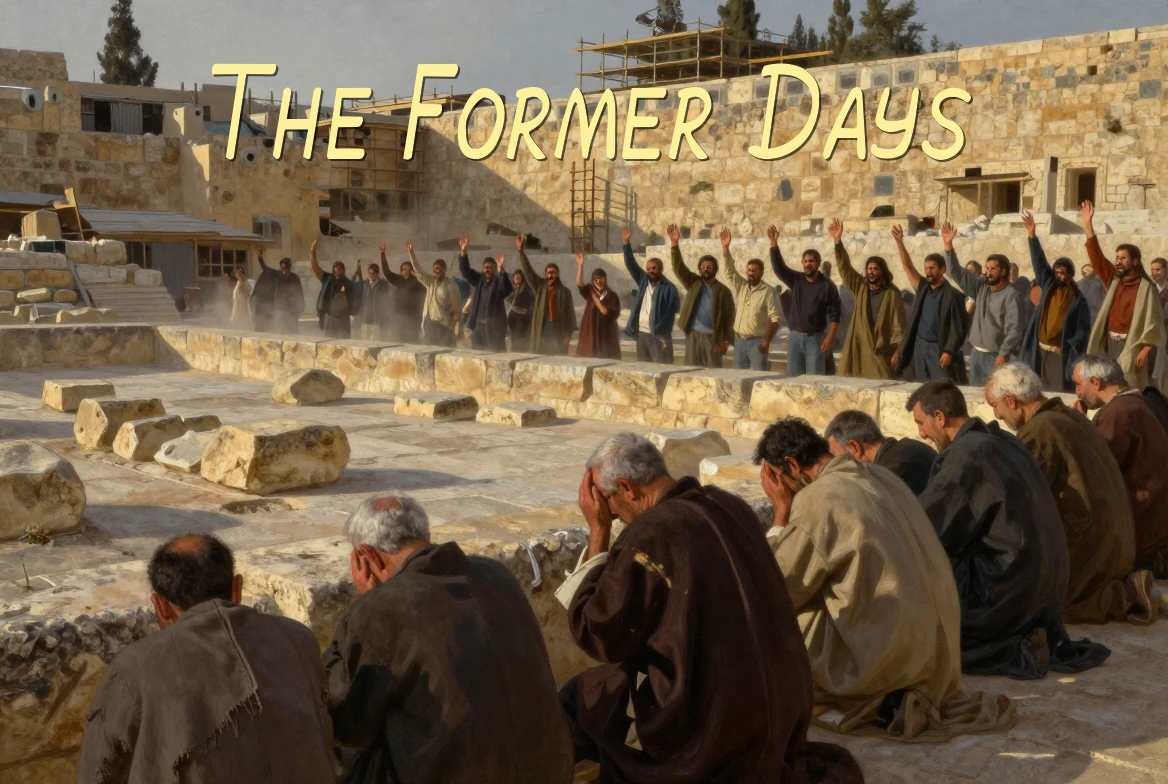
There is a grief running through a great many believers right now, and it is not fake. They look around at what is being celebrated, at what is being taught to children, at what has become of plain decency, and something in them aches for a time when it was not like this. Then comes the familiar sentence: things used to be better. People used to fear God. This was a Christian country once.
I am not going to mock that. The ache is real and the man who feels it is usually a man who loves the Lord. But the sentence he says out loud is wrong in three separate places, and every one of them costs him something. The past he is describing did not exist as he remembers it. The covenant he believes was broken was never made with his country at all. And the post God actually gave him — where He set him, and what He sent him there to do — is the one place he is not looking.
The Verse That Gets Borrowed, and What It Actually Says
Whenever a believer does try to make peace with his own moment, one verse gets handed to him. It is Mordecai to Esther, and it is usually quoted like this:
"For if thou altogether holdest thy peace at this time... but thou and thy father's house shall be destroyed: and who knoweth whether thou art come to the kingdom for such a time as this?" (Esther 4:14 KJV)
Read that way it says what everyone wants it to say: you were placed here on purpose, at this hour, and the hour needs you. It is a stirring thing to be told. Now put back the clause that was left out, and watch the whole sentence turn over:
"For if thou altogether holdest thy peace at this time, then shall there enlargement and deliverance arise to the Jews from another place; but thou and thy father's house shall be destroyed: and who knoweth whether thou art come to the kingdom for such a time as this?" (Esther 4:14 KJV)
Deliverance shall arise to the Jews from another place. That is the load-bearing clause, and it says the opposite of indispensability. Mordecai names his own ground for confidence, and it is not Esther: the Jews will be delivered whether she speaks or not. He does not say why he is so certain, but we may: God had promised Abraham a seed, and through that nation Christ would come, so the deliverance was never the thing in question. Only the instrument was. She is not told she was made for the moment. She is told the nation will stand either way, and she may be found faithful in it or perish outside it. And the last clause is not even a declaration. It is a question: who knoweth?
So the verse is about God keeping His word to Israel. The comfort men take from it is a true comfort, but it is being carried by a verse that is not teaching it to us — which is exactly the pattern examined at length in Rightly Dividing Bible Application: take the encouraging half, leave the Israel it was spoken to.
The Placement Doctrine Is Ours Already, and Paul States It Flatly
We do not need Esther's verse, because the thing men reach for it to say is written plainly in our own apostle. Paul, standing on Mars' hill and speaking about the Gentile nations, said this:
"And hath made of one blood all nations of men for to dwell on all the face of the earth, and hath determined the times before appointed, and the bounds of their habitation;" (Acts 17:26 KJV)
The times before appointed, and the bounds of their habitation. When, and where. Not one man in history chose either, and God determined both. That is the doctrine the Esther verse gets borrowed to teach, and here it stands without any borrowing at all.
Then comes the assignment that goes with the placement, and it is stated as a present duty in a bad age, not as a lament for a better one:
"Redeeming the time, because the days are evil." (Ephesians 5:16 KJV)
He says the same thing to Colosse — "Walk in wisdom toward them that are without, redeeming the time" (Colossians 4:5). Mark the reason attached to the command. Not redeem the time until better days return. Redeem it because the days are evil. The evil of the age is the argument for the work, not an excuse from it.
The Observation Is Right. The Golden Age Is Not.
Now be fair to the man who says things are getting worse, because on that point he is not wrong, and Paul says so:
"But evil men and seducers shall wax worse and worse, deceiving, and being deceived." (2 Timothy 3:13 KJV)
The trajectory is downward. That is not pessimism, it is revelation. So the error is not the observation.
But hold the concession to its exact size, because the whole disagreement sits here. A slope is not a summit. Granting that things are getting worse does not, by itself, identify any particular point behind us as good — that is a second claim, and it has to be made and proved on its own ground. The man who says worse is reading Paul correctly. The man who says therefore the old days were good has added something Paul never gave him — and the way to test a claim like that is to go and inspect the days he has in mind.
Which is why the error is the picture he is comparing it to, and the picture will not survive five minutes with an open Bible. Paul wrote "because the days are evil" (Ephesians 5:16) about his own days. He called the whole present age evil at the very opening of the dispensation — Christ gave Himself "that he might deliver us from this present evil world" (Galatians 1:4). And then look at how his generation actually finished:
"This thou knowest, that all they which are in Asia be turned away from me; of whom are Phygellus and Hermogenes." (2 Timothy 1:15 KJV)
That is the apostle of the mystery, still alive, writing that an entire region has abandoned him. "For Demas hath forsaken me, having loved this present world" (2 Timothy 4:10). At Corinth there were lawsuits between brethren and a fornication not so much as named among the Gentiles. Galatia removed itself from the gospel of grace within a few years of hearing it. And at Philippi, "Some indeed preach Christ even of envy and strife" (Philippians 1:15).
That is the apostolic age — a living apostle, direct revelation, and a wholesale defection inside one lifetime. If that era looked like that, no later century is the golden one either. What men are comparing the present to is not a time. It is a memory, and a memory is edited by the man who keeps it.
Scripture Treats This Instinct as a Fault, Not a Virtue
This is not a modern weakness. Be clear first about how the Old Testament passages in this section are being used, because every one of them belongs to Israel — her history, her people, her prophets — and not one is a command addressed to the Body of Christ. We are not free to mine Israel's history for whatever lesson suits us. But we do not have to, because on this exact point Paul selected the ensample himself and named it:
"Neither murmur ye, as some of them also murmured, and were destroyed of the destroyer. Now all these things happened unto them for ensamples: and they are written for our admonition, upon whom the ends of the world are come." (1 Corinthians 10:10-11 KJV)
Murmuring is on Paul's own short list, and Israel's wilderness murmuring is what he sends us to. Numbers 11 is one of those episodes, and it ended in a plague of its own (Numbers 11:33). So this is not a borrowed lesson; it is an authorized one, cut and handed to us by our apostle. Read what follows as the record of how God deals with this instinct in men — which is what Paul says it is for — and not as orders issued to us. What is ours to obey Paul supplies himself, in Ephesians 2. With that settled, hear how plainly God puts it:
"Say not thou, What is the cause that the former days were better than these? for thou dost not inquire wisely concerning this." (Ecclesiastes 7:10 KJV)
Notice how far back the correction goes. It does not stop at the answer a man arrives at; it reaches his asking. The question itself is badly built, and a badly built question cannot be answered well however sincerely it is asked.
Then watch the pattern run through the history. Israel in the wilderness, barely out of Egypt:
"We remember the fish, which we did eat in Egypt freely; the cucumbers, and the melons, and the leeks, and the onions, and the garlick:" (Numbers 11:5 KJV)
They remembered the menu. They did not remember the whips, the mortar, the drowned infants, or the crying that went up to God. And it did not stop at wistfulness — it hardened into a policy: "Let us make a captain, and let us return into Egypt" (Numbers 14:4). Nostalgia had a destination, and the destination was bondage.
And when the foundation of the second temple was laid, the same divide opened along the same line:
"But many of the priests and Levites and chief of the fathers, who were ancient men, that had seen the first house, when the foundation of this house was laid before their eyes, wept with a loud voice; and many shouted aloud for joy:" (Ezra 3:12 KJV)
Many shouted aloud for joy at a work of God beginning in front of them. The ancient men wept, because it was not what they remembered — and the two noises were so mingled that the people could not tell them apart (Ezra 3:13). God's own question to that generation, put through the prophet Haggai years afterward, is worth hearing in full: "Who is left among you that saw this house in her first glory? and how do ye see it now? is it not in your eyes in comparison of it as nothing?" (Haggai 2:3). He was not agreeing with them. He was naming what their eyes were doing to a work He Himself had begun — and He went on in that chapter to promise that the glory of the latter house would exceed the former.
But Scripture Also Commands the Backward Look — So Everything Turns on Its Object
Now the distinction that keeps that rebuke honest, because Scripture does command a man to look backward. "Remember the days of old, consider the years of many generations" (Deuteronomy 32:7). "I remember the days of old; I meditate on all thy works" (Psalm 143:5). So the backward look is not the fault. Read what those verses are looking at: "I will remember the works of the LORD: surely I will remember thy wonders of old" (Psalm 77:11). The object is what God did — His dealings, His faithfulness, His mighty acts.
That is the whole difference, and the two episodes already given show it working. The wilderness generation was not remembering the Lord's works in Egypt; they were remembering the food. The ancient men at the second temple were not rehearsing what God had done; they were measuring a new work against an old skyline. When the object of the memory is God, looking back is worship. When the object is our own circumstances, looking back is discontent wearing a reverent face.
And none of that has to be inferred from Israel's shelf, because Paul settles it in his own words, addressed to us:
"Wherefore remember, that ye being in time past Gentiles in the flesh, who are called Uncircumcision by that which is called the Circumcision in the flesh made by hands... But now in Christ Jesus ye who sometimes were far off are made nigh by the blood of Christ." (Ephesians 2:11-13 KJV)
Remember — and what he sets before us is not a better century but a worse standing, and what God did about it. He gives the same instruction again with the same kind of object: "Remember that Jesus Christ of the seed of David was raised from the dead according to my gospel" (2 Timothy 2:8).
And this is a thing the reader can go and check for himself, which is better than taking it from me. Run the word remember through Paul's thirteen epistles and look at what he asks them to remember each time. It is a work of God, or a doctrine he delivered, or a man's present need, or his own chains — not once is it a former age. Look back at what you were and at the blood that made you nigh, and you will not spend much time mourning a decade.
But Does Not God Tell Us to Ask for the Old Paths?
He tells Judah to. This is the verse this article will be answered with, so let it be quoted in full and then handled the way the article has been insisting Scripture must be handled:
"Thus saith the LORD, Stand ye in the ways, and see, and ask for the old paths, where is the good way, and walk therein, and ye shall find rest for your souls. But they said, We will not walk therein." (Jeremiah 6:16 KJV)
Name the audience first, because in a rightly divided Bible a quoted command is never neutral. God is speaking to Judah on the edge of the captivity, and three verses later He says plainly what the old path was: they had "not hearkened unto my words, nor to my law, but rejected it" (Jeremiah 6:19). The old path is His revealed word to that nation under that covenant. It is a body of truth, not a period of history — He is not telling them to admire an era, He is telling them to walk in what He said. And notice who refused: not the irreligious, but the established religious men of the day, who had the temple and the priesthood and the calendar, and would not walk in the word.
So the command stays where God put it. It was given to a covenant nation about a covenant code, and it does not cross over to the Body of Christ as a command any more than the sabbath does. Folded inside it, though, is a truth that rests on the nature of God rather than on Israel's stewardship — that His word, and not a man's memory or a nation's mood, is the standard a people is measured by. The question is then the only question that matters: does Paul supply that truth to us in his own words? He does, and more than once:
"Hold fast the form of sound words, which thou hast heard of me, in faith and love which is in Christ Jesus." (2 Timothy 1:13 KJV)
"Therefore, brethren, stand fast, and hold the traditions which ye have been taught, whether by word, or our epistle." (2 Thessalonians 2:15 KJV)
Stand fast. Hold fast. Which thou hast heard of me. That is ours, addressed to us, and it does the same work without taking a syllable from Judah. The same handling settles the other verse men bring — "Remove not the ancient landmark, which thy fathers have set" (Proverbs 22:28). A landmark is a boundary stone fixing an inheritance in the land God deeded to Israel. Leave the stone in Israel's field; the truth folded in it — do not move what God has fixed — Paul hands us directly, and with a curse attached: "though we, or an angel from heaven, preach any other gospel unto you than that which we have preached unto you, let him be accursed" (Galatians 1:8).
And for the Body There Is No Older Path Behind Paul
Now the turn, and it is the reason the borrowed verse does real damage rather than merely being untidy.
Israel's old path ran backward — to Sinai, to the fathers, to a law already given and already broken. A Jew under that call had somewhere behind him to go. The Body of Christ does not. What was committed to Paul had no earlier edition:
"Which in other ages was not made known unto the sons of men, as it is now revealed unto his holy apostles and prophets by the Spirit;" (Ephesians 3:5 KJV)
"hid in God" (Ephesians 3:9). "kept secret since the world began" (Romans 16:25). There is no ancient version of our doctrine lying further back to be recovered, because it was not there to be found. Ours is not an old path at all. It is a revelation, given late — concentrated in one apostle, and reaching us through him. (The holy apostles and prophets named in that verse received it from Paul and after him, which is why the plural does not divide the deposit; see The Holy Apostles of Ephesians 3:5.)
So the believer who takes ask for the old paths as spoken to himself is being sent in exactly the wrong direction — back past Paul, looking for his doctrine in an age that did not have it, which is the very error this whole article has been tracing, now arriving with a verse attached to it. The nostalgic instinct fails him twice over: the era he is reaching for is not what he remembers, and the thing he is reaching for was never back there in the first place.
Which is why going back to Paul is not the same instinct in better clothes. It is not a return to a time; it is a return to a deposit — and the deposit never moved. It stood in his epistles through every century that ignored it, so recovering it is not nostalgia and never was. (That obedience, and why it is obedience to Christ and not to a man, is set out in Following Paul Is Following Christ.) What we hold is not precious because it is old. It is fixed because of who delivered it, and to whom.
The Second Half of the Romance — the Nation That Was Never in Covenant
Here is where the two halves lock together, because neither one stands on its own. The imagined golden age supplies the evidence that a covenant was operating — God blessed America then. The covenant idea supplies the explanation for the decline — we broke faith with Him. Run that loop a few times and you have Deuteronomy 28 laid over American history, with a program attached: restore the nation, and the blessing returns.
The whole structure rests on a question that rarely gets asked. Which Gentile nation was ever in covenant with God?
"Who are Israelites; to whom pertaineth the adoption, and the glory, and the covenants, and the giving of the law, and the service of God, and the promises;" (Romans 9:4 KJV)
Every article there is definite. The covenants. The promises. Paul is grieving in that passage precisely because these things belong to Israel and Israel has stumbled. And the Gentile national standing is stated with equal plainness:
"That at that time ye were without Christ, being aliens from the commonwealth of Israel, and strangers from the covenants of promise, having no hope, and without God in the world:" (Ephesians 2:12 KJV)
Strangers from the covenants. Not late arrivals, not junior partners. And the remedy in that chapter is not that a Gentile nation is finally given one — it is that individual Gentiles are made nigh by the blood of Christ and placed in a body where the national distinction is abolished outright. The gospel of grace does not promote Gentile nations. It dissolves the category: "For there is no difference between the Jew and the Greek: for the same Lord over all is rich unto all that call upon him" (Romans 10:12). If there is no difference between Jew and Greek, there is certainly no covenanted third thing.
This ground has been walked in full elsewhere and there is no need to re-walk it here. The verse the whole movement leans on, taken term by term — a covenant, a temple, a land, a covenant people, and not one of them transferring — is handled in Reviving the Wrong Program; the claiming of it as personal promise is answered in Feigned Faith of the Fathers, which puts the question that ends the argument — can the Chinese believer claim it? the Russian? the North Korean? — and the method that lifts a promise out of its covenant is dismantled in Rightly Dividing Bible Application.
What belongs here is only the join: the golden age is the evidence the covenant theory needs, and the covenant theory is the meaning the golden age needs. Take away either one and the other has nothing to do.
What Government Was Actually Given to Do
Paul is not silent about the state. He simply says something much smaller than what is wanted from him.
"Let every soul be subject unto the higher powers. For there is no power but of God: the powers that be are ordained of God." (Romans 13:1 KJV)
"for he beareth not the sword in vain: for he is the minister of God, a revenger to execute wrath upon him that doeth evil." (Romans 13:4 KJV)
Order, and the sword. The restraint of evil. That is the charter, entire. Government is not a spiritual institution, it is not in covenant, and it is nowhere charged with making men righteous. And the man who wrote that wrote it about Nero's empire — a pagan, idolatrous government at whose hands he expected to die, and did. He tells believers to be subject to it and to pay it tribute. Nowhere in his thirteen epistles does he suggest Christianizing it, reclaiming it, or restoring it. There is no Pauline program for national reformation, and the absence is not an oversight in a body of doctrine this thorough.
What we are told to do about rulers has a stated purpose, and the purpose is the point:
"I exhort therefore, that, first of all, supplications, prayers, intercessions, and giving of thanks, be made for all men; For kings, and for all that are in authority; that we may lead a quiet and peaceable life in all godliness and honesty." (1 Timothy 2:1-2 KJV)
We pray for government so that conditions stay quiet enough for the gospel to travel — and the next verses say exactly that, that God "will have all men to be saved, and to come unto the knowledge of the truth" (1 Timothy 2:4). Government is instrumental to the free course of the word. It was never the object of the mission.
The Respectable Age Was Not the Easy One Either
Here is a turn that has nothing to do with politics, and it goes at the premise rather than the conclusion.
What men usually mean by more moral times is a culture of religious observance — full pews, public prayer, respectability, a general agreement about what a decent man looks like. But a society of unsaved moralists is a society persuaded it needs nothing. Paul's diagnosis of his own nation fits a Christianized culture exactly:
"For I bear them record that they have a zeal of God, but not according to knowledge. For they being ignorant of God's righteousness, and going about to establish their own righteousness, have not submitted themselves unto the righteousness of God." (Romans 10:2-3 KJV)
Self-righteousness has to be demolished before grace can be received, and a man with a righteousness of his own will not set it down to take another. A frankly pagan culture at least has no such righteousness to defend. (The same self-righteousness, working in a different direction, is traced in Why They Fight OSAS.)
Say the other half honestly, though, or the comparison is worth nothing. A pagan age is hard in its own way, and in ways the religious age is not: a man raised with no Scripture at all has no vocabulary for sin, no notion of a Judge, and nothing in him that the word can catch hold of, so the preacher must lay a foundation before he can build on it. That is real, and it is why this is not an argument that the present is an easier field. It is only an argument that the respectable age was not the easy one either, and that a man grieving its loss is often grieving the very thing that made his message hardest to preach. A nation full of religious lost people is not a better field. It is a different hard.
The Age They Miss Is an Age When the Mystery Lay Buried
There is one more test to apply, and for a man who has come out of inherited tradition into what the text actually says it is the one that ought to weigh most.
Take the standard that ought to govern — is the word of truth being rightly divided, and is grace being preached as grace? By that measure the romanticized past is not a lost summit. Right division was not being preached from most pulpits in 1955, or 1855. Paul's distinct apostleship lay covered under inherited religion for centuries. God never left Himself without witness and the lamp was never wholly dark — that history is traced in The Church that Kept the Wrong Apostle — but even the Reformation recovered the grace of Paul's gospel without yet recovering the full rightly dividing of it, and the clear distinction of the mystery came into focus later still. When There Was No Rightly Dividing sets out why the command to divide came so late and through Paul alone.
Which means the believer mourning the past is frequently mourning an age that would have fed him less than this one does. Sound doctrine is more findable, more testable, and more distributable now than it has been in a very long time. That is not a small mercy, and it is sitting in his hand while he looks over his shoulder.
What the Longing Actually Costs Him
Nostalgia is not a harmless mood. It does three things to the man who carries it, and none of them is neutral.
It supplies him an excuse. If the times are uniquely bad, then thin fruit is not his failure but his circumstance. Paul allows no such adjustment: "Moreover it is required in stewards, that a man be found faithful." (1 Corinthians 4:2) The standard does not move with the century.
It withdraws him. Longing backward and looking for the exit are the same posture aimed in different directions, and neither of them is redeeming the time.
And it quietly charges God with a misplacement. He determined the times before appointed and the bounds of the habitation. To wish oneself into another age is to say He set the bounds wrong.
Those three land on the man himself. There is a fourth, and it reaches past him to other people. Once the country's decline becomes the enemy, the lost man next door stops being a mission field and becomes an opponent. Paul had already closed that door: "Wherefore henceforth know we no man after the flesh" (2 Corinthians 5:16). And a ministry announcing God's reckoning upon a nation has swapped its own message for one belonging to another program — because the word committed to us now is this:
"To wit, that God was in Christ, reconciling the world unto himself, not imputing their trespasses unto them; and hath committed unto us the word of reconciliation." (2 Corinthians 5:19 KJV)
Let that be said carefully, because it does not mean the world is innocent and it does not mean judgment is canceled. The world is still guilty and still needs to be reconciled — what has changed is the administration under which God is presently dealing with it, which is set out in God Is Not Counting Your Trespasses. The wrath is real, and it is future, and it is preached to the Body as the thing we are delivered from: "even Jesus, which delivered us from the wrath to come" (1 Thessalonians 1:10).
Which brings the account back to where it began. All four costs come out of one habit: a man looking over his shoulder is not looking at the field. The excuse, the withdrawal, the quiet charge against God, and the neighbor turned into an opponent are that one glance, doing four kinds of damage.
One Guard, So None of This Is Read as Retreat
None of this is a call to retreat from public life, and none of it is a rebuke of loving your country. But the license for that has to come from Paul's doctrine and not merely from his biography — example is not doctrine, which is why his circumcising Timothy and shaving his head at Cenchrea bind nobody, and which is worked out at length in Prove All Things: Answering the Objections to Mid-Acts. So take the teaching first. Paul tells the Body outright what to render to the state: "Render therefore to all their dues: tribute to whom tribute is due; custom to whom custom; fear to whom fear; honour to whom honour" (Romans 13:7). He tells a man to stay where God set him — "Let every man abide in the same calling wherein he was called" (1 Corinthians 7:20) — which is the same hand that fixed the times and the bounds. And he settles exactly how a believer is to hold anything belonging to this world:
"And they that use this world, as not abusing it: for the fashion of this world passeth away." (1 Corinthians 7:31 KJV)
Use it, and do not lean on it, because its fashion is going. That covers the whole matter, and a citizenship is one of the things it governs.
Paul's own conduct then illustrates the doctrine rather than establishing it. He used his Roman citizenship freely and shrewdly — invoking it to stop a scourging, "Is it lawful for you to scourge a man that is a Roman, and uncondemned?" (Acts 22:25), and again at the end, "I appeal unto Caesar" (Acts 25:11). He offered no apology for either, and he never confused the citizenship with his standing.
So: use it. Vote, serve, be a good neighbor, be grateful for what you were given, and render what is owed. Only do not lean your hope on a fashion that is passing, do not mistake the country for a covenant, and do not grieve over the breaking of one that was never made. A man may value honesty, justice, and the restraint of evil without believing God is restoring a modern nation as His instrument.
Grace Scales With the Darkness
The answer to a worsening age was never a better age. It was this:
"Moreover the law entered, that the offence might abound. But where sin abounded, grace did much more abound:" (Romans 5:20 KJV)
Much more. Grace is not overtaken by the darkness it is answering; it enlarges against it. A worse age is not a smaller field for the gospel of the grace of God. It is a larger one.
Do not turn that into a reason to welcome the dark. Paul met that inference immediately and killed it — "Shall we continue in sin, that grace may abound? God forbid" (Romans 6:1-2) — and the same answer covers an age as covers a man. We are not told to be glad the days are evil. We are told to redeem the time because they are, which is a different thing entirely: the darkness is the condition of the work, never its justification.
So if you are the believer this article is for — the one who reads the news and feels something close to bereavement, who remembers a quieter world and cannot see how the gospel makes headway in this one — you were not foolish to feel it. You were handed that grief by good men who loved a country, and the loss you feel is a real loss. But you have not been left behind by a better age, and you have not been posted to a hopeless one. Your citizenship is settled and it is not here — "our conversation is in heaven" (Philippians 3:20) — and God has already "made us sit together in heavenly places in Christ Jesus" (Ephesians 2:6). Both of those are finished, and no century can reach them. What is left is the errand, and there is only one, and it was never conditioned on the century being agreeable:
"Now then we are ambassadors for Christ, as though God did beseech you by us: we pray you in Christ's stead, be ye reconciled to God." (2 Corinthians 5:20 KJV)
An ambassador does not choose his post. He does not spend his term filing complaints that the previous ambassador was sent to a better country. He delivers the message he was given, in the country he was sent to, for as long as he is left there.
Stop mourning the country you remember. Look up the street at the people God set you among, in the times before appointed and within the bounds of your habitation, and go and tell them.
© 2026 Edward R. Cross




Comments
No comments yet. Be the first to share your thoughts.
Leave a comment